‘Sometime Soon’: When is it?

There used to be a thing – maybe it’s still a thing – that would happen sometimes. You’d be talking to someone and suddenly they’d burst out:

‘Hey that rhymes! You’re a poet and don’t know it!’

This exclamation, this sudden and surprising interruption, was always prompted by some sort of accidental rhyming happening in something you’d said.
Or, sometimes, it even happened when you had written something and had through no fault or thought on your part, created a rhyme, even a little impromptu and accidental poem.

Well, that’s what happened to be. It was a while ago now and I was writing in my journal. It must have been ages ago because I don’t keep a journal anymore.

In any case, with nobody reading over my shoulder, it was left to me to express surprise at a sudden outburst of poetics on the page. And along with the surprise, I was able to make a quick note of what I’d written:
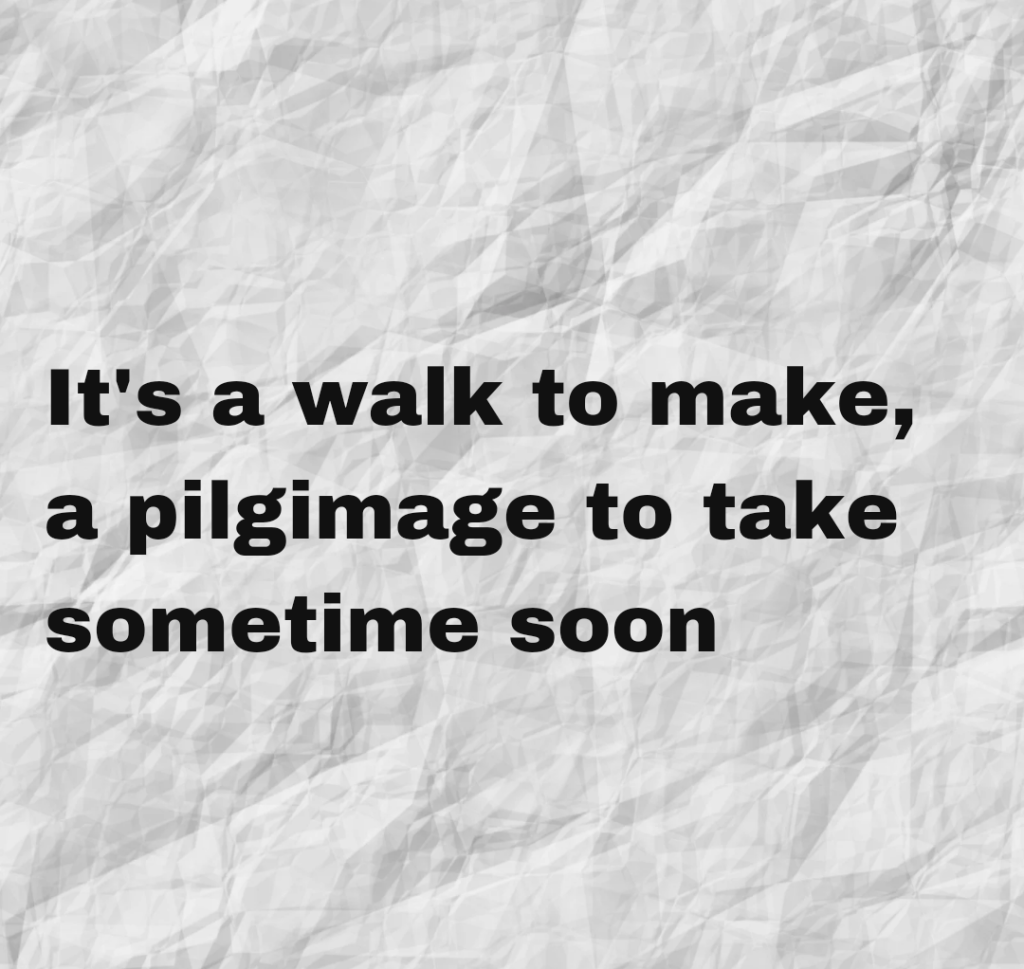
Anyway, this post isn’t about this little demonstration of spontaneous poetic genius; it’s actually about the ‘sometime soon’ tagging along on the end.

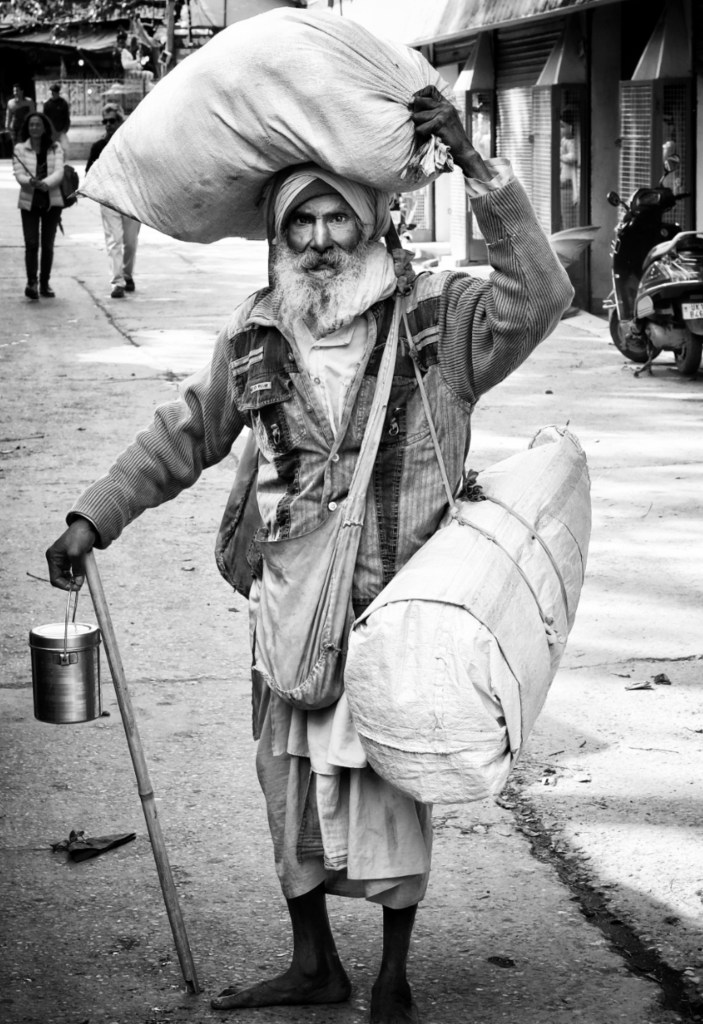
I have no idea where or what the walk to take, the pilgrimage to make, was – or is. Which suggests a rather obvious conclusion: ‘sometime soon’ never came. The walk was not taken; the pilgrimage was not made.

Now, I’m thinking to myself, if the walk under discussion was so appealing – as well as so significant that it transformed into a pilgrimage – then how come ‘sometime soon’ wasn’t right now, or rather right then. If you follow me.
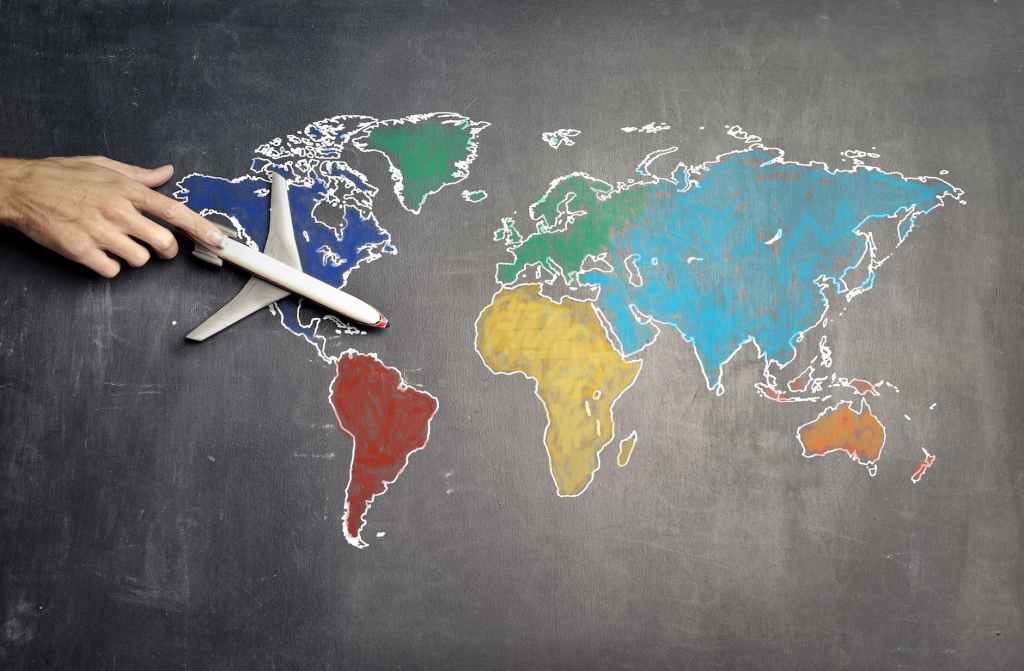
Of course there’s no telling the reasons for the sometime soon. Maybe plans would have been required; travel to arrange; equipment to gather; fitness to acquire. Who knows?

Clearly I was inspired to at least put down in writing that I thought this walk, this pilgrimage, was (or would be) a good thing to do.

Meaning, in that moment, in the present that is (or was) of that moment, that walk/pilgrimage was a thing I wanted to undertake.

Now, while I might have longed to take that walk, to make that pilgrimage, in the present of that moment of writing, and even though planning may have been required, thereby putting off the actuality of the taking and making till some future time, I at the very least could have taken some action – again in the present of that moment – to get the ball rolling so to speak.
So, what’s the lesson here?
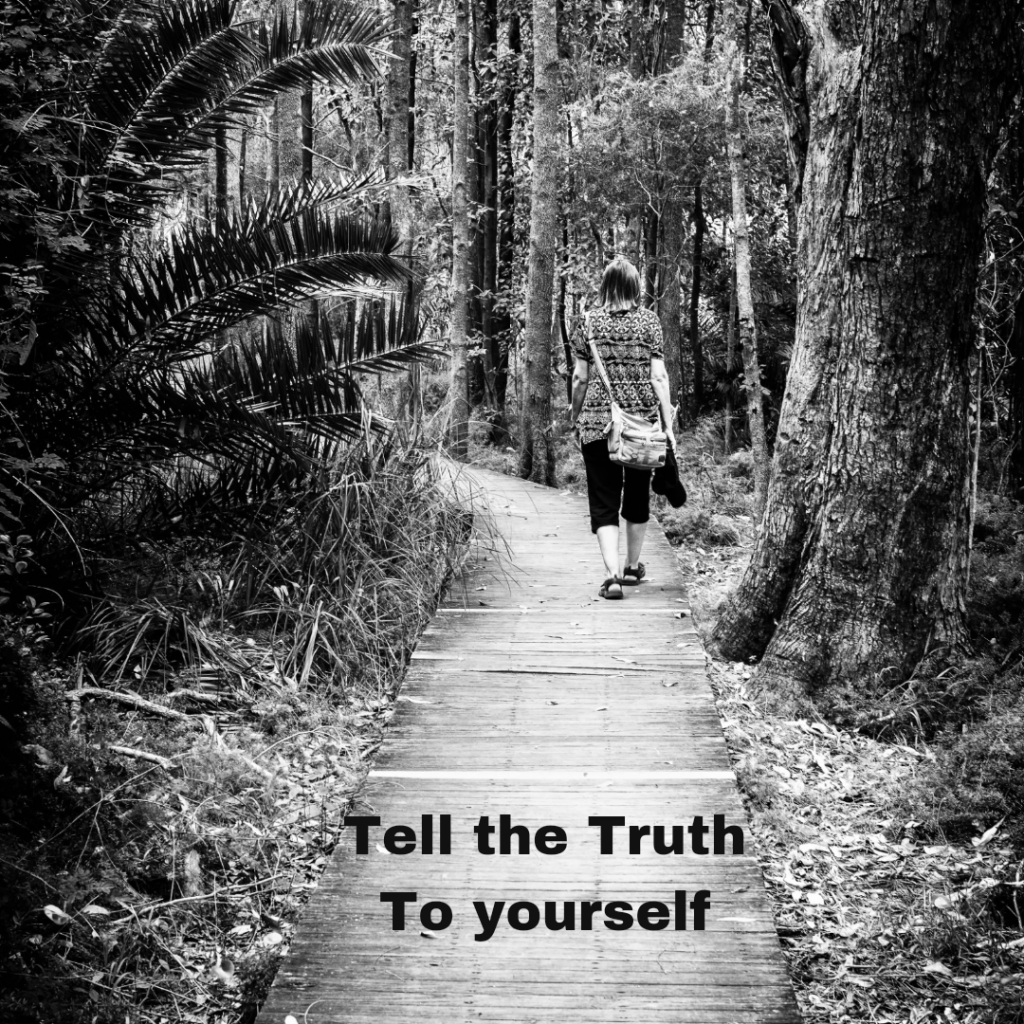
Well it’s simple really, very simple. Maybe simpler to say than to actually put into practice, but I think my lesson here is just this. Tell myself the truth as often and as much as I possibly can. In other words:

Be honest with myself

Let’s look at the options

If I’d really wanted to take this walk, to make this pilgrimage, no matter how remote, how complicated the logistics or planning, why didn’t I take action in that present? Or at least in some present before I actually forgot completely what the walk/pilgrimage was.

And why add ‘sometime soon’ if I didn’t actually desire or intend for this thing to happen? Well, possibly to put of any decision about doing or not doing. Or perhaps it was a way of saying (in completely other words), ‘Well, it sounds very nice, but I doubt I will ever end up doing it.’

So, honesty, and clear thinking about what I want and what I don’t want. That way I won’t be so attached, so keen on clinging to outcomes that I can’t see clearly, can’t easily know what I am to do or not do. Presence. Being present is what this is really about isn’t it?

To be completely present, to be fully here and now, requires me (all of us I suppose) let go of the maybes, and the ifs and buts as well as the endless ruminations about do this or don’t do that.

If I want to take a walk, or make a pilgrimage, then I say to me: just get on with it! If I don’t, then just say so, and move on.

Last little comment: I would really love for the present to remind me of what this walk/pilgrimage was. I’m a bit curious I guess(yes I know, curiosity is a present moment deflater) Maybe it’ll come back to me now I’ve written this post.

Peace
Changing the World: Maybe not such a Tall Order

I’ve always liked this idea, this notion, that by helping one person, you can change their world. I’ve always believed it to be true; after all,

Nobody ever made a bigger mistake than one who did nothing because they could only do a little.

  Sydney Smith

Reading this great quote again recently, I was struck by something I don’t think I’ve noticed before. Suddenly I saw: ‘might not change the world’. Might not? Then I thought why not turn the whole think around: I could as easily say ‘Helping one person might change the world …’.

But, you know, my thinking went even further: I realized that might and might not have nothing to do with it. The reality is that every action we take, and that includes the action of helping other living beings (as well as harming them, which is a whole other story for another time), actually does change the world.

Obviously we can’t always (actually it’s more like very rarely) see those changes, nor are we able to dictate what the changes will be or predict all the possible outcomes. We may think we know what the results of our actions will be; we may even guess right. Whatever the case, all we can do is take action while realising that impacts always occur and just keep on happening in a kind of cascading effect that literally never stops.

Then I thought about it some more, wondering how we can actually come to fully realise that the might not in this marvelous saying, which speaks of a negative possibility, is more an always will, which points to something definite, as well as a whole lot more positive.

All is One on the physical and the non-physical levels

We all have had at some time a sense that we are all connected; we feel that we are part of nature, part of something bigger than just a lone disconnected individual. But, have you ever had the feeling that you might be more than just a ‘part of’ the world or nature’? Have you ever had a sense that you are nature? Maybe this sounds a bit esoteric: But we are one Self; we are all physical manifestations of the one consciousness, the one Divine.

And of course we can’t know for sure what goes on beyond the physical world. But, even at that most basic level of the material, especially as we get down to the microscopic and even atomic levels, it’s hard to tell individual beings apart. Atoms merge and cross over, interact, and change, between all living and non-living things.

So, who’s to say that one small action on my part, one small change, won’t have a cascading effect as the ripples (that’s a good way to put it isn’t it?) from that action spread through the world and beyond.

The ‘What can One Person Do?’ Dilemma

Our Sydney Smith quote in a sense tackles this agonising question for us. Still, you might think that one person can’t do a lot when the needs are so vast and so many and so intractable. There is always something we can do, even at the supposedly one person, one individual level, even if as Mr Smith says, it’s a small thing we do.

Just think how many people everywhere are asking this same question: ‘What can one person do?’

If even a tiny percentage of those questioning individuals answered that they could do something, then you would start to see changes taking place for sure. How could all those actions not add up to a changed world?

The Multiplier Effect

Just now I used the words ‘add up’. Well actually it’s more like a multiplication effect.

Remember we mentioned earlier the idea of a cascading effect always in action whenever any action of any kind is performed? Isn’t there a saying that goes something like: if a butterfly flaps its wings in a forest somewhere in the world, then a polar bear in the Arctic sneezes? Okay, that’s not quite it but you know what I mean.

Then there is that concept of ‘pay it forward’. It’s an easy concept to grasp, though I don’t especially like the language.  For me it’s more to do with love, compassion, empathy, and a desire to make things better.

So, the truth is, helping one person does indeed change the world for that one person. And whatever we do for that one person, it also does definitely change the whole world. It may not appear to us personally that everything in the world has changed simply because of our one, apparently tiny action, but the world, (and that includes all of us who live here or anywhere else for that matter) is one living entity, one being, so those multiplying impacts just go on affecting everything and everyone in some way.

We may think of ourselves as just one separate little individual, but we are more than simply united with all life; we are that life, just as all life is us. And, as for believing we can be ‘agents of change’, we may think that it’s all too hard; too many problems; what can I do? The road to changing the world seems to be blocked, seems to be impassable.

Well, one teacher I admire is Ramdas. Among the many great things he said, this one stands out for me above them all. I may have the wording a bit wrong, but basically the message is:

If you set your feet upon the path, then you are already at your goal


Which is another way of saying that if you help one person, then you have changed the world.


Peace
The Beginning of Devotion: A Poem

The Paradox of the Hermit Life (Courtesy of @travellinghermit3)

THE BEGINNING OF DEVOTION

Attention, paying attention.
It’s the beginning of devotion.
And when you see? When there is seeing?
Well, seeing is praise.

When we see, what we see,
is God.
Not the god, or this or that god.
There aren’t lots of gods,
or so it seems.
And in the end, there isn’t even one god:
there is only God.
So it was said by the sages.

One Way to Look at Life

Peace & love
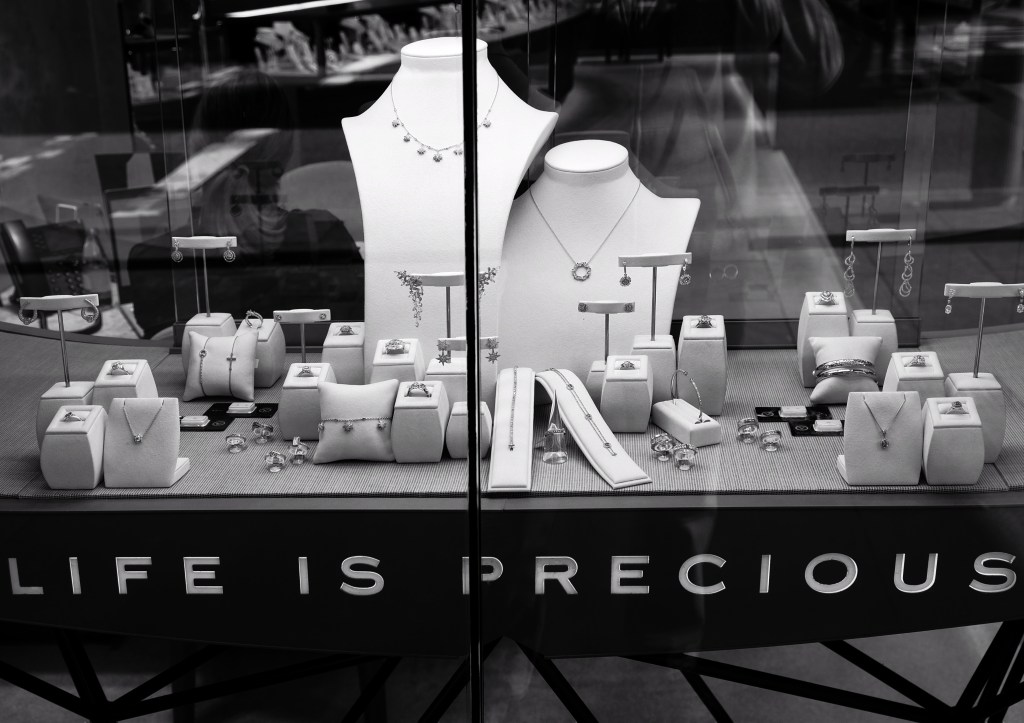
Yes, it’s true: life is precious.
But gold? Silver?
And what about diamonds?
Something to think about.

A Small Gift

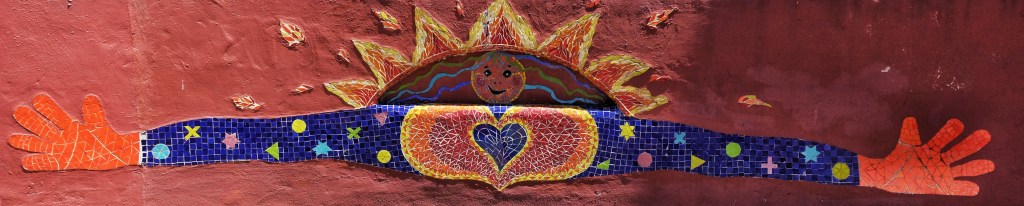
An Encircling Embrace (Unknown and brilliant street artists)

From the Hermit’s Cave to You, wherever you are

Suffer the Little Children

Suffer the Little Children

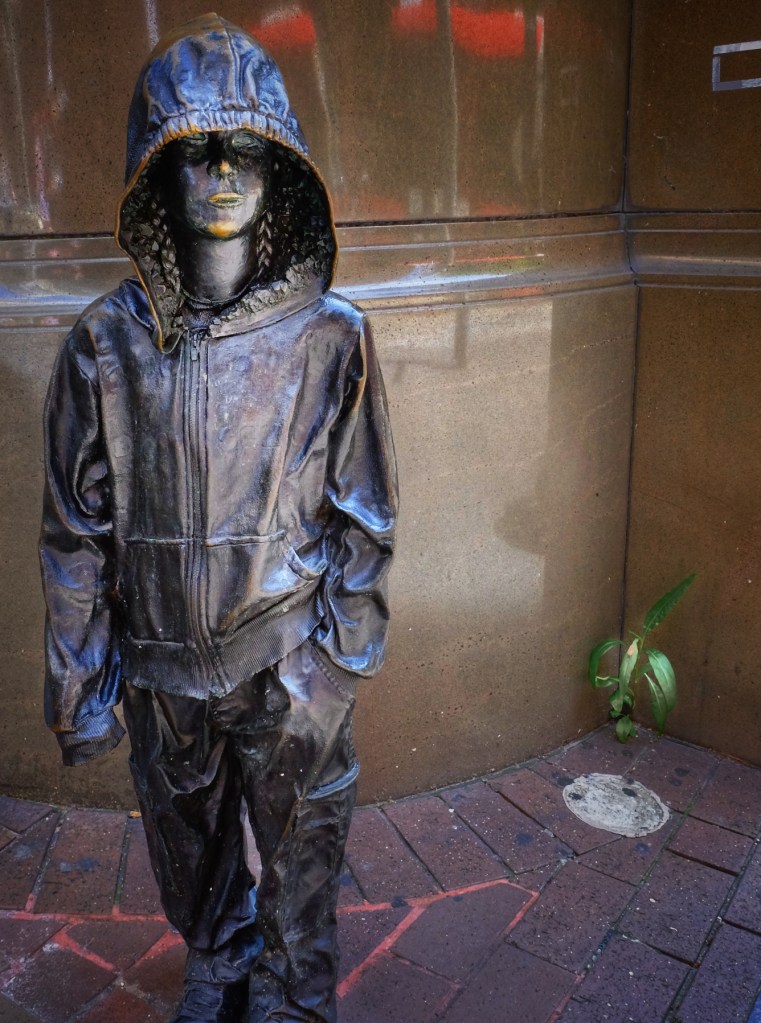
A sculpture of a young child, on a busy street corner in the heart of downtown Sydney. I like many thousands of others, have passed it by many times only giving passing thought to the origins, meaning, or significance of the statue itself.

Until a couple of days ago that is.

As a subject for contemplation and for a photograph, it is a powerful image: striking in its presence. Once one actually stops to look and reflect that is.

After several minutes of standing with the statue and asking myself who is it? What does it mean? (there is no plaque or sign to steer the way), I made this photo and I moved on.

Only later, at home, did I notice the little plant growing through the pavement in the corner. And zooming in on the plant I saw the little moth sitting on a leaf.

I decided to research online, see if I could learn more about this site. The sculpture is called Youngster and was created by artist Caroline Rothwell. It seeks to highlight the plight of refugees, in particular children.

There isn’t much online, but you can read a media article which gives some more insight into the sculpture here.

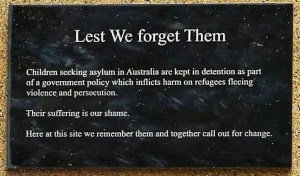
That article focuses mainly on the sudden appearance of a plaque at the site. Presumebly placed by a citizen with strong feelings on the subject, the plaque wasn’t ‘official’, so was later removed.

Actually, the text on this plaque pretty much sums up my own strongly held and often expressed feelings. Though, these days as a contemplative monk and hermit, I try hard to not have opinions, or make judgements on the way in which things in the material world play out.

But, obviously I am still human, and this is only one of so many issues that cause me distress, sadness, even rage. Actually, rage is a big one. But then, how could anyone of goodwill not be outraged? It is the very reason I am struggling hard to get this post down, to somehow make it all clear.

You see, at the same time as being so affected on the human heart level, I am very aware at the same time that it is the conditioning of material nature that leads to the very obvious fact that life is suffering.

Eating, sleeping, mating, and defending. Every single activity of every living being is motivated by one or more of these activities or a desire for their fullfillment. They are the basic drives that rule all life.

So what to do? As I’ve said (probably many times) I am not a warrior – I used to be but not now. However I am just like every other life form motivated by conditioning, either from my experiences in this life, or by that conditioning inherent in all material nature.

To a great extent I have retreated from the world. Not in order to escape or so I can ignore the suffering. I haven’t abandoned the world.

In fact the exact opposite is true: I have withdrawn, become a hermit monk, precisely so that I might be able to dedicate every ounce of my energy, my heart, my love, to prayer; to creating and maintaining a quiet and contemplative silence.

My prayer is not of the asking or begging kind, beseeching some invisible ‘god’ to give me something. Instead, I attempt to be still (never ever easy); to free and open my mind so that I may be more receptive to the Divine, to the will of the Universe; and to  become more mindful in every activity and moment.

In this way I am aspiring to realize fully my oneness with all life.  All life. I want to become fully awake to the fact that everything is Self. That there is nothing else.

And of course Self includes this child and all she symbolizes; it includes that little green plant growing through the pavement in the corner; and it includes the little moth perched on one of its leaves.

As well, my prayer, my aspiration for full self realization and union includes all those who are warriors, those whose activism and engagement with the material or physical world is every day alleviating and attempting to alleviate suffering and its causes in whatever form it takes on this planet we all share.

I am extremely flawed: I’d like to tell you I am always full of love and light, but there is much of darkness in me still to be rid of. So, all I’ve shared with you till now are still only aspirations and I have far to go. Nobody can say if I will ever reach that full realisation. In the meantime I intend to keep doing what I can to participate in the work of change.

Peace and love
Let the Music Play

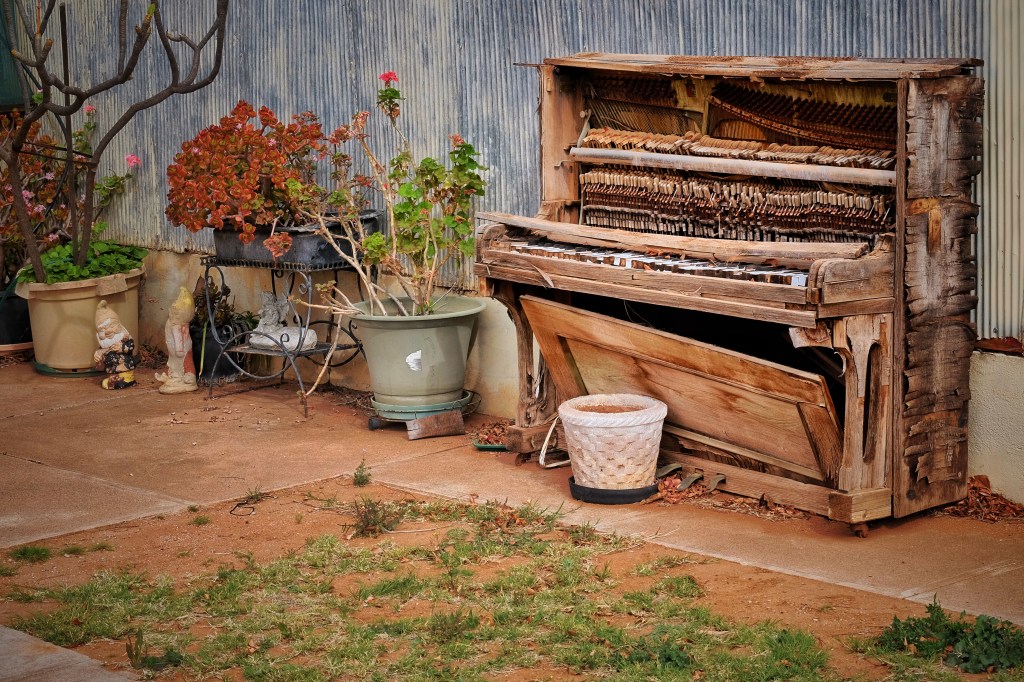
When thinking about a name for this photo I was really tempted to somehow reference the song American Pie by Don McLean. The phrase from the lyrics ‘the day the music died’, kept coming to mind – even as I made the photo of the scene.

By the way, ‘the day the music died’ refers to the plane crash in 1959 in which the up and coming Buddy Holly, and the more well known Ritchie Valens and The Big Bopper were killed.

And there was that brilliant MASH scene coming to mind. In the scene there is concert pianist who has lost the use of his right hand in battle. One of the doctors attempts to encourage him to not allow the music to die, to find other ways than actually playing piano to share the music.

Both connections seemed obvious: a very old dead piano decaying, returning to old forms of itself. But then it struck me: it was the instrument that had died and was changing forms. All material things change, die, becoming something else.

The music on the other hand, hasn’t died. It not only survived that plane crash and the transition of those three singers, it has thrived. Their music lives on. Music can’t die. Why?

Because music is life. Vibrations, harmony, and sound itself, are the foundations, the roots of ‘life the universe and everything’ (to borrow an old expression). As such, music is not a tangible, physical thing and it needs an instrument to make it manifest in the world; music merely passes through the instrument and emerges into being.

I liked that MASH episode. The doctor (stuffy Major Winchester) says to his patient, the wounded pianist, that as a skilled surgeon he has hands that ‘can make a scalpel sing’. But really, what he’s wanted all his life to is to experience music the way the pianist has.

He says he can play the notes, but he doesn’t have the gift that would allow the music (as in Chopin, Brahms and the rest) to flow through him. He tells his patient, who is depressed and unwilling or unable to consider that the music may not have died:

The gift does not live in your hands. The true gift is in your head, and in your heart, and in your soul.

Major Charles Winchester

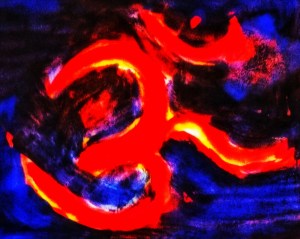
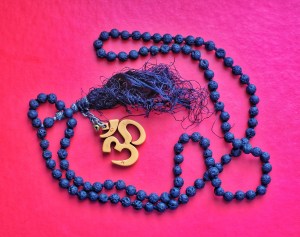
Hearing that line again reminded me of Om. There are a number of religious traditions that consider OM (sometimes spelt as AUM) to be the primordial sound, the very source of creation. The word itself, when written is considered sacred.

Then there is the verse from the Christian Bible that makes the exact same assertion:

In the beginning was the word and the word was with God and the word was God.

John 1:1-3

Well, music needs an instrument – whether in the form of a voice, body, mind, or in an object made of wood, strings, brass, or something else – in order to manifest into the material world and to be experienced by us.

Just think: the piano in my photo in the front garden of a house in a mining town has most likely allowed many generations to experience music. Accompanied them in celebrations and greivings; helped so many through good times and bad times; witnessed people laugh, cry, and even dance;

Of course, Major Winchester’s gifts as a surgeon are that he is a instrument for the vibration, the music of the universe, to make itself manifest in another way.

And what he is essentially saying to our wounded pianist is: ‘Look you can shut it off forever (his words) or you can continue making your gifts – your Self – available as an instrument that allows that music to come into the world for everyone to share’.

Well dear friends, I have pledged to carry on using my gifts and be available in just that way that allows the music to come through me in whatever form and shape it takes.

By gifts I mean those things that have been granted to every living being: the ability to create harmony; the ability to make and spread good vibrations; and the capacity to appreciate and celebrate beauty.

And when you think of it there is no way to put a limit on the number of ways that the music that is Life might be channelled through each and every one of us

A good place to pick up some good vibes, get into harmony with yourself and appreciate beauty all at the same time

In my own ways I try to make harmony in and around myself as much as I’m able. I am always attempting to cultivate behaviours and attitudes that help to create and spread good vibes. And I constantly seek to appreciate beauty, even when the world seems to be only ugliness.

Of course, as I say I am only the instrument. The music -the beauty, good vibes, and harmony – exist with or without me. But music in whatever shape and form it takes needs an instrument if it is to come into our material world and be there for all of us to share.

So, this is my prayer: that at least every once in a while, every now and then, I can actually be that instrument .

PS Just a little postscript. When passing that particular garden (the piano garden I call it now) I was drawn to this:

Eagle-eyed Garden Guardian

Just as I photographed this lovely creature, I heard my partner’s voice:

‘Did you see the piano?’

Now being in what you’ve heard me call the Zen Zone I was fully focused on and absorbed in, our winged friend. Coming back from wherever I’d been, I did in fact notice the piano.

You see, you just never never know where the music is going to come from. I might not have seen the piano with my own eagle eye but lucky for me music had a ready and willing instrument standing by to remind me of which way to look.

You Say You Want a Revolution, Well You Know …

Welcome friends to another post

I’m actually scheduling this one to publish sometime in the future. The reason is that, as I reread it now, I see I’ve used ideas, and even some sentences here that appear in a couple of recent posts. The thing is, I think this is a post worth reading, so I’m kind of sneaking it in via a touch of time travel. In any case, please enjoy, and by the way, thank you for sticking with me for this long (however long this is).

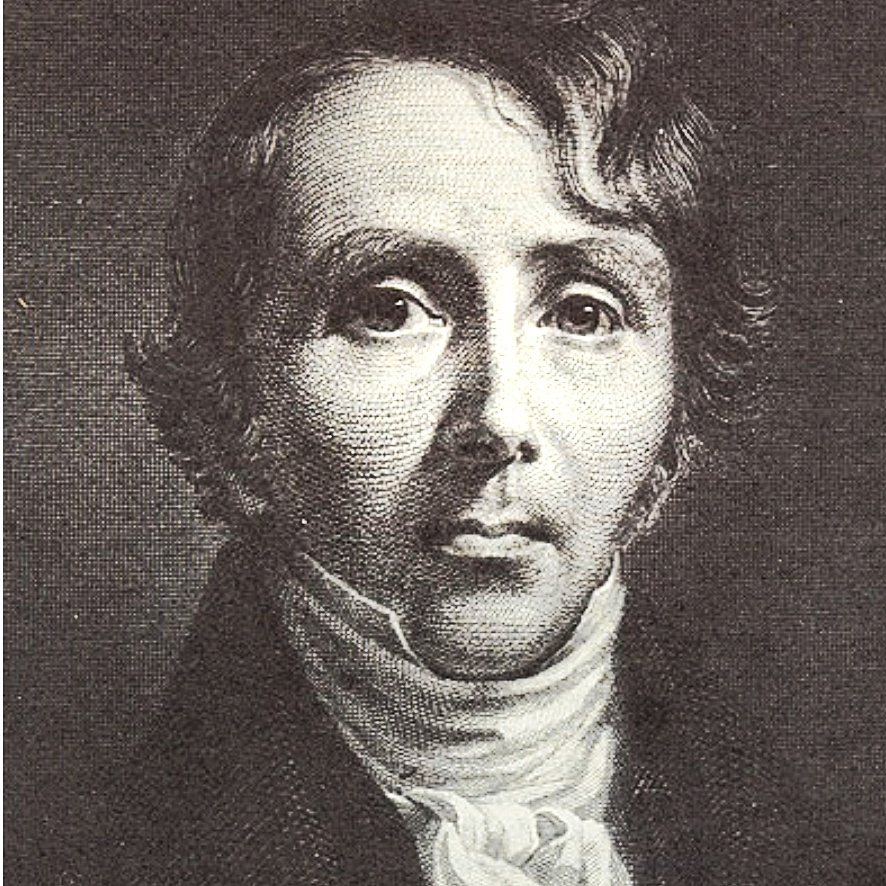
It was a revolutionary idea for its time, the early 19th Century. Come to think of it, it still is. A reform minded Christian minister, William Ellery Channing proposed that the proper goal for each of us human beings is perfection.

William Ellery Channing (Public Domain)

Or rather, the goal should be a  realisation of the perfection that is already our true natural state, our true selves, which we’ve forgotten as we have got on with the rarely easy business of living in a material world. You see? I did say it was a revolutionary idea.

After all, he wasn’t talking about the obsessive perfectionism that often curses so many of us anxious types. Or the myths propogated by mass media of what it means to be ‘perfect’. No, he was proposing a complete and thorough shift in the prevailing thinking about the nature of humans, and in reality, of all life.

Anyway, he posed the question:

Do you ask in what this perfection consists?

He then proceeded to answer his own rhetorical question:

I answer: in knowledge, in love, and in activity

When I came across this little vignette in an unrelated book I’ve recently finished reading, I was a little bit mind-blown. Channing’s formula is more or less identical to that presented over millennia in a number of the world’s religious or spiritual traditions.

For example in the tradition I am studying these last years, Sanātana Dharma, this little formula constitutes pretty much the foundation for any kind of spiritual growth. It could be said that in a real sense it is the very basis of all Yoga:

Jnana Yoga (knowledge, study, includes meditation, contemplative practices and so on), Bhakti Yoga (Divine Love. In the sense that love is always divine) and Karma Yoga (often called the Yoga of action. It basically includes everything we do in the physical world. The Karma bit is about our actions becoming selfless).

In other words, just sitting there on their own these three Yogas offer a pretty succinct answer to the question many of us ask ourselves constantly: How can I live a good life?

We pursue knowledge for many reasons: it may be a reluctant pursuit as we sit through the interminable years of high school; or later as we head to university or college to train for a career that we hope will support us. The thirst for knowledge might arise when we come upon a topic or an area of interest and fascination that we just have to learn more about.

Just as with the infinity of knowledge, love comes in equally infinite guises. Unlike knowledge, however, I don’t think there are ‘reasons’ we can give for love. Love is love; it is its own reward (and it’s own torture), it just is what it is. Divine is as good a word as any. Any love, all love, is love for all and for everything.

And then there is the kind of knowledge we pursue as we try to answer what I like to call the Who am I? questions. Things such as: What’s the meaning of life? Where am I from? Where am I going? Is this all there is? Oh, and of course the real biggie: Who am I?

Now, at the risk of having to take the prize for the most obvious statement ever made, let me make the point that all living things have to take action all the time if they are to remain alive. So obvious that I’m even having to take several different actions in order to tell you this. So, you might well ask, what’s the big deal? What’s Channing and all the others through the ages getting at? What activity?

Well, I think Channing was getting at the notion that every action we take needs to be informed by knowledge and love. But, what knowledge? Well, clearly we are caught in a tsunami of information much of which goes to making ‘fake’ knowledge, propaganda, deceptive advertising, biased education, and the rest.

In other words how often do we see knowledge not used correctly? And, how often is humanity’s use of knowledge – our actions – informed by love? Now we can begin to realise how revolutionary this idea is, and always has been.

I think that’s why the Sanātana Dharma teachings and world view embody the concept Bhakti, or divine love. As I noted, all love is divine. These teachings tell us that all action is to be undertaken with love, without attachment to rewards or outcomes, and dedicated to the welfare of all life.

Channing had the same idea: for him all life is pure and perfect already. And of course it follows I think that all actions we take have the potential to be informed by a wisdom gained from proper use of knowledge, and to be informed by love, whether it’s for self, for other people, other animals, Earth herself.

So, pretty revolutionary stuff eh? I guess a lot of us have heard that famous quote from Gandhi:

Be the change you wish to see in the world.

Well, here’s the freaky bit. Just now as I looked up the quote to make sure I got it right, I discovered that he never actually said those words. Not in that form anyway. Here’s what he actually did say. It’s a long quote but I think it’s an interesting note to finish on. I think for me it clarifies many of the questions this little discussion has raised in my own mind, as it will for you I hope.

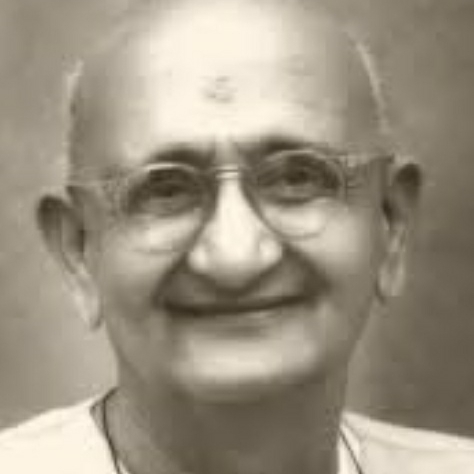
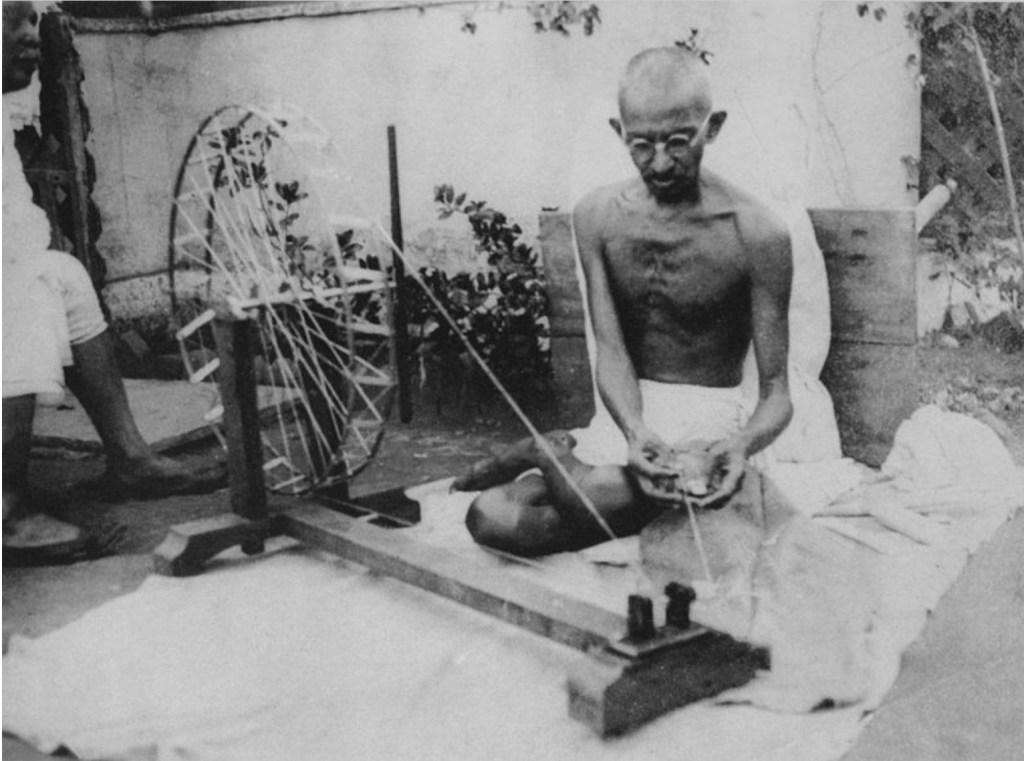
Gandhiji at his spinning wheel (thank you Wikimedia Commons)

Knowledge; Love; Activity

We but mirror the world. All the tendencies present in the outer world are to be found in the world of our body. If we could change ourselves, the tendencies in the world would also change. As a man [sic] changes his own nature, so does the attitude of the world change towards him. This is the divine mystery supreme. A wonderful thing it is and the source of our happiness. We need not wait to see what others do.

Mohandas Gandhi

Peace from me to you
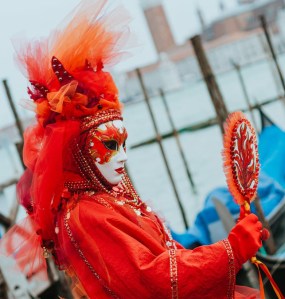
Allow Me to Introduce My Mask

Greetings friends

At the moment I’m reading a book (Myths of Light: Eastern Metaphors of the Eternal) by Joseph Campbell, the brilliant, more than brilliant scholar, writer, teacher, and philosopher of all things having to do with myth.

Actually, to be honest, it’s truly riveting reading, but still, it’s a hard book to get my head around, but I’m taking it in little chunks, and the effort is, you can believe me, well worth it.

Campbell makes so many fascinating observations and his insights are genius. One section that gave me much to think about was where he talked about Carl Jung‘s idea of masks:

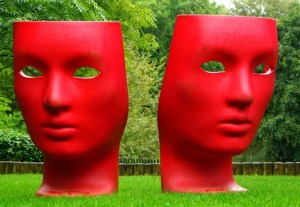
… he [Jung] points out that each one of us is invited by his [sic] society to play a certain role, a certain social function …
… We all have to put on a mask of some sort in order to function in the society. And even those who choose not to function in the society, to revolt from the society, put on masks too. They wear certain insignia that indicate, “I am in revolt.”

Yes, I know, it’s an idea we’re all pretty much familiar with: we all put on masks: work masks, school masks, relationship masks, masks to impress, masks to hide behind, all kinds of masks. But here’s what got me thinking: If you saw my last post, you’ll remember just near the end I said something like, ‘I am a hermit and a pilgrim’.

Now, normally, I tend to think I don’t wear masks. But, surely such a statement declares that I have simply put on one more mask? And, given the usual perceptions of hermits and even pilgrims, am I telling anyone who will listen (especially myself) that ‘I am in revolt’?

And that got me thinking more, about that ‘especially myself’ thing. I don’t think there’s anything wrong with wearing masks; after all as our quote says we wear them in order to function, to have a role or roles in our society.

But we also wear masks for ourselves, so we can give ourselves an identity, a role, a function. So a mask, you might say, is just how we get on in the world, and in our own minds; we take them off, and put them on according to the situation and needs of the moment.

Which says of course that we all are, I am, many things at different times and stages of our lives, our days, our careers, and so on. At this stage of my life I have put on the hermit/pilgrim mask I’ve carried around on the inside all my life. I am asking myself again, does this make me a rebel?

Well, before I donned the hermit/pilgrim mask properly, yes I wore the mask of the rebel, of the angry and outraged advocate of complete and total social change. And perhaps from some people’s point of view, I might still be a rebel: rebelling against the expectations, demands, and easy temptations of my society.

Anyway, I seem to have taken the very long route to the main point of my thoughts on all this rebel insignia stuff. The reality is, I’m not rebelling against anything. Except for those times (all too frequent) when I let anger and outrage slip through. After all, I am still human and have my weaknesses. ‘Tipping points’ as a wise person has called those moments when ‘it all gets too much’.

I see my role, the role of the mask I wear, as a creative one, one of building up, not tearing down.  This particular mask is still in the development stages, but isn’t that how everything works

There’s an aphorism I like very much:

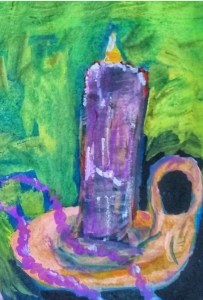
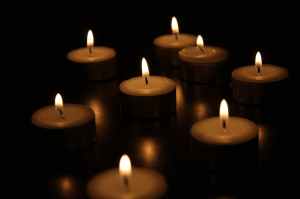
It is better to light a candle than curse the darkness.

(back in March I wrote a post describing a real-life event that illustrates this wonderful expression, both literally and metaphorically. If you missed it, do check it out).

Now, as of this moment in my life and in my progress on whatever path I’m on, I can truly say that I spend time – a lot of time – cursing the darkness. I mean, how could I not? That probably makes me still a bit of a rebel.

Yet, at the same time, I think I’m learning to understand the pointlessness of only cursing the darkness. Maybe it’s not a case of all one way or the other. Okay, I’m human, so I curse the darkness? There is a great deal of darkness to curse isn’t there?

Perhaps I can allow that cursing to lead me to action? And, well it has. At least that’s what I’m working on, aspiring to. Living as simply, quietly, and in as much solitude, as I am able; buying fewer things; letting compassion inform my eating, clothing, and travel choices (actually all my choices); having as little to do with what I call ‘the mainstream’ as possible; acting as far as I’m able in accordance with my true nature.  All these measures are aspects of the hermit/pilgrim role.

But I’ve missed the greatest, most important and vital aspect that goes with the responsibility of wearing the hermit/pilgrim mask: Prayer. Quiet prayer and contemplation. Sometimes just sitting (I know, it’s a favourite thing to do for me), letting the quiet come. Letting the light come.

You know, in some post, somewhere on this blog I’ve mentioned that often repeated statement:

It’s too late for thoughts and prayers

Well, more and more I am getting to grips with the notion that, far from being too late, this is precisely the exact moment when thoughts and prayers are needed most.

I hope that my little efforts can at least contribute in some small measure to the efforts of all the other people out there in the world who, while they may not be hermits or pilgrims, and while their natures might lead them to any number of differing activities in the world, nonetheless share with me the aspiration to light a few candles.

I Live On a Big Round Ball

Namaste friends

Recently I came across some notes I’d made about a book I read ages ago, at least a year I think. Anyway, the name of the book: The Art of Mindful Walking. Sorry, but no prizes for guessing what it’s about.

Reading my notes I see that I had been particularly taken with what the author had to say about ‘our place in the Universe’. He reflects on our – humanity’s that is – perception of our size in the big scheme of things.

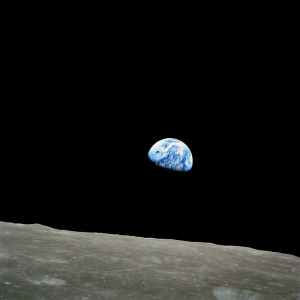
The author recounts how we once went for a walk with American astronaut Dave Scott, who’d been to the moon on one of the Apollo missions. Scott described to him what it felt like looking back at Earth from the surface of the moon:

It hangs in the black sky like a glass bauble, a blue and white Christmas decoration. It’s a small, fragile world.

Ford then goes on to reflect that this image, of a small, fragile ball floating in space, has ‘become a part of the modern psyche’. Then he says:

We begin to see how vulnerable we actually are. We are the first generation truly to see this. We are also the generation that is coming closest to polluting and destroying it.

I don’t think I’d quite looked at it in this way before. And I admit, it stunned me a bit.

Just think: Of all the humans who have ever lived, those alive in the last 50 or 60 years have been the first to see our home planet in its entirety. At least we’ve had the good fortune of seeing images of Earth just as those astronauts saw it. Thanks to those images made from space, we now have had a glimpse of where we actually live and the nature of our world.

Yet, at precisely this point in our history as a species, when we have that particular knowledge, this is the time we seem to be almost wilfully destroying the very ground we walk upon, the air that keeps us living, and the water without which there is no life.

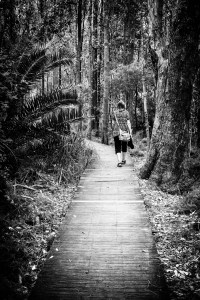
I’m not a warrior. I am a hermit and a pilgrim and I try hard to not make judgements. As such, I can only look on in wonder.

And I can pray.

Thanks to Jimmy Buffett for the title. It’s a line from one of his greatest songs, called Defying Gravity. Thanks Jimmy for all the music man.