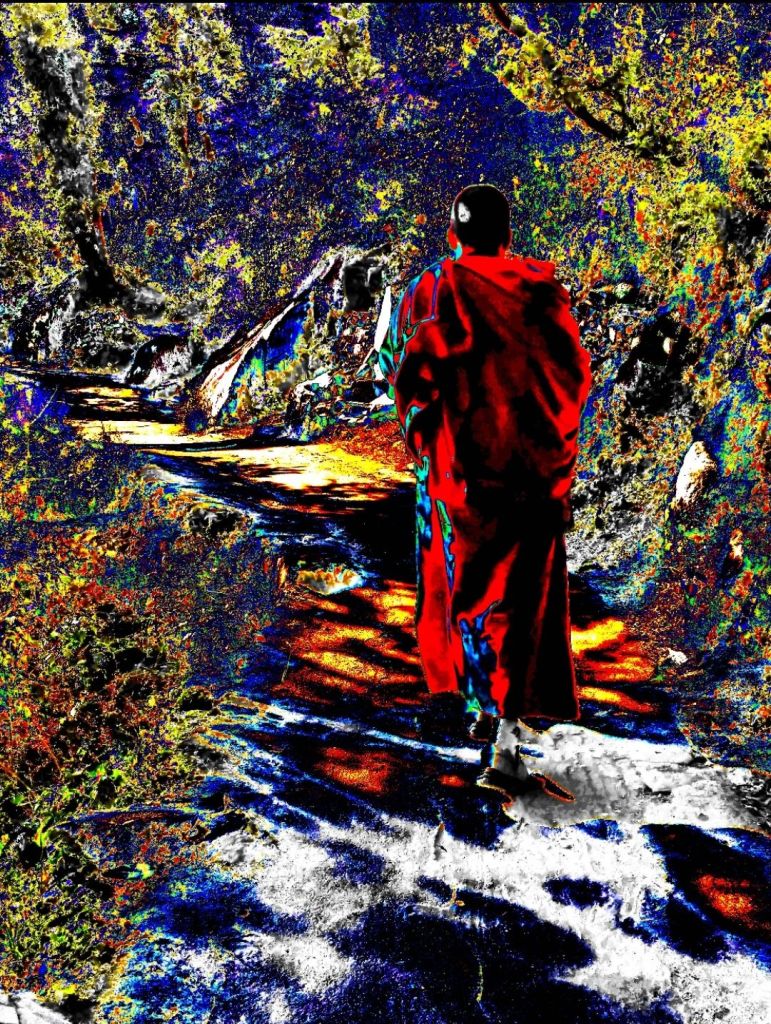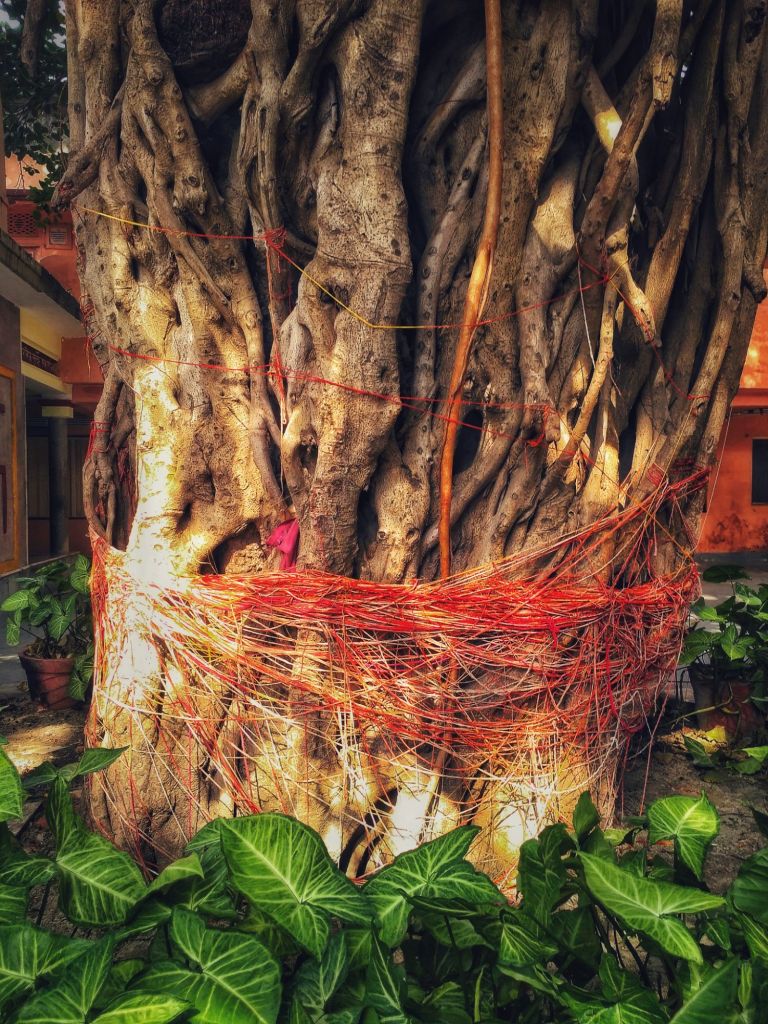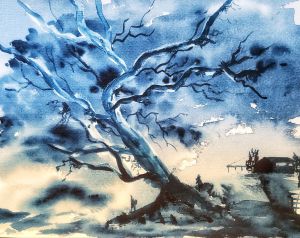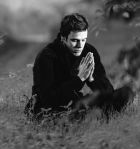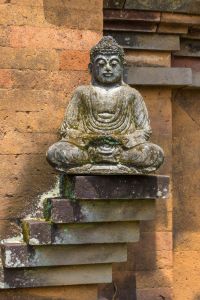
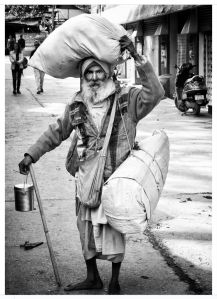
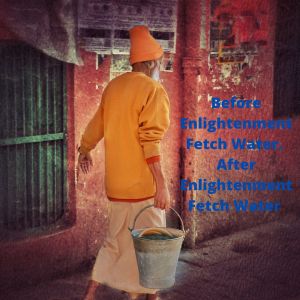
Today, a poem and a photo for you. I made the photo just over a year ago, and was very fond of it from the start. Then when I put into an editing app, it evolved to what you see today.
As well as that, as I ‘worked on’ the image, the little poem, (a kind of freestyle Haiku I think it could be called … sort of!) just emerged and I had to hurry to write it down.
Last night I was going through some poems of mine, and came across this one again. Not so much that I’d forgotten about it, more that I hadn’t thought of it since way back then.
So, I went on a search for the photo (also not forgotten, just buried deep in the hard drive!), so I could share it and the poem here with you on this blog. First the photograph:
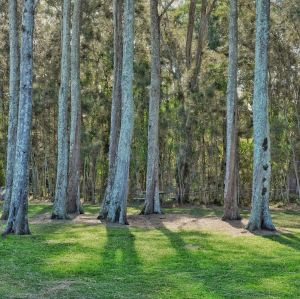
At one point in my last post on Bhakti (if you missed it you can find it here) I mentioned that I hoped to soon publish a recently written prayer titled A Prayer of Praise and Gratitude to Trees.
Even as I typed those words in that previous post, I thought: ‘soon’? Why the delay? What’s wrong with now? So, without any further delay, here is our next post and in it I’m very glad to be sharing that prayer with you.
As my comment in that previous post explained, this prayer (and others too) is one more little step in my ongoing effort to cultivate a mood or feeling, and a practice, of Bhakti or loving devotion to the Divine.
If you’ve read that last post you will recall that I stressed my deeply held and heartfelt conviction that the Divine is everything. As I may have actually said: there is only the Divine; one, whole, partless and indivisible. Now, to knowingly repeat myself: The Divine is one without a second; that’s all there is.
This prayer to trees is an attempt to acknowledge that oneness of which each and every tree – just like you and me and all other beings – is a manifestation, each with its own unique name and form.
This prayer, though composed by this particular name and form, is in fact just one more expression of that oneness we all share. As such it is as equally yours as it is mine. As I said earlier, I am glad we are sharing this now.
With this prayer we greet you. We offer you our praise, and our gratitude.
When we come into your presence, you remind us that in meeting and greeting you, we are in fact meeting and greeting God.
We bless you and we thank you for the shelter that you steadfastly provide to so many living beings. In so doing you support, protect, and nurture the continuance of life for all of us.
Your every exhalation is for so many other living beings the breath of life, of Prana – the life force itself.
You remind us as we witness your strength, your resilience, and your calm flowing with the winds of change that we too share that strength, resilience and the potential for calm flowing with those winds of change that are also constantly buffeting us.
Om Aranyani Namah
PS Who is Aranyani? She is a Hndu deity of the forests and all that dwell within the forests. Basically she is the Goddess of Trees and here is simply the name and form representing all trees.
A recent favourite quote from my teacher, that is helping me a lot on my own spiritual journey. Wikipedia also describes Bhakti in terms of intense devotion, adding words such as faith, love, homage, worship.
The wonderful Wikipedia also tells us that Bhakti is a term common in Indian religions, which may refer to loving devotion towards a personal god, a formless god or an enlightened being such as Buddha. They add:
Bhakti is often a deeply emotional devotion based on relationship between the devotee and the object of devotion.
Then what of one (AKA me) who at least aspires to see all things – all living and non-living things, all of ‘creation’ – as the Divine? How does a ‘loving devotion’ towards God work when one is striving to fully realise that there is only the Divine?
In my heart I know that all there is is the Divine, or God. Or put another way: it’s not so much that the Divine is in everything, or that everything is divine; the sense I have and aspire to realize completely, is that everything is the Divine. One without a second, the teachers say.
(Just a quick disclaimer: my heart may be telling me that there is only the Divine, but the rest of me still has a lot of catching up to do)
So, how does it work? Well writing it down in words seems to make it sound very simple: if everything is the Divine, is God, then it’s simple logic to assume that devotion to the Divine means having loving devotion towards all and everything; for all of existence, for everything that is. For all of creation as some say.
Simple to say, yes. Not so easy to easy to actually attain such a state. Of course the first thing to say is that it isn’t a state to attain. I am a part (not quite the right word) of that creation, that divinity, and as there is only one without a second, then logic again tells us that I am that creation – just like you and everyone and everything else that exists.
As such, it would seem to be an easy matter of me simply loving myself which automatically includes everyone and everything else in the Universe in that love (note to self: make this little paragraph my new mantra).
Here is where that ‘thoughts and concerns’ thing comes in. We all know how our minds like to interfere and get involved with every little thing. The mind tries to convince us of our separation from other people and the rest of life too, while its ally the ego runs wild convincing us of the urgency of status, of possessing things, of competing (also status isn’t it?), acquiring more stuff and worldly knowledge and power.
The solution? The means to realize one’s love for all? Prayerful surrender – which our quote tells us is acquired through the practice of Bhakti or loving devotion.
But hold on: Isn’t the realisation of our love the very thing we want to achieve? So, we are to use a practice involving love to realize our love?
Ah yes: the means is the end. Now that’s a nice little insight don’t you think? But, still, Bhakti or loving devotion isn’t at all easy, even if you’re talking about a personal God or deity or the Divine; how much harder it is (speaking only for me here mind you) to suddenly love everyone and everything, to suddenly recognise everyone and everything as the Divine. Including, mind you, things and people I don’t like or have a distaste for or aversion towards.
So what I try to do is be open and receptive to things, ideas, concepts, other living beings, that resonate within me as representing the Divine. Then I make those things the objects of my devotion which means my prayers are prayed with a mood of love. Good vibes you see. They spread out like (my partner hermit says) ripples in a pond or even waves in the ocean. No need to think of who or what I don’t like; they’ll be affected by those ripples too.
You’ve read my prayer to the Divine Mother – the embodiment of the Divine qualities of love, nurture, compassion. And soon I hope to post my Prayer of praise and gratitude to Trees. In that prayer I express my love, praise, respect for, and gratitude to, trees.
So many people – even the non-spiritual – view trees as symbols of creation in action, strength, resilience, even compassion and shelter. In other words, the Divine.
To surrender my heart to such representatives of the Divine is my continual effort and prayer. I pray to fully surrender to the natural order and smooth running of the universe, or the Divine.
And that surrender will come through my continuing and growing loving devotion.
Now, the ‘meditation is made possible’ bit? Well we all know what meditation means don’t we? Pretty much as many meanings as there are people meditating (and many who are not!). In this context I think the meditation that’s made possible is more a kind of contemplation leading to a clear comprehension or understanding.
Contemplation of the entirety of the Universe (which includes you obviously) as one whole, undivided expression of love or the Divine.
Comprehension is understanding, in a final, complete truly ‘knowing’ way, that the things of the world – the status, the possessions, wealth, sensual pleasures – are not and never can be the means to attaining perfect peace and happiness. Of course, the ‘things of the world’ continue to be important. After all, we are (at least our bodies and minds) things of the world too aren’t we?
But that contemplation of the totality as the Divine will help us to reduce our suffering by helping us to reduce our excessive desires or cravings for those worldly things.
I think I mentioned that Bhakti, loving devotion, can be difficult. It’s true it is often hard to focus on love and devotion, to always have your heart available and open. But, you know, it can actually be a very satisfying and enjoyable feeling, and I can say a really nice experience.
So, I hope some of the ripples (and some of the waves too), some of those good good vibes are making themselves known to you.
Growing up Catholic, attending Catholic schools from age six to fifteen, going to Confession most weeks, going to mass once a week, oftentimes more, I was deeply immersed in a particular cultural environment of Catholicism. Over time I was (we all were) inculcated with, among other things, a deep love and a reverence for Mary, the mother of Jesus.
I say deep love. No, I’m not being quite precise enough to let it slide. Sure we were taught to love her, but in a kind of limited way. We should love her because she is the mother of Jesus. Not that being the mother of Jesus was what you would label a ‘limited’ role of course. But other than that we were taught to view Mary as an intercessor for us, a conduit if you like between us and our wants, and her son Jesus. So love yes, but a kind of conditional love.
Mind you I was always very fond of Our Lady as we called her. Through a serious dedication (for a time) to The Rosary, and the numerous Hail Marys imposed as penances in Confession, I grew close to her.
And, even as I moved on and out of that Catholic sub-culture and began to explore other ideas and ways of being, I still maintained that fairly deep reverence for Mary, a reverence that has pretty much stayed with me all my life. I only realised today that it wasn’t until quite recently that I stopped calling her Our Lady.
But, in truth, my concept of her evolved beyond her being the mother of Jesus. Indeed, I came to a point when I realised it wasn’t at all relevant if Mary herself was an actual historical figure or not (this was much much later though).
For me Mary had come to represent or symbolise the female aspect of the Divine. Still, in the early days, very dualistic of course, but a huge step from the ‘second place’ she occupied in the earlier days when we weren’t even allowed to worship her as Divine. Worship was reserved for God – who was emphatically and indisputably male, sitting in heaven, entry to which was held tightly in the hands of more males in a male controlled and dominated institution. Which, it does have to be said merely reflected the world it operated in.
Anyway, let’s jump ahead half a life time of, (shall we say for our purposes here?) living, to put ourselves into the present day. Well, recent times anyway.
To put a very long story into one sentence (again for our purposes here today) I will simply say that I moved away from Christianity and especially the denomination of my childhood. Okay, we need another sentence: In more recent times, through a whole lot of circuitous meanderings, I have come to realise that there is only God.
That is to say, all there is is God, only God, nothing else. ‘Not one God, only God.’ as my teacher’s teacher used to say.
Earth Mother (Courtesy of Amber Avalona, CC0, via Wikimedia Commons)
Nowadays I still love and revere Mary. As symbol. A symbol of the creative energies responsible for bringing the Universe into existence, and which is engaged in the ongoingness of its maintainance through the laws of nature. She is one manifestation among so many of this divine creativity. In a very real sense for me, she is the Divine Mother.
So, a prayer written by me to and for the Great Mother who manifests in whatever form – or no form – in which any of us may choose to worship and love her.
Who am I to even contemplate composing a commentary on the Bhagavad Gita (BG) after only seven or eight years of study, some formal with a teacher and some more casual alone?
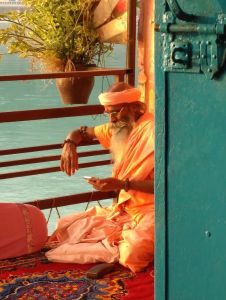
Well, what I am is nowhere near qualified, nowhere near ready. Actually I don’t feel qualified in any way for such a thing. So much less so was I when I first sat down with my newly gifted BG in a tiny cafe called The Office in Rishikesh, literally hanging over the river Ganges.
A Saddhu or Holy man and his phone at The Office
With the best fruit salad in the Universe, and fine chai to match, it was the ideal place for contemplation – that is when it wasn’t bursting at the seams and crazy.
But, as I sat there with my new BG I was one of only a couple of customers, so it was a conducive atmosphere for the aforementioned contemplation. Instead I think what happened as I thought about how to proceed to a proper study, was I allowed the sugar from the just ingested fruit salad go to my head.
You see, I decided, as I sipped a post-fruit salad chai, that the perfect study method would be to write a commentary on the whole thing starting with Chapter one, Verse one.
I no longer possess the diary in which this masterpiece was begun. Nor do I recall much, actually nothing, of what I wrote. It’s enough to say however that nothing I wrote could possibly have had any significance or depth or proper perspective.
So, as you might guess, I rambled and waffled for a couple of verses before I snapped out of my ego-driven state of arrogance and hubris. I realised I had absolutely no business taking on such a task. My lack of knowledge, wisdom, experience, all disqualified me from even thinking I had a right to try.
Now, even with the small amount of knowledge I have managed to acquire after all the study, I’m stunned at that arrogance and hubris – even if it was sugar induced. I mean, I’d never even read more than a few verses of the BG before. So, how could I even form a ‘first impression’ or ‘casual opinion’, much less a full blown commentary?
A couple of days ago I read a couple of verses that really resonated with me, as they have before. So, just like that fool sitting in The Office all those years ago, I confidently asserted that I was more than up to the job of making a commentary on those verses for this blog.
But, and here’s the really weird thing: I only just now realised, as I’ve been writing these notes, that the two verses which I will quote for you shortly, address precisely my behaviour on that post fruit salad, sugar shock induced ego trip.
I realised that it’s as if I have indeed written a commentary on those verses. And I have used a personal experience to illustrate the text. Absolutely unintentionally as it happens.
Regardless of what excuse I come up with the error in judgement in thinking I could write a full blown BG commentary all those years ago, the reality is that I failed to act with discrimination, or what I would call discernment.
In the high holy lands wrong thinking can still happen
Somehow I ignored (or totally forgot) the facts: I knew nothing! I’d lost the ability to discern what I could do and what I couldn’t do, what was a sensible action and what was a ridiculous one.
Stop! Memo to Self: Please stop picking on me!

Anyway, moving right along, here are the verses – free from commentary!
‘Thinking about sense objects brings an attachment towards them. Attachment leads to desire and desire leads to frustration, which in turn leads to delusion. When you are deluded you lose your memory [the knowledge and experiences you could draw on to make proper decisions; sometime even to the extent of compromising your own values] and with the loss of memory the power of discrimination is destroyed; with the destruction of discrimination your self itself is lost’ .
Bhagavad Gita Chapter 2 Verses 62-63 (my version of the BG sometimes combines verses as it has here)
As I sauntered along the shores of the Ganges River in Rishikesh several years ago, I was given a gift.
In the High Holy Lands Where Magic Sometimes Happens
As I ambled, headed upstream in a relaxed kind of mood on that sandy riverbank, I happened to glance down. There, right at my foot I noticed a small shell. Flat with the stereotypical fan shape so many shells have, and a about a centimetre across. I picked it up.
At that moment I sensed that this little shell was a gift from the river to me. Still, I had to wonder how it got there, a seashell on the sandy banks of a freshwater river with it’s source not too far from where I stood, just a bit higher up in the Himalayas – the highest mountain range on the surface of the planet.
One possibility is that this shell originated in the sea that once existed in the lands above, where the Himalayas now stand. Mind you, I’ve only ever heard of the fossils of sea creatures being found in that region.
Another possibility suggested to me at the time, is that some other traveller having picked up the shell on a beach somewhere other on their travels, kept it with them till they arrived at this sacred place.
Then, perhaps as an offering that traveller – fellow pilgrim?- let that shell go into the waters of Maa Ganga.
Of course it doesen’t matter in the least which – if either – of these scenarios reflect what actually happened. Somehow this little shell travelled from an ocean somewhere (and somewhen!) to this precise spot on the banks of the Ganga to be discovered, to be gifted to me.
I received that offering, now a gift from the river to me, with a deep and prayerful thank you, and a sense of the sacredness of that moment and of that place.
And, today, the journey made by that little shell, has come to a kind of full circle. This morning I released it to Varuna, to the sea here on the Pacific Coast at the beach over the dunes from the hermitage.
That initial giving and receiving took place about eight years ago now and I have that little shell with me ever since.
First I wore it around my neck attached to a mala (prayer beads) made of Rudraksha seeds I used for chanting mantra.
After that, it migrated to another mala – this one made of beads of black volcanic rock, perhaps very fitting given the little shell’s possibly ancient origins.
Then, one day about a year or so ago, that little shell developed a crack and then shattered into several little pieces.
Still, I treasured those remains, those fragment I kept with my other ‘holy bits and pieces’. Then, after a while, I began to get the sense that I was going to have to return this little shell to the sea from where it had come.
I knew, though, that it would have to be the right place, a place I was drawn or led to. So, time passed, we travelled to several different hermitages for about a year.
Then, two days ago, we moved here. To a cozy hermitage on the side of a sand dune, just across a bridge from and on the outskirts of a little seaside town on the Pacific Coast of Australia.
It’s one of those spots where the elevation, distance, and whatever else by nature’s arrangement, all combine in just the right way to allow a vast view that takes the eyes to the curve of Earth herself; the horizon isn’t flat here, it’s a sweeping giant curve. Add to this the equally dramatic view offered by the dome of the sky.
The coast is beautiful here. Not that it’s not special in so many places, but there is something here that speaks to me.
At the top of the dune just beside the hermitage there is an extremely convenient bench seat overlooking the beauty of the ocean.
And it just felt right: here is the place that seeks the return of the remains of that little shell, by now reduced to a couple of small fragments.
So, after a time sitting and contemplating at the above-mentioned convenient seat, I walked down the dune to the beach, and then to the water’s edge. In a mood of prayer, with the edge of the incoming waves lapping at my feet.
After first consigning to the water a shell native to this shore, to show the way to my little shell, I thought of the journey that little shell and I had undertaken together. Then I thought of how far and for how long that little shell had travelled so far on its own journey.
Then I returned what was left of that little shell to the sea from which it had come. And I watched it carried by the waves returning from the sands of the land to waters of the endless ocean.
PS See the Lava Rock Mala? Well, it too has changed form in recent times. It is now no longer a full length neck mala; it has evolved to become a compact and convenient pocket Mala for what you might say is ‘everyday use.
These last couple of days I’ve been getting a good lesson in enlightenment. Wait, that’s a silly thing to say. What I mean is that these last couple of days I’ve been getting a good lesson in what it means to be not enlightened. That’s a bit better I think.
Not that I’m not receiving lessons all the time; the reality of not being enlightened, is that the entirety of one’s life is really one long ongoing lesson.
Anyway, moving right along.
Not our actual hermitage
We’re about to move to another hermitage, to one more safe-haven by the side of the road (in this case a very small, very quiet road). Obviously it’s a process we’ve been through quite a few times. This time, the concept excited us (well it usually does!) and the arrangements began on a smooth and happy note.
But, just as when any of us make a plan, take some action to fulfil that plan, and proceed from a good start, the path forward doesn’t always remain smooth and hiccup free.
And so it is this time with the hermits’ plan to relocate: one or two quite small hiccups have cropped up that we have had no control over.
‘Quite small’ are the key words here: it’s more my reaction to said hiccups that’s the point of this post.
You see, I’m not enlightened, nor am I the toughest kid on the block, and my skin’s not that thick. As well as that I’m no expert at letting things run off me like water off a duck’s back (guess who is a cliché lover?).
You talkin’ ’bout us?
The hiccups under discussion themselves are trivial and as I say out of our hands. As such, they are not especially interesting to talk about.
Getting back to the water off a duck’s back thing: it’s actually a pretty neat description of what occurs when one in enlightened. Just a thought for now.
Contrary to popular myth, being enlightened isn’t a flash or some sort of mystical thunderbolt from heaven or from some other transcendental wherever, a flash that leads to bliss ongoing, superhuman or magical powers; It doesn’t render the enlightened one an intellectual or any other kind of giant.
And right to the point, being enlightened will not protect the enlightened one from the normal, natural apparently real troubles, ups and downs, pain, illnesses, sorrow and grief, and all the rest of being a physical creature living in a physical world.
What enlightenment does mean – in my interpretation at any rate – is the enlightened one is able to let these perfectly normal problems, hurts, pain, illness, and so on, (Oh the joy of repeating a great cliché) to roll off them like water off a duck’s back.
Of course the enlightened ones still experience the pain, the sadness, grief, the disappointments and so on; it’s just that those ones have attained to the knowledge – been enlightened to -that none of those things can really hurt them.
Sure they are still there, the pains in the body, the sadness or whatever in the mind. But the real us – the true Self that is the consciousness that witnesses all that’s going on in our lives right now – is unaffected.
That true Self, that Consciousness, is constant, it is and has always been existent and unchanging. All those pains in our bodies, those emotions, distress and the rest in our minds, will pass; they aren’t permanent. However that Self, that ‘I’ won’t pass, and it is permanent.
Anyway, back to the current topic. What happened to me was this: the hiccups refered to were minor – less than trivial in the context of the ‘real world’ – yet the disappointment resulting from one, and the annoyance coming from the other, were profound.
An enlightened person might say ‘That was disappointing.’ Or, ‘That was annoying.’ But me? Well I sank into a pit of negative emotions and negative (to put it mildly) thinking. I may as well have declared: ‘I am disappointment embodied. I am annoyance itself.’
Look dear reader, this was supposed to be a fairly light, quick telling of me reminding myself that the pains, sorrows and other stuff of the world can’t hurt me. That ‘me’ is the Self I talked about earlier, the ‘I’ who is, as I said, the witness to my experience here and now.
So, in conclusion as they say, all there’s left for me to say (in this post at any rate) is that I am most definitely not enlightened. Having said that, I wouldn’t say that I’m completely unenlightened. There was a time (a long stretch of time) when, far from letting things roll off me like water off a duck’s back, they very often overwhelmed and threatened to drown me.
Of course there is a lot more to be said on the subject of enlightenment. Suffice it to say that it is my dream and deep, deep aspiration to one day, one life (if there is indeed another one waiting for me) to get there, to realise enlightenment.
PS There is no need to worry. I feel a bit better now. I managed to gain a little perspective, a truer perspective. In fact gaining perspective is an important step on the path to enlightenment. The tricky thing about perspective though is hanging onto it once it’s been gained.
Everyday I affirm, I pray with longing and with hope, these words:
Let me keep silence in this world
Some days, like today for instance, the prayer feels empty, devoid of any hope, or faith on my part, that I will at some point really be able to attain at least a degree of silence.
Yes, I know, prayer is not some kind of magic formula by which one utters the words of the prayer as in some kind of incantation, then in due course that which has been prayed for appears or comes to pass as if by magic.
Prayer, rather, is affirmation in which the one praying places full attention on the words prayed and their meanings. And more importantly on the notion that the Universe is in perfect balance all of the time, and that things – all things – are manifesting how and where and when and why, and in precisely the manner that they’re supposed to.
Prayer is more a kind of wake-up call, a reminder notification to Self that everything is exactly as it is, and is meant to be that way.
Fine theory. Yet it’s a theory I sometimes know to be much more than a theory.
Other times, this being one of those times, I have a hard time, or I should say my mind can’t accept that silence does indeed exist. My mind is simply not able to grasp that silence is already within me, ready and able to give me peace.
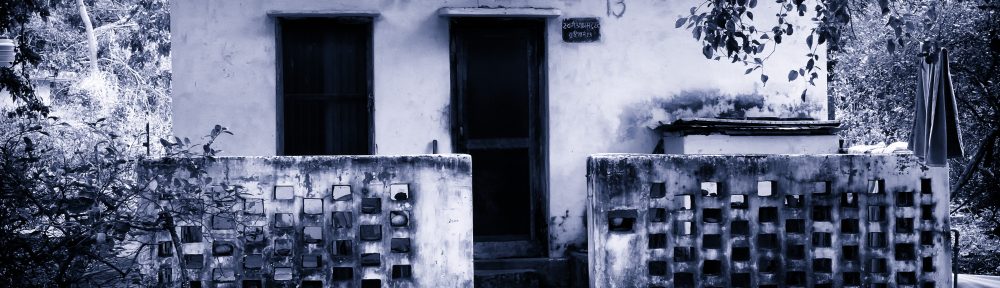
Closed Cafe at the End of Lonely Street: Silence comes in many and varied forms
It is obvious to all of us I think, that silence is not simply the mere absence of words, of speech. Not talking is simply one aspect of silence; it’s like silence is a thing, an entity or state of being that doesn’t only imply an absence but suggests an adding on of a new state of being.
When I pray Let me keep silence, it is true that I am seeking the silence of the mind, the inner silence that can bring calm and quiet to the heart and whole of Self too. But, to be truly upfront as they say, it is the silence or quiet that emerges from time spent not speaking that I long for.
Long for? I use that word quite often and it’s occured to me that, while to long for something is to have a desire for that thing, a longing is actually more than a simple desire. It’s a very strong desire, a kind of desperate wanting or wishing for that thing. You might even call it a compulsion.
Now I think about it, what is the desire or drive that keeps me doing exactly the opposite? Why do i feel the need to be talking (thinking too, but here I’m thinking about talking too much) all the time? It is clearly also a compulsion. That’s the only conclusion I can come to.
So then, why the compulsion to talk all the time?
Well, to once again be frank, upfront, I don’t really care about the reasons for or causes of, this compulsion. Probably stems from deep-seated anxiety, long-standing low self-esteem, old habits, fear. The list of explanations could go on and on, but what would be the point of that?
The real point, for me, is that compulsive talking is no mere bad or inconvenient habit. Personally it can actually cause physical symptoms of the ‘feeling sick’ variety, as well as guilt, shame, even sadness and regret.
And even far worse still is that this compulsion causes at the very least for those around me annoyance and frustration. Incessant talking distracts them from their own thoughts and activities, disturbs their own desire for silence. It’s all very obvious to me.
So, while I am compelled to talk all the time and too much, at the same time I have a strong aversion to that very act of talking too much (and all the time). The talking too much causes suffering to myself and others, while my inability to change also causes suffering. A kind of no-win situation arises, has risen, is always present.
Okay then, what is the solution? Or, more to the point,is there a solution? Well, I didn’t start making these notes with the hope that I would somehow come up with a solution to this dilemma . But, having said that, I’ve been thinking while writing that I do seem hugely attached to the idea that I talk too much, and too often.
As well, I also seem desperately attached to the desire to stop talking so much and so often.
While doing all this (possibly excessive) thinking, I was reminded that the Buddha didn’t say that the cause of suffering is desire; what he said was (allow me to paraphrase): the cause of suffering is attachment to desires.)
You know, another thing I write and think of a lot, is the idea that things work out exactly as they’re meant to. Of course not so easy to actually believe all the time, especially when things aren’t going according our personal wants, desires, and wishes. But it’s another of the prayers if you like, the affirmations which speak of the truth of the balance of the workings of the Universe.
In a way then, despite the lack of intention, I may have nevertheless stumbled upon at the very least a hint of a solution to my dilemma.
We ourselves are merely one more manifestation or result of those workings of the Universe, of that natural order, of those laws of nature that keep it all (including us) in motion.
So, I’m back where I started when I described what I believe prayer to be: an affirmation and a statement of faith in the reality that the Universe is unfolding exactly as it should.
Perhaps if I spent more time (not to forget more heart, more mind, more love) in reminding myself of that reality, and less in toying with my compulsions and aversions and with all my efforts to shift and maneuver the natural order of things to my liking, then I might find that equilibrium , that – what’s the word? – equipoise – in which I may actually realise the balance that I know already and always exists. Maybe then I can finally attain silence.
Deep with the still centre of my being, may I find peace.
Silently within the silence of the grove, may I share peace.
Gently & powerfully within the greater circle of humankind, may I radiate peace.
Just a quick final note: my idea that the universe is working out exactly as it’s supposed to is not mine and it’s not new. I’ve quoted the beautiful poem/prayer Desiderata (the word is from Latin for things desired) before, but there’s a line from it that I’ve borrowed heaps of times:
No doubt the Universe is unfolding as it should
Thank you for allowing me the privilege of sharing all of this, which is really one long prayer, with you.
Today, once again, I would like to share with you some thoughts and insights on a quote I have written in the front of my Bhagavad Gita. Yes, I know, I do this quite frequently, but there really is a good reason.
You see, for me, this particular Bhagavad Gita, this little book (and it is a little book: 10 x 7cm but still a little fat too!) is so much more than a collection of bits of paper with words printed on them inside a nice cover.
Well, it is a book, so of course it is that as well. But for me it is more a repository of wisdom. It is actually the first scripture or holy book of any kind that I have spent years studying. And over those years I have devoted who knows how much time, energy, heart and mind to it. As for how many times I’ve read it cover to cover, well I don’t keep count!
This Bhagavad Gita is truly a treasure trove that enriches me and my life every time I open it.
Anyway, enough of the praise and gratitude intro. Allow me to share the verse (in fact it’s a part of a verse) with you:
… restrain your senses and focus your entire mind on me. Bhagavad Gita 2:61
Let me try to explain why this verse – and this particular portion of the verse – is like a kind of motto or mission statement for my life. Well, to be honest, It’s one among a whole collection, but this one for me seems to especially significant.
It is through and only through, the senses that we are able to experience the world. In addition to the traditional five senses (sight, smell, hearing, taste, and touch) here we include the mind. This sixth sense includes all the activities of the mind.
When you think about it, the mind is really our major sense organ, in that it is in the mind that imput from our other senses comes together in such a way that allows us to perceive and experience the world around us as a coherent whole.
Then of course, the mind being a sense organ in its own right, does its share of providing us with imput in the form of thoughts and emotions. The problem arises when we let the mind have its way and we hand over control of our senses to our mind (and also we let our other senses free rein to control the mind) completely or at least in ways that might not be in our best interests.
So, if we are to restrain our senses – all of them – what are we to do? Well, rather than getting into a long rave with a big list of what we should do, why don’t I simply talk about some of the ways in which I try to put into practice, the injunction to restrain the senses.
The Eyes of the Teacher
First, a disclaimer : I’m still in a human body. Meaning that I’ve been struggling with my senses for a long long time. And it means the struggle continues, just as it does with all of us. It’s the effort, though, that is the real key: to restrain the senses we might easily add retrain the senses including the mind.
For so much of my life I was careless about what I put into my body by way of my sense of taste. Food, I was not very controlled when it came to what, when and how I ate. I’ve been vegetarian for about 40 years and vegan for at least the last ten years. But until the last few years (and I still struggle now) that didn’t stop me from going for the tasty stuff – meaning the fatty and sugary things that can (and do) cause great harm, as they did to me.
Now, strictly vegan as I said, I never add sugar (okay one in coffee on very rare occasions), there’s no cooking with oils, and eating as little processed foods as is possible. Simple food too, simply cooked, with just a few spices. Surprisingly (to myself at least) I always have enough taste sensations to satisfy.
As to what I consume via the senses of sight and hearing, there is only so much that one can do unless one lives in a remote desert or mountain cave. Which, of course, some people do for this exact reason – to control and limit what they consume or are exposed to. Still, I don’t watch, listen to, or read news of any kind.
Like many people I watch videos on the Internet. While there is a massive amount of brilliant content available, it is hard to sift through inappropriate suggested videos, impossible to avoid advertising, and even the news sneaks through quite often. For a while now I’ve been on the brink of deleting online video viewing platforms, but I’m not quite there yet. Soon.
Give up listening to Buddy Holly??? That’ll be the day!
As for music, I’ve gathered a large collection over the years. Lately however I’m finding that I’m not wanting to listen to much of the music I have. Why? Well, I think as I’ve meditated more, studied, contemplated more, I’m slowly beginning to exert some discipline over my mind making me more sensitive to what my senses pick up.
It seems to me that more and more of the music and songs I’ve loved and listened to my whole life are about dark themes and subjects, about emotions made petty, and sometimes songs or tunes just feel plain and simply nasty.
I’m content with this outcome and curious to see where it leads. As with videos, TV or the news, so much of the music I listened to does’t speak of Truth, at least for me.
With a view to control visual and audio imput, I try to live in as quiet an environment as possible. As we all know, these days this is becoming more and more difficult, perhaps even for those who can retreat to the desert cave! And we have a saying in the hermitage about just this issue: Something’s gotta give! Meaning of course that the time is right for radical thinking and action to be taken in the search for silence.
Which leads me to mind – my mind anyway. Like yours, my mind is a raging torrent of often repetitive thoughts going in all directions (or none) and very often without any kind of rhyme or reason.
But, through the above efforts at discipling the other senses, I do have some control, not much, but… . Through an increasing amount of time and effort spent on meditation and engaging mindfully in all my actions as much as I can, I think I am at least giving myself (my mind that is) some control over the other senses, my thoughts, and all that mental chaos.
Now, what does it mean, ‘focus your entire mind on me’? Well, this is a question that you will find asked and answered given in numerous books, blogs, and in many other places. But, for me, and to sum it up in the one sentence, it’s about focusing all my senses (including mind) on what is of the good, what is right, what speaks of truth, love, and is for the betterment of all beings.
I mentioned that our quote is only a part of a verse. Here’s the whole thing:
In order to attain steady wisdom {knowledge of the true nature of Self and the world} restrain your senses and focus your entire mind on me. Bhagavad Gita 2:61
Self Enquiry is the means to acquire Self Knowledge which leads to real wisdom
It is this wisdom, or at least the efforts we make at acquiring it, that is the way to a happier, freer life. At least that’s my take on it all. Peace
Tirtha. There is much varied, detailed and fascinating information about this word on its Wikipedia entry. While I invite you to click the link and head over there to read what is truly a riveting story, for this post I wanted to focus on the word’s actual meaning, especially the metaphoric meanings it has acquired.
Tirtha is a Sanskrit word meaning ford, as in a place one fords or crosses a river, stream or other body of water. Over time, however places of religious pilgrimage began to be called Tirthas. This evolved because so many holy sites were on or near rivers or lakes, or were the water bodies themselves, or were located nearby.
Sacred sites, and places of pilgrimage often inspire in people a sense of leaving the ordinary material existence of their day to day lives, and entering a kind of other world, the world of the spiritual or non-material. This experience, which we might call spiritual or religious , is something people remember as being very special, even transformational; for them it speaks of a connection, even briefly, with the divine in the form or in the presence of that place or site.
Perfect example of a Tirtha as a literal crossing place that is also an ancient sacred site. Mother Ganga at Rishikesh in India
And after many years – centuries and millennia very often – the energies from sometimes countless pilgrims and their prayers, devotion, love and mere presence, accumulate and begin to permeate the atmosphere in that place as well as the very ground and sacred objects there.
To me this notion is reminiscent of the concept of thin places as described in Celtic Spirituality (though the concept by the same or other names exists for many cultures around the world. Sorry I’m not providing any links: there are so many!).
Some would say they are places where Heaven and Earth meet. Places where the boundary between the mundane world and that ‘somewhere else’ of the transcendent, is especially thin, and where crossing over, or connecting with that transcendent may be possible, or made easier than at other places.
Of course, as I’ve written in at least one previous post, I feel that we are always standing upon sacred ground; all things are sacred or holy. At the same time, I have, like so many others, experienced what seem to be very real connections to or mergings with something transcendent, something ‘spiritual’ as we like to call it, at specific sites or location.
A few of these places of my own transcendent experiences have been churches, temples, and other historically recognised sacred places. However, I would say that most of my own experiences have been at unexpected places, places where the ‘transcendent’ has been for me alone at that moment.
The Campaspe River after the floods receded
One such place for me happens to be a river called the Campaspe. It was here that the ashes of two fellow hermit pilgrims of the feline persuasion found their rest.
As I stood on the muddy bank of that river, and made my offering, I sensed that feeling I describe above; that feeling of oneness with or connection to the river, to that place. As those two little creatures whom I loved (and love now) and who are made of the same stuff as me, were returning to some kind of essential or foundational state, we were there and connected with them as they continued on their journey.
I knew then for sure the sacredness of that place, the thinness of the boundaries there. While then I didn’t yet know the word, the Campaspe River had for me became a Tirtha.
DEDICATED TO:
Shanti and Lofi. Two beautiful beings and fellow hermits and pilgrims on the journey with us. With us in our hearts and now off carrying on with their own adventures and pilgrimages.