All I Had to Do Was Dream

Last night I had a dream. Of course there’s nothing unusual in that: I dream every night, every time I sleep (and sometimes when I’m supposed to be meditating as well). Actually I’m no different than probably every other living being in the Universe: I dream when I sleep.

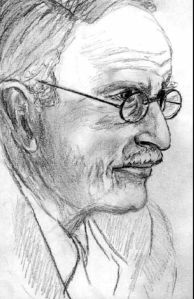
No. The particular dream isn’t my point here (though we’ll be discussing it soon enough). What makes it worth noting is the fact that last evening, before going to bed, I watched a documentary on Carl Jung and The Red Book.

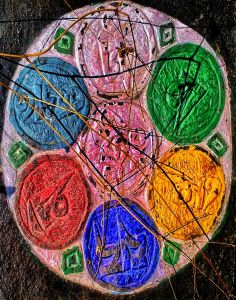
Jung compiled The Red Book at a time of personal crisis and distress. Using dream analysis, his own imagination, and intense self reflection, he used both paintings and text to express what he saw and understood from these practices. Hauntingly beautiful, other worldly pictures depicting dream images, archetypes, both personal and universal, helped him delve deeply into his unconscious mind and the collective unconscious.

I gave up trying to interpret dreams a long long time ago. Don’t ask me why: I probably couldn’t say. Most likely something to do with a kind of wariness about going too much into where the mind wants to take me, and my sense that the “dream” doesn’t stop when we wake up.

Still, watching this doco prompted a lot of discussion with my partner hermit, and a lot of thinking on my part. The mind is not our enemy, though sometimes I feel that it is. Well, it can be the enemy if we allow it, but equally we can allow the mind to be our friend. After all, what activity of any kind is possible in the world without mind?

So, with that in mind (get it? in mind?) I will share with you that above mentioned dream from last night.

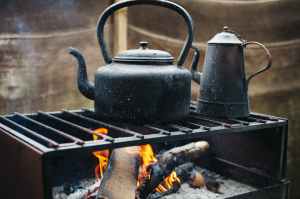
In the dream I was in a small kitchen, making tea. I’d put on a kettle to boil. A very large, heavy kettle, probably three or four times the size of a normal one. I was in the process of looking for a mug or cup, and just as I picked one up that I liked the look of, a crowd of five or six people came bustling noisily into this very crowded space.

‘I’ve just put the kettle on,’ I called loudly over the din. As it happened I’d filled the kettle almost to overflowing, much more than I needed for myself alone.

‘There’s plenty of boiling water to go round.’

Then I busied myself looking for something (a tea bag perhaps?), and when I finally turned back to the kettle to make my tea, I saw it was gone. I was very unhappy with this disappearance: After all, I was the one who had filled the kettle and put it on to boil. Then without a thought or a, what’s the expression? without a by your leave, it’s all gone, nothing left for me. Not only no more water, but nothing to boil more with.

I looked everywhere, even outside the kitchen. Outside was a camp ground and apartment complex, where I (and presumably all the other people) was staying.

Anyway, that’s it. All I remember at least. So, the meaning? Was I merely processing trivial facts and events from my day in this strange fashion? Or was I in touch with the deepest part of my psyche and with the collective unconscious? Possibly a bit of both.

It’s not a big job to make a guess about the meaning. I had a plentiful supply of water (or whatever), and without thought, put the needs of others before my own. But then, I actively resented what had been ‘taken from me’, even though I had freely given it in the first place.

So, the message I take from this dream? Just as I’ve been studying lately, the fruits of my actions are not my responsibility. I have no say over what, if anything, will happen as a result of actions I take. All I am responsible for is the taking of the action itself, the manner in which I undertake it, and the attitude with which I approach the actions I take. That’s it. That’s all I can do. The rest is up to the laws of the universe. Call it Karma, or Natural Law.

Another idea just occured to me: When I take action (like boiling the kettle) and then serve others, I am serving Self, all life, everyone and everything. And obviously that includes me. I’m not suggesting I should have made sure ahead of time that I’d ‘reserved’ enough water for myself, but at the same time …

I might keep this dream analysis thing as practice to practise occasionally, when the inclination or inspiration is there. No more blocking memories of dreams, no more stubborn refusal to reflect on dreams. After all, I spend a lot of time contemplating and reflecting on what I do in my waking life, how is it any different just because it happens while I’m asleep?

Making a Dream a Reality (kind of)

A few weeks ago I was wandering around in the CBD of Sydney, in Martin Place to be precise. It’s a popular square with loads of tourists,  shoppers, coffee drinkers, and lunching folks.

It’s also a drawcard for both buskers and for street photographers. For me, it’s mainly a short cut from one street to anoher, though I must say, I’ve very often stopped to make a photo or two of the grand architecture, fountain, and the great light that seems to permeate the place.

Anyway, on this occasion as I walked about slowly, I heard a busker. Not a singer, more a spoken word poet type performer. I guess if I were to categorise him, I’d have to say he was a Rapper.

And to put it mildly, his poetry was a amazing; I had to stop and watch and listen for a while. I realised quickly that what he was doing was focusing on a particular passerby and would then make some (mostly humourous) ryhmes about that person. Things like:

Here comes a dude with groovy green shoes.
Not having a pair like them is givin’ me the blues.

or:

Now I see a fella with a phone stuck on his ear.
Come on buddy, why not let us all hear?

Now, I confess that these are my own made-up examples. I wish I’d noted some of the real ones, but I was too busy listening!

It’s easy to tell right away that I’m not what you would call a “natural rhymer”, if there is even such a thing.

But what turns this into a true synchronicity for me is that for a few years now I’ve had a recurring dream in which I’m simply walking along making up superb rhymes as I go. It’s one of those dreams you’re never sure are ‘real’ or simply a dream.

In any case, when I saw and heard this guy that day, it got me remembering the dream and how I’d often thought I would really love to actually be able to do that exact same thing.

Not about people though. I used to photograph people in the street; all kinds of people.  I still consider photography among the most important of my contemplative and creative practices, just these days I don’t photograph people.

So, in a round about way, I’ve made a little “poem” that refers to what I do photograph, inspired by this encounter as well as particular photo I came across just yesterday but made months ago now.

Please enjoy

Strollin’ down the street
I lift my camera to my eye,
no longer interested in the people walking by.
Nowadays I tend to notice their many and varied traces left behind,
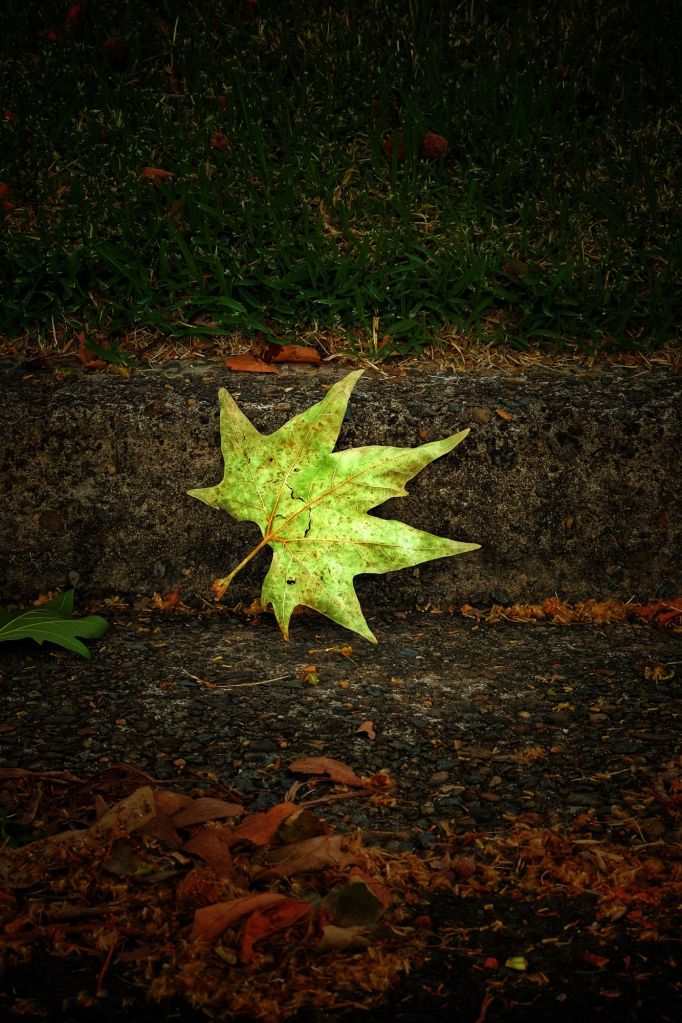
or perhaps (and even better) a golden leaf in the gutter I might find.

Thank you for reading this small attempt. Now here’s the photo I mentioned that inspired this attempt at a kind of spontaneous rhyme.

Blowin’ in the Wind

Changing the World: Maybe not such a Tall Order

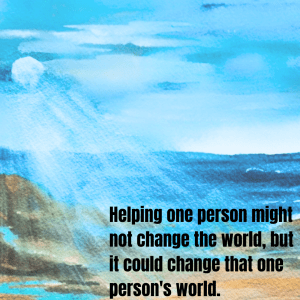
I’ve always liked this idea, this notion, that by helping one person, you can change their world. I’ve always believed it to be true; after all,

Nobody ever made a bigger mistake than one who did nothing because they could only do a little.

  Sydney Smith

Reading this great quote again recently, I was struck by something I don’t think I’ve noticed before. Suddenly I saw: ‘might not change the world’. Might not? Then I thought why not turn the whole think around: I could as easily say ‘Helping one person might change the world …’.

But, you know, my thinking went even further: I realized that might and might not have nothing to do with it. The reality is that every action we take, and that includes the action of helping other living beings (as well as harming them, which is a whole other story for another time), actually does change the world.

Obviously we can’t always (actually it’s more like very rarely) see those changes, nor are we able to dictate what the changes will be or predict all the possible outcomes. We may think we know what the results of our actions will be; we may even guess right. Whatever the case, all we can do is take action while realising that impacts always occur and just keep on happening in a kind of cascading effect that literally never stops.

Then I thought about it some more, wondering how we can actually come to fully realise that the might not in this marvelous saying, which speaks of a negative possibility, is more an always will, which points to something definite, as well as a whole lot more positive.

All is One on the physical and the non-physical levels

We all have had at some time a sense that we are all connected; we feel that we are part of nature, part of something bigger than just a lone disconnected individual. But, have you ever had the feeling that you might be more than just a ‘part of’ the world or nature’? Have you ever had a sense that you are nature? Maybe this sounds a bit esoteric: But we are one Self; we are all physical manifestations of the one consciousness, the one Divine.

And of course we can’t know for sure what goes on beyond the physical world. But, even at that most basic level of the material, especially as we get down to the microscopic and even atomic levels, it’s hard to tell individual beings apart. Atoms merge and cross over, interact, and change, between all living and non-living things.

So, who’s to say that one small action on my part, one small change, won’t have a cascading effect as the ripples (that’s a good way to put it isn’t it?) from that action spread through the world and beyond.

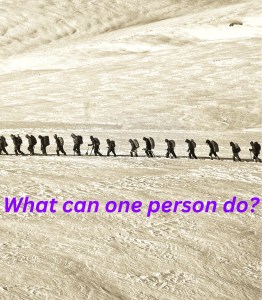
The ‘What can One Person Do?’ Dilemma

Our Sydney Smith quote in a sense tackles this agonising question for us. Still, you might think that one person can’t do a lot when the needs are so vast and so many and so intractable. There is always something we can do, even at the supposedly one person, one individual level, even if as Mr Smith says, it’s a small thing we do.

Just think how many people everywhere are asking this same question: ‘What can one person do?’

If even a tiny percentage of those questioning individuals answered that they could do something, then you would start to see changes taking place for sure. How could all those actions not add up to a changed world?

The Multiplier Effect

Just now I used the words ‘add up’. Well actually it’s more like a multiplication effect.

Remember we mentioned earlier the idea of a cascading effect always in action whenever any action of any kind is performed? Isn’t there a saying that goes something like: if a butterfly flaps its wings in a forest somewhere in the world, then a polar bear in the Arctic sneezes? Okay, that’s not quite it but you know what I mean.

Then there is that concept of ‘pay it forward’. It’s an easy concept to grasp, though I don’t especially like the language.  For me it’s more to do with love, compassion, empathy, and a desire to make things better.

So, the truth is, helping one person does indeed change the world for that one person. And whatever we do for that one person, it also does definitely change the whole world. It may not appear to us personally that everything in the world has changed simply because of our one, apparently tiny action, but the world, (and that includes all of us who live here or anywhere else for that matter) is one living entity, one being, so those multiplying impacts just go on affecting everything and everyone in some way.

We may think of ourselves as just one separate little individual, but we are more than simply united with all life; we are that life, just as all life is us. And, as for believing we can be ‘agents of change’, we may think that it’s all too hard; too many problems; what can I do? The road to changing the world seems to be blocked, seems to be impassable.

Well, one teacher I admire is Ramdas. Among the many great things he said, this one stands out for me above them all. I may have the wording a bit wrong, but basically the message is:

If you set your feet upon the path, then you are already at your goal


Which is another way of saying that if you help one person, then you have changed the world.


Peace

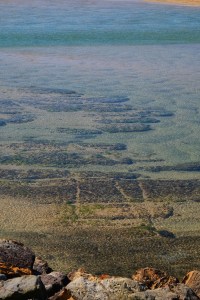
Remnants of Sea Cliffs

Here there are remnants
of sea cliffs.
Cliffs that have not towered
since ancient times.

My take on Dharma, Karma, & Living a Good Life Part 2

The inclination to seek knowledge is, for me, a gift, a blessing. And we live in a time when there are so many sources, so many resources available, and many are freely available too. There seems to be no limit to what the genuine seeker of knowledge can uncover.

Yes, of course, we’re swamped with information from all sides. We are deceived by fake news. And everything these days is a commodity, a thing to be bought, sold, acquired, or otherwise used for profit in the material world.

All true. However, this is where one’s discernment comes into play. It’s up to each of us as seekers of knowledge (on whatever topic or subject) to discern for ourselves the truth or otherwise of the information we use to form the knowledge we are seeking.

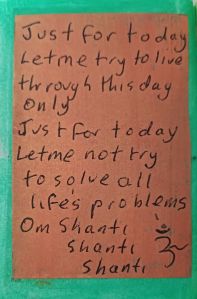
In my last post, I began to talk about two notes that I made in my notebook. These notes were quickly jotted down while seeking knowledge from two different sources about two distinct topics. Feel free to have a look at that post here if you happened to miss it.

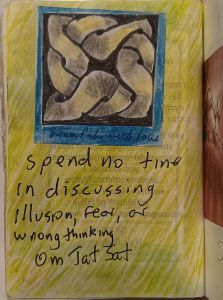
Do your duty
Follow Dharma
Live a righteous life

These three lines are the sum of what remains of a session with my teacher, Swami Tadatmananda. It’s his short, succinct summary of the teachings I was trying to absorb from him that day.

You’ve probably guessed I am not a great note-taker; I like to just let sink in what wants to sink in, absorb what resonates for me. Perhaps on that day, I felt the summary was all I needed as a basis for later contemplation.

With that in mind, I would like, in this post, to reflect on these three injunctions, try to work out how I’m doing when it comes to taking notice of them, and actually where I’m at with actually living by them.

Do Your Duty

What does it mean, ‘Do your duty’? And what does it mean, for me, to do my duty?

Firstly, let me try to define duty. Not from the dictionary meaning, not from some outside ‘authority’. No, this is me talking about how I define duty.

Duty, for me, is defined by the activities I choose to prioritize in my life. These are the things that I believe best serve my true, essential nature. Acting in accordance with this true nature includes responsibilities such as taking care of my physical, emotional, and mental health. While this may not always be easy and sometimes feels impossible, it is my duty because my mind and body are manifestations of my true self, of the divinity.

Duty, again for me, means persuing activites – in the world as well as within myself – that nurture, protect, and grow, who or what I percieve that Self to be.

This Self I refer to is not restricted to the apparently separate entity I call ‘me’. That apparent separation is just that, an appearance: Self is all there is; I am not simply bonded or joined with all other living (and non-living) beings: I am those beings, just as they are me.

As such, my duty is to act in ways that benefit (or at the very least do as little harm as possible to) all beings, all life. Here, I guess, we could talk about Karma. But let’s leave that for now. It’s enough to say that nobody can tell me – or you – what is our duty. In fact, the truth is I already know the full extent of my duty, as we all do.

The only thing lacking for me is what I might call a full disclosure of what that duty is. That full disclosure can only come from me – as in the Self. As they say, I might know in my head what my duty is, but I’ve yet to fully realise it in my heart. And if I’m honest with myself I can say that my aspiration to do my duty is a constant reminder and motivation to do always the best I can to fulfill my duty.

In some areas I think I do my duty pretty well, but in others I have a long way to go.

Courtesy of @travellinghermit3

In my next post (and the final one in this series: there just seems to be such a lot to think about when contemplating this topic), I will look at what it is to follow Dharma. Once again, it’ll be a very personal, subjctive answer because, to put it perhaps too simply, I like to think that I know right from wrong.

I hope this post has been of at least a little interest and value to you. I will look forward to seeing you here for my next post.

Thank you and I wish you peace.

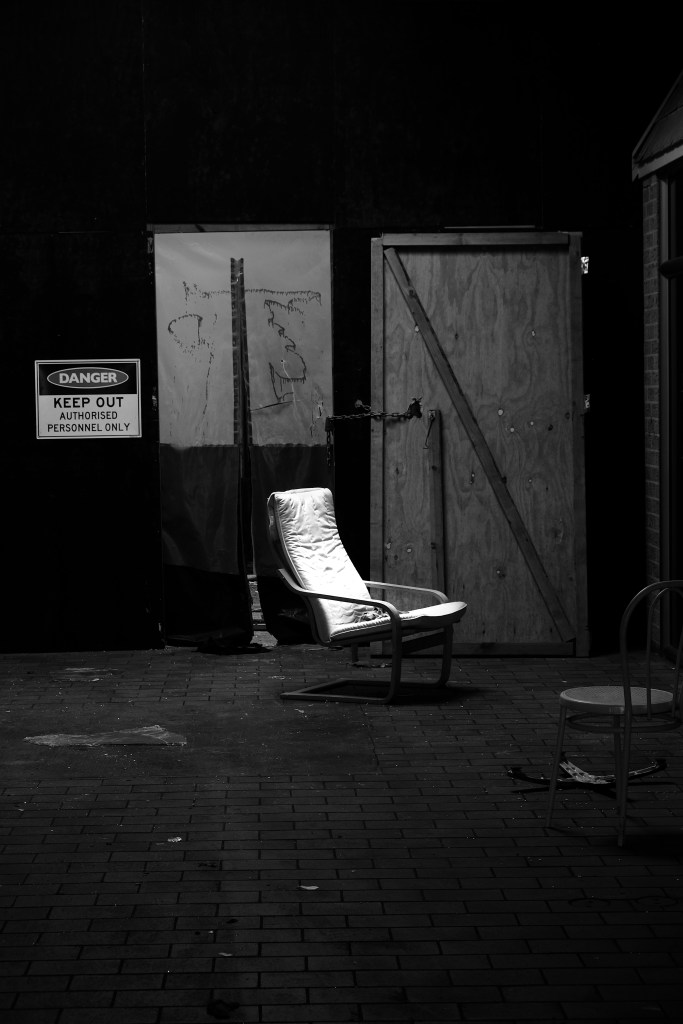
Looks Like a Comfy Chair

‘Looks like a comfy chair’.

That was the first thing my partner said when I showed her this photo. Her eyes – and perhaps even her heart – had found that which is illuminated by the sun, even though it’s surrounded by wreckage and ruin.

The wreckage by the way, of an abandoned and trashed store front. One of several in a small arcade, that’s long sat empty.

Ah, I thought: one more illustration of a metaphor I’ve been hearing a lot lately in my studies about consciousness.

Allow me, please, to adopt our teacher’s metaphor which, for me, really clarifies this concept of consciousness, or Atma as it’s called in Sanskrit.

Is the brilliant light streaming into this room and onto this chair affected in any way whatsoever because the chair is sitting amidst all that wreckage?

Is the sun shining any less brightly on the chair than it would if the chair was sitting in a luxuriously decorated space instead?

Of course the answer to both questions is no. The sun, and its brilliance remains undimmed, and completely unaffected, untouched, regardless of what it shines on.

The ‘I’ that photographed this scene, and my partner’s ‘I’ whose eyes were drawn to the chair in the scene, are both consciousness. Not ‘my’ consciousness; not ‘her’ consciousness. Consciousness is all; all there is. Boundaryless, infinite, all pervading. We can’t even say there is one consciousness, because there is only consciousness.

Ah, I hear you say: there is one sun shining on our world; and the sun isn’t ‘all there is’. Well, as our teacher likes to remind us, all metaphors are flawed: you can only take them so far.

Metaphors, are only meant to illustrate, to show us the way, point us in the right direction as it were. In our little example here, the metaphor is meant to help us gain some knowledge.

The knowledge that we are not what we see, hear, taste, touch, think or feel. We are that light – consciousness – that allows us to know what we experience with our senses.

One more thing: The light of the sun, flooding the chair with its brilliance, enabled my partner to see that it was comfy, even though it was sitting in that wrecked, abandoned and lonely place.

Just as in our lives, when everything seems to be crashing down around us and we feel we are the ones stranded in that wreckage, we can remember that the light of our own consciousness, is the way in which we may shine our attention on the truth of our unchanging eternal, and true nature, that is who we really are: perfect, eternal, absolutely unaffected by anything at all.

Peace and love

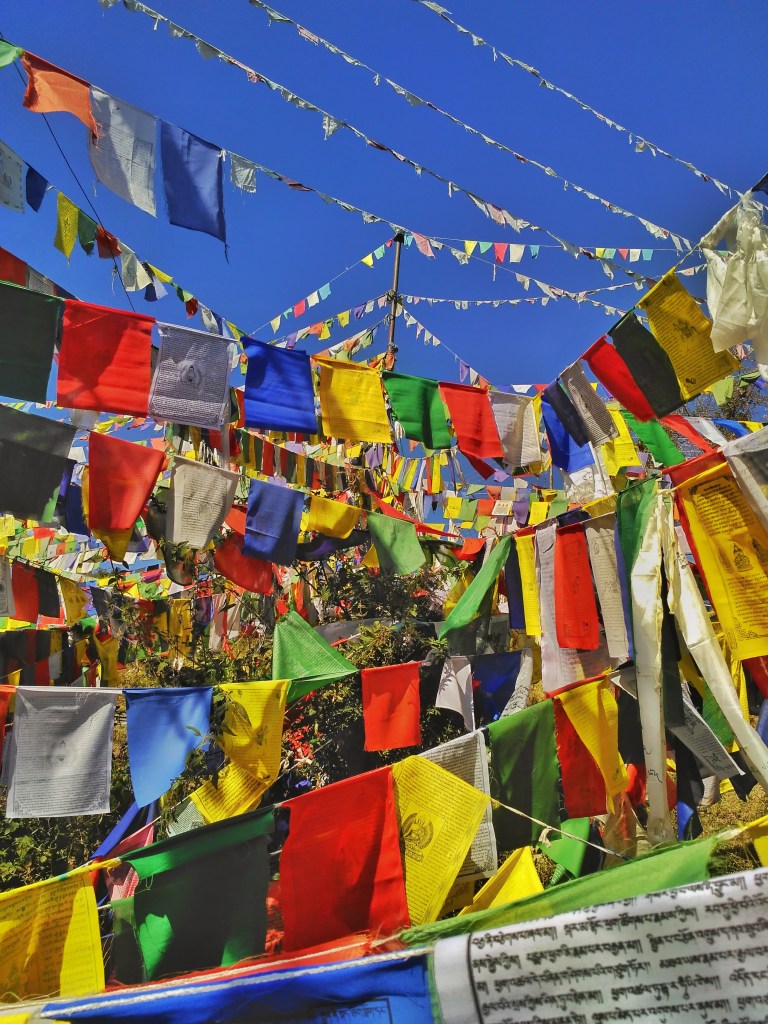
Dharamshala Dharma Dreaming

In the Forest of the Windhorses

DHARAMSALA DHARMA DREAMING


The hand of the monk 
agéd, insistent, but gentle too, 
takes and holds mine. 
The monk sits, the Dharma before him, 
sacred texts resting in their saffron shroud. 
My presence completes 
this circle. 

Mountain monastery 
calling him; it’s not home. 
Other mountains 
he’s climbed. Escape. 
High places divide 
this world from that, 
that time from this. 

His loving touch, his smile, 
linger in rarefied air. 
Air drenched with the warmth 
of the Dharma, 
in this late monsoon 
restaurant of the Snow Lion, 
south of his land.

The Mountain Monastery Calls

Mother Mother Ocean

Mother, mother ocean, I have heard you call
Wanted to sail upon your waters since I was three feet tall
You’ve seen it all, you’ve seen it all

NETI NETI

On the going down and the coming up
silvered and golded stairs
to and from the Underworld.
It’s all just a giant mirror
In which we see who we are not.

Hommage aux Ailés

Creatures of the Air,
the Winged ones.
Same like you and me:
Bound to material nature.