The poem I want to share with you today has, I think, been shared on this blog before. I haven’t checked because I didn’t want to be tempted to censor myself and not post it again if it has been posted.
The poem, titled simply Peace Prayer, has a repeating refrain in each verse:
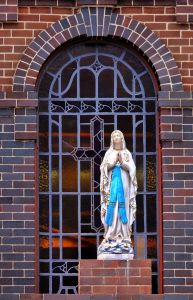
Our Lady Queen of Peace Pray for us.
A couple of days ago I came across a church dedicated to this particular manifestation of the Divine Feminine. I know it doesn’t seem to be such a far-out coincidence, but up till then, I had never encountered a church with this name.
So, obviously, it reminded me of my poem, written a couple of years ago now. As well as the story that prompted its writing:
When I was 12 my father went to war. As a professional soldier, he went as a part of this country’s commitment to its American allies in its war against Vietnam.
Our family was, at least nominally, Christian at that time, and anyway, desperate times do indeed call for desperate measures.
Which means we, my mother, my sisters, and I, formed a tiny prayer circle every night for over a year to pray for my father and for peace.
These days I no longer label my beliefs, not if I can help it anyway. What I seek now is the Divine wherever it is to be found. Which is everywhere of course!
In any case, here is my poem. It’s always the right time to pray for peace, though we should always remember our prayers are really directed at ourselves. It’s up to us to answer the prayer as we are able and see fit.
Peace and love to you all.
Peace Prayer
The father, the husband, the man of the house He’s away. At the war. Our Lady Queen of Peace pray for us.
Away at the war, yes, In a far off land. Not his own. Our Lady Queen of Peace pray for us.
Away at the war. “Incountry”. that’s what they call it. Our Lady Queen of Peace pray for us.
At home the children, the wife and mother wait. Wait and pray. Our Lady Queen of Peace pray for us.
At home they wait yes. Each night on their knees, in a circle. Prayer circle.
Away at the war, he is fighting. For what? At home, they are praying. For what? Our Lady Queen of Peace pray for us.
Indeed, it is clear to all who dwell there that through them the world is kept in being
I jotted down this note I forget how long ago. Over the last few years I’ve read a lot about the early Christian hermits who lived in the deserts of Egypt, Syria, and other areas of that area we label the Middle East.
While I think it was one of these early hermits who uttered these words, it may instead have been a monk or hermit from the 9th or 10th Century, living in the forests of Russia or Eastern Europe. (I wish was a lot less careless with sources for things I note down).
In any case, it was spoken by a hermit or monk who, along with perhaps thousands of other men and women, fled the strict dogmatism of both government and religious institutions , as well as the corruption, materialism, noise, and all the other distractions of the cities and towns.They went to the deserts, the forests, and other remote places, in search of solitude, silence, and peace.
They longed to commune with the divine. They chose to bypass the mire of worldliness, and hoped to find a better way to serve the divine and the world. The writer or speaker of our quote is pointing our attention to all those who went to the deserts, the forests, and other sanctuaries, who in her or his words, believe they are actually keeping the world going, and its people too.
These nuns, monks, priests and hermits, knew that by communing with the divine without distractions, and living a simple life completely and absolutely centred on the divine, was the way to save the world.
‘So’, you might be saying with a slightly cynical tone in your voice: ‘These are people who have ‘escaped’ from the world and are ignoring governments and the law, rejecting social status of any kind, not associating with other people like other good citizens. They’ve gone to sit in a hut or cave or whatever and are doing nothing productive at all. They’re not buying stuff so they aren’t contributing the the economy. And you say they are the ones keeping the world spinning round? Hardly.’
There are hermits everywhere.
Yes, I think they are. Keeping the world spinning I mean. Just as mystics from all the world’s religious traditions, these women and men of the deserts – and the forests too – knew that the world they’d left behind wasn’t real. Well, yes, it’s real enough of course: I mean we only have to look around us, and feel the workings of our bodies. It’s real alright.
But, realer (I know, it’s not a real word) than this physical world we are in and are an integral part of, is what lies within us as well as everything else in the Universe:
Holy Wanderer Detached from all Worldly Entanglements
The divine, God, the life force, Consciousness. So many names for the same thing. Many of us sense that at the core of ourselves there is ‘something else’; that there is some kind of intelligence for wont of a better word. This intelligence is what illumines life, as in life, the universe, and everything.
But, we don’t see this, or not so often anyway. The mire of worldliness (a phrase I mentioned earlier and which I like very much) seems to be specifically designed to keep us in the dark so to speak, about our true nature.
Think about the seemingly endless focus on materialism with its temptations and promises to make us happy; the conflict and competition among individuals and nations to acquire more power, possessions, land and anything else that ‘they’ve got and that we want’.
Mire is a good word: We’re trapped and sinking fast in a kind of quicksand.
And this mire keeps us from becoming aware, from realizing, that we are the Consciousness (the word I prefer but, as I said, names are just names) mentioned above. It keeps us ignorant of our true nature, and we go on and on struggling to keep afloat in the world.
The hermits of the past and the present, the nuns, monks and other contemplative people of all kinds, and, in many and various places, are all engaged in a quest to know – and yes, to realise – that they and everything else in the material and non-material universe is Consciousness.
I believe that, far from being unproductive, from ‘doing nothing’, It is the engagement by such people everywhere with this quest that does indeed keep the world in being.
Courtesy Wikimedia Commons Thank you
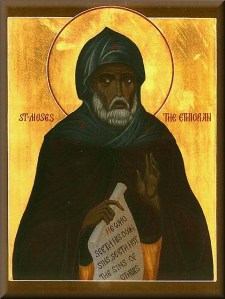
I would like to leave you with a couple of quotes if I may. The first is from Abba Moses, one of the greatest of the early desert fathers who was born in Ethiopia and lived in Egypt in the 4th Century:
‘Our objective is puritas cordis,’ Abba Moses told Cassian and Germanus [fellow monks]. ‘A heart kept free of all disturbance. The more we cultivate such inner stability, the more we can offer our lives in service to the world.’
Courtesy Wikimedia Commons Thank you
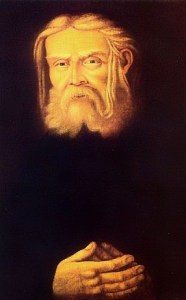
The second quote I would like to share is from Saint Seraphim of Sarov, a 19th Century Russian monk who lived as a hermit deep in the woods:
‘Acquire a peaceful spirit, and thousands around you will be saved.’
Remain in your cell, and your cell will teach you everything
This piece of advice from one of the early Christian desert hermits to a follower has been going round in my head for ages. And I mean a couple of years at least. I’d read it in several books at the time, and I’ve seen it in a few since.
Of course, most of the writers of those books interpreted this advice at face value, literally advising the student, hermit, monk, or other contemplative person to stay in their physical cell (hut, cave monastery cell, suburban bedroom, wherever is their permanent dwelling) and listen, meditate, study, and contemplate. The advice is, stay in that space in silence and seclusion. Quite possibly forever.
‘But it could be the cell of your Self,’ my partner hermit said to me one time. And yes, I thought, that’s exactly right. I liked the symbolism. The actual literal, physical space and its geographical location isn’t necessarily the important factor. What’s important is that you, the real you is actually fully present wherever you are, right here, right now.
Think about what it really means to be present – to be here now: It means that you can say, ‘This is the only space and the only moment that exists. Right here and right now.’
Living life is an ever-flowing movement or process, and at the same time (excuse the unintended pun) is always occuring in the present. And in that ongoing moment you – your Self -is always there.
Of course along for the ride is your little s self with its ego, chattering and never quiet mind reminding you of the distractions, stresses, anxieties, worries about things to do or not do, memories of the past, and fears for the future. It goes on and on.
But, still, that space within where you can meditate, pray, contemplate quietly, that’s your Self, your ‘cell’.
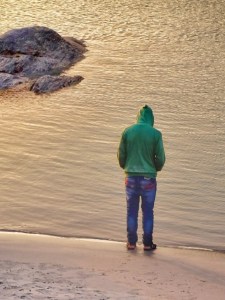
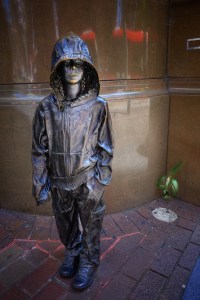
I’ve always liked and worn hoodies. I guess a lot of people do. For some it’s about fashion; others wear them for warmth in cold weather or to keep the sun off when it’s hot; some people even use them to hide.
Then there are others such as nuns, monks, priests and others too, for whom a hood is a part of the robe they wear as a member of their particular group.
In those cases, a hood is called a cowl and most often it’s a largish loose hood sewn onto the robe or habit. Just like a regular hoodie.
I read somewhere (I forget where) that some groups nickname these cowls ‘cells’. In other words, the wearer carries their cell with them wherever they go.
Of course they don’t always actually wear the hood on their heads, but whenever they wish or need to retreat to their cells, all they have to do is simply pull their hood up and over their head and all of a sudden they are in their own private and solitary world; they are in their cell.
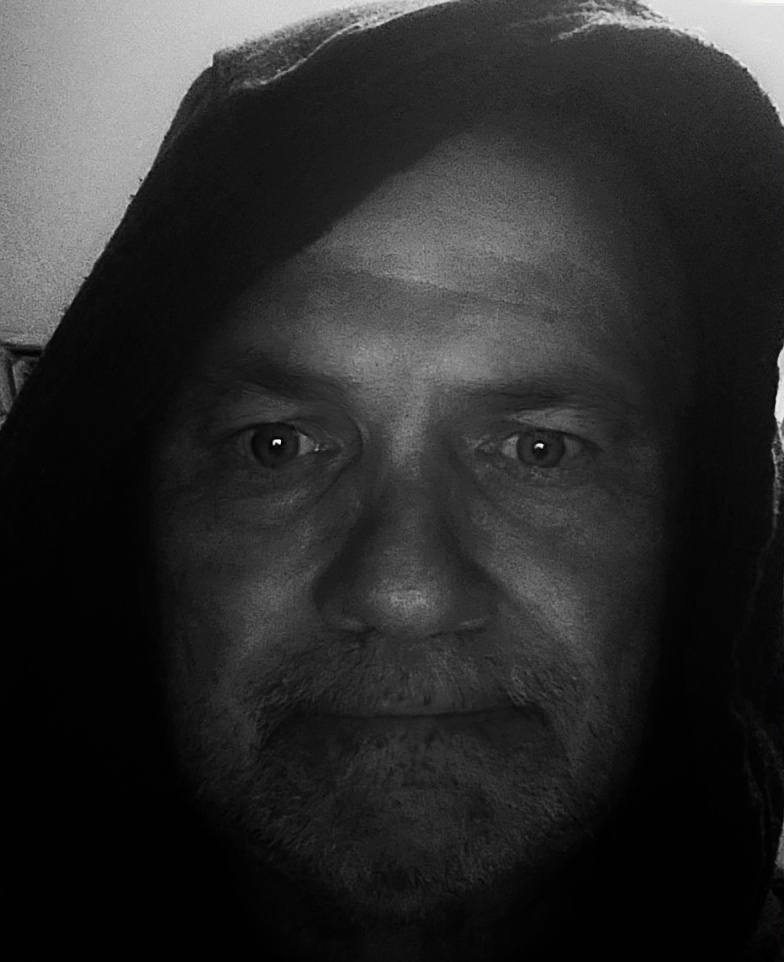
As I said earlier, I like the symbolism. But more than that: I find wearing a hood on my head or simply in standby mode, comforting.
I’m not overly good with crowds, or in close proximity to other people on a bus or train or whatever. I like knowing that just by pulling my hood on, I’m able to create my own space apart from my surroundings. In that space I can feel safe and kind of apart.
Even at home I wear a hood when I’m meditating or praying. It’s just one more opportunity to retreat into my cell, into Self
The Paradox of the Hermit Life (Courtesy of @travellinghermit3)
THE BEGINNING OF DEVOTION
Attention, paying attention. It’s the beginning of devotion. And when you see? When there is seeing? Well, seeing is praise.
When we see, what we see, is God. Not the god, or this or that god. There aren’t lots of gods, or so it seems. And in the end, there isn’t even one god: there is only God. So it was said by the sages.
Greetings friends A poem today for you to read and enjoy
If the Tea Needs Stirring: Lessons in Presence
Just now, just here, stirring the tea. A flash, an insight; in reality a realisation dawned as the tea brewed.
Suddenly I’d seen the solution to finding the real Self, to success in the search, to completing the quest for Truth.
Just keep doing this. That was the sense of it. That’s what I heard with the mind’s ear.
Stir the tea? Yes. Then? Keep on keeping on. Step by step, One task – or no task – to the next. Just a wu wei flow. In, through and on the ongoing moment; on the path of least resistance. But beware, take care: That path is not the slippery slope of apathy, of indifference. It’s not the way of doing nothing.
It is the way of being, Of being within your doing. Fully present, only present. The tea needs stirring? Then stir it.
Be the actor – the stirrer. Be the spoon, Be the tea. That’s all there is.
The inclination to seek knowledge is, for me, a gift, a blessing. And we live in a time when there are so many sources, so many resources available, and many are freely available too. There seems to be no limit to what the genuine seeker of knowledge can uncover.
Yes, of course, we’re swamped with information from all sides. We are deceived by fake news. And everything these days is a commodity, a thing to be bought, sold, acquired, or otherwise used for profit in the material world.
All true. However, this is where one’s discernment comes into play. It’s up to each of us as seekers of knowledge (on whatever topic or subject) to discern for ourselves the truth or otherwise of the information we use to form the knowledge we are seeking.
In my last post, I began to talk about two notes that I made in my notebook. These notes were quickly jotted down while seeking knowledge from two different sources about two distinct topics. Feel free to have a look at that post here if you happened to miss it.
Do your duty Follow Dharma Live a righteous life
These three lines are the sum of what remains of a session with my teacher, Swami Tadatmananda. It’s his short, succinct summary of the teachings I was trying to absorb from him that day.
You’ve probably guessed I am not a great note-taker; I like to just let sink in what wants to sink in, absorb what resonates for me. Perhaps on that day, I felt the summary was all I needed as a basis for later contemplation.
With that in mind, I would like, in this post, to reflect on these three injunctions, try to work out how I’m doing when it comes to taking notice of them, and actually where I’m at with actually living by them.
Do Your Duty
What does it mean, ‘Do your duty’? And what does it mean, for me, to do my duty?
Firstly, let me try to define duty. Not from the dictionary meaning, not from some outside ‘authority’. No, this is me talking about how I define duty.
Duty, for me, is defined by the activities I choose to prioritize in my life. These are the things that I believe best serve my true, essential nature. Acting in accordance with this true nature includes responsibilities such as taking care of my physical, emotional, and mental health. While this may not always be easy and sometimes feels impossible, it is my duty because my mind and body are manifestations of my true self, of the divinity.
Duty, again for me, means persuing activites – in the world as well as within myself – that nurture, protect, and grow, who or what I percieve that Self to be.
This Self I refer to is not restricted to the apparently separate entity I call ‘me’. That apparent separation is just that, an appearance: Self is all there is; I am not simply bonded or joined with all other living (and non-living) beings: I am those beings, just as they are me.
As such, my duty is to act in ways that benefit (or at the very least do as little harm as possible to) all beings, all life. Here, I guess, we could talk about Karma. But let’s leave that for now. It’s enough to say that nobody can tell me – or you – what is our duty. In fact, the truth is I already know the full extent of my duty, as we all do.
The only thing lacking for me is what I might call a full disclosure of what that duty is. That full disclosure can only come from me – as in the Self. As they say, I might know in my head what my duty is, but I’ve yet to fully realise it in my heart. And if I’m honest with myself I can say that my aspiration to do my duty is a constant reminder and motivation to do always the best I can to fulfill my duty.
In some areas I think I do my duty pretty well, but in others I have a long way to go.
In my next post (and the final one in this series: there just seems to be such a lot to think about when contemplating this topic), I will look at what it is to follow Dharma. Once again, it’ll be a very personal, subjctive answer because, to put it perhaps too simply, I like to think that I know right from wrong.
I hope this post has been of at least a little interest and value to you. I will look forward to seeing you here for my next post.
I was out and about photographing for a few hours this morning. On such walkabouts I like to walk at a slow but steady pace, and in a contemplative frame of mind.
Usually I’ll also chant mantras as a way of focusing my mind, of keeping random thoughts from distracting my attention. And so it was today.
Deep into today’s walk, I was feeling ‘in the zone’, as I like to call it. Making photos and chanting mantra. All of a sudden I heard myself singing a bhajan (sacred song or hymn) in place of the mantra I’d been reciting.
This particular bhajan was By Your Grace, by Krishna Das, It’s a beautiful devotional song that you can listen to here. I’ve been listening to it and singing it for years, and I love it. I find it puts me in a nice prayerful state of mind, Anyway, here are the lyrics:
Closer than breath, you are the air Sweeter than life itself, you are here I am a wanderer, you are my peace I am a prisoner, you are release
Jai Gurudev…
I am a pilgrim, your road so long I am the singer, you are the song Held in the open sky, so far above I am the lover, you are the love
Jai Gurudev…
I follow your footsteps through the flame All that I ever need is in your name Carry your heart in mine, vast as space All that I am today is by your grace. By your Grace… I live by your grace.
One more way to chant sacred songs
Now, the song was written by Krishna Das as a way of thanking and praising his Guru. But, the words and the power of the song can be dedicated to any of our own individual concepts of the Truth. Whether we call it the Absolute Reality, the Supreme Being, the Life Force, the inner Divinity, Nature, Consciousness, God, Guru, the Universe. After all, these are all simply names and forms.
I guess what I’m saying here is that the song is a fine prayerful and meditative way to express our gratitude to, our love for, and devotion to whatever it is in our heart of hearts we know as our support, our teacher, our creator, our Guru. Our very own Truth
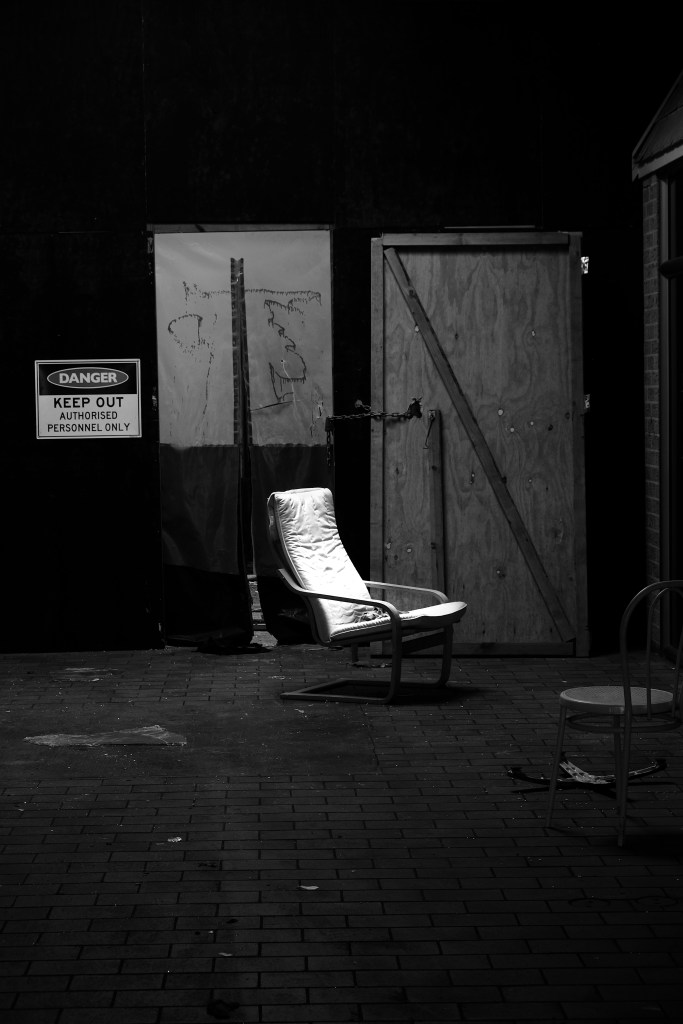
That was the first thing my partner said when I showed her this photo. Her eyes – and perhaps even her heart – had found that which is illuminated by the sun, even though it’s surrounded by wreckage and ruin.
The wreckage by the way, of an abandoned and trashed store front. One of several in a small arcade, that’s long sat empty.
Ah, I thought: one more illustration of a metaphor I’ve been hearing a lot lately in my studies about consciousness.
Allow me, please, to adopt our teacher’s metaphor which, for me, really clarifies this concept of consciousness, or Atma as it’s called in Sanskrit.
Is the brilliant light streaming into this room and onto this chair affected in any way whatsoever because the chair is sitting amidst all that wreckage?
Is the sun shining any less brightly on the chair than it would if the chair was sitting in a luxuriously decorated space instead?
Of course the answer to both questions is no. The sun, and its brilliance remains undimmed, and completely unaffected, untouched, regardless of what it shines on.
The ‘I’ that photographed this scene, and my partner’s ‘I’ whose eyes were drawn to the chair in the scene, are both consciousness. Not ‘my’ consciousness; not ‘her’ consciousness. Consciousness is all; all there is. Boundaryless, infinite, all pervading. We can’t even say there is one consciousness, because there is only consciousness.
Ah, I hear you say: there is one sun shining on our world; and the sun isn’t ‘all there is’. Well, as our teacher likes to remind us, all metaphors are flawed: you can only take them so far.
Metaphors, are only meant to illustrate, to show us the way, point us in the right direction as it were. In our little example here, the metaphor is meant to help us gain some knowledge.
The knowledge that we are not what we see, hear, taste, touch, think or feel. We are that light – consciousness – that allows us to know what we experience with our senses.
One more thing: The light of the sun, flooding the chair with its brilliance, enabled my partner to see that it was comfy, even though it was sitting in that wrecked, abandoned and lonely place.
Just as in our lives, when everything seems to be crashing down around us and we feel we are the ones stranded in that wreckage, we can remember that the light of our own consciousness, is the way in which we may shine our attention on the truth of our unchanging eternal, and true nature, that is who we really are: perfect, eternal, absolutely unaffected by anything at all.
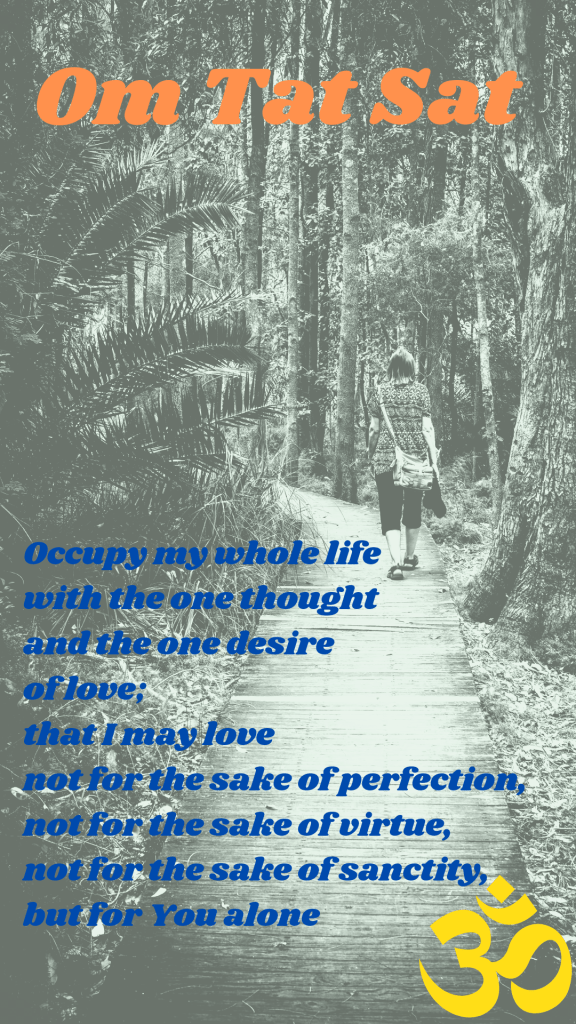
I’m not completely sure where I found this prayer. But I have a feeling it is by Thomas Merton, one of my most favourite and significant teachers and guides.









 Notes from the Hermit's Cave