Flee, Be Silent, and Pray Always

A few days ago I began a new work to study and contemplate in my not quite daily Lectio Divina practice. It’s actually a spiritual classic that, although I’ve read it before, I felt the need to explore a little more, dig a little deeper, rather than simply reading through it as I did the first time.

It is The Way of the Heart: The Spirituality of the Desert Fathers and Mothers by Henri Nouwen. It is essentially a sort of guide book for those of us who are looking to live more spiritually oriented lives. And I agree with the author when he suggests that the Desert fathers and mothers are the ultimate examples for us to today, even though they lived several hundred years ago.

I haven’t gotten very far in the book; like I say it’s going to be a slower, more reflective process this time (I’m amazed how little I remember as I reread now). A small story the author tells us by way of describing how he’s structured the book, is actually where I’ve left off, so that I can share it with you before I go on with the text and forget!
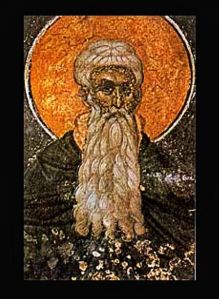
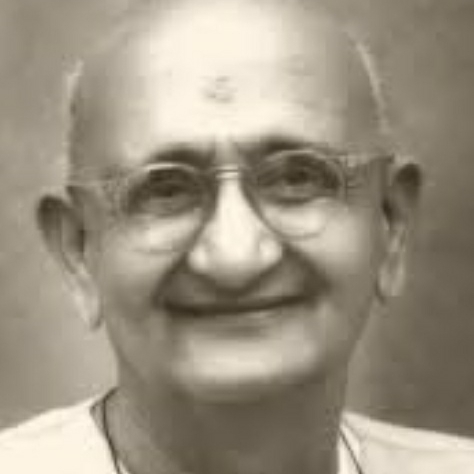
Abba Arsenius (courtesy Wikipedia)

It concerns Abba Arsenius who was a high ranking Roman official working in the household of the Emperor. Clearly he was looking for a more meaningful, more spiritually oriented lifestyle away from the dogma running people’s lives, politics, the decadence and the rest, because he constantly prayed to God, seeking a way out that would lead him ‘to salvation’. He was wanting badly to be free.

Well, he heard an answer, from deep within his soul:

Flee, be silent and pray always.
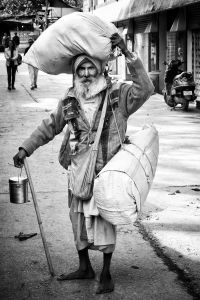
So, that’s what he did, fleeing first obviously. I don’t know the rest of his story. I mean I could look him up, but for our purposes here today, all we need to know is that he took off secretly to Egypt and went to live alone in the desert.

Nouwen believes:

“The words flee, be silent and pray summarize the spirituality of the desert. They indicate the three ways of preventing the world from shaping us in its image and are thus the three ways to life in the Spirit.”

Flee. It’s quite a strong word isn’t it? On the face of it, it simply means run away or escape. But it seems to suggest something more urgent, as if the one doing the fleeing needs to get away as quickly as possible; sticking around could be (or actually is) dangerous.

And that, as I said, is where I stopped to think. Sorry, I mean contemplate. I was so struck by the concept: in its essence, it is exactly the life I am attempting to live. Anyway, since reading it I’ve been thinking a lot about the three imperatives given to Arsenius in that very succinct answer he received to his question.

In fact, looking the word up just now I see that some slang terms for flee are: bolt, scram, schedaddle, or get the heck of out Dodge (or in the case of Arsenius, Rome). Let’s just say, to flee means to run away as quickly as you can, to escape imminent danger of some kind, real or metaphorical.

I read once of a woman who had the debilitating Chronic Fatigue Syndrome. In an attempt to recover and heal, she moved to a remote cottage in a tiny town ‘in the middle of nowhere’. Why such a drastic move? Surely if she is ill she should stay near to doctors and other resources?
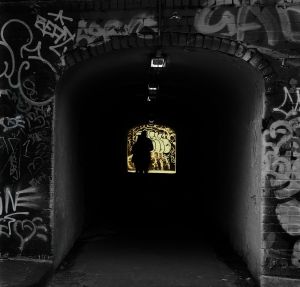
Well, for her being in a city was the problem. Noise, crowds, pollution, pressure to conform and consume, interaction on so many levels all the time with other people, trying to meet daily needs in a complex, crowded and hectic environment was precisely what was making her ill.

Not to mention the effects on mental health that living in such conditions has on a lot of people, and I think we can all relate to some degree to this idea. We’ve all felt sometimes (or even very often) how we would like to just get away from it all.

For me it was about the gross materialism, the lack of ethical and moral thinking in the running of businesses, governments, and the rest; I longed also for a deeper connection with what one might call the sacred; more time and space for contemplation and just a simpler, slower, less rushed, less complex life.
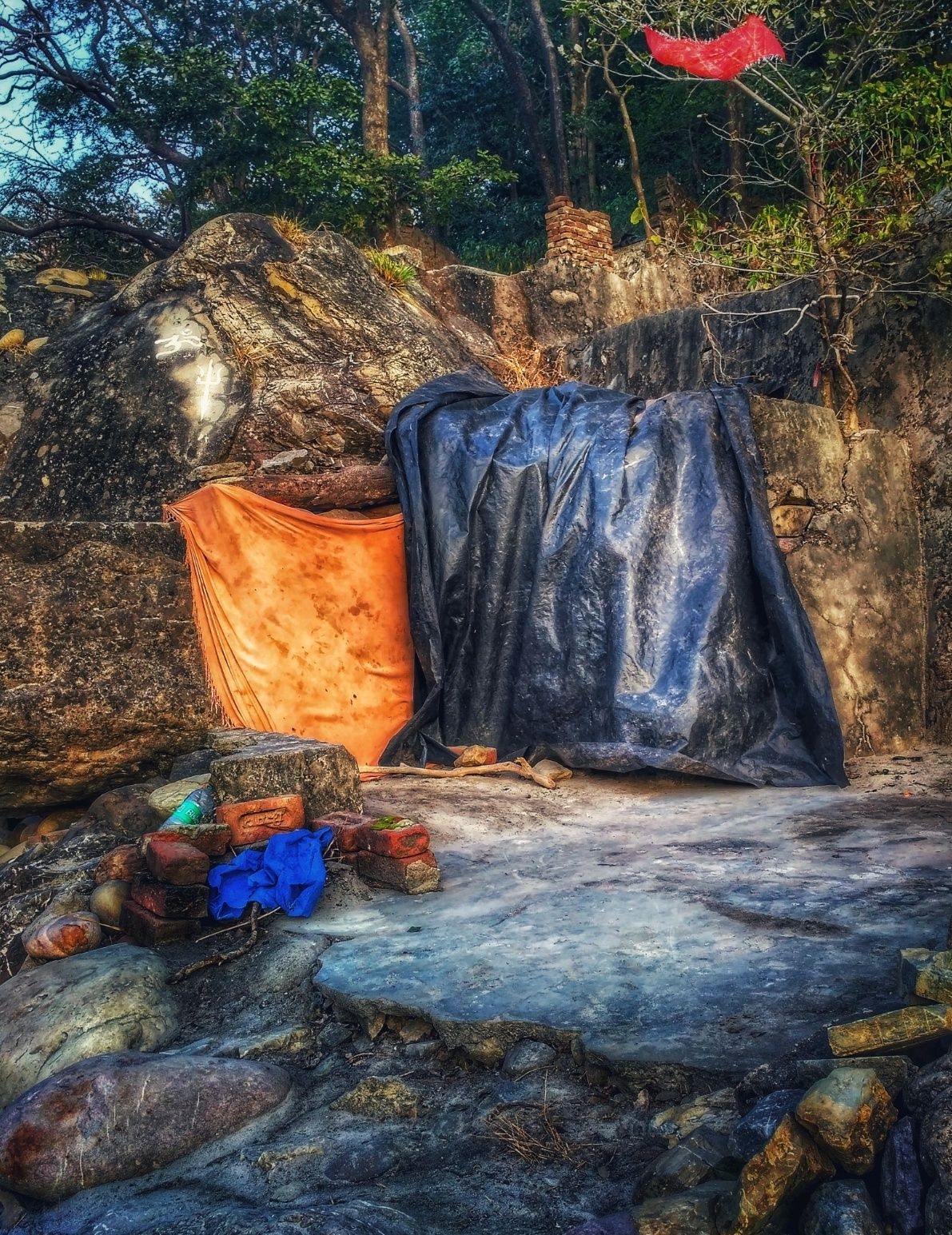
Now, I hear you saying: ‘not everyone can or should just give up everything and take off to live in a cave’. (or desert, wherever). And you are right, of course. In fact, we can say the cave is a metaphor for all sorts of spaces one might feel drawn to when fleeing and seeking separation from the world.  Actually, we’ll be talking more about this later when we get to the be silent bit.           

For these Hermit Pilgrims ‘fleeing from the world’  has meant a nomadic lifestyle, few possessions and material needs, a hermit life where our engagement or entanglement with the world is kept to a minimum, and in which we feel less of a pressure to conform, to ‘be shaped’ by the world around us’).

The reality is of course, at the end of the day for most of us and for most of our lives we have to make money to feed and clothe ourselves and our families. And for that we need to work. And in order to work we need a house to live in, and to have a house to live in we (perhaps) have to get a mortgage, and to get a mortgage … . Well I guess you get the point.
But, for a moment ask yourself: What would it look like for me to ‘flee’? For each person it’s going to take on its own unique meaning. I suppose the easiest way to put it is to say that fleeing for all of us essentially means laying aside those things (or people, places, behaviours) that we look at as ‘dangerous’ , ‘bad for us’, or from which we constantly feel the need to escape. Sometimes they’re little things, sometimes more serious.

It might be that we’ve taken on too many social media ‘obligations’ that are swallowing up any precious spare moments we have, that we’d like to be free of. Or it could be our compulsion for bringing our work home that we are desperate to give up (the bringing work home, though of course it might be the job too), so we can actually make some more free moments.

Perhaps it’s our drive to ‘know what’s going on’ by watching the news every night that’s doing our head in. These are some of the so-called minor things that we know are shaping who we are, and often against our own wishes too. Now I think about it, maybe none of it’s ‘minor’ after all.

Oh dear, I’ve done it again: word count is very nearly 1000. Too many words is another thing people try to flee from: we’re flooded, overwhelmed by words. And as much as I personally love words, I get the point and I will leave our contemplation on what was actually a message of very few words, till the next post.

Thank you for being here. Peace and love

Paul the Hermit
Oh No! Another Blog About Chanting

Not too long ago, I completed what I’m now calling my first formal (structured) study of the entire Bhagavad Gita. Of course this wasn’t my first exposure to that text: I’d been reading it on my own for a few years before I came upon a teacher to act as guide.

Anyway, since that bitter-sweet day of completion, I’ve been looking at ‘random’ verses on a more or less daily basis as a way to keep in touch and to act as a reminder of what I’ve learned.

Just opening my Bhagavad Gita at random, just to see what the universe wants me to think about.

Today, I happened to open it up at what are a series of my favourite verses. (I know I’ve got a lot of favourites; it’s that kind of book). In these particular verses, Krishna describes the meaning and significance of the mantras Om Tat Sat.

In a nutshell, these three syllables, these mantras, are a way of describing the Absolute Reality of the Universe, or God, Consciousness, the Truth, the laws of nature and the universe. Whatever names we might use to encompass all existence.

Krishna details when and why to use the mantras (it’s one mantra made of three, for the technically minded). Again in a nutshell, it’s a mantra to use whenever we perform our duties, basically any actions, with a devotional mood.

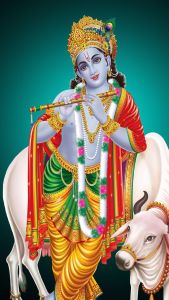
By the way, that, and the inclusion of my favourite image of Krishna, doesn’t necessarily imply that our actions have to have a ‘religious’ intent or flavour: Any action we undertake, for whatever purpose as long as it is motivated by Truth, Love and right thinking, qualifies as being devotional.

While you can see the actual verses yourself via the Om Tat Sat link above, I would like to share with you my very liberal paraphrasing of Krishna’s teaching on the mantra. Also, I am adding a few observations of my own that I hope serve to clarify this great teaching. Oh, please forgive any repetitions, if they occur.

The syllables Om Tat Sat are the symbolic representation of the Supreme Absolute Truth; what I choose to describe simply as all that is. It is called by any number of names or none. It’s existence itself.

It’s an ancient practice, this chanting of these three syllables as a mantra. It is recited when one is engaged in any action in a mood of devotional service. Meaning any act that is imbued with a prayerful attitude and feeling, and with a mood or attitude of devotion to and recognition of, Truth in all things.

And it includes any and every action we undertake, from washing the dishes, to sitting in meditation or silent contemplation. And everything in between.

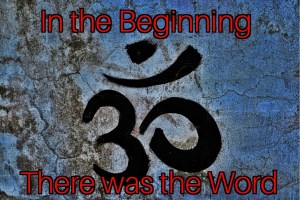
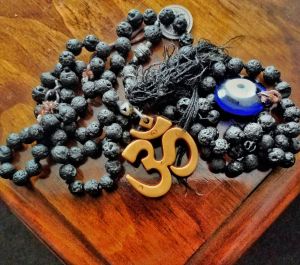
Om

Om is sometimes called the primordial sound, the creative principle, the word from which all creation sprung. I’ve also heard it defined as being the Big Bang, from which the universe emerged.

Om is considered the sacred sound and word by many cultures around our world. Consider the opening of John’s Gospel in the Christian New Testament :

Om is to be chanted when beginning and performing any and all actions motivated and driven by Truth. Chanting Om assists us to actually realise or understand with our heart and not just our mind, the presence of the divine or the universal consciousness in all that we do.

Tat

Tat is chanted by those wishing to be freed from attachment to material things, which includes the desire or compulsion to enjoy the fruits or rewards of our actions.

In the beginning was the word, and the word was with God, and the word was God

John 1:1 New Testament

Attachment is when we depend for our well-being or happiness (physical, mental, or spiritual) upon another thing (money, job, status, etc), person, or desired outcome. Attachment (and clinging, extreme longing, compulsivity), Buddha told us, is the cause of suffering: when things are going well with the things or people we are attached to we are elated; when things aren’t going so well, we are miserable and we suffer.

Sat

The syllable Sat indicates both reality and goodness. In other words, Sat is used to represent that Absolute Truth or Universal Consciousness that we’ve been discussing.

Sat follows very nicely on from Tat as it helps to strengthen our Dharmic (motivated by what’s right and true) actions, so that they actually become Sat – Truth.

So, chanting Om Tat Sat when performing any or all our activities in the world (as well as within) will help us to come to realise or understand that there is only the one Absolute Reality, the one consciousness that is not only universal in nature, but is actually the universe itself.

Oh one more quick note: Often you hear the chant with an extra word up front: Hari Om Tat Sat. Hari is a way to address that which removes darkness, that aids in the shining of the light of knowledge.

It’s a word that represents that Absolute Reality that we’ve talked about here. It can also refer to King or Lord, or otherwise influential entity. I find it rounds out the chant, and I like it!

Please feel free to explore Om Tat Sat for yourself. You will find a lot of great recordings of the chant on YouTube, and the wikipedia link at the beginning of this post is very Illuminating as well.

Om Tat Sat

All I Had to Do Was Dream

Last night I had a dream. Of course there’s nothing unusual in that: I dream every night, every time I sleep (and sometimes when I’m supposed to be meditating as well). Actually I’m no different than probably every other living being in the Universe: I dream when I sleep.

No. The particular dream isn’t my point here (though we’ll be discussing it soon enough). What makes it worth noting is the fact that last evening, before going to bed, I watched a documentary on Carl Jung and The Red Book.

Jung compiled The Red Book at a time of personal crisis and distress. Using dream analysis, his own imagination, and intense self reflection, he used both paintings and text to express what he saw and understood from these practices. Hauntingly beautiful, other worldly pictures depicting dream images, archetypes, both personal and universal, helped him delve deeply into his unconscious mind and the collective unconscious.

I gave up trying to interpret dreams a long long time ago. Don’t ask me why: I probably couldn’t say. Most likely something to do with a kind of wariness about going too much into where the mind wants to take me, and my sense that the “dream” doesn’t stop when we wake up.

Still, watching this doco prompted a lot of discussion with my partner hermit, and a lot of thinking on my part. The mind is not our enemy, though sometimes I feel that it is. Well, it can be the enemy if we allow it, but equally we can allow the mind to be our friend. After all, what activity of any kind is possible in the world without mind?

So, with that in mind (get it? in mind?) I will share with you that above mentioned dream from last night.

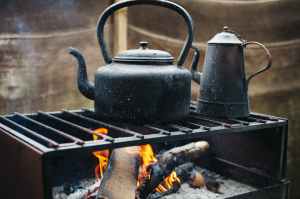
In the dream I was in a small kitchen, making tea. I’d put on a kettle to boil. A very large, heavy kettle, probably three or four times the size of a normal one. I was in the process of looking for a mug or cup, and just as I picked one up that I liked the look of, a crowd of five or six people came bustling noisily into this very crowded space.

‘I’ve just put the kettle on,’ I called loudly over the din. As it happened I’d filled the kettle almost to overflowing, much more than I needed for myself alone.

‘There’s plenty of boiling water to go round.’

Then I busied myself looking for something (a tea bag perhaps?), and when I finally turned back to the kettle to make my tea, I saw it was gone. I was very unhappy with this disappearance: After all, I was the one who had filled the kettle and put it on to boil. Then without a thought or a, what’s the expression? without a by your leave, it’s all gone, nothing left for me. Not only no more water, but nothing to boil more with.

I looked everywhere, even outside the kitchen. Outside was a camp ground and apartment complex, where I (and presumably all the other people) was staying.

Anyway, that’s it. All I remember at least. So, the meaning? Was I merely processing trivial facts and events from my day in this strange fashion? Or was I in touch with the deepest part of my psyche and with the collective unconscious? Possibly a bit of both.

It’s not a big job to make a guess about the meaning. I had a plentiful supply of water (or whatever), and without thought, put the needs of others before my own. But then, I actively resented what had been ‘taken from me’, even though I had freely given it in the first place.

So, the message I take from this dream? Just as I’ve been studying lately, the fruits of my actions are not my responsibility. I have no say over what, if anything, will happen as a result of actions I take. All I am responsible for is the taking of the action itself, the manner in which I undertake it, and the attitude with which I approach the actions I take. That’s it. That’s all I can do. The rest is up to the laws of the universe. Call it Karma, or Natural Law.

Another idea just occured to me: When I take action (like boiling the kettle) and then serve others, I am serving Self, all life, everyone and everything. And obviously that includes me. I’m not suggesting I should have made sure ahead of time that I’d ‘reserved’ enough water for myself, but at the same time …

I might keep this dream analysis thing as practice to practise occasionally, when the inclination or inspiration is there. No more blocking memories of dreams, no more stubborn refusal to reflect on dreams. After all, I spend a lot of time contemplating and reflecting on what I do in my waking life, how is it any different just because it happens while I’m asleep?

Making a Dream a Reality (kind of)

A few weeks ago I was wandering around in the CBD of Sydney, in Martin Place to be precise. It’s a popular square with loads of tourists,  shoppers, coffee drinkers, and lunching folks.

It’s also a drawcard for both buskers and for street photographers. For me, it’s mainly a short cut from one street to anoher, though I must say, I’ve very often stopped to make a photo or two of the grand architecture, fountain, and the great light that seems to permeate the place.

Anyway, on this occasion as I walked about slowly, I heard a busker. Not a singer, more a spoken word poet type performer. I guess if I were to categorise him, I’d have to say he was a Rapper.

And to put it mildly, his poetry was a amazing; I had to stop and watch and listen for a while. I realised quickly that what he was doing was focusing on a particular passerby and would then make some (mostly humourous) ryhmes about that person. Things like:

Here comes a dude with groovy green shoes.
Not having a pair like them is givin’ me the blues.

or:

Now I see a fella with a phone stuck on his ear.
Come on buddy, why not let us all hear?

Now, I confess that these are my own made-up examples. I wish I’d noted some of the real ones, but I was too busy listening!

It’s easy to tell right away that I’m not what you would call a “natural rhymer”, if there is even such a thing.

But what turns this into a true synchronicity for me is that for a few years now I’ve had a recurring dream in which I’m simply walking along making up superb rhymes as I go. It’s one of those dreams you’re never sure are ‘real’ or simply a dream.

In any case, when I saw and heard this guy that day, it got me remembering the dream and how I’d often thought I would really love to actually be able to do that exact same thing.

Not about people though. I used to photograph people in the street; all kinds of people.  I still consider photography among the most important of my contemplative and creative practices, just these days I don’t photograph people.

So, in a round about way, I’ve made a little “poem” that refers to what I do photograph, inspired by this encounter as well as particular photo I came across just yesterday but made months ago now.

Please enjoy

Strollin’ down the street
I lift my camera to my eye,
no longer interested in the people walking by.
Nowadays I tend to notice their many and varied traces left behind,
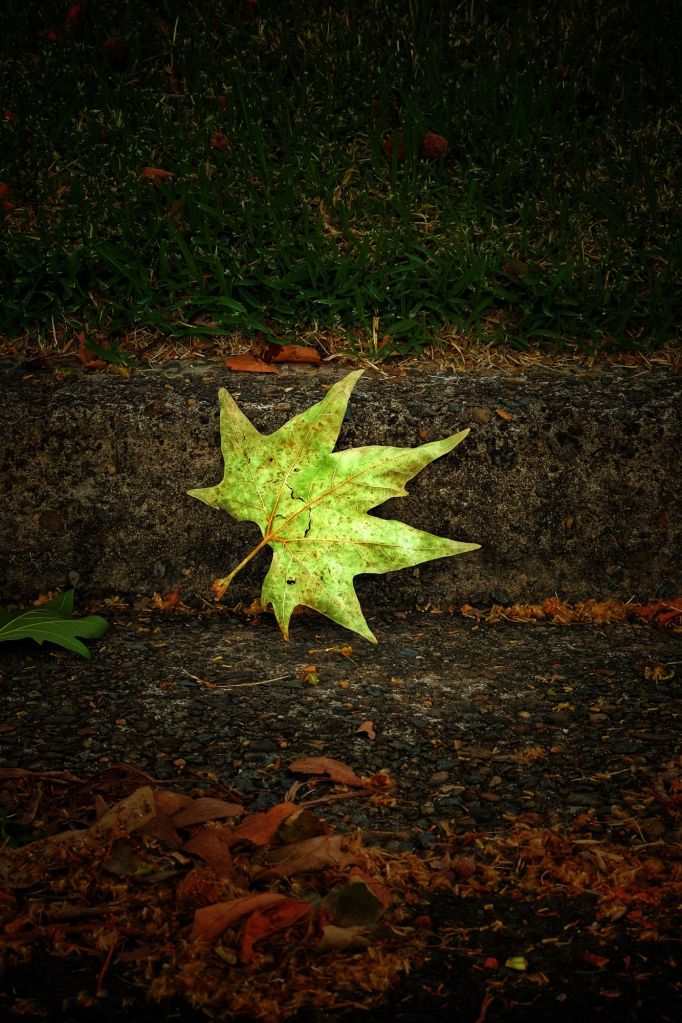
or perhaps (and even better) a golden leaf in the gutter I might find.

Thank you for reading this small attempt. Now here’s the photo I mentioned that inspired this attempt at a kind of spontaneous rhyme.

Blowin’ in the Wind

Making Peace with Poetry and a Prayer

Namaste my friends

The poem I want to share with you today has, I think, been shared on this blog before. I haven’t checked because I didn’t want to be tempted to censor myself and not post it again if it has been posted.

The poem, titled simply Peace Prayer, has a repeating refrain in each verse:

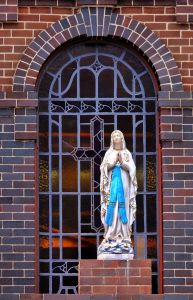
Our Lady Queen of Peace Pray for us.

A couple of days ago I came across a church dedicated to this particular manifestation of the Divine Feminine. I know it doesn’t seem to be such a far-out coincidence, but up till then, I had never encountered a church with this name.


So, obviously, it reminded me of my poem, written a couple of years ago now. As well as the story that prompted its writing:

When I was 12 my father went to war. As a professional soldier, he went as a part of this country’s commitment to its American allies in its war against Vietnam.

Our family was, at least nominally, Christian at that time, and anyway, desperate times do indeed call for desperate measures.

Which means we, my mother, my sisters, and I, formed a tiny prayer circle every night for over a year to pray for my father and for peace.

These days I no longer label my beliefs, not if I can help it anyway. What I seek now is the Divine wherever it is to be found. Which is everywhere of course!

In any case, here is my poem. It’s always the right time to pray for peace, though we should always remember our prayers are really directed at ourselves. It’s up to us to answer the prayer as we are able and see fit.

Peace and love to you all.

Peace Prayer

The father, the husband, the man of the house
He’s away. At the war.
Our Lady Queen of Peace pray for us.

Away at the war, yes,
In a far off land. Not his own.
Our Lady Queen of Peace pray for us.

Away at the war. “Incountry”.
that’s what they call it.
Our Lady Queen of Peace pray for us.

At home the children, the wife and mother wait.
Wait and pray.
Our Lady Queen of Peace pray for us.

At home they wait yes.
Each night on their knees,
in a circle. Prayer circle.

Away at the war, he is fighting. For what?
At home, they are praying. For what?
Our Lady Queen of Peace pray for us.

The Best Job in the World

Indeed, it is clear to all who dwell there that through them the world is kept in being

I jotted down this note I forget how long ago. Over the last few years I’ve read a lot about the early Christian hermits who lived in the deserts of Egypt, Syria, and other areas of that area we label the Middle East.

While I think it was one of these early hermits who uttered these words, it may instead have been a monk or hermit from the 9th or 10th Century, living in the forests of Russia or Eastern Europe. (I wish was a lot less careless with sources for things I note down).

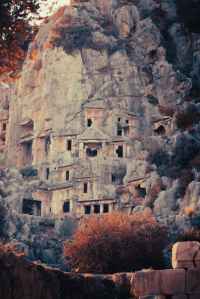
In any case, it was spoken by a hermit or monk who, along with perhaps thousands of other men and women, fled the strict dogmatism of both government and religious institutions , as well as the corruption, materialism, noise, and all the other distractions of the cities and towns.They went to the deserts, the forests, and other remote places, in search of solitude, silence, and peace.

They longed to commune with the divine. They chose to bypass the mire of worldliness, and hoped to find a better way to serve the divine and the world. The writer or speaker of our quote is pointing our attention to all those who went to the deserts, the forests, and other sanctuaries, who in her or his words, believe they are actually keeping the world going, and its people too.

These nuns, monks, priests and hermits, knew that by communing with the divine without distractions, and living a simple life completely and absolutely centred on the divine, was the way to save the world.

‘So’, you might be saying with a slightly cynical tone in your voice: ‘These are people who have ‘escaped’ from the world and are ignoring governments and the law, rejecting social status of any kind, not associating with other people like other good citizens. They’ve gone to sit in a hut or cave or whatever and are doing nothing productive at all. They’re not buying stuff so they aren’t contributing the the economy. And you say they are the ones keeping the world spinning round? Hardly.’

There are hermits everywhere.

Yes, I think they are. Keeping the world spinning I mean. Just as mystics from all the world’s religious traditions, these women and men of the deserts – and the forests too – knew that the world they’d left behind wasn’t real. Well, yes, it’s real enough of course: I mean we only have to look around us, and feel the workings of our bodies. It’s real alright.

But, realer (I know, it’s not a real word) than this physical world we are in and are an integral part of, is what lies within us as well as everything else in the Universe:

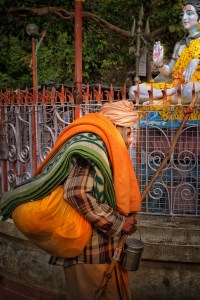
Holy Wanderer
Detached from all Worldly Entanglements

The divine, God, the life force, Consciousness. So many names for the same thing. Many of us sense that at the core of ourselves there is ‘something else’; that there is some kind of intelligence for wont of a better word. This intelligence is what illumines life, as in life, the universe, and everything.

But, we don’t see this, or not so often anyway. The mire of worldliness (a phrase I mentioned earlier and which I like very much) seems to be specifically designed to keep us in the dark so to speak, about our true nature.

Think about the seemingly endless focus on materialism with its temptations and promises to make us happy; the conflict and competition among individuals and nations to acquire more power, possessions, land and anything else that ‘they’ve got and that we want’.

Mire is a good word: We’re trapped and sinking fast in a kind of quicksand.

And this mire keeps us from becoming aware, from realizing, that we are the Consciousness (the word I prefer but, as I said, names are just names) mentioned above. It keeps us ignorant of our true nature, and we go on and on struggling to keep afloat in the world.

The hermits of the past and the present, the nuns, monks and other contemplative people of all kinds, and, in many and various places, are all engaged in a quest to know – and yes, to realise – that they and everything else in the material and non-material universe is Consciousness.

I believe that, far from being unproductive, from ‘doing nothing’, It is the engagement by such people everywhere with this quest that does indeed keep the world in being.

Courtesy Wikimedia Commons Thank you

I would like to leave you with a couple of quotes if I may.
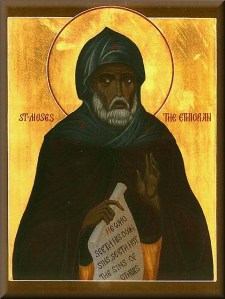
The first is from Abba Moses, one of the greatest of the early desert fathers who was born in Ethiopia and lived in Egypt in the 4th Century:

Our objective is puritas cordis,’ Abba Moses told Cassian and Germanus [fellow monks].A heart kept free of all disturbance. The more we cultivate such inner stability, the more we can offer our lives in service to the world.’

Courtesy Wikimedia Commons Thank you

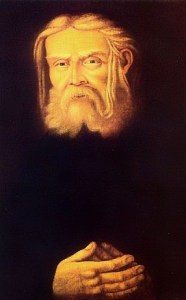
The second quote I would like to share is from Saint Seraphim of Sarov, a 19th Century Russian monk who lived as a hermit deep in the woods:

‘Acquire a peaceful spirit, and thousands around you will be saved.’

Probably the best gig in the world I would say.

Peace and love

Changing the World: Maybe not such a Tall Order

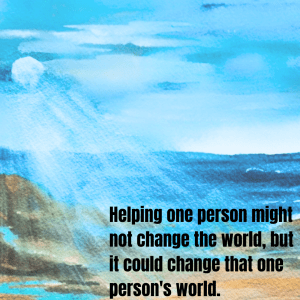
I’ve always liked this idea, this notion, that by helping one person, you can change their world. I’ve always believed it to be true; after all,

Nobody ever made a bigger mistake than one who did nothing because they could only do a little.

  Sydney Smith

Reading this great quote again recently, I was struck by something I don’t think I’ve noticed before. Suddenly I saw: ‘might not change the world’. Might not? Then I thought why not turn the whole think around: I could as easily say ‘Helping one person might change the world …’.

But, you know, my thinking went even further: I realized that might and might not have nothing to do with it. The reality is that every action we take, and that includes the action of helping other living beings (as well as harming them, which is a whole other story for another time), actually does change the world.

Obviously we can’t always (actually it’s more like very rarely) see those changes, nor are we able to dictate what the changes will be or predict all the possible outcomes. We may think we know what the results of our actions will be; we may even guess right. Whatever the case, all we can do is take action while realising that impacts always occur and just keep on happening in a kind of cascading effect that literally never stops.

Then I thought about it some more, wondering how we can actually come to fully realise that the might not in this marvelous saying, which speaks of a negative possibility, is more an always will, which points to something definite, as well as a whole lot more positive.

All is One on the physical and the non-physical levels

We all have had at some time a sense that we are all connected; we feel that we are part of nature, part of something bigger than just a lone disconnected individual. But, have you ever had the feeling that you might be more than just a ‘part of’ the world or nature’? Have you ever had a sense that you are nature? Maybe this sounds a bit esoteric: But we are one Self; we are all physical manifestations of the one consciousness, the one Divine.

And of course we can’t know for sure what goes on beyond the physical world. But, even at that most basic level of the material, especially as we get down to the microscopic and even atomic levels, it’s hard to tell individual beings apart. Atoms merge and cross over, interact, and change, between all living and non-living things.

So, who’s to say that one small action on my part, one small change, won’t have a cascading effect as the ripples (that’s a good way to put it isn’t it?) from that action spread through the world and beyond.

The ‘What can One Person Do?’ Dilemma

Our Sydney Smith quote in a sense tackles this agonising question for us. Still, you might think that one person can’t do a lot when the needs are so vast and so many and so intractable. There is always something we can do, even at the supposedly one person, one individual level, even if as Mr Smith says, it’s a small thing we do.

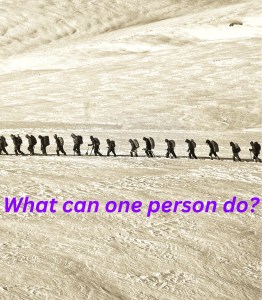
Just think how many people everywhere are asking this same question: ‘What can one person do?’

If even a tiny percentage of those questioning individuals answered that they could do something, then you would start to see changes taking place for sure. How could all those actions not add up to a changed world?

The Multiplier Effect

Just now I used the words ‘add up’. Well actually it’s more like a multiplication effect.

Remember we mentioned earlier the idea of a cascading effect always in action whenever any action of any kind is performed? Isn’t there a saying that goes something like: if a butterfly flaps its wings in a forest somewhere in the world, then a polar bear in the Arctic sneezes? Okay, that’s not quite it but you know what I mean.

Then there is that concept of ‘pay it forward’. It’s an easy concept to grasp, though I don’t especially like the language.  For me it’s more to do with love, compassion, empathy, and a desire to make things better.

So, the truth is, helping one person does indeed change the world for that one person. And whatever we do for that one person, it also does definitely change the whole world. It may not appear to us personally that everything in the world has changed simply because of our one, apparently tiny action, but the world, (and that includes all of us who live here or anywhere else for that matter) is one living entity, one being, so those multiplying impacts just go on affecting everything and everyone in some way.

We may think of ourselves as just one separate little individual, but we are more than simply united with all life; we are that life, just as all life is us. And, as for believing we can be ‘agents of change’, we may think that it’s all too hard; too many problems; what can I do? The road to changing the world seems to be blocked, seems to be impassable.

Well, one teacher I admire is Ramdas. Among the many great things he said, this one stands out for me above them all. I may have the wording a bit wrong, but basically the message is:

If you set your feet upon the path, then you are already at your goal


Which is another way of saying that if you help one person, then you have changed the world.


Peace

The Beginning of Devotion: A Poem

The Paradox of the Hermit Life (Courtesy of @travellinghermit3)
THE BEGINNING OF DEVOTION

Attention, paying attention.
It’s the beginning of devotion.
And when you see? When there is seeing?
Well, seeing is praise.

When we see, what we see,
is God.
Not the god, or this or that god.
There aren’t lots of gods,
or so it seems.
And in the end, there isn’t even one god:
there is only God.
So it was said by the sages.

If the Tea Needs Stirring: Lessons in Presence (A Poem)

Greetings friends A poem today for you to read and enjoy

If the Tea Needs Stirring: Lessons in Presence

Just now, just here,
stirring the tea.
A flash, an insight;
in reality a realisation
dawned as the tea brewed.

Suddenly I’d seen the solution
to finding the real Self,
to success in the search,
to completing the quest for Truth.

Just keep doing this.
That was the sense of it.
That’s what I heard with the mind’s ear.

Stir the tea?
Yes.
Then? Keep on keeping on.
Step by step,
One task – or no task – to the next.
Just a wu wei flow.
In, through and on the ongoing moment;
on the path of least resistance.
But beware, take care:
That path is not the slippery slope
of apathy, of indifference.
It’s not the way of doing nothing.

It is the way of being,
Of being within your doing.
Fully present, only present.
The tea needs stirring?
Then stir it.

Be the actor – the stirrer.
Be the spoon,
Be the tea.
That’s all there is.

My take on Dharma, Karma, & Living a Good Life Part 2

The inclination to seek knowledge is, for me, a gift, a blessing. And we live in a time when there are so many sources, so many resources available, and many are freely available too. There seems to be no limit to what the genuine seeker of knowledge can uncover.
Yes, of course, we’re swamped with information from all sides. We are deceived by fake news. And everything these days is a commodity, a thing to be bought, sold, acquired, or otherwise used for profit in the material world.
All true. However, this is where one’s discernment comes into play. It’s up to each of us as seekers of knowledge (on whatever topic or subject) to discern for ourselves the truth or otherwise of the information we use to form the knowledge we are seeking.

In my last post, I began to talk about two notes that I made in my notebook. These notes were quickly jotted down while seeking knowledge from two different sources about two distinct topics. Feel free to have a look at that post here if you happened to miss it.

Do your duty
Follow Dharma
Live a righteous life

These three lines are the sum of what remains of a session with my teacher, Swami Tadatmananda. It’s his short, succinct summary of the teachings I was trying to absorb from him that day.

You’ve probably guessed I am not a great note-taker; I like to just let sink in what wants to sink in, absorb what resonates for me. Perhaps on that day, I felt the summary was all I needed as a basis for later contemplation.

With that in mind, I would like, in this post, to reflect on these three injunctions, try to work out how I’m doing when it comes to taking notice of them, and actually where I’m at with actually living by them.

Do Your Duty

What does it mean, ‘Do your duty’? And what does it mean, for me, to do my duty?

Firstly, let me try to define duty. Not from the dictionary meaning, not from some outside ‘authority’. No, this is me talking about how I define duty.

Duty, for me, is defined by the activities I choose to prioritize in my life. These are the things that I believe best serve my true, essential nature. Acting in accordance with this true nature includes responsibilities such as taking care of my physical, emotional, and mental health. While this may not always be easy and sometimes feels impossible, it is my duty because my mind and body are manifestations of my true self, of the divinity.

Duty, again for me, means persuing activites – in the world as well as within myself – that nurture, protect, and grow, who or what I percieve that Self to be.

This Self I refer to is not restricted to the apparently separate entity I call ‘me’. That apparent separation is just that, an appearance: Self is all there is; I am not simply bonded or joined with all other living (and non-living) beings: I am those beings, just as they are me.

As such, my duty is to act in ways that benefit (or at the very least do as little harm as possible to) all beings, all life. Here, I guess, we could talk about Karma. But let’s leave that for now. It’s enough to say that nobody can tell me – or you – what is our duty. In fact, the truth is I already know the full extent of my duty, as we all do.

The only thing lacking for me is what I might call a full disclosure of what that duty is. That full disclosure can only come from me – as in the Self. As they say, I might know in my head what my duty is, but I’ve yet to fully realise it in my heart. And if I’m honest with myself I can say that my aspiration to do my duty is a constant reminder and motivation to do always the best I can to fulfill my duty.

In some areas I think I do my duty pretty well, but in others I have a long way to go.

Courtesy of @travellinghermit3

In my next post (and the final one in this series: there just seems to be such a lot to think about when contemplating this topic), I will look at what it is to follow Dharma. Once again, it’ll be a very personal, subjctive answer because, to put it perhaps too simply, I like to think that I know right from wrong.

I hope this post has been of at least a little interest and value to you. I will look forward to seeing you here for my next post.

Thank you and I wish you peace.