Remember that old Bee Gees‘ song Words? It’s about one person offering all they have to another. Well, the one doing the offering must have been a writer because, while the song’s a love story, it’s words that are the big thing on offer here:
It’s only words, and words are all I have To take your heart away
Well, as this is a blog, words are the way it hopes to reach your heart. Actually, the posts also include photos and sometimes other art, but the main vehicle used here is words.
So, with that in mind I have a couple of words to offer you today. Well, one word and its opposite. Have a look at this sentence from Thomas Merton:
If Irish monks affirmed his Celtic spirit in their mastery of cataphatic contemplation of the wonders of divinity in nature, Buddhist monks evoked his Zen mind and drew him into the apophatic path of formless ’emptiness’…
As sentences go (though this is obviously only part of a sentence) this has to rank pretty close to the top for length and denseness.
Kataphatic. What a word! Of course I had to look it up; I’d never heard the word before (this post is a rewrite from notes written a while ago that I never got around to posting.), and even though the sentence seems to suggest the meaning, I was still curious.
Looking at Wikipedia – where they spell it with a ‘C’ like Merton, as well as with a ‘K’- I learned that cataphatic is an adjective that describes an approach to theology that uses ‘positive terminology to describe or refer to the divine (God, Truth, Dharma, Spirit. You know what I mean: the divine).
Apophatic, as you probably figured out already, is when one uses ‘negative terminology to indicate what it is believed the divine is not’. A process of negation or we could say you get to what the divine is by a process of elimination.
Pretty simple concept really, but with a couple of big words to label it, and a lot of words to define it. No, don’t worry, I won’t bore you with the meaning and origin of the words and all the rest. Mainly because I don’t know and I’m not especially interested anyway in all that technical stuff.
I simply resonated with the word, and the concept. Cataphatic made me think of Dick Van Dyke and Julie Andrews singing Supercalifragilisticexpialidocious in Mary Poppins. But let’s not go there: this is a serious blog after all. Except to say there’s more to that word than you might imagine.
Putting aside the aesthetic appeal of the word for a minute, let’s contemplate a while on cataphatic, and it’s opposite, apothatic.
To begin thinking about these two words, it’s necessary to acknowledge the existence of the divine. We can call it God, if we like. Or Dharma, Truth, Spirit, Love, Beauty.
As the quote suggests, a cataphatic approach, ideology, theology, or whatever we call it, ascribes names and forms to the divine, as well as describing where and in what the divine may reside.
Whereas apothatic, again as the quote suggests, does not ascribe names and forms to the divine. Instead it seeks to discover what or who god is or isn’t by a process of negation as described already.
For a long time I labelled myself as a Humanist. I had decided that this physical body is all there is; the physical or material universe is all there is, and that there is no ‘god’ separate from us or who has special powers to affect our lives. No God at all in fact.
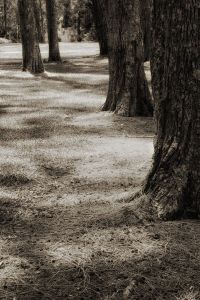
In the Grove of the Sentinals
But, all that while, I just knew that there was something else, something more than just the physical. And over time, I came to the knowledge that there is indeed more than the simply phsical universe (including we humans).
I’ve thought about it a lot over the years and I came to the conclusion not that many years ago, that I had simply been afraid to name or define that something more. It would have meant admitting to myself that something more really did exist.
That is to say, I was scared of taking the cataphatic approach – and I’d never even heard the word.
Well brothers and sisters, I saw the light. The truth was revealed to me. And what is that truth? Well, to put it simply, I wasn’t scared anymore. Not of names and forms, and not of what I couldn’t see.
Now I could take both the Catophatic and the Apothatic approach: that the something else I had actually always known just was, really is, and can have a name and form, or not. The divine is not an omniscient being or any kind of being at all; As I’m very fond of saying, the divine (or truth, God, Dharma) simply is. And it’s all there is.
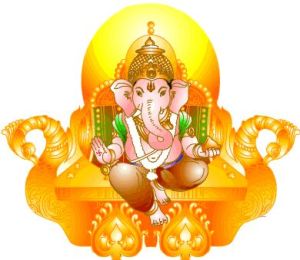
Some of you might know that I am really quite fond of the Indian deity, Ganesha . Do I believe that a man with the head of an elephant actually exists or ever existed?. Of course not. Do I actually think that he resides in the lovely painted icon that sits by my bed? Well, obviously not.
But do I believe that there is a spark or aspect or attribute in all life, in you and me, in nature, in (scary word time) creation, that we can tap into to help us overcome obstacles? Or that we can access when we begin new ventures of whatever kind, or when we need strength to face challenges? Yes, I do. Very definitely.
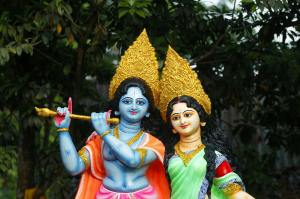
And do I believe in a blue boy called Krishna who lived in India 5000 years ago and spent his time playing in the fields with the village cows and his friends, entertaining them with his flute? Again, of course not. Does he live in the other beautiful icon by my bed? The answer is obvious: no.
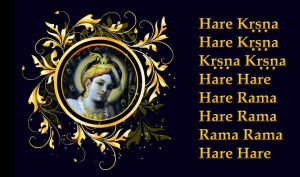
But do I chant the Hare Krishna mantra in an effort to come closer to the divine that is… well, that just is? Yes, again, very definitely.
Words. It’s all only words. Only words? Only??
In the beginning was the word, and the word was with God and the word was God. (from the opening of the Gospel of John)
Last night I had a dream. Of course there’s nothing unusual in that: I dream every night, every time I sleep (and sometimes when I’m supposed to be meditating as well). Actually I’m no different than probably every other living being in the Universe: I dream when I sleep.
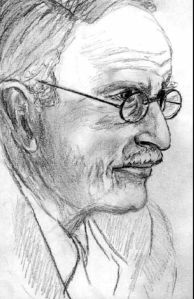
No. The particular dream isn’t my point here (though we’ll be discussing it soon enough). What makes it worth noting is the fact that last evening, before going to bed, I watched a documentary on Carl Jung and The Red Book.
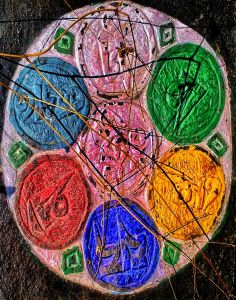
Jung compiled The Red Book at a time of personal crisis and distress. Using dream analysis, his own imagination, and intense self reflection, he used both paintings and text to express what he saw and understood from these practices. Hauntingly beautiful, other worldly pictures depicting dream images, archetypes, both personal and universal, helped him delve deeply into his unconscious mind and the collective unconscious.
I gave up trying to interpret dreams a long long time ago. Don’t ask me why: I probably couldn’t say. Most likely something to do with a kind of wariness about going too much into where the mind wants to take me, and my sense that the “dream” doesn’t stop when we wake up.
Still, watching this doco prompted a lot of discussion with my partner hermit, and a lot of thinking on my part. The mind is not our enemy, though sometimes I feel that it is. Well, it can be the enemy if we allow it, but equally we can allow the mind to be our friend. After all, what activity of any kind is possible in the world without mind?
So, with that in mind (get it? in mind?) I will share with you that above mentioned dream from last night.
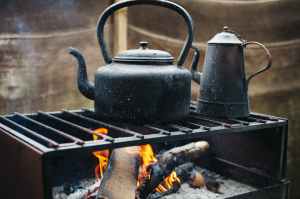
In the dream I was in a small kitchen, making tea. I’d put on a kettle to boil. A very large, heavy kettle, probably three or four times the size of a normal one. I was in the process of looking for a mug or cup, and just as I picked one up that I liked the look of, a crowd of five or six people came bustling noisily into this very crowded space.
‘I’ve just put the kettle on,’ I called loudly over the din. As it happened I’d filled the kettle almost to overflowing, much more than I needed for myself alone.
‘There’s plenty of boiling water to go round.’
Then I busied myself looking for something (a tea bag perhaps?), and when I finally turned back to the kettle to make my tea, I saw it was gone. I was very unhappy with this disappearance: After all, I was the one who had filled the kettle and put it on to boil. Then without a thought or a, what’s the expression? without a by your leave, it’s all gone, nothing left for me. Not only no more water, but nothing to boil more with.
I looked everywhere, even outside the kitchen. Outside was a camp ground and apartment complex, where I (and presumably all the other people) was staying.
Anyway, that’s it. All I remember at least. So, the meaning? Was I merely processing trivial facts and events from my day in this strange fashion? Or was I in touch with the deepest part of my psyche and with the collective unconscious? Possibly a bit of both.
It’s not a big job to make a guess about the meaning. I had a plentiful supply of water (or whatever), and without thought, put the needs of others before my own. But then, I actively resented what had been ‘taken from me’, even though I had freely given it in the first place.
So, the message I take from this dream? Just as I’ve been studying lately, the fruits of my actions are not my responsibility. I have no say over what, if anything, will happen as a result of actions I take. All I am responsible for is the taking of the action itself, the manner in which I undertake it, and the attitude with which I approach the actions I take. That’s it. That’s all I can do. The rest is up to the laws of the universe. Call it Karma, or Natural Law.
Another idea just occured to me: When I take action (like boiling the kettle) and then serve others, I am serving Self, all life, everyone and everything. And obviously that includes me. I’m not suggesting I should have made sure ahead of time that I’d ‘reserved’ enough water for myself, but at the same time …
I might keep this dream analysis thing as practice to practise occasionally, when the inclination or inspiration is there. No more blocking memories of dreams, no more stubborn refusal to reflect on dreams. After all, I spend a lot of time contemplating and reflecting on what I do in my waking life, how is it any different just because it happens while I’m asleep?
A few weeks ago I was wandering around in the CBD of Sydney, in Martin Place to be precise. It’s a popular square with loads of tourists, shoppers, coffee drinkers, and lunching folks.
It’s also a drawcard for both buskers and for street photographers. For me, it’s mainly a short cut from one street to anoher, though I must say, I’ve very often stopped to make a photo or two of the grand architecture, fountain, and the great light that seems to permeate the place.
Anyway, on this occasion as I walked about slowly, I heard a busker. Not a singer, more a spoken word poet type performer. I guess if I were to categorise him, I’d have to say he was a Rapper.
And to put it mildly, his poetry was a amazing; I had to stop and watch and listen for a while. I realised quickly that what he was doing was focusing on a particular passerby and would then make some (mostly humourous) ryhmes about that person. Things like:
Here comes a dude with groovy green shoes. Not having a pair like them is givin’ me the blues.
or:
Now I see a fella with a phone stuck on his ear. Come on buddy, why not let us all hear?
Now, I confess that these are my own made-up examples. I wish I’d noted some of the real ones, but I was too busy listening!
It’s easy to tell right away that I’m not what you would call a “natural rhymer”, if there is even such a thing.
But what turns this into a true synchronicity for me is that for a few years now I’ve had a recurring dream in which I’m simply walking along making up superb rhymes as I go. It’s one of those dreams you’re never sure are ‘real’ or simply a dream.
In any case, when I saw and heard this guy that day, it got me remembering the dream and how I’d often thought I would really love to actually be able to do that exact same thing.
Not about people though. I used to photograph people in the street; all kinds of people. I still consider photography among the most important of my contemplative and creative practices, just these days I don’t photograph people.
So, in a round about way, I’ve made a little “poem” that refers to what I do photograph, inspired by this encounter as well as particular photo I came across just yesterday but made months ago now.
Please enjoy
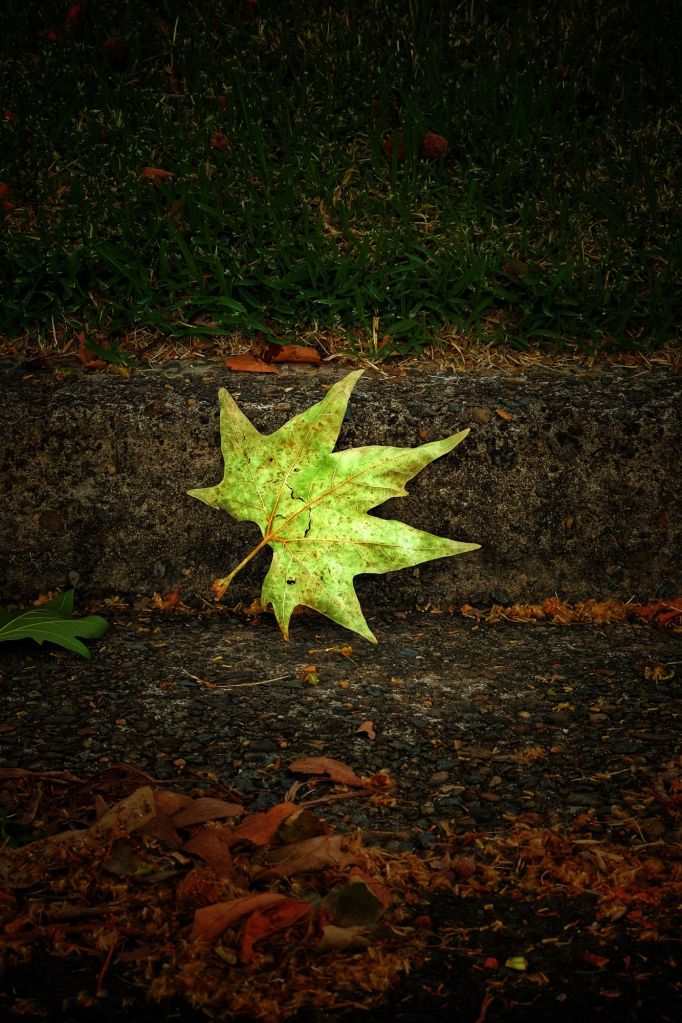
Strollin’ down the street I lift my camera to my eye, no longer interested in the people walking by. Nowadays I tend to notice their many and varied traces left behind, or perhaps (and even better) a golden leaf in the gutter I might find.
Thank you for reading this small attempt. Now here’s the photo I mentioned that inspired this attempt at a kind of spontaneous rhyme.
Remain in your cell, and your cell will teach you everything
This piece of advice from one of the early Christian desert hermits to a follower has been going round in my head for ages. And I mean a couple of years at least. I’d read it in several books at the time, and I’ve seen it in a few since.
Of course, most of the writers of those books interpreted this advice at face value, literally advising the student, hermit, monk, or other contemplative person to stay in their physical cell (hut, cave monastery cell, suburban bedroom, wherever is their permanent dwelling) and listen, meditate, study, and contemplate. The advice is, stay in that space in silence and seclusion. Quite possibly forever.
‘But it could be the cell of your Self,’ my partner hermit said to me one time. And yes, I thought, that’s exactly right. I liked the symbolism. The actual literal, physical space and its geographical location isn’t necessarily the important factor. What’s important is that you, the real you is actually fully present wherever you are, right here, right now.
Think about what it really means to be present – to be here now: It means that you can say, ‘This is the only space and the only moment that exists. Right here and right now.’
Living life is an ever-flowing movement or process, and at the same time (excuse the unintended pun) is always occuring in the present. And in that ongoing moment you – your Self -is always there.
Of course along for the ride is your little s self with its ego, chattering and never quiet mind reminding you of the distractions, stresses, anxieties, worries about things to do or not do, memories of the past, and fears for the future. It goes on and on.
But, still, that space within where you can meditate, pray, contemplate quietly, that’s your Self, your ‘cell’.
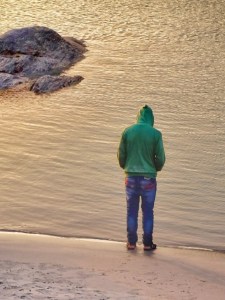
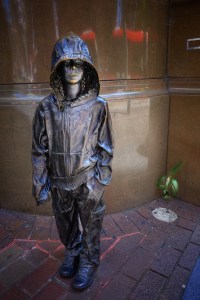
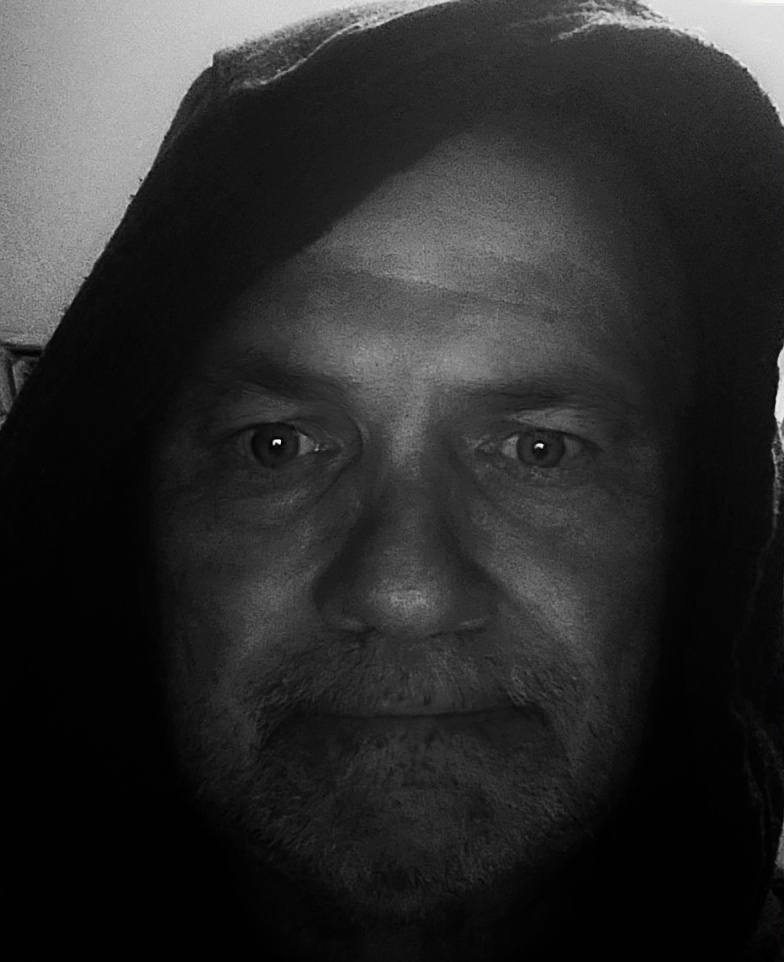
I’ve always liked and worn hoodies. I guess a lot of people do. For some it’s about fashion; others wear them for warmth in cold weather or to keep the sun off when it’s hot; some people even use them to hide.
Then there are others such as nuns, monks, priests and others too, for whom a hood is a part of the robe they wear as a member of their particular group.
In those cases, a hood is called a cowl and most often it’s a largish loose hood sewn onto the robe or habit. Just like a regular hoodie.
I read somewhere (I forget where) that some groups nickname these cowls ‘cells’. In other words, the wearer carries their cell with them wherever they go.
Of course they don’t always actually wear the hood on their heads, but whenever they wish or need to retreat to their cells, all they have to do is simply pull their hood up and over their head and all of a sudden they are in their own private and solitary world; they are in their cell.
As I said earlier, I like the symbolism. But more than that: I find wearing a hood on my head or simply in standby mode, comforting.
I’m not overly good with crowds, or in close proximity to other people on a bus or train or whatever. I like knowing that just by pulling my hood on, I’m able to create my own space apart from my surroundings. In that space I can feel safe and kind of apart.
Even at home I wear a hood when I’m meditating or praying. It’s just one more opportunity to retreat into my cell, into Self
Yesterday I came across a couple of stories – true ones – that I wrote years ago. They are what we might loosely call ‘travellers’ tales. I thought it might be nice to share them here. So here’s the first one. Enjoy
Not the Manu temple I write about, but another one close by
I’d walked up to Old Manali, and I’d kept walking through the town. Then higher still, past the temple to Manu, and the scattering of traditional houses and small fields clustered around the temple.
Three near-naked and stoned saddhus invited me into their cave – more a kind of overhanging rock shelf poking out from the foundations of the temple itself.
Naturally I declined. Politely. I wasn’t, never had been, and never shall be a stoner. Besides, here I was deep in the Himalayas walking through ancient villages and past temples to ancient gods. Seems to me that that’s enough to bring on a high all its own and like no other.
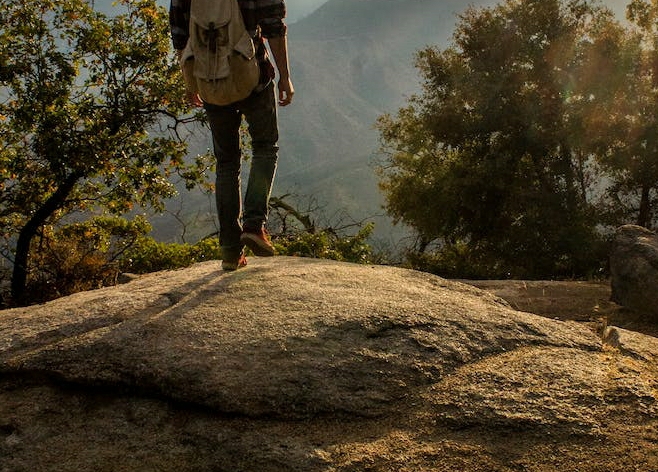
Then, a little higher up the trail. I rounded a corner to be greeted by a kind of open forest glade; a grassed and flowered field protected by a semi circle of forest sentinels, their crowns maybe thirty metres above my head.
And there, in the middle of this magic field, a large flat rocky area, like a series of ‘shelves’ layered one on the other. This maybe twenty square metre tiered platform was probably the remnants of an ancient hill (or mountain?) that got in the way of a more recent but clearly relentless glacier.
Whatever the history, here was an arena with views no theatre or movie could ever hope to reproduce. This natural amphitheatre faced several layers of peaks across the valley. But, before those peaks, and directly in front of me, just down the slope, stood the temple, then more trees, reaching down into the valley. Here the river flowed, surrounded by farmers’ fields and the brown dots of houses.
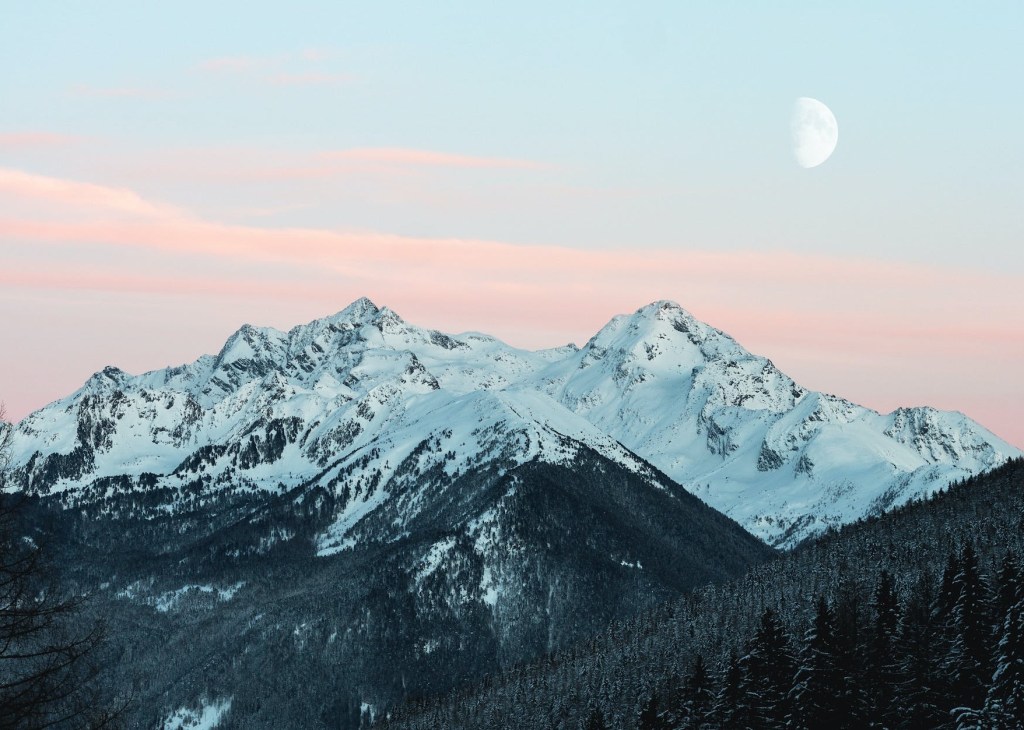
Then the forests begin again, thick at the bottom in the valley, but becoming more scattered on the higher ground. Then those many layers of higher and higher hills, mountains really, rolling off into the distance to, where on the horizon and behind it all, a row of the really high peaks covered in their permanent snows.
‘This is a special place, a sacred place,’ I heard myself sigh out loud. Sitting cross-legged now, I let my eyes wander over the scene taking in the blue sky, the white peaks, the multiple greens of the forests, the sliver ribbon of the river, and the rest.
At such times and in such places, one’s eyes tend to close of their own accord. And so it was for me then and there. I let myself drift. Thoughts came and went, to be replaced by more thoughts that came and went.
Then, my eyes opened. Again of their own accord. After a few seconds of that cliched ‘where am I?’ feeling one has when startled out of one state and into another, I made out the figure of a person standing facing me a few metres from where I sat.
‘I’m sorry,’ I heard her voice call to me. ‘You just looked so peaceful sitting there meditating, I just had to stop and watch you.’
She told me she’s been watching me for about fifteen minutes, which gave me a start: It’d felt l Ike I’d only just sat down and closed my eyes.
‘They say the light of the world is held about twelve kilometres up this trail. That means it’s the centre of the world.’
I had to stand to try to take in a revelation of this magnitude.
‘And apparently,’ she went on, ‘they’re going to move it soon and nobody knows where.’
Was she an angel? Was I dreaming? They, whoever they were, are about to shift the centre of the world? Even in India one doesn’t hear this kind of news everyday. Actually, I doubt you’d ever hear it on any day.
Then she was gone, headed up the trail. I didn’t follow. I remember thinking: twelve kilometres was too far for me especially as I already had a long walk downhill to my hotel back down in the new town.
Yes, mundane, practical musings, a typical response to news of such a wild and far-out nature. So, not exactly in shock, yet not quite myself, I turned back. Down. Through the village, past the temple with three crashed out saddhus out front, back into the town.
There are cafes there. They sell Chai there. I needed one.
Actually, given the momentous news I was going to have to digest, I might even have a couple extras.
This is a true story; it actually happened more or less the way it’s described here.
Of course, there is no ‘light of the world’ stored in some secret spot, somewhere on Earth.
Well, I suppose if there is a light of the world, then it’s likely to be the world itself, I mean Earth, all the beings who live on this planet. Life itself I guess you could say. Life is light; Life is love.






 Notes from the Hermit's Cave