Remember that old Bee Gees‘ song Words? It’s about one person offering all they have to another. Well, the one doing the offering must have been a writer because, while the song’s a love story, it’s words that are the big thing on offer here:
It’s only words, and words are all I have To take your heart away
Well, as this is a blog, words are the way it hopes to reach your heart. Actually, the posts also include photos and sometimes other art, but the main vehicle used here is words.
So, with that in mind I have a couple of words to offer you today. Well, one word and its opposite. Have a look at this sentence from Thomas Merton:
If Irish monks affirmed his Celtic spirit in their mastery of cataphatic contemplation of the wonders of divinity in nature, Buddhist monks evoked his Zen mind and drew him into the apophatic path of formless ’emptiness’…
As sentences go (though this is obviously only part of a sentence) this has to rank pretty close to the top for length and denseness.
Kataphatic. What a word! Of course I had to look it up; I’d never heard the word before (this post is a rewrite from notes written a while ago that I never got around to posting.), and even though the sentence seems to suggest the meaning, I was still curious.
Looking at Wikipedia – where they spell it with a ‘C’ like Merton, as well as with a ‘K’- I learned that cataphatic is an adjective that describes an approach to theology that uses ‘positive terminology to describe or refer to the divine (God, Truth, Dharma, Spirit. You know what I mean: the divine).
Apophatic, as you probably figured out already, is when one uses ‘negative terminology to indicate what it is believed the divine is not’. A process of negation or we could say you get to what the divine is by a process of elimination.
Pretty simple concept really, but with a couple of big words to label it, and a lot of words to define it. No, don’t worry, I won’t bore you with the meaning and origin of the words and all the rest. Mainly because I don’t know and I’m not especially interested anyway in all that technical stuff.
I simply resonated with the word, and the concept. Cataphatic made me think of Dick Van Dyke and Julie Andrews singing Supercalifragilisticexpialidocious in Mary Poppins. But let’s not go there: this is a serious blog after all. Except to say there’s more to that word than you might imagine.
Putting aside the aesthetic appeal of the word for a minute, let’s contemplate a while on cataphatic, and it’s opposite, apothatic.
To begin thinking about these two words, it’s necessary to acknowledge the existence of the divine. We can call it God, if we like. Or Dharma, Truth, Spirit, Love, Beauty.
As the quote suggests, a cataphatic approach, ideology, theology, or whatever we call it, ascribes names and forms to the divine, as well as describing where and in what the divine may reside.
Whereas apothatic, again as the quote suggests, does not ascribe names and forms to the divine. Instead it seeks to discover what or who god is or isn’t by a process of negation as described already.
For a long time I labelled myself as a Humanist. I had decided that this physical body is all there is; the physical or material universe is all there is, and that there is no ‘god’ separate from us or who has special powers to affect our lives. No God at all in fact.
In the Grove of the Sentinals
But, all that while, I just knew that there was something else, something more than just the physical. And over time, I came to the knowledge that there is indeed more than the simply phsical universe (including we humans).
I’ve thought about it a lot over the years and I came to the conclusion not that many years ago, that I had simply been afraid to name or define that something more. It would have meant admitting to myself that something more really did exist.
That is to say, I was scared of taking the cataphatic approach – and I’d never even heard the word.
Well brothers and sisters, I saw the light. The truth was revealed to me. And what is that truth? Well, to put it simply, I wasn’t scared anymore. Not of names and forms, and not of what I couldn’t see.
Now I could take both the Catophatic and the Apothatic approach: that the something else I had actually always known just was, really is, and can have a name and form, or not. The divine is not an omniscient being or any kind of being at all; As I’m very fond of saying, the divine (or truth, God, Dharma) simply is. And it’s all there is.
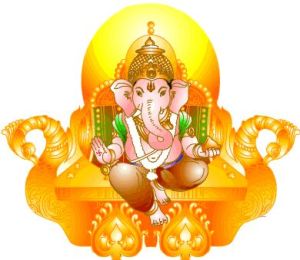
Some of you might know that I am really quite fond of the Indian deity, Ganesha . Do I believe that a man with the head of an elephant actually exists or ever existed?. Of course not. Do I actually think that he resides in the lovely painted icon that sits by my bed? Well, obviously not.
But do I believe that there is a spark or aspect or attribute in all life, in you and me, in nature, in (scary word time) creation, that we can tap into to help us overcome obstacles? Or that we can access when we begin new ventures of whatever kind, or when we need strength to face challenges? Yes, I do. Very definitely.
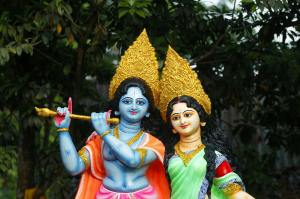
And do I believe in a blue boy called Krishna who lived in India 5000 years ago and spent his time playing in the fields with the village cows and his friends, entertaining them with his flute? Again, of course not. Does he live in the other beautiful icon by my bed? The answer is obvious: no.
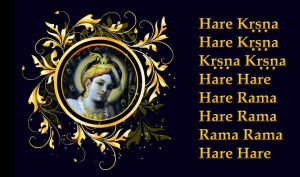
But do I chant the Hare Krishna mantra in an effort to come closer to the divine that is… well, that just is? Yes, again, very definitely.
Words. It’s all only words. Only words? Only??
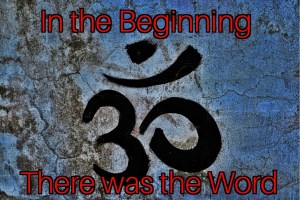
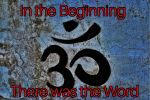
In the beginning was the word, and the word was with God and the word was God. (from the opening of the Gospel of John)
Not too long ago, I completed what I’m now calling my first formal (structured) study of the entire Bhagavad Gita. Of course this wasn’t my first exposure to that text: I’d been reading it on my own for a few years before I came upon a teacher to act as guide.
Anyway, since that bitter-sweet day of completion, I’ve been looking at ‘random’ verses on a more or less daily basis as a way to keep in touch and to act as a reminder of what I’ve learned.
Just opening my Bhagavad Gita at random, just to see what the universe wants me to think about.
Today, I happened to open it up at what are a series of my favourite verses. (I know I’ve got a lot of favourites; it’s that kind of book). In these particular verses, Krishna describes the meaning and significance of the mantras Om Tat Sat.
In a nutshell, these three syllables, these mantras, are a way of describing the Absolute Reality of the Universe, or God, Consciousness, the Truth, the laws of nature and the universe. Whatever names we might use to encompass all existence.
Krishna details when and why to use the mantras (it’s one mantra made of three, for the technically minded). Again in a nutshell, it’s a mantra to use whenever we perform our duties, basically any actions, with a devotional mood.
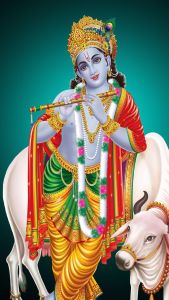
By the way, that, and the inclusion of my favourite image of Krishna, doesn’t necessarily imply that our actions have to have a ‘religious’ intent or flavour: Any action we undertake, for whatever purpose as long as it is motivated by Truth, Love and right thinking, qualifies as being devotional.
While you can see the actual verses yourself via the Om Tat Sat link above, I would like to share with you my very liberal paraphrasing of Krishna’s teaching on the mantra. Also, I am adding a few observations of my own that I hope serve to clarify this great teaching. Oh, please forgive any repetitions, if they occur.
The syllables Om Tat Sat are the symbolic representation of the Supreme Absolute Truth; what I choose to describe simply as all that is. It is called by any number of names or none. It’s existence itself.
It’s an ancient practice, this chanting of these three syllables as a mantra. It is recited when one is engaged in any action in a mood of devotional service. Meaning any act that is imbued with a prayerful attitude and feeling, and with a mood or attitude of devotion to and recognition of, Truth in all things.
And it includes any and every action we undertake, from washing the dishes, to sitting in meditation or silent contemplation. And everything in between.
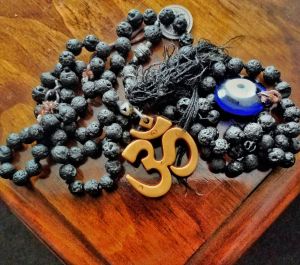
Om
Om is sometimes called the primordial sound, the creative principle, the word from which all creation sprung. I’ve also heard it defined as being the Big Bang, from which the universe emerged.
Om is considered the sacred sound and word by many cultures around our world. Consider the opening of John’s Gospel in the Christian New Testament :
Om is to be chanted when beginning and performing any and all actions motivated and driven by Truth. Chanting Om assists us to actually realise or understand with our heart and not just our mind, the presence of the divine or the universal consciousness in all that we do.
Tat
Tat is chanted by those wishing to be freed from attachment to material things, which includes the desire or compulsion to enjoy the fruits or rewards of our actions.
In the beginning was the word, and the word was with God, and the word was God
John 1:1 New Testament
Attachment is when we depend for our well-being or happiness (physical, mental, or spiritual) upon another thing (money, job, status, etc), person, or desired outcome. Attachment (and clinging, extreme longing, compulsivity), Buddha told us, is the cause of suffering: when things are going well with the things or people we are attached to we are elated; when things aren’t going so well, we are miserable and we suffer.
Sat
The syllable Sat indicates both reality and goodness. In other words, Sat is used to represent that Absolute Truth or Universal Consciousness that we’ve been discussing.
Sat follows very nicely on from Tat as it helps to strengthen our Dharmic (motivated by what’s right and true) actions, so that they actually become Sat – Truth.
So, chanting Om Tat Sat when performing any or all our activities in the world (as well as within) will help us to come to realise or understand that there is only the one Absolute Reality, the one consciousness that is not only universal in nature, but is actually the universe itself.
Oh one more quick note: Often you hear the chant with an extra word up front: Hari Om Tat Sat. Hari is a way to address that which removes darkness, that aids in the shining of the light of knowledge.
It’s a word that represents that Absolute Reality that we’ve talked about here. It can also refer to King or Lord, or otherwise influential entity. I find it rounds out the chant, and I like it!
Please feel free to explore Om Tat Sat for yourself. You will find a lot of great recordings of the chant on YouTube, and the wikipedia link at the beginning of this post is very Illuminating as well.
It’s a funny thing, but as soon as I start thinking about resharing older (let’s call them prior posts instead) all sorts of posts come up begging to be the next in line to be shared again.
Anyway, I’d sat down to write something on a quote I really like:
Forget all that and hit the road into exile.
FROM A LONG LOST DEEPLY BURIED NOTE-TAKING APP ON MY TABLET
But nothing was coming. Then suddenly I remembered: I’d already written (sort of, kind of, in a manner of speaking) about this topic, if not this particular quote.
Looking up the post, well it did its thing and said very clearly and in no uncertain terms, Post me!
So, here it is dear friends. I will let it speak for itself
Today I’d like to share a poem with you. I wrote it exactly a year ago, but it’s about a day many many years ago. At other places on this site I’ve mentioned that cliched but for me ever so real question: Am I running away from something or am I running towards something?
In one of those other places I joke about my answer: ‘Neither. I’m just a journey person’. Well, this poem began life as a story of the day I first met Jesus freaks as I hitchhiked on just one more random excursion.
Then it becomes at the same time a piece about running, or journeying towards. And, there’s more: it then speaks about the journey as the point of the journey; the movement is the thing
But the thing morphed into a rap about journey beginnings, or at least in the sense of my ongoing attempted, and until a lot of years later, futile escapes from the madness of family and circumstance. That’s the running away bit.
You see, there was something holy felt then, as now, about those seemingly random hitching trips (not that I would dream of hitching in these times). Somehow I knew the Road was the escape route from the growing madness and horror.
Of course I was only able to partially articulate this at that time, but I remember even at 17 (no, it was a year earlier when I’d made my first attempt. I’d forgotten about that) feeling a sort of specialness about the covering of new (for me) ground, the movement, then the arrival at new (for me) places, new towns and cities.
Much of this pilgrimming (for that is what it was) was done in solitude – except for interactions with drivers of course (one of whom was on the day in question one of the said Jesus Freaks) and other necessary people along the way.
I felt a sense of belonging when on the Road; a kind of being in place and in sync. A sense of belonging that I kept fucking up as I let the trickster ego with its taunting messages of fear, loneliness, greed for things and status, and the rest, take control of me and lead me on twisting and tricky roads back to madness.
And now, these 50 years later, I survey the damage done, the cost to self and others. Especially others. No use of course, to look back with wishful thoughts of what if things had been done differently, what if other choices had been made. Such is not truth, not real. Well, none of it’s real anyway is it? Samsara is all it is – it’s all a sea of madness and illusion isn’t it?
Anyway, here is the poem. May it speak to you. Peace
The Road Rises Up
I woke up that morning marooned in Albion in a village of warriors, on a street, in a house, going mad in a nest of madness on an island of madness, in a sea of madness. Escape, refuge, safety – waking thoughts. Waking dreams. Looking for a way out.
The Road. The Road rose up in my mind. The Road will save me. Not the shrink the patriarch screamed I needed to see. The Road was waiting; I found it waiting for me. And my thumb in silent salutation and prayer held aloft in supplication as I trudged on that seemingly straight but trickster road.
Welcome to the pilgrims’ way, the Road greeted me as I trod ever more lightly and Babylon’s chariots hurtled past me bound for far nowheres. Or maybe somewheres. All in the fast lanes and howling deceptively of invitations and rejections, attractions and aversions. Then – in time – an invitation proffered and accepted. This pilgrim was on his way.
Let me begin this post by asking you a question. No. I’ll start again: I’m going to begin this post by asking me a question. It’s a question prompted by prayers I recite every day, not only during my morning practice, but at random times during the day. Here goes with the question:
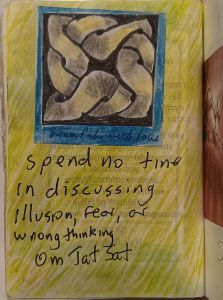
How much time do I spend discussing illusion, fear, and wrong thinking?
Well the short answer is, a lot! Despite all my efforts, prayers, meditation, discipline, and the rest, I spend way too much time pondering all kinds of illusions, indulging in an ever revolving range of fears, and thinking about all sorts of ridiculous, irrelevant, and unwanted stuff.
Oh, before I go on, I should mention that there are actually two prayers I’m referring to:
This prayer, which you might call an affirmation comes, I think, from the teachings of the ancient Indian Rishi Adi Shankara. I’ve not been able to track down the exact source. Getting a little ahead of ourselves here, but a perfect example of wrong thinking would be to berate myself for not being more careful with sources.
So, what does it mean to spend time discussing illusion, fear, and wrong thinking? Well, I know I said I was asking myself this question, but I think it would not be out of order to say that we are all prone to spending time on these things.
Discussing is obvious: talking about, thinking about, angsting over, worrying over. Illusion? Anything that isn’t real, stuff that’s ‘make believe’ as the expression goes. Anything that we are imagining for good or bad.
Our illusions are often about worst-case scenarios, or at the other end of the spectrum, they can be about some fantasy, an idealized perfect outcome to a situation. There is a lot written about how we are so very much trapped in illusion; it’s not the place here for that discussion.
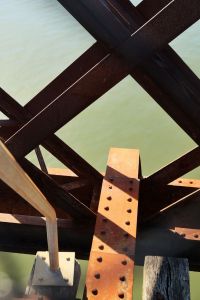
Fears: pretty obvious what fears are. I don’t know about you, but I can get to thinking of stuff to be fearful of anytime, anywhere, even things I know I can face without fear. Like a couple of days ago I was walking across a rail and walking bridge near our current hermitage. A long time ago I had huge paralysing fears of high bridges, especially over water as this one is.
But for a long time now I’ve felt I have mastered this fear and then suddenly on this occasion I looked down to the river below and shocked myself with ‘What am I doing?’ type thinking and fear returned. Mind you, it passed quite quickly as I reminded myself I’d walked over this bridge (and many others) a lot of times without a second thought.
And then there are fears about the future, fears of consequences of past actions, fears of not making the right choices now, fears for health, loved ones, the world. Anything goes when it comes to fear doesn’t it?
Ah, now we get to the biggie: wrong thinking. Again I think it’s safe to say that we all spend far too much time in the company of wrong thoughts. And again, they can be about anything, and can pop up to take over our mind without warning.
Consider how often we think about things that are either none of our business, or they are things we can’t do anything about. We obsess over what we see on the news, or what celeb is doing what and with whom. Think about how interested we often are in what other people are doing, thinking, saying.
Then there’s blindly following fashion, thinking so much about things we don’t have (and how everyone except us has those things already) that we give into advertising, and end up buying lots of stuff we don’t need, maybe can’t afford, and might not ever use. And don’t forget about the one we all fall for: gossiping about others whether they are famous, our family or friends, or simply our neighbours.
A huge case of wrong thinking are the harsh judgements we make on ourselves; and the amount of time we spend thinking about our faults and failings. And don’t forget the other end of the ego spectrum: it’s also wrong thinking to be constantly telling ourselves how great we are.
There are endless examples of wrong thinking. We need to bear in mind Buddha’s central teachings: there is a middle path that can be taken in all things. Well, this maxim applies to thinking as well. Remember that our mind can be our enemy or our friend.
Even enlightened ones such as sages, rishis, saints and the like, fall victim to illusion, fears, and wrong thinking. Of course as they are enlightened, they perhaps are less affected, less inclined to fall to the depths, as the rest of us might.
Of course, there are ways we can put ourselves on the path to that enlightenment. But in truth, it is a subject that is dealt with very adequately by all great scriptures of the world, not to mention the visionaries who have delved deeply into psychology, philosophy, and the human condition.
And this leads me to the second prayer:
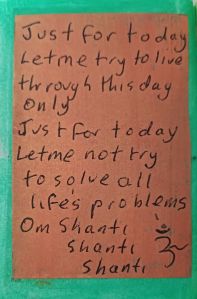
This one comes from a song by George Harrison, titled Just for Today. I actually did a post on this song a couple of years ago that you can find here. As well, if you do check out the lyrics of this masterpiece, you will see that my prayer is a rather generous paraphrase. I don’t think George would mind; I hope you don’t either.
Just for Today (the song and, a little less articulately, this, my paraphrased prayer) is a prayer for presence, a plea to be in this place, and in this time. In other words, an affirmation that I (or you) may remember that there is only here, and only now.
But, and it’s a big big but, we need to make of our entire lives a prayer.
Of course that means using the words, but it also requires a whole lot more. Discipline, self-control, deliberate actions (saying prayers is obviously also an action), meditation, silence, contemplation, and to put it simply: good behaviour in all that we do and think.
Now, this prayer inspired by George is a good place to finish. Or rather, it’s a good place to remind ourselves we can’t solve all life’s problems at once.
Being present, being here and now, really says we have no other choice but to live through this day only. Or perhaps we can paraphrase once more and say we have to actually realise what is already true: we can only live through this one, ever-evolving and moving moment.
So, how do we get to that point of spending less time discussing illusion, fears, and wrong thinking? By coming to realise that being in this moment, and in this place, we are already perfectly fine. All we can and need to do is remember that one simple fact. But don’t worry, all you need to do is remember it just for today.
This morning I completed the penultimate lesson in a course of classes on the Bhagavad Gita. The classes were held once a week for I think 3 or 4 years and finished a few months ago. As it happens the entire course was recorded giving me and so many others the opportunity to study it online.
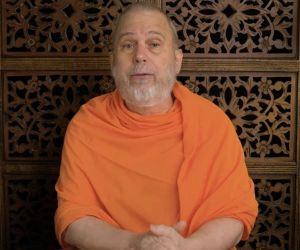
Anyway, at the start of the lesson today Swamiji ( Swami Tadatmananda, resident teacher at the Arsha Bodha Centre) reminded us that the course will soon be over. I thought (and it was by no means the first time I’ve had this thought): what an achievement; finishing this long and complicated course; fancy me sticking with it till the end.
Second thought, following a nano-second behind: What an odd idea, to think how great I am simply for finishing my study. Especially when it is not in the slightest way true. I’ll be studying the Bhagavad Gita (and I hope many other teachings) for the rest of my life. This period of study has been simply an introduction, a foretaste of what is to come.
Swami Tadatmananda
Having said all that, I have to say that this time of digging deep into the Gita has been a terrific ride. I’d been studying it by myself for a few years, but that’s nothing compared to having a qualified teacher guide me through such an in depth study and contemplation of this great teaching.
While I do know a few of the 800 verses by heart, I understand that this is not ‘ordinary’ knowledge. As the disclaimer goes: it is very much a pointer to the knowledge; the key is to not to confuse the pointer with the very much transcendental knowledge that is to be gained from what the pointer points to.
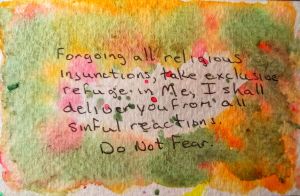
Probably my favourite verse written on a little card that I treasure
My partner hermit has been responding to some of my photos when I post them with little Haiku-like writings. Yesterday (or was it the day before?) I said to her:
‘You’ve done 71 so far.’ I was thinking to praise the achievement.
She replied (with much wisdom as always):
‘I don’t count them. One or seventy one, it’s all the same.’ I’m paraphrasing here.
Looks as if I might be only just at the beginning of my lessons.
A few weeks ago I was wandering around in the CBD of Sydney, in Martin Place to be precise. It’s a popular square with loads of tourists, shoppers, coffee drinkers, and lunching folks.
It’s also a drawcard for both buskers and for street photographers. For me, it’s mainly a short cut from one street to anoher, though I must say, I’ve very often stopped to make a photo or two of the grand architecture, fountain, and the great light that seems to permeate the place.
Anyway, on this occasion as I walked about slowly, I heard a busker. Not a singer, more a spoken word poet type performer. I guess if I were to categorise him, I’d have to say he was a Rapper.
And to put it mildly, his poetry was a amazing; I had to stop and watch and listen for a while. I realised quickly that what he was doing was focusing on a particular passerby and would then make some (mostly humourous) ryhmes about that person. Things like:
Here comes a dude with groovy green shoes. Not having a pair like them is givin’ me the blues.
or:
Now I see a fella with a phone stuck on his ear. Come on buddy, why not let us all hear?
Now, I confess that these are my own made-up examples. I wish I’d noted some of the real ones, but I was too busy listening!
It’s easy to tell right away that I’m not what you would call a “natural rhymer”, if there is even such a thing.
But what turns this into a true synchronicity for me is that for a few years now I’ve had a recurring dream in which I’m simply walking along making up superb rhymes as I go. It’s one of those dreams you’re never sure are ‘real’ or simply a dream.
In any case, when I saw and heard this guy that day, it got me remembering the dream and how I’d often thought I would really love to actually be able to do that exact same thing.
Not about people though. I used to photograph people in the street; all kinds of people. I still consider photography among the most important of my contemplative and creative practices, just these days I don’t photograph people.
So, in a round about way, I’ve made a little “poem” that refers to what I do photograph, inspired by this encounter as well as particular photo I came across just yesterday but made months ago now.
Please enjoy
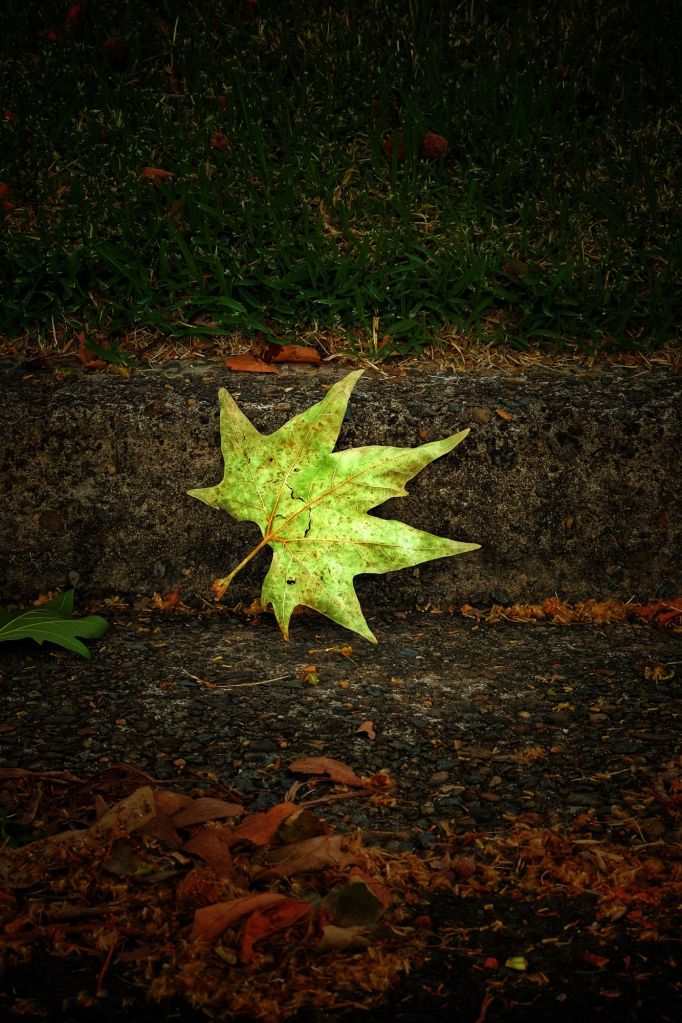
Strollin’ down the street I lift my camera to my eye, no longer interested in the people walking by. Nowadays I tend to notice their many and varied traces left behind, or perhaps (and even better) a golden leaf in the gutter I might find.
Thank you for reading this small attempt. Now here’s the photo I mentioned that inspired this attempt at a kind of spontaneous rhyme.
The poem I want to share with you today has, I think, been shared on this blog before. I haven’t checked because I didn’t want to be tempted to censor myself and not post it again if it has been posted.
The poem, titled simply Peace Prayer, has a repeating refrain in each verse:
Our Lady Queen of Peace Pray for us.
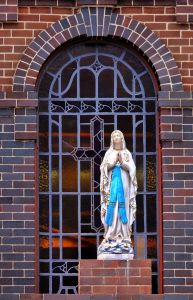
A couple of days ago I came across a church dedicated to this particular manifestation of the Divine Feminine. I know it doesn’t seem to be such a far-out coincidence, but up till then, I had never encountered a church with this name.
So, obviously, it reminded me of my poem, written a couple of years ago now. As well as the story that prompted its writing:
When I was 12 my father went to war. As a professional soldier, he went as a part of this country’s commitment to its American allies in its war against Vietnam.
Our family was, at least nominally, Christian at that time, and anyway, desperate times do indeed call for desperate measures.
Which means we, my mother, my sisters, and I, formed a tiny prayer circle every night for over a year to pray for my father and for peace.
These days I no longer label my beliefs, not if I can help it anyway. What I seek now is the Divine wherever it is to be found. Which is everywhere of course!
In any case, here is my poem. It’s always the right time to pray for peace, though we should always remember our prayers are really directed at ourselves. It’s up to us to answer the prayer as we are able and see fit.
Peace and love to you all.
Peace Prayer
The father, the husband, the man of the house He’s away. At the war. Our Lady Queen of Peace pray for us.
Away at the war, yes, In a far off land. Not his own. Our Lady Queen of Peace pray for us.
Away at the war. “Incountry”. that’s what they call it. Our Lady Queen of Peace pray for us.
At home the children, the wife and mother wait. Wait and pray. Our Lady Queen of Peace pray for us.
At home they wait yes. Each night on their knees, in a circle. Prayer circle.
Away at the war, he is fighting. For what? At home, they are praying. For what? Our Lady Queen of Peace pray for us.
Indeed, it is clear to all who dwell there that through them the world is kept in being
I jotted down this note I forget how long ago. Over the last few years I’ve read a lot about the early Christian hermits who lived in the deserts of Egypt, Syria, and other areas of that area we label the Middle East.
While I think it was one of these early hermits who uttered these words, it may instead have been a monk or hermit from the 9th or 10th Century, living in the forests of Russia or Eastern Europe. (I wish was a lot less careless with sources for things I note down).
In any case, it was spoken by a hermit or monk who, along with perhaps thousands of other men and women, fled the strict dogmatism of both government and religious institutions , as well as the corruption, materialism, noise, and all the other distractions of the cities and towns.They went to the deserts, the forests, and other remote places, in search of solitude, silence, and peace.
They longed to commune with the divine. They chose to bypass the mire of worldliness, and hoped to find a better way to serve the divine and the world. The writer or speaker of our quote is pointing our attention to all those who went to the deserts, the forests, and other sanctuaries, who in her or his words, believe they are actually keeping the world going, and its people too.
These nuns, monks, priests and hermits, knew that by communing with the divine without distractions, and living a simple life completely and absolutely centred on the divine, was the way to save the world.
‘So’, you might be saying with a slightly cynical tone in your voice: ‘These are people who have ‘escaped’ from the world and are ignoring governments and the law, rejecting social status of any kind, not associating with other people like other good citizens. They’ve gone to sit in a hut or cave or whatever and are doing nothing productive at all. They’re not buying stuff so they aren’t contributing the the economy. And you say they are the ones keeping the world spinning round? Hardly.’
There are hermits everywhere.
Yes, I think they are. Keeping the world spinning I mean. Just as mystics from all the world’s religious traditions, these women and men of the deserts – and the forests too – knew that the world they’d left behind wasn’t real. Well, yes, it’s real enough of course: I mean we only have to look around us, and feel the workings of our bodies. It’s real alright.
But, realer (I know, it’s not a real word) than this physical world we are in and are an integral part of, is what lies within us as well as everything else in the Universe:
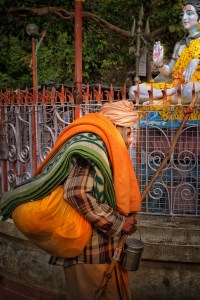
Holy Wanderer Detached from all Worldly Entanglements
The divine, God, the life force, Consciousness. So many names for the same thing. Many of us sense that at the core of ourselves there is ‘something else’; that there is some kind of intelligence for wont of a better word. This intelligence is what illumines life, as in life, the universe, and everything.
But, we don’t see this, or not so often anyway. The mire of worldliness (a phrase I mentioned earlier and which I like very much) seems to be specifically designed to keep us in the dark so to speak, about our true nature.
Think about the seemingly endless focus on materialism with its temptations and promises to make us happy; the conflict and competition among individuals and nations to acquire more power, possessions, land and anything else that ‘they’ve got and that we want’.
Mire is a good word: We’re trapped and sinking fast in a kind of quicksand.
And this mire keeps us from becoming aware, from realizing, that we are the Consciousness (the word I prefer but, as I said, names are just names) mentioned above. It keeps us ignorant of our true nature, and we go on and on struggling to keep afloat in the world.
The hermits of the past and the present, the nuns, monks and other contemplative people of all kinds, and, in many and various places, are all engaged in a quest to know – and yes, to realise – that they and everything else in the material and non-material universe is Consciousness.
I believe that, far from being unproductive, from ‘doing nothing’, It is the engagement by such people everywhere with this quest that does indeed keep the world in being.
Courtesy Wikimedia Commons Thank you
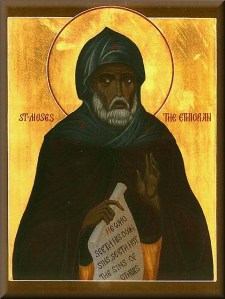
I would like to leave you with a couple of quotes if I may. The first is from Abba Moses, one of the greatest of the early desert fathers who was born in Ethiopia and lived in Egypt in the 4th Century:
‘Our objective is puritas cordis,’ Abba Moses told Cassian and Germanus [fellow monks]. ‘A heart kept free of all disturbance. The more we cultivate such inner stability, the more we can offer our lives in service to the world.’
Courtesy Wikimedia Commons Thank you
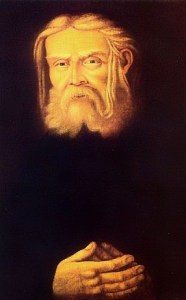
The second quote I would like to share is from Saint Seraphim of Sarov, a 19th Century Russian monk who lived as a hermit deep in the woods:
‘Acquire a peaceful spirit, and thousands around you will be saved.’
Remain in your cell, and your cell will teach you everything
This piece of advice from one of the early Christian desert hermits to a follower has been going round in my head for ages. And I mean a couple of years at least. I’d read it in several books at the time, and I’ve seen it in a few since.
Of course, most of the writers of those books interpreted this advice at face value, literally advising the student, hermit, monk, or other contemplative person to stay in their physical cell (hut, cave monastery cell, suburban bedroom, wherever is their permanent dwelling) and listen, meditate, study, and contemplate. The advice is, stay in that space in silence and seclusion. Quite possibly forever.
‘But it could be the cell of your Self,’ my partner hermit said to me one time. And yes, I thought, that’s exactly right. I liked the symbolism. The actual literal, physical space and its geographical location isn’t necessarily the important factor. What’s important is that you, the real you is actually fully present wherever you are, right here, right now.
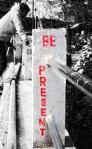
Think about what it really means to be present – to be here now: It means that you can say, ‘This is the only space and the only moment that exists. Right here and right now.’
Living life is an ever-flowing movement or process, and at the same time (excuse the unintended pun) is always occuring in the present. And in that ongoing moment you – your Self -is always there.
Of course along for the ride is your little s self with its ego, chattering and never quiet mind reminding you of the distractions, stresses, anxieties, worries about things to do or not do, memories of the past, and fears for the future. It goes on and on.
But, still, that space within where you can meditate, pray, contemplate quietly, that’s your Self, your ‘cell’.
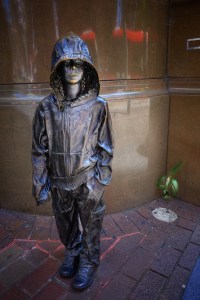
I’ve always liked and worn hoodies. I guess a lot of people do. For some it’s about fashion; others wear them for warmth in cold weather or to keep the sun off when it’s hot; some people even use them to hide.
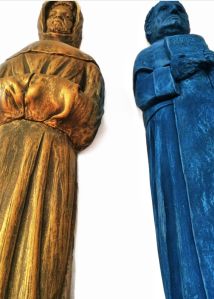
Then there are others such as nuns, monks, priests and others too, for whom a hood is a part of the robe they wear as a member of their particular group.
In those cases, a hood is called a cowl and most often it’s a largish loose hood sewn onto the robe or habit. Just like a regular hoodie.
I read somewhere (I forget where) that some groups nickname these cowls ‘cells’. In other words, the wearer carries their cell with them wherever they go.
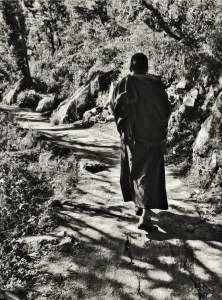
Of course they don’t always actually wear the hood on their heads, but whenever they wish or need to retreat to their cells, all they have to do is simply pull their hood up and over their head and all of a sudden they are in their own private and solitary world; they are in their cell.
As I said earlier, I like the symbolism. But more than that: I find wearing a hood on my head or simply in standby mode, comforting.
I’m not overly good with crowds, or in close proximity to other people on a bus or train or whatever. I like knowing that just by pulling my hood on, I’m able to create my own space apart from my surroundings. In that space I can feel safe and kind of apart.
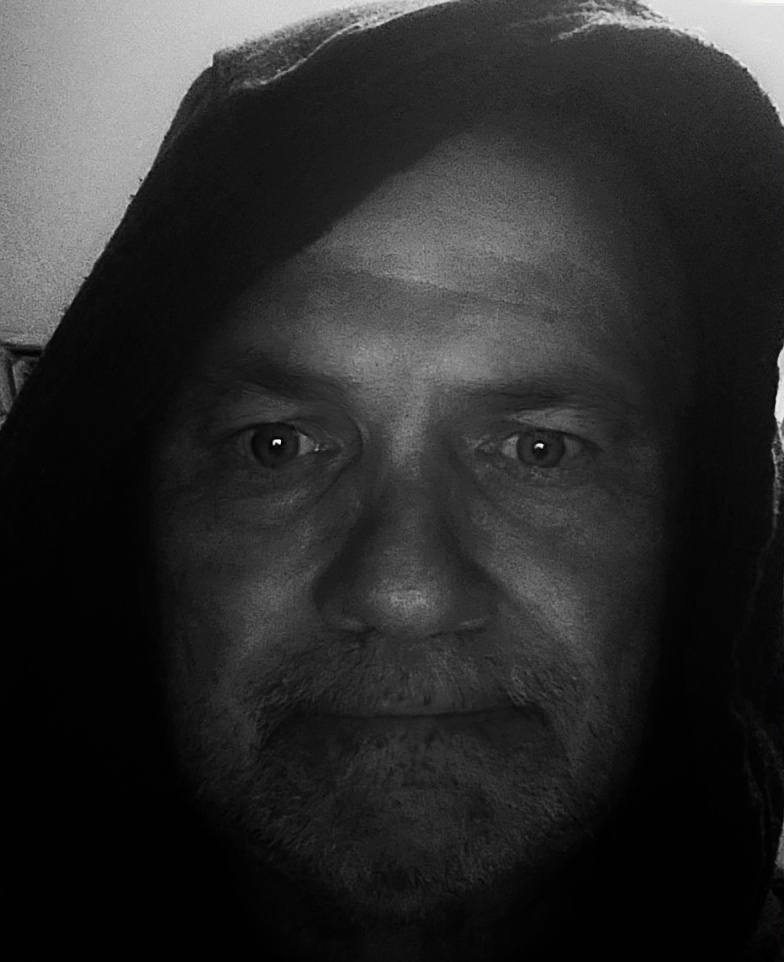
Even at home I wear a hood when I’m meditating or praying. It’s just one more opportunity to retreat into my cell, into Self











 Notes from the Hermit's Cave