The Dharma of Keeping

A curious title for a post, I thought as the words popped into mind. And it’s one that could be hinting at, pointing towards, any number of ideas, topics, or whatever.
In this case, however, it is really quite straightforward: The title refers to a three-line quote I rediscovered when I was transferring notes from a full notebook to a new one the other day.

Actually, ‘three-line’ quote may not be quite correct. In fact, I have no idea if it is a longer quote consisting of three lines, or, three individual one-liners that I happen to have grouped together.

Whatever the case, I don’t know where I found this quote or these quotes. All I can say is that I was surprised to come across them as I performed the normally routine task of transferring notes.
Surprised,  because each of these lines I think, hold a special message for me; a unique piece of advice. You could even call them guidance.

Each individual line and its message is wrapped around  and driven by the verb to keep:

Keep your spirits up
Please help keep the silence.
God’s will be done and keep calm.

As a whole, this quote (these quotes) constitute  a kind of ‘how to live in the world’ mini-guide. Each – and all – of the three lines point to an aspect of what we might call Right Living – guiding us to the means by which we may approach daily life with its ups and downs, its sorrows and joys, good and bad times, mistakes, hurts, confusion, that make up our lives as flawed human beings living the best we can in an imperfect world.

Keep your spirits up

What with all those ups and downs, sorrows, daily crises – in our own lives and in the world around us – how are we to keep  our spirits up?
How do we free ourselves of the pain and suffering caused to us by all these travails?

How do we remain positive and optimistic in the face of what passes for a life ‘in the world’?

All good questions, and there are many many answers out there in that same crazy, mixed-up world that’s giving us all the trouble in the first place.

Speaking only for me, I have nowhere near reached the point where I can say that my spirits are consistently lifted, that I let nothing disturb me.
Why is that? The answer is simple: because I’m a human being. Or perhaps it’s better to say I inhabit a human body which is subject to one thing only: constant change.

I’m learning more and more that the only one I can address such questions to is me. If there are any answers to how to keep my spirits up, I’m realizing slowly that I won’t find them out there in the world or in the things of the world.

So, going within has to be at least my tentative response. It seems that there really is nothing else that will keep my spirits up for more than some fleeting often illusory moments here and there.

Please help keep the silence

What silence? Well may you ask: hardly what you’d call a quiet place to live, this world of ours.

Once again, for me, going within is a good start. Though I’m not the quietest person in the world, especially ‘within’. Too many thoughts, emotions coming and going, all the craziness of an overactive mind and heart.

But it’s a start.
I keep re-centring  when I can. I focus on my breath; recite some favourite prayers; chant mantra (the names of God); I sometimes just sit. All these do help me, will help me, I know. They do, sometimes, every now and again, for little moments, create that little (vast?) space I call silence.

As to playing my part in keeping that broader, silence? Well I’ve mentioned before the invisible community – the heaps of people all over the world who are on the same or similar paths, practising their own unique ways of going within, of cultivating both inner and external quiet, or silence.

All of which tells me, I am not alone. And it says, my little contribution to silence – to being still and quiet – actually counts.

God’s will be done and keep calm

For me, ‘God’s will be done’ is simply another way of saying that the Universe (or life) is unfolding exactly as it does in the only way it can. It just is as it is. And me, being also that life, I play my part.

And that’s all: we play our part; we do our bit, and it all happens as it does.

Acceptance of this truth is also one of those aspiration things I keep near the top of my list. Surrender, I sometimes call it. Surrender, rather than being a ‘giving up’ as we sometimes use the word, is more about going with the flow of the river, or accepting and cooperating with the flow of the natural order of the Universe as we experience it in our lives.

That ‘keep calm’ bit reminds me of that meme that was everywhere a few years ago: ‘Keep calm and carry on’. It, in a real sense, is exactly what I’m trying to do.
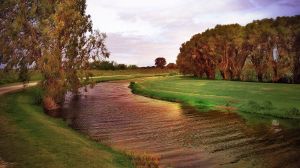
Surrendering, or accepting that ‘the universe is unfolding as it should’ (to borrow once again from the astonishing Desiderata) seems to be the clearest most obvious way to that calm our quote speaks about: Calm acceptance, free from the resistance and struggle against the flow of the river of life that lies at the root of much of our suffering.

So, the Dharma of Keeping. One small (or perhaps not so small) set of clues about how to live right in the world – and with the world.

The river of life is calling me to the kitchen. Even hermit monks have dishes to put away. So, keeping calm, I carry on.
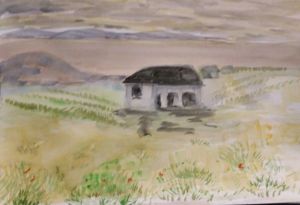
Hermitage on the Loch (courtesy: a member of our community

My take on Dharma, Karma, & Living a Good Life Part 3

Towards the end of my last post I looked at where I was (or is it am?) on the Do your duty front. Do I actually do my duty? And if I do, then how well am I doing it?

My conclusion was that in some areas I am doing okay,, while in others I need to work harder to get them right. Now I’m thinking about it again, I would say that being here, in a physical body, suggests that I still have a way to go in all areas of life. I suggested in that last post that my aspiration to do my duty is a good motivator and incentive to keep on moving in the right direction.

In summary I can say I do my duty as best I am able, and, at the same time I aspire to do that duty in an even more complete and satisfactory manner.

Oh, one more conclusion – and I think it’s a really important point – is that nobody can tell you (and me) what your duty is; only you know your duty. And only you can get yourself doing it.

Which leads us nicely to our next injunction: Follow Dharma. Following Dharma will be a great help in allowing you to discover the knowledge of what your duty is and how to go about actually doing that duty. Of course there are quite a lot of other benefits to be had from following Dharma.

Follow Dharma

As I did with defining duty, I will talk here about my own definition of Dharma; and as with duty, I will be thinking about what it means to me. Once again, there are a number of ways to define Dharma, and I have my own ideas.

The easiest, most straightforward way to say what Dharma is is to say that what is right is Dharma, and what is not right (or wrong) is Adharma.

Here’s where we might ask ourselves, who gets to decide what’s right and what’s wrong? Remember in my last post I mentioned that I think I know the difference between right and wrong? Well, it’s the truth; it’s a Dharmic statement. And I suspect it applies in exactly the same way to you too.

Obviously I get it wrong – quite often actually. I’m simply a human being who is flawed, who gets tired, angry, forgetful, distracted, and even just plain lazy.

On the Path

Which is another way of saying that, despite knowing right from wrong, I don’t always manage to act accordingly. So, what do I use as a guide, as a kind compass to steer me in the right direction? How do i in real life discern right from wrong? How do I know what path to follow?

When I was thinking about these questions, I thought, well, I just know: my intuition tells me how to behave, how to act. Clearly my intuition is not as foolproof as I would like, so thinking harder, I asked: is there a ‘code’ or something I follow that helps me keep on the Dharmic path?

Then it occured to me that, on a very much informal level, I try to follow Buddha’s Eightfold Path.

The Buddha taught this Eightfold Path as the means by which we might free ourselves from suffering.

The Path is not a set of commandments imposed by some outside authority. It’s not a set of rules or laws that we must obey for fear of punishment, either here in this life or in the next life.

What the Eightfold Path is is a series of pointers, a collection of concepts or ideas that can help us to navigate our lives directed by a moral compass that keeps us heading in the right direction.

The steps that make up the Eightfold Path are Right Understanding; Right Thought; Rght Speech; Right Action; Right Livelihood; Right Effort; Right Mindfulness; and Right Concentration.

A long time ago (and I’m sorry I no longer have the source) I read somewhere that one can summarise these eight steps with two short and direct sentences:

Be ethical in thought, word, and deed
Be a good, kind, and moral person.

You can probably guess what I’m going to say next: This is all way easier said than done. Well, exactly. For me it really comes down, once again, to aspiration, to trying.

In fact, one of the steps on the Eightfold Path addresses this point directly: Right Effort. Buddha recognised that it was never going to be an easy path to walk, so he reminds us that effort is as vital as any of the other steps. Perhaps, knowing how flawed I am, I would say it should be the number one step.

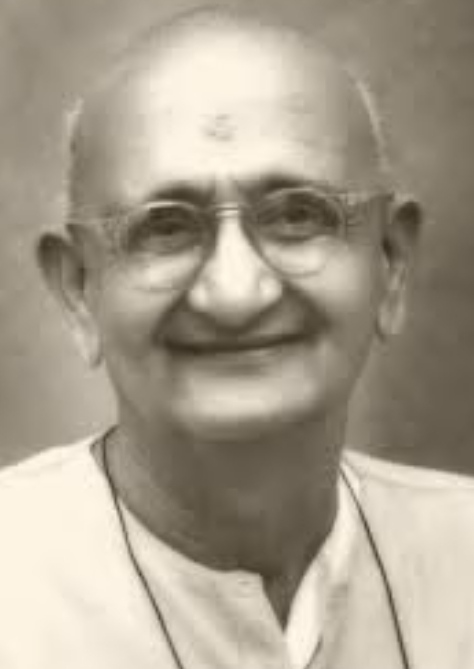
Swami Ramdas

Essentially what The Buddha is saying here is what Swami Ramdas, another favourite teacher of mine, once said (I have to paraphrase a little here):

Once you step on the path, you have already reached the destination.

Again, it’s the effort, the trying, that is the point. For me it’s actually The Way itself.

And that’s where I’m at. Deeply flawed; deeply and seriously lacking in the right ‘thought, words, and deeds’. But I try; I’m making effort.

Live a Righteous Life

Well, at this stage, I have to wonder what else I can add. It seems to me that the aspiration to be ‘ethical in thought, word, and deed’ – not forgetting the effort to persue that aspiration – is already the grounds for living a righteous life. And at least I’ve made a start over many (or is it just one?) lifetimes.

Do good, be good, seek knowledge, celebrate all that is sacred, beautiful and is truth.

I think that’s about it, don’t you?

Peace

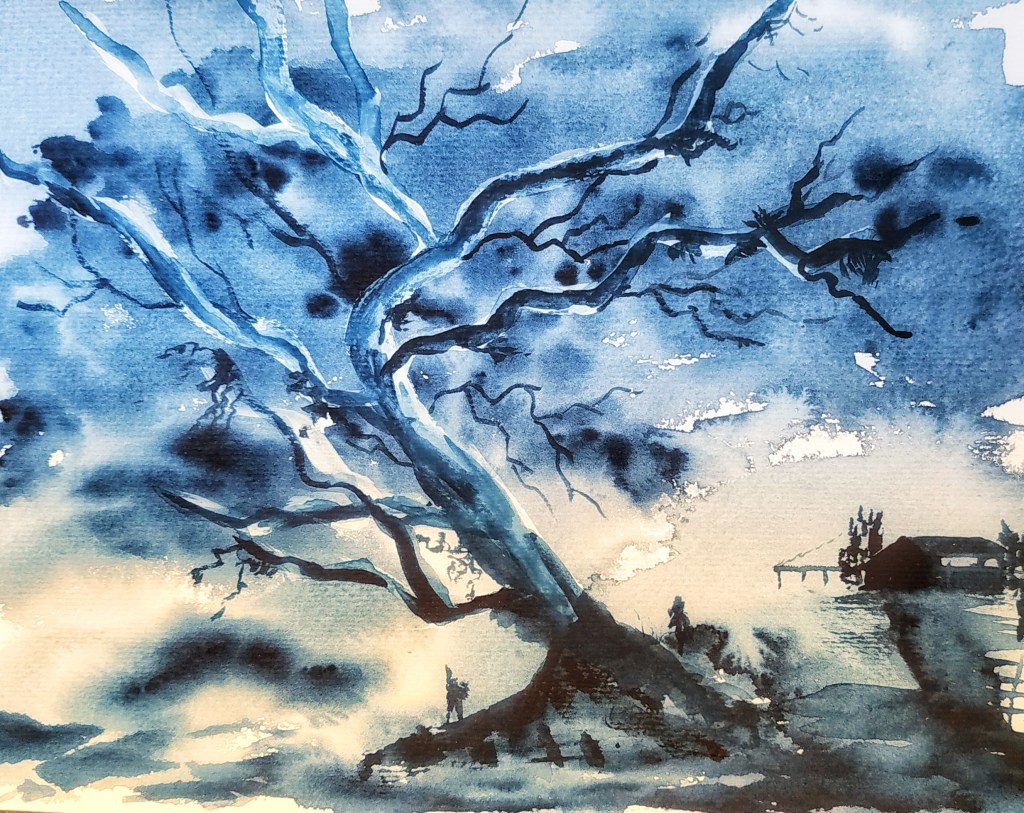
When Trees Speak

Watercolour by Pauline (with digital enhancement by the Hermit)

Vibing on the mystic trees,
their upside is downside, their downside is upside
selves telling me:
You’ve got to cut through the attachments.
Then, not a new, but old made new again, insight
confirms, clarifies, brings details to,
shines a light on the specifics:
Stop desiring what you already have.

By the River’s Light

By the River’s Light
I’ll Live My Life
out of sight of Babylon

A Note From Me: I can’t tell you who wrote these words. Maybe I did; maybe it’s a song lyric; or maybe it’s a quote from someone famous. Whatever the case, a half hour internet search failed to come up with anything even close. So, The best I can do is thank whoever did bring these beautiful words into the world. I hope you are pleased with how I’ve made use of them.

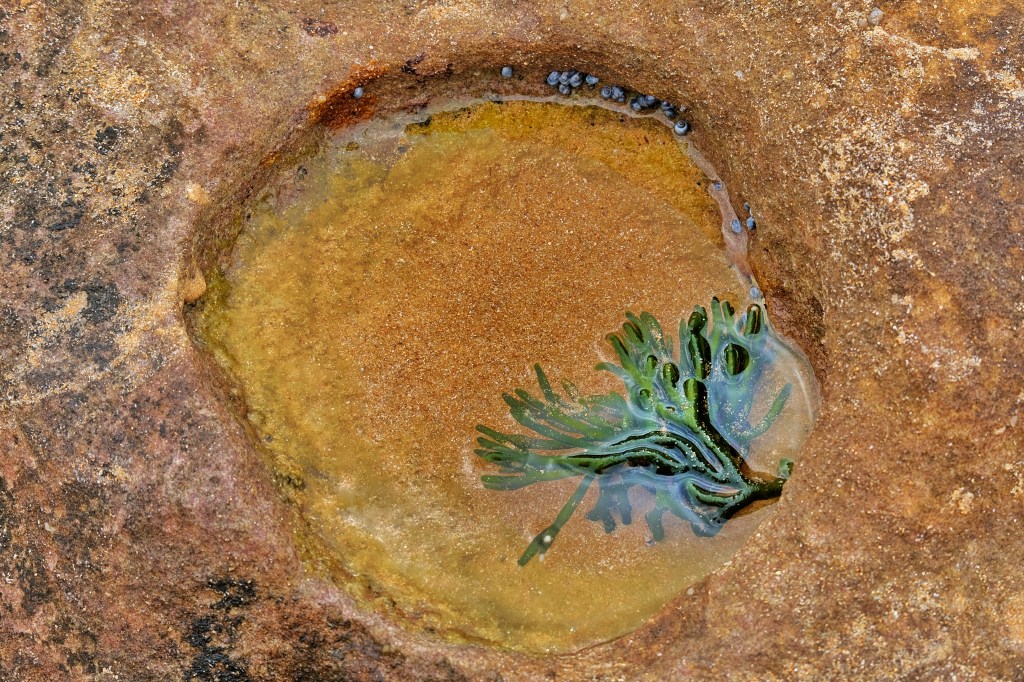
A Seaside Musing

Yellow-Golden sands
carpet the floors
of tidal rockpools,
home to crustations and seagrasses.
And the coffee tasted like medicine.

You Can’t Chase Happiness: You Can Only Be Happy

Sitting down just now at the keyboard (actually to be honest it was 30 minutes ago) I thought I had an idea for a blog post. But, sure enough, the moment I opened a new document, fingers poised on the keys, it went. As in vanished from my mind, disappeared. And what remnant that was left seemed to be taunting me with ‘Why on Earth did you ever think this was a good idea?’

So, what do you think this hermit pilgrim, living the serene monkish life who goes on and on about presence did? Relaxed my poised fingers, closed my eyes, and whispered my mantra as I waited for inspiration to revisit?

Hardly. What I actually did was begin having unhappy thoughts, frustration boiling up: I had really been looking forward to writing that post, and now it’s gone. And all that’s left is this annoying frustration and growing desperation to do something.

Nevertheless, I did in the end manage to calm myself at least a little. I just stopped. Took my hands off the keyboard and just sat. Just sitting is a go to strategy for me as you know.

Thoughts emerged, wandered around my mind, crashed together, one pushing another out of the way.

‘Just typical,’ one of those thoughts ran. ‘I try to do something to make me happy and nothing happens except I make myself miserable’. Next thought: don’t I have a quote somewhere about this? Sure enough, there it was, at the other end of a search of my quote files (I’ve got lots!).

You do not become happy by pursuing happiness.  You become happy by living a life that means something.

Then a quick online search revealed literally dozens of articles, books, similar quotes, podcasts, on and on, telling me the exact same thing. I didn’t know where to start, so I just closed the searches after scanning a few headlines, then sat thinking for a bit on my own, at the keyboard yes, but not poised. More like, well just thinking.

I read somewhere a long time ago that some say the word happiness comes from the verb to happen. Or put another way, happiness is living life so that we are in touch with what’s happening, when it’s happening.

Have you ever noticed that the happiest, most content people are often those who simply get on with whatever life puts before them? Whether it looks to be good or bad?

It seems to me that the pursuit of happiness has become so much more than a lofty turn of phrase; its become an almost obligatory activity to fill ones life with. All this despite those many dozens of articles etc advising against it. (Just as an aside: This says to me that we are swamped by so much information that we hardly have time, energy, or mental space to turn most of that information into knowledge we can use)

So. How do we get past this obligation? How do we get back in touch with what’s happening right now? How do we just get happy from what happens? And, then, how do we get to live a life that means something?

Let me say that I can’t give you the answers: what is meaningful to me might not be for you and vice versa.  But the process is the same for us all.  And it is this:  ask the questions (the ones above).

It’s that simple.  It is enough to ask the questions.  We don’t have to worry about the answers.  The answers will come when the time’s right; its just that sometimes we don’t always notice their arrival.  They sort of sneak up on us!

Whatever answers we come up with, we need to remember that living life fully means living each moment, each thing that happens, as it happens.  It means not being too concerned about what will happen next week or in five minutes time.

This doesn’t mean we don’t make plans or think about the consequences of our actions.  In fact just the opposite is true:  it is by living fully in the moment that we best prepare for the future precisely because the moment is not something that comes and is gone: it’s a flowing thing. The moment is continuous always. No past present future (well except when you have to write stuff, then there’s grammar) Only now.

So, thinking about all this I decided: don’t worry. If no idea for a blog post works, then that’s just what’s happening. Be happy, be content with that, and just move with the ever-flowing moment.

And I’m going to try to remember that everything I do, no matter how mundane it seems, has its own meaning.  There’s no rush to get onto some mythical ‘next thing’. Meanwhile, blog post ideas come when they’re ready, not because I’m chasing them.

peace

Mind Your Own Business and Save the World

Namaste friends

Welcome to another post. Just a little note before we get into it: This one picks up where the last one left off. Kind of. No need to read that one first, unless you want to.

And that’s the whole thing in one sentence, or at least in part of a sentence: unless you want to: none of it is any of my business. What do I mean when I say ‘none of it’? Just that. None of it. Or we can say it in another way: the only thing that is your business is you.

But, all of us are bound to ask, how can I simply mind my own business in a world torn by endless war? How can I ignore the environment I live in and that it’s dying before my eyes? How can I turn away from the evils of racism, injustice, greed, and cruelty?

Well, the simple answer is we can’t and we shouldn’t. Of course, in order to reconcile this apparent contradiction, it would be helpful to clarify exactly what we mean by minding our own business.

In essence my business (or yours or anyone’s) is anything that has to do with me: what I do; how I behave; what I think, feel, and believe; my behaviour and attitudes towards others; and—and this is the key—how I interact with and respond to the world as I experience it as I go about living my life.

So, it isn’t completely accurate to say that the wars, racism, injustice, and the killing of the environment (and everything else) is none of my business; my business is limited to my interaction with and response to all of it. And that has to be determined by a range of factors like my nature, my abilities, my circumstances, and so on.

Above all, and as Susan Sontag, American writer, philosopher, and political activist, said in a speech in 2004:

To be a moral human being is to pay, be obliged to pay, certain kinds of attention.

While the theme of that speech had to do with the writer’s responsibility to truth, I think her assertion applies here and may provide a solution to the seeming contradiction between minding our own business while at the same time stating that our business can, should, and does indeed include what goes on outside of ourselves (actually as we shall see, in reality there is no outside or inside)

How we utilise our own personal resources is in the end for each of us to decide. In the sense of our engagement with the world, the most precious of these resources are arguably time and attention.

Each of us possesses these things in our own unique quantities, just as we all have our own unique qualities, so each of us has the opportunity to decide how we use our time, and what we pay attention to.

It is so very easy to be overwhelmed by the constant torrent of information detailing the horrors threatening to consume and destroy our poor Earth and the life she supports. It is so very tempting to throw up our hands in defeat, and shrug our shoulders as we turn away exclaiming ‘It’s none of my business’.

While none of us would blame anyone for retreating in this way, a great many of us realise that for us this is not an option. Well, as the Buddha taught, there is a middle way. A way that allows us to avoid this kind of ‘none of my business’ denial, at the same time as protecting us from being overwhelmed and beaten down by the scale of it all.

The first step involves surrender. Surrender to the idea that there is no ‘me’; there is no ‘you’. There is no ‘them’, no ‘us’. There is only ‘I’. Surrender to the notion that not only is all life ‘connected’ or linked, but to the thought that all life—human, other animals, plant, mineral — everything —  is one. There is no separation.

Easy eh? Hardly. But this is where the paying attention thing comes in. Rather than being swamped by the never-ending tsunami,  choose where to put your attention. Ask yourself, where am I able to place my attention? How can I—how am I able to—use my time so that I avoid drowning yet still contribute to the well-being of the whole of which I am a part?

Obviously, as I hinted at above, the answers will be different for each and every one of us. For some, the kind of attention they pay will involve being on the literal front lines, working in the political field, or with activist groups working for social justice.

Then there will be those whose nature compels them to  choose to put their attention on a life of prayer, meditation, and contemplation.

For these people this requires the quiet and solitude of monastery, ashram, or cave (whether it be in forest, mountain, or suburban home). And along the huge spectrum in between, there is a a unique spot for every one of us.

Each of us is a part of the whole. Everything we do affects the whole. Remember that saying that goes something like: A butterfly flutters it’s wings in the forest and the sun rises? Okay, maybe I’m pushing it a bit, but you know what I mean.

Never underestimate what (you perceive of as the little) you’re able to do; no one can say what impact it will have. All that is required of you is that you mind your own business.

Buddhism’s Three Refuges: They’re for Everyone

Greetings and Welcome

To become a Buddhist, , there are a number of things a person must commit to. One of these consists of a kind of three in one resolution that’s welcomed by any aspirant. In fact, some say that in order to be a Buddhist, one has to repeat The Triratna or The Three Jewels. Three refuges is the other name used.

I take refuge in the Buddha
I take refuge in the Dharma
I take refuge in the Sangha

The exact words used may vary, but The Three Jewels is common throughout the Buddhist world. And of course there will be many meanings ascribed to ‘take refuge’, but the one I like is the one that any of us might use in, say, a heavy downfall of rain. What do we usually do in when the rain starts falling? We look for shelter, we take refuge.

I don’t mean to suggest that becoming a Buddhist automatically means that one is seeking a safe dry cosy place out of the storm. Though, now I’ve said that, it does make sense. I know myself that (though I am not a Buddhist) sometimes the only way forward, the only means to seek the truth, and to find peace, is to take refuge somewhere or in someone or something.

Not being a Buddhist as I said, I’m not qualified to speak about Buddhism in any real detail. What I have in mind is I would like to borrow the Three Refuges and reflect on how we could all use what me might call a ‘secular’ interpretation as a way of putting into words our own commitment to finding a refuge, a safe haven as we tackle what is for all of us born into a physical body, a life of trials, tribulations, ups and downs, storms and lulls, happy times and sad times, and all the rest of the package that’s called living a life.

Let’s take a look at each of the Three Jewels (also known as the Three Treasures which I like a lot), and think about how we can apply it to our own life, to our own seeking of refuge.

I take refuge in the Buddha.

For a Buddhist, the Buddha is the Guru, the teacher, the one who holds the Truth and shows the way. Many people would say right now, well that counts me out. I don’t follow a religion. I don’t have a teacher or guru. I’m just another regular person trying to make my way through life.

While it may be true that you don’t have a teacher or priest or guru, or anyone else in the role of guide, there is one person who is always there with and for you, one person who is always thinking about you, who is making decisions for you on which way to go, what to do and all the rest: you.


Yes, you. Your Self. When it comes down to it, who knows you better than you do? Take refuge in you, in the Self. Need to make a hard choice? Look within. Feeling tired, or ill or fed up? Look within you for the answers to what can be done. Follow your intuition. You, plus intuition, plus you taking refuge in you, equals teacher, guide. You are your own guru.

I take refuge in the Dharma.

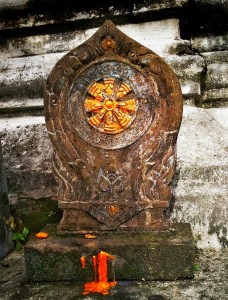
Once again there’s a myriad of ways to define dharma. And once again, I have a favourite: Dharma (often represented by a wheel) according to the religious tradition we know as Hinduism is cosmic or universal law that underpins right behaviour. It is the eternal and inherent nature of reality. In other words it is Truth.

We can all say, regardless of our beliefs say, I take refuge in the truth and in what is right. It’s a commitment to always acting in the best interests of everyone – including ourselves (maybe even especially ourselves). It is taking shelter or refuge in what is right. Living such a life in our messed up world is never going to be easy, so it is best to think in terms of doing the best one can. But having it as your ongoing guide will ease the path.

I take refuge in the Sangha.

A Sangha is an association or a community. Often used to describe monastic communities of monks or nuns, it may also include lay people. If we step outside of the religious framework, then a Sangha is a community that shares common bonds, beliefs, commitments, interests, and so on. Family, tribe, workmates, recreational and sports clubs. You name it: all sorts of groups might be sanghas or communities.

Of course, and perhaps very obviously, not all groups will be communities, And equally we may not think we are a part of any community; we may think of ourselves as being quite outside any group. However there are no rules that say a community has to have a set number of members. Besides, being in community is a condition and has nothing to do with group size or composition.

So, if you find yourself in a community of one – or two or however many – take refuge there. Make a commitment there. As with any other real community, this one begins with you and your truth.

The Buddha, the Dharma, and the Sangha. The Teacher, the Truth, and the Community. Making commitments to the Three Refuges can create a solid foundation as we continue our journey through the world and our lives. The refuges – the safe havens we can call them – we have sought and found will support us through good and bad times.

Actually, I just thought: if we are genuinely able to take true refuge in these three treasures then we will conditioning our Selves to be more present, more in the here and now of who we are, what we’re doing, and what’s happening to us.

Peace to you from me

Mother Mary Come to Me

Namaste friends

During the early days of the pandemic, I lived in a small town out on the edge of the Outback. But after a few months, the time felt right to head for the coast. Slowly. With that in mind and headed in the right direction, I spent six weeks in another small town in that semiarid zone, staying in a motel.

I liked it there, at the Maria Motel in Moree. Described as a low-key 1960s era motel, the Maria is right across the street from the Artesian Hot Pools, which are Moree’s claim to fame. For me (for us), it was another temporary hermitage and safe haven on the side of the road in which to take shelter for a while.

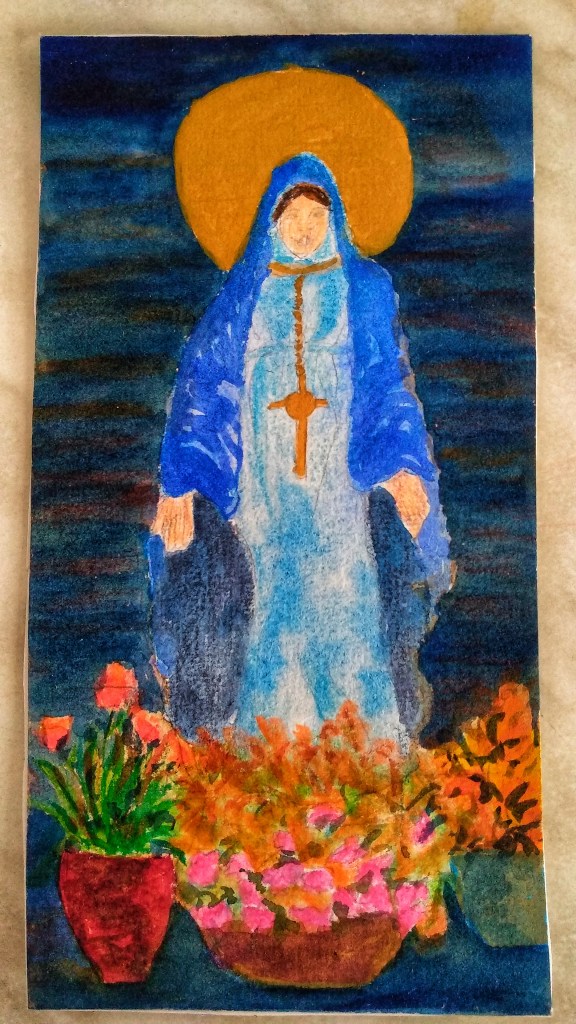
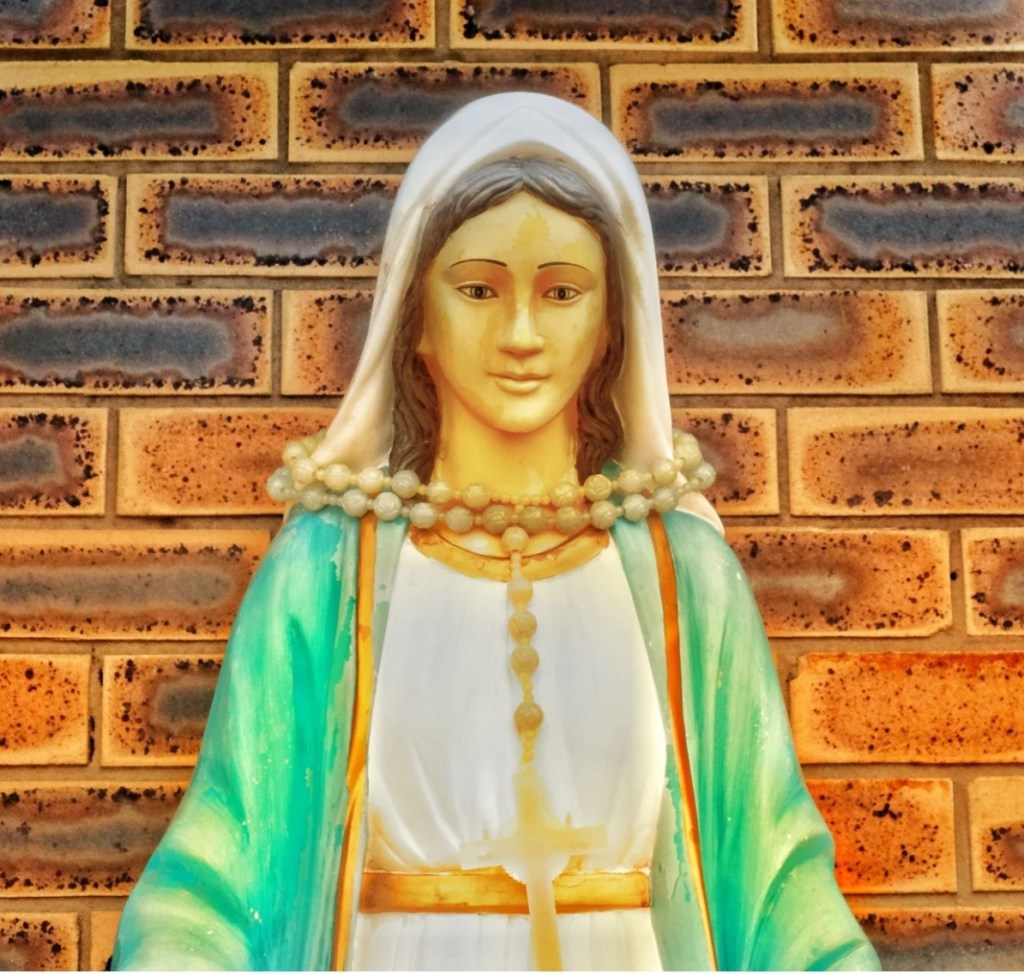
My favourite among the list of things I like about the Maria Motel is the statue of Mary out front in the courtyard. The Virgin Mary that is, Our Lady, the mother of Jesus. You know who I mean. And it isn’t only my Catholic upbringing and education that accounts for my fondness of Mary. It is more about what she symbolizes, what she stands for.

Watercolour by Pauline

For me Mary represents what I might call the feminine aspect of God. Some would call her the Earth Goddess. Mary is the mother, as in Mother Earth, Mother Nature. She is the feminine principle of the Universe. Respect and care for the mother is obviously the key to our survival.

This land from which this town was carved, has been inhabited since long before we began to mark time; since the beginning some say.

Those hot pools have been sacred for a very very long time. While nobody asked permission of the people who already lived here to build a town, at least when some of the invaders came they chose to honour the sacredness of the land they had appropriated by placing this statue representing the sacred feminine in sight of those ancient holy waters, and naming that temporary hermitage of mine, the Maria Motel.

Just Passing Through … or Seeking Noble Truths: A Poetical Sharing

Greetings friends

In my last post I mentioned I would share a poem with you in this one. And here it is!

Just Passing Through … or Seeking Noble Truths, is, like the previous post, concerned with passing through, how as I go through life, I am always in some sort of passing through place. Before we get to the poem, just let me fill you in on a bit of the back story.

First, I wrote the poem as I walked home to our hermitage at the time in a town called Moama on the Murray River in Australia. Now, the Murray is the biggest river in the country and the then little town of Moama sits across the river from its bigger city sized sibling: Echuca, the biggest inland port in Australia.

Anyway, I’d just crossed the river bridge and the words just started coming to me. Not exactly as you read it here, but close. I am very lucky that I had only a few minutes walk left to get home, otherwise the whole lot could have been lost to memory.

The longer back back story? Well, as the poem suggests, I’d spent a lot of time hitchhiking, in Australia and a few other places too. It’s true what it says in the first lines: I’d done a lot of trudging through a rather large number of towns unknown to me then, and only some of which are better known to me now in much later years.

Okay, that’s enough back story to last a while, so let’s just present the star of the show. I share this, as I do all my efforts, with heart.

JUST PASSING THROUGH … OR SEEKING NOBLE TRUTHS


Many have been the nights 
I’ve trudged (and less often, strode) 
past illuminated windows framing. 
families sharing sit down meals. 
Or huddled worshipfully before 
flickering and silent (to my passing by ears) 
picture boxes in corners of cosy family rooms. 

I am just one more invisible (to most), anonymous 
drifter. Just passing through 
the empty nighttime streets of one more 
anonymous town. 
Longing to enter the illumined frame. 
Longing to share one of those sit down meals. 
Longing to worship at the alter of the flickering picture box. 
Longing is loss. 

The edge of town roadside summons 
this lonesome bodhisattva begging rides. 

It’s just one more quiet and cold 
semi desert night. A high moon in a clear sky 
casts ghostly shadows through Eucalypts: 
my only company as the waiting game begins. 
Waiting to see headlights coming and going my way. 
Waiting to be rescued from this lonely edge of town roadside. 
Waiting for another ride, to another anonymous town. 
Waiting is wasteful 

Better to be here, now, on this 
edge of town roadside. A place as good 
as any. Illumined by the moon, 
the ghostly gums create the frame 
in which this bodhisattva rests. 
And worships. 

Thank you for allowing me to share these words with you. The road, as many of you will know, can be a teacher, a guru. I don’t hitch-hike anymore, but the road is still teaching me. And I am grateful.