The poem I want to share with you today has, I think, been shared on this blog before. I haven’t checked because I didn’t want to be tempted to censor myself and not post it again if it has been posted.
The poem, titled simply Peace Prayer, has a repeating refrain in each verse:
Our Lady Queen of Peace Pray for us.
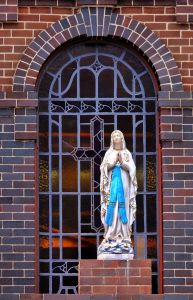
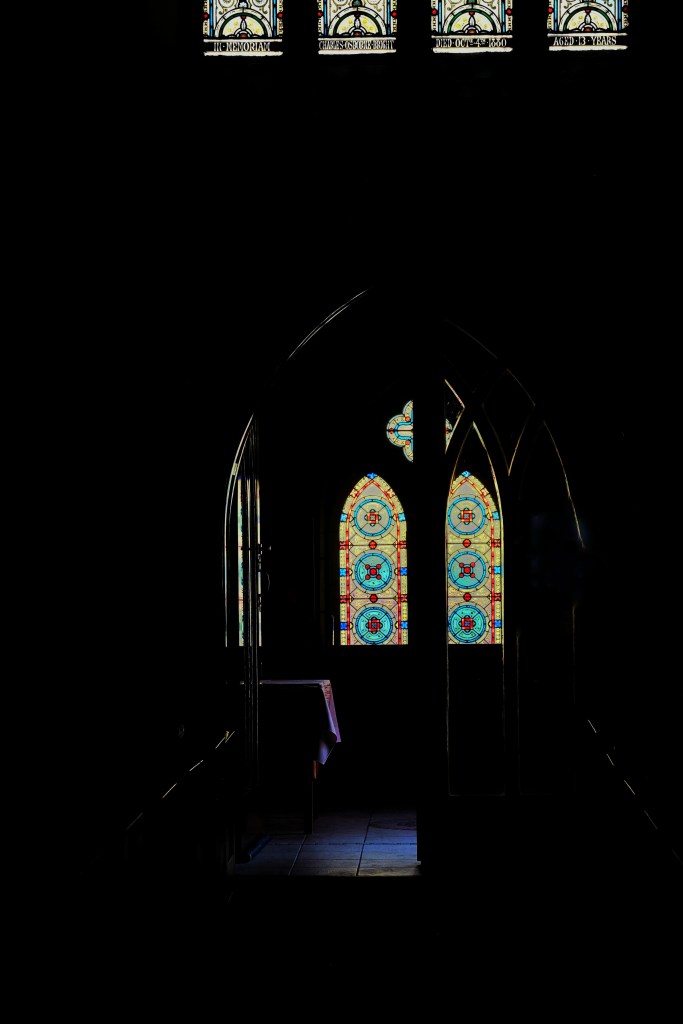
A couple of days ago I came across a church dedicated to this particular manifestation of the Divine Feminine. I know it doesn’t seem to be such a far-out coincidence, but up till then, I had never encountered a church with this name.
So, obviously, it reminded me of my poem, written a couple of years ago now. As well as the story that prompted its writing:
When I was 12 my father went to war. As a professional soldier, he went as a part of this country’s commitment to its American allies in its war against Vietnam.
Our family was, at least nominally, Christian at that time, and anyway, desperate times do indeed call for desperate measures.
Which means we, my mother, my sisters, and I, formed a tiny prayer circle every night for over a year to pray for my father and for peace.
These days I no longer label my beliefs, not if I can help it anyway. What I seek now is the Divine wherever it is to be found. Which is everywhere of course!
In any case, here is my poem. It’s always the right time to pray for peace, though we should always remember our prayers are really directed at ourselves. It’s up to us to answer the prayer as we are able and see fit.
Peace and love to you all.
Peace Prayer
The father, the husband, the man of the house He’s away. At the war. Our Lady Queen of Peace pray for us.
Away at the war, yes, In a far off land. Not his own. Our Lady Queen of Peace pray for us.
Away at the war. “Incountry”. that’s what they call it. Our Lady Queen of Peace pray for us.
At home the children, the wife and mother wait. Wait and pray. Our Lady Queen of Peace pray for us.
At home they wait yes. Each night on their knees, in a circle. Prayer circle.
Away at the war, he is fighting. For what? At home, they are praying. For what? Our Lady Queen of Peace pray for us.
Indeed, it is clear to all who dwell there that through them the world is kept in being
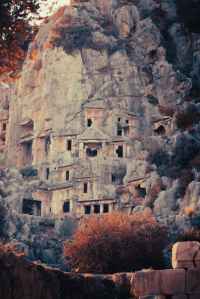
I jotted down this note I forget how long ago. Over the last few years I’ve read a lot about the early Christian hermits who lived in the deserts of Egypt, Syria, and other areas of that area we label the Middle East.
While I think it was one of these early hermits who uttered these words, it may instead have been a monk or hermit from the 9th or 10th Century, living in the forests of Russia or Eastern Europe. (I wish was a lot less careless with sources for things I note down).
In any case, it was spoken by a hermit or monk who, along with perhaps thousands of other men and women, fled the strict dogmatism of both government and religious institutions , as well as the corruption, materialism, noise, and all the other distractions of the cities and towns.They went to the deserts, the forests, and other remote places, in search of solitude, silence, and peace.
They longed to commune with the divine. They chose to bypass the mire of worldliness, and hoped to find a better way to serve the divine and the world. The writer or speaker of our quote is pointing our attention to all those who went to the deserts, the forests, and other sanctuaries, who in her or his words, believe they are actually keeping the world going, and its people too.
These nuns, monks, priests and hermits, knew that by communing with the divine without distractions, and living a simple life completely and absolutely centred on the divine, was the way to save the world.
‘So’, you might be saying with a slightly cynical tone in your voice: ‘These are people who have ‘escaped’ from the world and are ignoring governments and the law, rejecting social status of any kind, not associating with other people like other good citizens. They’ve gone to sit in a hut or cave or whatever and are doing nothing productive at all. They’re not buying stuff so they aren’t contributing the the economy. And you say they are the ones keeping the world spinning round? Hardly.’
There are hermits everywhere.
Yes, I think they are. Keeping the world spinning I mean. Just as mystics from all the world’s religious traditions, these women and men of the deserts – and the forests too – knew that the world they’d left behind wasn’t real. Well, yes, it’s real enough of course: I mean we only have to look around us, and feel the workings of our bodies. It’s real alright.
But, realer (I know, it’s not a real word) than this physical world we are in and are an integral part of, is what lies within us as well as everything else in the Universe:
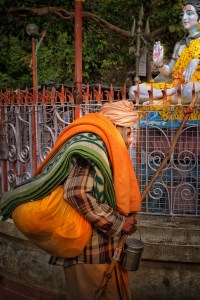
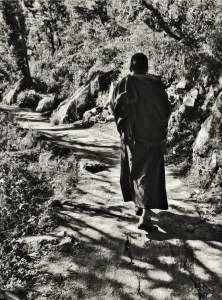
Holy Wanderer Detached from all Worldly Entanglements
The divine, God, the life force, Consciousness. So many names for the same thing. Many of us sense that at the core of ourselves there is ‘something else’; that there is some kind of intelligence for wont of a better word. This intelligence is what illumines life, as in life, the universe, and everything.
But, we don’t see this, or not so often anyway. The mire of worldliness (a phrase I mentioned earlier and which I like very much) seems to be specifically designed to keep us in the dark so to speak, about our true nature.
Think about the seemingly endless focus on materialism with its temptations and promises to make us happy; the conflict and competition among individuals and nations to acquire more power, possessions, land and anything else that ‘they’ve got and that we want’.
Mire is a good word: We’re trapped and sinking fast in a kind of quicksand.
And this mire keeps us from becoming aware, from realizing, that we are the Consciousness (the word I prefer but, as I said, names are just names) mentioned above. It keeps us ignorant of our true nature, and we go on and on struggling to keep afloat in the world.
The hermits of the past and the present, the nuns, monks and other contemplative people of all kinds, and, in many and various places, are all engaged in a quest to know – and yes, to realise – that they and everything else in the material and non-material universe is Consciousness.
I believe that, far from being unproductive, from ‘doing nothing’, It is the engagement by such people everywhere with this quest that does indeed keep the world in being.
Courtesy Wikimedia Commons Thank you
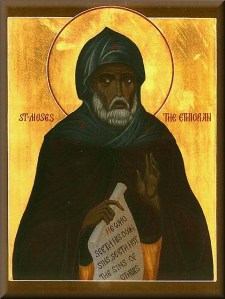
I would like to leave you with a couple of quotes if I may. The first is from Abba Moses, one of the greatest of the early desert fathers who was born in Ethiopia and lived in Egypt in the 4th Century:
‘Our objective is puritas cordis,’ Abba Moses told Cassian and Germanus [fellow monks]. ‘A heart kept free of all disturbance. The more we cultivate such inner stability, the more we can offer our lives in service to the world.’
Courtesy Wikimedia Commons Thank you
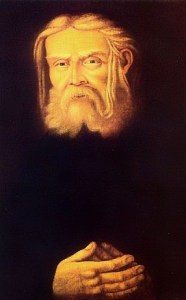
The second quote I would like to share is from Saint Seraphim of Sarov, a 19th Century Russian monk who lived as a hermit deep in the woods:
‘Acquire a peaceful spirit, and thousands around you will be saved.’
Remain in your cell, and your cell will teach you everything
This piece of advice from one of the early Christian desert hermits to a follower has been going round in my head for ages. And I mean a couple of years at least. I’d read it in several books at the time, and I’ve seen it in a few since.
Of course, most of the writers of those books interpreted this advice at face value, literally advising the student, hermit, monk, or other contemplative person to stay in their physical cell (hut, cave monastery cell, suburban bedroom, wherever is their permanent dwelling) and listen, meditate, study, and contemplate. The advice is, stay in that space in silence and seclusion. Quite possibly forever.
‘But it could be the cell of your Self,’ my partner hermit said to me one time. And yes, I thought, that’s exactly right. I liked the symbolism. The actual literal, physical space and its geographical location isn’t necessarily the important factor. What’s important is that you, the real you is actually fully present wherever you are, right here, right now.
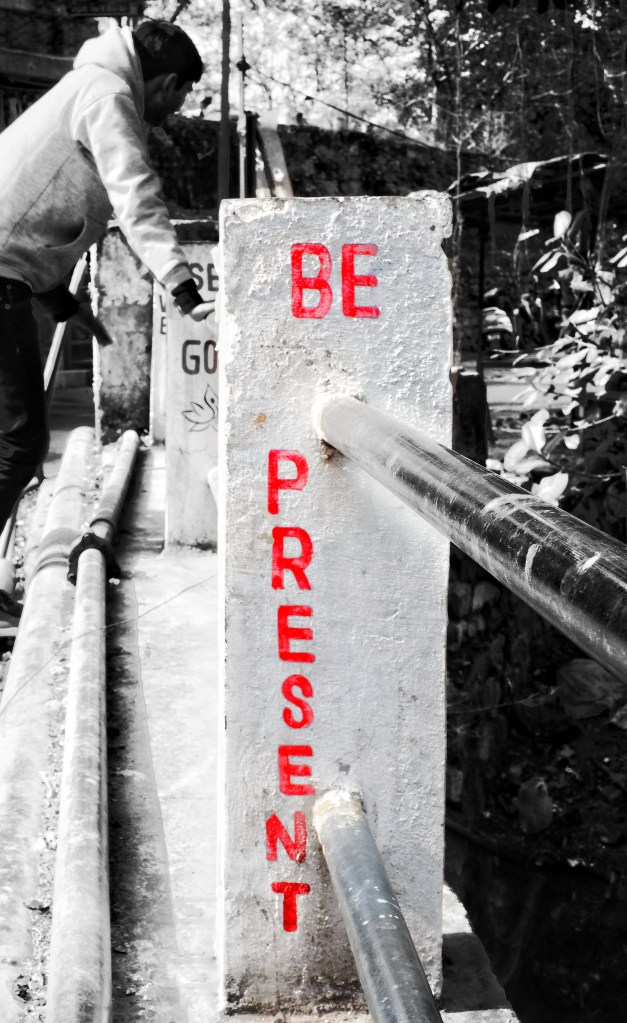
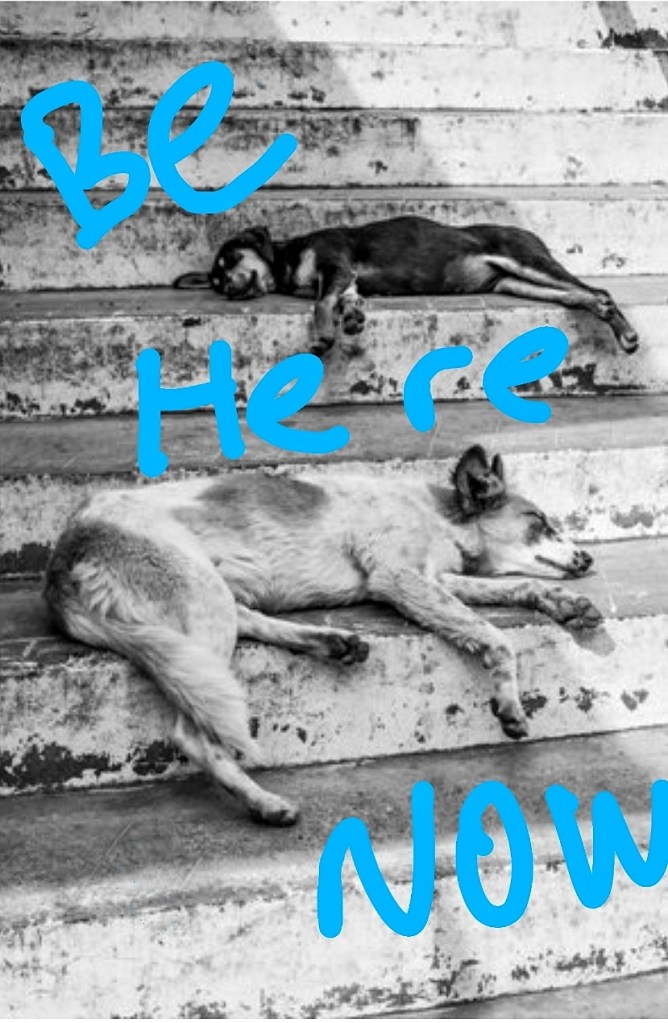
Think about what it really means to be present – to be here now: It means that you can say, ‘This is the only space and the only moment that exists. Right here and right now.’
Living life is an ever-flowing movement or process, and at the same time (excuse the unintended pun) is always occuring in the present. And in that ongoing moment you – your Self -is always there.
Of course along for the ride is your little s self with its ego, chattering and never quiet mind reminding you of the distractions, stresses, anxieties, worries about things to do or not do, memories of the past, and fears for the future. It goes on and on.
But, still, that space within where you can meditate, pray, contemplate quietly, that’s your Self, your ‘cell’.
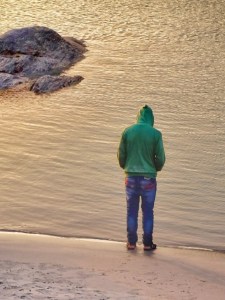
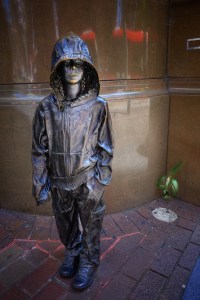
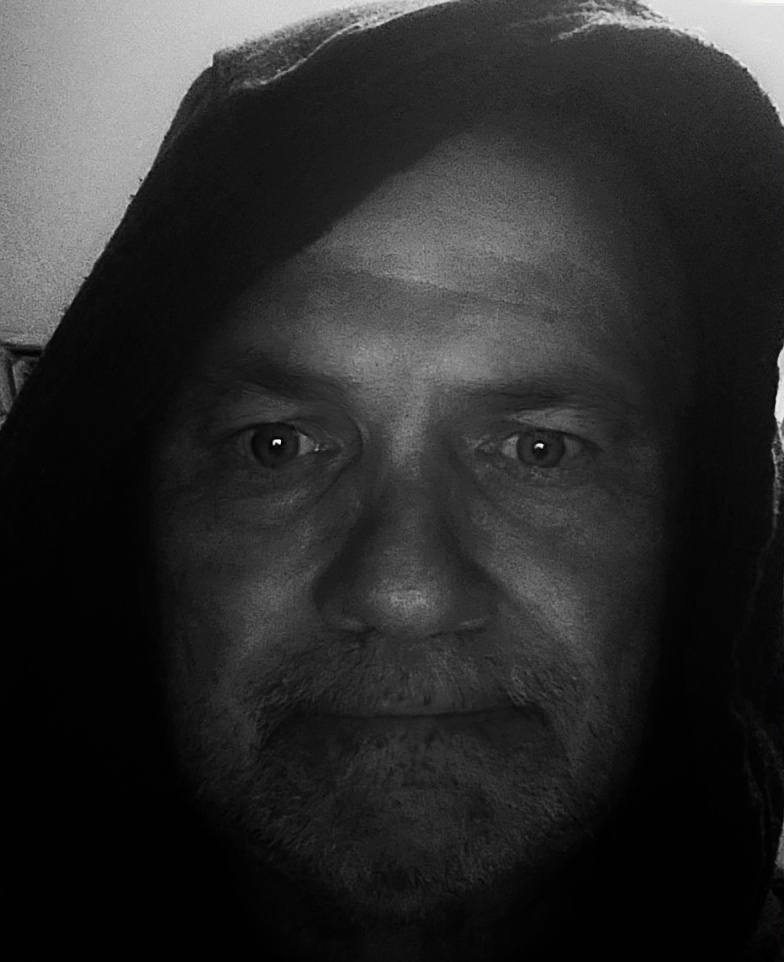
I’ve always liked and worn hoodies. I guess a lot of people do. For some it’s about fashion; others wear them for warmth in cold weather or to keep the sun off when it’s hot; some people even use them to hide.
Then there are others such as nuns, monks, priests and others too, for whom a hood is a part of the robe they wear as a member of their particular group.
In those cases, a hood is called a cowl and most often it’s a largish loose hood sewn onto the robe or habit. Just like a regular hoodie.
I read somewhere (I forget where) that some groups nickname these cowls ‘cells’. In other words, the wearer carries their cell with them wherever they go.
Of course they don’t always actually wear the hood on their heads, but whenever they wish or need to retreat to their cells, all they have to do is simply pull their hood up and over their head and all of a sudden they are in their own private and solitary world; they are in their cell.
As I said earlier, I like the symbolism. But more than that: I find wearing a hood on my head or simply in standby mode, comforting.
I’m not overly good with crowds, or in close proximity to other people on a bus or train or whatever. I like knowing that just by pulling my hood on, I’m able to create my own space apart from my surroundings. In that space I can feel safe and kind of apart.
Even at home I wear a hood when I’m meditating or praying. It’s just one more opportunity to retreat into my cell, into Self
Yesterday I came across a couple of stories – true ones – that I wrote years ago. They are what we might loosely call ‘travellers’ tales. I thought it might be nice to share them here. So here’s the first one. Enjoy
Not the Manu temple I write about, but another one close by
I’d walked up to Old Manali, and I’d kept walking through the town. Then higher still, past the temple to Manu, and the scattering of traditional houses and small fields clustered around the temple.
Three near-naked and stoned saddhus invited me into their cave – more a kind of overhanging rock shelf poking out from the foundations of the temple itself.
Naturally I declined. Politely. I wasn’t, never had been, and never shall be a stoner. Besides, here I was deep in the Himalayas walking through ancient villages and past temples to ancient gods. Seems to me that that’s enough to bring on a high all its own and like no other.
Then, a little higher up the trail. I rounded a corner to be greeted by a kind of open forest glade; a grassed and flowered field protected by a semi circle of forest sentinels, their crowns maybe thirty metres above my head.
And there, in the middle of this magic field, a large flat rocky area, like a series of ‘shelves’ layered one on the other. This maybe twenty square metre tiered platform was probably the remnants of an ancient hill (or mountain?) that got in the way of a more recent but clearly relentless glacier.
Whatever the history, here was an arena with views no theatre or movie could ever hope to reproduce. This natural amphitheatre faced several layers of peaks across the valley. But, before those peaks, and directly in front of me, just down the slope, stood the temple, then more trees, reaching down into the valley. Here the river flowed, surrounded by farmers’ fields and the brown dots of houses.
Then the forests begin again, thick at the bottom in the valley, but becoming more scattered on the higher ground. Then those many layers of higher and higher hills, mountains really, rolling off into the distance to, where on the horizon and behind it all, a row of the really high peaks covered in their permanent snows.
‘This is a special place, a sacred place,’ I heard myself sigh out loud. Sitting cross-legged now, I let my eyes wander over the scene taking in the blue sky, the white peaks, the multiple greens of the forests, the sliver ribbon of the river, and the rest.
At such times and in such places, one’s eyes tend to close of their own accord. And so it was for me then and there. I let myself drift. Thoughts came and went, to be replaced by more thoughts that came and went.
Then, my eyes opened. Again of their own accord. After a few seconds of that cliched ‘where am I?’ feeling one has when startled out of one state and into another, I made out the figure of a person standing facing me a few metres from where I sat.
‘I’m sorry,’ I heard her voice call to me. ‘You just looked so peaceful sitting there meditating, I just had to stop and watch you.’
She told me she’s been watching me for about fifteen minutes, which gave me a start: It’d felt l Ike I’d only just sat down and closed my eyes.
‘They say the light of the world is held about twelve kilometres up this trail. That means it’s the centre of the world.’
I had to stand to try to take in a revelation of this magnitude.
‘And apparently,’ she went on, ‘they’re going to move it soon and nobody knows where.’
Was she an angel? Was I dreaming? They, whoever they were, are about to shift the centre of the world? Even in India one doesn’t hear this kind of news everyday. Actually, I doubt you’d ever hear it on any day.
Then she was gone, headed up the trail. I didn’t follow. I remember thinking: twelve kilometres was too far for me especially as I already had a long walk downhill to my hotel back down in the new town.
Yes, mundane, practical musings, a typical response to news of such a wild and far-out nature. So, not exactly in shock, yet not quite myself, I turned back. Down. Through the village, past the temple with three crashed out saddhus out front, back into the town.
There are cafes there. They sell Chai there. I needed one.
Actually, given the momentous news I was going to have to digest, I might even have a couple extras.
This is a true story; it actually happened more or less the way it’s described here.
Of course, there is no ‘light of the world’ stored in some secret spot, somewhere on Earth.
Well, I suppose if there is a light of the world, then it’s likely to be the world itself, I mean Earth, all the beings who live on this planet. Life itself I guess you could say. Life is light; Life is love.
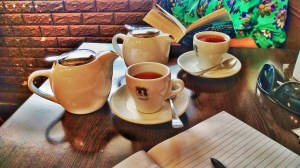
Journalling always seemed to go along with tea drinking
About a year or so ago I stopped keeping a journal. And, when I say stopped keeping, I mean keep as in both senses of the word. Let me explain.
I began writing my life in a journal in my teens. I stopped for a while in my late teens and early twenties, then later in my twenties, took to it again. I then kept my Journal going ever since. That is, until last year.
Of course, some periods saw a more intense, even daily journal keeping. And then there were periods where the journal only saw me every now and again. On the whole though, I’d been completely dedicated to my Journal for more than 40 years.
What over 40 years of journalling looks like
So, why suddenly end it? What prompted me to just stop keeping it – again in both senses of the word – after almost a lifetime committed to it?
Yes. A good, good question. First of all, it wasn’t a sudden decision; I didn’t ‘just stop’. For some time I hadn’t been feeling quite so committed, quite as excited about keeping a journal (as in using it to write my feelings, ideas, and essentially my life). And, just as with so many of the decisions we make thoughout our lives, this one had a practical, even a pragmatic ‘seed’ as well:
See the picture above? That’s my journal. The rest of the Old blue tin trunk would get itself filled with all kinds of stuff not needed on rhe road. The trunk lived with my cousin for a few years, then it was my sister’s turn; she had it on and off for many years.
As you are no doubt beginning to guess, this arrangement began to wear thin. We (the hermit pilgrims) were constantly asking ourselves, what’s the point of storing this stuff for years? Do we really need it?
My answer had always been yes. I needed my journal. I might read it again someday; I might need it to write books or whatever. So, we’d keep the trunk, filling the remaining space with stuff and things.
Then, on the penultimate occasion we had the old blue tin trunk shipped to us in our latest (then) current roadside cave, I looked at it, and thought: What’s the point?
Somehow the attachment – the compulsion to hold onto my Journal – had gone. It was a liberation, a freeing of my mind. I suddenly realised that the prospect of me ever rereading the thing, or needing it for some other purpose, was remote. Actually such a prospect was also extremely unappealing.
I should add here that that particular aversion and disinterest in rereading my journal, seemed to cement my already growing disinterest in keeping a journal in that sense I mentioned earlier of writing down feelings, ideas and so on. Now, both the idea of keeping the journal in the sense of storing the physical volumes for a rainy day, and that need to keep a journal by constantly writing my life, collided. Time to stop keeping!
So, I sat and leafed through every volume, more as a kind of farewell ritual than anything else. I did ‘rescue’ the odd bit and piece, most of which have since gone the way of their host volumes. Then I simply set the lot on its way to oblivion.
I mentioned that this whole chain of events happened on our penultimate reunification with the old blue trunk; what about the ultimate time? Well, we’d kept it full of various pieces of art by both of us; with various household things; ornaments; and other stuff I can’t remember.
Repacking it to ship back to my sister’s as we got ready to move on from that particular cave, we both just said, let’s leave it all behind.To cut a long story short, that’s exactly what we did. My son, a couple of charity shops, and the house we’d been sheltering in, were all recipients of the last of the contents of that old blue trunk – and the blue trunk itself.
Now, do I miss my journal? Well yes and no.
No I don’t miss having the thing as in owning it. Or maybe it’s better to say I don’t miss always having it in storage and out of reach the great majority of time. Like I said, I went completely off the idea of holding onto it – keeping it – just in case someday I might want to read it all again or use to for research. Now I think, why would I ever want to do that? (okay, I think I might have already said that)
The yes is kind of qualified. Yes, I miss writing in it. Yes I miss having a vehicle for expressing feelings, thoughts, and ideas.
I say that this yes is qualified because while I say this to myself from time to time, I don’t actually seem to ever really feel it. So perhaps it’s less a yes and no than it is an unequivocal no.
Besides if I have the urge to write, to put pen to paper, fingers to keyboard, then there’s nothing to stop me.
After all, that’s precisely what I’m doing now isn’t it?
The hand of the monk agéd, insistent, but gentle too, takes and holds mine. The monk sits, the Dharma before him, sacred texts resting in their saffron shroud. My presence completes this circle.
Mountain monastery calling him; it’s not home. Other mountains he’s climbed. Escape. High places divide this world from that, that time from this.
His loving touch, his smile, linger in rarefied air. Air drenched with the warmth of the Dharma, in this late monsoon restaurant of the Snow Lion, south of his land.
On the going down and the coming up silvered and golded stairs to and from the Underworld. It’s all just a giant mirror In which we see who we are not.
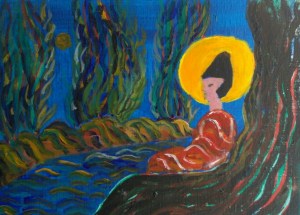
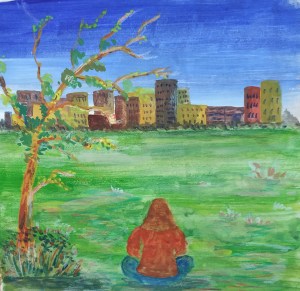
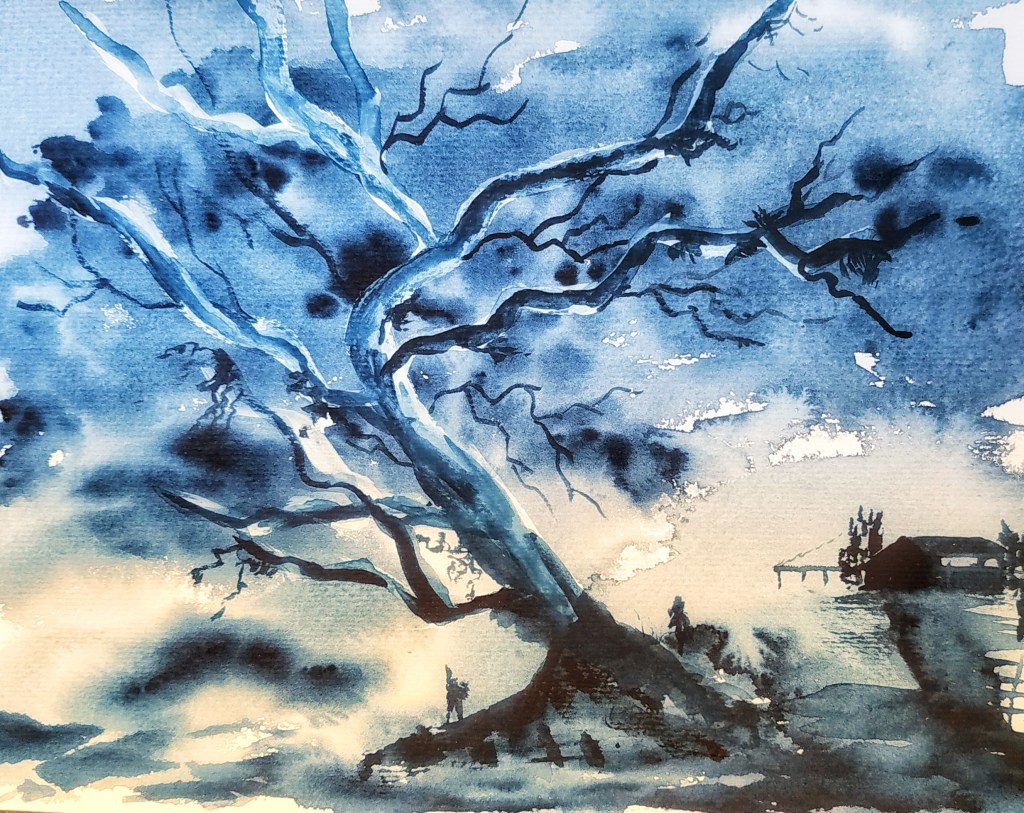
Watercolour by Pauline (with digital enhancement by the Hermit)
Vibing on the mystic trees, their upside is downside, their downside is upside selves telling me: You’ve got to cut through the attachments. Then, not a new, but old made new again, insight confirms, clarifies, brings details to, shines a light on the specifics: Stop desiring what you already have.





 Notes from the Hermit's Cave