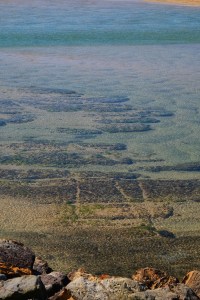
Here there are remnants
of sea cliffs.
Cliffs that have not towered
since ancient times.

Here there are remnants
of sea cliffs.
Cliffs that have not towered
since ancient times.
The inclination to seek knowledge is, for me, a gift, a blessing. And we live in a time when there are so many sources, so many resources available, and many are freely available too. There seems to be no limit to what the genuine seeker of knowledge can uncover.
Yes, of course, we’re swamped with information from all sides. We are deceived by fake news. And everything these days is a commodity, a thing to be bought, sold, acquired, or otherwise used for profit in the material world.
All true. However, this is where one’s discernment comes into play. It’s up to each of us as seekers of knowledge (on whatever topic or subject) to discern for ourselves the truth or otherwise of the information we use to form the knowledge we are seeking.
In my last post, I began to talk about two notes that I made in my notebook. These notes were quickly jotted down while seeking knowledge from two different sources about two distinct topics. Feel free to have a look at that post here if you happened to miss it.
Do your duty
Follow Dharma
Live a righteous life
These three lines are the sum of what remains of a session with my teacher, Swami Tadatmananda. It’s his short, succinct summary of the teachings I was trying to absorb from him that day.

You’ve probably guessed I am not a great note-taker; I like to just let sink in what wants to sink in, absorb what resonates for me. Perhaps on that day, I felt the summary was all I needed as a basis for later contemplation.
With that in mind, I would like, in this post, to reflect on these three injunctions, try to work out how I’m doing when it comes to taking notice of them, and actually where I’m at with actually living by them.
What does it mean, ‘Do your duty’? And what does it mean, for me, to do my duty?
Firstly, let me try to define duty. Not from the dictionary meaning, not from some outside ‘authority’. No, this is me talking about how I define duty.
Duty, for me, is defined by the activities I choose to prioritize in my life. These are the things that I believe best serve my true, essential nature. Acting in accordance with this true nature includes responsibilities such as taking care of my physical, emotional, and mental health. While this may not always be easy and sometimes feels impossible, it is my duty because my mind and body are manifestations of my true self, of the divinity.
Duty, again for me, means persuing activites – in the world as well as within myself – that nurture, protect, and grow, who or what I percieve that Self to be.
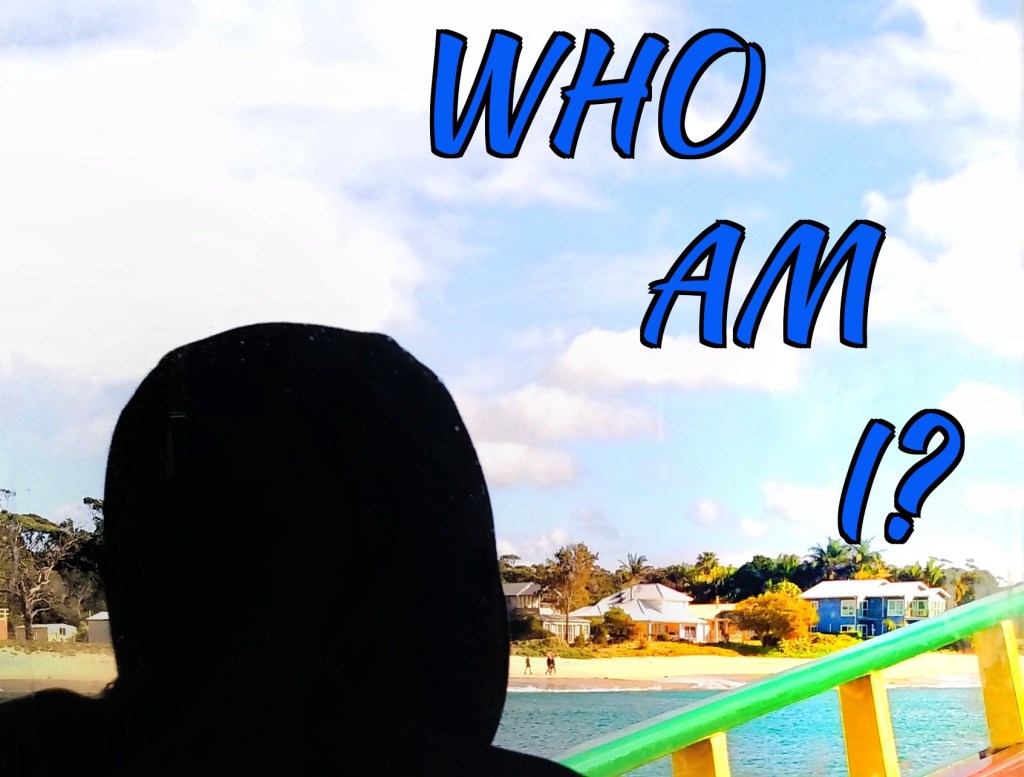
This Self I refer to is not restricted to the apparently separate entity I call ‘me’. That apparent separation is just that, an appearance: Self is all there is; I am not simply bonded or joined with all other living (and non-living) beings: I am those beings, just as they are me.
As such, my duty is to act in ways that benefit (or at the very least do as little harm as possible to) all beings, all life. Here, I guess, we could talk about Karma. But let’s leave that for now. It’s enough to say that nobody can tell me – or you – what is our duty. In fact, the truth is I already know the full extent of my duty, as we all do.
The only thing lacking for me is what I might call a full disclosure of what that duty is. That full disclosure can only come from me – as in the Self. As they say, I might know in my head what my duty is, but I’ve yet to fully realise it in my heart. And if I’m honest with myself I can say that my aspiration to do my duty is a constant reminder and motivation to do always the best I can to fulfill my duty.
In some areas I think I do my duty pretty well, but in others I have a long way to go.
In my next post (and the final one in this series: there just seems to be such a lot to think about when contemplating this topic), I will look at what it is to follow Dharma. Once again, it’ll be a very personal, subjctive answer because, to put it perhaps too simply, I like to think that I know right from wrong.
I hope this post has been of at least a little interest and value to you. I will look forward to seeing you here for my next post.
Thank you and I wish you peace.
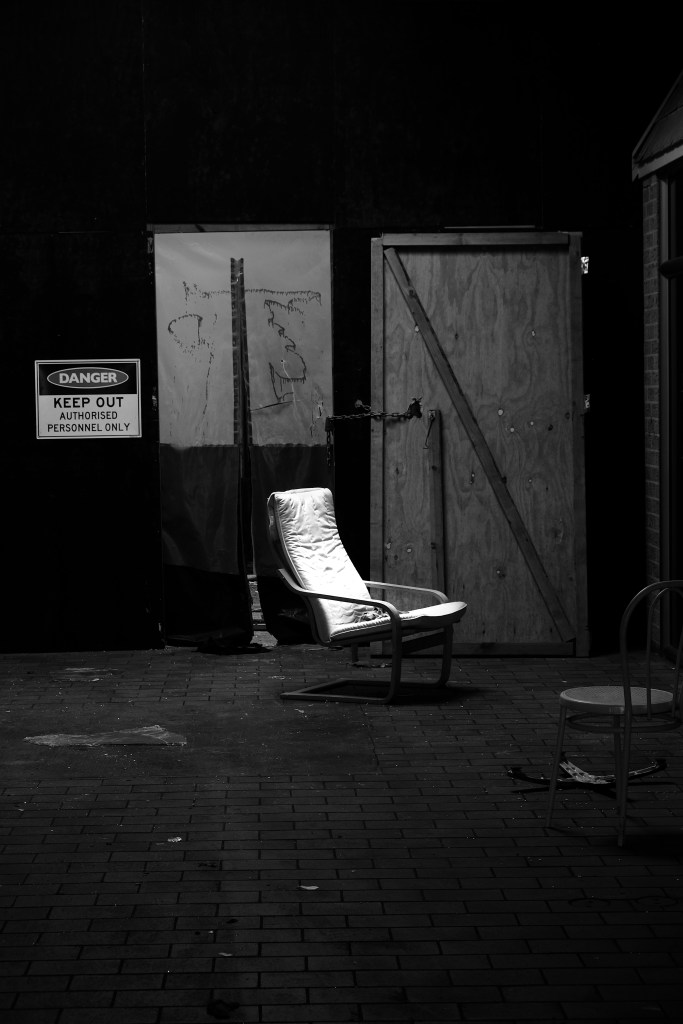
‘Looks like a comfy chair’.
That was the first thing my partner said when I showed her this photo. Her eyes – and perhaps even her heart – had found that which is illuminated by the sun, even though it’s surrounded by wreckage and ruin.
The wreckage by the way, of an abandoned and trashed store front. One of several in a small arcade, that’s long sat empty.
Ah, I thought: one more illustration of a metaphor I’ve been hearing a lot lately in my studies about consciousness.
Allow me, please, to adopt our teacher’s metaphor which, for me, really clarifies this concept of consciousness, or Atma as it’s called in Sanskrit.
Is the brilliant light streaming into this room and onto this chair affected in any way whatsoever because the chair is sitting amidst all that wreckage?
Is the sun shining any less brightly on the chair than it would if the chair was sitting in a luxuriously decorated space instead?
Of course the answer to both questions is no. The sun, and its brilliance remains undimmed, and completely unaffected, untouched, regardless of what it shines on.
The ‘I’ that photographed this scene, and my partner’s ‘I’ whose eyes were drawn to the chair in the scene, are both consciousness. Not ‘my’ consciousness; not ‘her’ consciousness. Consciousness is all; all there is. Boundaryless, infinite, all pervading. We can’t even say there is one consciousness, because there is only consciousness.
Ah, I hear you say: there is one sun shining on our world; and the sun isn’t ‘all there is’. Well, as our teacher likes to remind us, all metaphors are flawed: you can only take them so far.
Metaphors, are only meant to illustrate, to show us the way, point us in the right direction as it were. In our little example here, the metaphor is meant to help us gain some knowledge.
The knowledge that we are not what we see, hear, taste, touch, think or feel. We are that light – consciousness – that allows us to know what we experience with our senses.
One more thing: The light of the sun, flooding the chair with its brilliance, enabled my partner to see that it was comfy, even though it was sitting in that wrecked, abandoned and lonely place.
Just as in our lives, when everything seems to be crashing down around us and we feel we are the ones stranded in that wreckage, we can remember that the light of our own consciousness, is the way in which we may shine our attention on the truth of our unchanging eternal, and true nature, that is who we really are: perfect, eternal, absolutely unaffected by anything at all.
Peace and love
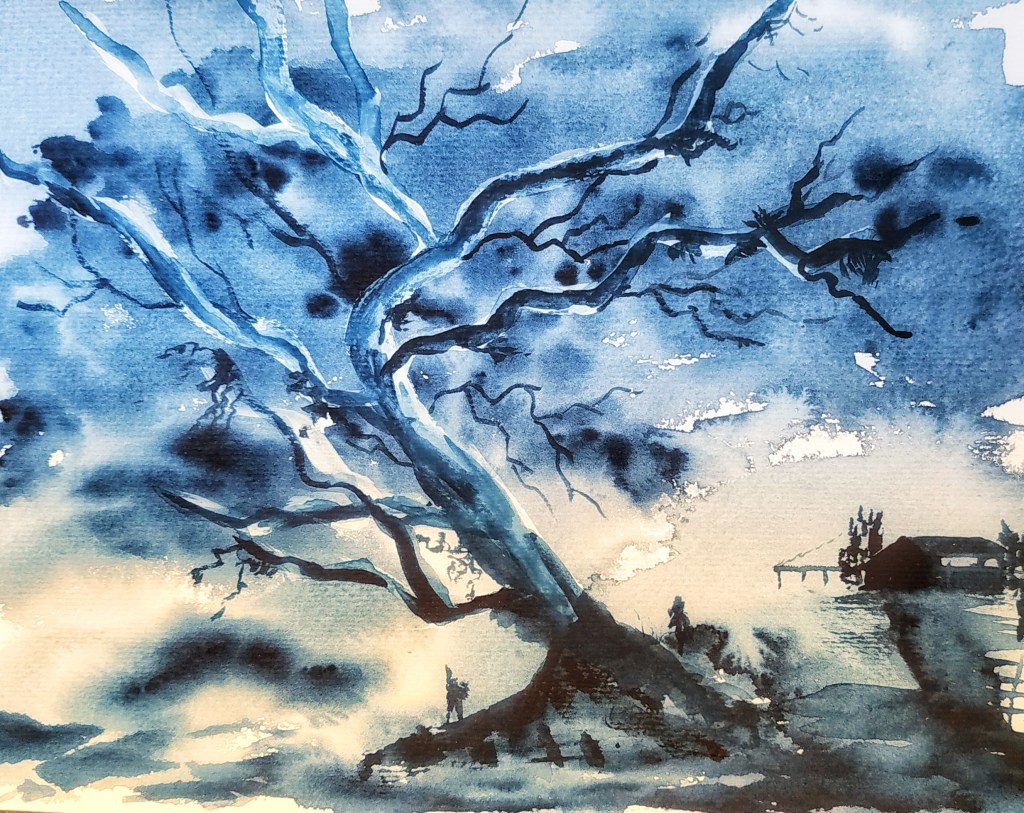
Vibing on the mystic trees,
their upside is downside, their downside is upside
selves telling me:
You’ve got to cut through the attachments.
Then, not a new, but old made new again, insight
confirms, clarifies, brings details to,
shines a light on the specifics:
Stop desiring what you already have.
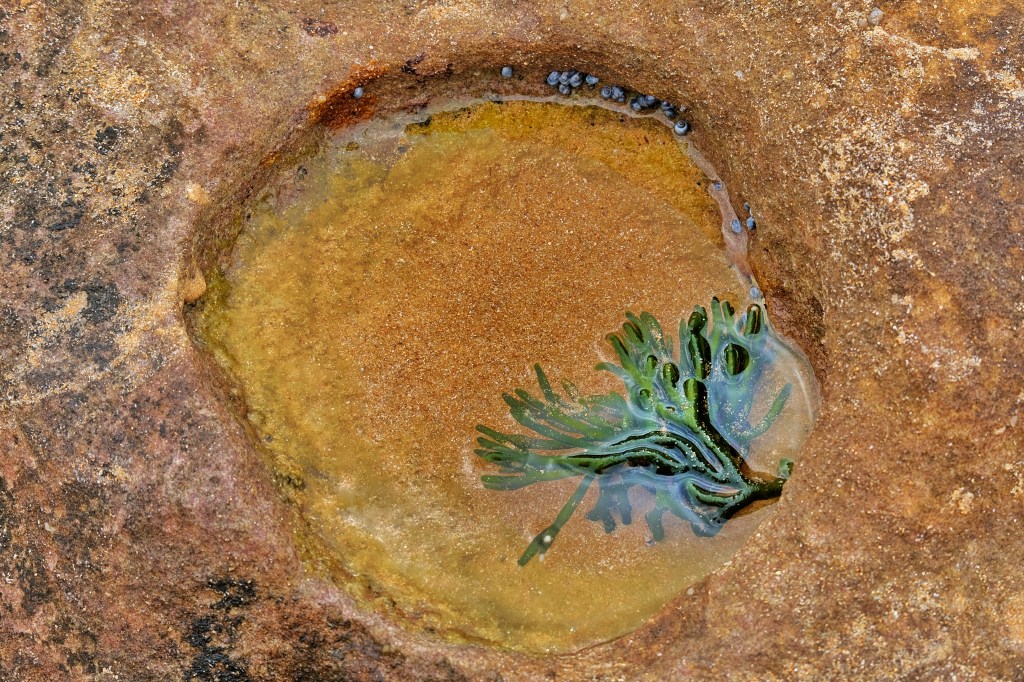
Yellow-Golden sands
carpet the floors
of tidal rockpools,
home to crustations and seagrasses.
And the coffee tasted like medicine.
You know how YouTube will recommend videos? Well one that’s constantly recommended to me actually is illustrated with my photos.
So, when it came up again today, I thought I would take a look. It’s been a while since I last watched it. To be honest with you I found it really quite moving, watching it again. Anyway let me share the brief story of how this all came about.
I’d met folk singers Susan and Colin Parrish through the community radio station I once managed. I loved their music and style right away and now, over ten years later I’m still drawn to their music and listen to them very often.
We became friends and after sharing some of my photos with Colin, I was truly surprised when he used them as the visuals for a video he put together of Sue and his cover of The Rose, a terrific song made famous by Bette Midler.
An extraordinary take on a beautiful and powerful song. And to see my photos accompanying was a real thrill. Then as it is now.
I thought I would share it with you here. One thing I hadn’t remembered: Colin’s description :

I was surprised to see my words there. And you know something? I think this song, my photos and that little forgotten quote from me, are all a perfect match. Love is. That’s it really: love is. We, each of us, all are merely expressions of love made manifest in the material world.
I hope you enjoy watching and listening. My little quote really is only echoing lyrics from the song:
Some say love it is a flower and you it’s only seed
Amanda McBroom The Rose
Peace
Welcome dear reader
Have I shared with you my Bhagavad Gita? Well, I know I’ve mentioned a few times that it’s one of, if not the primary resource for study and guidance for me.
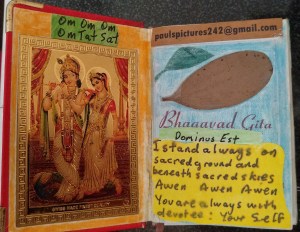
As you’ve probably guessed, this is a quick photo of the inside of the front cover. And, again as you’ve noticed, I like to stick things in my books, especially this little one. (Actually now I mention it, this is the only book in the traditional format as in made of paper, I own). It’s an old practice and for me adds multiple dimensions and depths to what is already a treasure.
Sometime I’d like to go through and describe to you all that I have added, but for today, do you see the little green section with the words Dominus Est printed?
In the religious tradition I was raised in, these two words have a specific meaning and use. However, it’s only recently that I’ve come to think of this little Latin phrase (well technically it’s a sentence, but …) in the sense of the literal meaning of the words themselves: God is.
That’s it. Or the Lord is, or the Master is. If we change the Dominus, we can use this tiny sentence to define our conception of the divine, the holy, in any way that seems right: Truth is, Beauty is, Art is. For me, God is, sits right. As do the others in this list. Same same.
So, God Is. What else could possibly be said that would add to this already very emphatic and simple statement? Nothing at all. It’s stand-alone, complete in itself.
Why? Well, if we were to add anything at all to these two words, such as God is Truth, or God is Love, or God Resides in …, or God is called … , then we are in fact stating only a little of the truth. Sure, God is truth and love, and goes by many names and is found in many forms, but once we say what something is, we are actually making more of a statement about what it is not.
Mind you, it’s perfectly natural, and for many of us helpful, even necessary, to ascribe to God a name and or form. We are ourselves material beings, living in a material universe; it’s logical that we would choose (or need) to see God in a word, a physical object, or attribute some other kind of materiality to our notions of the divine.
I must say that I am one of those who find it difficult to envisage an invisible, non-physical, and impersonal ‘God’. Of course, our little statement, God is, does indeed say just this doesn’t it? Isness is pretty non-corporeal, certainly not in the least physical. And isn’t even a ‘spirit’ or ‘entity’ of any kind; Isness just is. The moment we label something (including ourselves) we miss that isness, that essence.
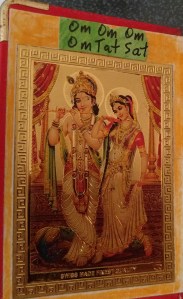
You see my picture of Krishna and Radha? This form, or forms, is one of the several that I feel right in having as a kind of focus, or centre of my devotion to and love for the divine; for love, for truth, and for it all.
You might be saying, this guy does believe in a personal God. He just told us. The truth is I don’t believe or not believe that Krishna (or any of the myriad names and forms we’ve invented) is God. God simply is. And my heart tells me that this is enough.
There are a pair of theological ideas known as Cataphatic Theology, and Apophatic Theology. Cataphatic describes or approaches the divine by stating what God is, while Apothatic (you guessed it) describes God by speaking only of what God is not.
My guess is that pretty much everybody, from whatever tradition, would approach the divine (and not only the divine) in one or other of these ways. But for me it was such a relief to realise that there was no need to go there at all. I could stop with the definitions and the descriptions, the what is and what is not. I have the freedom to not have to believe or not beleive. None of it matters. Dominus Est. God is.
Am I there yet? Have I let go of dualities? Hardly. Maybe the odd glimpse, but it’s rare. And it always will be for as long as I live in a physical body. But to paraphrase something Swami Ramdas said:
I’ve set my feet upon the path, so I am already at the goal.
Peace and love from me to you