A Little Ode to Vincent: A Poem & more

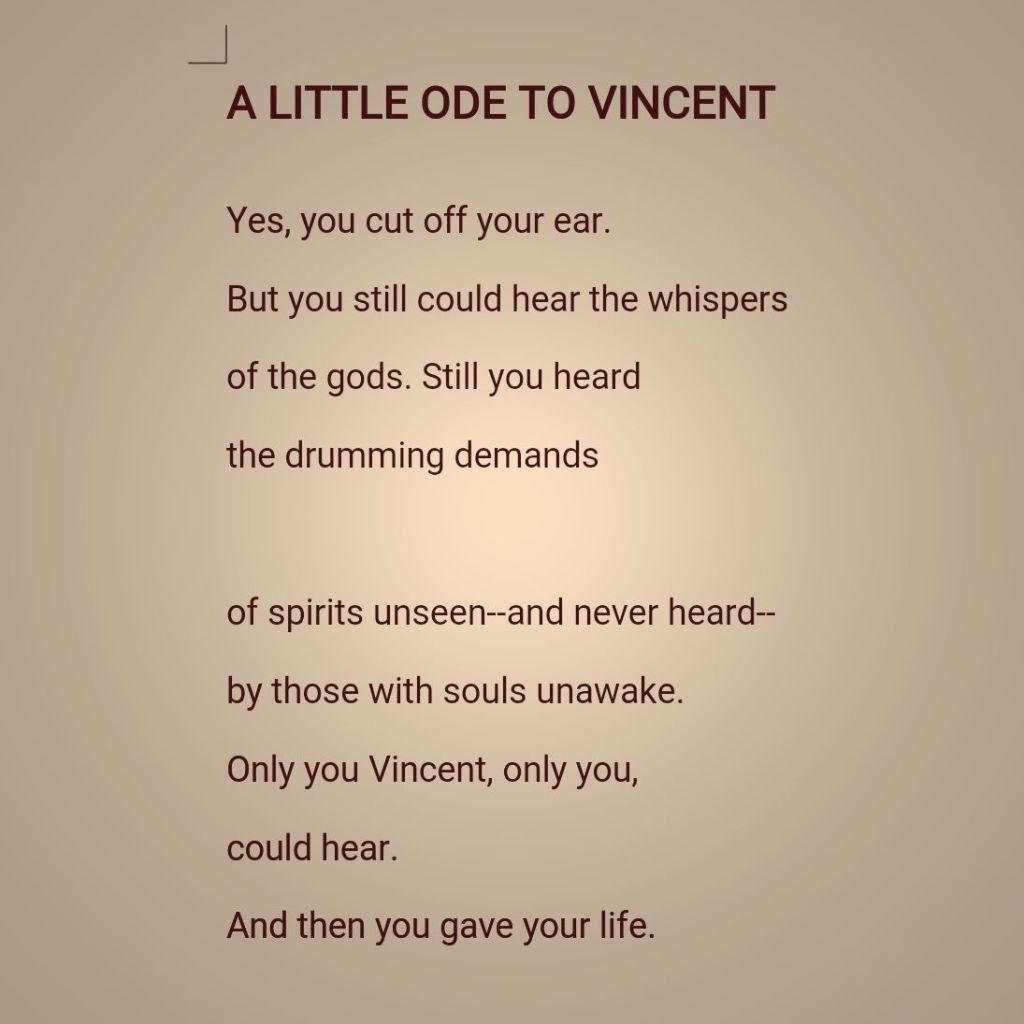
Way back long ago in late 2014 I wrote a poem. Which as a stand alone statement is hardly cause for excitement on any level I can think of.

Except to say that in that poem I expressed much of what I felt (and still feel all these years later, perhaps more so) about Vincent Van Gogh. I called it A Little Ode to Vincent, because it was a kind of love song, a celebration of Vincent and an affirmation of my reverence for that great one.

Anyway, I was reading some old poems last night and I came across A Little Ode to Vincent. I checked to see if I’d shared it with you on this blog at some point, but to my surprise I found that I hadn’t. Which is very nice for me, because I get to share it with you now.


There it is then. Thank you for allowing me to share it with you. There isn’t a word I’d change if I were writing it now.

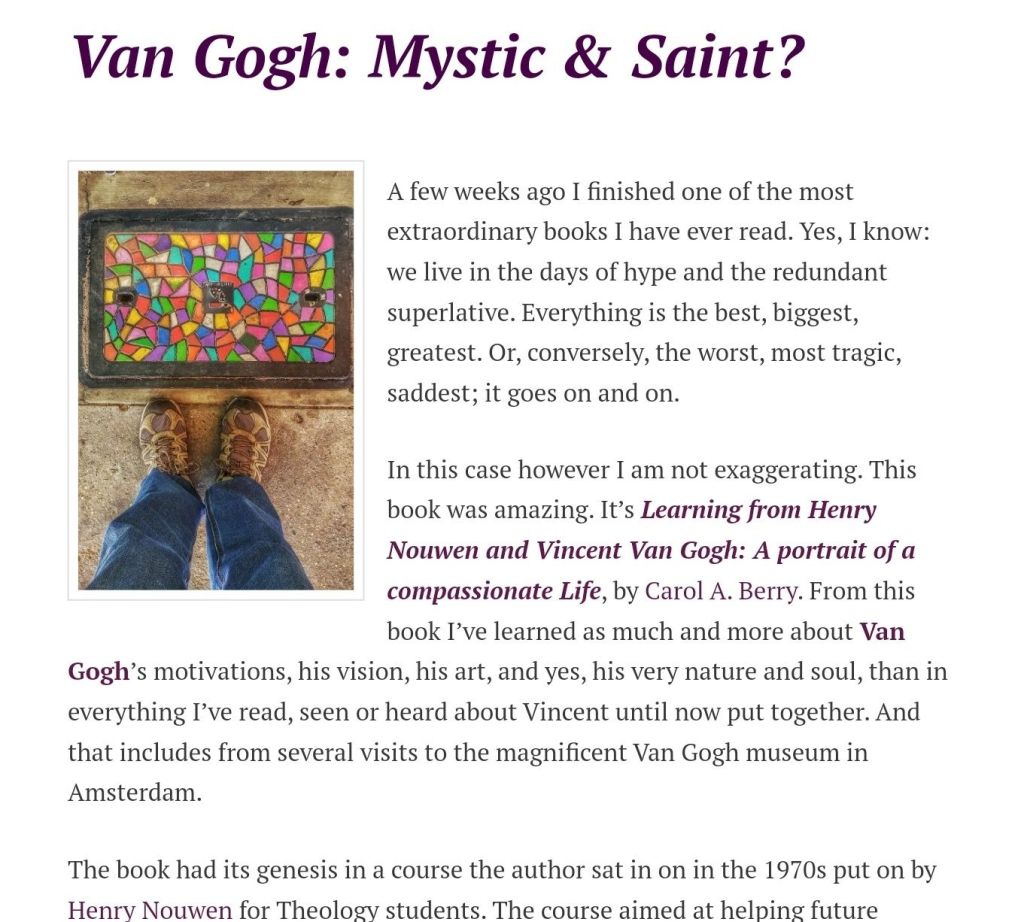
While looking through my blog checking for this poem, I came across two posts from 2022 which mention Vincent. Well, one is about a book I’d read on his spirituality and his quest to lead a compassionate life. Have a look at the beginning of that post and what I wrote about that book:

I still remember the book and its impact on me vividly. Please read the post Van Gogh Mystic & Saint, and if at all possible read the book. In fact I’m going to try to track it down and read it again, or at least do some Googling on the topic.

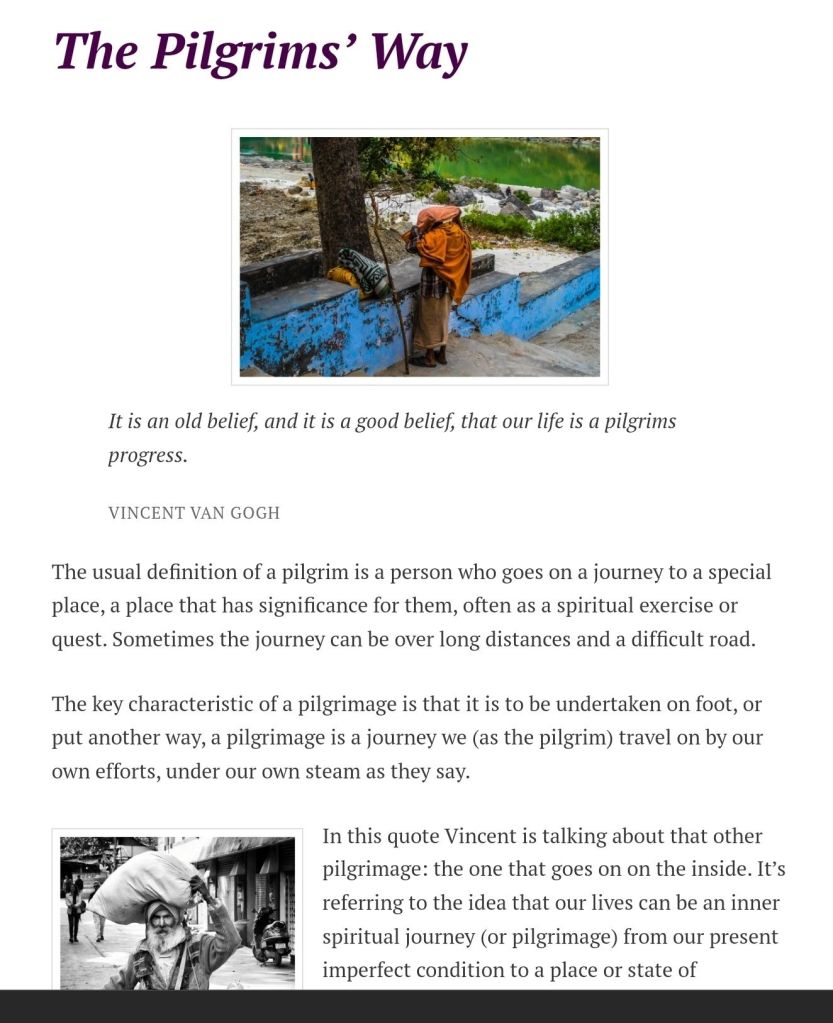
The other post I wrote at around the same time isn’t about Vincent directly, but it does open with a quote from him, and he’s referred to throughout the post. Here’e the opening section:

Again, please take the time to read it. It’s called The Pilgrims’ Way, and I think it makes a very nice sibling post for that first one I’ve linked to.

I hope you found the little Ode of mine satisfying. I have always had great reverence for Vincent, and after reading the book about his spirituality, I was even more deeply attracted to the man, the artist, and the mystic saint that was Vincent Van Gogh.

There’s nothing more genuinely artistic than to love people.

Vincent Van Gogh

Illusion, fear and wrong thinking? A good question

Greetings to you, visitors to the cave

Let me begin this post by asking you a question. No. I’ll start again: I’m going to begin this post by asking me a question. It’s a question prompted by prayers I recite every day, not only during my morning practice, but at random times during the day. Here goes with the question:

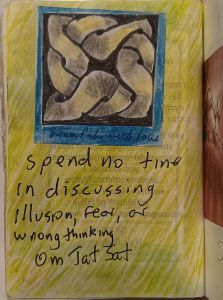
How much time do I spend discussing illusion, fear, and wrong thinking?

Well the short answer is, a lot! Despite all my efforts, prayers, meditation, discipline, and the rest, I spend way too much time pondering all kinds of illusions, indulging in an ever revolving range of fears, and thinking about all sorts of ridiculous, irrelevant, and unwanted stuff.

Oh, before I go on, I should mention that there are actually two prayers I’m referring to:

This prayer, which you might call an affirmation comes, I think, from the teachings of the ancient Indian Rishi Adi Shankara. I’ve not been able to track down the exact source. Getting a little ahead of ourselves here, but a perfect example of wrong thinking would be to berate myself for not being more careful with sources.

So, what does it mean to spend time discussing illusion, fear, and wrong thinking? Well, I know I said I was asking myself this question, but I think it would not be out of order to say that we are all prone to spending time on these things.

Discussing is obvious: talking about, thinking about, angsting over, worrying over. Illusion? Anything that isn’t real, stuff that’s ‘make believe’ as the expression goes. Anything that we are imagining for good or bad.

Our illusions are often about worst-case scenarios, or at the other end of the spectrum, they can be about some fantasy, an idealized perfect outcome to a situation. There is a lot written about how we are so very much trapped in illusion; it’s not the place here for that discussion.

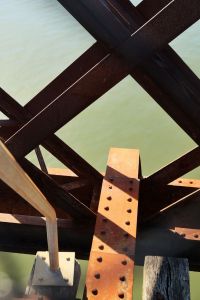
Fears: pretty obvious what fears are. I don’t know about you, but I can get to thinking of stuff to be fearful of anytime, anywhere, even things I know I can face without fear. Like a couple of days ago I was walking across a rail and walking bridge near our current hermitage. A long time ago I had huge paralysing fears of high bridges, especially over water as this one is.

But for a long time now I’ve felt I have mastered this fear and then suddenly on this occasion I looked down to the river below and shocked myself with ‘What am I doing?’ type thinking and fear returned. Mind you, it passed quite quickly as I reminded myself I’d walked over this bridge (and many others) a lot of times without a second thought.

And then there are fears about the future, fears of consequences of past actions, fears of not making the right choices now, fears for health, loved ones, the world. Anything goes when it comes to fear doesn’t it?

Ah, now we get to the biggie: wrong thinking. Again I think it’s safe to say that we all spend far too much time in the company of wrong thoughts. And again, they can be about anything, and can pop up to take over our mind without warning.

Consider how often we think about things that are either none of our business, or they are things we can’t do anything about. We obsess over what we see on the news,  or what celeb is doing what and with whom. Think about how interested we often are in what other people are doing, thinking, saying.

Then there’s blindly following fashion, thinking so much about things we don’t have (and how everyone except us has those things already) that we give into advertising, and end up buying lots of stuff we don’t need, maybe can’t afford, and might not ever use. And don’t forget about the one we all fall for: gossiping about others whether they are famous, our family or friends, or simply our neighbours.

A huge case of wrong thinking are the harsh judgements we make on ourselves; and the amount of time we spend thinking about our faults and failings. And don’t forget the other end of the ego spectrum: it’s also wrong thinking to be constantly telling ourselves how great we are.

There are endless examples of wrong thinking. We need to bear in mind Buddha’s central teachings: there is a middle path that can be taken in all things. Well, this maxim applies to thinking as well. Remember that our mind can be our enemy or our friend.

Even enlightened ones such as sages, rishis, saints and the like, fall victim to illusion, fears, and wrong thinking. Of course as they are enlightened, they perhaps are less affected, less inclined to fall to the depths, as the rest of us might.

Of course, there are ways we can put ourselves on the path to that enlightenment. But in truth, it is a subject that is dealt with very adequately by all great scriptures of the world, not to mention the visionaries who have delved deeply into psychology, philosophy, and the human condition.

And this leads me to the second prayer:

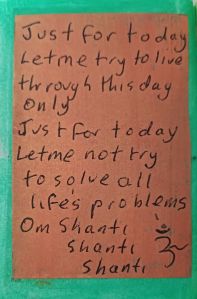
This one comes from a song by George Harrison, titled Just for Today. I actually did a post on this song a couple of years ago that you can find here. As well, if you do check out the lyrics of this masterpiece, you will see that my prayer is a rather generous paraphrase. I don’t think George would mind; I hope you don’t either.

Just for Today (the song and, a little less articulately, this, my paraphrased prayer) is a prayer for presence, a plea to be in this place, and in this time. In other words, an affirmation that I (or you) may remember that there is only here, and only now.

But, and it’s a big big but, we need to make of our entire lives a prayer.

Of course that means using the words, but it also requires a whole lot more. Discipline, self-control, deliberate actions (saying prayers is obviously also an action), meditation, silence, contemplation, and to put it simply: good behaviour in all that we do and think.

Now, this prayer inspired by George is a good place to finish. Or rather, it’s a good place to remind ourselves we can’t solve all life’s problems at once.

Being present, being here and now, really says we have no other choice but to live through this day only. Or perhaps we can paraphrase once more and say we have to actually realise what is already true: we can only live through this one, ever-evolving and moving moment.

So, how do we get to that point of spending less time discussing illusion, fears, and wrong thinking? By coming to realise that being in this moment, and in this place, we are already perfectly fine. All we can and need to do is remember that one simple fact. But don’t worry, all you need to do is remember it just for today.

peace and love

The Best Job in the World

Indeed, it is clear to all who dwell there that through them the world is kept in being

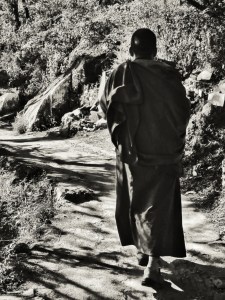
I jotted down this note I forget how long ago. Over the last few years I’ve read a lot about the early Christian hermits who lived in the deserts of Egypt, Syria, and other areas of that area we label the Middle East.

While I think it was one of these early hermits who uttered these words, it may instead have been a monk or hermit from the 9th or 10th Century, living in the forests of Russia or Eastern Europe. (I wish was a lot less careless with sources for things I note down).

In any case, it was spoken by a hermit or monk who, along with perhaps thousands of other men and women, fled the strict dogmatism of both government and religious institutions , as well as the corruption, materialism, noise, and all the other distractions of the cities and towns.They went to the deserts, the forests, and other remote places, in search of solitude, silence, and peace.

They longed to commune with the divine. They chose to bypass the mire of worldliness, and hoped to find a better way to serve the divine and the world. The writer or speaker of our quote is pointing our attention to all those who went to the deserts, the forests, and other sanctuaries, who in her or his words, believe they are actually keeping the world going, and its people too.

These nuns, monks, priests and hermits, knew that by communing with the divine without distractions, and living a simple life completely and absolutely centred on the divine, was the way to save the world.

‘So’, you might be saying with a slightly cynical tone in your voice: ‘These are people who have ‘escaped’ from the world and are ignoring governments and the law, rejecting social status of any kind, not associating with other people like other good citizens. They’ve gone to sit in a hut or cave or whatever and are doing nothing productive at all. They’re not buying stuff so they aren’t contributing the the economy. And you say they are the ones keeping the world spinning round? Hardly.’

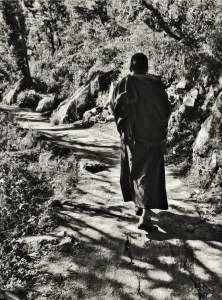
There are hermits everywhere.

Yes, I think they are. Keeping the world spinning I mean. Just as mystics from all the world’s religious traditions, these women and men of the deserts – and the forests too – knew that the world they’d left behind wasn’t real. Well, yes, it’s real enough of course: I mean we only have to look around us, and feel the workings of our bodies. It’s real alright.

But, realer (I know, it’s not a real word) than this physical world we are in and are an integral part of, is what lies within us as well as everything else in the Universe:

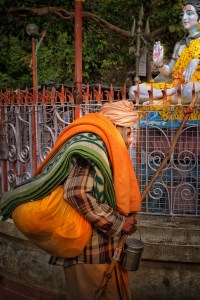
Holy Wanderer
Detached from all Worldly Entanglements

The divine, God, the life force, Consciousness. So many names for the same thing. Many of us sense that at the core of ourselves there is ‘something else’; that there is some kind of intelligence for wont of a better word. This intelligence is what illumines life, as in life, the universe, and everything.

But, we don’t see this, or not so often anyway. The mire of worldliness (a phrase I mentioned earlier and which I like very much) seems to be specifically designed to keep us in the dark so to speak, about our true nature.

Think about the seemingly endless focus on materialism with its temptations and promises to make us happy; the conflict and competition among individuals and nations to acquire more power, possessions, land and anything else that ‘they’ve got and that we want’.

Mire is a good word: We’re trapped and sinking fast in a kind of quicksand.

And this mire keeps us from becoming aware, from realizing, that we are the Consciousness (the word I prefer but, as I said, names are just names) mentioned above. It keeps us ignorant of our true nature, and we go on and on struggling to keep afloat in the world.

The hermits of the past and the present, the nuns, monks and other contemplative people of all kinds, and, in many and various places, are all engaged in a quest to know – and yes, to realise – that they and everything else in the material and non-material universe is Consciousness.

I believe that, far from being unproductive, from ‘doing nothing’, It is the engagement by such people everywhere with this quest that does indeed keep the world in being.

Courtesy Wikimedia Commons Thank you

I would like to leave you with a couple of quotes if I may.
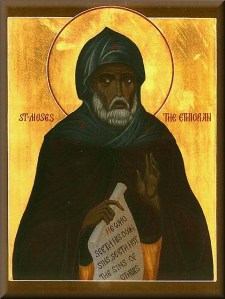
The first is from Abba Moses, one of the greatest of the early desert fathers who was born in Ethiopia and lived in Egypt in the 4th Century:

Our objective is puritas cordis,’ Abba Moses told Cassian and Germanus [fellow monks].A heart kept free of all disturbance. The more we cultivate such inner stability, the more we can offer our lives in service to the world.’

Courtesy Wikimedia Commons Thank you

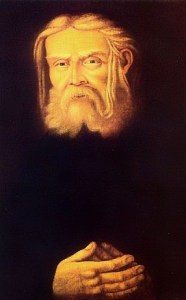
The second quote I would like to share is from Saint Seraphim of Sarov, a 19th Century Russian monk who lived as a hermit deep in the woods:

‘Acquire a peaceful spirit, and thousands around you will be saved.’

Probably the best gig in the world I would say.

Peace and love

Believe It or Not

Welcome friend to another post. It’s good you are here.

Like so many other people I like documentaries on, well, all kinds of topics. I sort of go through phases and a while back I was on an historical/archaeological kick. And if it involved adventurous journeying, then so much the better.

Anyway, one I watched has stuck with me. In this show, an Indiana Jones type went in search of an ancient religious artifact. After a sombre pilgrimage across a stunning but arid landscape, a number of adventures and fascinating tours of interesting historic sites, he was forced to conclude that nobody could know for sure that this particular artifact actually existed.

This was especially the case given the fact that several hundred individual churches across a vast area claimed to possess said artifact, according to our intrepid guide. Then there was a doco I’d seen a few days prior that suggested this artifact was in fact hidden in Southern France.

Or perhaps it was destroyed in 800BC as some other ‘experts’ suggest. In any case, our fearless explorer came to the conclusion that, at the end of the day, whether the artifact still exists (or ever did exist) isn’t the point. He told us that what mattered was that people believed it existed, and that its power existed through that belief and was a force for good in people’s lives.

Actually I think even this misses the real point: I don’t think we are necessarily meant to have a belief one way or the other when it comes to the historical accuracy of myth. Myths tell us stories about truth, about our place in the Universe, and how to behave and live a good life. The facts or lack of them aren’t important.

Every culture throughout human history has had its myths: about creation, about their pasts, their gods, their futures, and how to conduct one’s life so that society can continue to function. Some will say that we in the so-called West are lacking our own myths and stories.

Well, I also believe that our myths are in many respects largely forgotten, or perhaps are only held by this group or that within our societies.

I think we all have our own myths, whether they are ones received from our society either consciously or unconsciously learned, or from our own personal life experience. Then of course there are the so called ‘modern mythmakers’: the media, politicians, and marketeers, all advertising their own ‘truths’. But that’s not what I’m talking about today.

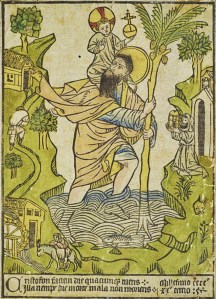
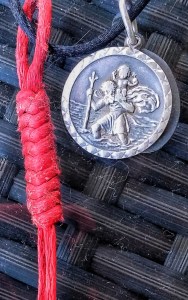
So, moving right along. Hands up if you’ve ever owned or been given a St Christopher medal? Ah, just as I thought. Huge numbers of people out there have at one time or another had a St Christopher around their neck, or hanging from their car’s rear vision mirror, or perhaps tucked securely in their bags. And really one doesn’t have to be ‘religious’ to admit to ownership of such an artifact.

He’s an interesting character this Christopher. He is a saint of the Roman Catholic Church and here we start already to get into the myths and legends around our friend Chris. It’s widely known that he was stripped of sainthood and declared to have never existed after the reforms of the late 60s in the Catholic Church. Myth number one.

He is still a saint, and all that happened was the church found itself with an overly crowded calender of saints’ days and decided that some could be cut off because they weren’t necessarily of ‘universal importance’, and besides, he may not have actually ever existed.

Poor old Christopher was thus unceremoniously dumped. No saint’s day, but he did keep his sainthood. As for the minor question of his existence, the church said that wasn’t their decision to make.

Not much is known about the possibly historical figure of Christopher. First up (myth number two) his name wasn’t Christopher: he was a seven foot five inch (may or may not be a myth) called Reprobus. He was a Canaanite who while working for the king suddenly decided to go off on a spiritual quest to find an even greater king.

Like all good heroes, Reprobus has all kinds of adventures, until one day he meets a wise old hermit who tells him that if he wants to serve the greatest king of all then he has to help people cross a treacherous river where many drowned trying to get across.

So, Reprobus started to carry people safely across the raging river. One day he lifted a small child onto his broad shoulders and carried him safely to the other side. Reprobus told the child that he’d never carried such a heavy weight before, and so they had both been in grave danger.

The child then told Reprobus that he had not only carried the weight of the world on his shoulders, but also the one who made the world. In other words our friend was informed that he was indeed serving the greatest King of all.

And that’s how good old Reprobus got the name Christopher: the name means Christ bearer. Later, Christopher is martyred for his faith and the rest, as they say, is history. Because of his splendid lifesaving deeds serving people crossing the river, our hero over time became the patron saint of travellers. And his fame spread beyond the confines of the Catholic Church and all sorts of people have looked to him for protection for themselves or loved ones when travelling.

I have a confession to make: I love and always have loved (venerated isn’t too strong a word) St Christopher.

Mind you, I’d always had some issues around the lack of evidence for his having ever existed. Not to mention the small detail of a miraculous appearance of the Christ as a child who was as heavy as the whole planet.

Anyway, while I was never quite convinced that St Christopher was a real historical figure anyway, I agree with what our friend the Indiana Jones look-a-like says: it doesn’t matter.

And for me there is still a truth at the heart of all this: Our pal St Christopher is me. He is you; he is each of us. We all have the strength to carry the soul of Self, the heart of ourselves, across the raging rivers, through the wild storms, and across the sometimes very rocky ground that make up each of our lives here on Earth.

Do I wear a St Christopher medal? I most certainly do. Belief or non-belief in his historical existence is beside the point for me. It’s the myth I resonate with, the symbolism.

My medal shows a big, strong guy wading through knee high water carrying a small child on his shoulder. Both of them are me. Both of them are you.

Peace and Love
Paul