It’s been just over a week now since the new page on the blog went live. I have to say that it’s been very satisfying setting it up, then uploading some of my devotional poems.
Actually, it was while uploading one yesterday that I thought, I’ll feature this one in its own post. I did mention that I would like to continue this occasional practice.
There’s not too much to say about this particular poem really – best to leave it to speak for itself. I’m only introducing it like this because I wanted to include a Wikipedia link that might help clarity a couple of the terms and some of the details mentioned in the poem.
The poem speaks about the concept of Viakuntha, which as you’ll see is the supreme heaven for some Indian traditions. The link leads to an interesting and short read, well worth the time I think.
The myth of Vaikuntha was a trigger for this poem, as was the meaning of the word itself. Is it a real place? Who knows. Fact and truth don’t always agree, and as for me, I don’t think about the question.
Myth has been the way we humans have always used to tell our story. To try to sort out the big questions: where are we from? Who are we? Where are we going? All the ‘big questions’ are addressed by mythologies from every culture – every family, country, you name it – on Earth.
In any case I think that my poem came about as a result of my own contemplation on the story, on those big questions, on Self really.
I hope you will visit my Poems of Devotion page. I’m still adding poems to the page, and of course, with grace, I will continue to write.
Now, please enjoy reading my poem, and I hope it’s a nice experience for you.
Love and Peace Paul the hermit
OUT BEYOND CAPRICORN & DEEP WITHIN EACH HEART
Vaikuntha: Without anxiety. Is there such a place? Free from worry? Out there, they say, beyond Capricorn. There’ll you’ll find the highest heaven, the abode of God.
No need to look to the stars: Vaikuntha is here. Vaikuntha is now. Within and without you.
Vaikuntha is indeed beyond; beyond the material world, beyond the realm of bodies and minds; beyond the illusions of places and spaces. Atma – Universal Consciousness – you and me, that’s Vaikuntha. You and me, all there is. No anxiety
‘You must be sick in the head,’ replies, as quick as you like, his partner hermit of 40 odd years. (Obviously an old and oft shared joke).
‘Of course I’m sick in the head,’ bursts out of the hermit in response. ‘It’s like saying the sun comes up every morning. It’s a given, a simple fact of life.’
Problem is, it’s not true is it? the sun I mean; it doessn’t come up does it? Doesn’t go down either for that matter. I mean it looks like it rises up every morning, and it looks like it goes down every night. But it doesn’t. In reality it’s us here on planet Earth who are doing the turning.
At ‘sunrise’, our home planet in its continual revolving has us looking at a stationary star (our Sun, Sol, Surya) that is, rather than going up, just sits there as we revolve downwards leaving it behind, Same story at night with the sunset, just the other way round.
Our experience when looking at this scene is that the sun is going down behind the hills. But in reality it’s the hills and river and the viewer going up as Earth rovolves. Hard to get one’s head around.
To explain what we see, what we experience – or rather what our ancestors saw and sought to explain – the simplest, most obvious thing to do is tell it like we see it. Sounds obvious enough, but as we’ve just seen, the story we inherited and which was only recently (in historical terms that is) shown to be incorrect, of the rising and the setting of the sun was based on an illusion,
As to the hermit and his story – the long-held believed to be true story – well, if we’ve been able to establish that stories we tell ourselves are often based on illusions, then perhaps the hermit can look for another story concerning the state of his head health, that is based a little more on facts, not so much on illusion.
Or to put it in other words: It’s quite possible that if the truth of the matter is that the sun never goes up and never goes down, then just maybe the hermit is not actually sick in the head.
Except perhaps when it comes to old jokes shared between beloved partner hermits.
Surrender is a key issue for our community of Hermits. Surrender in the sense of, to put it really simply, how to just go with the flow; how to recognise that the universe moves as it does, and how might we fully realise that while we do what we can, playing our part, in the final analysis, life unfolds as it does.
Like I guess, most people we often have trouble accepting the so-called realities of life like bodily changes, world events that sadden, shock or outrage us. You know what I’m talking about. We just like stuff to work out just as we would prefer, and when it doesn’t? Well that’s when we suffer; we get angry, frustrated or sad or otherwise affected emotionally and even physically. Again you know what I mean.
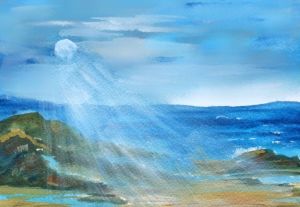
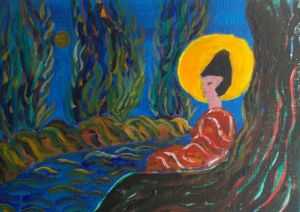
Courtesy of our resident artist
‘The will of God’ or ‘the will of the Universe’ are common recommendations for surrendering to. But of course ‘God’ or the ‘Universe’ have no will of their own; it simply is what it is, and follows the laws of nature, the natural order of life the Universe and everything as has been famously said time and again.
So, a small poetic offering on just that theme of surrender. This time asking: surrender to whom or to what? The answer I come up with is perhaps not as far out as it might first appear when you read it. Maybe we’ll do a post looking more deeply at that one.
Anyway, please accept my small offering.
WE SHALL SURRENDER UNTO WHOM?
To whom, or to what shall we surrender? We are hermits; we dwell in a hermitage. Here are our cells, our Paradise. A walled enclosure unto which we may surrender.
I feel like talking more … Sorry. Start again. It’s not what it seems and, well rather than get into it now, just read on a bit and all shall become clear.
Anyway, there’s an old joke that goes like this: One friend says to another friend: ‘How come you’re always talking to yourself?’ To which the second friend replies: ‘Well, you see, I always like to talk to the most intelligent person in the room, so I look around and usually I find that it’s me. So I end up talking to myself’.
Okay, maybe not so funny. Could be taken as bad manners or rude come to think of it. But that’s how jokes often are isn’t it?
Anyway, and here we get to the little bit of clarity I promised, you’re probably going to remind me that I have often said I would like to talk less, and be quiet more often.
That’s still true, but this is different. You see, lately I’ve been feeling the need to talk more about various aspects of my ‘inner life’. You know the sort of thing: confusions and worries; niggling issues bugging me; that kind of stuff.
And my community hear and experience quite enough of my inner life, with its contradictions, mood swings, and the rest; I have no intention of being more of a burdon than I probably already am.
So, I look around and ask who’s left? Me! Myself! I! Not exactly the most intelligent person in the room, so there the joke breaks down, but it does indeed look like I might end up talking to myself after all.
Well, it’s kind of a yes and no sort of thing. ‘Myself’ is the individual with this mind and body, making these words appear on the screen. It’s the ego self, the me that’s the being who walks, talks, breathes, and … Well you know what else.
But, and this is the brilliant bit, if I separate the words to read My Self, will it’s a whole other story. For a start, Self is not ‘mine’. Self is that part of me that is consciousness; and it’s not a different entity than ‘your’ consciousness, or anyone or anything else’s.
So, if I start talking to this Self that’s actually anyone and everyone, and not just me, who is it that I am in fact talking to?
Sounds to me like I’d be talking to you, and you, and everyone else; to the trees, the birds; everybody!
And yes, that’s exactly right. For me, there is only Self – consciousness – that is indeed anyone, anything, everyone, and everything in the Universe, both seen and unseen.
In other words, I’d be talking to God; the Divine; the Absolute Reality; the Thou Art That described by at least one of the world’s great spiritual traditions.
Which is to say, I want – need – to spend some more time talking to, and in conversation with, God.
Phew. I’m glad I figured that out.
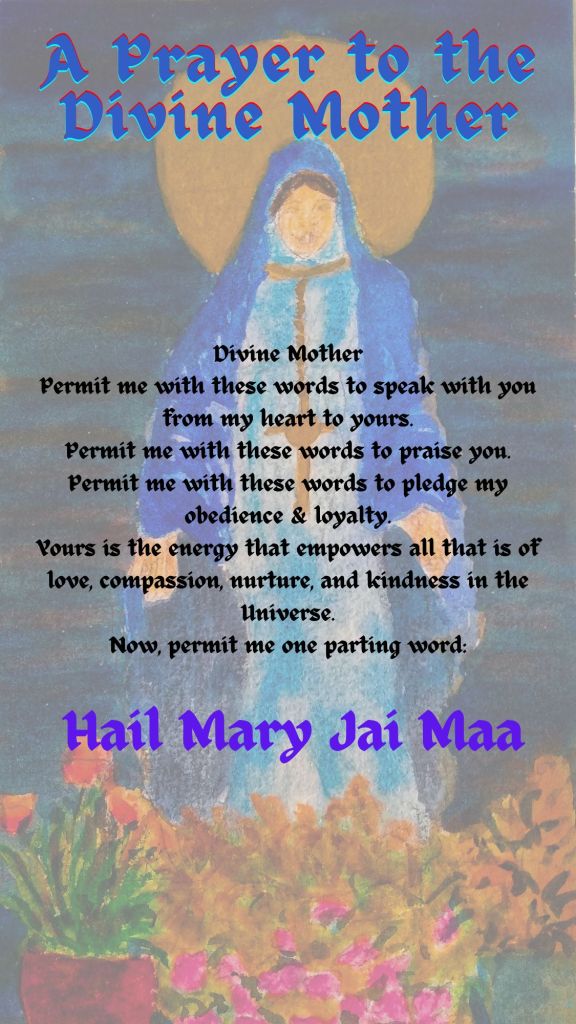
You might remember the prayer I wrote a while ago to the Divine Mother? Seems like a good place to share it with you again.
It was way back in the earlier days of this blog, sometime in 2022, that I wrote a post about our community’s liking for snacking on plain toast by choice. It’s our more or less regular late evening, before bed, bite to eat. Perhaps accompanied by black tea, as I described in that post.
As I also point out in that post, I do actually enjoy plain toast. It’s not that I no longer like jam or other yummy spreads; I like them too well truth be told, but sometimes, well, plain is good.
As the day winds down to become night, and we settle to our evening snack, I will sometimes make a joke about simple food, or monks with simple tastes, whatever. Anyway, a few nights ago I made a remark, a joke, that has had a profound impact on me.
‘I’ll just say a prayer for my two slices of dry toast.’
Of course I am just like so many other religious or spiritually inclined people, and say a prayer before I receive any and all food or drink. It’s a long time habit, and a blessing I like to perform. Just a thank you is all it is really.
This comment, this joke, as soon as it was out of my mouth, I realised, of course I will. Don’t I always?
It’s true that our community lives simply, as simply as we can. And that includes what we eat and drink. It’s also true that this is not some sort of ethical stance consciously taken; nor is it a kind of overlaid act of solidarity with those who have no choices due to poverty or other circumstances.
It’s purely and simple because we like simple. It really does suit our natures and temperaments and for us it is the obvious way to live.
It is no renunciation: we welcome simple. This obviously is not to say that we are unaware that our very natures and temperaments naturally steer us away from choices that are unethical or are out of sync with compassion (call it solidarity) for other beings.
The reason I’m ranting on about this off-hand comment thrown out as a so-called joke is, well just that: It was off-hand, and my misguided intention in making this ‘joke’ was insensitive and careless; it was lacking compassion for all the other living beings sharing life and consciousness with me.
And for that flippancy and carelessness, I ask forgiveness from the invisible community that is in fact all of us struggling to live in a material world.
My sense is that in saying ‘all of us’ I might instead say, all of us who are in truth One; We who are that one Self that seeks forgiveness.
Lately I’ve been dwelling on thoughts and other mind stuff. A lot, and in both senses: mind stuff won’t leave me alone; and the nature of that mind stuff has had me thinking about it all, as well.
Of course, it’s the way mind works – especially as one makes the effort to calm the mind, still the thoughts and move beyond them to that little place of stillness and silence. It seems the more one practises, the more mind works hard on keeping one thinking, distracted, absorbed in memories and fantasies; anything but still and quiet.
And, in recent times, I’ve come to understand how and why the Desert Fathers and the Desert Mothers spoke of these mind activities as ‘demons’ who came to tempt, torment, distract and disturb.
The memories, thoughts, fantasies, fears plaguing me lately have been like that – extreme, upsetting, disturbing. All making me long for the good old days of simple day to day ‘distractions’.
So, here’s a weird thing: Yesterday, when once again sitting for meditation, I realised that yes indeed, those good old days had returned. Thoughts and memories had taken on a lighter tone – even running a Star Trek episode in my mind. Mind you, there are some that might say that this is very deep meditation material.
Still all the ‘what ifs’, the ‘should haves’, and the rest, but not so heavy, not so frightening or depressing. I was more or less welcoming the light relief.
Then it occured to me with a shock: I had fallen for a sneaky mind trick. Welcoming the relief as I just said, I wasn’t being so firm in my efforts to still these kindler and gentler, not so threatening thoughts as I had when the ‘demons’ had come calling.
So, mind with its wiley ways figured I was an easier target for distraction. No need now for extreme measures.
Well, dear mind of mine, I have woken up to your sneaky little strategy. I’d like to have you as my friend – as you most certainly are a great deal of the time – but if you want to play the old demon game, then I am going to have to try just that much harder to ignore you.
Actually, no. No trying. Despite your determined efforts dear mind, and your ever-changing strategies to keep me off balance, I will simply be here. Being still. Not disturbed.
Reading the other day about the deeper meanings of the word Amen, a memory surfaced.
A memory from the summer of 1971. I was seventeen years old; young yes. I was hitchhiking around Europe, and as for this memory in particular, I was sitting day by day in the Dam Square in Amsterdam.
The memory of which we are speaking involves chanting. One day (or it could have been more), chanting, along with dozens, perhaps hundreds of hippies, freaks, travellers from all over the world, assorted tourists and locals. Chanting Amen. Just like Sidney Poitier sings in Lilies of the Field. Minus all the verses; we chanted the chorus only. Amen. To help get the vibe, just go here.
Anyway, it was a nice memory, a memory of a day (and more) of music in a time of exploration, on the road and trying to be free.
More that that though: experiencing the memory gave me the feeling that that day, in the Square, had included at least a moment of devotion.
Sure, it was likely just one more tune among many sung during those times, but as I think about it now, I sense a distinct vibe of devotion and praise. I recall a sense of a kind of rejoicing in the word itself – Amen.
Anyway, here is the resulting poem. Do look up the chant; and do please join in, add your voice – your own distinct vibration – to the gathered voices.
Amen
DAYS OF AMSTERDAM CHANTING
Once upon a time I hitchhiked to Holland. Another mad attempted escape, trying to leave the madness behind. Amen.
Crashing in the park in the night, beneath a bridge – when it rained, behind the bushes – when it didn’t. Amen.
Squatting in the Square in the day. Sometimes singing days. Dozens of hippies, freaks, travellers, and even a few tourists and locals. Amen.
Many memories of those days remain. Like this one: I was 17, you see, in those days, squatting in the Square – Dam Square. Music in all directions. Truly surround sound. Guitars, bongos, reedy things like flutes and whistles, even a trumpet I can recall. Amen.
Then, a chant erupts, and soon engulfs the gathered. Amen … Amen … Amen, Amen, Amen.
And, now, I’ve joined the chanting, maracas shaking held high, as if in exalted devotion, as I sway to vibration overwhelming. Amen.
This entrancing word, this creative vibration, how long did it linger, permeating the very air I was breathing? Amen.
Memory informs: it was hours. That is to say, it was eternal – or was it a mere moment? Same. Of course, Amen – Om – the vibration of creation was never born, is never changing, always existent. Amen.
Always creating. Always dissolving. Then again creating. Making manifest that which was unmanifest. Amen.
Or, is it a sound and light show? Amen, the word, the vibration, the sound shining a light on what is there already? And what is there already, is all there is. Amen Amen Amen
Welcome to another installment in our occasional series (see links to all previous installments at the end of this post) looking at some of the answers given by Krishna to his cousin Uddhava during a kind of Q&A session that takes place as both are about to leave their hometown which is on the brink of war. Krishna’s returning to Heaven, while Uddhava is heading for parts – and a future – unknown.
Hence all the questions around living a good true life, all driven by the knowledge that Krishna isn’t going to be around anymore to give Uddhava life advice.
And the question we’re discussing today is certainly a big one. In fact, though it is a single part of a three part question, I felt inclined to give it our full attention. To me it is that significant. In fact, thinking about it now, I could even add here that of all the questions and answers, this one could stand alone as the question, the answer.
To the question then, as asked by Uddhava to Krishna:
What is Charity?
Well, although I thought I knew what the word charity meant, and what charity is, I did end up looking it up, just to get a clearer and deeper picture.
Yes, a charity is an organization set up to give aid to those in need. And, as I also knew, charity is the voluntary giving of help – often in the form of money or other material goods – to those in need.
All just as I’d thought. But, then, I came across another entry that filled out the picture for me a little more. In addition to the above, this listing told me that the ‘true meaning‘ of charity is generosity and helpfulness.
Again, it specifies that this generosity, this helpfullness, is usually extended to the ‘suffering and needy’. Still it suggests that charity may be at least a little more universal an attitude toward functioning in the world, a world shared with so many other living beings.
(note from me: This latter definition comes from the Merriam-Webster Dictionary. I’ve used this dictionary a great deal, and for very many years. It’s been my favourite go to, as they say.
PRESS THE PAUSE BUTTON PLEASE
Right, yes, I hear you loud and clear. Here I am going on as if this is a semantics blog. Sorry about that. Perhaps we should get back on track and allow Krishna to give the answer Uddhava and the rest of us have been waiting for:
Charity is the renunciation of aggression.
Perhaps you can see why I was at first a bit taken by surprise, and I puzzled over it for a while. Then after seeing that Merriam-Webster definition, I knew I’d found a clue: generosity and helpfullness.
Then it came to me: Ahimsa!! No, this is not some obscure exclamation reserved for Eureka! moments. Rather Ahimsa is a foundational principle underpinning many of the great religious traditions of India.
For me, Ahimsa is basically doing no harm, the practice of non-violence towards all living beings, through one’s thoughts, words (speech), attitudes, actions.
However because life is complicated (ie: there are no easy answers), various schools of thought over time have developed a kind of modification in which they say that Ahimsa is choosing to tackle the complexities of our lives in the world in such a way that we do as little harm as possible.
But how, one might ask, can we expand those dictionary definitions to include Ahimsa? Well, as far as I’ve been able to think about it so far, I’d say that Krishna’s answer itself is the root that we can graft those definitions onto
Which is to say, renouncing aggression is that root, that foundation on which to base the cultivation of charity and a charitable attitude and manner in our relationship with ourselves, with all other beings, and with the planet (and the rest of the Universe too of course).
(By the way, thank you to my Partner Hermit for that word: charitable. Not that I didn’t already know the word, obviously, it’s just that at the time I just could not find it anywhere in my slow-moving brain!)
That open, generous, helpful, compassionate, patient, kind, thoughtful (oh let me count the applicable words!), that charitable demeanour and behaviours with which we engage with the world (and with ourselves) are the result of removing aggression from our thoughts, words, and deeds.
Actually, thinking about cause and effect, and effect and cause, for a second: the way towards that state of charity is the same. In other words the means and the end don’t only justify each other, they are each other. One thing.
Don’t be ready for fight or flight each time you communicate with your boss, or your spouse, or your child, or your parent. Or with anyone else in any situation you find yourself in.
Listen to and observe with patience, care, compassion, and your full attention, the needs of others. Don’t assume you know best. And include yourself in this paying attention.
Look before you leap. Stop, listen, think, pause, before jumping into any situation that needs understanding, calm, quiet and time to alleviate any possible confusions, or misunderstandings.
If you make a mistake (or is it when?), don’t be so hard (aggression?) on yourself. Be just as open, friendly, forgiving, patient and the rest, with you as you would like to be with everyone else.
As to ‘generosity and helpfullness to the needy and suffering’? Well, all living beings suffer simply in the act of living itself. We are all well aware of this. The degree and forms of this suffering (and the needs that cause the suffering) will always vary, but even so, they are inevitable.
There’s a small mantra or prayer, I often use to end other prayers or reading, that I’ve always liked a lot:
Om Shanti, Shanti, Shanti
I have always thought that this was simply a prayer to the Divine that included the repetition of the word for peace three times.
Of course it is that, but recently I heard that it’s structured in this way with the three repetitions to make of it a deeper or more universal prayer:
Shanti: Peace within myself Shanti: Peace to all living beings Shanti: Peace to the world itself
I may have the words slightly off, but the essence is there. Anyway, for me this really does sound like Charity.
If you’ve missed earlier posts in this series please click on the links below
With the current hermitage located not so much on the side of the road, as right on the side of a large sand dune system, you might imagine that I am at and on the beach every day.
While almost every day, I walk the track that follows the crest of the dunes in this particular area, I’ve only actually gone down to the beach itself a handful of times.
So, yesterday as start to my resolve to make amends for this omission, I climbed the dune, ignored the crest track leading left and right, and continued straight on and down the other side of the dune, and onto the beach itself. My intent was to spend an hour or so walking along the tide line.
And so it was.
Judging by such rare experience of the beach itself, I might easily say I am no ‘beachcomber’; no discoverer of coastal treasures, little natural beauties from the sea, or even the occasional oddity one might expect washed up. Until yesterday that is.
Not that I went to ‘comb’ the beach: rather I was there trying to put myself on the receiving end so to speak, to be a receptacle for what I might be blessed with (not to forget the need for exercise and movement).
And so it was.
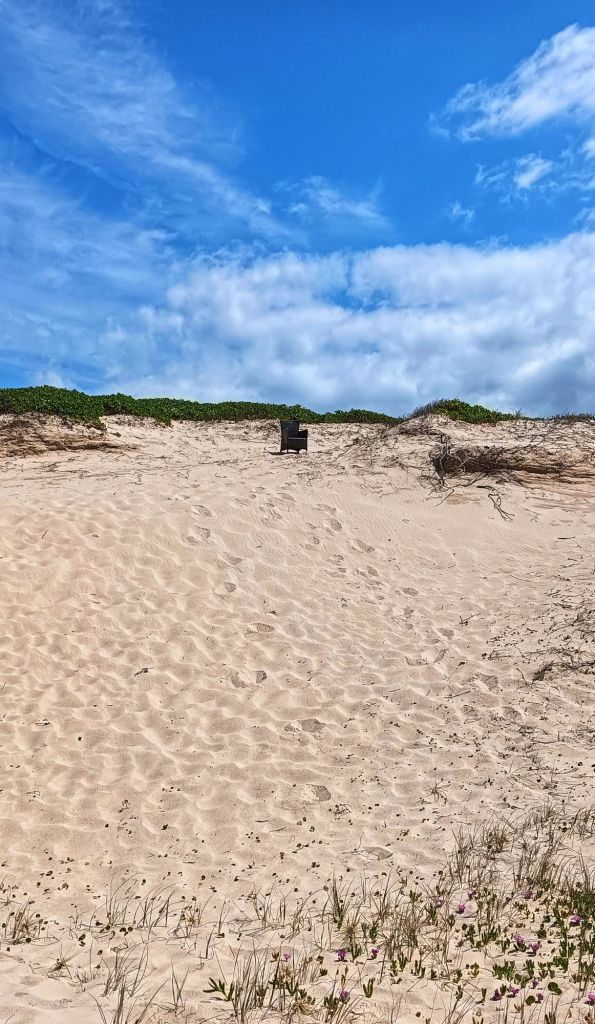
This sense of grace and blessings, I hope I’ve conveyed in the small poetic effort (as well as its companion photo) that I now share with you.
SPOTTED ON THE SAND DUNE
Strolling (briskly mind you) along the sands, There I was – deep in the liminal zone. Ankle-deep – sometimes – seawater cooling my feet. One way to receive Varuna’s blessings.
Back on dry sands (still in the liminal zone) I pause to examine a spiral shell – an elegant and delicate sea creature. It lives. Reverently, I move it to deeper water.
As I rise from my small task of union, of reunion, I glance – still within the liminal zone – upwards. There, near the crest of the sand dune sits a chair. An armchair I spotted right there on the sand dune.
There it was, facing me – and the sea – in the middle of nowhere. Though this is clearly somewhere for somebody. The perfect perch for taking in Pacific views.
Empty chair, lonely sight overlooking the liminal zone.
Today I went on a pilgrimage.Not that I don’t undertake all kinds of little pilgrimages all the time. And even more, it’s not as if my whole life – just like yours and everyone else’s – isn’t one ongoing and continuing pilgrimage.
All true; but this one, today, was embarked upon in what might be called, a classic manner: on foot, to a place of sacred significance, and in a spirit of contemplation of the nature of the journey as well on that which is being pilgrimed too. (I am positive there is no such word!)
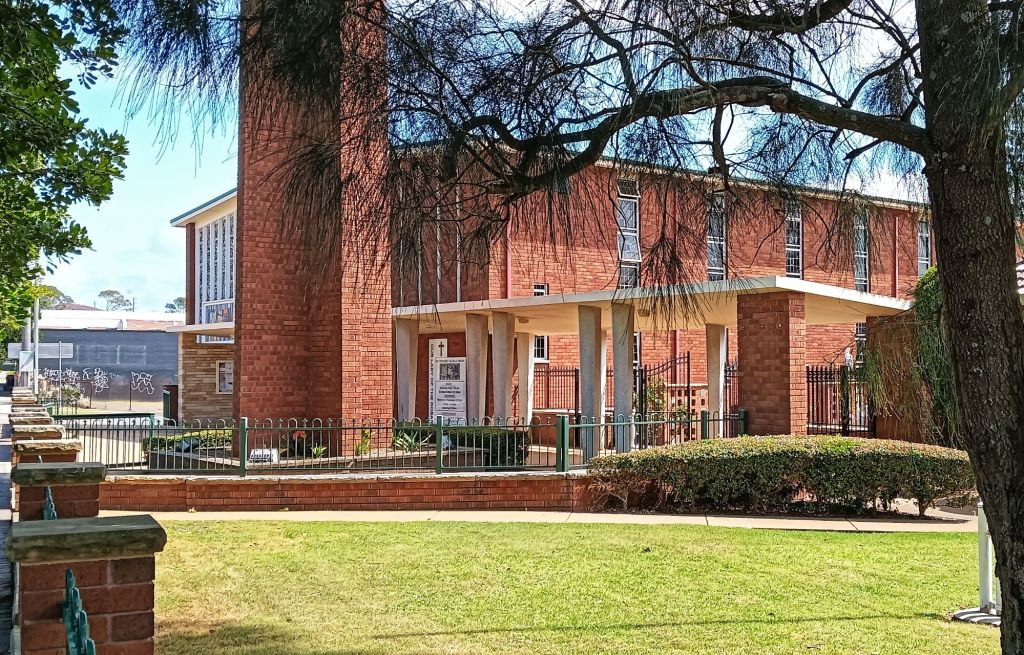
In this case, today’s pilgrimage, that place was a church about two and a half kilometres from the hermitage. It’s a place I have visited several time, but today was the first time I set out as a pilgrim and walked in the way and spirit of the pilgrim.
Our Lady of the Rosary is a Catholic church dedicated to the Mother of Jesus in her role as patron of the Holy Rosary, a Catholic way of prayer that has evolved over time and is a key part of the lives of many Catholic people.
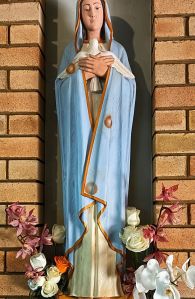
Just to the right, just inside the door there is a plain brick wall in which there is a small niche. The niche holds an almost life-size statue of Mary. She stands, hands folded over her chest on which sits the Dove of Peace.
You can see from the photo that the church itself is a lovely, quiet, serene place full of good vibes and nice peaceful energies. The object, however, of my pilgrimage was not the church in itself, but stood just inside the side door accessed through an equally peaceful, fountain centred garden.
I have come to offer her – this form or manifestation of the Divine Mother – the prayer I wrote to her which I hope you saw when I posted it on this blog recently.
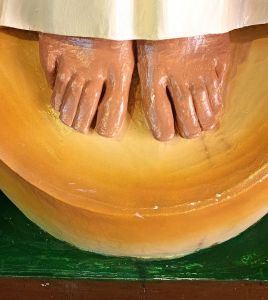
I had decided that my pilgrimage vow would be fulfilled once I had knelt at her feet and offered her the words of my heart in prayer.
My reverence for the Divine Mother is well known, and especially in her form as Mary the Mother of Jesus. Or Our Lady as we called her as good little Catholic children way back in the long ago. And I know I have said often that the entirety of the material and non-material cosmos is a manifestation of the Divine.
So, why then a special trip on foot, that I’m labeling a pilgrimage to a specific site, so I can kneel at the feet of a statue that I know perfectly well is made of stone or plaster and is simply a symbol of one aspect of the Divine?
Actually, the question has answered itself. The pilgrimage and my associated actions worded in that question tell us the why.
It is about acknowledging at a heart level and in my own way, that that symbol, that form, is actually representing a particular aspect of the Divine that I revere.
Besides, I’m not the first person who’s knelt at that spot, at Mary’s feet. I don’t know the age of the church, nor do I know the history of that particular statue, but I think we can say for certain that many hundreds, if not thousands of other people have been there where I was and spoken words from their hearts.
Being honest and true now, what I can say is that, as I said to my partner hermit: ‘I feel like i’ve been on a pilgrimage’.
And I do. I’ve walked – praying and chanting – to a sacred place where I have prayed at the feet of the Divine in the form of a likeness of Mary. I feel blessed that I actually got to offer the prayer I wrote to the Divine Mother.
Somehow I feel a link was established. A heart (mine) opened ever so slightly. I acknowledged the Divine, and I sense that I might just be – ever so slightly again! – topped up with a bit of the Grace that is in reality our true state.
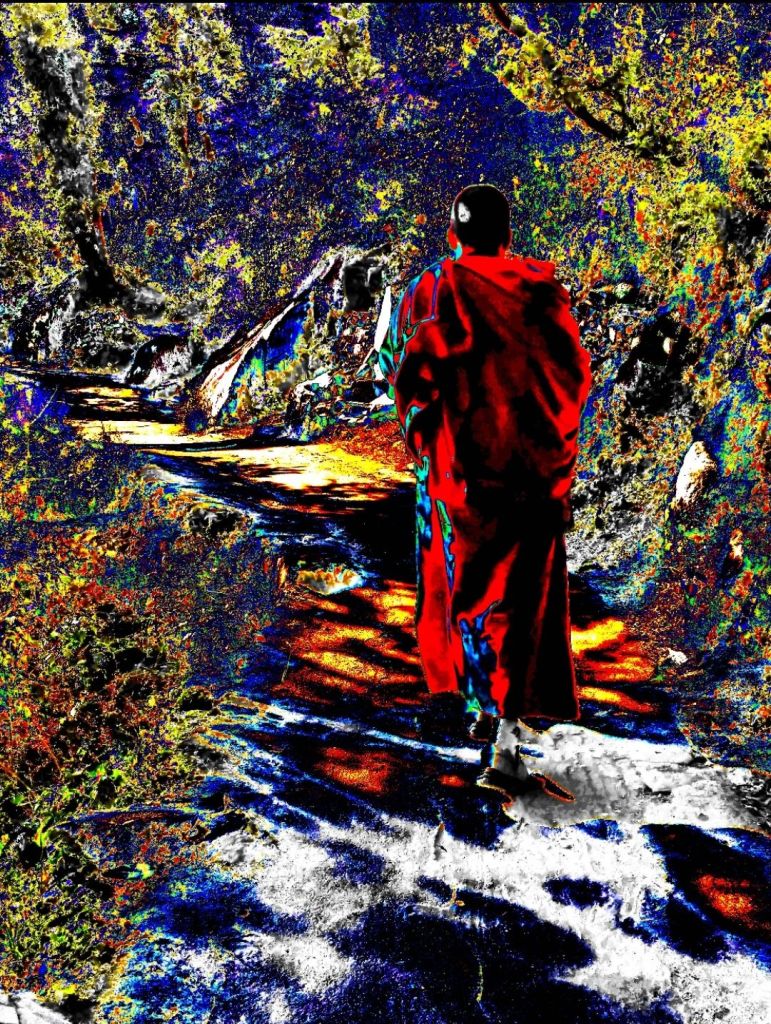
Mary in the Garden (enhanced by a fellow Hermit Pilgrim. Thank you)
So, this is the story of my pilgrimage. I was absolutely exhausted when I arrived back at the hermitage. Most likely that was due to the heat, the traffic, and the noise encountered on the way I trod.
But, now I’ve shared this little tale with you, I’m not tired. Anyway, the Way is not always easy, and we are all very well aware of that aren’t we?
Namaste friends. The Divine in me salutes the Divine in you.
It’s a walk to take,
a pilgrimage to make.
Sometime soon.
Said by me long ago, I don’t know when or where. It was one of those ‘You’re a poet and don’t know it’ moments.



















 Notes from the Hermit's Cave