On the going down and the coming up
silvered and golded stairs
to and from the Underworld.
It’s all just a giant mirror
In which we see who we are not.


On the going down and the coming up
silvered and golded stairs
to and from the Underworld.
It’s all just a giant mirror
In which we see who we are not.
Creatures of the Air,
the Winged ones.
Same like you and me:
Bound to material nature.

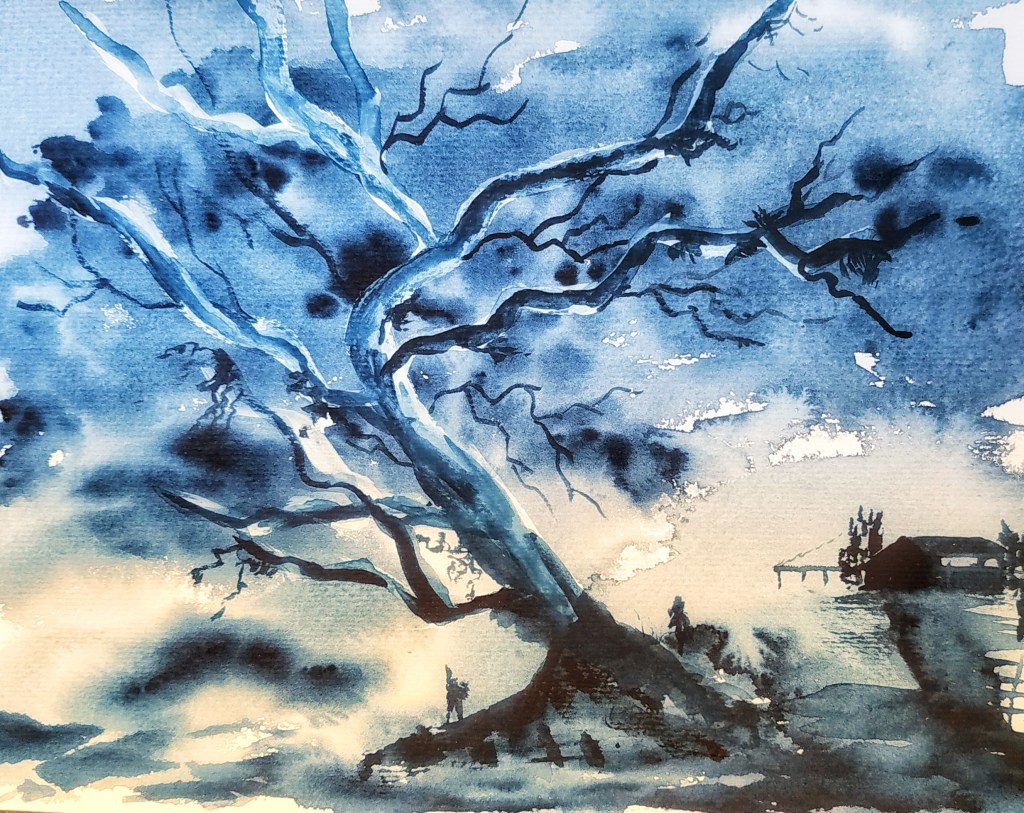
Vibing on the mystic trees,
their upside is downside, their downside is upside
selves telling me:
You’ve got to cut through the attachments.
Then, not a new, but old made new again, insight
confirms, clarifies, brings details to,
shines a light on the specifics:
Stop desiring what you already have.
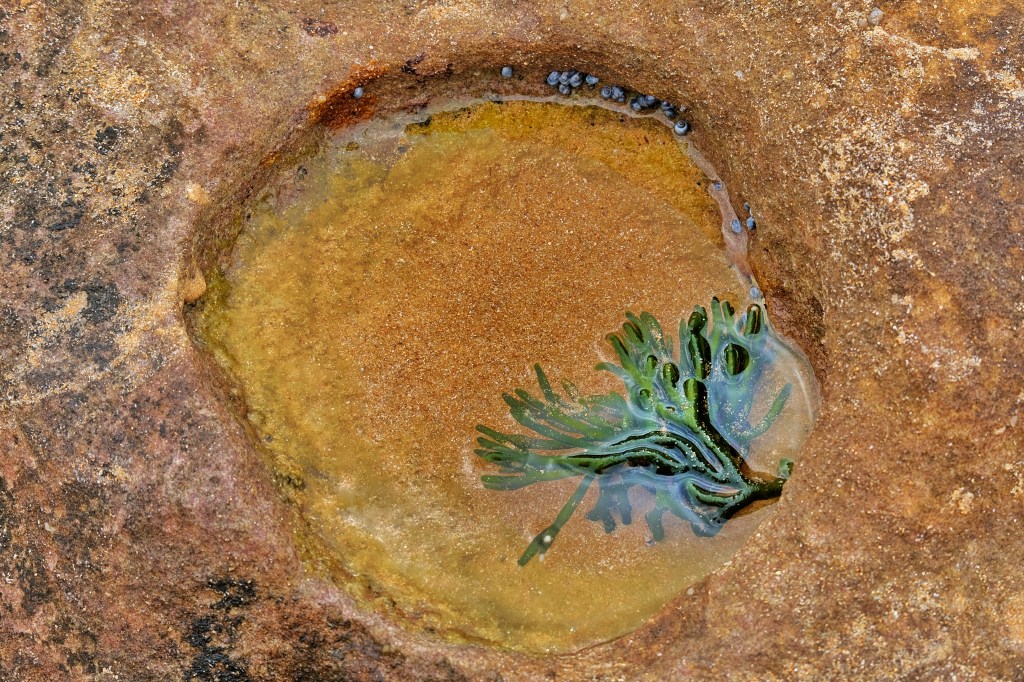
Yellow-Golden sands
carpet the floors
of tidal rockpools,
home to crustations and seagrasses.
And the coffee tasted like medicine.
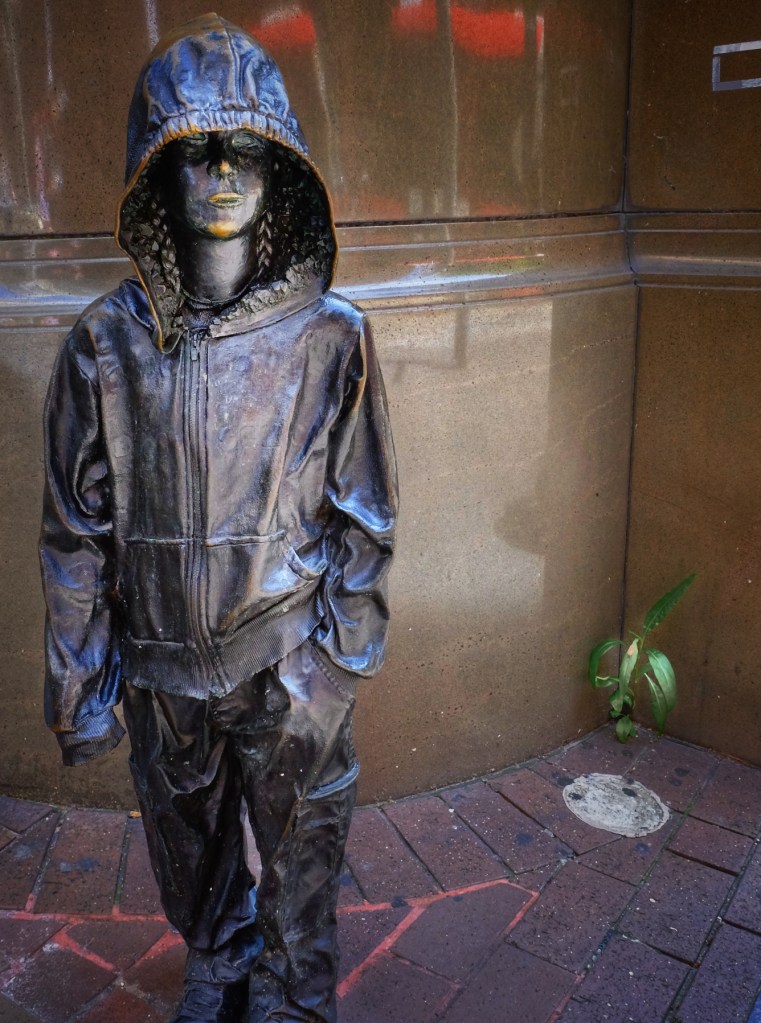
A sculpture of a young child, on a busy street corner in the heart of downtown Sydney. I like many thousands of others, have passed it by many times only giving passing thought to the origins, meaning, or significance of the statue itself.
Until a couple of days ago that is.
As a subject for contemplation and for a photograph, it is a powerful image: striking in its presence. Once one actually stops to look and reflect that is.
After several minutes of standing with the statue and asking myself who is it? What does it mean? (there is no plaque or sign to steer the way), I made this photo and I moved on.
Only later, at home, did I notice the little plant growing through the pavement in the corner. And zooming in on the plant I saw the little moth sitting on a leaf.
I decided to research online, see if I could learn more about this site. The sculpture is called Youngster and was created by artist Caroline Rothwell. It seeks to highlight the plight of refugees, in particular children.
There isn’t much online, but you can read a media article which gives some more insight into the sculpture here.
That article focuses mainly on the sudden appearance of a plaque at the site. Presumebly placed by a citizen with strong feelings on the subject, the plaque wasn’t ‘official’, so was later removed.
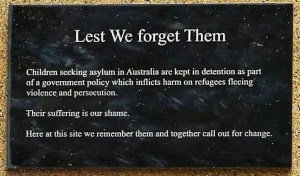
Actually, the text on this plaque pretty much sums up my own strongly held and often expressed feelings. Though, these days as a contemplative monk and hermit, I try hard to not have opinions, or make judgements on the way in which things in the material world play out.
But, obviously I am still human, and this is only one of so many issues that cause me distress, sadness, even rage. Actually, rage is a big one. But then, how could anyone of goodwill not be outraged? It is the very reason I am struggling hard to get this post down, to somehow make it all clear.
You see, at the same time as being so affected on the human heart level, I am very aware at the same time that it is the conditioning of material nature that leads to the very obvious fact that life is suffering.
Eating, sleeping, mating, and defending. Every single activity of every living being is motivated by one or more of these activities or a desire for their fullfillment. They are the basic drives that rule all life.
So what to do? As I’ve said (probably many times) I am not a warrior – I used to be but not now. However I am just like every other life form motivated by conditioning, either from my experiences in this life, or by that conditioning inherent in all material nature.
To a great extent I have retreated from the world. Not in order to escape or so I can ignore the suffering. I haven’t abandoned the world.
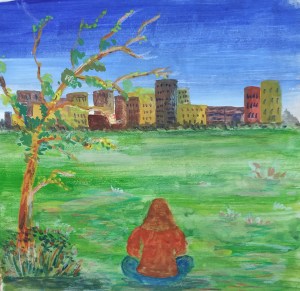
In fact the exact opposite is true: I have withdrawn, become a hermit monk, precisely so that I might be able to dedicate every ounce of my energy, my heart, my love, to prayer; to creating and maintaining a quiet and contemplative silence.
My prayer is not of the asking or begging kind, beseeching some invisible ‘god’ to give me something. Instead, I attempt to be still (never ever easy); to free and open my mind so that I may be more receptive to the Divine, to the will of the Universe; and to become more mindful in every activity and moment.
In this way I am aspiring to realize fully my oneness with all life. All life. I want to become fully awake to the fact that everything is Self. That there is nothing else.
And of course Self includes this child and all she symbolizes; it includes that little green plant growing through the pavement in the corner; and it includes the little moth perched on one of its leaves.
As well, my prayer, my aspiration for full self realization and union includes all those who are warriors, those whose activism and engagement with the material or physical world is every day alleviating and attempting to alleviate suffering and its causes in whatever form it takes on this planet we all share.
I am extremely flawed: I’d like to tell you I am always full of love and light, but there is much of darkness in me still to be rid of. So, all I’ve shared with you till now are still only aspirations and I have far to go. Nobody can say if I will ever reach that full realisation. In the meantime I intend to keep doing what I can to participate in the work of change.
Peace and love
What a piece of magic this is!
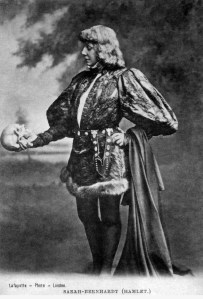
No, it’s not a quote from Shakespeare. Mind you, now I think about it, there’s a line in Hamlet, where the man himself is monologuing about the human condition and declaims a strong-felt sentiment:
What a piece of work is man! [sic]
The reality is that first quote is from someone far more mundane than the bard: me. The occasion on which I uttered this equally impassioned statement was as I sat holding my smartphone and listening to the music flowing from it through bluetooth fairy land and into the headphones I was wearing.
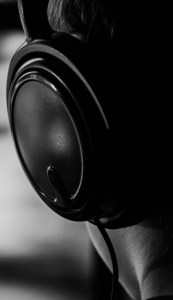
The truth is I was at that moment just awestruck and a bit overwhelmed with what I was hearing, and just as significantly, with how I was hearing a particular song.
Not being a materialist by any measure, my phone and headphones are nowhere the latest or top of the line models, but still, to me, what I was hearing was magnificent. It’s the only word that fits really.
Anyway, that isn’t exactly what I want to write about today. Reflecting on the experience described above, got me thinking about the actual song I was listening to. And that’s what I want to write about now.
The song in question is written and sung by Australian singer-songwriter Cyndi Boste (died 2018) and is called Cry Down on Me. Here are the lines that have struck me particularly:
I’m not afraid of your tears.
Cry down on me
I’ll make sure nobody hears
Cry down on me.

Before we go on, a short note. Until I started research for this post I had my own idea of what ‘Cry down on me’ means. Seems I got it wrong. However, for this post I am choosing to believe that the songwriter agrees with me. If you look up the meaning and then listen carefully to the lyrics, you’ll see that perhaps I didn’t get it wrong after all.
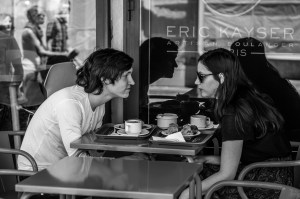
Essentially here we have the singer/protagonist reassuring another person (friend? lover? sibling? We don’t really find out, but if I had to guess, I’d say they are lovers) that they are safe to share their tears, their sadness, anger, fears and so on. Most of us at some time or another (or always?) have been afraid to express or share our emotions, to show our tears.
So, why is our protagonist going to make sure nobody hears the other’s tears? Well, she is obviously aware that the other is at the very least embarrassed, perhaps afraid of being ridiculed, rejected, or perhaps they’re worried about appearing ‘weak’ or making themselves seem vulnerable.
And how did she come to that awareness? I think she has seen this other with the eyes of her heart, seen their need. And now she’s telling them: ‘Look don’t worry, I am listening to you with my heart and I can hear you.’
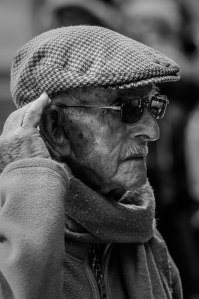
We are exposed to so much ‘noise’ from everywhere all the time. Even the tears of a loved one can be lost in the overall din that sometimes threatens to smother us all.
And of course we’re not just talking about literal tears here, and the sound the shedding of them makes: anything said, written or otherwise made known that is of substance, or real importance and meaning, is threatened with annihilation by all the trivia, gossip, advertising, round the clock news, and what I often call the general blah blah, that passes for life in the modern materialistic world.
Of course to protect ourselves from all that noise, it’s no surprise that we so often only listen with our physical ears, see with our physical eyes. Actually having said that, I know from my own experience that even that level of engagement and attention can be a struggle sometimes. And doesn’t that struggle sometimes lead us to closing down altogether?
I guess the answer lies in what Buddha call The Middle Way or Path: The bottom line is that we can choose what we listen to (or look at) and what we don’t. No need to switch off and isolate ourselves completely from the ‘outside’. Nor is it necessary to leave ourselves wide open to all that noise.
Like our protagonist in the song, we can listen with the ears of our hearts; we can see with the eyes of our hearts. It is in our hearts that love lies, where Truth lives. We can say to that other that we are listening and seeing with our hearts, while at the same time reassuring them that nobody, including us, is going to simply be hearing or seeing you only with physical ears and eyes.
The last time I listened to the song (yesterday: it’s become a big favourite) I had the thought that maybe our protagonist is reminding her Self that she’s listening. Sometimes our ‘real’ self can feel like a stranger, as if that Self is someone unknown, and living as a separate entity outside of us can’t it?
It’s at that heart level where we can truly listen, truly see, the other. And whether that other is one’s Self or another person, the truth is there really is no difference: your heart is truth, the other’s heart is truth, and it’s the same Truth.
We’ve all had this experience I think. I’ll be reading something, and right away I’ll come to a conclusion, become either sure of something or the complete opposite; I can be confused, force myself to ask more questions. I can even have brilliant insights or realizations.
No? Well, maybe it’s really just me then. But, wait there’s more: this is a two part experience. When that second part happens we will come to realise that what we think we read is nothing at all like what the words on the paper (or screen) actually said in a factual sense.
Yes, you’ve probably guessed by now that there’s a story coming. In fact this exact thing happened to me this morning, all the way to the brilliant insight or realisation bit.
In fact it was a brilliant realisation, the only problem was that it was based on only on what I thought I read, not what was actually being said.
Anyway, I was reading the verse quoted below, from my Bhagavad Gita and a sudden flash of insight hit me.
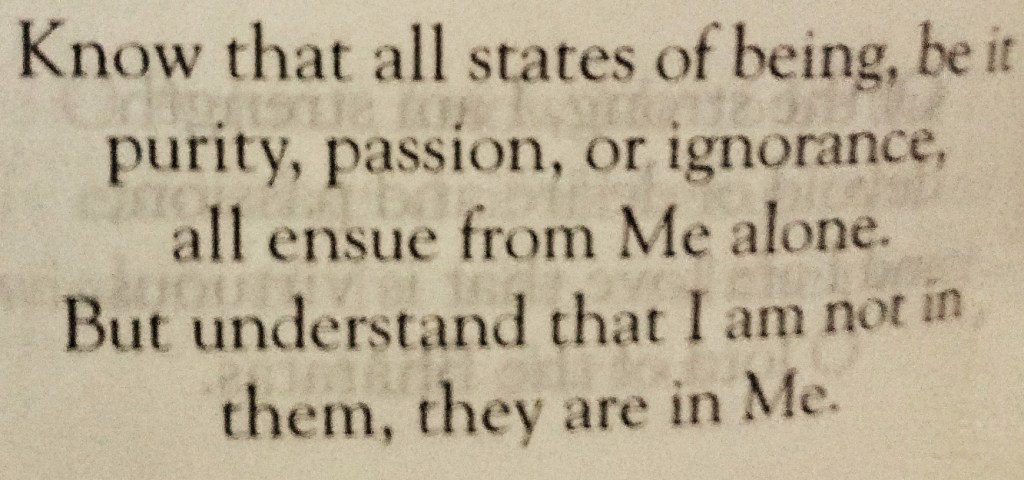
Despite these five lines saying a particular thing in a clear and precise manner, I somehow misread the first three lines to say:
All beings ensue from Me.
Bhagavad Gita Ch 7:12
Somehow my mind skipped the ‘states of’ bit and made a leap that actually lead to a great realisation: Of course, I thought; God is not in us (as in living beings), it’s we who are in God.
Which to me means that we are all part and parcel of God. I’m not saying, I’m God; I’m not saying you are either. What I am saying is that all creation as one, unified whole, is in God. And if that one unified whole does indeed ensue from God, then it follows that all of creation is God.
As individualized, embodied entities, we (along with all life everywhere) are simply manifestations in the material form of that divine energy, that life, that truth; that which we often call God.
Now, this is an instance of a flash of insight leading to a truth, when the receiver of the insight (that’s me) is engaged with what you might call some other factual reality, that is, the actual words on the page.
At first I thought, that’s weird: how did I misread all those words related to states of being? I mean they are pretty clear right? But then I thought, no, maybe not so weird. In fact, it makes sense.
How can my material mind and intellect possibly be expected to always keep its millions of thoughts, ideas, impulses and the rest, in perfect order each thought or whatever following completely logically from the one before and to the one after? It’s never going to happen is it? Not for any of us (Well maybe I’m overstating my case here, but you know what I mean).
And if mind does indeed operate on what seems on the face of it to be a random basis, then it’s perfectly reasonable to suppose that one might be prompted to some momentous insight by, well by anything really. Even if it’s a conclusion jumped to after the misreading of a text.
In this case though, that jumping to conclusions, even though based a misreading, has turned out to be a genuine realisation that I feel on an intuitive level; my instincts tell me it’s Truth.
Jai Gurudev
All that I am today is by your grace.

Welcome dear reader
Have I shared with you my Bhagavad Gita? Well, I know I’ve mentioned a few times that it’s one of, if not the primary resource for study and guidance for me.
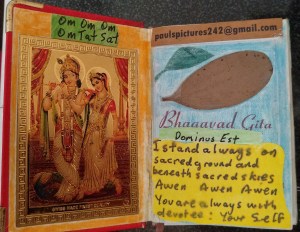
As you’ve probably guessed, this is a quick photo of the inside of the front cover. And, again as you’ve noticed, I like to stick things in my books, especially this little one. (Actually now I mention it, this is the only book in the traditional format as in made of paper, I own). It’s an old practice and for me adds multiple dimensions and depths to what is already a treasure.
Sometime I’d like to go through and describe to you all that I have added, but for today, do you see the little green section with the words Dominus Est printed?
In the religious tradition I was raised in, these two words have a specific meaning and use. However, it’s only recently that I’ve come to think of this little Latin phrase (well technically it’s a sentence, but …) in the sense of the literal meaning of the words themselves: God is.
That’s it. Or the Lord is, or the Master is. If we change the Dominus, we can use this tiny sentence to define our conception of the divine, the holy, in any way that seems right: Truth is, Beauty is, Art is. For me, God is, sits right. As do the others in this list. Same same.
So, God Is. What else could possibly be said that would add to this already very emphatic and simple statement? Nothing at all. It’s stand-alone, complete in itself.
Why? Well, if we were to add anything at all to these two words, such as God is Truth, or God is Love, or God Resides in …, or God is called … , then we are in fact stating only a little of the truth. Sure, God is truth and love, and goes by many names and is found in many forms, but once we say what something is, we are actually making more of a statement about what it is not.
Mind you, it’s perfectly natural, and for many of us helpful, even necessary, to ascribe to God a name and or form. We are ourselves material beings, living in a material universe; it’s logical that we would choose (or need) to see God in a word, a physical object, or attribute some other kind of materiality to our notions of the divine.
I must say that I am one of those who find it difficult to envisage an invisible, non-physical, and impersonal ‘God’. Of course, our little statement, God is, does indeed say just this doesn’t it? Isness is pretty non-corporeal, certainly not in the least physical. And isn’t even a ‘spirit’ or ‘entity’ of any kind; Isness just is. The moment we label something (including ourselves) we miss that isness, that essence.
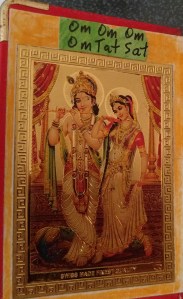
You see my picture of Krishna and Radha? This form, or forms, is one of the several that I feel right in having as a kind of focus, or centre of my devotion to and love for the divine; for love, for truth, and for it all.
You might be saying, this guy does believe in a personal God. He just told us. The truth is I don’t believe or not believe that Krishna (or any of the myriad names and forms we’ve invented) is God. God simply is. And my heart tells me that this is enough.
There are a pair of theological ideas known as Cataphatic Theology, and Apophatic Theology. Cataphatic describes or approaches the divine by stating what God is, while Apothatic (you guessed it) describes God by speaking only of what God is not.
My guess is that pretty much everybody, from whatever tradition, would approach the divine (and not only the divine) in one or other of these ways. But for me it was such a relief to realise that there was no need to go there at all. I could stop with the definitions and the descriptions, the what is and what is not. I have the freedom to not have to believe or not beleive. None of it matters. Dominus Est. God is.
Am I there yet? Have I let go of dualities? Hardly. Maybe the odd glimpse, but it’s rare. And it always will be for as long as I live in a physical body. But to paraphrase something Swami Ramdas said:
I’ve set my feet upon the path, so I am already at the goal.
Peace and love from me to you



 Notes from the Hermit's Cave