Here there are remnants
of sea cliffs.
Cliffs that have not towered
since ancient times.

Here there are remnants
of sea cliffs.
Cliffs that have not towered
since ancient times.

Towards the end of my last post I looked at where I was (or is it am?) on the Do your duty front. Do I actually do my duty? And if I do, then how well am I doing it?
My conclusion was that in some areas I am doing okay,, while in others I need to work harder to get them right. Now I’m thinking about it again, I would say that being here, in a physical body, suggests that I still have a way to go in all areas of life. I suggested in that last post that my aspiration to do my duty is a good motivator and incentive to keep on moving in the right direction.
In summary I can say I do my duty as best I am able, and, at the same time I aspire to do that duty in an even more complete and satisfactory manner.
Oh, one more conclusion – and I think it’s a really important point – is that nobody can tell you (and me) what your duty is; only you know your duty. And only you can get yourself doing it.
Which leads us nicely to our next injunction: Follow Dharma. Following Dharma will be a great help in allowing you to discover the knowledge of what your duty is and how to go about actually doing that duty. Of course there are quite a lot of other benefits to be had from following Dharma.
As I did with defining duty, I will talk here about my own definition of Dharma; and as with duty, I will be thinking about what it means to me. Once again, there are a number of ways to define Dharma, and I have my own ideas.
The easiest, most straightforward way to say what Dharma is is to say that what is right is Dharma, and what is not right (or wrong) is Adharma.
Here’s where we might ask ourselves, who gets to decide what’s right and what’s wrong? Remember in my last post I mentioned that I think I know the difference between right and wrong? Well, it’s the truth; it’s a Dharmic statement. And I suspect it applies in exactly the same way to you too.
Obviously I get it wrong – quite often actually. I’m simply a human being who is flawed, who gets tired, angry, forgetful, distracted, and even just plain lazy.

Which is another way of saying that, despite knowing right from wrong, I don’t always manage to act accordingly. So, what do I use as a guide, as a kind compass to steer me in the right direction? How do i in real life discern right from wrong? How do I know what path to follow?
When I was thinking about these questions, I thought, well, I just know: my intuition tells me how to behave, how to act. Clearly my intuition is not as foolproof as I would like, so thinking harder, I asked: is there a ‘code’ or something I follow that helps me keep on the Dharmic path?
Then it occured to me that, on a very much informal level, I try to follow Buddha’s Eightfold Path.

The Buddha taught this Eightfold Path as the means by which we might free ourselves from suffering.
The Path is not a set of commandments imposed by some outside authority. It’s not a set of rules or laws that we must obey for fear of punishment, either here in this life or in the next life.
What the Eightfold Path is is a series of pointers, a collection of concepts or ideas that can help us to navigate our lives directed by a moral compass that keeps us heading in the right direction.
The steps that make up the Eightfold Path are Right Understanding; Right Thought; Rght Speech; Right Action; Right Livelihood; Right Effort; Right Mindfulness; and Right Concentration.
A long time ago (and I’m sorry I no longer have the source) I read somewhere that one can summarise these eight steps with two short and direct sentences:
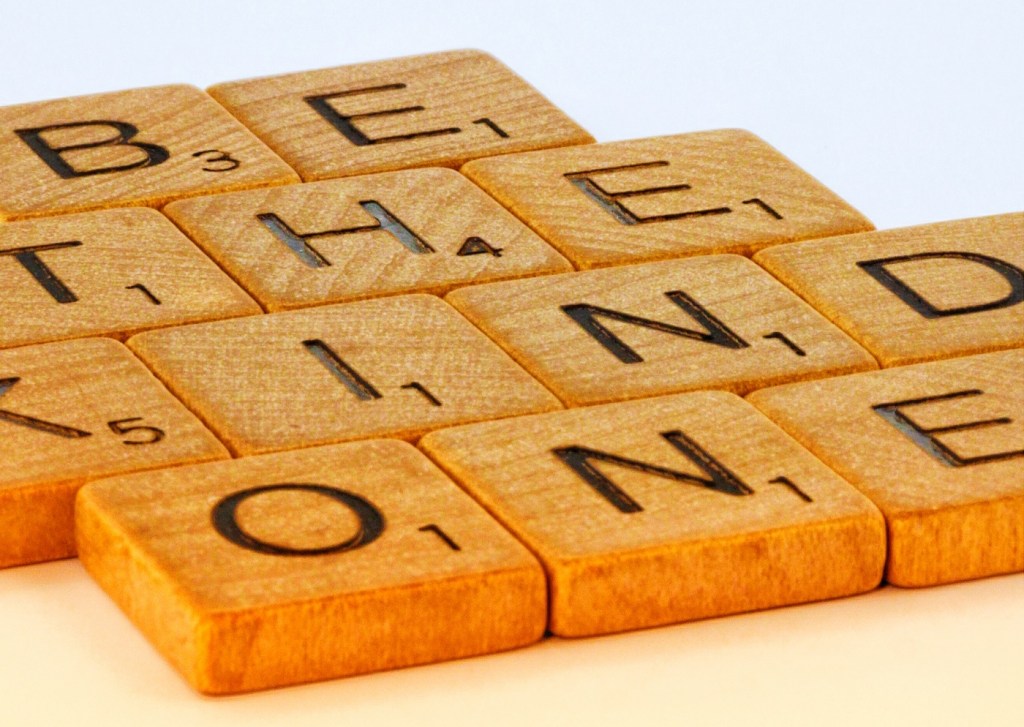
Be ethical in thought, word, and deed
Be a good, kind, and moral person.
You can probably guess what I’m going to say next: This is all way easier said than done. Well, exactly. For me it really comes down, once again, to aspiration, to trying.
In fact, one of the steps on the Eightfold Path addresses this point directly: Right Effort. Buddha recognised that it was never going to be an easy path to walk, so he reminds us that effort is as vital as any of the other steps. Perhaps, knowing how flawed I am, I would say it should be the number one step.

Essentially what The Buddha is saying here is what Swami Ramdas, another favourite teacher of mine, once said (I have to paraphrase a little here):
Once you step on the path, you have already reached the destination.
Again, it’s the effort, the trying, that is the point. For me it’s actually The Way itself.
And that’s where I’m at. Deeply flawed; deeply and seriously lacking in the right ‘thought, words, and deeds’. But I try; I’m making effort.
Live a Righteous Life
Well, at this stage, I have to wonder what else I can add. It seems to me that the aspiration to be ‘ethical in thought, word, and deed’ – not forgetting the effort to persue that aspiration – is already the grounds for living a righteous life. And at least I’ve made a start over many (or is it just one?) lifetimes.
Do good, be good, seek knowledge, celebrate all that is sacred, beautiful and is truth.
I think that’s about it, don’t you?
Peace


The inclination to seek knowledge is, for me, a gift, a blessing. And we live in a time when there are so many sources, so many resources available, and many are freely available too. There seems to be no limit to what the genuine seeker of knowledge can uncover.
Yes, of course, we’re swamped with information from all sides. We are deceived by fake news. And everything these days is a commodity, a thing to be bought, sold, acquired, or otherwise used for profit in the material world.
All true. However, this is where one’s discernment comes into play. It’s up to each of us as seekers of knowledge (on whatever topic or subject) to discern for ourselves the truth or otherwise of the information we use to form the knowledge we are seeking.
In my last post, I began to talk about two notes that I made in my notebook. These notes were quickly jotted down while seeking knowledge from two different sources about two distinct topics. Feel free to have a look at that post here if you happened to miss it.
Do your duty
Follow Dharma
Live a righteous life
These three lines are the sum of what remains of a session with my teacher, Swami Tadatmananda. It’s his short, succinct summary of the teachings I was trying to absorb from him that day.

You’ve probably guessed I am not a great note-taker; I like to just let sink in what wants to sink in, absorb what resonates for me. Perhaps on that day, I felt the summary was all I needed as a basis for later contemplation.
With that in mind, I would like, in this post, to reflect on these three injunctions, try to work out how I’m doing when it comes to taking notice of them, and actually where I’m at with actually living by them.
What does it mean, ‘Do your duty’? And what does it mean, for me, to do my duty?
Firstly, let me try to define duty. Not from the dictionary meaning, not from some outside ‘authority’. No, this is me talking about how I define duty.
Duty, for me, is defined by the activities I choose to prioritize in my life. These are the things that I believe best serve my true, essential nature. Acting in accordance with this true nature includes responsibilities such as taking care of my physical, emotional, and mental health. While this may not always be easy and sometimes feels impossible, it is my duty because my mind and body are manifestations of my true self, of the divinity.
Duty, again for me, means persuing activites – in the world as well as within myself – that nurture, protect, and grow, who or what I percieve that Self to be.

This Self I refer to is not restricted to the apparently separate entity I call ‘me’. That apparent separation is just that, an appearance: Self is all there is; I am not simply bonded or joined with all other living (and non-living) beings: I am those beings, just as they are me.
As such, my duty is to act in ways that benefit (or at the very least do as little harm as possible to) all beings, all life. Here, I guess, we could talk about Karma. But let’s leave that for now. It’s enough to say that nobody can tell me – or you – what is our duty. In fact, the truth is I already know the full extent of my duty, as we all do.
The only thing lacking for me is what I might call a full disclosure of what that duty is. That full disclosure can only come from me – as in the Self. As they say, I might know in my head what my duty is, but I’ve yet to fully realise it in my heart. And if I’m honest with myself I can say that my aspiration to do my duty is a constant reminder and motivation to do always the best I can to fulfill my duty.
In some areas I think I do my duty pretty well, but in others I have a long way to go.

In my next post (and the final one in this series: there just seems to be such a lot to think about when contemplating this topic), I will look at what it is to follow Dharma. Once again, it’ll be a very personal, subjctive answer because, to put it perhaps too simply, I like to think that I know right from wrong.
I hope this post has been of at least a little interest and value to you. I will look forward to seeing you here for my next post.
Thank you and I wish you peace.

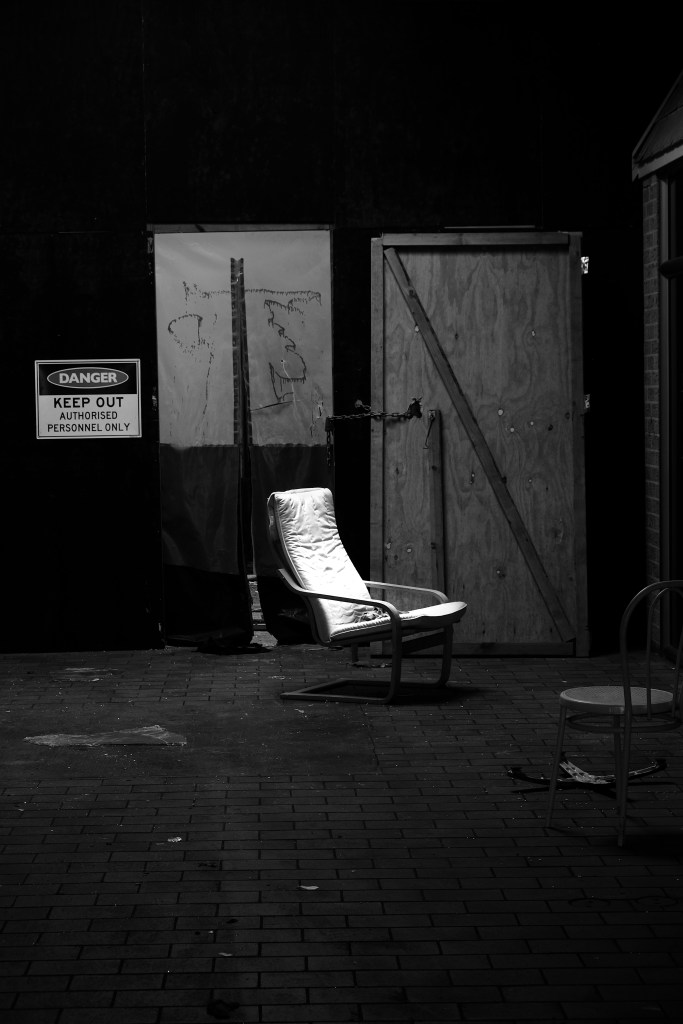
‘Looks like a comfy chair’.
That was the first thing my partner said when I showed her this photo. Her eyes – and perhaps even her heart – had found that which is illuminated by the sun, even though it’s surrounded by wreckage and ruin.
The wreckage by the way, of an abandoned and trashed store front. One of several in a small arcade, that’s long sat empty.
Ah, I thought: one more illustration of a metaphor I’ve been hearing a lot lately in my studies about consciousness.
Allow me, please, to adopt our teacher’s metaphor which, for me, really clarifies this concept of consciousness, or Atma as it’s called in Sanskrit.
Is the brilliant light streaming into this room and onto this chair affected in any way whatsoever because the chair is sitting amidst all that wreckage?
Is the sun shining any less brightly on the chair than it would if the chair was sitting in a luxuriously decorated space instead?
Of course the answer to both questions is no. The sun, and its brilliance remains undimmed, and completely unaffected, untouched, regardless of what it shines on.
The ‘I’ that photographed this scene, and my partner’s ‘I’ whose eyes were drawn to the chair in the scene, are both consciousness. Not ‘my’ consciousness; not ‘her’ consciousness. Consciousness is all; all there is. Boundaryless, infinite, all pervading. We can’t even say there is one consciousness, because there is only consciousness.
Ah, I hear you say: there is one sun shining on our world; and the sun isn’t ‘all there is’. Well, as our teacher likes to remind us, all metaphors are flawed: you can only take them so far.
Metaphors, are only meant to illustrate, to show us the way, point us in the right direction as it were. In our little example here, the metaphor is meant to help us gain some knowledge.
The knowledge that we are not what we see, hear, taste, touch, think or feel. We are that light – consciousness – that allows us to know what we experience with our senses.
One more thing: The light of the sun, flooding the chair with its brilliance, enabled my partner to see that it was comfy, even though it was sitting in that wrecked, abandoned and lonely place.
Just as in our lives, when everything seems to be crashing down around us and we feel we are the ones stranded in that wreckage, we can remember that the light of our own consciousness, is the way in which we may shine our attention on the truth of our unchanging eternal, and true nature, that is who we really are: perfect, eternal, absolutely unaffected by anything at all.
Peace and love


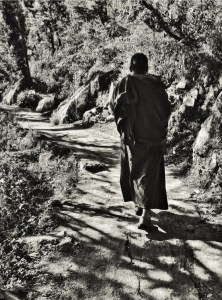
The hand of the monk
agéd, insistent, but gentle too,
takes and holds mine.
The monk sits, the Dharma before him,
sacred texts resting in their saffron shroud.
My presence completes
this circle.
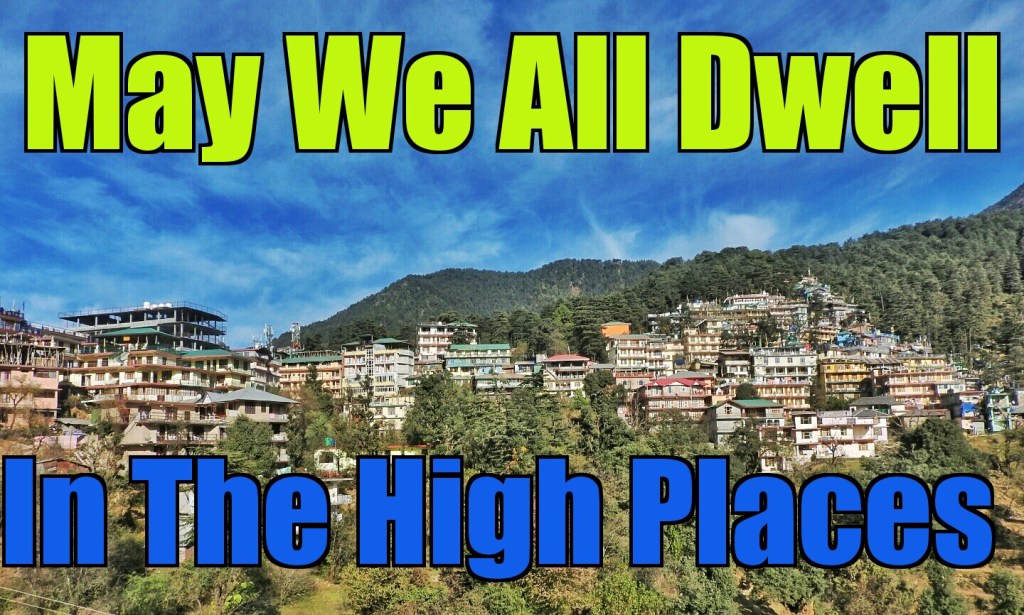
Mountain monastery
calling him; it’s not home.
Other mountains
he’s climbed. Escape.
High places divide
this world from that,
that time from this.
His loving touch, his smile,
linger in rarefied air.
Air drenched with the warmth
of the Dharma,
in this late monsoon
restaurant of the Snow Lion,
south of his land.


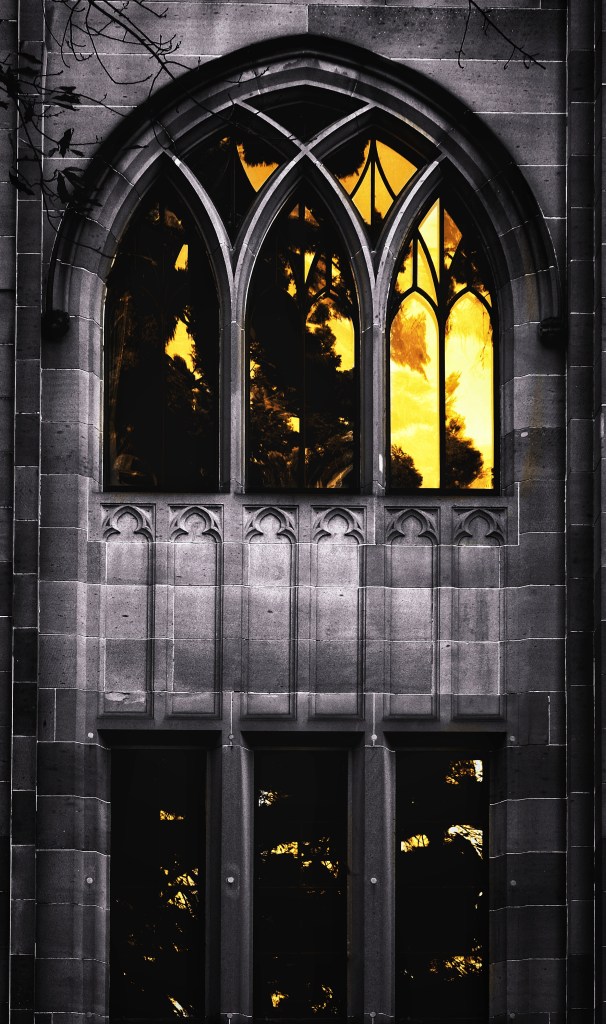
AS GAIA TURNS
Surya illumines
with his fiercely gentle life-giving light.
Gothic panes receive and reflect
golden impressions
as Gaia turns.

I’m not completely sure where I found this prayer. But I have a feeling it is by Thomas Merton, one of my most favourite and significant teachers and guides.
Thank you with Love
On the going down and the coming up
silvered and golded stairs
to and from the Underworld.
It’s all just a giant mirror
In which we see who we are not.

Creatures of the Air,
the Winged ones.
Same like you and me:
Bound to material nature.