A Gift Came to Me in an Email

Even a Leaf

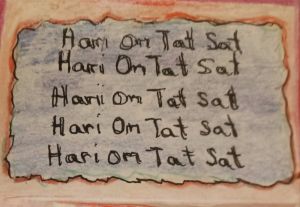
A couple of days ago I recieved a beautiful gift in an email. I often receive wonderful things through the email, and this one, as with so many of the others, has profound meaning for me.

Not only that, but this gift has served as a reminder to me of that significance. I’d like to share with you that gift, as well as some thoughts on its importance and meaning to me.

There are a multitude of sources online where you can learn all the technical stuff, word meanings, history, origin, when it’s used and all the rest. I would like, however, to just ‘think out loud’ in my own words, and follow my own heart’s promptings.

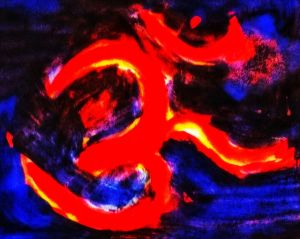
Hari Om Tat Sat, is actually two mantras in one: Hari Om, and Om Tat Sat.

Hari Om represents the totality of what we might call God. Hari refers to the manifested cosmos, as well as the creative impulse in its manifest form. I call that Ishvara, but it doesn’t have a name I’m sure!

Om, is the unmanifested universal consciousness, the Absolute Reality. Meaning, as I understand it, existence itself. I call it Brahman, or God, but again, names are just labels we humans apply to things to make it all seem so neat and tidy!

They say that Om Tat Sat is the most sacred of mantras (in Hinduism). It’s used at the completion of prayers and rituals as a way of invoking the presence of the divine and ‘bringing it all together’ you might say. Well not so much bringing, more like a reminder that everything is one already.

I really like the chanting of Hari Om Tat Sat. It’s a centering practice I would say, a way to remember the oneness of all. And I say it, as the traditionalists do, as a closing to prayers or other practice; it’s like ‘Amen’ or ‘It is so’ or ‘Let it be so’ or, well it’s endless – and personal and subjective.

As mentioned, Om means Brahman – or God in the unmanifested state; Tat, not only sounds like that but does in fact mean all that is. In other words, Brahman or the Absolute. Sat means Truth, Absolute Truth or, once again Brahman.

For me it is a little prayer of its own actually. And I’ve heard it used as a greeting many times. It’s a means I think of honouring the divine within the one being greeted, while at the same time I have a sense that it is a recognition, or acknowledgement rather, of the oneness, the unity of the greeter and the greeted along with everything else.

This is why I don’t really feel the need to break the mantra down to explain in technical detail all the constituent syllables (even I were qualified to do so, which I most surely am not).

It really is a way to acknowledge the oneness of all, the Absolute, which includes, obviously, me and you. The Truth is absolute, it says, so must we be, absolute.

Hari Om!
Om Tat Sat

Less Desires, Less Entanglements Equals More Freedom

Along with many other spiritual seekers across many world cultures and over time as well, I have a more or less daily practice of opening a spiritual book, scripture, or other text ‘at random’ (as if there is such a thing) to receive a message, a lesson, or a little bit of guidance for the day.

In my case, that text has for ages now been the Bhagavad Gita. And over I think the last two or three years, one verse in particular has come up time and again, sometimes on two or three days in a row.

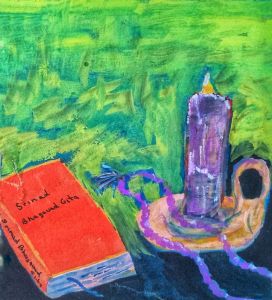
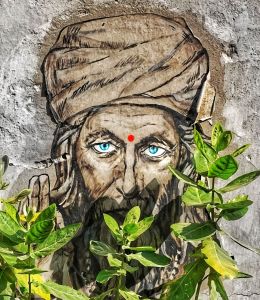
Much thanks to the Hermit Pilgrim who created this beautiful painting

So frequently has this occured that not only have I neglected to examine the verse in any depth, I actually began to ignore it when it came up and went right away to pick another one at random.

Well, this morning, I opened my Gita and there was that verse again – for the second day in a row. However, today, for some reason, I realised that this verse has been calling out to me. Or put it more sensibly: the Divine has been calling on me to take some notice of this verse and its meaning.

So, first of all, allow me to share with you the verse in question.

The Lord of Sri said:

It is said there is an eternal Banyan tree with its roots growing upwards and branches downwards, whose leaves are the Vedic hymns. One who knows this tree knows the Vedas

         Bhagavad Gita 15:01

For me at least, this verse has always appeared quite complicated, complex really, and full of symbolism. Of course, being from an ancient religious text, it’s likely to be all those things isn’t it?

Still, despite reading the verse many times and studying and hearing a few commentaries on it, for some reason it has remained for me rather daunting. At least I can say that I was convinced of the notion that this verse confused me, entangling me in convoluted and sometimes upside down thinking.

Like the Banyan tree itself I guess. Considered especially sacred among all other sacred trees in India, the Banyan is well known for its way of growing willy nilly, every which way, until the whole thing becomes a complete and dense tangle.

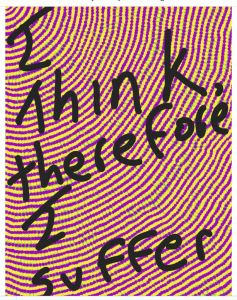
And it is this tangle that is at the heart of the metaphor used to illustrate the lesson in this chapter of the Bhagavad Gita: The tree is Samsara, the illusion that is the material universe in which all of us living beings are entangled. It’s as if we’ve walked into that tangle of branches and roots believing that’s where we will achieve our desires.

A major city in the middle of tourist season is another neat metaphor for this tangle we’re talking about. We look for worldly pleasures there, but find chaos, confusion, and often unhappiness

We are so attached that we identify completely with that physical world (convinced we are merely physical beings ourselves) and are convinced that this is where we can fulfill all our needs.

As the verse says, the leaves of the tree are the Vedas, and one who knows the tree, knows the Vedas. The Vedas are the sacred Hindu scriptures which in this context can be said to represent knowledge. But not knowledge of a mundane ‘ordinary’ kind.

The knowledge to realise (because we already possess this knowledge, we just aren’t aware of it yet) is that we are not the body, so we have no need to be bound to the tree of Samsara with its suffering and its endless entanglements. It is Self Knowledge.

This Self Knowledge leads us to develop what a following verse calls ‘the weapon of detachment’ with which we can chop down this very strong tree of attachments and illusions

A little note: I don’t like this weapon and chopping metaphor at all. I simply pass it on to you as written.

As we begin and progress with this process of truly realizing we aren’t the body, and therefore have no need to identify with or be attached to worldly objects and desires, then slowly the tangle binding us begins to clear, to fall away bit by bit.

I din’t think we need to actually get to that point of cutting down the whole tree before we begin to see results. to reap the benefits if you want to put it that way.

Each and every small thing, desire, compulsion or aversion we no longer feel ourselves bound to, frees us just that much more.

As with any tangle we get ourselves caught up in, once we loosen that first thread (to switch metaphors), the task of unravelling becomes easier.

It’s true – and I think I’ve mentioned it previously – some of my attachments and compulsions are loosening. Some (small ones I admit) have fallen away completely.

As you read in my little note, I’m not comfortable with the whole cutting down trees with weapons metaphor. Perhaps the loosening of threads, the unravelling of tangles and knots sits better with us.

Perhaps my – our? – efforts at detaching from the desires and aversions, from the compulsions for worldly things and objects, and for sense pleasures, can be achieved by a more gentle untying we could call it. A kinder, gentler, calmer, friendlier, means to realizing we are already free.

The Q&A in the Scripture: Part 2

Namaste

And welcome to Part 2 of The Q&A in the Scripture series in which we are looking at the answers given by Krishna to a list of questions asked by his cousin Uddhava in a scripture called the Uddhava Gita.

Remember the scene? Uddhava has asked Krishna a pile of questions about how to live a good life, how to live in the world with discernment.

These questions have become urgent because the cousins are about to leave their hometown which is on the brink of war. Both will be going their separate ways and both know they won’t be seeing each other for a while – perhaps never again.

Anyway, moving right along: In our last installment, we had Uddhava asking the first of his questions; this one happens to have two parts:

What is quietude and what is self-control?

We discovered that quietude is not the state in which one finds peace, silence, our true selves, or the Divine, but is itself that consciousness, that pervades and permeates all that is, silence, peace. In other words, quietude is  the Divine itself.

In the present post, we move to the second of Uddhava’s two-part question: what is self-control? Krishna’s answer is excellently short and sweet:

Dama  (self-control) is restraint of the senses.

Krishna in his response, makes it clear that restraining the (one’s own) senses includes mind as a kind of sixth sense in addition to the five physical senses. In the context you could almost say that it’s his mind that Uddhava is in most need of restraining. Maybe that’s the message for all of us?

Well, we are all well aware of the ways in which we have tried to control our senses; Uddhava knows too. But look at the situation these two cousins find themselves in:

It’s fine for Krishna: he’s returning home to Heaven, or wherever. But, Uddhava, who is also about to leave, is facing more uncertain prospects. He’s experiencing great turmoil, and fear over his and his familiy’s safety as the threat of war closes in. Most likely he’s also grieving over having to go into exile from his ancestral home.

Of course he’d be fearful for the future: where will he go? What will he do? How will he protect and provide for his family? Like I said, an onslaught of mental and emotional anguish.

Still, it does seem that Uddhava is maintaining quite a steady presence of mind. He’s thinking about the future; he is clear about the sort of stuff he needs to find out from his cousin (remember Krishna is God) in order to put and keep his life on the right track despite the challenges facing him now and in the future.

Then there’s the fact that this self-control thing is only one question on a list of 36. Clearly Uddhava is looking for a lot of advice.

Restrain the senses – all six of them – Krishna says. But how? What does it mean, ‘restrain the senses’? I think I alluded to the notion that we all have some ideas, some clues, about how we as individuals might restrain them, but let’s personalise this: What does it mean for me to restrain my senses?

Actually, now I’ve made that suggestion, I feel overwhelmed: Where would I start? Surely I need to do a whole series of posts, just on this one topic alone?

Oh wait, I can start right there. Exaggeration, hyperbole, over-dramatising, catastrophizing, all perfect examples of emotional reactions leaping from an unrestrained senses central: my mind.

Let’s put aside that mental stuff for a little while, and just say that all those emotional responses could do with a bit more restraining training. Just looking at the physical senses to begin with, I can easily say that they also, at least some of them sometimes, need various degrees of working on.

First, my sense of taste: it goes into overdrive sometimes, and then I eat too much. Not so much as in the past, but the restraint has a way to go still.

My sense of sight is pretty good, well restrained for the most part. But there are times when I lapse into old habits and spend too much time looking at a screen and scrolling in a mindless kind of way. Getting there though!

As for my sense of hearing: You might remember a post from a while ago when I talked about letting go of much of my music collection, some of which I’ve listened to my whole life.  I’m doing this because so much of what used to be ‘my favourite’ songs or artists, no longer serve my spiritual growth, nor does much of it reflect the view of life and the world that I’m trying to cultivate.

Well, I’ve made a good start, but occasionally I slip and find myself humming old tunes, or listening to an album that I really ‘should have’ deleted already. Restrained? Sort of, and I’m still encouraged.

Enough! Let’s get straight to the biggie: my mind. If I’m honest, I have to say that my mind, while not exactly in full agreement with my efforts at restraint, is starting to get into sync with me and my aspirations for a more controlled mind.

But still, those previously mentioned emotional reactions like exaggeration, over-dramatising and the rest, are still there. Falling into line, it’s true, still … .

Then there is the (more than) occasional first port of call reactions to pieces of news of various kinds: I’m prone to ask, just as I imagine Uddhava might have: Why don’t ‘they’ control themselves? Why can’t he or she or such and such country or politician show a little restraint?

Yes, I know, we’re all guilty of this one to some degree or other.

My quickness to anger is not quite, but almost, might soon be, won’t be long before it is, a thing of the past.

Then, there’s my tendency to ruminate: rehash endlessly real and imagined events and other stuff from the past – as well as the always imagined possibilities (as well as the impossibilities) for the future.

Again, I know I’m not alone in this emotional roller coaster ride, and I do know that I am nowhere near as much of a ruminator as I was; I have made great strides, significant inroads, and I am encouraged that the end of rumination is getting closer!

And now, here is the one thing I tend to think of one of my biggest, most tiresome and tedious, most annoying conditioned emotional responses: I talk too much. Not as much as I used to, but still too much for my comfort, and for the peace of mind of those around me. More restraint is called for.

Restraint has played its part in reducing my talking. But in a sense the major ally has been the ongoing quest I’m engaged in to discover my true nature, as consciousness, which is really my oneness with all that is.

And here our second question and answer leads us right back to the first: quietude.

I wrote in that post:

Quietude, calmness, peace of mind, are not where  you will find God, consciousness, or whatever we call it.  Quietude and the rest are God. They are consciousness.

Or putting it the other way round: cultivate silence, calm, peace of mind, and your senses will no longer need to be restrained. Your whole Self, including body and mind, will then be resting in Quietude, in your true nature.

That’s why I think these two questions are asked and answered together: Each leads to the other: by restraining our senses we are more easily able to achieve a state of calm, quiet, some level of peace of mind – in other words, Quietude.