What Will Please You Lord? A Prayer Contemplated

Namaste my friends

In my last post I reflected upon the meaning for me personally of a Bhagavad Gita verse that had particularly struck me as I carried on with my renewed inspiration to read the text from the beginning.
Today, I didn’t even get to the place where my reading left off yesterday. Before reading I like to pray some or all the prayers I have pasted in the front (and the back now). As I was deep into this practice, one prayer in particular stopped me, just as with that verse yesterday.

This one seemed to speak to me, asking ‘What do I mean to you?’ So, I made a mental note (always a risky proposition with me), and carried on with my prayers, determined to take time later to think about that prayer, and try to answer its question. So, here I am, later in the day, making these notes.

The prayer itself I am fairly sure comes from Thomas Merton, monk, mystic, and writer. Not completely sure, but I know that whoever composed it was one clearly inclined towards living the life of the mystic.
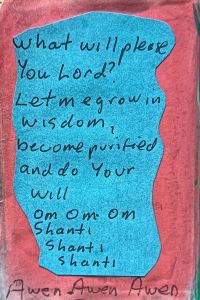
What will please you Lord?
Let me grow in wisdom,
become purified,
and do your will.

For whoever composed this prayer, it is an expression of a genuine longing. I can say that for me it is a deep plea, expresses my own longing. Each time I recite it, in fact, I can say that, although this is the first time I’ve addressed the big what does it mean question, I do sense the longing and grasp the meanings of the various words and ideas in the prayer. Actually, now I think about it, I do say this prayer or parts thereof in one form or another very often.

What will please you Lord?

When I begin to pray these words, what I feel I am actually doing is asking the Universe, the Divine, Self, God – the I AM – how can I live my life so that it is attuned to the natural order and flow of the Universe.

I am asking, what do I need to do to let go of attachments to worldly things which arise from material desires? How do I find the grace to accept when things aren’t going completely my way?

In other words, I’m asking how can i live a good, truthful, happy life in harmony with all other beings and with the Universe.

Let me grow in wisdom
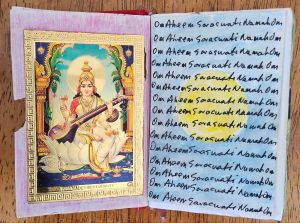
Another of my prayer pages. This one devoted to Maa Saraswati, goddess of, among other things, wisdom

A good place to start, a great first step. But, again I have to ask myself, what does growing in wisdom mean to me?

To me wisdom is not merely knowledge. Though, having said that wisdom needs to rest on a firm foundation of knowledge, otherwise what’s there to be ‘wise’ about?

I’m not talking about worldly knowledge here, though obviously it takes some degree of knowledge for any of us to live in the world. Also it’s relevant to the next part of our prayer; we’ll see that soon.

I’m referring instead to a special kind of knowledge that will (I pray) lead me somewhere closer to acquiring some degree of wisdom – one day.

Self-knowledge is what I’m getting at. And I go about my attempt to obtain self-knowledge in a couple of different ways. I study, sacred texts like the Bhagavad Gita, as well as the words of those wiser than me (which is rather a large selection of people I can tell you) both living and historical.
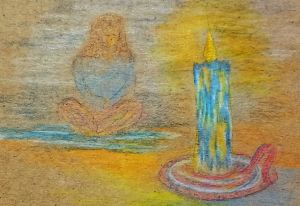
I meditate (not nearly enough!) as a way to enquire into my own ‘real’ or true nature: who am I? what am I? Just digging deep within to reach some realisation of the answers to those questions.

When I have answered those questions, I will understand that I have reached a true level of self-knowledge. I sense that, at least being on the path to that realisation, I would never be able to develop any level of wisdom.

Mind you, I do feel that all humans are born with some degree of wisdom potential ‘built in’ so to say. As for me, I don’t feel especially wise just yet.

Become purified

For me, becoming purified goes hand in hand with the cultivation of wisdom. In fact I would say that in the very efforts to become purified, it might be possible for me to develop some wisdom as a result of those efforts.

So, here we go again: What does it mean? To become purified? For me it means living a Dharmic life. By Dharmic I mean a life steered and driven by Truth, Right Living, Right Speech, Right Conduct , Right … The Buddha taught The Noble Eightfold Path. That is in my opinion the very best, topmost, pinnacle of self directed means to living a Dharmic or purified life.
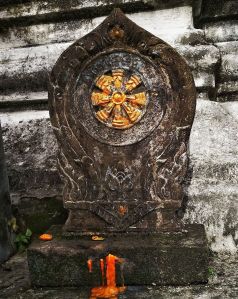
The Eightfold Path is not a set of dogmas, rules, or anything like a list of commandments or instructions . The eight steps are merely signposts, a roadmap, pointers for me to follow in order to purify my life, live a Dharmic life. No behaviours are prescribed: it’s entirely my choice what forms my behaviour, actions, and the rest take.

Obviously the path to becoming purified is a life-long one, though some would say that many lifetimes are required. Personally, I can’t even hint that I might be anywhere near close; some days I feel further away than ever.

But, as I work towards ‘growing in wisdom, with the help of my becoming purified path, I pray that some day I might actually learn what I call proper discernment.

This discernment is the ability to act in the world and to react to the joys and sorrows that are inevitable, with compassion, love, and wisdom. To face those inevitabilities with calm and equanimity. Acting with proper discernment will mean that I am living in Truth.

… and do your will

As I reread the words I’ve just written, I realise that, by the time I reach the state described in that last paragraph, I will have succeeded in ‘doing your will.
I will have aligned my self perfectly with the order of the Universe. I will know my place as a tiny fragment of that very order.

If I’m honest however, I have to say that I think it’s going to be a very very long time before such a state come to pass. So, what to do in the meantime?

Well, along with my attempts to live Dharmically, and to cultivate wisdom, I have committed myself to a life of devotion. Devotion, prayer, contemplation.

Devotion to what? To whom?

To the Universe, Divinity, God; all that is represented by all those names we humans have put on the Absolute Reality, that is all there is.

Everything. And everybody, is what I’m saying. There really is no separation except a kind of superficial one we allow ourselves to imagine by applying so many names and forms to the material objects, things and so on, that appear to us as separate one from another, whereas there is in fact only one, without a second.

That’s where the contemplation comes in. It’s a going within, inward to what we imagine is a kind of ‘space’ where all merges into one, the one that is all there is.

I think that’s what ‘pleases the Lord’. While I am indescribably, gravely, deficient at all the steps described above, one course I know to be right for me is to continue to engage with those steps, and to devote myself and my life to the Divine, to the Truth.

That’s what pleases me. I pray that it pleases the Lord.

Out for a walk & Singing Sacred Songs

I call this one: Self-portrait With Tree 😁

I was out and about photographing for a few hours this morning. On such walkabouts I like to walk at a slow but steady pace, and in a contemplative frame of mind.

Usually I’ll also chant mantras as a way of focusing my mind, of keeping random thoughts from distracting my attention. And so it was today.

Deep into today’s walk, I was feeling ‘in the zone’, as I like to call it. Making photos and chanting mantra. All of a sudden I heard myself singing a bhajan (sacred song or hymn) in place of the mantra I’d been reciting.

This particular bhajan was By Your Grace, by Krishna Das, It’s a beautiful devotional song that you can listen to here. I’ve been listening to it and singing it for years, and I love it. I find it puts me in a nice prayerful state of mind,  Anyway, here are the lyrics:

Closer than breath, you are the air
Sweeter than life itself, you are here
I am a wanderer, you are my peace
I am a prisoner, you are release

Jai Gurudev…

I am a pilgrim, your road so long
I am the singer, you are the song
Held in the open sky, so far above
I am the lover, you are the love

Jai Gurudev…

I follow your footsteps through the flame
All that I ever need is in your name
Carry your heart in mine, vast as space
All that I am today is by your grace.
By your Grace…
I live by your grace.

One more way to chant sacred songs

Now, the song was written by Krishna Das as a way of thanking and praising his Guru. But, the words and the power of the song can be dedicated to any of our own individual concepts of the Truth. Whether we call it the Absolute Reality, the Supreme Being, the Life Force, the inner Divinity, Nature, Consciousness, God, Guru, the Universe. After all, these are all simply names and forms.

I guess what I’m saying here is that the song is a fine prayerful and meditative way to express our gratitude to, our love for, and devotion to whatever it is in our heart of hearts we know as our support, our teacher, our creator, our Guru. Our very own Truth

Peace blessings from me to you

You Say You Want a Revolution, Well You Know …

Welcome friends to another post

I’m actually scheduling this one to publish sometime in the future. The reason is that, as I reread it now, I see I’ve used ideas, and even some sentences here that appear in a couple of recent posts. The thing is, I think this is a post worth reading, so I’m kind of sneaking it in via a touch of time travel. In any case, please enjoy, and by the way, thank you for sticking with me for this long (however long this is).

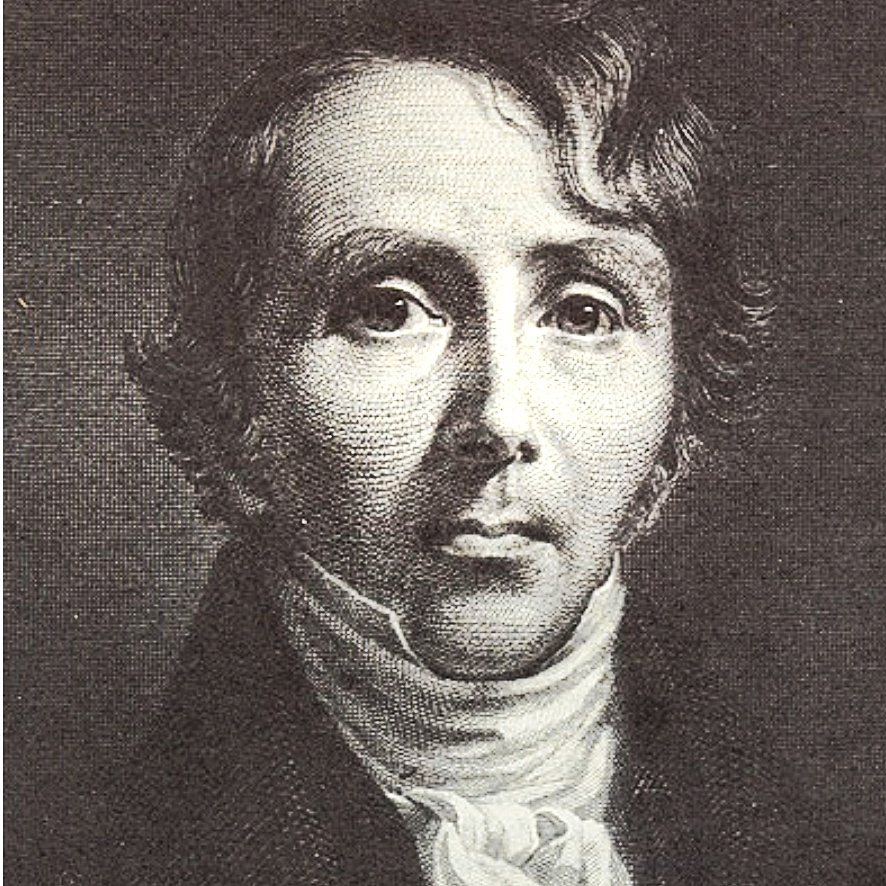
It was a revolutionary idea for its time, the early 19th Century. Come to think of it, it still is. A reform minded Christian minister, William Ellery Channing proposed that the proper goal for each of us human beings is perfection.

William Ellery Channing (Public Domain)

Or rather, the goal should be a  realisation of the perfection that is already our true natural state, our true selves, which we’ve forgotten as we have got on with the rarely easy business of living in a material world. You see? I did say it was a revolutionary idea.

After all, he wasn’t talking about the obsessive perfectionism that often curses so many of us anxious types. Or the myths propogated by mass media of what it means to be ‘perfect’. No, he was proposing a complete and thorough shift in the prevailing thinking about the nature of humans, and in reality, of all life.

Anyway, he posed the question:

Do you ask in what this perfection consists?

He then proceeded to answer his own rhetorical question:

I answer: in knowledge, in love, and in activity

When I came across this little vignette in an unrelated book I’ve recently finished reading, I was a little bit mind-blown. Channing’s formula is more or less identical to that presented over millennia in a number of the world’s religious or spiritual traditions.

For example in the tradition I am studying these last years, Sanātana Dharma, this little formula constitutes pretty much the foundation for any kind of spiritual growth. It could be said that in a real sense it is the very basis of all Yoga:

Jnana Yoga (knowledge, study, includes meditation, contemplative practices and so on), Bhakti Yoga (Divine Love. In the sense that love is always divine) and Karma Yoga (often called the Yoga of action. It basically includes everything we do in the physical world. The Karma bit is about our actions becoming selfless).

In other words, just sitting there on their own these three Yogas offer a pretty succinct answer to the question many of us ask ourselves constantly: How can I live a good life?

We pursue knowledge for many reasons: it may be a reluctant pursuit as we sit through the interminable years of high school; or later as we head to university or college to train for a career that we hope will support us. The thirst for knowledge might arise when we come upon a topic or an area of interest and fascination that we just have to learn more about.

Just as with the infinity of knowledge, love comes in equally infinite guises. Unlike knowledge, however, I don’t think there are ‘reasons’ we can give for love. Love is love; it is its own reward (and it’s own torture), it just is what it is. Divine is as good a word as any. Any love, all love, is love for all and for everything.

And then there is the kind of knowledge we pursue as we try to answer what I like to call the Who am I? questions. Things such as: What’s the meaning of life? Where am I from? Where am I going? Is this all there is? Oh, and of course the real biggie: Who am I?

Now, at the risk of having to take the prize for the most obvious statement ever made, let me make the point that all living things have to take action all the time if they are to remain alive. So obvious that I’m even having to take several different actions in order to tell you this. So, you might well ask, what’s the big deal? What’s Channing and all the others through the ages getting at? What activity?

Well, I think Channing was getting at the notion that every action we take needs to be informed by knowledge and love. But, what knowledge? Well, clearly we are caught in a tsunami of information much of which goes to making ‘fake’ knowledge, propaganda, deceptive advertising, biased education, and the rest.

In other words how often do we see knowledge not used correctly? And, how often is humanity’s use of knowledge – our actions – informed by love? Now we can begin to realise how revolutionary this idea is, and always has been.

I think that’s why the Sanātana Dharma teachings and world view embody the concept Bhakti, or divine love. As I noted, all love is divine. These teachings tell us that all action is to be undertaken with love, without attachment to rewards or outcomes, and dedicated to the welfare of all life.

Channing had the same idea: for him all life is pure and perfect already. And of course it follows I think that all actions we take have the potential to be informed by a wisdom gained from proper use of knowledge, and to be informed by love, whether it’s for self, for other people, other animals, Earth herself.

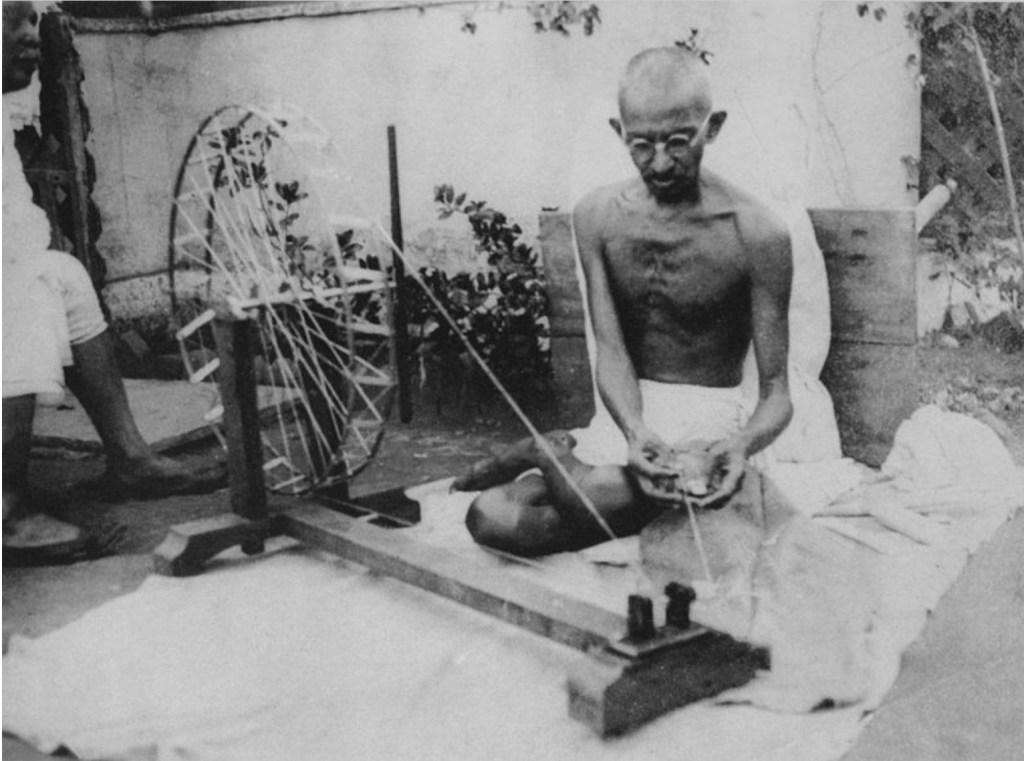
So, pretty revolutionary stuff eh? I guess a lot of us have heard that famous quote from Gandhi:

Be the change you wish to see in the world.

Well, here’s the freaky bit. Just now as I looked up the quote to make sure I got it right, I discovered that he never actually said those words. Not in that form anyway. Here’s what he actually did say. It’s a long quote but I think it’s an interesting note to finish on. I think for me it clarifies many of the questions this little discussion has raised in my own mind, as it will for you I hope.

Gandhiji at his spinning wheel (thank you Wikimedia Commons)

Knowledge; Love; Activity

We but mirror the world. All the tendencies present in the outer world are to be found in the world of our body. If we could change ourselves, the tendencies in the world would also change. As a man [sic] changes his own nature, so does the attitude of the world change towards him. This is the divine mystery supreme. A wonderful thing it is and the source of our happiness. We need not wait to see what others do.

Mohandas Gandhi

Peace from me to you