Thank you for bearing with me as I chose to post a short story before I got onto this post, the next part in our small series. Actually, I hope you enjoyed the story, and if you missed it, then please feel free to have a look. You will find it here.
Anyway, welcome to Part 2 in our little series of contemplations on the answer that Abba Arsenius received to his question: How can I be saved? (from the world with its sorrows and noise and traps of all kinds)
The answer he heard from deep within his own Self – what he called God -was the succinct, to the point, no nonsense:
Flee, Be Silent, and Pray Always.
In Part 1 we realised that fleeing (from the world) doesn’t necessarily mean we have to leave everything and everyone behind and go live in a cave in the desert as he did. For some of course it might mean exactly that or some 21st Century equivalent, but I think for the vast majority of us, fleeing simply involves some modification of our current lifestyle, changes to our habitual ways of thinking and behaviours in order to rid ourselves of attachment to and entanglement in the things, situations, and people in the world that aren’t working for us.
And, now, in this post we will spend some time in contemplating the second injunction given to Arsenius: Be Silent.
Be Silent
I haven’t actually given a lot of thought to this topic since our last post. Nor have I done any online research, or watched YouTubes (I checked for fun and there seems to be hundreds, maybe thousands) about silence.
No, at least in this I have tried to remain silent and simply wait for the post to come together of its own accord in its own time. Perhaps this decision came from that same place Mr A heard from when he had his question.
So, what does it mean to be silent? Well, as I just mentioned, there are seemingly unlimited answers out there just waiting for us to grab on to. The better question would probably be, what does it mean for me to be silent?
First thing to say is that I’ve come to realise (okay, it’s an ongoing process of coming to realise, not there quite yet) that there is absolutely no person, no circumstance, and no place that I can rely on to provide me with silence. So, I’m coming to accept, there is no point in looking anywhere, or to anyone, as the source of silence, at least not in the physical world.
Of course, one key element of achieving silence may be the absence of noise. Maybe. so living where there is less traffic, less focus on materialism and commerce, fewer people, less media imput (news, TV, Internet, and all the rest) might be a place for some to start.
Even if it isn’t possible to to avoid all these things completely, I try to drop or change the things I can which for me sometimes at least, gives me a chance at a little silence.
Having said that, I’m reminded of an aphorism I once read: A hermit living alone, in a cave on a remote mountain, away from any kind of road, no radio, TV, etc, is never going to manage to be in silence if his mind and emotions are always busy with thoughts, memories, desires, fears and other emotions.
On the other hand a person living on a busy city street in the midst of all kinds of chaos and noise, may be living in perfect silence. If they have a still mind, steady emotions, that give them the ability to ‘sail through life’ as the saying goes.
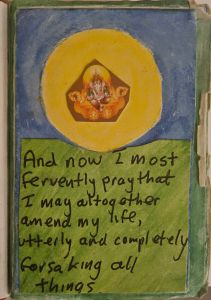
But what about me? Well, this prayer says it all In order to achieve a state in which I can actually be silent, I am attempting to amend my life – utterly and completely. I can be quite self-critical on this, badgering myself with desperate questions how come I can’t just be silent (and quiet in the accepted sense of the word as well). It’s a dilemma which frustrates and disappoints me. But, to be a little fair to myself, I suspect I’m not very different to most other people when it comes to silence. After all, if it was so easy, how come we need thousands of books, articles, YouTubes on how it’s done?
As mentioned, the absence of noise isn’t necessarily a prerequisite to achieving silence. But, I have to say, that for me, it’s pretty important. Being surrounded by the noise of the world, as well as my own hyperactive mind and seesawing emotions, are for me blocks to silence. Though, when I think about it, there are glimpses, even when one of our temporary hermitages is on a busy street, or under an airport flightpath.
As a bottom-line starting point, I don’t watch or read news; I don’t (anymore) randomly scroll the Internet even when ‘looking for something to watch’ on YouTube. And of course I don’t use television. Ever.
I’m not saying that when I do watch a video online that it’s always only spiritual or holy stuff. Nor do I only read books about saints and spiritual matters. Mind you, I would say more and more lately I’ve been tending in that direction. It’s just happening naturally I think.
A reason for that progression is effects of the amount of time I spend meditating, chanting mantra, and ‘just sitting’. Never enough time spent, but I’m getting there.
In all these three activities there is of course always lot of mental noise trying to mess things up. Not to mention the dreaded external noises. But, even then, there are gaps, spaces between breaths, pauses between repetitions of the mantra, and even when just sitting there are (if my mind has mercy on me) little moments free of thoughts, fleeting gifts of silence.
I think most of us have a tendency to focus on the problem of noise and disturbance, both external and internal, and ignore those fleeting little moments of silence.
With the momentary absence of thoughts it’s like when we ‘get lost in a beautiful piece of music’ as my teacher says. We’re still there, we can still hear, it’s just that we – as in our ego in one of its many and varied forms, our mind – is absent. And that means there is silence. Then we are in that legendary blissful state of being one with the music (or whatever the activity we are ‘lost in’).
Because our thinking mind seems to be absent (no thought equals no mind), there is nothing to judge whether there is silence or not. Just as when we are in deep sleep, as opposed to the dreaming state, there is silence, the absence of thought; no ego dialogues; all is silence. That’s why often don’t realise we have achieved that silent state: no mind to record the experience, so when we do resume thinking, we assume we’ve not stopped thinking at all.
Despite these many years of meditating, chanting, and sitting, I seem to still expect something spectacular to occur. Some blissful state, some revelation of enlightenment, or some other magical happening, maybe visions or some genius idea or something. It’s not a rational expectation of course, but …
Yes. It’s still hard to let go of the search for some kind of ‘signal’ buried under all the ‘noise’. Lately, however, I’m slowly coming to realise that looking for signal is really my ego/mind looking outside in the world for some kind of experience of silence. But to belabour the obvious, silence is silence; what’s to experience?
That doesn’t mean that there’s nothing. Nor that it’s some kind of void, just emptiness and ‘nothingness’. Silence is the space in which the seeds or knowledge are able to take root before they can become manifest in our material world.
It’s just that we might not notice untill sometime later when we see or sense a change in our thinking, our behaviour, or how we feel about the people, places, things, and circumstances of our lives.
See you next post when we look at the final of the three injunctions given to our friend Arsenius, Pray Always.
Thank you and may you realise the silence that already is present within you.
Something quite different today. I had planned to write the second part of our contemplations on Armenius’s answer to his prayer. But then I came across a short story from quite a few years ago now, that seems to speak directly to our series title, Flee, Be Silent, Pray Always.
Grab a cup of tea, relax and enjoy the story
I offer it, I share it with you now in the hope that you will find it interesting and (or) entertaining. It’s going to make this post way way longer than usual, but I hope you find it worthwhile to spend some little time reading it.
So, with love, here is the story I once called:
LEAD ME NOT INTO TEMPTATION
The old carpetbag perched as if it ” a living thing, an alien visitor from the other world, in the middle of Brian’s old table. Its bulging bulk and musty smell, a constant reminder of its threatening presence.
It had been three days now and he knew he’d have to make up his mind soon, make some sort of decision. He had to find a way to deal with this.
Brian, or Brother Brian as he would prefer to be known, had made the long climb to this crumbling stone house a long time ago. He could no longer tell how many years it had been. All his life he had known what his destiny was to be. Even as a child, he had felt the call of the mountains and the monastic life. But, like most people, he had ignored the call, ignored his destiny, and settled for an ordinary life: school, university and a job shuffling papers for some obscure government department.
Then, one day without warning, he walked out of the office, sold his belongings, packed a small bag and caught a one-way flight to India. He didn’t know quite what he was looking for, but he did know it was something vaguely spiritual. He thought that if he couldn’t find a spiritual life in India, then he wouldn’t find it anywhere.
It didn’t take him long to find his way to the remote mountain monastery of a reclusive order of contemplative monks. For Brian, it didn’t matter what they taught, what lineage, gurus, or teachings they followed; for him it was the simple and quiet life of meditation that was the main attraction.
Now, all these years later as he sat staring at the carpetbag, he reflected on how fast time can pass when you spend your days meditating and working in the gardens that supplied the monastery. Sighing, he thought that they had been good years. Was it ten? Twelve? No, it was ten years he spent in that place. But, for some reason he could no longer fathom, he had decided that the so-called isolation of the monastery wasn’t isolated enough for him.
Then, smiling, he remembered: after a while the other monks’ constant chatter had begun to irritate him; he had begun to long for total silence.
Not our monk’s actual hermitage!
The Abbot understood Brian’s need for quiet and deeper contemplation. After all, he had been his mentor and advisor for many years and knew his student well. He told Brian of the old house, long abandoned, that lay just over a week’s walk in the hills above the monastery.
So, along with a brother monk to accompany him on his trek and help him carry cooking utensils, food and seeds for the garden he planned, Brother Brian left his home.
There weren’t many comings or goings at the monastery, so Brian’s leaving was a momentous event in the life of the community. Not sad, not happy; these monks had long since learned that what happens is simply what happens. But, for Brian, there was a sneaking sense of excitement as he began the long, but welcome, trek to what he hoped would be his home for the rest of his life.
He embraced his brother with a farewell. Brian smiled as it occurred to him that this was likely to be his last ever contact with a fellow human being. Soon the brother was gone, and Brian was alone. He surveyed the house and saw it wasn’t as bad as he’d been led to believe. Why, there was even a table and chairs to sit at.
It was the work of an hour to place his meagre belongings in their place in the house. And so his life of true isolation began. The years passed and Brian’s prediction proved accurate: he saw nobody, heard no human sounds. His only contact with that other world was the monthly cache of rice and other staples the Abbot arranged to have dropped off for him to collect a couple of hours walk downhill from the house.
Brian always ensured that he would not encounter the brother who made that long trek for him. Lately though, he had seen the tracks of a horse and cart. The monastery must have modernized, he’d laughed to himself at the time. Samsara, he thought, it’ll get you every time.
His plan for total seclusion and quiet had worked for a long time. But now as he stared at the carpetbag, he remembered the day that other visitor from the other world had come calling. It was six months ago now and he’d been at his cooking fire, about to ladle his daily rice into his bowl, when he heard the knock.
At first, it was just another sound from the old house that had over the years developed its own voice, or so Brian liked to think. But the knocking persisted, grew louder, and that did strike him as odd.
Putting down his bowl he went to the door of the house, opened it and came face to face with the first human he had seen since his brother had left him here all those years before.
‘Are you Brian?’ the apparition questioned.
Brian, for some moments, had no answer. It’d been a very long time since he had heard another human voice, and just as long since he’d had to use his own to give an answer to anyone.
‘Are you the man known as Brother Brian?’ The voice was more insistent now and Brian saw its owner seemed to be dressed in some kind of uniform. Was he a policeman? A soldier?
‘I am Brian. His voice shocked him.
‘Well, this letter is for you. It is from the government and it is necessary to deliver it to you in person. That bloody Abbot fellow tried to stop me, but it is my duty you know.’
So, this stranger was a postman. He shoved the letter into Brian’s hand, turned and marched away, leaving Brian standing dumbly in his doorway.
After some time Brian came out of his stunned reverie. He stared at the letter, which did indeed bear his name, or rather the name he once owned and was of use only in that other world he’d turned his back on. And it bore the crest of the government. Brian could not begin to work out what it was about.
But, realizing that there was only one way to find out, he opened the tattered and crumpled envelope.
Before he even read the letter’s contents, Brian’s world fell apart. The date at the top of the typewritten page transported him back into that other world. As if the long intervening years had counted for nothing, he became who he had been then.
That date told him how long he had been away from the place of his birth; it said to him that he was not alone. His years of practice, of attempting to exist in a timeless state with only nature’s seasons to guide his daily activities, suddenly seemed to have no meaning. But what he read next was almost beyond his comprehension:
Dear Sir
You have lived in our country for many years. We believe you are a member of a religious community. However, such a status does not exempt you from the very strict immigration rules that we have put in place to ensure the security and well-being of our nation and her people.
It has recently come to our attention that your original visa was for a period of six months only. Therefore, you are in this country illegally.
We have decided to be lenient in your case and have not insisted on your immediate arrest and detention pending trial for the extremely serious crime of visa violation. We hereby inform you are to leave this country by no later than three weeks from the date on this letter.
Please be warned that should you not present yourself Immigration officials at your chosen point of departure by that date, action will be taken to place you under arrest and your case will be prosecuted to the fullest extent of the law.
Yours truly
Ministerfor Immigration
Brian was calm. He folded the letter, returned it to its envelope and placed it on the little shelf he reserved for his few books and papers. It would not be correct to say that Brian’s life and routine returned normal; he was really only going through the motions, tending his garden, even meditating a little more than usual.
But he was disturbed. Not only had his isolation been broken by the visit of the postman all those months ago, he was as the letter demanded, being forced to leave his safe haven, his home of all these years.
But it was neither of these two issues that seemed to occupy him most on this day. As time passed from what he now called the Day of the Letter, Brian had grown increasingly restless. He found himself spending long hours daydreaming and remembering his old life, his life before that day he walked out of the office and bought a one-way ticket. He even sometimes caught himself wondering what life would be like if he walked back down the mountain.
And now, six months later, he sat staring at the carpetbag. He smiled now, remembering the threat in the letter: he’d had three weeks to leave. Still, he remembered from his old life how slow bureaucracy could move sometimes. He reached down to rub the soreness on the side of his lower leg. As he felt the scratches, he recalled how he’d come by them. Actually, he thought, if it hadn’t been for the carpetbag and its soft bulk, he might have been more badly injured …
Along with that general restlessness engendered by The Day of the Letter, he sensed a growing dissatisfaction, a dissatisfaction that had not passed, even after so many months.
And these feelings seemed to extend to the house itself, still as tumbledown as it was when he’d first laid eyes on it all those years ago. Suddenly it didn’t seem good enough and he had an irresistible urge to improve it, to fix it up a little, as he liked to put it.
So, it was three days ago, and he was rummaging around in one of the small outbuildings at the back of the house. He trod with care: the rough floorboards were all loose and in varying stages of decay. And, sure enough, all his care didn’t prevent the inevitable. As he reached for a bundle of metal garden stakes that he thought might make a fine tripod for his cooking pot, his foot sunk into the floor as one of the rotten boards gave way.
He didn’t sink far; something solid but soft got in the way. Pulling his leg out he saw it had been cut. A small amount of blood oozed from some long scratches. Even so, he realized hed been lucky not to have gone in further and he wondered what had broken his fall.
He peered into the hole and saw what looked like a fabric bag. He reached in and pulled it out. Nice bag, he thought, with his newly reacquired eye for things of the outside world. He seemed to remember that such a bag was called a carpetbag.
Standing up and heaving the bag from the floor, Brian was surprised by its weight. He decided to take the bag, reeking of dust and the musty smell of damp and age, into the house before opening it to see what was inside.
How different he was since the Day of the Letter, he thought as he sat three days since finding the carpetbag, staring at the thing. How many years had he been here without even setting foot in that shed? Anyway, it’d been a very long time since he had been even remotely interested in anything of a material nature.
But, at the time he found the bag, he had acted without a second thought; it was just natural to take the bag from its hiding place and into the house. And it seemed perfectly normal for him to want to open it and look inside.
He had lugged the carpetbag through the door and into his house, heaving the heavy load onto his table. The dust made him cough, but he didn’t hesitate. The bag’s zip was rusty, but came apart easily. However, the sight of the bags contents did make him hesitate.
Bundles of paper that he could see were old English banknotes. Pulling himself together, he started taking out the bundles, twenty in all. He guessed that each bundle had to contain several hundred pounds. Of course, he knew that they were no longer legal currency, but on the antique market, he was sure they would fetch a fortune.
At the very bottom of the bag, he found a large pouch, heavy and solid. Opening the drawstring, he found it full of stones. Pulling out a handful, he realized they were small diamonds, dozens of them. Mixed with the diamonds were stones of many colours: red rubies, green emeralds, purple amethysts.
Even his newfound interest in material things was defeated by this discovery. He returned the pouch and the wads of banknotes to the carpetbag and set the thing in the middle of his table. Suddenly he felt the pain from the scratches on his leg, so he left the house and went to the little stream he used for water and washed the wounds.
For those three days he went about his daily routines as best he could. But he had to pass his table and the carpetbag many times a day, and it came to preoccupy his thoughts. Its contents could ease his re-entry to the outside world in a very nice way. In fact, he doubted he would ever have to think about getting a job or earning a living. But this was his home. No matter how much the postman with his letter had pulled him back to that other world, no matter how much stuff, how many things, this carpetbag and its cargo could buy, he’d have to leave his home.
So he sat and stared. He didn’t think; he’d gone over and over his choices. He couldn’t do it anymore. He just stared, and time passed. With a start, Brian realized it was dark and that the house was cold. Still not thinking, only acting, he went to the little shelf and retrieved the letter and a pencil. He returned to the table where he sat and began to write on the back of the envelope in the tiny script he’d mastered all those years ago when he still thought keeping a journal was a useful practice.
My Dear Brother Abbot
How many years you and my other dear brothers have made the arduous trek to bring to me the staples that keep this body alive. No words of gratitude would ever be enough to tell you how I feel. Of course, I know if I were there with you now you would tell me that you and they are only doing what needs to be done for a brother. Still.
When this letter arrived, I was deeply disturbed. I found myself thinking of and longing for the old world of my youth. I found myself falling into Samsara again. I did not like this, but I found it drove me to change my world here. I began to be obsessed by the need to improve the house in a physical way.
While I went about this crazy business, I injured myself by stepping through a rotten floorboard. My fall was stopped, and my injuries lessened by this carpetbag that I now send to you.
However, in the three days since, I have not been able to engage correctly in my daily routines and practice. When you see what is in the bag you will understand my distress and confusion. On the other hand, you might not: you are so much more advanced along the path to enlightenment than I.
I have just sat through a long dark night of the soul, completely lost and not aware of this body or this material world that surrounds me. When I rose from this state, I knew what I had to do. The letter in this envelope and this carpetbag and its contents do not belong to me, nor do they belong in my world. I send them to you because I do not know what else to do with them.
As always, I rely on your help. You have always been there for me when I stumble and as I enter the bliss.
Your brother salutes you dear Abbot.
Brian
Scooping up the letter and dragging the carpetbag off the table, Brian strode out of the house, and in the darkness, trod the well-worn path to the spot his brothers brought his supplies to.
Long ago, he had built a small shelter for the brothers to rest in, and in which perishable items could be left. He placed the bag there and, with a large stone, weighted down the letter so it would not be missed when the brother next came.
As he rose from this task, Brian saw that it would soon be dawn. He would have to hurry if he was to make it back to the house for his morning meditation.
THE END
If you’ve made it this far, thank you. I hope you had an enjoyable and interesting read. Next post will truly be part 2 of the series, and we will be contemplating the second part of Armenius’s message: Be Silent.
A few days ago I began a new work to study and contemplate in my not quite daily Lectio Divina practice. It’s actually a spiritual classic that, although I’ve read it before, I felt the need to explore a little more, dig a little deeper, rather than simply reading through it as I did the first time.
I haven’t gotten very far in the book; like I say it’s going to be a slower, more reflective process this time (I’m amazed how little I remember as I reread now). A small story the author tells us by way of describing how he’s structured the book, is actually where I’ve left off, so that I can share it with you before I go on with the text and forget!
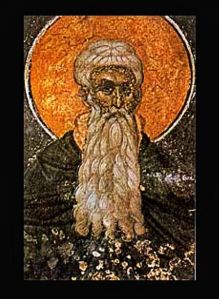
Abba Arsenius (courtesy Wikipedia)
It concerns Abba Arsenius who was a high ranking Roman official working in the household of the Emperor. Clearly he was looking for a more meaningful, more spiritually oriented lifestyle away from the dogma running people’s lives, politics, the decadence and the rest, because he constantly prayed to God, seeking a way out that would lead him ‘to salvation’. He was wanting badly to be free.
Well, he heard an answer, from deep within his soul:
Flee, be silent and pray always.
So, that’s what he did, fleeing first obviously. I don’t know the rest of his story. I mean I could look him up, but for our purposes here today, all we need to know is that he took off secretly to Egypt and went to live alone in the desert.
Nouwen believes:
“The words flee, be silent and pray summarize the spirituality of the desert. They indicate the three ways of preventing the world from shaping us in its image and are thus the three ways to life in the Spirit.”
Flee. It’s quite a strong word isn’t it? On the face of it, it simply means run away or escape. But it seems to suggest something more urgent, as if the one doing the fleeing needs to get away as quickly as possible; sticking around could be (or actually is) dangerous.
And that, as I said, is where I stopped to think. Sorry, I mean contemplate. I was so struck by the concept: in its essence, it is exactly the life I am attempting to live. Anyway, since reading it I’ve been thinking a lot about the three imperatives given to Arsenius in that very succinct answer he received to his question.
In fact, looking the word up just now I see that some slang terms for flee are: bolt, scram, schedaddle, or get the heck of out Dodge (or in the case of Arsenius, Rome). Let’s just say, to flee means to run away as quickly as you can, to escape imminent danger of some kind, real or metaphorical.
I read once of a woman who had the debilitating Chronic Fatigue Syndrome. In an attempt to recover and heal, she moved to a remote cottage in a tiny town ‘in the middle of nowhere’. Why such a drastic move? Surely if she is ill she should stay near to doctors and other resources?
Well, for her being in a city was the problem. Noise, crowds, pollution, pressure to conform and consume, interaction on so many levels all the time with other people, trying to meet daily needs in a complex, crowded and hectic environment was precisely what was making her ill.
Not to mention the effects on mental health that living in such conditions has on a lot of people, and I think we can all relate to some degree to this idea. We’ve all felt sometimes (or even very often) how we would like to just get away from it all.
For me it was about the gross materialism, the lack of ethical and moral thinking in the running of businesses, governments, and the rest; I longed also for a deeper connection with what one might call the sacred; more time and space for contemplation and just a simpler, slower, less rushed, less complex life.
Now, I hear you saying: ‘not everyone can or should just give up everything and take off to live in a cave’. (or desert, wherever). And you are right, of course. In fact, we can say the cave is a metaphor for all sorts of spaces one might feel drawn to when fleeing and seeking separation from the world. Actually, we’ll be talking more about this later when we get to the be silent bit.
For these Hermit Pilgrims ‘fleeing from the world’ has meant a nomadic lifestyle, few possessions and material needs, a hermit life where our engagement or entanglement with the world is kept to a minimum, and in which we feel less of a pressure to conform, to ‘be shaped’ by the world around us’).
The reality is of course, at the end of the day for most of us and for most of our lives we have to make money to feed and clothe ourselves and our families. And for that we need to work. And in order to work we need a house to live in, and to have a house to live in we (perhaps) have to get a mortgage, and to get a mortgage … . Well I guess you get the point.
But, for a moment ask yourself: What would it look like for me to ‘flee’? For each person it’s going to take on its own unique meaning. I suppose the easiest way to put it is to say that fleeing for all of us essentially means laying aside those things (or people, places, behaviours) that we look at as ‘dangerous’ , ‘bad for us’, or from which we constantly feel the need to escape. Sometimes they’re little things, sometimes more serious.
It might be that we’ve taken on too many social media ‘obligations’ that are swallowing up any precious spare moments we have, that we’d like to be free of. Or it could be our compulsion for bringing our work home that we are desperate to give up (the bringing work home, though of course it might be the job too), so we can actually make some more free moments.
Perhaps it’s our drive to ‘know what’s going on’ by watching the news every night that’s doing our head in. These are some of the so-called minor things that we know are shaping who we are, and often against our own wishes too. Now I think about it, maybe none of it’s ‘minor’ after all.
Oh dear, I’ve done it again: word count is very nearly 1000. Too many words is another thing people try to flee from: we’re flooded, overwhelmed by words. And as much as I personally love words, I get the point and I will leave our contemplation on what was actually a message of very few words, till the next post.
Not too long ago, I completed what I’m now calling my first formal (structured) study of the entire Bhagavad Gita. Of course this wasn’t my first exposure to that text: I’d been reading it on my own for a few years before I came upon a teacher to act as guide.
Anyway, since that bitter-sweet day of completion, I’ve been looking at ‘random’ verses on a more or less daily basis as a way to keep in touch and to act as a reminder of what I’ve learned.
Just opening my Bhagavad Gita at random, just to see what the universe wants me to think about.
Today, I happened to open it up at what are a series of my favourite verses. (I know I’ve got a lot of favourites; it’s that kind of book). In these particular verses, Krishna describes the meaning and significance of the mantras Om Tat Sat.
In a nutshell, these three syllables, these mantras, are a way of describing the Absolute Reality of the Universe, or God, Consciousness, the Truth, the laws of nature and the universe. Whatever names we might use to encompass all existence.
Krishna details when and why to use the mantras (it’s one mantra made of three, for the technically minded). Again in a nutshell, it’s a mantra to use whenever we perform our duties, basically any actions, with a devotional mood.
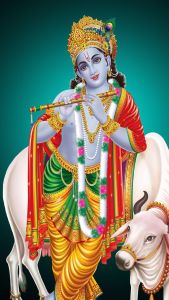
By the way, that, and the inclusion of my favourite image of Krishna, doesn’t necessarily imply that our actions have to have a ‘religious’ intent or flavour: Any action we undertake, for whatever purpose as long as it is motivated by Truth, Love and right thinking, qualifies as being devotional.
While you can see the actual verses yourself via the Om Tat Sat link above, I would like to share with you my very liberal paraphrasing of Krishna’s teaching on the mantra. Also, I am adding a few observations of my own that I hope serve to clarify this great teaching. Oh, please forgive any repetitions, if they occur.
The syllables Om Tat Sat are the symbolic representation of the Supreme Absolute Truth; what I choose to describe simply as all that is. It is called by any number of names or none. It’s existence itself.
It’s an ancient practice, this chanting of these three syllables as a mantra. It is recited when one is engaged in any action in a mood of devotional service. Meaning any act that is imbued with a prayerful attitude and feeling, and with a mood or attitude of devotion to and recognition of, Truth in all things.
And it includes any and every action we undertake, from washing the dishes, to sitting in meditation or silent contemplation. And everything in between.
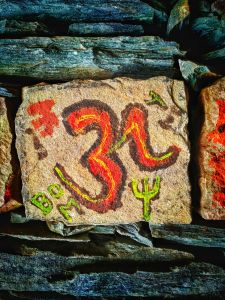
Om
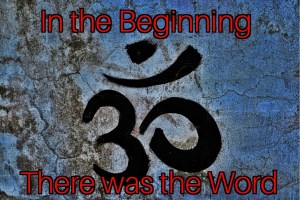
Om is sometimes called the primordial sound, the creative principle, the word from which all creation sprung. I’ve also heard it defined as being the Big Bang, from which the universe emerged.
Om is considered the sacred sound and word by many cultures around our world. Consider the opening of John’s Gospel in the Christian New Testament :
Om is to be chanted when beginning and performing any and all actions motivated and driven by Truth. Chanting Om assists us to actually realise or understand with our heart and not just our mind, the presence of the divine or the universal consciousness in all that we do.
Tat
Tat is chanted by those wishing to be freed from attachment to material things, which includes the desire or compulsion to enjoy the fruits or rewards of our actions.
In the beginning was the word, and the word was with God, and the word was God
John 1:1 New Testament
Attachment is when we depend for our well-being or happiness (physical, mental, or spiritual) upon another thing (money, job, status, etc), person, or desired outcome. Attachment (and clinging, extreme longing, compulsivity), Buddha told us, is the cause of suffering: when things are going well with the things or people we are attached to we are elated; when things aren’t going so well, we are miserable and we suffer.
Sat
The syllable Sat indicates both reality and goodness. In other words, Sat is used to represent that Absolute Truth or Universal Consciousness that we’ve been discussing.
Sat follows very nicely on from Tat as it helps to strengthen our Dharmic (motivated by what’s right and true) actions, so that they actually become Sat – Truth.
So, chanting Om Tat Sat when performing any or all our activities in the world (as well as within) will help us to come to realise or understand that there is only the one Absolute Reality, the one consciousness that is not only universal in nature, but is actually the universe itself.
Oh one more quick note: Often you hear the chant with an extra word up front: Hari Om Tat Sat. Hari is a way to address that which removes darkness, that aids in the shining of the light of knowledge.
It’s a word that represents that Absolute Reality that we’ve talked about here. It can also refer to King or Lord, or otherwise influential entity. I find it rounds out the chant, and I like it!
Please feel free to explore Om Tat Sat for yourself. You will find a lot of great recordings of the chant on YouTube, and the wikipedia link at the beginning of this post is very Illuminating as well.
The previous post on this blog was about the notion of Kora, or the circumambulation of a sacred site or object on foot as a kind of pilgrimage. If you missed it, you can find that post here.
While researching for that blog, I came across an old file in a forgotten folder which also touched on Kora as a topic. I’d forgotten all about it as it was really only a first draft of a proposed post that, at the time didn’t go any further.
Reading it again, I right away realized it was a great theme for its own post and would follow on quite nicely. So, before I share that with you, allow me a minute to set the context.
In early 2020 we had just arrived in a small outback town in central NSW. We’d planned our arrival to coincide with the onset of the very first lockdown put in effect as a response to the outbreak of Covid 19. Our hermitage remained there for about six months before that first (of several as it turned out, though we didn’t know it at the time) lockdown eased and we moved on.
As with that last post, this one features a sports ground, and my adoption of it for the purposes of my own circular pilgrimage practice.
Thank you for your patience
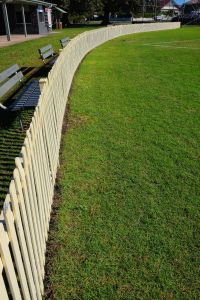
Across the road from the little apartment in which we took refuge a few months ago as fear of the Corona virus spread and travel was restricted, is a sports ground. In freer, safer times, they play cricket, and – in the winter – football there.
That ground, or rather the oval shaped fenceline surrounding it, has become a Kora for us. A Kora is a kind of pilgrimage in the form of a mindful and meditative Circumambulation.
Kora is a Tibetan word, but the concept of pilgrimages circling sacred sites is common to most religious traditions. I guess you might say, we’ve kind of adapted the practice to suit our purposes.
Anyway, a few days ago I noticed that markings had been painted on the grass: a set of giant squares and other lines. I realized that football must soon be returning, along with the reopening of cafes, restaurants, and so on in the town.
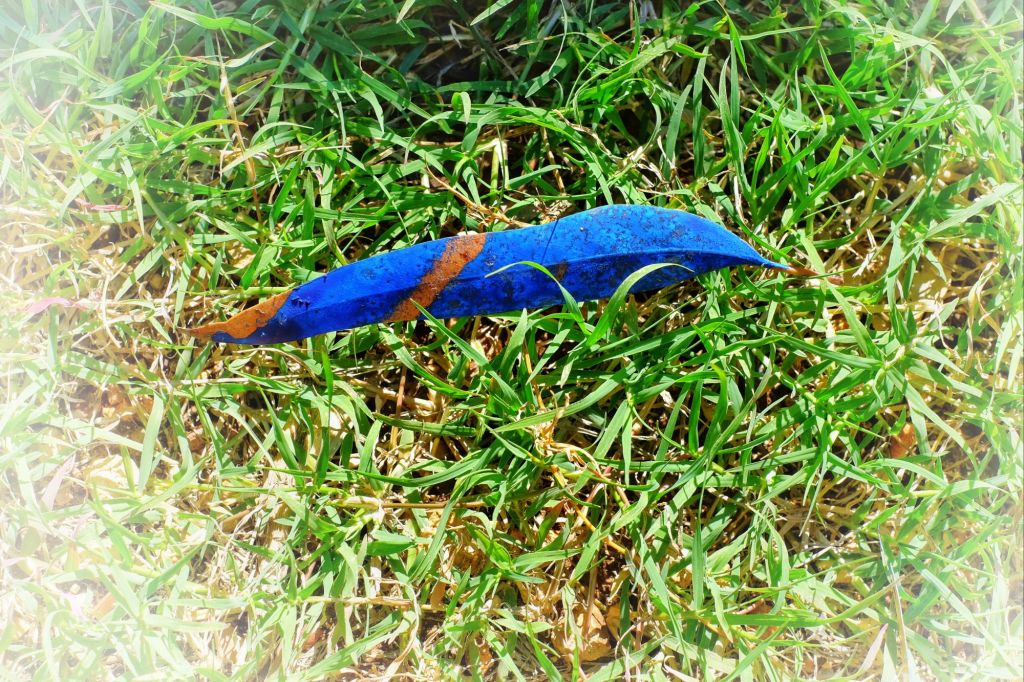
As I continued on my Kora that day, I began to notice that many leaves had been painted along with the grass. It occurred to me that these blue-hued leaves could be seen as a kind of symbol for at least one aspect of the current ‘crisis’ that I’d been thinking about already.
Since first adopting this ground as my own Kora, I’d often seen – and sometimes collected – leaves blown from neighbouring trees by winter winds. I’m always doing stuff like that. Sort of my way of connecting with nature.
Then, on the day in question, I saw the return of human activity to that grassy leaf-strewn space.
I make no comment here, no judgements about rights and wrongs. Life must go on. And with life, the cultural activities of all human communities must resume.
I simply point out that it seemed to me that blue paint on winter-blown leaves is an apt metaphor for the impacts that we, the human species, have on the world we live in.
Also, as you can see from my photo, that impact isn’t always ugly, or bad. In this case, I think it’s actually quite beautiful.
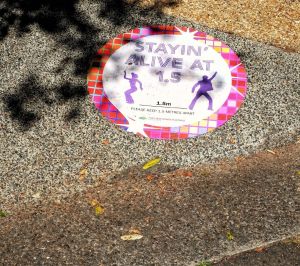
The other thing to say is (as I read on a sign taped to the fence on the same sports ground) please remember to social distance. (note: the pandemic is officially no longer with us, but when you think about it, it might be seen as a wise precaution at any time. There are always germs around waiting to spread!)
Oh okay, one more thing. In a time – in a world – where social distance has become a verb, remember that the only distance between any of us is purely physical and an invented mental construct. All life, despite seemingly unlimited names and forms, is one. There is no separation.
As a self-described Hermit Pilgrim, I aspire always to live a contemplative and secluded life, as far apart from wordly concerns as I can manage. At the same time, I am a pilgrim, in both the sense of the internal journey of the Self as I study and meditate, as well as in the world itself: I move from one living space to another – one temporary hermitage to another- as I feel directed or led.
In the last several years I’ve noticed how often I seem to find myself in one more temporary hermitage that ‘just happens’ to be located right next door or across the road from a sports-ground, or what’s often called ‘a local oval’.
At least three times in recent years, that I can recall. And it is so at the moment. This time the hermitage is in a suburb of a mid-size city (by Australian standards) that in reality is more a low-key and small seaside town on a peninsular.
Anyway, just as with those other occasions, I have been grateful for the oval across the road: It makes for an ideal Kora.
Kora is a Tibetan words that means the act of walking around or circumamabulating a sacred place or object.
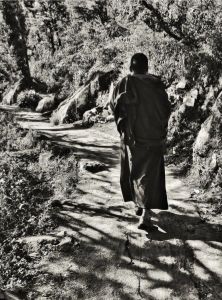
A monk on the Kora around the home and temple of the Dalai Lama in the Indian Himalayas
Tibetan Buddhists do Kora as a form of pilgrimage and walking meditation. It is a devotional practice and it is said to have transformative powers.
Of course Buddhists are not alone in practising this kind of circumamabulation (from the Latin circum (around) and ambulare (to walk).): Muslims circle seven times around the Kaaba in Mecca as the final stage of Hajj .
Many religious traditions consider Mount Kailish in Tibet a sacred place and circling it on foot, even once, is considered by some to be the equivalant of one complete lifetime.
In south India there is another sacred hill called Mount Arunachala. Each year millions of pilgrims walk around its base, which takes a couple of days. In India, the word pradakshina is used to describe such circular acts of devotion and pilgrimage.
And the list goes on: as I said many if not most religious traditions have a practice of walking around sacred sites or places as acts of pilgrimage or devotion.
So, what has any of this have to do with me walking around local ovals or sports grounds and calling what I do a Kora? Well, my intentions are similar to those other pilgrims but perhaps more humble. Let me explain.
Not being a sports-oriented person (not into competition and team sports at all really) I can’t comment too much on the idea that a sportsground is sacred ground because of the sports played there.
I do acknowledge and understand how it is that so many people do in fact consider the games played there as sacred activity with winnings and losings and full of heroic deeds. This indeed makes these places sacred sites.
Then there is the fact that many such grounds are named in memory of local people who have been prominent in the community. And, as is the case with the oval over the road from the current hermitage, ovals do actually become sites of memory.
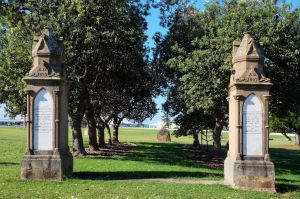
This one, called Lynn Oval hosts several memorials at its periphery: there are tributes to miners who have died in accidents in local mines.
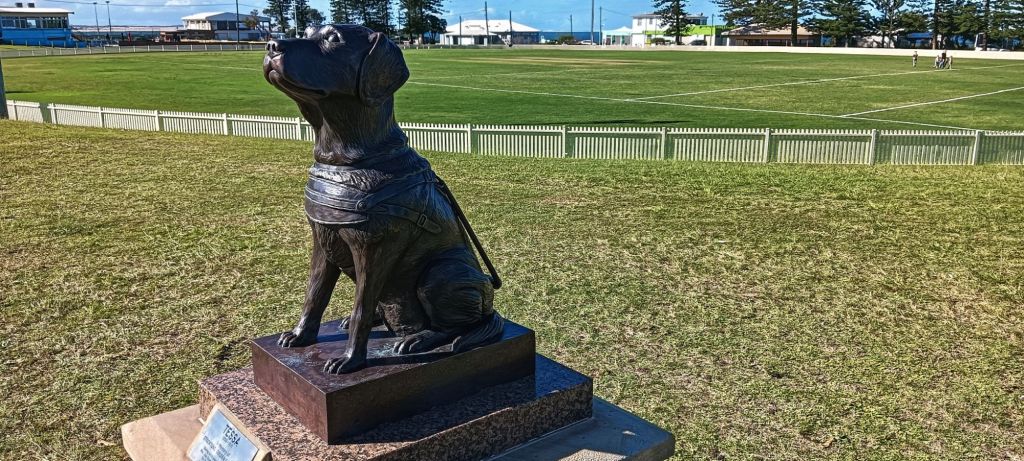
And there is a lovely statue of a guide (service dog for people who have vision impairments) dog called Tessa who is famous in the area for helping to raise a lot of money for more guide dogs.
Lastly but, for me, probably the most significant ‘evidence’ for a local oval being sacred ground is that it, well it just is. Just as all ground is sacred. An affirmation borrowed from First Nations’ Peoples says it all very nicely:
We stand always on sacred ground and beneath sacred skies.
In other words, everthing, everytwhere is sacred. All the rest, the memorials, the games played, they are not what makes the ground sacred, they are the things that people layer onto the space as a way of acknowledging the inherent sacredness.
And that is how it is for me. It’s not me walking around the oval chanting mantra (or at other times ‘just thinking’) that makes it sacred ground, despite being sacred acts in their own right.
I mentioned earlier an alternative word for Kora, pradakshina. This comes from the Sanskrit for ‘to the right’, because traditionally the idea was to always circle the sacred site or object clockwise, so the sacred object remains on one’s right.
Obvioiusly there isn’t much to see on the middle of the oval as I walk around the boundary fence (it’s about 400 to 500 meters by the way). Mind you, the other day a flock of pigeons were feeding in the centre while I walked. Then, at another oval, in another town, there would often be a lone Ibis sitting almost in the centre. It’s all sacred.
This idea of centre has me realising that the whole point for me of walking around ovals chanting my mantra, is the reach mycentre. The temple I’m circumamabulating is me; I’m the container so to speak, for the Consciousness which pervades and actually is all there is.
Peace and Love
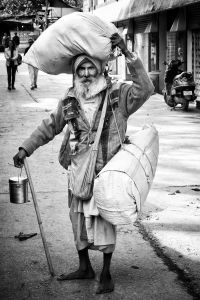
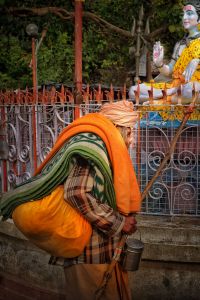
Holy Wanderer: A Saddhu performs pradakshina around a shrine to Shiva in Rishikesh India
PS: I’ve written another post, also related to Kora. Please feel free to visit that post here
Greetings. Just now as I scrolled my blog at random as I like to do from time to time, I came across a pair of posts from successive days almost exactly two years ago.
It was kind of neat rereading, so naturally I thought I would like to share them with you again.
Even the biggest dream catcher won’t always catch the dreams
This morning I woke up restless, and extremely tired. It felt as if I hadn t slept at all, though I know I did. Who can say about these things? Perhaps dreams disturbed me or something.
Anyway, despite this grogginess/restlessness vibe, I resolved to get on with morning routines. And, in addition to breakfast and normal stuff, I set an intention to continue with my usual morning devotional practice.
So with that in mind (and a coffee in hand as an extra aid to wakefullness), I sat with that intention and in a mood of devotion. As is my usual practice, I picked up my Bhagavad Gita.
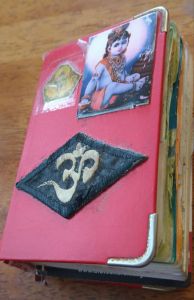
Now, this particular edition has some pages in front and in the back that aren’t really a part of the main text. Over the years I’ve written things on these pages, and pasted in various pictures, prayers, and other things meaningful to me.
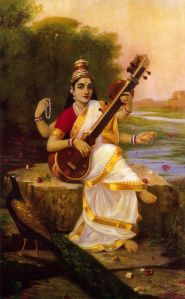
As I picked up the book, it fell open accidentally, by chance, at random, to the pages on which I had placed an image of Saraswati, as well as a page of repeated mantras to her. (I use the female personal pronouns because she is a female representation of the divine in particular aspects. More on this later).
Okay I thought: that’s a pretty clear message about where to go from here. I will chant Saraswati’s mantra for a while. Then I thought, there’s a really nice live recording of the mantra by Krishna Das. Do check it out, it’s very lovely, very meditative and soothing.
So, for about 30 minutes I chanted along with this beautiful renditon of the mantra. Well, it’s a hymn really, a sacred song. And, now? How do I feel?
Awake! Wide awake, alert, ready to face the rest of the day. Inspired also, hence this quick post. No longer restless, well not as bad as I was anyway.
Oh, I should tell you a little about who I think Saraswati is, though of course if you click on the link on her name above, you’ll learn more.
For me, She is a personifcation, a representation, of the divine; the universal consciousness in its aspect of the arts and learning. Obviously, there’s a lot more to Saraswati than that, but for me, she is like a muse, a sort of mentor; She reminds me that art (and study which I have to get to today as well!) is an expression of all that is divine. Actually, art is the divine just as all things are.
I think that Saraswati has been busy with me this morning. She has helped me to set down these words I share with you. Perhaps, this little story of my morning has reminded me that I can call on Her more often. One of my biggest aspirations, you see, is to share more with you here.
Oh, one last reminder: There is no such as thing as ‘accidentally’, or ‘by chance’ or ‘at random.
Makes sense, don’t you think? It is a really excellent affirmation to give oneself isn’t it? A wise piece of advice also. And I agree with you: great advice, sensible, logical, very helpful for anyone and everyone. Unfortunately, it’s not something I can honestly tell you that I practise on any kind of regular basis. It’s more likely that I would have to admit to you that:
‘I am always hurrying to get things done, and until I do, there’s no rest. Doesn’t matter how I feel’.
And it doesn’t seem to matter whether I have a lot to do, or only a little – or even if there’s nothing needing my attention. Whatever the situation, you will catch me in a hurry, going as fast as I can to get whatever there is, done. ASAP.
Okay, I admit it: I am exaggerating slightly. But not by much. Always rushing, always ‘getting ahead of myself’, always in a hurry. It’s been a problem for, well, forever really.
And I know I’m not alone. The world – as in society, economics, education, and the rest – is in a never-ending race to do whatever they do, and to get it done as quickly as possible, regardless of the cost to the planet and all of us who live on Her.
And, obviously, we are all caught up in this ‘race’, in pretty much every area of our lives.
Whether it’s an exercise program we set for ourselves, or which has been forced upon on us by advertising, cultural shaming, false identification with our bodies. Or the intense and all-pervading pressure to be ‘more productive’ at work. Or the newest mobile app that will magically make even our off-work lives more productive and (supposedly) give us that extra edge in the marketplace (whatever that means).
And remember school? High school? College? The night classes you took for fun and relaxation? How many classes began with the teacher giving the following little speech:
‘Now, we can really take our time with this class/course/semester, and we will be able to take as many breaks as we like. We have plenty of time to cover all the material. So, sit back, relax, take your time and enjoy.’
Not many I’m guessing.
Now, as a hermit, you might think I lead a quiet life. And it’s true: I do. Relatively speaking that is. All of us are required to be constantly taking some kind of action in order to maintain life.
Just like everyone else I have to do whatever it takes to just be alive: Cooking, eating, cleaning, laundry, shopping, praying, meditating, relating to loved ones as well as other people I encounter.
Then there’s reading, studying, talking (way too much in my own case), thinking. Well, that’s probably enough to be getting on with, I think.
Despite my hermit life, all these and more I do. And for me, it’s always in a rush and hurry. Well, not always perhaps, but too often for my liking, and way too often for my mental health, peace of mind and for the calm, peaceful like, I aspire to.
Whatever our personal lifestyle, or way of living, we are all in the same boat, so to speak.
Fix your mind of truth and be free from the concerns of the material world.
So, what to do? How can we slow down, get some sort of equilibrium or balance in our lives? How do we stop the rush, the panic, the pressures that besiege us and sometimes overwhelm us?
Well, there’s the problem. I won’t say I have no idea. I can’t say I don’t know. But, and here’s the point, while I can tell you how I am trying to do.If you’ve read what I’ve told you already, you will realise that whatever I try only works sometimes. And a very few sometimes’s at that.
Mindfullness
I try all the time to make everything I do, even if it’s just walking down the street, or washing the dishes, a prayer. Which is really simply another way to say that I try to do everything mindfully.
Sounds really simple when I put it like this, but of course it’s not at all. It takes discipline (I want to talk about this a little more later on). It’s about focusing on how you are interacting with the world around you, and obviously this starts with being fully mindful in each moment as you take action in the world, whatever it might be.
Simplify.
Not easy, I know. Life is full of details and complications. It’s full of conflicting priorities, each with their own sense of urgency and importance. The simple advice is to do what you can. Once again, tackle all the things you have to do one step/thing at a time.
Did you notice the italics? Be alert to the old urgent vs important dichotomy: not everything is of equal importance, regardless of appearances. Equally, we have to discern a thing’s or action’s degree of urgency for ourselves. With obvious exceptions, most things aren’t as urgent or immediate as they are presented.
Minimise.
Sound familiar?
Listen carefully to the commands to buy, buy, buy, and do, do, do that we are constantly being bombarded with from all direction. Ask yourself one of the big self enquiry questions: Do I really need … ?
Related to this is the question of how much money we actually need to have a good life, support our families, and so on. No guru, teacher, book, or anything else can help with this one; we are all different and have our own unique and specific needs. Only you can know what is right for you.
Discipline.
I mentioned this aspect of the solution to bringing a calmer, slower, less pressured vibe of equilibrium to our lives. For me (self-discipline is what we’re talking about here) is not only about willpower, though of course, it’s an important part of the picture. A quote from Bhagavad Gita that I think points us in a helpful direction:
What does it mean, ‘fix your mind on truth’? While it is very often an extremely difficult thing to do, fixing your mind on truth simply means keeping your mind (and consequently your body and heart too) focused on what is actually real, important, and meaningful to you. It means staying focused on what truly resonates with you as the way you wish to live your life.
So hard is this for me to do, that I am engaged in an ongoing project (please forgive the productivity cult lingo) to keep focused on what is true and real to me. To be honest, while I’m pretty sure that it does get easier with practise, I will always be refocusing on my truth. As they say, it comes with the job description for all of us human beings.
Now, about the second half of that Bhagavad Gita quote. If we do manage to reach that stage where we are able to focus on the meaningful and important, the truth for us, will all our troubles, problems, pressures, commitments of all kinds, just magically go away? Can we eliminate completely ‘the concerns of the material world’?
Absolutely not. The only thing that will potentially cease is our constant state of being stressed.
While the things we worry about now won’t disappear, the worry itself may lessen. Our abilities to function more effectively and happily in the world (in our family, our work, our own mind) will also improve. We really may become one of those people who always (or most of the time) take things in our stride.
But we should remember that the pressures, conflicts, health issues, the need to support ourselves and family, relationships with all their ups and downs, remain; they are part of the human condition; they are the natural order of things in this material world.
What we can do, is try as much as we can to control our minds, trying to remain focused on that which is true and meaningful to us.
Minimise, simplify as far as possible in all everything. We can focus on all that is true and meaningful in the life you are creating on an ongoing basis. And, of course, it is one considered and deliberate step at a time.
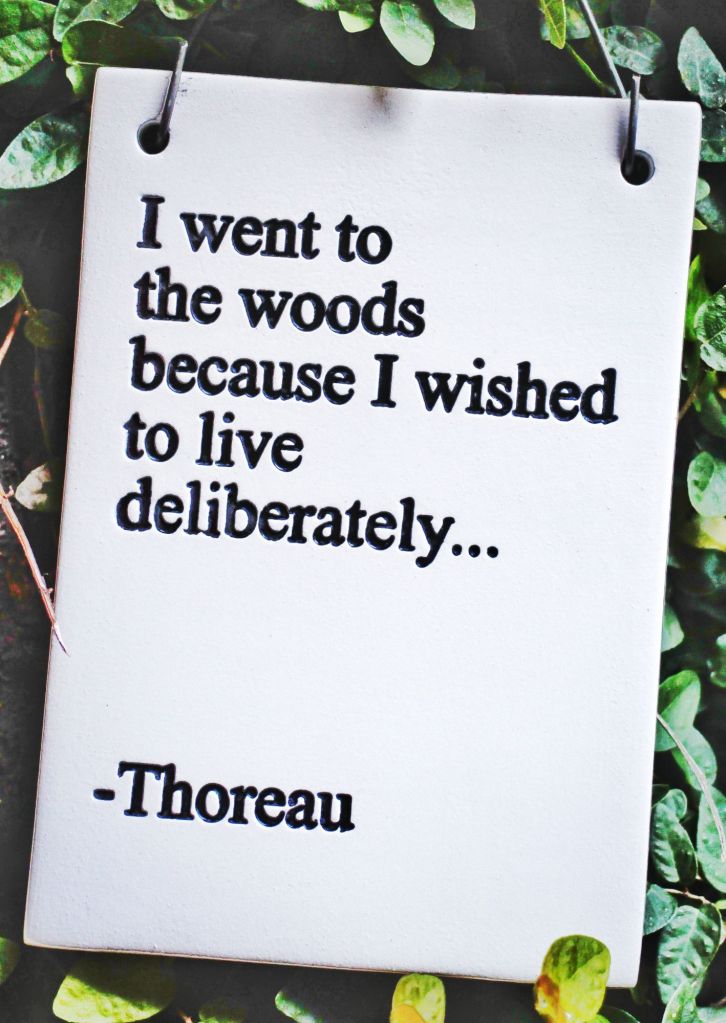
For Thoreau, going to live in the woods was the natural thing to do. It resonated with his soul and heart.
Of course going to live in the woods isn’t for everyone, but if it speaks to you; if it is in tune with your own truth and you feel it would give your life meaning, then why not?
All of us have within us our own ‘going to the woods’ equivalent. It might be anything. Go find it! Rest there.
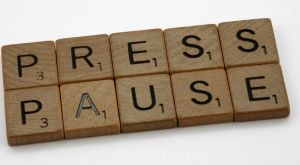
The last words of this post are the same as the first. Actually as I think about it now, I see more clearly that this entire post with all its words and thoughts, might be summed up very nicely by that one small affirmative statement. Well, I might add three more words of my own:
In all things, I pause to rest whenever I feel the need. Peace and love from me to you.
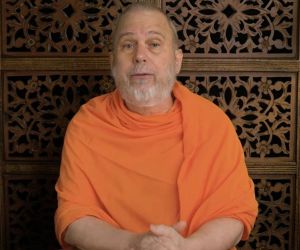
The other day, while listening to a talk by my teacher Swami Tadatmananda, I was struck by something he said. Of course, being my teacher, there are many things that he says that have significance and that resonate with me. But these statements in particular found a home in me that day:
Words can’t get you there (ie realisation of our oneness with the Divine, God, Universal Consciousness, we may call it many things), but words can help you get rid of everything else.
Talking with my partner hermit this morning about this idea, I suddenly thought that for the vast majority of us there are only a given number of words used on a daily basis. And I think this would apply to whatever language we speak – even when you think of specialist groups like scientists, religious people, engineers, – any group.
I’m not talking here about whether me or you as an individual has a ‘wide’ vocabulary, or a ‘limited’ one; I’m just saying that there are only so many words we need to get by while living in our particular worlds.
And that thought led to a not so original idea that those words will be used to achieve all kinds of ends, including opposing goals and purposes.
In other words (no pun intended, I promise!), words may be used to attack and hurt others and ourselves; or in the relaying or writing of the news telling us (constantly and repetitively) all the bad things going on in the world; to express hate; to promote violence; in advertising for anything and everything; to threaten and dominate – have power over – other living beings or Earth herself.
Then, on the other hand, those exact same words can be used to heal others and ourselves; spread news about good things happening around us; in the prayers many of us utter every day; in the many holy scriptures and other sacred texts so many hold dear; to promote love and express love; to promote harmony and unity among peoples and with Earth and all her life; to empower ourselves and others to live well and to thrive.
So, where’s the difference? Well, I think there is a theme developing in this post: it’s going to be packed solid with obvious, even clichéd words and statements. What I’m getting at is this: Two very well worn clichés just popped into mind:
Sticks and stones might break my bones, but words will never hurt me.
And the other:
The pen (or any other means of communication) is mightier than the sword.
Behold the Mighty Pen
It seems to me that these two statements appear to be at odds with each other; kind of opposite ideas aren’t they? Well, clichés may be ‘hackneyed oft-repeated aphorisms’ (I read that definition somewhere ages ago), but I rather think that a great many clichés are merely truths passed down the ages that have been remembered and treasured precisely because they are true and have proven helpful.
Words can hurt; we have all experienced that truth for ourselves. Of course, for ‘enlightened ‘ people words might roll over them like, (forgive another cliché or two) like water off a duck’s back, or those words will go in one ear and out the other. But, I think most of us have a way to go before enlightenment, certianly it’ll be a rather high number of lifetimes before I’m even close.
Which means that before that day of enlightenment comes, words will continue to hurt. Or heal. All of us can think of many examples of words that can be used in so many ways, but let’s just take one example:
Power or powerful. In how many ways can we use that word? What does it mean if I say: ‘He’s a powerful politician’.?
Does it mean this politician is a dictator who forces people to do what he wants? Does he ban anyone who disagrees with him? Is he a believer in the myth that the people are all there to serve him? Does he raise taxes so he can live luxuriously? Does he make policies that keep people poor or hungry?
Or does it mean that this politician is a strong, good, and compassionate leader? Does he know how to empower people to move themselves and society forward? Is he sensitive to the needs of all the people he serves? Does he listen to the people and follow through on what they tell him? Does he do his best to ensure that nobody goes poor and hungry?
You probably get the point I think? Exactly the same words; two diametrically opposed meanings. Of course, we could all cite countless examples of this duality: same words, different meanings. And you know something? We all do it.
So, what’s the solution? How can we find words that don’t hurt? How are we to learn that our ‘pen’ (read voice, keyboard, paintbrush, camera, or any medium we use to ‘speak with’) is mightier? Well, until that aforementioned day of enlightenment is upon us, all we can do is practise; after all, practise makes perfect (sorry).
Okay then, how shall we practise? I can only tell you what I am trying to do myself. Focus on truth in all your actions, words, thoughts. Turn away, as your default response, from all that you know to be untrue. Develop your powers of discernment so you will know what is true and what isn’t.
And this requires that you remind yourself constantly that you already do know the difference. Your heart will tell you, so listen to it as well!
Does all this work. Yes. Maybe. Sometimes. But what I can say for sure is that practising this way of reconditioning your thoughts, words, and deeds so that they are all on the same page, (there I go again with the clichés again) advances you ever so steadily on that road that leads to enlightenment, when we will know exactly what, when, and how to say what we need to say whenever we try to express ourselves in any given situation.




















 Notes from the Hermit's Cave