You Can’t Try to Go With the Flow

Every writer, every painter, every person who makes things – and that includes all of us human beings – will sometimes get the feeling that they are never going to have another idea, or the inspiration, the creative spark or energy, to create anything ever again. Not ever again.

Certainly  that – what could we call it: crisis of confidence? Moment of fear? A feeling of inadequacy? The seeming loss of the desire to create? We could probably keep going with this, but let’s not.

Where was I? Yes. Certainly that, whatever we call it, comes over me really quite often when it comes to the writing of this blog. It’s become a standing joke in the hermitage: Whenever I’m asked if I have another post coming on, my most usual response goes something like:

‘No, and I don’t think I’ll ever write another post. The ideas are all gone. It’ over.

(As I reached for this notebook just now, I was asked that question and ironically I was able to answer with confidence and certainty, ‘Yes I do’.)

As I said, it’s a standing joke because, well, something always reveals itself to me, eventually. An idea, an inspiration, an insight is presented. Something I sense is worthy of sharing, always comes to me.

Having said that, there are times when I really do have that horrible sense that it’s finished, that I will never ever again receive an idea for another blog post.

But, here’s the great thing: Having become a standing joke, this perceived loss of ideas, insights, inspiration, the joke serves its purpose: It makes me smile, it treats the whole thing with some humour.

In other words, I’m not allowed to just get away with feeling sorry for myself. It cheers me up. It props me up a little, and gets a little part of my mind opening up to something new or fresh to write about.

There have been times during the journey of this blog when I have strayed from my intention for this blog. As it says beneath the blog title on the top of the page, this blog is meant to be:

musings on one hermit’s life and world

In the past, I’ve sometimes solved this ‘no ideas’ problem by writing about a topic from something I’ve read, teachings I’ve studied, or some other things not directly about me or my personal experience.

Lately (for some time now) I’ve resisted this ‘easy way out’, and tried more attentively to stick to the intention stated in my sub-heading – write about me and my experience.

Okay, it’s in fact not trying that’s the point, both with me writing this blog, and also with every other aspect of how I try (sorry, not try) to live my life.

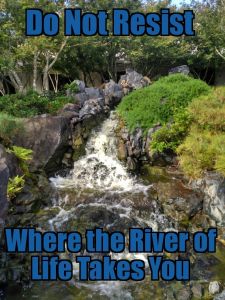
Wu Wei it’s called, the path of least resistance. Certainly wracking my brain to come up with post ideas, and straying from intentions just so I can have a post, sets up much resistance on many levels.

You can’t ‘force’ musings, can you? If you muse you muse, if you don’t muse you don’t muse. It’s about letting it flow, or if it’s not flowing, let it be.

And here’s the interesting thing: it – the flow of ideas, insights, musings, whatever – flows at its own pace anyway regardless of my interference, angst, worry, or my forcing things to go this way or that.

My lesson for today – for my life too I pray:

Go with the flow

You’re the Voice, Try and Understand It

One of the things I like about one of our local coffee shops is that they play a nice wide selection of music. Mostly popular songs from pretty much every decade back to the ’60s. I think they have one of those looping playlists you hear sometimes in shops and cafés.

It must be quite a long list because you don’t necessarily hear the same songs repeated at every visit. Which is a nice thing too.

Anyway, yesterday the chorus of a song I heard played got stuck in my head. The song, You’re the Voice, was a hit around the world in 1986 when it was released by Australian singer John Farnham.

It’s essentially a protest song reminding us that we all have a voice, and encouraging us to use our voices to stand up against corruption and war. One of the co-writers Chris Thompson missed out on going to an anti-nuclear protest because he slept late. He felt so badly about sleeping in that he wrote the lyrics reminding us about taking personal responsibility and making our voices heard.

Okay, back to the chorus getting stuck in my head.

You’re the voice, try and understand it
Make a noise and make it clear Oh woah.
We’re not gonna sit in silence
We’re not gonna live in fear Oh woah

You see? It’s very catchy, and an excellent piece of advice too. And, for a hermit monk, it’s actually advice I could and do aspire to live by. Just not quite in the sense the song intends perhaps.

This morning, when my partner hermit suggested we just sit in silence for a while, I spontaneously started singing the chorus, though a slightly modified version:

We’re just gonna sit in silence
We’re not gonna live with fear.

Then, as I sat in said silence, I got to thinking about the words of the chorus.  Nobody wants to live in fear, yet it is an aspect of the human condition and something so many people live with constantly all over the world. All through human history as well.

The message of the song reminds us all that we have a voice which we can use to help create a state of affairs in which we don’t have to live in quite so much fear, fear that’s coming at us from so many sources.

For me, this is a vital, fundamental, and absolutely essential principle. Without those who do stand up, those who do use their voices to try to right wrongs, then, well I can’t think of what that might mean.

Yet, for me, I’ve chosen silence. Not only chosen I must admit: temperament, my own nature, health, all are factors that have made silence the best course for me to take. Silence as in seclusion from the world, minimizing outside imput, and reducing as much as possible the attachment to the world and its things and fears.

And this way of living ironically allows me to use my voice in my own ways to address the Truth as I see it; to help effect change and contribute to the healing so sorely needed.

Being ‘out there’ and engaged with worldly things and activities and interacting with people constantly causes me so much anxiety that it threatens my health and ability to act in the world.

There is also the personal choice aspect, common to so many who live a contemplative life. Silence – when I can actually achieve such a state – gives me the energy and clarity to write; it gives me the mental, emotional and spiritual ‘space’ and energy to pray, to contemplate, and to foster the ‘good vibrations’ I feel are also necessary to turn the world towards peace, healing, and truth, as well as to assist in maintaining the wellbeing of all life.

The world, and all of life, needs both those who can’t or won’t be silent (I’m definitely not suggesting the world needs more noise). We all need people who can and do raise their voices against war, poverty, corruption, and all the ills that plague us.

And it needs those who are able to ‘just sit in silence’. The work to be done is the same; the outcomes perused are the same; and in essence the means themselves aren’t all that different either. Silence as mentioned can include the use of our voices in ‘quiet’ ways, in ways that don’t have to relate so directly the affairs of the world.

It really is a symbiosis: Those of us living secluded and contemplative lives with our prayers, our witness, our creative endeavours, support those active and vocal ones out there trying to heal the world.

And at the same time those out there in the world support the secluded and contemplative ones. Their efforts and hard work, and simply knowing they are there, are encouraging and nurturing for the secluded and contemplative ones.

We are One after all.
Yet our voices are all unique, each and every one.
That’s what I understand to be true.

Self Enquiry: Listen to Your Self

This last little while I’ve been going through some serious contemplation, some deep questioning, on how to be ‘more of a monk’. Things like how to pray more deeply, and often; how to have a more focused and concentrated devotional practice; how to be a nicer person. Things like that.

Actually, that’s not exactly right is it? These are questions, enquiries, that for a number of years (is all my life too big a stretch?) habe occupied me. I’ve consistently been making enquiries, addressing questions, to Self – as well as to God or the Divine.

Still, like all things in life, self-enquiry goes through more intense, then less intense phases or periods. Let’s just say that lately I’ve been immersed – sometimes to the point of distraction – in one of those more intense periods.

(note from internal editor: Do I have to remind you once again to get on with the story you are here to tell?)

Okay then; let me see. Oh yes, right. Last night I was looking forward to beginning a new book. I’d read the introduction and thought that it was going to be just my cup of tea as it were, that it was something I would enjoy and learn from.

Anyway, as I opened the book on my tablet, I was suddenly stopped by a sort of wordless warning. The sense I had was that this book would indeed be a little piece of the answers I’ve been seeking.
Not so much in the contents I felt, it was more about approaching the book with more openness, less skepticism, more generosity of spirit and mental attitude. And the idea seemed to also include taking these qualities with me later as I thought about what I had read (or was about to read I should say).

You see, being more open, less skeptical, and more generous, come under the umbrella of being nicer. Still given the subject I was about to read about, I was a bit surprised by this ‘warning’.

As it turned out, I finished the entire book, so enthralled was I by the contents. The only things that tested my resolve to ‘be nicer’ was a number of occasions when the author’s worldview and interpretation of events, stretched my patience.

But, I managed. I didn’t become inpatient or outraged or irritable . When threatened by such responses I simply reminded myself that I was reading about another person, and I didn’t have to have an opinion one way or the other about what they believed or how they lived. Not only do I not have to have an opinion, I’m not sure I really have the right to an opinion about someone else’s life at all.

Besides, haven’t I just got through describing how I am myself deeply engaged in a process of self-enquiry? And wouldn’t such a process involve exposing myself to ideas, worldviews, kinds of information, new to me or not in alignment with my own beliefs? Surely bursts of impatience, indignance, judgement, and the like, would close me off in my search for answers?

Anyway, as I said I was so enthralled by the book – my reading informed by a little more generosity, a little less judgement, a renewed attempt at openness – that I finished the book in that one sitting.
Mind you it was only one hundred and something pages long. Still, for me, it was pretty good going.
PS Speed reading wasn’t – isn’t, nor ever will be – a part of my ongoing self-enquiry into the depths of my monkhood. Perhaps I need to add something like ‘Transcend the ego’ to my list.

Note to Self: Have a Little Faith Will Ya?

As a hermit, I am a pilgrim, dependent on a pure faith that I am exactly where God would have me be. I am here, and it is now.

I forget in which of his books I read this, but it’s a prayer written by Thomas Merton shortly after he’d finally moved into his hermitage full time. The ‘I am here, and it is now’ I added, though of course it’s also borrowed.

It’s a prayer, an affirmation, I recite at least once a day. And, like Merton, I aspire to that ‘pure faith’. Faith is a strange thing: it may grow and develop and then it does indeed support me in my intentions and living, not to mention the comfort it provides..

But, all of a sudden it can just flow away, leaving me adrift, bereft, and not sure of anything.

I am a pilgrim, it’s true. But as Bhajan (a bhajan is a sacred song, a hymn) singer Krishna Das sings:

I am a pilgrim/the road’s so long.

And sometimes it seems a lot longer than this particular pilgrim would like. Still, as they say, how long’s a piece of string? And it’s rougher than I’d like as well. but again how rough is rough? Layers of meaning in that word longer.

Yes, I am a  hermit, and my mind’s not the same, as Jackson VanHorn sings. Same as what? Whose mind is mine different from? Is my mind somehow not that same as it once was? True though: my mind is hardly ever the same.Here’s the whole chorus as it spoke to me:

Yes I am a hermit
My mind is not the same
Yes I am a hermit and ecstacy’s
my game.

For this hermit, ecstacy is not a stage experienced all that often. Mind you, there are fleeting moments, but like the pilgrim road, there are long distances to be trod between one of those moments and the next.

And as for Tim Moore claiming he’s

‘… sittin’ peacefully on Hermit Rock’?

Well, yes the rock – the hermitage – has much potential for peacefulness; a peace expereienced quite often actually. It’s a sacred space

But, as in any way of living, any way of being, peace comes and peace goes. And when it goes, it can seem like it never existed, and that ‘sittin’ peacefully’ is, and always will be a fantasy never to be realised or made real.

It’s about equinimity 

That’s something else I heard today. Well, there’s not a lot of equinimity in this hermit pilgrim today. Seems, then, that there needs to be some shifting of perspective; some peace needs to be restored

My Lord Ishvara

Deep withn the still centre of my being

May I find peace.

Silently withing the quiet of the grove

May I share peace.

Gently and powerfully in the wider circle of humankind

May I radiate peace.

Om Tat Sat

Om Shanti Shanti Shanti

Afterword:

A few hours have passed since I made these notes; I have regained a little balance, but still thought it was important to publish this post.

Thank you for your patience

Love and peace

Paul the hermit

A Lesson in Humility

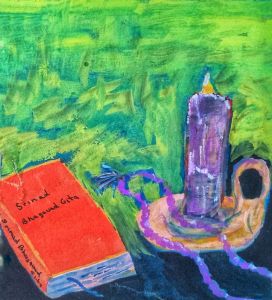
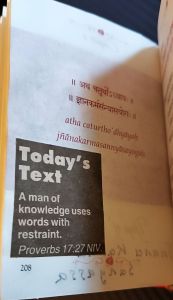
Opening my Bhagavad Gita this morning for my daily reading, I noticed that I was about to begin a new chapter. I always like when that happens, but this post isn’t about that; it’s inspired by a small scrap of paper glued on the facing page.

In years long gone, a less minimalist me would collect bits and pieces cut from newspapers, magazines or wherever (no Internet in those days). This particular strip of paper was cut from a newspaper (makes me shudder a bit to think how I would devour newspapers every day if I could. Shudder in horror) and has the title Today’s Text. It was a daily quote, usually a verse, from the Bible, and I’d often cut out those that appealed to me. As this one obviously did.

No longer collecting such bits and pieces, this one somehow survived the now ancient culling of excess material stuff, and has ended up in my Bhagavad Gita. Don’t ask me how or when.

Anyway, before I get off track, or too far down the track, here’s the quote we’re talking about

A man of knowledge uses words with restraint.
    Proverbs 17:37

I paused when I read this. As you probably are already guessing, I just had to write it down and added some notes of my own before getting on with my Bhagavad Gita reading.

What comes next is essentially what those full of first thought notes said, plus a little context setting to begin with.

In addition to the Bhagavad Gita, I am also reading, bit by bit, another sacred text. A couple of times (including today) I’ve been frustrated at having to plough through a page and a half (for example) of a description of a concept or idea that I’ve thought could have been said in no more than a couple of sentences.

Is he, the author, a person of knowledge? He most certainly is. He has wisdom too. He was a respected teacher and scholar. Some, many, say he was a saint.

So, perhaps it’s me demonstrating my own lack of knowledge here. Perhaps it is me, also lacking in wisdom, who is using words without restraint. Just because my opinion proposed using fewer words, does not mean by any means that they are better words.

Perhaps it’s me in error: passing judgement on an author I consider knowledgeable and wise, and who is certainly more than intimate with the topics he’s commenting on.

So, allow me to put another perhaps into this mix: Perhaps if such a person takes one and a half pages to describe an idea, then it might just mean that I am in need of more knowledge than I think I have. Surely I am missing something.

At the very least I am being prompted to reread the sections in question, that I was so hasty to dismiss as too wordy. Perhaps (what is it with this word today? Have to nominate it word of the day – perhaps) there is something for me to actually learn before letting my mind run away with critical thoughts based on quick and ill-informed judgements.

Foster Your True Self: It’s A Big Deal

Today I finished watching  a beautiful and extremely fascinating documentary.  It was about life in a Trappist monastery as well as a fascinating history of that movement. I was struck by something one of the monks said.

He was referring to what he and his fellow monks are actually doing with their lives in the monastery. He said their lifestyle was helping them to:

‘foster who we truly are before God.’

Hearing this, I had to pause the video, make notes, and do some thinking. What had actually struck me, my first thought on pausing, was that this is exactly what I’m doing as a hermit monk dwelling in our Hermitage. Exactly what I’m doing. Well, at least it’s what I’m aspiring to.

There are two aspects or primary intentions that inform the life I try to live as a hermit and monk that are in fact integral one to the other; they merge actually to become one primary focus of my life.

I practice an ever evolving and I hope intensifying devotion to the divine, with the upliftment of the world and all beings as its central theme.

The other, integral focus, is an equally ever evolving and intensifying quest for self-knowledge, for the answer to the question, who am I?

In other words, I am attempting to foster who I truly am before God. Foster as in ‘encourage the development of …’ (as one definition puts it).

In this case, the development is the growth of the knowledge of my true nature – who I am above and beyond this physical (and mental) creature running around madly trying to figure things out.

In my life there is much effort devoted to the cultivation – a synonym for foster – of that knowledge: meditation, prayer, contemplation, study, just sitting, being still. Did I mention the aspirational nature of all this? It’s an ongoing project to say the least.

Speaking of aspirational: Two more synonyms for foster that I like are nurture and support. Both are even more in that aspirational category; at least it feels like that sometimes. Actually, maybe there’s a more accurate way for me to be putting this.

After all, as I think about it now, even I would agree that my whole lifestyle, my entire way of being in the world supports and nurtures me.

Except for me, myself, and I, that is: Lest the inner grammarian sends me mad in a search for antonyms for foster, let me just say that I am overly skilled in the self-critical and self-destructive departments. My ability to put myself down and to tear myself apart is legendary.

Anyway, with overwhelming nurture and support coming from my partner hermit all the time reinforcing my sense of Self, all I have to do is work on ridding myself of these self-destrucitive and self-critical tendencies.

So, the conditions for the banishment of self-loathing are there; all that’s missing is discipline on my own part in seeing the Divine in myself as I profess to be trying to see it in everyone else.

I need to be rid of the forgetfulness  that blinds me to the Truth that is actually very plain to see.

Speaking of the Divine, the ‘before God’ is the vital element for me. God is all there is, so it is always before God that I act, whether in a positive or in a not so great manner.

The best prescription is for me to remember. To remember that God is everywhere and everything (did I say that already?). To remember that me, myself, and I, are also included in that everything and everywhere.

I think that once I do remember these truths even for the odd moment now and again, then the real fostering of who I truly am will have begun.

A Story of a Door

The walk from the Hermitage to the coffee shop at the Village Green takes around five minutes or so. This morning, noticing a pause in the rain, we thought we might take the opportunity to get some fresh air and a walk, at the end of which there would be coffee. So, we stepped bravely forward, with the faith that the gods of the rain were indeed taking a break.

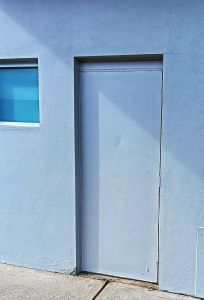
‘Look over there, ‘ said my partner hermit as we passed through the centre of the village. ‘There’s a door that can only be opened from the inside.’

‘I’ve never noticed that before,’ I replied, looking across the street to a wall into which was set a door with no visible handles or lock. The only things that suggested that it was in fact a door were the hinges on one side, as well as its size and shape.

Now don’t ask me how many times I’d passed that spot. Most likely dozens of times, on both sides of the road. Still, now that I had been shown it, I was intrigued. Mentally I was captured: I thought, what a wonderful thing: the one or ones on the other side of the door have complete control over who or what is allowed to enter.

With such a door, one that only opens from your side, you could easily choose to rarely – or even never – open it. Ah, peace at last went my thoughts.

But, right away, those thoughts were dismissed, sent packing: too simplistic, too extreme, to heavy a response. Though, you know, I do feel strongly that such a response to the world – shutting it all out completely – is perfectly understandable, completely reasonable, and oftentimes even an absolute necessity .

Still, I had that feeling towards my reactive thoughts of ‘too extreme’ (inner editor’s note: he has no idea what he’s saying does he? If you ask me, right this minute he will be thinking his initial reaction was spot on and he’d love to have a door like that. Anyway, we’ll let him have it his way).

Some further, more careful thought is required here I think. For a start, here’s a question: If I were to keep the door shut all the time, how would I ever be able to allow my own light, my own love, my own Self, out into the world?

Maybe there’s a way to keep the door open sometimes, then at other times choose to keep it closed to bar access to unwanted intruders in the form of people, thoughts, events, emotions and so on.

After all, it is my door (in this little fantasy at least), the door to the inside, where resides the ‘real’ me, the Self within, beyond and above, the physical form that I so tenaciously cling to as as being the real me. Talk about attachment!

Perhaps slightly exagerated, but this is close to how I see my actual door working as distinct from the story I’m telling in this post.

Where was I? Oh yes. With that door that opens only from the inside, I might come – eventually – to realise that there is nothing to disturb me – unless I open the door and let whoever or whatever that is unwanted, through the door.

I am my own gatekeeper, and without my consent my gate (door) cannot be opened and entered.

And, getting back to the choices I am able to make to sometimes open the door to allow some light and love to flow out from me, out the door and into the world. The more I’m able to discern when, and for how long, to open the door as a way to control what comes in, to what can reach me, the more resources of said love and light I shall be able to build up.

Which, in turn, will lead to more and more opportunities I’ll have to open the door in order to share some of that good.

I can envisage a state reached where my door could quite possibly be left to stand ajar all the time.

You see, the more love and light pouring out, the less that disturbs me can get in. Love and light is transforming, isn’t it?

Yes. Now I’ve noticed – recognised – the door that can only be opened from the inside: It’s me! Now, where did I leave my door keys?

What Will Please You Lord? A Prayer Contemplated

Namaste my friends

In my last post I reflected upon the meaning for me personally of a Bhagavad Gita verse that had particularly struck me as I carried on with my renewed inspiration to read the text from the beginning.

Today, I didn’t even get to the place where my reading left off yesterday. Before reading I like to pray some or all the prayers I have pasted in the front (and the back now). As I was deep into this practice, one prayer in particular stopped me, just as with that verse yesterday.

This one seemed to speak to me, asking ‘What do I mean to you?’ So, I made a mental note (always a risky proposition with me), and carried on with my prayers, determined to take time later to think about that prayer, and try to answer its question. So, here I am, later in the day, making these notes.

The prayer itself I am fairly sure comes from Thomas Merton, monk, mystic, and writer. Not completely sure, but I know that whoever composed it was one clearly inclined towards living the life of the mystic.

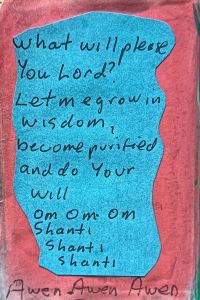
What will please you Lord?
Let me grow in wisdom,
become purified,
and do your will.

For whoever composed this prayer, it is an expression of a genuine longing. I can say that for me it is a deep plea, expresses my own longing. Each time I recite it, in fact, I can say that, although this is the first time I’ve addressed the big what does it mean question, I do sense the longing and grasp the meanings of the various words and ideas in the prayer. Actually, now I think about it, I do say this prayer or parts thereof in one form or another very often.

What will please you Lord?

When I begin to pray these words, what I feel I am actually doing is asking the Universe, the Divine, Self, God – the I AM – how can I live my life so that it is attuned to the natural order and flow of the Universe.

I am asking, what do I need to do to let go of attachments to worldly things which arise from material desires? How do I find the grace to accept when things aren’t going completely my way?

In other words, I’m asking how can i live a good, truthful, happy life in harmony with all other beings and with the Universe.

Let me grow in wisdom

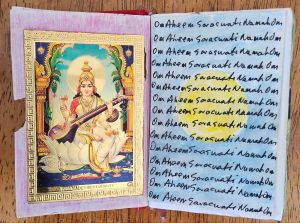
Another of my prayer pages. This one devoted to Maa Saraswati, goddess of, among other things, wisdom

A good place to start, a great first step. But, again I have to ask myself, what does growing in wisdom mean to me?

To me wisdom is not merely knowledge. Though, having said that wisdom needs to rest on a firm foundation of knowledge, otherwise what’s there to be ‘wise’ about?

I’m not talking about worldly knowledge here, though obviously it takes some degree of knowledge for any of us to live in the world. Also it’s relevant to the next part of our prayer; we’ll see that soon.

I’m referring instead to a special kind of knowledge that will (I pray) lead me somewhere closer to acquiring some degree of wisdom – one day.

Self-knowledge is what I’m getting at. And I go about my attempt to obtain self-knowledge in a couple of different ways. I study, sacred texts like the Bhagavad Gita, as well as the words of those wiser than me (which is rather a large selection of people I can tell you) both living and historical.

I meditate (not nearly enough!) as a way to enquire into my own ‘real’ or true nature: who am I? what am I? Just digging deep within to reach some realisation of the answers to those questions.

When I have answered those questions, I will understand that I have reached a true level of self-knowledge. I sense that, at least being on the path to that realisation, I would never be able to develop any level of wisdom.

Mind you, I do feel that all humans are born with some degree of wisdom potential ‘built in’ so to say. As for me, I don’t feel especially wise just yet.

Become purified

For me, becoming purified goes hand in hand with the cultivation of wisdom. In fact I would say that in the very efforts to become purified, it might be possible for me to develop some wisdom as a result of those efforts.

So, here we go again: What does it mean? To become purified? For me it means living a Dharmic life. By Dharmic I mean a life steered and driven by Truth, Right Living, Right Speech, Right Conduct , Right … The Buddha taught The Noble Eightfold Path. That is in my opinion the very best, topmost, pinnacle of self directed means to living a Dharmic or purified life.

The Eightfold Path is not a set of dogmas, rules, or anything like a list of commandments or instructions . The eight steps are merely signposts, a roadmap, pointers for me to follow in order to purify my life, live a Dharmic life. No behaviours are prescribed: it’s entirely my choice what forms my behaviour, actions, and the rest take.

Obviously the path to becoming purified is a life-long one, though some would say that many lifetimes are required. Personally, I can’t even hint that I might be anywhere near close; some days I feel further away than ever.

But, as I work towards ‘growing in wisdom, with the help of my becoming purified path, I pray that some day I might actually learn what I call proper discernment.

This discernment is the ability to act in the world and to react to the joys and sorrows that are inevitable, with compassion, love, and wisdom. To face those inevitabilities with calm and equanimity. Acting with proper discernment will mean that I am living in Truth.

… and do your will

As I reread the words I’ve just written, I realise that, by the time I reach the state described in that last paragraph, I will have succeeded in ‘doing your will.
I will have aligned my self perfectly with the order of the Universe. I will know my place as a tiny fragment of that very order.

If I’m honest however, I have to say that I think it’s going to be a very very long time before such a state come to pass. So, what to do in the meantime?

Well, along with my attempts to live Dharmically, and to cultivate wisdom, I have committed myself to a life of devotion. Devotion, prayer, contemplation.

Devotion to what? To whom?

To the Universe, Divinity, God; all that is represented by all those names we humans have put on the Absolute Reality, that is all there is.

Everything. And everybody, is what I’m saying. There really is no separation except a kind of superficial one we allow ourselves to imagine by applying so many names and forms to the material objects, things and so on, that appear to us as separate one from another, whereas there is in fact only one, without a second.

That’s where the contemplation comes in. It’s a going within, inward to what we imagine is a kind of ‘space’ where all merges into one, the one that is all there is.

I think that’s what ‘pleases the Lord’. While I am indescribably, gravely, deficient at all the steps described above, one course I know to be right for me is to continue to engage with those steps, and to devote myself and my life to the Divine, to the Truth.

That’s what pleases me. I pray that it pleases the Lord.

You Are Invited to Visit the New Page on the Blog

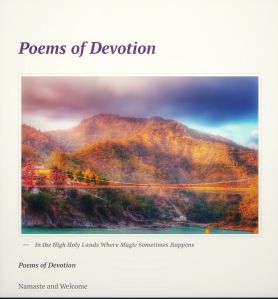
Have you seen the new page on the blog? It’s called Poems of Devotion (no prizes for guessing what’s on that page).

What you’ll see when you get there!

You are warmly invited to head over there to read and enjoy a poem. Or perhaps two, or seven! The choice is yours.

The page, as you already guessed, seeing right through the extremely obscure title, is dedicated solely to devotional poems I have composed. Many have been written in recent times, though there are some which are, well, no longer the new kids on the block (get it? New kids on the block? New page on the blog? Oh, okay, never mind).

I hope to continue my occasional practice of featuring a poem in a post (perhaps with its story or some other commentary). But, in time, all my devotional poetic pieces will be on the new page.

You are very welcome to visit the page, Poems of Devotion, to read, to contemplate, and if you so wish, copy anything you find there for your own reflections or to share with others.

Love & beauty; What else is there?

I’m grateful that I have come somehow to compose these poems of praise and love. I call it a gift of grace that has been granted me. It is a gift I now ask that I may share with you.

Thank you

Paul the hermit

A Plea for Forgiveness

It was way back in the earlier days of this blog, sometime in 2022, that I wrote a post about our community’s liking for snacking on plain toast by choice. It’s our more or less regular late evening, before bed, bite to eat. Perhaps accompanied by black tea, as I described in that post.

As I also point out in that post, I do actually enjoy plain toast. It’s not that I no longer like jam or other yummy spreads; I like them too well truth be told, but sometimes, well, plain is good.

As the day winds down to become night, and we settle to our evening snack, I will sometimes make a joke about simple food, or monks with simple tastes, whatever. Anyway, a few nights ago I made a remark, a joke, that has had a profound impact on me.

‘I’ll just say a prayer for my two slices of dry toast.’

Of course I am just like so many other religious or spiritually inclined people, and say a prayer before I receive any and all food or drink. It’s a long time habit, and a blessing I like to perform. Just a thank you is all it is really.

This comment, this joke, as soon as it was out of my mouth, I realised, of course I will. Don’t I always?

It’s true that our community lives simply, as simply as we can. And that includes what we eat and drink. It’s also true that this is not some sort of ethical stance consciously taken; nor is it a kind of overlaid act of solidarity with those who have no choices due to poverty or other circumstances.

It’s purely and simple because we like simple. It really does suit our natures and temperaments and for us it is the obvious way to live.

It is no renunciation: we welcome simple. This obviously is not to say that we are unaware that our very natures and temperaments naturally steer us away from choices that are unethical or are out of sync with compassion (call it solidarity) for other beings.

The reason I’m ranting on about this off-hand comment thrown out as a so-called joke is, well just that: It was off-hand, and my misguided intention in making this ‘joke’ was insensitive and careless; it was lacking compassion for all the other living beings sharing life and consciousness with me.

And for that flippancy and carelessness, I ask forgiveness from the invisible community that is in fact all of us struggling to live in a material world.

My sense is that in saying ‘all of us’ I might instead say, all of us who are in truth One; We who are that one Self that seeks forgiveness.