It always surprises me how quickly, how easily – how smoothly – a perfectly okay conversation or train of thought will, just like that, morph into a full-on gossipy rant.
You know the thing: pointing the finger at what someone else is doing wrong; or precisely and with great clarity of analysis detailing how another person (or sometimes myself) has erred, how they’ve slipped up, made mistakes they could have or in ‘my opinion’ should have avoided.
How easy it seems to happen that I will suddenly find myself very eagerly ranting about the sawdust in the eye of another, while breezily ignoring the huge plank in my own eye. The errors in someone else’s way are so often clear to me, while my own not so terrific ways are completely ignored.
And the weird thing is, how it sneaks up on you. I mean on me. As I said at the start, one minute I’m having a pleasant and reasonable conversation, the next minute I’m ranting about him, or her, or them, or who or whatever.
Such an error in my own ways, occured this morning as I fell into what felt like a perfectly rational pointing the finger session, full of criticisms and judgements about someone I actually quite admire.
That is until one of the hermits with just one comment, brought the whole thing to a sudden and definite stop:
‘We should be sitting here sending out good vibes. That’s our job.’
A perfectly timed cause for a pause for thought. And absolutely correct – as hermits, as monks committed to the welfare of all beings, it’s more than our job; our lives are dedicated supposedly to love, prayer, service, contemplation on the Divine in all things and how we can best serve that Divine.
Human nature is a tricky topic to think about though. So much of what we do in the world is driven by our desires for more things, for status, for happiness, or pleasure. Eating, sleeping, mating, and defending, I have heard it called by way of summary.
Hermits behind walls are still flawed human beings
I’ve supposedly withdrawn from all that, left it behind ‘in the world’. I live a secluded, quiet, and contemplative life precisely in order to counter those very attributes of human nature.
I suppose all this says is, I am still a human being with all the flaws, all the desires – and aversions – that come with being that kind of, well, being.
Yes, all true. Maybe. But, isn’t it possible that I might use just a bit more discipline? Could I be perhaps a little more clear in my focus?
Perhaps I could ‘sit here’ and send out good vibes. At the very least I could pay a bit more attention to those times when I’m about to slide – or have already slid – into my ‘putting out bad vibes’ mode.
We can’t really ever know what’s going on in the lives of other people, or in their minds and hearts. In any case, it is rarely, if ever, our business to even want to know or make guesses or assumptions about others’ lives.
As a hermit monk, as a pilgrim on the spiritual path I aspire to walk, my only business is the making of ripples (I know it’s a cliché but it works for me, just as so many do), the distribution of waves, or vibrations of replenishment, of love, and kindness, of good things, out beyond myself.
Good vibes to all living beings who I am pledged to serve, to the Divine that is in, and in fact is, all beings, including me, you and all there is.
In my last post, I spent some time contemplating a question:
If I’m actually praying a prayer, how could it even occur to me that I might in fact not be praying, but instead simply be reading the words of the prayer? (substitute here ‘reciting the words of the prayer in rote fashion’)
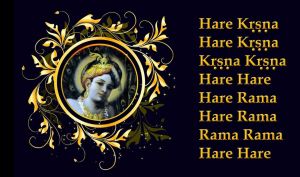
Well, for today’s post I have a poetic offering which I composed several days ago. It’s actually words of my own built around – embracing even – an already existing prayer: the Mahā-mantra, which is better known as the Hare Krishna mantra.
While making notes for that post, my mind at one point drifted to that poem. So, after finally publishing the post, I reread the poem a few times.
It struck me that, rather than creating a simple poem, I had instead composed another and distinct prayer of my own, which incorporates the Mantra. That was a revelation to me.
It’s a poem, no a prayer, of gratitude. And of praise also. It has a structure and a cadence that has me sensing that it is a prayer to be prayed, and not simply a poem to be read as words on a page – or screen.
It is with that gratitude and with love that I humbly offer these words – this prayer – to you.
TAKE THE LORD’S NAMES
‘Going to chant for a while’. Hare Krishna A refrain often heard Hare Krishna Here in this place Krishna Krishna In this hermitage Hare Hare In this place of abode of hermits Hare Rama In this paradise for hermits Hare Rama In this place of refuge Rama Rama In this safe haven Hare Hare Where we servants serve Hare Krishna
‘I’ll carry on with my Gita then,’ I said to my partner hermit after we’d been discussing something for a while.
‘I’m enjoying reading my prayers this morning. So I’ll read a few more then read a few verses’ (of the Bhagavad Gita).
‘Reading’ my prayers? Is that what I’m doing? Surely a prayer – prayers – are for praying? Anyway, not simply for ‘reading’.
Of course in this particular instance, the forms the prayers are taking – on the most superficial, worldly, material level – are as words written by human hand (mine) on paper pages in a little book.
But, right now, the big question, the existential question really, is have I been merely reading those prayers? Or have I been praying those prayers?
Then there’s another, equally existential, concern that arises: How to know the difference. Reading? Or praying?
I feel like saying that the first thought that comes to mind – the first answer to reach the tip of my pen on this page – is this: Actually, the answer has come in the form of a rhetorical question:
If a prayer is prayed, how would it ever even occur to me query if it is in fact a prayer, and not just words on a page to be read?
Yes, first thought best thought here I think. When a prayer is prayed, even if its form is words written on a page, there is a movement beyond those words on the page. In fact, there is a transcendence of all that is of the material world that takes place.
A prayer is what it’s always been: a prayer. The forms prayers take are, I think, literally endless, uncountable, and can never be submitted to categorisation by us humans.
Prayer is for praying, that’s the lesson for me. Just pray.
One of the things I like about one of our local coffee shops is that they play a nice wide selection of music. Mostly popular songs from pretty much every decade back to the ’60s. I think they have one of those looping playlists you hear sometimes in shops and cafés.
It must be quite a long list because you don’t necessarily hear the same songs repeated at every visit. Which is a nice thing too.
Anyway, yesterday the chorus of a song I heard played got stuck in my head. The song, You’re the Voice, was a hit around the world in 1986 when it was released by Australian singer John Farnham.
It’s essentially a protest song reminding us that we all have a voice, and encouraging us to use our voices to stand up against corruption and war. One of the co-writers Chris Thompson missed out on going to an anti-nuclear protest because he slept late. He felt so badly about sleeping in that he wrote the lyrics reminding us about taking personal responsibility and making our voices heard.
Okay, back to the chorus getting stuck in my head.
You’re the voice, try and understand it Make a noise and make it clear Oh woah. We’re not gonna sit in silence We’re not gonna live in fear Oh woah
You see? It’s very catchy, and an excellent piece of advice too. And, for a hermit monk, it’s actually advice I could and do aspire to live by. Just not quite in the sense the song intends perhaps.
This morning, when my partner hermit suggested we just sit in silence for a while, I spontaneously started singing the chorus, though a slightly modified version:
We’re just gonna sit in silence We’re not gonna live with fear.
Then, as I sat in said silence, I got to thinking about the words of the chorus. Nobody wants to live in fear, yet it is an aspect of the human condition and something so many people live with constantly all over the world. All through human history as well.
The message of the song reminds us all that we have a voice which we can use to help create a state of affairs in which we don’t have to live in quite so much fear, fear that’s coming at us from so many sources.
For me, this is a vital, fundamental, and absolutely essential principle. Without those who do stand up, those who do use their voices to try to right wrongs, then, well I can’t think of what that might mean.
Yet, for me, I’ve chosen silence. Not only chosen I must admit: temperament, my own nature, health, all are factors that have made silence the best course for me to take. Silence as in seclusion from the world, minimizing outside imput, and reducing as much as possible the attachment to the world and its things and fears.
And this way of living ironically allows me to use my voice in my own ways to address the Truth as I see it; to help effect change and contribute to the healing so sorely needed.
Being ‘out there’ and engaged with worldly things and activities and interacting with people constantly causes me so much anxiety that it threatens my health and ability to act in the world.
There is also the personal choice aspect, common to so many who live a contemplative life. Silence – when I can actually achieve such a state – gives me the energy and clarity to write; it gives me the mental, emotional and spiritual ‘space’ and energy to pray, to contemplate, and to foster the ‘good vibrations’ I feel are also necessary to turn the world towards peace, healing, and truth, as well as to assist in maintaining the wellbeing of all life.
The world, and all of life, needs both those who can’t or won’t be silent (I’m definitely not suggesting the world needs more noise). We all need people who can and do raise their voices against war, poverty, corruption, and all the ills that plague us.
And it needs those who are able to ‘just sit in silence’. The work to be done is the same; the outcomes perused are the same; and in essence the means themselves aren’t all that different either. Silence as mentioned can include the use of our voices in ‘quiet’ ways, in ways that don’t have to relate so directly the affairs of the world.
It really is a symbiosis: Those of us living secluded and contemplative lives with our prayers, our witness, our creative endeavours, support those active and vocal ones out there trying to heal the world.
And at the same time those out there in the world support the secluded and contemplative ones. Their efforts and hard work, and simply knowing they are there, are encouraging and nurturing for the secluded and contemplative ones.
We are One after all. Yet our voices are all unique, each and every one. That’s what I understand to be true.
Thinking about the idea of making all I do, all actions I take, everything I say, write, even think, a prayer, I’ve been wondering if I’ve written about it before on this blog. Of course I have (I think!) but I thought rather than actually check, I’d simply write about it again
Well, not write in a post about it exactly; more like share with you a poem on that theme I wrote yesterday. It’s kind of whimsical, kind of not. It’s like a ‘list poem’ actually. You’ll see!
I know I’ve shared the following quote from Oglala holy man Black Elk, in the past. But please allow me to reshare it here because it’s very much related to the peom I am sharing with you here and it is something I myself use as a prayer:
Let every step you take upon Mother Earth be as a prayer.
Now, the poem, which I hope adds weight to that prayer:
IT’S ALL PRAYER
This morning, I thought, I’d like to write a prayer. But, I haven’t yet – and it soon be sunset. Been too busy.
I cooked breakfast – made tea too; I read Bhagavad Gita – and discussed what was read; I chanted the Lord’s names; then visited the temple; And chanted some more – sat in silence too. I made lunch – and made more tea too. And then? I went shopping. Oh, almost forgot: I went for a walk. And now? My dear Lord …
This last little while I’ve been going through some serious contemplation, some deep questioning, on how to be ‘more of a monk’. Things like how to pray more deeply, and often; how to have a more focused and concentrated devotional practice; how to be a nicer person. Things like that.
Actually, that’s not exactly right is it? These are questions, enquiries, that for a number of years (is all my life too big a stretch?) habe occupied me. I’ve consistently been making enquiries, addressing questions, to Self – as well as to God or the Divine.
Still, like all things in life, self-enquiry goes through more intense, then less intense phases or periods. Let’s just say that lately I’ve been immersed – sometimes to the point of distraction – in one of those more intense periods.
(note from internal editor: Do I have to remind you once again to get on with the story you are here to tell?)
Okay then; let me see. Oh yes, right. Last night I was looking forward to beginning a new book. I’d read the introduction and thought that it was going to be just my cup of tea as it were, that it was something I would enjoy and learn from.
Anyway, as I opened the book on my tablet, I was suddenly stopped by a sort of wordless warning. The sense I had was that this book would indeed be a little piece of the answers I’ve been seeking.
Not so much in the contents I felt, it was more about approaching the book with more openness, less skepticism, more generosity of spirit and mental attitude. And the idea seemed to also include taking these qualities with me later as I thought about what I had read (or was about to read I should say).
You see, being more open, less skeptical, and more generous, come under the umbrella of being nicer. Still given the subject I was about to read about, I was a bit surprised by this ‘warning’.
As it turned out, I finished the entire book, so enthralled was I by the contents. The only things that tested my resolve to ‘be nicer’ was a number of occasions when the author’s worldview and interpretation of events, stretched my patience.
But, I managed. I didn’t become inpatient or outraged or irritable . When threatened by such responses I simply reminded myself that I was reading about another person, and I didn’t have to have an opinion one way or the other about what they believed or how they lived. Not only do I not have to have an opinion, I’m not sure I really have the right to an opinion about someone else’s life at all.
Besides, haven’t I just got through describing how I am myself deeply engaged in a process of self-enquiry? And wouldn’t such a process involve exposing myself to ideas, worldviews, kinds of information, new to me or not in alignment with my own beliefs? Surely bursts of impatience, indignance, judgement, and the like, would close me off in my search for answers?
Anyway, as I said I was so enthralled by the book – my reading informed by a little more generosity, a little less judgement, a renewed attempt at openness – that I finished the book in that one sitting.
Mind you it was only one hundred and something pages long. Still, for me, it was pretty good going.
PS Speed reading wasn’t – isn’t, nor ever will be – a part of my ongoing self-enquiry into the depths of my monkhood. Perhaps I need to add something like ‘Transcend the ego’ to my list.
As a hermit, I am a pilgrim, dependent on a pure faith that I am exactly where God would have me be. I am here, and it is now.
I forget in which of his books I read this, but it’s a prayer written by Thomas Merton shortly after he’d finally moved into his hermitage full time. The ‘I am here, and it is now’ I added, though of course it’s also borrowed.
It’s a prayer, an affirmation, I recite at least once a day. And, like Merton, I aspire to that ‘pure faith’. Faith is a strange thing: it may grow and develop and then it does indeed support me in my intentions and living, not to mention the comfort it provides..
But, all of a sudden it can just flow away, leaving me adrift, bereft, and not sure of anything.
I am a pilgrim, it’s true. But as Bhajan (a bhajan is a sacred song, a hymn) singer Krishna Das sings:
I am a pilgrim/the road’s so long.
And sometimes it seems a lot longer than this particular pilgrim would like. Still, as they say, how long’s a piece of string? And it’s rougher than I’d like as well. but again how rough is rough? Layers of meaning in that word longer.
Yes, I am a hermit, and my mind’s not the same, as Jackson VanHorn sings. Same as what? Whose mind is mine different from? Is my mind somehow not that same as it once was? True though: my mind is hardly ever the same.Here’s the whole chorus as it spoke to me:
Yes I am a hermit My mind is not the same Yes I am a hermit and ecstacy’s my game.
For this hermit, ecstacy is not a stage experienced all that often. Mind you, there are fleeting moments, but like the pilgrim road, there are long distances to be trod between one of those moments and the next.
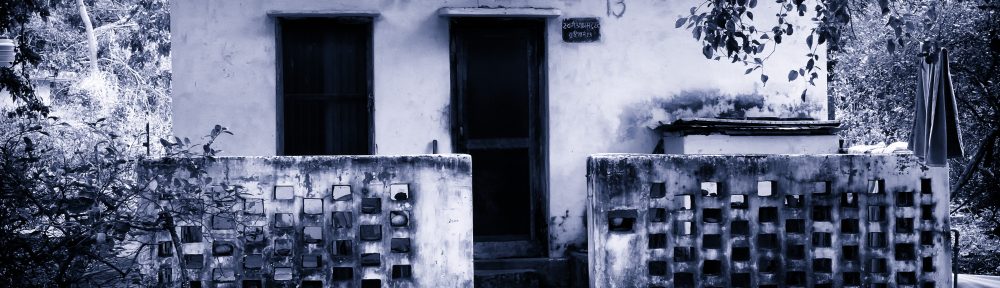
Well, yes the rock – the hermitage – has much potential for peacefulness; a peace expereienced quite often actually. It’s a sacred space
But, as in any way of living, any way of being, peace comes and peace goes. And when it goes, it can seem like it never existed, and that ‘sittin’ peacefully’ is, and always will be a fantasy never to be realised or made real.
It’s about equinimity
That’s something else I heard today. Well, there’s not a lot of equinimity in this hermit pilgrim today. Seems, then, that there needs to be some shifting of perspective; some peace needs to be restored
My Lord Ishvara
Deep withn the still centre of my being
May I find peace.
Silently withing the quiet of the grove
May I share peace.
Gently and powerfully in the wider circle of humankind
May I radiate peace.
Om Tat Sat
Om Shanti Shanti Shanti
Afterword:
A few hours have passed since I made these notes; I have regained a little balance, but still thought it was important to publish this post.
The Lion Sleeps Tonight. That’s the song name I always think of. Sometimes you might hear it called Wimoweh. While it’s the song’s Zulu title, it’s actually not a real word: it references a mishearing (and subsequent recording by a group in the early ’50s) of Uyimube (the original chorus) which is Zulu for you are a lion.
In any case, I feel like I’ve known the song all my life. I suppose I have: it was a smash hit when I was seven or eight years old. It’s been one of those songs that have stuck, become a constant presence, to be hummed occasionally, to be sung even less frequently, heard rarely, but loved and familiar.
Anyway, recently (in March I think) my affection for the song surfaced. I was thinking about something my partner hermit had said about creativity and suddenly the melody to The Lion Sleeps Tonight came into mind.
That melody, and my memory of the lyrics then became integral to the poem I wrote to express some of my thoughts about my partner hermit’s statement. It helped me say what I had to say.
I hope you like it – the song – Listen to the Tokens doing their version from 1961; check out the lyrics too. It’s a happy song, a reassuring song of safety and love.
With that I humbly offer my poem. Enjoy
THE HERMITS SLEEP TONIGHT
A creative way to start the day. A prayerful way, a prayerful way.
In Samsara’s jungle there is a village, a suburban village. A prayerful way, a prayerful way.
Near the village – no, in the village the hermits sleep tonight. A prayerful way, a prayerful way.
The walled enclosure, their very own paradise, like a castle keep, keeps them safe. A peaceful way, a peaceful way.
Hush my sisters; hush my brothers. No need to fear the jungle. A prayerful way, a prayerful way.
Day breaks; Surya rises. A prayerful way, a prayerful way.
Sleeping hermits gather, to break the fast. A prayerful way, a prayerful way.
Fast broken, sacred tea imbibed. A prayerful way, a prayerful way
The hermits begin, begin their day of prayer.
A creative way to start the day. A prayerful way, a prayerful way.
In my last post I reflected upon the meaning for me personally of a Bhagavad Gita verse that had particularly struck me as I carried on with my renewed inspiration to read the text from the beginning.
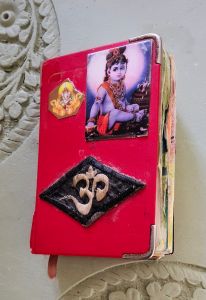
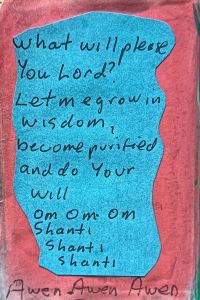
Today, I didn’t even get to the place where my reading left off yesterday. Before reading I like to pray some or all the prayers I have pasted in the front (and the back now). As I was deep into this practice, one prayer in particular stopped me, just as with that verse yesterday.
This one seemed to speak to me, asking ‘What do I mean to you?’ So, I made a mental note (always a risky proposition with me), and carried on with my prayers, determined to take time later to think about that prayer, and try to answer its question. So, here I am, later in the day, making these notes.
The prayer itself I am fairly sure comes from Thomas Merton, monk, mystic, and writer. Not completely sure, but I know that whoever composed it was one clearly inclined towards living the life of the mystic.
What will please you Lord? Let me grow in wisdom, become purified, and do your will.
For whoever composed this prayer, it is an expression of a genuine longing. I can say that for me it is a deep plea, expresses my own longing. Each time I recite it, in fact, I can say that, although this is the first time I’ve addressed the big what does it mean question, I do sense the longing and grasp the meanings of the various words and ideas in the prayer. Actually, now I think about it, I do say this prayer or parts thereof in one form or another very often.
What will please you Lord?
When I begin to pray these words, what I feel I am actually doing is asking the Universe, the Divine, Self, God – the I AM – how can I live my life so that it is attuned to the natural order and flow of the Universe.
I am asking, what do I need to do to let go of attachments to worldly things which arise from material desires? How do I find the grace to accept when things aren’t going completely my way?
In other words, I’m asking how can i live a good, truthful, happy life in harmony with all other beings and with the Universe.
Let me grow in wisdom
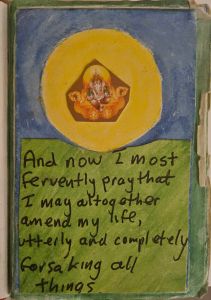
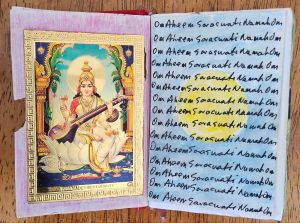
Another of my prayer pages. This one devoted to Maa Saraswati, goddess of, among other things, wisdom
A good place to start, a great first step. But, again I have to ask myself, what does growing in wisdom mean to me?
To me wisdom is not merely knowledge. Though, having said that wisdom needs to rest on a firm foundation of knowledge, otherwise what’s there to be ‘wise’ about?
I’m not talking about worldly knowledge here, though obviously it takes some degree of knowledge for any of us to live in the world. Also it’s relevant to the next part of our prayer; we’ll see that soon.
I’m referring instead to a special kind of knowledge that will (I pray) lead me somewhere closer to acquiring some degree of wisdom – one day.
Self-knowledge is what I’m getting at. And I go about my attempt to obtain self-knowledge in a couple of different ways. I study, sacred texts like the Bhagavad Gita, as well as the words of those wiser than me (which is rather a large selection of people I can tell you) both living and historical.
I meditate (not nearly enough!) as a way to enquire into my own ‘real’ or true nature: who am I? what am I? Just digging deep within to reach some realisation of the answers to those questions.
When I have answered those questions, I will understand that I have reached a true level of self-knowledge. I sense that, at least being on the path to that realisation, I would never be able to develop any level of wisdom.
Mind you, I do feel that all humans are born with some degree of wisdom potential ‘built in’ so to say. As for me, I don’t feel especially wise just yet.
Become purified
For me, becoming purified goes hand in hand with the cultivation of wisdom. In fact I would say that in the very efforts to become purified, it might be possible for me to develop some wisdom as a result of those efforts.
So, here we go again: What does it mean? To become purified? For me it means living a Dharmic life. By Dharmic I mean a life steered and driven by Truth, Right Living, Right Speech, Right Conduct , Right … The Buddha taught The Noble Eightfold Path. That is in my opinion the very best, topmost, pinnacle of self directed means to living a Dharmic or purified life.
The Eightfold Path is not a set of dogmas, rules, or anything like a list of commandments or instructions . The eight steps are merely signposts, a roadmap, pointers for me to follow in order to purify my life, live a Dharmic life. No behaviours are prescribed: it’s entirely my choice what forms my behaviour, actions, and the rest take.
Obviously the path to becoming purified is a life-long one, though some would say that many lifetimes are required. Personally, I can’t even hint that I might be anywhere near close; some days I feel further away than ever.
But, as I work towards ‘growing in wisdom, with the help of my becoming purified path, I pray that some day I might actually learn what I call proper discernment.
This discernment is the ability to act in the world and to react to the joys and sorrows that are inevitable, with compassion, love, and wisdom. To face those inevitabilities with calm and equanimity. Acting with proper discernment will mean that I am living in Truth.
… and do your will
As I reread the words I’ve just written, I realise that, by the time I reach the state described in that last paragraph, I will have succeeded in ‘doing your will. I will have aligned my self perfectly with the order of the Universe. I will know my place as a tiny fragment of that very order.
If I’m honest however, I have to say that I think it’s going to be a very very long time before such a state come to pass. So, what to do in the meantime?
Well, along with my attempts to live Dharmically, and to cultivate wisdom, I have committed myself to a life of devotion. Devotion, prayer, contemplation.
Devotion to what? To whom?
To the Universe, Divinity, God; all that is represented by all those names we humans have put on the Absolute Reality, that is all there is.
Everything. And everybody, is what I’m saying. There really is no separation except a kind of superficial one we allow ourselves to imagine by applying so many names and forms to the material objects, things and so on, that appear to us as separate one from another, whereas there is in fact only one, without a second.
That’s where the contemplation comes in. It’s a going within, inward to what we imagine is a kind of ‘space’ where all merges into one, the one that is all there is.
I think that’s what ‘pleases the Lord’. While I am indescribably, gravely, deficient at all the steps described above, one course I know to be right for me is to continue to engage with those steps, and to devote myself and my life to the Divine, to the Truth.
That’s what pleases me. I pray that it pleases the Lord.
Thanks to inspiration from my partner hermit, I’ve once again begun reading Bhagavad Gita from the beginning. The quoted verse came up this morning as I continued through chapter 2.
Setting the scene, the Bhagavad Gita is a conversation between Krishna (God) and Arjuna, a famous warrior who’s leading the army of the ‘good guys’. The context is actually a metaphor for the battle that goes on constantly between what some call the Higher Self (represented by Krishna of course), and our lower selves, our ego, mind, and the rest of the worldly us (represented by the very worldly Arjuna).
Knowing that, sometimes a verse will jump out at me as being in some direct way related to me. This verse, this morning seemed spookily all knowing about my mood of just slightly earlier.
Before we move on, I should point out that Arjuna has just realised that if the battle goes ahead, he’s going to have to kill many relatives and friends, teachers, and others he respects. And he’s just decided he’s not going to do it and sits down depressed and dejected on his chariot.
Now while I personally applaud this decision (he even says it might be better if he went off into the forest and lived the life of a wandering monk rather than be in this battle), I have to remind myself that it’s not for real, it’s a metaphor for the battle between our two selves.
Krishna says to Arjuna that you’re going to look really bad if you don’t fight the fight to uphold the Truth as you know it. Lesson number one when studying the Gita: don’t sweat the context!
Anyway, to our current story.
I’d just finished my breakfast cup of tea, and I knew it was time to ‘get on with the day’ as the saying goes. Today, though, Tamas** was strong. Which left me feeling, I don’t really want to get on with the day.
Instead I felt I wanted to not get on with anything; I wanted to lie down and sleep, and not think about anything, or do anything else either!
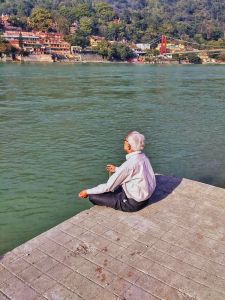
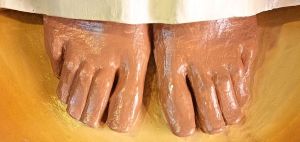
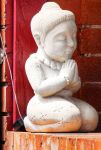
This picture is called Lunchtime Sleeper but it’s how I felt after breakfast this morning!
Mind you, not in the ’empty your mind of random thoughts, relax the body, realise the Divine’ kind of mood. No, more like ‘lay down, block out everything, blank the mind, sleep.’ Blank as it blot out!
Then, the famous second thought kicks in: No, I said to myself. I will not allow Tamas to take control. So, I got up, brushed my teeth, washed my face, and got ready to begin my practice.
I guess you could say that Tamas finds it easy to take control when one’s mind is in enemy mode as I like to call it (somewhere else in the Gita, Krishna says the mind can be our friend or our enemy).
My mind in particular doesn’t usually need a lot of help to disparage me, put me down. Getting me to question my own capabilities is one of its favourite activities – sometimes.
And it’s exactly right, perhaps I should be questioning myself: If I allow Tamas (mind and ego etc) to have free rein, the pain and the shame is all I feel. Well, perhaps not all, and not always, but still, it’s not a good thing.
So, what’s going on now? I’ve been reading Bhagavad Gita, and now I’m making these notes. Tamas is on the run and my mind is being ever so friendly.
**Tamas is that aspect of our (human) nature that has us leaning towards lethargy, laziness, that ‘I can’t be bothered’ feeling, and excess sleep, and all the other slothful stuff. Blotting out, as I termed it earlier.




























 Notes from the Hermit's Cave