‘I’ll carry on with my Gita then,’ I said to my partner hermit after we’d been discussing something for a while.
‘I’m enjoying reading my prayers this morning. So I’ll read a few more then read a few verses’ (of the Bhagavad Gita).
‘Reading’ my prayers? Is that what I’m doing? Surely a prayer – prayers – are for praying? Anyway, not simply for ‘reading’.
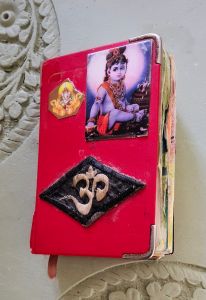
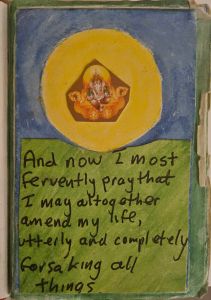
Of course in this particular instance, the forms the prayers are taking – on the most superficial, worldly, material level – are as words written by human hand (mine) on paper pages in a little book.
But, right now, the big question, the existential question really, is have I been merely reading those prayers? Or have I been praying those prayers?
Then there’s another, equally existential, concern that arises: How to know the difference. Reading? Or praying?
I feel like saying that the first thought that comes to mind – the first answer to reach the tip of my pen on this page – is this: Actually, the answer has come in the form of a rhetorical question:
If a prayer is prayed, how would it ever even occur to me query if it is in fact a prayer, and not just words on a page to be read?
Yes, first thought best thought here I think. When a prayer is prayed, even if its form is words written on a page, there is a movement beyond those words on the page. In fact, there is a transcendence of all that is of the material world that takes place.
A prayer is what it’s always been: a prayer. The forms prayers take are, I think, literally endless, uncountable, and can never be submitted to categorisation by us humans.
Prayer is for praying, that’s the lesson for me. Just pray.
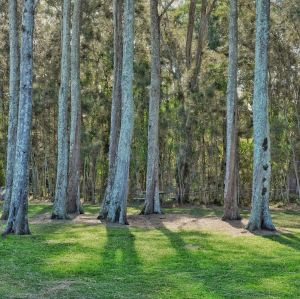
This post is from several months ago. I was reminded of it as I read a book that’s partly about humankind’s relationship with trees.
Seems like a good good moment to share this prayer with you all once again
At one point in my last post on Bhakti (if you missed it you can find it here) I mentioned that I hoped to soon publish a recently written prayer titled A Prayer of Praise and Gratitude to Trees.
Even as I typed those words in that previous post, I thought: ‘soon’? Why the delay? What’s wrong with now? So, without any further delay, here is our next post and in it I’m very glad to be sharing that prayer with you.
As my comment in that previous post explained, this prayer (and others too) is one more little step in my ongoing effort to cultivate a mood or feeling, and a practice, of Bhakti or loving devotion to the Divine.
If you’ve read that last post you will recall that I stressed my deeply held and heartfelt conviction that the Divine is everything. As I may have actually said: there is only the Divine; one, whole, partless and indivisible. Now, to knowingly repeat myself: The Divine is one without a second; that’s all there is.
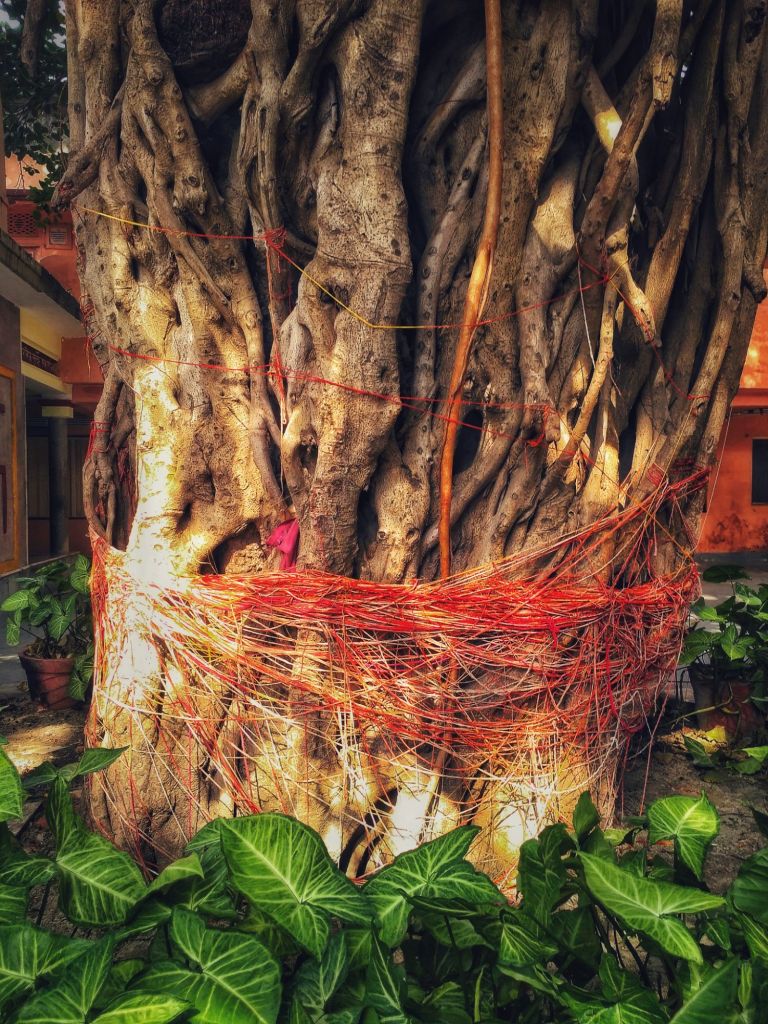
This prayer to trees is an attempt to acknowledge that oneness of which each and every tree – just like you and me and all other beings – is a manifestation, each with its own unique name and form.
This prayer, though composed by this particular name and form, is in fact just one more expression of that oneness we all share. As such it is as equally yours as it is mine. As I said earlier, I am glad we are sharing this now.
With this prayer we greet you. We offer you our praise, and our gratitude.
When we come into your presence, you remind us that in meeting and greeting you, we are in fact meeting and greeting God.
We bless you and we thank you for the shelter that you steadfastly provide to so many living beings. In so doing you support, protect, and nurture the continuance of life for all of us.
Your every exhalation is for so many other living beings the breath of life, of Prana – the life force itself.
You remind us as we witness your strength, your resilience, and your calm flowing with the winds of change that we too share that strength, resilience and the potential for calm flowing with those winds of change that are also constantly buffeting us.
Om Aranyani Namah
PS Who is Aranyani? She is a Hndu deity of the forests and all that dwell within the forests. Basically she is the Goddess of Trees and here is simply the name and form representing all trees.
This last little while I’ve been going through some serious contemplation, some deep questioning, on how to be ‘more of a monk’. Things like how to pray more deeply, and often; how to have a more focused and concentrated devotional practice; how to be a nicer person. Things like that.
Actually, that’s not exactly right is it? These are questions, enquiries, that for a number of years (is all my life too big a stretch?) habe occupied me. I’ve consistently been making enquiries, addressing questions, to Self – as well as to God or the Divine.
Still, like all things in life, self-enquiry goes through more intense, then less intense phases or periods. Let’s just say that lately I’ve been immersed – sometimes to the point of distraction – in one of those more intense periods.
(note from internal editor: Do I have to remind you once again to get on with the story you are here to tell?)
Okay then; let me see. Oh yes, right. Last night I was looking forward to beginning a new book. I’d read the introduction and thought that it was going to be just my cup of tea as it were, that it was something I would enjoy and learn from.
Anyway, as I opened the book on my tablet, I was suddenly stopped by a sort of wordless warning. The sense I had was that this book would indeed be a little piece of the answers I’ve been seeking.
Not so much in the contents I felt, it was more about approaching the book with more openness, less skepticism, more generosity of spirit and mental attitude. And the idea seemed to also include taking these qualities with me later as I thought about what I had read (or was about to read I should say).
You see, being more open, less skeptical, and more generous, come under the umbrella of being nicer. Still given the subject I was about to read about, I was a bit surprised by this ‘warning’.
As it turned out, I finished the entire book, so enthralled was I by the contents. The only things that tested my resolve to ‘be nicer’ was a number of occasions when the author’s worldview and interpretation of events, stretched my patience.
But, I managed. I didn’t become inpatient or outraged or irritable . When threatened by such responses I simply reminded myself that I was reading about another person, and I didn’t have to have an opinion one way or the other about what they believed or how they lived. Not only do I not have to have an opinion, I’m not sure I really have the right to an opinion about someone else’s life at all.
Besides, haven’t I just got through describing how I am myself deeply engaged in a process of self-enquiry? And wouldn’t such a process involve exposing myself to ideas, worldviews, kinds of information, new to me or not in alignment with my own beliefs? Surely bursts of impatience, indignance, judgement, and the like, would close me off in my search for answers?
Anyway, as I said I was so enthralled by the book – my reading informed by a little more generosity, a little less judgement, a renewed attempt at openness – that I finished the book in that one sitting.
Mind you it was only one hundred and something pages long. Still, for me, it was pretty good going.
PS Speed reading wasn’t – isn’t, nor ever will be – a part of my ongoing self-enquiry into the depths of my monkhood. Perhaps I need to add something like ‘Transcend the ego’ to my list.
Among the physical exercises I try to perform on a daily basis, are a couple for strengthening the hips. One of these begins with me standing upright, feet together, eyes level, looking ahead.
Then I swing one leg at a time for ten repetitions in a kind of arc like motion out to side, keeping it level with the side of my body, bringing the leg back to the rest position with feet together. It’s a pendulum motion.
Anyway I’d been merrily going along doing these exercises more or less every day for ages, months really, until one day my partner hermit was watching me, and said:
‘You’re supposed to be doing it slowly and mindfully’. Or words to that effect.
You see I had been quite happy swinging each leg out in turn at a fast pace, kind of like an aerobic sort of thing. Just to get it done if I’m honest. Wrong! Supposed to be slowly and mindfully.
Lift one leg slowly in an arc like motion out to the side of the body. Pay attention to the movement as it’s happening; no need to push the leg out, just lift it to a comfortable position. Just let the arm trail loosely and of its own accord, along with the leg. Then, again slowly and paying attention to the process of the movement, bring the leg back.
And I do have to say there’s been an amazing difference. I can actually feel the muscles working during the exercise, and can sense the minute incremental motion as the leg swings slowly. It’s a way better exercise than it was, and now I wouldn’t do it any other way.
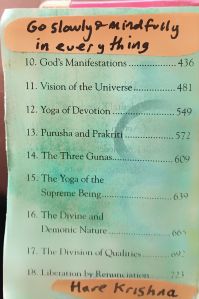
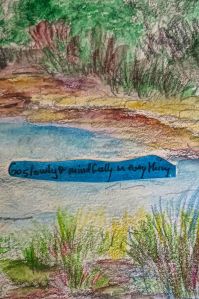
I was reminded of this incident this morning as I came across a short admonition, a little reminder to myself I have stuck on a Table of Contents page in my Bhagavad Gita.
Go slowly and mindfully in everything
What’s interesting is that, despite seeing and reading this so-called reminder more or less every day, and despite proofs of the benefits of actually listening to the reminder, such as what I’ve just described with the exercise , the reminder seems to mostly go right over my head, in one ear and out the other as they say.
Today, for some mysterious reason, it actually got my attention. At the same time, again who knows why, it triggered a truly relevant and appropriate memory to act as a kind of metaphor to illustrate the point to me.
I suppose it’s stating the obvious, but I can say that doing that (or any) exercise slowly and mindfully – in a watchful and observant manner – acts as an exercise in presence. Otherwise I’d not be sensing or feeling the muscles and the movement, or the peace of no random thoughts.
Did I mention that, having corrected my modus operandi with that particular exercise , I’m feeling the benefits? It definitely feels like things with legs and hips are loosening up, getting stronger. I’m actually walking further now without my legs aching on me.
More than that, I actually find myself wanting to do the exercise as opposed to ‘wanting to get it done’. Why is this? Well, I think it’s because I’m yearning to rediscover that feeling of presence; it’s a bit like a meditation, and in the same way clears the mind of random thoughts – at least for the short duration of the exercise. Having said that, even a short duration clarity plays its part in reconditioning a stubborn mind.
So, mental clarity, good exercise for the body, for the heart, even the soul?I think it’s the perfect metaphor for how I aspire to be living my life.
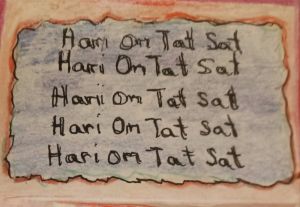
A couple of days ago I recieved a beautiful gift in an email. I often receive wonderful things through the email, and this one, as with so many of the others, has profound meaning for me.
Not only that, but this gift has served as a reminder to me of that significance. I’d like to share with you that gift, as well as some thoughts on its importance and meaning to me.
There are a multitude of sources online where you can learn all the technical stuff, word meanings, history, origin, when it’s used and all the rest. I would like, however, to just ‘think out loud’ in my own words, and follow my own heart’s promptings.
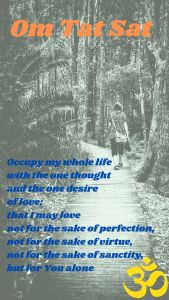
Hari Om Tat Sat, is actually two mantras in one: Hari Om, and Om Tat Sat.
Hari Om represents the totality of what we might call God. Hari refers to the manifested cosmos, as well as the creative impulse in its manifest form. I call that Ishvara, but it doesn’t have a name I’m sure!
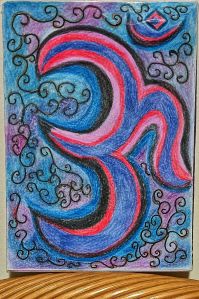
Om, is the unmanifested universal consciousness, the Absolute Reality. Meaning, as I understand it, existence itself. I call it Brahman, or God, but again, names are just labels we humans apply to things to make it all seem so neat and tidy!
They say that Om Tat Sat is the most sacred of mantras (in Hinduism). It’s used at the completion of prayers and rituals as a way of invoking the presence of the divine and ‘bringing it all together’ you might say. Well not so much bringing, more like a reminder that everything is one already.
I really like the chanting of Hari Om Tat Sat. It’s a centering practice I would say, a way to remember the oneness of all. And I say it, as the traditionalists do, as a closing to prayers or other practice; it’s like ‘Amen’ or ‘It is so’ or ‘Let it be so’ or, well it’s endless – and personal and subjective.
As mentioned, Om means Brahman – or God in the unmanifested state; Tat, not only sounds like that but does in fact mean all that is. In other words, Brahman or the Absolute. Sat means Truth, Absolute Truth or, once again Brahman.
For me it is a little prayer of its own actually. And I’ve heard it used as a greeting many times. It’s a means I think of honouring the divine within the one being greeted, while at the same time I have a sense that it is a recognition, or acknowledgement rather, of the oneness, the unity of the greeter and the greeted along with everything else.
This is why I don’t really feel the need to break the mantra down to explain in technical detail all the constituent syllables (even I were qualified to do so, which I most surely am not).
It really is a way to acknowledge the oneness of all, the Absolute, which includes, obviously, me and you. The Truth is absolute, it says, so must we be, absolute.
One of the stories I’ve been telling myself for pretty much as long as I can remember, is that my life has been impacted, influenced, directed, controlled, by depression and fatigue. As with all stories, there are elements of fact, fiction, fantasy, real life experience, truth, and the not so true in this one.
Anyway, with the fatigue factor in mind, I’ve recently made an intention (I call it a sankalpa) to lie down for an hour or two every day whether I ‘felt like’ it or not. The idea was that a daily break would be like a catch up, a preemptive measure if you like. Even if I didn’t sleep, it’d be an opportunity to just be still, listen to nice music, relax for a while, a quiet time.
Today, just after breakfast, and getting deeply into my spiritual practice, I suddenly experienced an epiphany. Or to be a little less grandiose about it, I had a little insight which has lead to me to make these notes.
Despite that feeling of exhaustion, and despite the previously mentioned intention to rest more, I resisted going to lie down, thinking I can lie down later in the day.
Why? Surely a person who thinks their life has been ruled by depression and fatigue, would welcome any pretext to lie down, to sleep, to shut the world out for a while.
And, then comes the insight: All of a sudden I realised why I was resisting taking rest: Well, the fact was that I didn’t want to sleep because, well, I’d be asleep. I’d not be able to continue my practice, read, write, to ‘live now’. Putting it another way, I simply wanted to keep on keeping on doing exactly what I was doing.
But wait, I hear you asking: how can you fully live now when you’re so tired?
Excellent question; the exact question in fact that I asked myself. The answer I got from Self was interesting: fatigue as a symptom and outcome of depression is one thing; fatigue resulting from living a full life with enthusiasm (sort of sometimes) is quite a different thing.
Actually, now I think about it, there’s another little insight making its way to the surface of this over-active, over-full mind: The very fact that I thought I had living to do now is a very clear signal that, for at least the moment, depression is not dragging me around, or down, or anywhere else.
Just that concept of wanting to be awake to live this moment? Well, isn’t that a joyful thing? But what about being so tired? Should I go and lie down now anyway?
Ummm… Actually I don’t know; I can’t say really. So, I think I will just keep on doing what I was doing when I began these notes.
Which was chanting the names of God.
Hare Krishna Hare Krishna Krishna Krishna Hare Hare Hare Rama Hare Rama Rama Rama Hare Hare.
Now that should wake me up for a bit.
PS It’s a bit later in the day, and I’m typing up the notes as a post for the blog. I did in fact carry on chanting for a while, I’ve had lunch, and I think after I post this, I might go for a walk around the neighbourhood. And no, I haven’t had to lie down yet.
The Lion Sleeps Tonight. That’s the song name I always think of. Sometimes you might hear it called Wimoweh. While it’s the song’s Zulu title, it’s actually not a real word: it references a mishearing (and subsequent recording by a group in the early ’50s) of Uyimube (the original chorus) which is Zulu for you are a lion.
In any case, I feel like I’ve known the song all my life. I suppose I have: it was a smash hit when I was seven or eight years old. It’s been one of those songs that have stuck, become a constant presence, to be hummed occasionally, to be sung even less frequently, heard rarely, but loved and familiar.
Anyway, recently (in March I think) my affection for the song surfaced. I was thinking about something my partner hermit had said about creativity and suddenly the melody to The Lion Sleeps Tonight came into mind.
That melody, and my memory of the lyrics then became integral to the poem I wrote to express some of my thoughts about my partner hermit’s statement. It helped me say what I had to say.
I hope you like it – the song – Listen to the Tokens doing their version from 1961; check out the lyrics too. It’s a happy song, a reassuring song of safety and love.
With that I humbly offer my poem. Enjoy
THE HERMITS SLEEP TONIGHT
A creative way to start the day. A prayerful way, a prayerful way.
In Samsara’s jungle there is a village, a suburban village. A prayerful way, a prayerful way.
Near the village – no, in the village the hermits sleep tonight. A prayerful way, a prayerful way.
The walled enclosure, their very own paradise, like a castle keep, keeps them safe. A peaceful way, a peaceful way.
Hush my sisters; hush my brothers. No need to fear the jungle. A prayerful way, a prayerful way.
Day breaks; Surya rises. A prayerful way, a prayerful way.
Sleeping hermits gather, to break the fast. A prayerful way, a prayerful way.
Fast broken, sacred tea imbibed. A prayerful way, a prayerful way
The hermits begin, begin their day of prayer.
A creative way to start the day. A prayerful way, a prayerful way.
Thanks to inspiration from my partner hermit, I’ve once again begun reading Bhagavad Gita from the beginning. The quoted verse came up this morning as I continued through chapter 2.
Setting the scene, the Bhagavad Gita is a conversation between Krishna (God) and Arjuna, a famous warrior who’s leading the army of the ‘good guys’. The context is actually a metaphor for the battle that goes on constantly between what some call the Higher Self (represented by Krishna of course), and our lower selves, our ego, mind, and the rest of the worldly us (represented by the very worldly Arjuna).
Knowing that, sometimes a verse will jump out at me as being in some direct way related to me. This verse, this morning seemed spookily all knowing about my mood of just slightly earlier.
Before we move on, I should point out that Arjuna has just realised that if the battle goes ahead, he’s going to have to kill many relatives and friends, teachers, and others he respects. And he’s just decided he’s not going to do it and sits down depressed and dejected on his chariot.
Now while I personally applaud this decision (he even says it might be better if he went off into the forest and lived the life of a wandering monk rather than be in this battle), I have to remind myself that it’s not for real, it’s a metaphor for the battle between our two selves.
Krishna says to Arjuna that you’re going to look really bad if you don’t fight the fight to uphold the Truth as you know it. Lesson number one when studying the Gita: don’t sweat the context!
Anyway, to our current story.
I’d just finished my breakfast cup of tea, and I knew it was time to ‘get on with the day’ as the saying goes. Today, though, Tamas** was strong. Which left me feeling, I don’t really want to get on with the day.
Instead I felt I wanted to not get on with anything; I wanted to lie down and sleep, and not think about anything, or do anything else either!
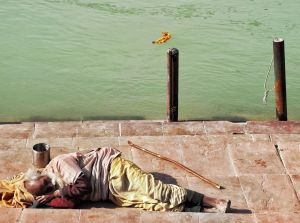
This picture is called Lunchtime Sleeper but it’s how I felt after breakfast this morning!
Mind you, not in the ’empty your mind of random thoughts, relax the body, realise the Divine’ kind of mood. No, more like ‘lay down, block out everything, blank the mind, sleep.’ Blank as it blot out!
Then, the famous second thought kicks in: No, I said to myself. I will not allow Tamas to take control. So, I got up, brushed my teeth, washed my face, and got ready to begin my practice.
I guess you could say that Tamas finds it easy to take control when one’s mind is in enemy mode as I like to call it (somewhere else in the Gita, Krishna says the mind can be our friend or our enemy).
My mind in particular doesn’t usually need a lot of help to disparage me, put me down. Getting me to question my own capabilities is one of its favourite activities – sometimes.
And it’s exactly right, perhaps I should be questioning myself: If I allow Tamas (mind and ego etc) to have free rein, the pain and the shame is all I feel. Well, perhaps not all, and not always, but still, it’s not a good thing.
So, what’s going on now? I’ve been reading Bhagavad Gita, and now I’m making these notes. Tamas is on the run and my mind is being ever so friendly.
**Tamas is that aspect of our (human) nature that has us leaning towards lethargy, laziness, that ‘I can’t be bothered’ feeling, and excess sleep, and all the other slothful stuff. Blotting out, as I termed it earlier.
Welcome to another poetic sharing post. There have been a few lately haven’t there? I had thought that once I had the new page Poems of Devotion up and running that I would only feature one every now and again in its own post.
However the one I feel inclined to share with you today is slightly different. Well, not really: it’s still a devotional piece, but for some reason feels a little other than that.
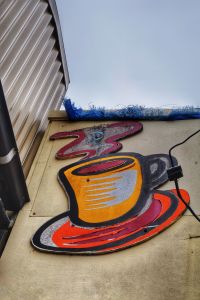
This hermit’s choice: the number 1 coffee shops in the Hermitage neighbourhood
For a start, it’s set in a café and features the thoughts of a hermit monk (me), and is about what’s going on in that space at that moment. As well as what’s in his mind and heart. Oh yes, almost forgot: the action takes place on Election Day.
So, what is it that makes me feel this poem is ‘still devotional but slightly other’? Well, aside from the setting, timing, and so on I just described, I sense that, in its words, in its composition, the hermit has sought to record (through the poem) that moment in the café as the reaching out to all those fellow beings sharing the space, to recognise, and to celebrate the divine in them all.
May that intention shine through to you too, dear reader
THE HERMITS HAVE COFFEE ON ELECTION DAY
I feel like I’m sitting in a Hopper painting. Just off the village green at a coffee shop, in the Toukley Mall.
There are people; aren’t there always? Coming and going. This one catching gossip; that one seeking connection; One or two heads down, backs bent over newspapers assimilating myriad tales of woe. It’s election day.
Of little interest to the hermits, out of the hermitage for coffee. A treat that comes at a cost.
Voices – of people and of headlines – speak, some even shout, of worldly things. To us not real.
Leaves me hollow. That’s the vibe, the feeling inside – And that’s not real either.
It’s been just over a week now since the new page on the blog went live. I have to say that it’s been very satisfying setting it up, then uploading some of my devotional poems.
Actually, it was while uploading one yesterday that I thought, I’ll feature this one in its own post. I did mention that I would like to continue this occasional practice.
There’s not too much to say about this particular poem really – best to leave it to speak for itself. I’m only introducing it like this because I wanted to include a Wikipedia link that might help clarity a couple of the terms and some of the details mentioned in the poem.
The poem speaks about the concept of Viakuntha, which as you’ll see is the supreme heaven for some Indian traditions. The link leads to an interesting and short read, well worth the time I think.
The myth of Vaikuntha was a trigger for this poem, as was the meaning of the word itself. Is it a real place? Who knows. Fact and truth don’t always agree, and as for me, I don’t think about the question.
Myth has been the way we humans have always used to tell our story. To try to sort out the big questions: where are we from? Who are we? Where are we going? All the ‘big questions’ are addressed by mythologies from every culture – every family, country, you name it – on Earth.
In any case I think that my poem came about as a result of my own contemplation on the story, on those big questions, on Self really.
I hope you will visit my Poems of Devotion page. I’m still adding poems to the page, and of course, with grace, I will continue to write.
Now, please enjoy reading my poem, and I hope it’s a nice experience for you.
Love and Peace Paul the hermit
OUT BEYOND CAPRICORN & DEEP WITHIN EACH HEART
Vaikuntha: Without anxiety. Is there such a place? Free from worry? Out there, they say, beyond Capricorn. There’ll you’ll find the highest heaven, the abode of God.
No need to look to the stars: Vaikuntha is here. Vaikuntha is now. Within and without you.
Vaikuntha is indeed beyond; beyond the material world, beyond the realm of bodies and minds; beyond the illusions of places and spaces. Atma – Universal Consciousness – you and me, that’s Vaikuntha. You and me, all there is. No anxiety