You’re Already There.

There are many blessings that come with the living of the hermit life. And I am especially blessed as I am not a ‘hermit alone’ – I share my life, the Hermitage, and my spiritual practice with another hermit. We are partner hermits.

One component of that spiritual practice is our times spent together reading a few verses from the Bhagavad Gita. We pursue our own personal studies, but sometimes one or the other of us will share an especially resonant verse, or an insight or thoughts.

This morning my partner hermit told me, in a casual almost by the way manner, that she’d just read a verse that spoke about not disturbing others, and not letting ourselves be disturbed by others.

At first, I had no memory at all of this verse; I just couldn’t place it. Which might sound a little worrisome, given I’ve been studying this text for seven or eight years.

So, it wasn’t till she gave me chapter and verse and I looked it up for myself, that it finally clicked into place. Of course I knew this verse, but it had slipped from conscious memory.

And that surprised me: this verse seems to me to be speaking to a key concept in the teaching of the text as a whole, as well as to my personal aspirations. Surely, I would think, it should be, what’s the expression? Top of mind?

He [sic] who disturbs no one, and who is never perturbed by anyone, who is unattached to happiness, impatience, fear, and anxiety is dear to Me.

               Bhagavad Gita 12:15

This verse is full of meaning for me. It’s like a one-stop how to lesson in avoiding the personal suffering that’s brought about through attachments. Mind you, once again I can’t help wondering after years of study, and with how much this verse resonates for me, why I had such a hard time remembering even seeing it before.

I suspect the power of the ego and the mind have a lot to do with it. Ego – along with its master, the mind – love attachments to the world, to anything really. I guess they are always doing their best to keep me attached to my compulsions and aversions.

Imagine though, not being disturbed by anything – or anyone – and me actually not doing anything that disturbs anyone or anything?

Not just people and other living entities in my immediate physical environment, but out there in the wider world – in the Universe even.

It’s about vibes isn’t it? What vibrations am I putting out into the world? Are they vibrations and waves of love, peace, compassion, detachment, equinimity? Or at they vibes of discord, dislike, anger and sorrow over the stuff I can’t control?

And just think what it would be like if I weren’t so attached to the idea that my happiness depends on getting pleasure or ‘results’ from worldly things, activities based on the senses? Imagine really understanding that the only true and real and lasting happiness and satisfaction can only come come from within my Self?

This doesn’t mean at all that I can’t be happy, or can’t have fun or enjoyment. It is merely saying that, if I can accept whatever comes to me in life without clinging to the things I want, or running away from the things or situations I don’t want, then there will be less suffering.

Ego is jumping in now and wants me to note that, while I may in fact be on the path to detachment and freedom, I’m not far along enough yet to escape its clutches. Anyway, moving right along.

Impatience, fear, and anxiety are tricky presences in the attachment arena. I’m even less far along the path to letting go of these stubborn attachments. But, again, at least I’m on the path.

And what is that path? Where’s it going? Well (paradox alert), on the path in this instance is another way of saying I’ve not realised fully that I am already at the path’s destination. I just think I have a long way to go.

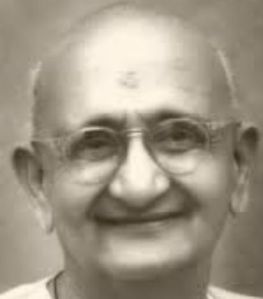
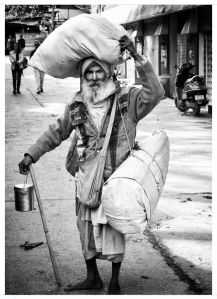
Swami Ramdas (1884-1963) Courtesy Wikipedia

I think Swami Ramdas said: ‘When you set foot upon the path, you have reached the destination.’ I think!

That’s the ‘dear to me’ bit of the verse explained. The ‘me’ in this phrase represents the aspired to full realisation that I am free, liberation or enlightenment some call it. It’s a place, or state of mind in which I move through the world with peace, calm and equilibrium, where nothing disturbs me, and I disturb no one.

That state of liberation doesn’t mean I have given up, or will have to give up, all desires for things I want, nor will I have escaped the things I have aversions to. It simply means I will no longer be driven by those desires and aversions, I will no longer be attached.

It means, too, that I will no longer be concerned in an attached way, to who says or does what to whom, when, where, why or whatever. At that stage I will be in the world, but not of it.

Of course, I am a hermit; you would think it’s easy for me being secluded from the world (well it’s not total seclusion). If only that were true.

I still have the clingings, cravings, and aversions; I’m even attached to the clingings and the aversions.

The one desire, the one I permit myself to cling to, is the desire to free from all other attachments, the attachments that cause so much suffering.

As long at I have that desire guiding my life, then I will be satisfied, when I can be, knowing that one day I will fully realise that I’m already free, unattached, liberated and happy.

There’s a song I wish I could remember the name of, or at least who sings it, but there’s a line in the lyrics that, says something like ‘I don’t want to go searching for what I already have.’ That’s me!

You Can’t Try to Go With the Flow

Every writer, every painter, every person who makes things – and that includes all of us human beings – will sometimes get the feeling that they are never going to have another idea, or the inspiration, the creative spark or energy, to create anything ever again. Not ever again.

Certainly  that – what could we call it: crisis of confidence? Moment of fear? A feeling of inadequacy? The seeming loss of the desire to create? We could probably keep going with this, but let’s not.

Where was I? Yes. Certainly that, whatever we call it, comes over me really quite often when it comes to the writing of this blog. It’s become a standing joke in the hermitage: Whenever I’m asked if I have another post coming on, my most usual response goes something like:

‘No, and I don’t think I’ll ever write another post. The ideas are all gone. It’ over.

(As I reached for this notebook just now, I was asked that question and ironically I was able to answer with confidence and certainty, ‘Yes I do’.)

As I said, it’s a standing joke because, well, something always reveals itself to me, eventually. An idea, an inspiration, an insight is presented. Something I sense is worthy of sharing, always comes to me.

Having said that, there are times when I really do have that horrible sense that it’s finished, that I will never ever again receive an idea for another blog post.

But, here’s the great thing: Having become a standing joke, this perceived loss of ideas, insights, inspiration, the joke serves its purpose: It makes me smile, it treats the whole thing with some humour.

In other words, I’m not allowed to just get away with feeling sorry for myself. It cheers me up. It props me up a little, and gets a little part of my mind opening up to something new or fresh to write about.

There have been times during the journey of this blog when I have strayed from my intention for this blog. As it says beneath the blog title on the top of the page, this blog is meant to be:

musings on one hermit’s life and world

In the past, I’ve sometimes solved this ‘no ideas’ problem by writing about a topic from something I’ve read, teachings I’ve studied, or some other things not directly about me or my personal experience.

Lately (for some time now) I’ve resisted this ‘easy way out’, and tried more attentively to stick to the intention stated in my sub-heading – write about me and my experience.

Okay, it’s in fact not trying that’s the point, both with me writing this blog, and also with every other aspect of how I try (sorry, not try) to live my life.

Wu Wei it’s called, the path of least resistance. Certainly wracking my brain to come up with post ideas, and straying from intentions just so I can have a post, sets up much resistance on many levels.

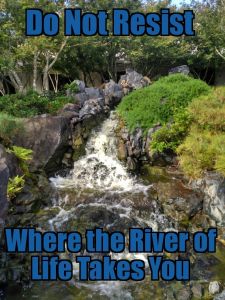
You can’t ‘force’ musings, can you? If you muse you muse, if you don’t muse you don’t muse. It’s about letting it flow, or if it’s not flowing, let it be.

And here’s the interesting thing: it – the flow of ideas, insights, musings, whatever – flows at its own pace anyway regardless of my interference, angst, worry, or my forcing things to go this way or that.

My lesson for today – for my life too I pray:

Go with the flow

You’re the Voice, Try and Understand It

One of the things I like about one of our local coffee shops is that they play a nice wide selection of music. Mostly popular songs from pretty much every decade back to the ’60s. I think they have one of those looping playlists you hear sometimes in shops and cafés.

It must be quite a long list because you don’t necessarily hear the same songs repeated at every visit. Which is a nice thing too.

Anyway, yesterday the chorus of a song I heard played got stuck in my head. The song, You’re the Voice, was a hit around the world in 1986 when it was released by Australian singer John Farnham.

It’s essentially a protest song reminding us that we all have a voice, and encouraging us to use our voices to stand up against corruption and war. One of the co-writers Chris Thompson missed out on going to an anti-nuclear protest because he slept late. He felt so badly about sleeping in that he wrote the lyrics reminding us about taking personal responsibility and making our voices heard.

Okay, back to the chorus getting stuck in my head.

You’re the voice, try and understand it
Make a noise and make it clear Oh woah.
We’re not gonna sit in silence
We’re not gonna live in fear Oh woah

You see? It’s very catchy, and an excellent piece of advice too. And, for a hermit monk, it’s actually advice I could and do aspire to live by. Just not quite in the sense the song intends perhaps.

This morning, when my partner hermit suggested we just sit in silence for a while, I spontaneously started singing the chorus, though a slightly modified version:

We’re just gonna sit in silence
We’re not gonna live with fear.

Then, as I sat in said silence, I got to thinking about the words of the chorus.  Nobody wants to live in fear, yet it is an aspect of the human condition and something so many people live with constantly all over the world. All through human history as well.

The message of the song reminds us all that we have a voice which we can use to help create a state of affairs in which we don’t have to live in quite so much fear, fear that’s coming at us from so many sources.

For me, this is a vital, fundamental, and absolutely essential principle. Without those who do stand up, those who do use their voices to try to right wrongs, then, well I can’t think of what that might mean.

Yet, for me, I’ve chosen silence. Not only chosen I must admit: temperament, my own nature, health, all are factors that have made silence the best course for me to take. Silence as in seclusion from the world, minimizing outside imput, and reducing as much as possible the attachment to the world and its things and fears.

And this way of living ironically allows me to use my voice in my own ways to address the Truth as I see it; to help effect change and contribute to the healing so sorely needed.

Being ‘out there’ and engaged with worldly things and activities and interacting with people constantly causes me so much anxiety that it threatens my health and ability to act in the world.

There is also the personal choice aspect, common to so many who live a contemplative life. Silence – when I can actually achieve such a state – gives me the energy and clarity to write; it gives me the mental, emotional and spiritual ‘space’ and energy to pray, to contemplate, and to foster the ‘good vibrations’ I feel are also necessary to turn the world towards peace, healing, and truth, as well as to assist in maintaining the wellbeing of all life.

The world, and all of life, needs both those who can’t or won’t be silent (I’m definitely not suggesting the world needs more noise). We all need people who can and do raise their voices against war, poverty, corruption, and all the ills that plague us.

And it needs those who are able to ‘just sit in silence’. The work to be done is the same; the outcomes perused are the same; and in essence the means themselves aren’t all that different either. Silence as mentioned can include the use of our voices in ‘quiet’ ways, in ways that don’t have to relate so directly the affairs of the world.

It really is a symbiosis: Those of us living secluded and contemplative lives with our prayers, our witness, our creative endeavours, support those active and vocal ones out there trying to heal the world.

And at the same time those out there in the world support the secluded and contemplative ones. Their efforts and hard work, and simply knowing they are there, are encouraging and nurturing for the secluded and contemplative ones.

We are One after all.
Yet our voices are all unique, each and every one.
That’s what I understand to be true.

Note to Self: Have a Little Faith Will Ya?

As a hermit, I am a pilgrim, dependent on a pure faith that I am exactly where God would have me be. I am here, and it is now.

I forget in which of his books I read this, but it’s a prayer written by Thomas Merton shortly after he’d finally moved into his hermitage full time. The ‘I am here, and it is now’ I added, though of course it’s also borrowed.

It’s a prayer, an affirmation, I recite at least once a day. And, like Merton, I aspire to that ‘pure faith’. Faith is a strange thing: it may grow and develop and then it does indeed support me in my intentions and living, not to mention the comfort it provides..

But, all of a sudden it can just flow away, leaving me adrift, bereft, and not sure of anything.

I am a pilgrim, it’s true. But as Bhajan (a bhajan is a sacred song, a hymn) singer Krishna Das sings:

I am a pilgrim/the road’s so long.

And sometimes it seems a lot longer than this particular pilgrim would like. Still, as they say, how long’s a piece of string? And it’s rougher than I’d like as well. but again how rough is rough? Layers of meaning in that word longer.

Yes, I am a  hermit, and my mind’s not the same, as Jackson VanHorn sings. Same as what? Whose mind is mine different from? Is my mind somehow not that same as it once was? True though: my mind is hardly ever the same.Here’s the whole chorus as it spoke to me:

Yes I am a hermit
My mind is not the same
Yes I am a hermit and ecstacy’s
my game.

For this hermit, ecstacy is not a stage experienced all that often. Mind you, there are fleeting moments, but like the pilgrim road, there are long distances to be trod between one of those moments and the next.

And as for Tim Moore claiming he’s

‘… sittin’ peacefully on Hermit Rock’?

Well, yes the rock – the hermitage – has much potential for peacefulness; a peace expereienced quite often actually. It’s a sacred space

But, as in any way of living, any way of being, peace comes and peace goes. And when it goes, it can seem like it never existed, and that ‘sittin’ peacefully’ is, and always will be a fantasy never to be realised or made real.

It’s about equinimity 

That’s something else I heard today. Well, there’s not a lot of equinimity in this hermit pilgrim today. Seems, then, that there needs to be some shifting of perspective; some peace needs to be restored

My Lord Ishvara

Deep withn the still centre of my being

May I find peace.

Silently withing the quiet of the grove

May I share peace.

Gently and powerfully in the wider circle of humankind

May I radiate peace.

Om Tat Sat

Om Shanti Shanti Shanti

Afterword:

A few hours have passed since I made these notes; I have regained a little balance, but still thought it was important to publish this post.

Thank you for your patience

Love and peace

Paul the hermit

A Few Thoughts on the Big Question: Why a Monk’s Life?

Just now, on rediscovering a quote I’d noted down months ago, I spontaneously decided to download again the book I took it from. This will be the third reading: seems to be one of those books that keep calling you back.

The book (The Abbot’s Shoes by Peter Robertson) tells the story of the author’s foray into monastic living in New Zealand way back in the early 1970s when he was twenty something.

One of many mini monastries we’ve been blessed to live in

I’d like to share the mentioned quote with you, because I think it really speaks to my own commitment to the contemplative, hermit life, which is for us a monastic life too – a hermitage is actually a mini monastery.

Sitting in his apartment one night, completely dissatisfied with life the universe and everything, the author contemplates the state of the world around him.

‘All the marching, all the writing, all the campaigning in the world isn’t going to change this insanity, brutality, and carnage.’

Actually this isn’t the quote I’d made a note of; it’s the preceding  sentence which I saw again today and it seemed to just fill out the context for me. Anyway, after a few moments of quietness and thought, the author concludes:

‘I somehow intuited that the most powerful, significant , and influential  action I could take to change the course of this kind of history, was to hide in a monastery.’

He goes on to reflect that by doing so – living simply, in a community devoted totally to contemplation and prayer – he could become a tiny part of ‘the turning of the tide’.

Years later, reading Thomas Merton‘s diaries, he discovered that Merton had felt the same way, concluding that those living simple, prayer filled, contemplative and quiet lives were ‘keeping the universe from crashing in pieces and falling apart.’

There is a strong sense among contemplatives, hermits, nuns, monks, that this is their function: keeping the whole thing going. Or as our author says, each playing a tiny part in the big picture. I would say, like I know Merton did many times (and acted upon his words), that action in the world is absolutely necessary; it’s just that it can’t do all the work alone.

In our hermitage we too speak often of these ideas, and think about them deeply and try to realise how they affect our lives as hermit monks.

So, hiding in a monastery? Or in a hermitage? It’s true it’s very much a hidden life in many ways. For me though, it’s not about  being hidden, it’s more about just what Black Elk says, I’m trying to make my every step a prayer.

Speaking for myself, it’s not that I’m unwilling to pray for a specific individual, or for peace in such and such a country, or relief from poverty, and oppression for specific individuals or communities.

It’s more that: picking and choosing in that way risks leaving people and issues out inadvertently or through some unconscious bias.

I have chosen to live this life apart as much as possible from the world in order to minimise the anxiery being ‘out there’ causes me, to have the quiet, the time, the ‘head and heart’ space to simply pray. To make of my life a prayer

Let every step you take upon Mother Earth be as a prayer

Black Elk (Ogala Lakota Holy Man)

My partner hermit is fond of reminding me of the well known aphorism that a stone dropped in a pond will make ripples that spread out and out. Just like the vibes – the vibrations – emanating from a prayerful life, from all the prayerful lives.

Foster Your True Self: It’s A Big Deal

Today I finished watching  a beautiful and extremely fascinating documentary.  It was about life in a Trappist monastery as well as a fascinating history of that movement. I was struck by something one of the monks said.

He was referring to what he and his fellow monks are actually doing with their lives in the monastery. He said their lifestyle was helping them to:

‘foster who we truly are before God.’

Hearing this, I had to pause the video, make notes, and do some thinking. What had actually struck me, my first thought on pausing, was that this is exactly what I’m doing as a hermit monk dwelling in our Hermitage. Exactly what I’m doing. Well, at least it’s what I’m aspiring to.

There are two aspects or primary intentions that inform the life I try to live as a hermit and monk that are in fact integral one to the other; they merge actually to become one primary focus of my life.

I practice an ever evolving and I hope intensifying devotion to the divine, with the upliftment of the world and all beings as its central theme.

The other, integral focus, is an equally ever evolving and intensifying quest for self-knowledge, for the answer to the question, who am I?

In other words, I am attempting to foster who I truly am before God. Foster as in ‘encourage the development of …’ (as one definition puts it).

In this case, the development is the growth of the knowledge of my true nature – who I am above and beyond this physical (and mental) creature running around madly trying to figure things out.

In my life there is much effort devoted to the cultivation – a synonym for foster – of that knowledge: meditation, prayer, contemplation, study, just sitting, being still. Did I mention the aspirational nature of all this? It’s an ongoing project to say the least.

Speaking of aspirational: Two more synonyms for foster that I like are nurture and support. Both are even more in that aspirational category; at least it feels like that sometimes. Actually, maybe there’s a more accurate way for me to be putting this.

After all, as I think about it now, even I would agree that my whole lifestyle, my entire way of being in the world supports and nurtures me.

Except for me, myself, and I, that is: Lest the inner grammarian sends me mad in a search for antonyms for foster, let me just say that I am overly skilled in the self-critical and self-destructive departments. My ability to put myself down and to tear myself apart is legendary.

Anyway, with overwhelming nurture and support coming from my partner hermit all the time reinforcing my sense of Self, all I have to do is work on ridding myself of these self-destrucitive and self-critical tendencies.

So, the conditions for the banishment of self-loathing are there; all that’s missing is discipline on my own part in seeing the Divine in myself as I profess to be trying to see it in everyone else.

I need to be rid of the forgetfulness  that blinds me to the Truth that is actually very plain to see.

Speaking of the Divine, the ‘before God’ is the vital element for me. God is all there is, so it is always before God that I act, whether in a positive or in a not so great manner.

The best prescription is for me to remember. To remember that God is everywhere and everything (did I say that already?). To remember that me, myself, and I, are also included in that everything and everywhere.

I think that once I do remember these truths even for the odd moment now and again, then the real fostering of who I truly am will have begun.