One, Without a Second, is All There Is

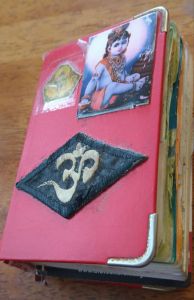
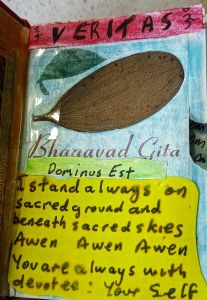
Right at the front of my Bhagavad Gita (the only book aside from the notebook I’m writing this in, that I personally own), I have recorded and inserted sayings and various words , that are important to me. Among those things is a statement I first heard many many years ago, that is common among the First Nations’ peoples of this country:

I [We] stand always on sacred ground and beneath sacred skies.


It is not an affirmation of ownership or possession. It is, instead, an affirmation of belonging to the land, to nature. It is a prayer of thanks, and it is a declaration of the knowledge of unity with the rest of the natural world, that is the hallmark and foundation for Indigenous cultures throughout the world and through time.

I’ve valued – treasured – this sentiment for a very long time – probably from even before I first heard it, which was so long ago as to be lost to memory. Perhaps I always knew it because I’ve somehow always thought this idea was a fundamental truth concerning my existence as a being living on this planet.

Well, now I have heard another statement that for me makes a perfect compliment for this one. The other day, during a lecture, my teacher mentioned that in his student days a fellow student said:

Wherever you are, you are walking through Ishwara

(Ishwara being her preferred name for the divine – for all that is.)

There is a feeling or sense of ‘belonging’, of awe and wonder when we attempt to immerse ourselves in what we term the natural world.

Once again I immediately felt the bell of Truth ringing clearly through this statement. Yes, I thought, everything is divine – including our own selves – so of course it follows that wherever we go, whatever we do, we are always in the divine.

You’ve probably read a number of times me quoting my teacher quoting his teacher:

It’s not that there is only one God, there is only God.
          Swami Dayananda Saraswati

Emphasis very much on only. Meaning of course, that it’s not that God is within us, or that we are within God; we are not surrounded by God; and it’s not that God ‘sits in our hearts’. The reality (for my teacher’s teacher) was that all that is, everywhere, everything, every thought, every word and deed, everything there is, is the divine.

Another way to describe the divine or God, that appeals to me is that Ishwara (also my own preferred name for the Divine) is in reality the natural order of the universe as dictated by the laws of nature. Those laws of nature, the rules that govern how the universe works, are also Ishwara, as are all that is manifest or in existence  as a consequence of the workings of those laws.

In other words, the Divine is the sum total of what some would call the entirety of creation.***
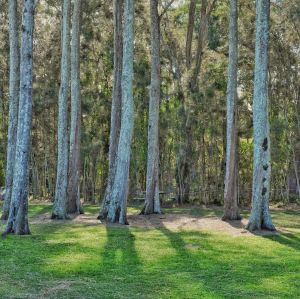
For the hermits a sacred site. Part of a grove we named The Sentinels. A place of experience of unity and oneness of creation

For me this an enormously comforting and reassuring concept. Of course, for me at least, it is also an extremely difficult one to wrap my head around. But here’s a small summary of what I think I’ve grasped so far.

Ishwara – the Divine – is all there is; everything. Also divine is the natural order of the Universe as governed by the laws of nature. These laws are neither good or bad – there is no duality. They are neutral.

You and I, as one more entity among who knows how many others, act as we do and are subject to the laws of nature, just like everything else. We can’t change or influence those laws; we can only live our lives as they unfold.
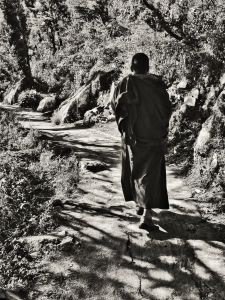
To quote from Desiderata: No doubt the Universe is unfolding as it should

And, well, then things just work out as they do. While we can’t change the laws of nature, or bend the universe to always suit our liking, it is also true to say that every action we take, every thought we think, every word we utter, even our very presence as a living being in our time and place, do indeed contribute to ‘how things work out’. Another way of saying this is to say, we do our bit, and the universe does its bit and what happens, well, happens.

For me, this is not at all as simple or as straightforward as it sounds. Naturally  we see ourselves as individual selves, as entities on our own. After all, to state the obvious, we live and operate in a material (dualistic) world. So automatically we see ourselves as individuals living in, but always separate from all the other individual entities, as well as being disconnected from the world itself.

It is part of human nature (for the most part) to long for connection; there is so often a drive within us pushing us to create family, enter relationships, feel we belong to a community or communities, and for many but not all, there is the almost instinctive urge to seek connection with the rest of nature.
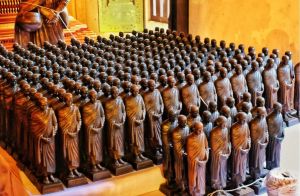
Many forms, One reality

We often think of these longings as goals to achieve, as something outside of ourselves to attain, to reach for. Consequently, so very often we tend to focus our attention outwards, towards other people, or material things.

But, instead, all these inclinations, desires and longings are simply our Self (note the capital?) endeavoring to open itself to discovering (or rediscovering?) that which already exists: our oneness with, and our non-separation, and non-difference from, The All That Is.

Peace and Love from Paul the Hermit

FOOTNOTE

***Just a few thoughts about naming, or giving labels to the Universe and its laws.  Obviously it’s a personal choice for each of us what we choose to call that creation. Then, on the other hand, we don’t have to call it anything at all. For me personally it is very difficult, even near impossible to not name it. By naming the creation, I don’t think I am attributing the manifestation of the Universe to some distant entity living in some heavenly abode (as my teacher likes to say). Rather I am acknowledging the intelligence  and order, beauty, complexity of all that is and how it all works, as its own reality. At the same time, I am learning to understand that I as my true nature am not separate from the rest of creation, and I feel the need to have a name towards which I am able to focus my thanks and my reverence.
When Two or Three …

It would be true to say that I’ve been on a spiritual journey all my life. Perhaps there have been other lives too, who can know? Who can work it out? And, anyway, I don’t think it matters at all. This life will do.

That’s an easy generalised statement to make I know. So, being more specific, let’s just say that for as long as I can remember I’ve been interested in and studied ‘spiritual stuff’; and in more recent years I’ve narrowed my focus, so to speak, and now I am on a deliberate and committed journey towards that time when I actually recognise, when I fully realise for myself that I am already one with God. Or the Divine, Dharma, Love, Absolute reality, Truth, Spirit. Many names and no names.

During this long journey, I’ve been blessed to have been exposed to so many sacred texts, scriptures, books, teachers, and so on, from so many different spiritual and religious traditions. And of course, the Christian New Testament ranks high among these treasure troves.

Like many of us, however, long before I actually read the text itself I had heard and was familiar with many of the stories and characters in the Gospels and so on. As well, over the years of childhood (and later too) I came to know several different Gospel verses. One of these in particular has long been a favourite (actually there are a lot of ‘favourites’ but …) and I couldn’t possible tally up all the times I’ve either thought about this verse or quoted it out loud.


For where two or three are gathered together in My name, I am there in the midst of them.”

             Gospel of Matthew 18:20


Now, this verse comes in the context of a chapter with some really powerful teachings from Jesus to his disciples, in which he is telling them how things should work when people gather to pray, to praise, celebrate the Divine. Essentially in this and other verses Jesus talks about the characteristics that should be present in a community of disciples.

And everyone else too

Things like harmonious relations between people. He stresses the importance of forgiveness when people think someone has wronged them. There is a great stress placed on the value of consensus when it comes to decision making or disputes between people.

Another biggie is the emphasis on how people should not behave in any way that would cause their fellow disciples to ‘stumble’ or fall. Meaning I think, be a good influence, not a negative one on others.

I have a confession to make: I knew none of this before I read the full chapter along with a few commentaries quite recently. Let me tell you what I thought for many many years the verse meant.

For me, it was simple. It just meant what it says: If I gather with one or more other people in the name of Truth, Dharma, God, the Divine, or whatever else we might choose to call the Absolute Reality that is everything, then we are reminded to recognise that Absolute Reality is present with us and in us.

Which means we have to act accordingly, just as Lord Jesus advises. That is, with love, with an intention to foster consensus and harmony; in ways that build us all up and bring nobody down.

While Jesus was addressing the needs of the newly formed Christian communities, I believe that this verse can refer to any gathering of people of goodwill. And communication between people that has as its intent love, devotion, positive living, peacemaking of any kind. Basically any meeting of people that is infused with good intentions and the desire to pursue right action in the world, or internally within each individual. And when you think of it like this, then it pretty much covers any coming together of people doesn’t it?

I especially like the use of the phrase I am in the verse. Of course, the ‘I AMis a name for God. Essentially there is no need for any other name because ‘God’ encompasses everything and there is no need to ‘label’ that I AM because that would limit what is actually Absolute Reality to some ‘created thing’, which is less real or perhaps absolutely unreal!

Notice I seem to be labelling the I AM as Absolute Reality. That’s the trouble with us limited beings: we have to use words to help us define or describe everything. So be it. Some people will call that Absolute Reality as God. Others will call it the Divine, Truth, Love, Dharma, and a million other names (or by no name as I said earlier).

This verse promising the presence of I AM may have been uttered by the human incarnation we know as Jesus, but for me, those words in truth came from Universal Consciousness, the I AM. Meaning, again for me,  Universal Consciousness or Absolute Reality, which really is all there is.

Peace and Love

Paul

My Visit to the Beach, and a Poem Shared

Greetings friends

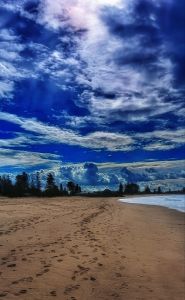
One of the key elements of the current temporary hermitage, the current safe-haven by the side of the road, is that it is literally two minutes walk from a very uncrowded and quiet coastal beach.

It is a place of golden sands (I know that’s a cliche but in this case I have the evidence!), gentle wave action, and the promise of a possible serenity of a kind I’ve not been close to for a long while.

While I don’t visit this little slice of Pacific coast every day, I get to walk and or sit there several days a week. And when I do, I find that it’s always uplifting and relaxing. A reminder too, of my oneness with all nature. All of us are actually nature, along with every other living thing on our planet (and of course elsewhere too).

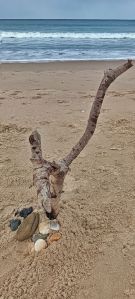
Today, for the second time I built a little ‘shrine’ on the sand.  Walking away from my little temporary temple, a poetic voice entered my mind and wrote itself a few lines. Too engrossed in the moment, I neglected to record it on my phone, so when I got back to the hermitage I wrote it as remembered.

And now, I would like to share it with you. I am grateful that I am actually able to share it, so thank you.

WE STAND ON SACRED GROUND

I planted the branch,
the branch of a fallen tree person.
On the beach,
in the sand of the beach.

And I built a shrine
around that branch.
A pop-up shrine.
Shells, stones, and a piece of coal.

A shrine to Varuna.
A shrine to Surya, to Saraswati.
A shrine to all the gods
of Earth, Sky, Water.
A shrine to the gods of all beings.

A shrine on the beach
is subject to tidal flow.
And soon, this simple shrine,
pop-up and temporary in nature,
will be engulfed.

Lord Varuna will make his claim.
What has emerged, must always return.

with love and in peace


Flee, Be Silent, Pray Always Part 3

Namaste and welcome

Well, here we are with the third and final part of our contemplations on Flee, Be silent, Pray Always, the answer discovered by our friend Arsenius who was looking for a way to be saved from the the things of the world.

In a very real sense, this third injunction might be seen as the most important of the three. Indeed, again in a very real sense, those first two seem to me to be prerequisites for the third. Certainly, many of us would like to flee to a place and state of silence in order to escape the world and its many and varied causes of our suffering. Such people are simply and completely over the noise, the chaos, war, greed, the complexity of relationships, and all the rest.

Then there are many many others who, rather than looking to escape the world, are wanting to ‘flee’ towards a place and state of silence in order to engage more fully with the world by contemplation, meditation, and most of all, prayer. Such people are working towards making their entire lives a prayer.

And then there are the third group which is made up of those who have some sense of running away from the world while at the same time they feel compelled to move towards a contemplative life that they sense will be the best way they can actually serve the world.

I think I can include myself in this last group. I’ve never coped well with masses of people, being in the workforce, or dealing with the horrors that the world seemed to be overwhelmed with.

At the same time, I’ve always wanted to (and have tried to) combat injustice, racism, violence and the rest. I guess you could sum it up by putting it this way: I was (still am) an oversensitive person who one day had had enough of trying to ‘fight the system’ when it was the system making and changing the rules of the game as it went along.

Better I thought, to turn inwards in order to reach or realise my oneness with all living things. I’ve always been predisposed to praying as well, so it was a natural evolution in many ways. My intention and commitment these last few years has been (and still is of course) to pray continuously and with all my being.

My prayer is for the release from suffering for all living beings and that’s my central focus for prayer. For me, it feels very much that I am a lot more use to others living what I think of as a prayerful contemplative life than being actively engaged with the world out there in the midst of it all so to speak.

Pray Always

Prayer for me is not so much about petitioning some all-powerful being who is seemingly on a whim able to grant or refuse my wishes. For me it is more an affirmation of the reality of my already existent oneness with the entirety of the universe. It’s a way of seeking to actually realise that this oneness is my very Self.

Prayer is about being present, not wishing blindly that things be different than they are. In praying I seek to affirm that the ‘universe is unfolding as it should’, as it says in a famous poem I’ve always loved. (Actually if you don’t know about Desiderata [Things Desired] then please do check it out; you’ll love it).

I think that in this sense, prayer is in fact an act of mindfulness, or rather an act which will help develop a mindfulness practice. It is a way to practise being fully focused and present to whatever is going on, whatever circumstances we find ourselves in.

And if we’re able to be present – even on a temporary or momentary basis – then we will be more calm, more at peace, and more able to achieve some clarity in our lives and with whatever is the intention with our prayer.

I know it might sound like a clumsy attempt at a clever play on words, but we’ve described mindfulness as the practice of being fully present. But we can put it another way. We can define that state of being fully present as being in presence.  Like what we might say to a friend who is daydreaming while we are trying to talk to them. We might say something like ‘so and so, your presence would be appreciated’.
In presence of what? I would say everything. When we are absolutely in the present moment (again even momentarily), when we are able to realise our oneness with all things. Essentially the universe is there – or is it here? – with you in that present moment. It’s a moment when we may indeed feel we are in the presence of all that is.

Some may call that presence God, or the Divine, or Universal Consciousness. Others may see it as being in the presence of their own true and authentic Self.

That leads quite nicely to the next aspect of prayer that I want us to look at. Praying to God. I’ve spent so long on mindfulness because I wanted to stress that I don’t think it’s necessary to have a personal name or form for God, or even a notion of an unmanifested, invisible ‘force’ called God, in order to pray.

On the other hand for me, and I know for a lot of people, there are names and forms of the universal consciousness that pervades and permeates the universe, that I personally resonate with and I can reach out to them whenever the feeling or inclination arises. It sounds a bit odd to say, but for me to think that all that is, is all that is, sort of sums it up.

And as a result of that, any prayer  I pray is addressed to my own Self which is simply part and parcel of all there is. In other words, it’s a personal choice for any one of us what form or name we choose to pray to. Or if we don’t pray to a name and form at all. All is one.

One thing I’ve mentioned I think a couple of times is the idea of making all our activities into a prayer, but other than the discussion on mindfulness and presence, I’ve not really addressed the how and why.

Why is pretty obvious. Because living and acting mindfully helps us in so many way such as being more peaceful, more relaxed, happier, and so on. The how, now I’m thinking about it is the purpose of this post. And it’s also true to say we’ve been talking about it since this series began.

That is to say, we flee from the aspects of our lives that don’t serve us and which can be changed. This might be a decision to spend 30 minutes every day sitting quietly and undisturbed. And as we’ve mentioned a few times already it could be going all out and moving to a desert cave somewhere.

In both those scenarios we give ourselves the opportunity to be silent and, hopefully also surrounded by silence. How to pray always? There’s an expression I love and try to live by: Follow your Dharma. Here Dharma means your own truth, being authentic to who you are, having the intention to do what’s right in all situations. And of course actually following through with that intention if at all possible. In this way you transform every action into prayer.

Living a life of prayer does seem on the face of it to not involve much use of spoken prayers, as in saying prayers with words. Well, I don’t intend to be humourous here, but a great deal of prayer does it fact involve talking to one’s Self. To the real self, that part of us that’s part of everything else. It can do us good to have these deep conversations.

Then of course there are the many many prayers that already exist to serve people from so many traditions, cultures, to suit all kinds of purposes and intentions.

Many of us will be familiar with a number of prayers learnt when we were children. If you’re anything like me, they still pop up by themselves from time to time.

Actually as I deepen my prayer practice, I’m discovering that I’m remembering all sorts of prayers from many and varied sources. I think as I dig deeper, more and more are coming up to the surface.
This prayer (by Thomas Merton I think) resonates deeply with me

If these ‘pre-prepared’ prayers say what you want to say and in a way that resonates with you, then you are free to choose those that feel right for you. I guess I mix and match the prayers I use; it’s always dependent on my feelings, thoughts, and intentions at the time.

Like  Arsenius, I try to be open and responsive to whatever the ‘answers’ are, even though my ego does sometimes when it doesn’t like the answer, try and control outcomes.
One point about such prayers: I find it tempting oftentimes to simply recite them at what I’ve heard described as lip level. By rote and without emotion, in other words. At those times I try to slow down or pause to reflect on what I’m doing and why to get back in touch with Self.

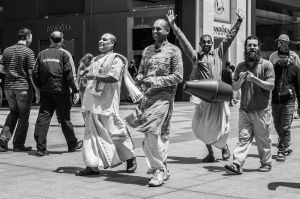
A major part of my prayer life is chanting mantra. I try to spend more time chanting as time passes. There are a number that I use depending on inclination and need.

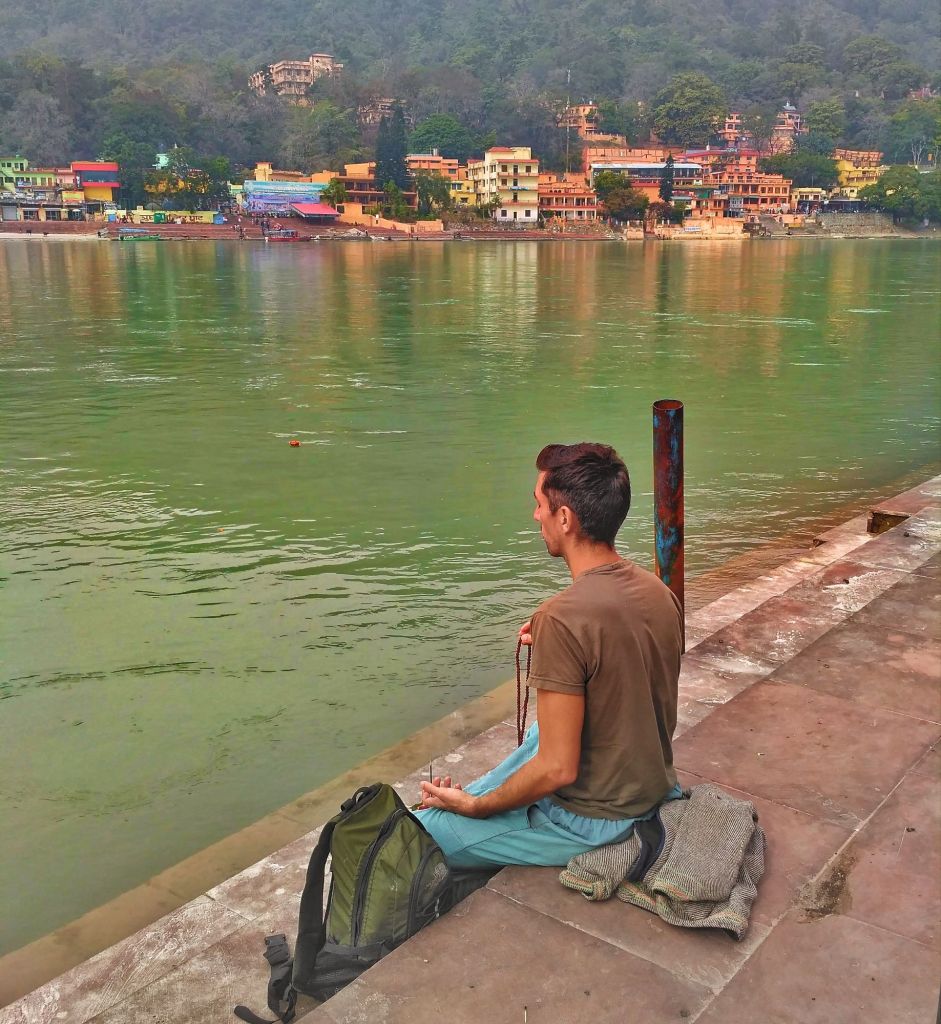
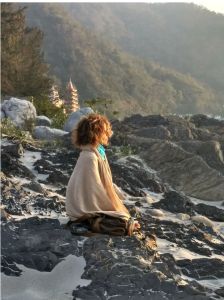
I chant anywhere and sometimes a mantra will start chanting itself, surprising me by its arrival

(This photo isn’t me by the way)

Now, probably one of the most important aspects of my own prayer life: I know I’ve mentioned my intentions in praying at all, but one aspect I haven’t mentioned is praying as devotion.

Devotion as in worship, praise, as in gratitude for the beauty in my life, as an expression of love. Knowing with the mind that all is one is fine, but these kinds of prayers help us to cement our awareness of that oneness of all living beings. As I said earlier, I, like you or anyone else, may use particular names and forms to represent this oneness, but, well, it’s all one, so we are non-different from all those names and forms.

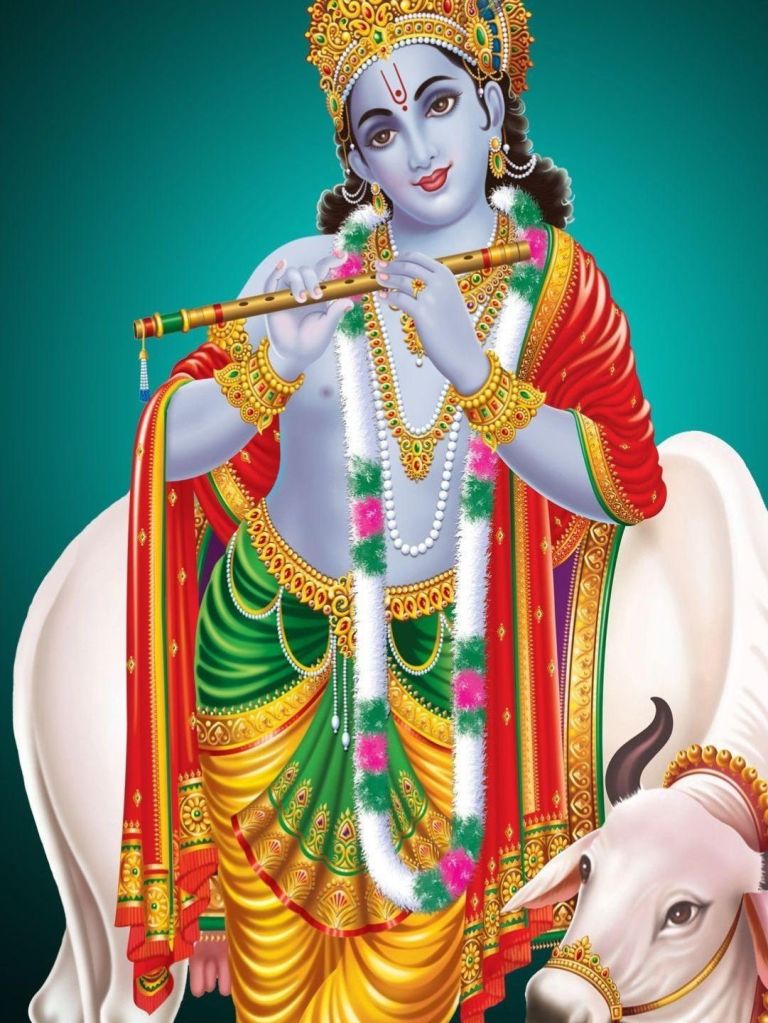
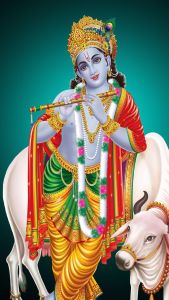
Lord Sri Krishna is among my favourite forms of Universal Consciousness  (also known as Brahman)

There are many representations of the Divine, but Krishna and this picture of Him are special to me.

Focusing your devotion on a particular form seems to help make it easier or more real. It’s tricky to pray to and with a thing that has no form and is invisible.

So, my friends I hope what I’ve said here is of some little interest to you and that you have found at least something you can use for your own life.

With peace, love, and with my prayers

Paul

Oh No! Another Blog About Chanting

Not too long ago, I completed what I’m now calling my first formal (structured) study of the entire Bhagavad Gita. Of course this wasn’t my first exposure to that text: I’d been reading it on my own for a few years before I came upon a teacher to act as guide.

Anyway, since that bitter-sweet day of completion, I’ve been looking at ‘random’ verses on a more or less daily basis as a way to keep in touch and to act as a reminder of what I’ve learned.

Just opening my Bhagavad Gita at random, just to see what the universe wants me to think about.

Today, I happened to open it up at what are a series of my favourite verses. (I know I’ve got a lot of favourites; it’s that kind of book). In these particular verses, Krishna describes the meaning and significance of the mantras Om Tat Sat.

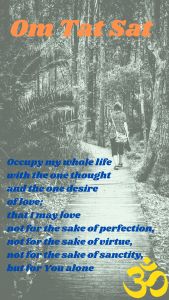
In a nutshell, these three syllables, these mantras, are a way of describing the Absolute Reality of the Universe, or God, Consciousness, the Truth, the laws of nature and the universe. Whatever names we might use to encompass all existence.

Krishna details when and why to use the mantras (it’s one mantra made of three, for the technically minded). Again in a nutshell, it’s a mantra to use whenever we perform our duties, basically any actions, with a devotional mood.

By the way, that, and the inclusion of my favourite image of Krishna, doesn’t necessarily imply that our actions have to have a ‘religious’ intent or flavour: Any action we undertake, for whatever purpose as long as it is motivated by Truth, Love and right thinking, qualifies as being devotional.

While you can see the actual verses yourself via the Om Tat Sat link above, I would like to share with you my very liberal paraphrasing of Krishna’s teaching on the mantra. Also, I am adding a few observations of my own that I hope serve to clarify this great teaching. Oh, please forgive any repetitions, if they occur.

The syllables Om Tat Sat are the symbolic representation of the Supreme Absolute Truth; what I choose to describe simply as all that is. It is called by any number of names or none. It’s existence itself.

It’s an ancient practice, this chanting of these three syllables as a mantra. It is recited when one is engaged in any action in a mood of devotional service. Meaning any act that is imbued with a prayerful attitude and feeling, and with a mood or attitude of devotion to and recognition of, Truth in all things.

And it includes any and every action we undertake, from washing the dishes, to sitting in meditation or silent contemplation. And everything in between.

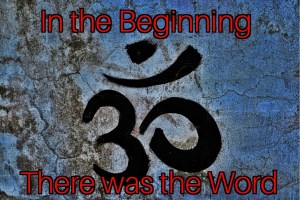
Om

Om is sometimes called the primordial sound, the creative principle, the word from which all creation sprung. I’ve also heard it defined as being the Big Bang, from which the universe emerged.

Om is considered the sacred sound and word by many cultures around our world. Consider the opening of John’s Gospel in the Christian New Testament :

Om is to be chanted when beginning and performing any and all actions motivated and driven by Truth. Chanting Om assists us to actually realise or understand with our heart and not just our mind, the presence of the divine or the universal consciousness in all that we do.

Tat

Tat is chanted by those wishing to be freed from attachment to material things, which includes the desire or compulsion to enjoy the fruits or rewards of our actions.

In the beginning was the word, and the word was with God, and the word was God

John 1:1 New Testament

Attachment is when we depend for our well-being or happiness (physical, mental, or spiritual) upon another thing (money, job, status, etc), person, or desired outcome. Attachment (and clinging, extreme longing, compulsivity), Buddha told us, is the cause of suffering: when things are going well with the things or people we are attached to we are elated; when things aren’t going so well, we are miserable and we suffer.

Sat

The syllable Sat indicates both reality and goodness. In other words, Sat is used to represent that Absolute Truth or Universal Consciousness that we’ve been discussing.

Sat follows very nicely on from Tat as it helps to strengthen our Dharmic (motivated by what’s right and true) actions, so that they actually become Sat – Truth.

So, chanting Om Tat Sat when performing any or all our activities in the world (as well as within) will help us to come to realise or understand that there is only the one Absolute Reality, the one consciousness that is not only universal in nature, but is actually the universe itself.

Oh one more quick note: Often you hear the chant with an extra word up front: Hari Om Tat Sat. Hari is a way to address that which removes darkness, that aids in the shining of the light of knowledge.

It’s a word that represents that Absolute Reality that we’ve talked about here. It can also refer to King or Lord, or otherwise influential entity. I find it rounds out the chant, and I like it!

Please feel free to explore Om Tat Sat for yourself. You will find a lot of great recordings of the chant on YouTube, and the wikipedia link at the beginning of this post is very Illuminating as well.

Om Tat Sat

All I Had to Do Was Dream

Last night I had a dream. Of course there’s nothing unusual in that: I dream every night, every time I sleep (and sometimes when I’m supposed to be meditating as well). Actually I’m no different than probably every other living being in the Universe: I dream when I sleep.

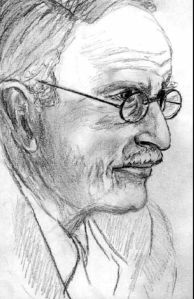
No. The particular dream isn’t my point here (though we’ll be discussing it soon enough). What makes it worth noting is the fact that last evening, before going to bed, I watched a documentary on Carl Jung and The Red Book.

Jung compiled The Red Book at a time of personal crisis and distress. Using dream analysis, his own imagination, and intense self reflection, he used both paintings and text to express what he saw and understood from these practices. Hauntingly beautiful, other worldly pictures depicting dream images, archetypes, both personal and universal, helped him delve deeply into his unconscious mind and the collective unconscious.

I gave up trying to interpret dreams a long long time ago. Don’t ask me why: I probably couldn’t say. Most likely something to do with a kind of wariness about going too much into where the mind wants to take me, and my sense that the “dream” doesn’t stop when we wake up.

Still, watching this doco prompted a lot of discussion with my partner hermit, and a lot of thinking on my part. The mind is not our enemy, though sometimes I feel that it is. Well, it can be the enemy if we allow it, but equally we can allow the mind to be our friend. After all, what activity of any kind is possible in the world without mind?

So, with that in mind (get it? in mind?) I will share with you that above mentioned dream from last night.

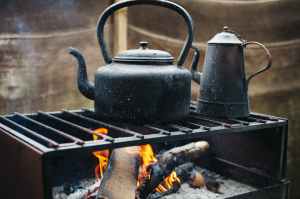
In the dream I was in a small kitchen, making tea. I’d put on a kettle to boil. A very large, heavy kettle, probably three or four times the size of a normal one. I was in the process of looking for a mug or cup, and just as I picked one up that I liked the look of, a crowd of five or six people came bustling noisily into this very crowded space.

‘I’ve just put the kettle on,’ I called loudly over the din. As it happened I’d filled the kettle almost to overflowing, much more than I needed for myself alone.

‘There’s plenty of boiling water to go round.’

Then I busied myself looking for something (a tea bag perhaps?), and when I finally turned back to the kettle to make my tea, I saw it was gone. I was very unhappy with this disappearance: After all, I was the one who had filled the kettle and put it on to boil. Then without a thought or a, what’s the expression? without a by your leave, it’s all gone, nothing left for me. Not only no more water, but nothing to boil more with.

I looked everywhere, even outside the kitchen. Outside was a camp ground and apartment complex, where I (and presumably all the other people) was staying.

Anyway, that’s it. All I remember at least. So, the meaning? Was I merely processing trivial facts and events from my day in this strange fashion? Or was I in touch with the deepest part of my psyche and with the collective unconscious? Possibly a bit of both.

It’s not a big job to make a guess about the meaning. I had a plentiful supply of water (or whatever), and without thought, put the needs of others before my own. But then, I actively resented what had been ‘taken from me’, even though I had freely given it in the first place.

So, the message I take from this dream? Just as I’ve been studying lately, the fruits of my actions are not my responsibility. I have no say over what, if anything, will happen as a result of actions I take. All I am responsible for is the taking of the action itself, the manner in which I undertake it, and the attitude with which I approach the actions I take. That’s it. That’s all I can do. The rest is up to the laws of the universe. Call it Karma, or Natural Law.

Another idea just occured to me: When I take action (like boiling the kettle) and then serve others, I am serving Self, all life, everyone and everything. And obviously that includes me. I’m not suggesting I should have made sure ahead of time that I’d ‘reserved’ enough water for myself, but at the same time …

I might keep this dream analysis thing as practice to practise occasionally, when the inclination or inspiration is there. No more blocking memories of dreams, no more stubborn refusal to reflect on dreams. After all, I spend a lot of time contemplating and reflecting on what I do in my waking life, how is it any different just because it happens while I’m asleep?

A Journey to the Centre of the World (sort of)

Namaste and greetings

Yesterday I came across a couple of stories – true ones – that I wrote years ago. They are what we might loosely call ‘travellers’ tales. I thought it might be nice to share them here. So here’s the first one. Enjoy

Not the Manu temple I write about, but another one close by

I’d walked up to Old Manali, and I’d kept walking through the town. Then higher still, past the temple to Manu, and the scattering of traditional houses and small fields clustered around the temple.

Three near-naked and stoned saddhus invited me into their cave – more a kind of overhanging rock shelf poking out from the foundations of the temple itself.

Naturally I declined. Politely. I wasn’t, never had been, and never shall be a stoner. Besides, here I was deep in the Himalayas walking through ancient villages and past temples to ancient gods. Seems to me that that’s enough to bring on a high all its own and like no other.

Then, a little higher up the trail. I rounded a corner to be greeted by a kind of open forest glade; a grassed and flowered field protected by a semi circle of forest sentinels, their crowns maybe thirty metres above my head.

And there, in the middle of this magic field, a large flat rocky area, like a series of ‘shelves’ layered one on the other. This maybe twenty square metre tiered platform was probably the remnants of an ancient hill (or mountain?) that got in the way of a more recent but clearly relentless glacier.

Whatever the history, here was an arena with views no theatre or movie could ever hope to reproduce. This natural amphitheatre faced several layers of peaks across the valley. But, before those peaks, and directly in front of me, just down the slope, stood the temple, then more trees, reaching down into the valley. Here the river flowed, surrounded by farmers’ fields and the brown dots of houses.

Then the forests begin again, thick at the bottom in the valley, but becoming more scattered on the higher ground. Then those many layers of higher and higher hills, mountains really, rolling off into the distance to, where on the horizon and behind it all, a row of the really high peaks covered in their permanent snows.

‘This is a special place, a sacred place,’ I heard myself sigh out loud. Sitting cross-legged now, I let my eyes wander over the scene taking in the blue sky, the white peaks, the multiple greens of the forests, the sliver ribbon of the river, and the rest.

At such times and in such places, one’s eyes tend to close of their own accord. And so it was for me then and there. I let myself drift. Thoughts came and went, to be replaced by more thoughts that came and went.

Then, my eyes opened. Again of their own accord. After a few seconds of that cliched ‘where am I?’ feeling one has when startled out of one state and into another, I made out the figure of a person standing facing me a few metres from where I sat.

‘I’m sorry,’ I heard her voice call to me. ‘You just looked so peaceful sitting there meditating, I just had to stop and watch you.’

She told me she’s been watching me for about fifteen minutes, which gave me a start: It’d felt l Ike I’d only just sat down and closed my eyes.

‘They say the light of the world is held about twelve kilometres up this trail. That means it’s the centre of the world.’

I had to stand to try to take in a revelation of this magnitude.

‘And apparently,’ she went on, ‘they’re going to move it soon and nobody knows where.’

Was she an angel? Was I dreaming? They, whoever they were, are about to shift the centre of the world? Even in India one doesn’t hear this kind of news everyday. Actually, I doubt you’d ever hear it on any day.

Then she was gone, headed up the trail. I didn’t follow. I remember thinking: twelve kilometres was too far for me especially as I already had a long walk downhill to my hotel back down in the new town.

Yes, mundane, practical musings, a typical response to news of such a wild and far-out nature. So, not exactly in shock, yet not quite myself, I turned back. Down. Through the village, past the temple with three crashed out saddhus out front, back into the town.

There are cafes there. They sell Chai there. I needed one.

Actually, given the momentous news I was going to have to digest, I might even have a couple extras.

This is a true story; it actually happened more or less the way it’s described here.

Of course, there is no ‘light of the world’ stored in some secret spot, somewhere on Earth.

Well, I suppose if there is a light of the world, then it’s likely to be the world itself, I mean Earth, all the beings who live on this planet. Life itself I guess you could say. Life is light; Life is love.

Peace

Remnants of Sea Cliffs

Here there are remnants
of sea cliffs.
Cliffs that have not towered
since ancient times.

Dharamshala Dharma Dreaming

In the Forest of the Windhorses

DHARAMSALA DHARMA DREAMING


The hand of the monk 
agéd, insistent, but gentle too, 
takes and holds mine. 
The monk sits, the Dharma before him, 
sacred texts resting in their saffron shroud. 
My presence completes 
this circle. 

Mountain monastery 
calling him; it’s not home. 
Other mountains 
he’s climbed. Escape. 
High places divide 
this world from that, 
that time from this. 

His loving touch, his smile, 
linger in rarefied air. 
Air drenched with the warmth 
of the Dharma, 
in this late monsoon 
restaurant of the Snow Lion, 
south of his land.

The Mountain Monastery Calls

Homage to Holiness: A picture & A Poem

Iridescent Rosary

HOMAGE TO HOLINESS

Threads harvested from threadbare clothing.
Pea-sized bits of bread, sliced from meagre rations,
Secretly hoarded for sacred purpose.

Mala makers work at night
in the dark of the stinking and freezing stone cell.
Chewed bits of bread become dough again,

and, by feel, frozen fingers knead the dough
Until tiny beads of bread emerge.
A tiny twig, again by feel, pierces each bead through.

Then in solemn prayerful silence and focus,
the nun passes her harvested thread through the first bead.
She ties a knot, no easy task with freezing fingers in the frozen dark.


And so it goes; all sacred duties take their own time.
One by one; one bead of bread threaded; one knot knotted.
The nun nears collapse. But now, at last, her task is done.

As the last knot is knotted, the last bead in its place,
The nun sighs and mutters, whispers, a prayer of thanks.
One hundred and eight beads plus one.
She has made her Mala.
Om Mani Padme Hum