When Love is a Yoga and Lovers are Yogis

There was light at the end of the research tunnel

These last few days I’ve been researching and thinking about an idea for a blog post. But I’ve come to realise that I am grossly underqualified to write about the topic I had in mind. Let me put it another way: I am completely and utterly unqualified in any way whatsoever to go there. In fact, after all the research, I think I’m going to disqualify myself from ever going there in writing.

However, I’m a great believer in the idea that no quest for knowledge is ever a waste of time or effort; there is always something to be learned. During my research I came across a topic I believe I am qualified to discuss, as it forms an integral and vital part of my own personal spiritual practice.

Why I’ve decided to write this post, though, is because I made a discovery that lead to an insight that I know will lead to a great progress in that practice. It’s nothing new, not really, but it was one of those occasions we’ve all experienced of ‘I knew that, but now I really know it.’ For me, it was a realisation of something that till then had been a nice cosy theory and belief.

Bhakti Yoga is that practice. It is really a key foundation, a valuable component of my spiritual life.

Wikipedia opens its entry on Bhakti Yoga (see the link just above) with a description of the practice that mirrors what I think is the traditional understanding of Bhakti Yoga:
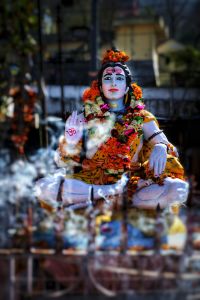
Bhakti Yoga (also called Bhakti Marga, literally the path of Bhakti) is a spiritual path or practice within Hinduism focused on loving devotion towards any personal deity.

In the same entry there is a description of the origins and meanings of the two words, Bhakti and Yoga:

The Sanskrit word Bhakti is derived from the root bhaj, which means “divide, share, partake, participate, to belong to”. The word also means ‘attachment, devotion to, fondness for, homage, faith or love, worship, piety to something as a spiritual, religious principle or means of salvation’.

The term Yoga literally means “union, yoke”, and in this context connotes a path or practice for ‘salvation, liberation’. yoga referred to here is the ‘joining together, union’ of one’s Atman (true self) with the concept of Supreme Brahman (true reality).
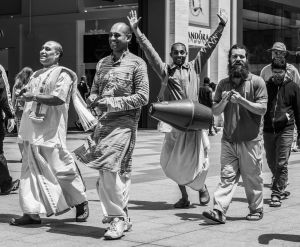
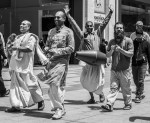
For some, dancing while chanting the names of their God, demonstrates their devotion and celebrates their union with each other and with God

In other words, those called to a religious or spiritual life, practise Bhakti Yoga whenever they pray or otherwise express devotion towards their personal conception of God, or the Divine. This particular definition seems to be saying that such a conception of the Divine, or God, is in the form of a personal deity who is a kind of representative of true reality, which the devotee is aspiring to join with.
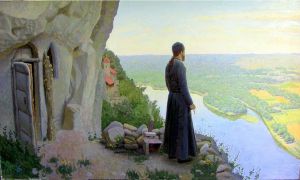
Some Bhakta Yogis are full-time, full-on practitioners. People like contemplative nuns or monks, hermits who retire from the world into seclusion. Anyone basically whose entire life and activities are spent in devotion.

So, when I discovered all this, I became intrigued; I decided to go off on a tangent and explore the word Bhakti itself. Wikipedia has a separate entry for the word on its own:

Bhakti is a term common in Indian religions which means attachment, fondness for, devotion to, trust, homage, worship, piety, faith, or love. In Indian religions, it may refer to loving devotion for a personal God

is often a deeply emotional devotion based on a relationship between a devotee and the object of devotion.

In ancient texts the term simply means participation, devotion and love for any endeavor.

May refer to devotion to a personal god? While I thought this entry doesn’t contradict our first quote above, it does seem to broaden, and deepen, the meaning of Bhakti. Expand might be the better word.
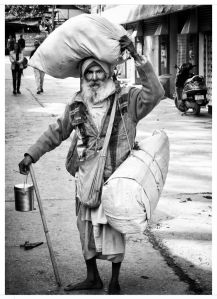
In some traditions a simple life on the road is a way to commit full time to Bhakti or devotion.

It struck me that that object of devotion might be anything. Or even everything. You see? I told you it wasn’t a new idea. It’s just that it’s resonated deeply within me now. It appears that the object of Bhakti Yoga practice doesn’t necessarily have to be a ‘personal god’.

Many many people would say ‘I like animals’ or ‘I think we should save the world’. But, while that may imply a kind of love for or at least a fondness for, I think Bhakti is something more – actually several somethings more!

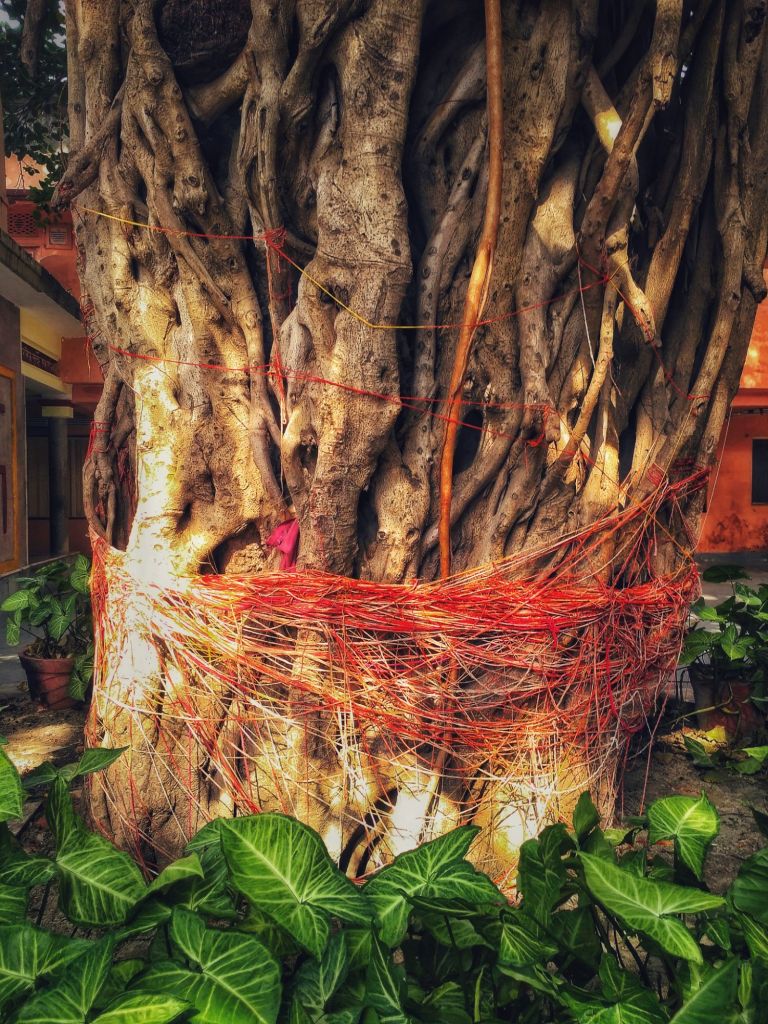
For example, some people have a particular attraction to and love for, the ocean, or it might be a river they view as, if not sacred in a religious sense, then as special to them in some deep, comforting, even therapeutic way. Others have similar relationships with and feelings for trees, or even a particular tree.

Animals as either individuals or as a species or group, can have the same appeal and call to other people. Then there are those who feel strongly in their hearts you could say, that Earth itself is a sacred object, or others have a knowing that the planet is a living entity and worthy of our devotion.

Bhakti begins with love and devotion, which is about caring for, affection towards, loyalty to, emotional engagement with the object of devotion. But even more than that, there is faith in that object of devotion; faith as in trust, confidence that the love is real, that the ‘relationship’ is sound and real.

Homage and worship too are key aspects of Bhakti. The deep inner feeling we have towards a thing, person, or other being, that is beyond what we normally call ‘love’. It’s about seeing and actually realizing ‘in our hearts’ our desire to be merged or united with that thing, person, or other being.

Actually, seeing that word other just now got me thinking. I had to go back and reread our definition of Yoga up there near the beginning. It says Yoga means ‘union, yoke’. It goes on to add: yoga refers to a ‘joining together, union’.

This passage seems to be suggesting that Yoga (in our case Bhakti Yoga) is both an already existing union, and a process of joining together to achieve union. One thing I would say here is that in my practice of Bhakti (and love as a general thing to strive for and be) it’s both.
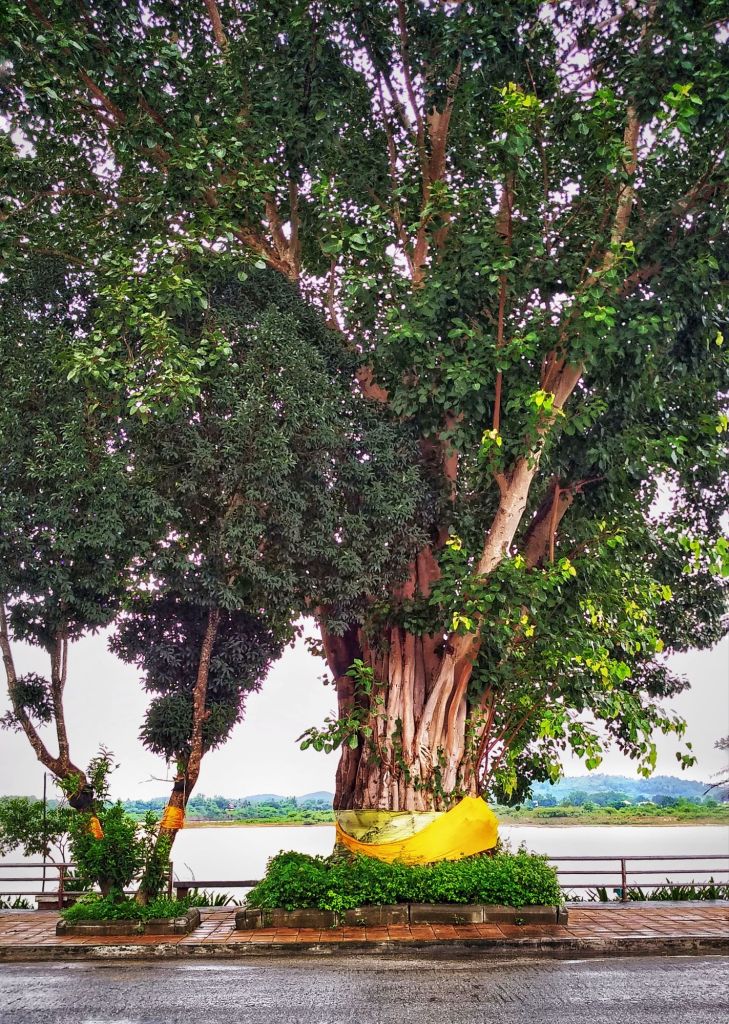
Trees are special beings for many people from a whole variiety of cultures all over the world

But, in the end, it seems to me that the process or practice, the path of Bhakti, serves to awaken us, to assist us to acknowledge, recognise, and realise in that really knowing way, our pre-existent true nature.

That true essential nature can be said to be the reality of our oneness with all things, living and non-living. And their oneness with us too of course. In fact, by putting it that way, I’m saying there is only one, or oneness. What’s that expression? One without a second.

May you be a Bhakta Yogi. Or, perhaps you already are one?

Love and peace from Paul the Hermit

Life has manifested itself as the multitudinous forms that comprise the universe. It is the one Universal Life, Power or Shakti (the laws of the universe or natural laws) that controls, guides and actuates all movements and activities in all beings, creatures and things.

                — Swami Ramdas
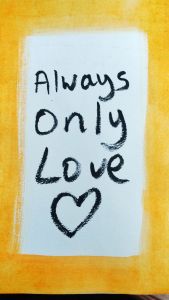
Chant the Name and Write a Blog Post!

Even the biggest dream catcher won’t always catch the dreams

This morning I woke up restless, and extremely tired. It felt as if I hadn t slept at all, though I know I did. Who can say about these things? Perhaps dreams disturbed me or something.

Anyway, despite this grogginess/restlessness vibe, I resolved to get on with morning routines. And, in addition to breakfast and normal stuff, I set an intention to continue with my usual morning devotional practice.

So with that in mind (and a coffee in hand as an extra aid to wakefullness), I sat with that intention and in a mood of devotion.  As is my usual practice, I picked up my Bhagavad Gita.

Now, this particular edition has some pages in front and in the back that aren’t really a part of the main text. Over the years I’ve written things on these pages, and pasted in various pictures, prayers, and other things meaningful to me.

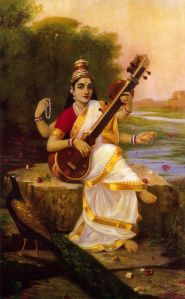
As I picked up the book, it fell open accidentally, by chance, at random, to the pages on which I had placed an image of Saraswati, as well as a page of repeated mantras to her. (I use the female personal pronouns because she is a female representation of the divine in particular aspects. More on this later).

Okay I thought: that’s a pretty clear message about where to go from here. I will chant Saraswati’s mantra for a while. Then I thought, there’s a really nice live recording of the mantra by Krishna Das. Do check it out, it’s very lovely, very meditative and soothing.

So, for about 30 minutes I chanted along with this beautiful renditon of  the mantra. Well, it’s a hymn really, a sacred song. And, now? How do I feel?

Awake! Wide awake, alert, ready to face the rest of the day. Inspired also, hence this quick post. No longer restless, well not as bad as I was anyway.

Oh, I should tell you a little about who I think Saraswati is, though of course if you click on the link on her name above, you’ll learn more.

For me, She is a personifcation, a representation, of the divine; the universal consciousness in its aspect of the arts and learning. Obviously, there’s a lot more to Saraswati than that, but for me, she is like a muse, a sort of mentor; She reminds me that art (and study which I have to get to today as well!) is an expression of all that is divine. Actually, art is the divine just as all things are.

I think that Saraswati has been busy with me this morning.  She has helped me to set down these words I share with you. Perhaps, this little story of my morning has reminded me that I can call on Her more often. One of my biggest aspirations, you see, is to share more with you here.

Oh, one last reminder: There is no such as thing as ‘accidentally’, or ‘by chance’ or ‘at random.

Peace

Out for a walk & Singing Sacred Songs

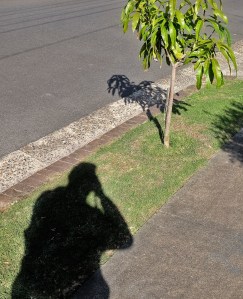
I call this one: Self-portrait With Tree 😁

I was out and about photographing for a few hours this morning. On such walkabouts I like to walk at a slow but steady pace, and in a contemplative frame of mind.

Usually I’ll also chant mantras as a way of focusing my mind, of keeping random thoughts from distracting my attention. And so it was today.

Deep into today’s walk, I was feeling ‘in the zone’, as I like to call it. Making photos and chanting mantra. All of a sudden I heard myself singing a bhajan (sacred song or hymn) in place of the mantra I’d been reciting.

This particular bhajan was By Your Grace, by Krishna Das, It’s a beautiful devotional song that you can listen to here. I’ve been listening to it and singing it for years, and I love it. I find it puts me in a nice prayerful state of mind,  Anyway, here are the lyrics:

Closer than breath, you are the air
Sweeter than life itself, you are here
I am a wanderer, you are my peace
I am a prisoner, you are release

Jai Gurudev…

I am a pilgrim, your road so long
I am the singer, you are the song
Held in the open sky, so far above
I am the lover, you are the love

Jai Gurudev…

I follow your footsteps through the flame
All that I ever need is in your name
Carry your heart in mine, vast as space
All that I am today is by your grace.
By your Grace…
I live by your grace.

One more way to chant sacred songs

Now, the song was written by Krishna Das as a way of thanking and praising his Guru. But, the words and the power of the song can be dedicated to any of our own individual concepts of the Truth. Whether we call it the Absolute Reality, the Supreme Being, the Life Force, the inner Divinity, Nature, Consciousness, God, Guru, the Universe. After all, these are all simply names and forms.

I guess what I’m saying here is that the song is a fine prayerful and meditative way to express our gratitude to, our love for, and devotion to whatever it is in our heart of hearts we know as our support, our teacher, our creator, our Guru. Our very own Truth

Peace blessings from me to you

Homage to Holiness: A picture & A Poem

Iridescent Rosary

HOMAGE TO HOLINESS

Threads harvested from threadbare clothing.
Pea-sized bits of bread, sliced from meagre rations,
Secretly hoarded for sacred purpose.

Mala makers work at night
in the dark of the stinking and freezing stone cell.
Chewed bits of bread become dough again,

and, by feel, frozen fingers knead the dough
Until tiny beads of bread emerge.
A tiny twig, again by feel, pierces each bead through.

Then in solemn prayerful silence and focus,
the nun passes her harvested thread through the first bead.
She ties a knot, no easy task with freezing fingers in the frozen dark.


And so it goes; all sacred duties take their own time.
One by one; one bead of bread threaded; one knot knotted.
The nun nears collapse. But now, at last, her task is done.

As the last knot is knotted, the last bead in its place,
The nun sighs and mutters, whispers, a prayer of thanks.
One hundred and eight beads plus one.
She has made her Mala.
Om Mani Padme Hum

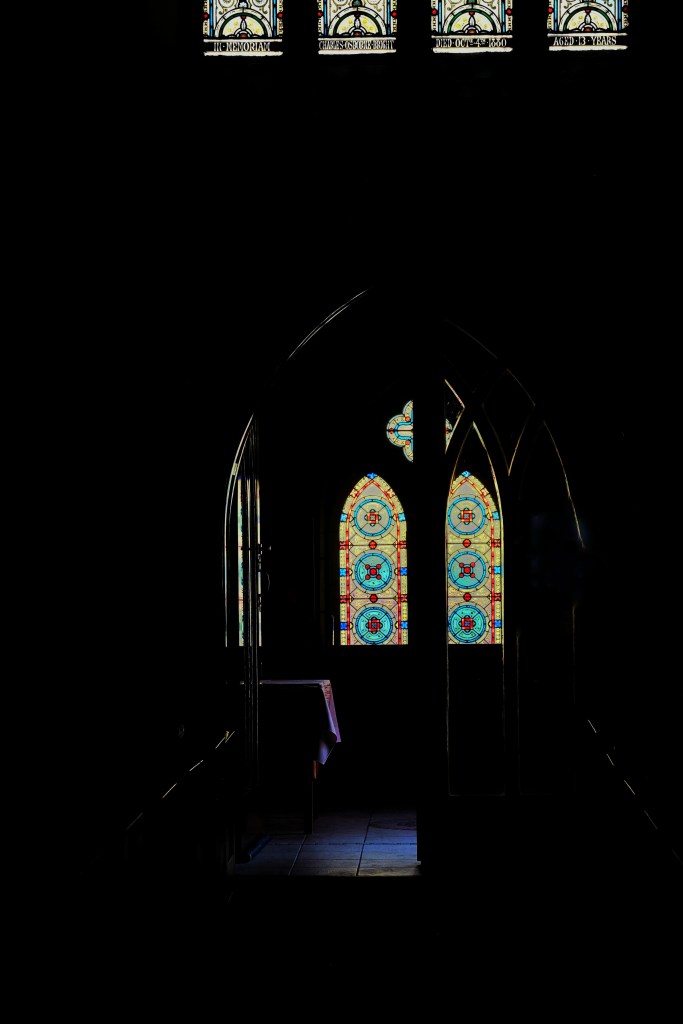
Illumination

AS GAIA TURNS

Surya illumines
with his fiercely gentle life-giving light.
Gothic panes receive and reflect
golden impressions
as Gaia turns.

Sacred Glass in God’s House

At the entrance to the temple, the Way is illumined

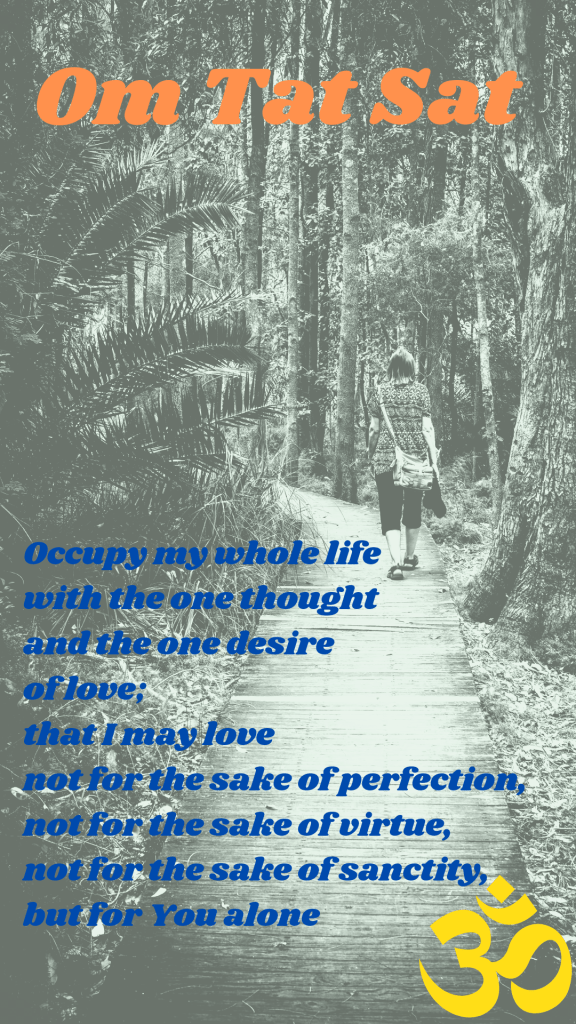
For You Alone: A Prayer

I’m not completely sure where I found this prayer. But I have a feeling it is by Thomas Merton, one of my most favourite and significant teachers and guides.

Thank you with Love

A Small Gift

An Encircling Embrace (Unknown and brilliant street artists)

From the Hermit’s Cave to You, wherever you are

Hommage aux Ailés

Creatures of the Air,
the Winged ones.
Same like you and me:
Bound to material nature.

God is in the Ink

My eyes follow the line her pen inscribes
across the page, its whiteness coming alive.
In such moments, I know that it is true :
I know that God is truly in the ink.