The Lion Sleeps Tonight. That’s the song name I always think of. Sometimes you might hear it called Wimoweh. While it’s the song’s Zulu title, it’s actually not a real word: it references a mishearing (and subsequent recording by a group in the early ’50s) of Uyimube (the original chorus) which is Zulu for you are a lion.
In any case, I feel like I’ve known the song all my life. I suppose I have: it was a smash hit when I was seven or eight years old. It’s been one of those songs that have stuck, become a constant presence, to be hummed occasionally, to be sung even less frequently, heard rarely, but loved and familiar.
Anyway, recently (in March I think) my affection for the song surfaced. I was thinking about something my partner hermit had said about creativity and suddenly the melody to The Lion Sleeps Tonight came into mind.
That melody, and my memory of the lyrics then became integral to the poem I wrote to express some of my thoughts about my partner hermit’s statement. It helped me say what I had to say.
I hope you like it – the song – Listen to the Tokens doing their version from 1961; check out the lyrics too. It’s a happy song, a reassuring song of safety and love.
With that I humbly offer my poem. Enjoy
THE HERMITS SLEEP TONIGHT
A creative way to start the day. A prayerful way, a prayerful way.
In Samsara’s jungle there is a village, a suburban village. A prayerful way, a prayerful way.
Near the village – no, in the village the hermits sleep tonight. A prayerful way, a prayerful way.
The walled enclosure, their very own paradise, like a castle keep, keeps them safe. A peaceful way, a peaceful way.
Hush my sisters; hush my brothers. No need to fear the jungle. A prayerful way, a prayerful way.
Day breaks; Surya rises. A prayerful way, a prayerful way.
Sleeping hermits gather, to break the fast. A prayerful way, a prayerful way.
Fast broken, sacred tea imbibed. A prayerful way, a prayerful way
The hermits begin, begin their day of prayer.
A creative way to start the day. A prayerful way, a prayerful way.
The walk from the Hermitage to the coffee shop at the Village Green takes around five minutes or so. This morning, noticing a pause in the rain, we thought we might take the opportunity to get some fresh air and a walk, at the end of which there would be coffee. So, we stepped bravely forward, with the faith that the gods of the rain were indeed taking a break.
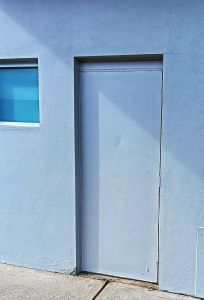
‘Look over there, ‘ said my partner hermit as we passed through the centre of the village. ‘There’s a door that can only be opened from the inside.’
‘I’ve never noticed that before,’ I replied, looking across the street to a wall into which was set a door with no visible handles or lock. The only things that suggested that it was in fact a door were the hinges on one side, as well as its size and shape.
Now don’t ask me how many times I’d passed that spot. Most likely dozens of times, on both sides of the road. Still, now that I had been shown it, I was intrigued. Mentally I was captured: I thought, what a wonderful thing: the one or ones on the other side of the door have complete control over who or what is allowed to enter.
With such a door, one that only opens from your side, you could easily choose to rarely – or even never – open it. Ah, peace at last went my thoughts.
But, right away, those thoughts were dismissed, sent packing: too simplistic, too extreme, to heavy a response. Though, you know, I do feel strongly that such a response to the world – shutting it all out completely – is perfectly understandable, completely reasonable, and oftentimes even an absolute necessity .
Still, I had that feeling towards my reactive thoughts of ‘too extreme’ (inner editor’s note: he has no idea what he’s saying does he? If you ask me, right this minute he will be thinking his initial reaction was spot on and he’d love to have a door like that. Anyway, we’ll let him have it his way).
Some further, more careful thought is required here I think. For a start, here’s a question: If I were to keep the door shut all the time, how would I ever be able to allow my own light, my own love, my own Self, out into the world?
Maybe there’s a way to keep the door open sometimes, then at other times choose to keep it closed to bar access to unwanted intruders in the form of people, thoughts, events, emotions and so on.
After all, it is my door (in this little fantasy at least), the door to the inside, where resides the ‘real’ me, the Self within, beyond and above, the physical form that I so tenaciously cling to as as being the real me. Talk about attachment!
Perhaps slightly exagerated, but this is close to how I see my actual door working as distinct from the story I’m telling in this post.
Where was I? Oh yes. With that door that opens only from the inside, I might come – eventually – to realise that there is nothing to disturb me – unless I open the door and let whoever or whatever that is unwanted, through the door.
I am my own gatekeeper, and without my consent my gate (door) cannot be opened and entered.
And, getting back to the choices I am able to make to sometimes open the door to allow some light and love to flow out from me, out the door and into the world. The more I’m able to discern when, and for how long, to open the door as a way to control what comes in, to what can reach me, the more resources of said love and light I shall be able to build up.
Which, in turn, will lead to more and more opportunities I’ll have to open the door in order to share some of that good.
I can envisage a state reached where my door could quite possibly be left to stand ajar all the time.
You see, the more love and light pouring out, the less that disturbs me can get in. Love and light is transforming, isn’t it?
Yes. Now I’ve noticed – recognised – the door that can only be opened from the inside: It’s me! Now, where did I leave my door keys?
Thanks to inspiration from my partner hermit, I’ve once again begun reading Bhagavad Gita from the beginning. The quoted verse came up this morning as I continued through chapter 2.
Setting the scene, the Bhagavad Gita is a conversation between Krishna (God) and Arjuna, a famous warrior who’s leading the army of the ‘good guys’. The context is actually a metaphor for the battle that goes on constantly between what some call the Higher Self (represented by Krishna of course), and our lower selves, our ego, mind, and the rest of the worldly us (represented by the very worldly Arjuna).
Knowing that, sometimes a verse will jump out at me as being in some direct way related to me. This verse, this morning seemed spookily all knowing about my mood of just slightly earlier.
Before we move on, I should point out that Arjuna has just realised that if the battle goes ahead, he’s going to have to kill many relatives and friends, teachers, and others he respects. And he’s just decided he’s not going to do it and sits down depressed and dejected on his chariot.
Now while I personally applaud this decision (he even says it might be better if he went off into the forest and lived the life of a wandering monk rather than be in this battle), I have to remind myself that it’s not for real, it’s a metaphor for the battle between our two selves.
Krishna says to Arjuna that you’re going to look really bad if you don’t fight the fight to uphold the Truth as you know it. Lesson number one when studying the Gita: don’t sweat the context!
Anyway, to our current story.
I’d just finished my breakfast cup of tea, and I knew it was time to ‘get on with the day’ as the saying goes. Today, though, Tamas** was strong. Which left me feeling, I don’t really want to get on with the day.
Instead I felt I wanted to not get on with anything; I wanted to lie down and sleep, and not think about anything, or do anything else either!
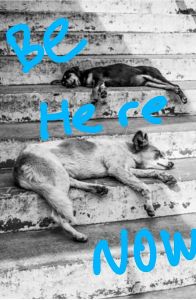
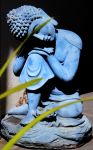
This picture is called Lunchtime Sleeper but it’s how I felt after breakfast this morning!
Mind you, not in the ’empty your mind of random thoughts, relax the body, realise the Divine’ kind of mood. No, more like ‘lay down, block out everything, blank the mind, sleep.’ Blank as it blot out!
Then, the famous second thought kicks in: No, I said to myself. I will not allow Tamas to take control. So, I got up, brushed my teeth, washed my face, and got ready to begin my practice.
I guess you could say that Tamas finds it easy to take control when one’s mind is in enemy mode as I like to call it (somewhere else in the Gita, Krishna says the mind can be our friend or our enemy).
My mind in particular doesn’t usually need a lot of help to disparage me, put me down. Getting me to question my own capabilities is one of its favourite activities – sometimes.
And it’s exactly right, perhaps I should be questioning myself: If I allow Tamas (mind and ego etc) to have free rein, the pain and the shame is all I feel. Well, perhaps not all, and not always, but still, it’s not a good thing.
So, what’s going on now? I’ve been reading Bhagavad Gita, and now I’m making these notes. Tamas is on the run and my mind is being ever so friendly.
**Tamas is that aspect of our (human) nature that has us leaning towards lethargy, laziness, that ‘I can’t be bothered’ feeling, and excess sleep, and all the other slothful stuff. Blotting out, as I termed it earlier.
Welcome to another poetic sharing post. There have been a few lately haven’t there? I had thought that once I had the new page Poems of Devotion up and running that I would only feature one every now and again in its own post.
However the one I feel inclined to share with you today is slightly different. Well, not really: it’s still a devotional piece, but for some reason feels a little other than that.
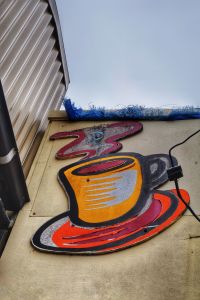
This hermit’s choice: the number 1 coffee shops in the Hermitage neighbourhood
For a start, it’s set in a café and features the thoughts of a hermit monk (me), and is about what’s going on in that space at that moment. As well as what’s in his mind and heart. Oh yes, almost forgot: the action takes place on Election Day.
So, what is it that makes me feel this poem is ‘still devotional but slightly other’? Well, aside from the setting, timing, and so on I just described, I sense that, in its words, in its composition, the hermit has sought to record (through the poem) that moment in the café as the reaching out to all those fellow beings sharing the space, to recognise, and to celebrate the divine in them all.
May that intention shine through to you too, dear reader
THE HERMITS HAVE COFFEE ON ELECTION DAY
I feel like I’m sitting in a Hopper painting. Just off the village green at a coffee shop, in the Toukley Mall.
There are people; aren’t there always? Coming and going. This one catching gossip; that one seeking connection; One or two heads down, backs bent over newspapers assimilating myriad tales of woe. It’s election day.
Of little interest to the hermits, out of the hermitage for coffee. A treat that comes at a cost.
Voices – of people and of headlines – speak, some even shout, of worldly things. To us not real.
Leaves me hollow. That’s the vibe, the feeling inside – And that’s not real either.
It’s been just over a week now since the new page on the blog went live. I have to say that it’s been very satisfying setting it up, then uploading some of my devotional poems.
Actually, it was while uploading one yesterday that I thought, I’ll feature this one in its own post. I did mention that I would like to continue this occasional practice.
There’s not too much to say about this particular poem really – best to leave it to speak for itself. I’m only introducing it like this because I wanted to include a Wikipedia link that might help clarity a couple of the terms and some of the details mentioned in the poem.
The poem speaks about the concept of Viakuntha, which as you’ll see is the supreme heaven for some Indian traditions. The link leads to an interesting and short read, well worth the time I think.
The myth of Vaikuntha was a trigger for this poem, as was the meaning of the word itself. Is it a real place? Who knows. Fact and truth don’t always agree, and as for me, I don’t think about the question.
Myth has been the way we humans have always used to tell our story. To try to sort out the big questions: where are we from? Who are we? Where are we going? All the ‘big questions’ are addressed by mythologies from every culture – every family, country, you name it – on Earth.
In any case I think that my poem came about as a result of my own contemplation on the story, on those big questions, on Self really.
I hope you will visit my Poems of Devotion page. I’m still adding poems to the page, and of course, with grace, I will continue to write.
Now, please enjoy reading my poem, and I hope it’s a nice experience for you.
Love and Peace Paul the hermit
OUT BEYOND CAPRICORN & DEEP WITHIN EACH HEART
Vaikuntha: Without anxiety. Is there such a place? Free from worry? Out there, they say, beyond Capricorn. There’ll you’ll find the highest heaven, the abode of God.
No need to look to the stars: Vaikuntha is here. Vaikuntha is now. Within and without you.
Vaikuntha is indeed beyond; beyond the material world, beyond the realm of bodies and minds; beyond the illusions of places and spaces. Atma – Universal Consciousness – you and me, that’s Vaikuntha. You and me, all there is. No anxiety
Renunciation. It’s a popular topic here at the Hermitage. Perhaps popular isn’t the right word; let’s say it’s a subject of conversation, thought, and contemplation on a quite frequent basis. As it is, I think, for most people attempting to live a spiritually focused life. For today, however, I really want to focus on some of my own thoughts around renunciation.
For those of us oriented towards the quest to live a spiritual, prayerful, and dharmic or truthful life, renunciation tends to mean the giving up of things, activities, and behaviours (including thoughts, attitudes, and the like). The theory is the very act of renunciation itself predisposes one to more authentic and close identification with their own true natures. It places them nearer to realisation of the Divine, of God, Absolute Reality.
And of course when harmful things, situations and attitudes are released, one has less to distract from the spiritual quest and life, Of course, most acts of renunciation don’t result in a one off quick fix: I heard in one of our hermitage conversations a few days ago the perfect quote to help make this point:
‘You just have to keep renewing the renunciation.‘
In other words, it’s a full-time, life-long job!
But, in the attempt at renouncing, we can potentially find some help towards a clearer focus on the spiritual side of life as well as more sensitivity towards what is good and what is not good for us.
A person free from both hatred & desire is always renounced. Indifferent to dualities, he is free from all bondage and easily attains liberation
Bhagavad Gita Ch 5:V 3
Which is where every one of us knows exactly what it means to try to give up what’s bad for us. It ‘ain’t easy is it? Still, we’re here to talk about me, not you or anyone else. So …
There are a few things that in perusing the monkish life, that I didn’t have to renounce; some things like eating flesh, drinking and smoking, going out to clubs, pubs and the rest, are things I’ve either never engaged in, or haven’t done for a very long time.
Which brings me to a good point to mention here. Any renunciation whatsover has to be a personal decision taken only after serious reflection and thought. And it must be made without outside coercion or pressures. While others may think they know what’s good (or bad) for you, in truth, it’s only you who really knows.
Anyway, as I was saying, or about to say, renouncing things hasn’t always a piece of cake for me. Actually, I love cakes of many and varied kinds and have had to renounce all of them. But that was more for my body’s health than for my spirit, though obviously the two go hand in hand.
Then, just a couple of days ago in a momentous event which in fact was the trigger for all this reflection on renunciation, I vowed to give up a particular breakfast cereal I’m really very fond of.
This renunciation – not the first attempt I might add – being prompted by the fact that I tend to experience quite strong indigestion, huge bloating, and general feeling yuck, when I’ve indulged in this cereal for any length of time.
There is nothing trivial about attempting to renounce foods and so on that harm our health; as I said, it’s a lifetime’s effort. And equally daunting are the non-physical things like attitudes and behaviours.
Any renunciation whatsover has to be a personal decision taken only after serious reflection and thought.
Here is an example, or group of examples, which along with the above-mentioned cereal saga, played a serious role in bringing about this post. They are behaviours and attitudes which very emphatically interfere with my quest for a Dharmic, prayerful, and spiritually focused life,
What I absolutely hate, despise, detest, am revolted by … Oops sorry; I forgot my monkish manners there for a minute. Let me try to rephrase.
I have a strong aversion to gossip, to judgemental thoughts and comments. I am averse to it on a couple of levels. Firstly, I do not like, for one second, the idea of not minding my own business, of commenting on what other beings do or say, or don’t do or don’t say, or how they behave.
Surely, my thinking goes, I have enough of my own business to mind, why do I need to mind the world’s business?
That’s the key one I think. But I really dislike the feelings such behaviour and attitudes invoke in me: anger, frustration, guilt, inappropriate thoughts, words and conversations. There is even a physical component sometimes when I make myself sick in some way through the stress of such things.
There is another point too, just as key if not more so. I’m routinely disgusted by the notion that these criticisms, judgements, not minding my own business, really do impact on what I call the vibes of life for all of us. Call it vibes, energies, whatever, but I sense that our own behaviour has a ripple effect beyond our immediate relationships and environments to the wider world beyond.
So, by now it’s pretty clear that I am in need of some serious renunciation of my judgemental, critical thought and words, as well as the anger, disgust and the like, I feel and express towards those I deem worthy of my judgement. Okay, not just others: all we’ve been saying here applies equally to myself.
Perhaps it’s to do with family, school, or societal conditioning? And like any full-on conditioning it can tend to preoccupy, even possess, one’s life.
These are all old stories. They come from a past that doesn’t exist. For real, it’s gone right? Actually, when you think about it, there really is no such thing as the past.
Long ago, decades really, I was big into affirmations. I had a whole collection in a little folder that I kept in my pocket of on my desk or wherever was handy.
There are a few I remember even now thirty or more years later, and there are one or two that come to mind that might be helpful that I can resurrect to share here.
I release and let go of all that is unlike love. There is plenty of time and space for everything I want to do.
You let go of all that’s unlike love, what’s left? Love. Love is all. All is love. And this affirmation has an added bonus: no regrets, it’s never too late, there is time – and space – aplenty.
And the second one. I think it’s just as good:
I am at peace with my own feelings. I am safe where I am. I create my own security. I love and approve of myself.
This one I’ve rewritten as a prayer; I might share that one sometime. The helpfulness here is easy to get: I’m safe; it’s okay to have my own feelings.
There’s no outside threat – nothing to attack, nothing to defend – and, finally, I have no need to be entangled with all that unwanted stuff, that – as I’ve already said a couple of times – is none of my business.
For my community, the invisible and the visible, with love
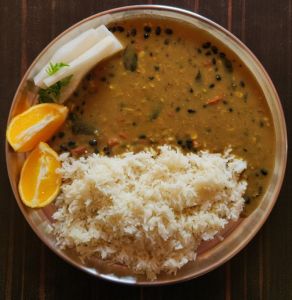
This morning I announced here in the Hermitage to anyone within range, that today, I would be making lentils. No, I thought, I can’t ‘make’ lentils; my job is to cook them so they might become Dhal. Jokingly to myself I stated by way of correction in my best mentally affirmative voice ‘It’s Dhal day today.’
Dhal is an important staple for us here at the hermitage. Please don’t imagine I’m exaggerating when I say that we eat it everyday. Actually, come to think of it, it might be just an ever so slight exaggeration.
Very very occasionally we choose some other evening meal, always vegan. But to tell the truth, we all like Dhal so much that we hardly ever feel the need for a change.
Anyway, as I say, it’s one of my relished responsibilities to once a week, or thereabouts, play my part in producing the Dhal that sustains the community for the next week.
Just a little aside: Lest you think Dhal is all we eat, I should mention we eat lots of fruits and vegetables, rice and breads, beans and various other things that come to us one way or another.
Please, the inner editor is begging me, can we just get on with today’s topic? Actually, the topic is the Dhal making that has taken place today. So, really, we are still kind of on track.
Right then. Not long after my announcements to the community and to myself, I got to it, to the task at hand. First, I pour red lentils into a largish saucepan.
Not my picture. Just to give you an idea of what I saw that prompted my feelings
I watched as the lentils streamed from the packet to form a little mountain, first at the bottom of the saucepan, growing to full saucepan scale. Funny thing to say but I was kind of mesmerized by this mountain building. I was struck by the thought – more like a feeling – this is wonderful, this is important.
I mean to say that I felt a little awestruck by the abundance. In a sort of gratitude induced reverie, I scooped a handful of said lentil mountain, letting lentils stream back to Lentil Mountain in the saucepan.
Then it’s rinsing time. You see, you need to rinse the lentils to get rid of excess starch, bits of dirt, little stones, or twigs. This is a vital step in the process according to the Dhal Grand Master who taught me this life-sustaining art.
In any case, it’s at this stage that you’re allowed to get your hands right into the mix. Run water, swish the lentils around, drain off now starchy, twiggy, stony water. And repeat five, six, or more times determined by the clarity of the water after each rinse.
I like that bit too actually: kind of pleasant sensation as lentils swirl through fingers and you get experience something of the lentils themselves. Nice feeling.
Next step, fill a giantish sized saucepan (I call it the big pot) with the rinsed lentils, add water (very exacting amounts too, but don’t ask me for precise details), bring to the boil occasionally scooping off any remaining bits and pieces as you watch the alchemy happen.
Then, once boiling, it’s time to stir in various spices. Once again, exact amounts are called for, but, well it’s kind of a trade secret. By which I mean, I couldn’t tell you measurements; one just knows. Could be a cook thing. Or maybe it’s a monk thing?
Enough cooking (sometimes the inner editor doesn’t know when to leave the writer alone).
Okay then.
Gratitude. And wonder. Both experienced today – and not for the first time.
Wonder at & gratitude to Surya (the Sun) which gives and sustains all life, including lentils
Wonder at the aforementioned alchemy that transforms dried, red lentils, a few spices, and water, into a delicious, substantial, healthy and nourishing, food that satisfies and sustains.
Gratitude that I am able to take a small part in this alchemy. Gratitude for the beings who sustain us – me, our community, you, all of us on Earth. Gratitude for the grace I have been granted that actually allows me access to such wonders and abundance.
It’s a lot to be grateful for. All I can add is that it is my deep gratitude that will keep me ‘making lentils’ always.
Just now (as in earlier today) I had some perfectly natural, normal, and expected thoughts about my prayer life. If I’m to be honest though, and perhaps a tad overly tough on myself, the thoughts I had felt slightly ridiculous given my professed commitment to praying constantly, and my supposed understanding of the meaning and function of prayer. In other words, there I was again: putting some kind of unrealistic expectations on myself – again!
Anyway, enough of that. To sum up those thoughts: I was thinking they – my prayers – aren’t working. Nothing is happening. And I was asking myself questions: What’s been achieved? What’s coming from all the effort? Where are the results?
And then, exactly at the moment I was writing down those thoughts and questions, I lifted my eyes from my notebook to see my partner-hermit approaching.
‘It’s my blessing at the moment,’ she said walking by my chair.
Why did she say that?
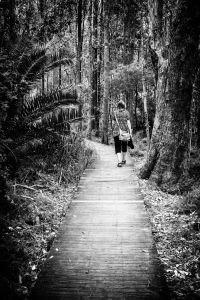
Because, right there before my eyes was evidence that none of my ridiculous thoughts and questions on my prayer life, had any meaning whatsoever. There was the answer, walking past me.
Today’s post opens with what I think is called an oxymoron (funny word that)
No need to repeat here that I am a hermit; there you go, I repeated it, but it’s true nonetheless: I am a hermit. The oxymoron bit comes in when I make another obvious statement to the effect of, as a hermit I very much prefer to spend the vast majority of my time right here where I am right now: in our hermitage.
This has become even more the case since our community decided to ‘settle down’ for a while in the one spot.
Obviously, just like everyone else, we have shopping and other chores that need to be done. Then there’s the occasional visit to the Doctor, and even the dreaded dentist, that will call me away from my safe-haven.
And that’s even before I mention walking for fresh air, exercise, and simple enjoyment. Or pursuing my Contemplative Photography practise. Both activities take me out and about, but usually not too far or for too long, from the Hermitage.
In any case, both these welcome (and absolutely necessary) pastimes have me mostly on my own, being quiet with heart, mind, and eyes open, or simply contemplating ‘stuff’.
No, it’s nore the occasions when I’m having to interact with people, or when there are crowds. Some might call me over-sensitive, but that label would only apply on my outgoing and gregarious days.
While that was intended as a little ironic humour, I must insist (internal editor speaking here) that I add that oftentimes said outgoingness and gregarious demeanor is an act, a cover for anxiety, and usually ends up making me feel worse anyway.
Although I guess you could also say that I’m allergic to the world and its ways, there are the occasional times when I want to, not so much ‘be around people’, as feeling the need to be somewhere where some life is going on around me. Not hectic life, as I’ve said, more like people going quietly about their business, doggies walking and playing with their humans, maybe people sitting chatting to friends. I guess you know the kind of thing.
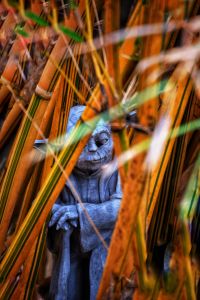
This Mystic Tree stands for all the Tree People
The hermit gods blessed us in placing us in a hermitage which we love more and more, literally five minutes walk to a low-key, friendly indoor/outdoor café overlooking the village green with it’s big tree in the middle, and its nice lawns where the above-mentioned not so hectic life with it’s chatting, sitting, and relaxing people, and its doggies leading their humans in games and walks goes on. The coffee is okay too.
Except. People can be friendly, which in itself ,of course, is a lovely lovely thing, but as I’ve been telling you, I’m not really very good with people in those kinds of situations. Keep a low profile, is my ongoing advice to me.
The poem I share today was composed as I sat in the sun on a recent visit to that coffee shop. This visit prompted me to try to describe something – in poetic form and in ‘real time’ – of what I’ve been sharing with you here. No, what it actually describes is my strategy on that occasion for keeping said low profile.
This poem also holds a timely reminder that arrived with, what I can only think of as divinely inspired timing.
SOUNDS AND VIBRATIONS
My eyes are cast down – not downcast. The brim of my hat pulled low. As good, I hope, as a Do Not Disturb sign.
For a hermit, out of his cell, the cell must be reconstructed. He is his cell. Eyes focused on these words revealed; hat brim, the walls.
I never forget, but just in case!
A chime resounds, but it does not disturb, for I know for what it tolls: Chant Hare Krishna, it calls to me. So, these words must conclude; words of praise now commence.

























 Notes from the Hermit's Cave