Welcome to another poetic sharing post. There have been a few lately haven’t there? I had thought that once I had the new page Poems of Devotion up and running that I would only feature one every now and again in its own post.
However the one I feel inclined to share with you today is slightly different. Well, not really: it’s still a devotional piece, but for some reason feels a little other than that.
This hermit’s choice: the number 1 coffee shops in the Hermitage neighbourhood
For a start, it’s set in a café and features the thoughts of a hermit monk (me), and is about what’s going on in that space at that moment. As well as what’s in his mind and heart. Oh yes, almost forgot: the action takes place on Election Day.
So, what is it that makes me feel this poem is ‘still devotional but slightly other’? Well, aside from the setting, timing, and so on I just described, I sense that, in its words, in its composition, the hermit has sought to record (through the poem) that moment in the café as the reaching out to all those fellow beings sharing the space, to recognise, and to celebrate the divine in them all.
May that intention shine through to you too, dear reader
THE HERMITS HAVE COFFEE ON ELECTION DAY
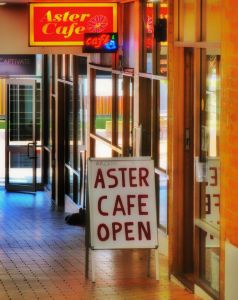
I feel like I’m sitting in a Hopper painting. Just off the village green at a coffee shop, in the Toukley Mall.
There are people; aren’t there always? Coming and going. This one catching gossip; that one seeking connection; One or two heads down, backs bent over newspapers assimilating myriad tales of woe. It’s election day.
Of little interest to the hermits, out of the hermitage for coffee. A treat that comes at a cost.
Voices – of people and of headlines – speak, some even shout, of worldly things. To us not real.
Leaves me hollow. That’s the vibe, the feeling inside – And that’s not real either.
Today’s post opens with what I think is called an oxymoron (funny word that)
No need to repeat here that I am a hermit; there you go, I repeated it, but it’s true nonetheless: I am a hermit. The oxymoron bit comes in when I make another obvious statement to the effect of, as a hermit I very much prefer to spend the vast majority of my time right here where I am right now: in our hermitage.
This has become even more the case since our community decided to ‘settle down’ for a while in the one spot.
Obviously, just like everyone else, we have shopping and other chores that need to be done. Then there’s the occasional visit to the Doctor, and even the dreaded dentist, that will call me away from my safe-haven.
And that’s even before I mention walking for fresh air, exercise, and simple enjoyment. Or pursuing my Contemplative Photography practise. Both activities take me out and about, but usually not too far or for too long, from the Hermitage.
In any case, both these welcome (and absolutely necessary) pastimes have me mostly on my own, being quiet with heart, mind, and eyes open, or simply contemplating ‘stuff’.
No, it’s nore the occasions when I’m having to interact with people, or when there are crowds. Some might call me over-sensitive, but that label would only apply on my outgoing and gregarious days.
While that was intended as a little ironic humour, I must insist (internal editor speaking here) that I add that oftentimes said outgoingness and gregarious demeanor is an act, a cover for anxiety, and usually ends up making me feel worse anyway.
Although I guess you could also say that I’m allergic to the world and its ways, there are the occasional times when I want to, not so much ‘be around people’, as feeling the need to be somewhere where some life is going on around me. Not hectic life, as I’ve said, more like people going quietly about their business, doggies walking and playing with their humans, maybe people sitting chatting to friends. I guess you know the kind of thing.
This Mystic Tree stands for all the Tree People
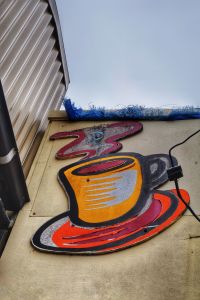
The hermit gods blessed us in placing us in a hermitage which we love more and more, literally five minutes walk to a low-key, friendly indoor/outdoor café overlooking the village green with it’s big tree in the middle, and its nice lawns where the above-mentioned not so hectic life with it’s chatting, sitting, and relaxing people, and its doggies leading their humans in games and walks goes on. The coffee is okay too.
Except. People can be friendly, which in itself ,of course, is a lovely lovely thing, but as I’ve been telling you, I’m not really very good with people in those kinds of situations. Keep a low profile, is my ongoing advice to me.
The poem I share today was composed as I sat in the sun on a recent visit to that coffee shop. This visit prompted me to try to describe something – in poetic form and in ‘real time’ – of what I’ve been sharing with you here. No, what it actually describes is my strategy on that occasion for keeping said low profile.
This poem also holds a timely reminder that arrived with, what I can only think of as divinely inspired timing.
SOUNDS AND VIBRATIONS
My eyes are cast down – not downcast. The brim of my hat pulled low. As good, I hope, as a Do Not Disturb sign.
For a hermit, out of his cell, the cell must be reconstructed. He is his cell. Eyes focused on these words revealed; hat brim, the walls.
I never forget, but just in case!
A chime resounds, but it does not disturb, for I know for what it tolls: Chant Hare Krishna, it calls to me. So, these words must conclude; words of praise now commence.
Yesterday I came across a couple of stories – true ones – that I wrote years ago. They are what we might loosely call ‘travellers’ tales. I thought it might be nice to share them here. So here’s the first one. Enjoy
Not the Manu temple I write about, but another one close by
I’d walked up to Old Manali, and I’d kept walking through the town. Then higher still, past the temple to Manu, and the scattering of traditional houses and small fields clustered around the temple.
Three near-naked and stoned saddhus invited me into their cave – more a kind of overhanging rock shelf poking out from the foundations of the temple itself.
Naturally I declined. Politely. I wasn’t, never had been, and never shall be a stoner. Besides, here I was deep in the Himalayas walking through ancient villages and past temples to ancient gods. Seems to me that that’s enough to bring on a high all its own and like no other.
Then, a little higher up the trail. I rounded a corner to be greeted by a kind of open forest glade; a grassed and flowered field protected by a semi circle of forest sentinels, their crowns maybe thirty metres above my head.
And there, in the middle of this magic field, a large flat rocky area, like a series of ‘shelves’ layered one on the other. This maybe twenty square metre tiered platform was probably the remnants of an ancient hill (or mountain?) that got in the way of a more recent but clearly relentless glacier.
Whatever the history, here was an arena with views no theatre or movie could ever hope to reproduce. This natural amphitheatre faced several layers of peaks across the valley. But, before those peaks, and directly in front of me, just down the slope, stood the temple, then more trees, reaching down into the valley. Here the river flowed, surrounded by farmers’ fields and the brown dots of houses.
Then the forests begin again, thick at the bottom in the valley, but becoming more scattered on the higher ground. Then those many layers of higher and higher hills, mountains really, rolling off into the distance to, where on the horizon and behind it all, a row of the really high peaks covered in their permanent snows.
‘This is a special place, a sacred place,’ I heard myself sigh out loud. Sitting cross-legged now, I let my eyes wander over the scene taking in the blue sky, the white peaks, the multiple greens of the forests, the sliver ribbon of the river, and the rest.
At such times and in such places, one’s eyes tend to close of their own accord. And so it was for me then and there. I let myself drift. Thoughts came and went, to be replaced by more thoughts that came and went.
Then, my eyes opened. Again of their own accord. After a few seconds of that cliched ‘where am I?’ feeling one has when startled out of one state and into another, I made out the figure of a person standing facing me a few metres from where I sat.
‘I’m sorry,’ I heard her voice call to me. ‘You just looked so peaceful sitting there meditating, I just had to stop and watch you.’
She told me she’s been watching me for about fifteen minutes, which gave me a start: It’d felt l Ike I’d only just sat down and closed my eyes.
‘They say the light of the world is held about twelve kilometres up this trail. That means it’s the centre of the world.’
I had to stand to try to take in a revelation of this magnitude.
‘And apparently,’ she went on, ‘they’re going to move it soon and nobody knows where.’
Was she an angel? Was I dreaming? They, whoever they were, are about to shift the centre of the world? Even in India one doesn’t hear this kind of news everyday. Actually, I doubt you’d ever hear it on any day.
Then she was gone, headed up the trail. I didn’t follow. I remember thinking: twelve kilometres was too far for me especially as I already had a long walk downhill to my hotel back down in the new town.
Yes, mundane, practical musings, a typical response to news of such a wild and far-out nature. So, not exactly in shock, yet not quite myself, I turned back. Down. Through the village, past the temple with three crashed out saddhus out front, back into the town.
There are cafes there. They sell Chai there. I needed one.
Actually, given the momentous news I was going to have to digest, I might even have a couple extras.
This is a true story; it actually happened more or less the way it’s described here.
Of course, there is no ‘light of the world’ stored in some secret spot, somewhere on Earth.
Well, I suppose if there is a light of the world, then it’s likely to be the world itself, I mean Earth, all the beings who live on this planet. Life itself I guess you could say. Life is light; Life is love.
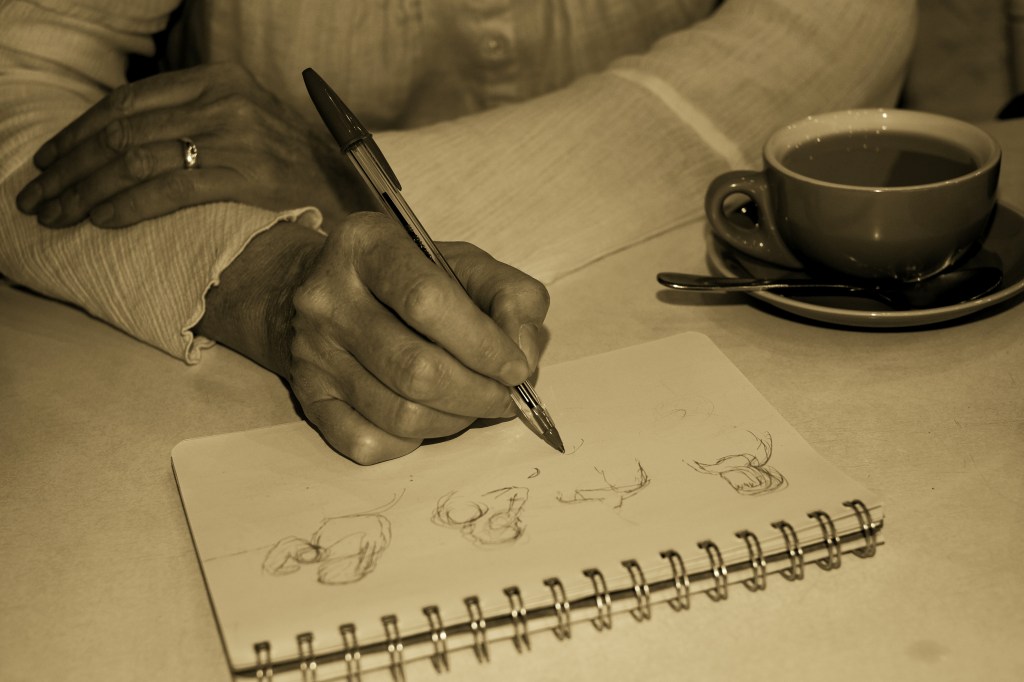
My eyes follow the line her pen inscribes across the page, its whiteness coming alive. In such moments, I know that it is true : I know that God is truly in the ink.
Notes from the Hermit’s Cave is what this blog is called. I promised to publish musings or notes of all sorts: your regular text blog; photos or other pictures; poems; and other assorted bit and pieces.
Well, I’ve rediscovered a poem that I think would be great to share with you.
Looking through some posts saved from old blogs no longer active, I came across theaforementioned poem. It’s about a guy I met in a cafe in India back in 2006. This person kept me and a crowd of other travellers spellbound for a couple of hours one monsoon afternoon. Not to mention the many conversations focused on him that followed in the next few days and the several pages in my Journal recounting the whole experience.
Anyway, as soon as I saw this poem again, I thought I just have to post it here. That trip was a big step for me in my own healing and spiritual journey. And meeting this guy has played a part in all that.
So, please join me in making this small offering of thanks to that guy, whose actual name I never learned, and who forever will be known to several very fortunate travellers as the Cockroach Man
THE COCKROACH MAN
This is what he said. He’d lived many years in India, and, in that time he’d done many things. Even, he said, for a while he’d trained with a yogi, his guru. This is what he said.
Yogic training is not easy, he said, In fact, he said, one aspect made him sick for a year. This is what he said.
His Guru put beings in his head. Beings like parasites he said. Yes, yogic training, it made him sick. This is what he said.
Parasites implanted in the head? A part of yogic training? No. I don’t think so. Actually, inserted was the word he used. ‘inserted beings in my head.’ This is what he said.
All gone now, save one, he said. Only one remains—it’s like a cockroach. And it’s still in him making him sick. This is what he said.
At night, he said, there is sometimes relief. The cockroach leaves and floats just below the ceiling. Well, its astral body leaves his head and floats above his bed. This is what he said
‘You’re a healer. You understand,’ is what he says as he turns to me. Umm, no. Actually I don’t. But this is not what I said.
Where is he now, the Cockroach Man? ‘It’s winter soon. I’m gonna give blankets to the villagers.’ This is what he said.
He’s known suffering, he said. And you could tell he was tired from fighting the cockroach. ‘I’ll feed the poor.’ This is what he said.
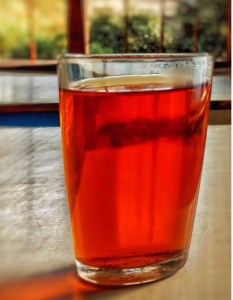
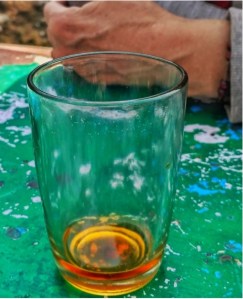
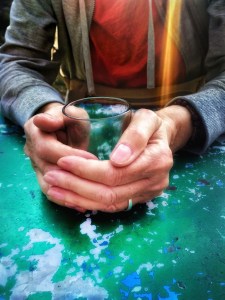
One of my favourite things to do India back in the days when I still spent hours in cafes was to drink tea. Or Chai as it’s called there, very often served in a glass.
Most of the time the glass is filled to a level that leaves a small space at the top of the glass cool enough to allow the drinker to pick up the (usually) super-heated glass. A great idea really because Chai is best imbibed at close to boiling point!
However, occasionally, a glass will arrive full to the brim with scalding hot but sweet and tempting Chai. With no cooler glass at the rim, how is the desperate Chai addict going to get to that sweet and satisfying liquid?
Well, obviously, the only way is to take the rim of that glass as gingerly as possible between one’s toughest and most calloused two fingers and just lift that glass and finally taste the flavorsome nectar contained within.
Of course there is another possible response: our Chai drinker may fear the painful consequences of taking hold of the hot glass, so will either leave the glass to cool or will reject the Chai completely. Neither of these outcomes would ever satisfy a true Chai aficionado.
Now, how does the cliché go? This is a lot like life isn’t it? Well yes it is. How often have we been confronted with an obstacle that’s preventing us from achieving something we want, or that is keeping us away from finding peace or love or some other condition we want in our lives?
Those problems, those obstacles, they are simply the hot glass blocking our way to the good things we want. Perhaps this is a good time to go ahead bravely, grab that hot glass and declare that for you there really are no problems that are (ready for another cliché?) too hot to handle.
Not many people know this, but I’m a big fan of clichés. Not always, only when they serve a purpose, make a point, illustrate an idea, or have some other relevance or meaning. I remember an occasion when I witnessed a perfect illustration of a favourite cliché.
Once, many years ago I was sitting in a café in the Himalayas on a late monsoon afternoon when the clouds hung low and the lights were on so people could see. Suddenly, the lights went out.
A collective groan from the full café: people writing in journals, reading books and so on (no smartphones or laptops in those days), had to stop what they were doing. Although not an uncommon occurrence in those parts, lights going off was a bit of a pain for us spoiled tourists.
Anyway, one of the waiters fetched some candles, and began lighting one on each table. I think there were perhaps ten tables. I watched him as he moved slowly around the packed, but tiny café. As he lit the candle on the very last table, the electricity came back on.
Again the collective sighed, this time in relief, as light flooded the café. I heard one voice say something to the effect of: ‘he shouldnt have bothered, I mean the lights came on eventually’ .
‘Well, you know, if he hadn’t made the effort to make some light for us, maybe the power wouldn’t have come back so quickly’, I commented casually.
Another collective sigh and murmurs of, ‘Yes true’, and ‘far out’, ‘never thought of that’ and ‘so profound’. All this as response to some off the cuff, random remark by me.
And the cliché?
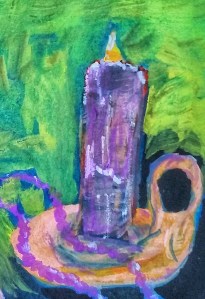
Its better to light a candle than to curse the darkness.
This cliché goes so well with something I like to say that has become a bit of cliché in itself (because I say it so often):
Just look at what you can do, not what you can’t do.
Of course, I didn’t invent this one, but still, to me it makes sense. For example, In the little scene described above, we couldn’t do anything to turn the electricity back on, but one of us (the waiter) could fetch and light some candles.
At Dictionary.com, it tells me that a cliché is:
a trite, stereotyped expression; … usually expressing a popular or common thought or idea, that has lost originality, ingenuity, and impact by long overuse.
Rubbish I say! Overuse? Why does using something a lot make it bad? Why should an idea or thought be robbed of its meaning or power, simply because its been around for a long time? There’s no need to overthink the topic; I’m not saying we should always use clichés. But at the same time, clichés have usually become clichés because they are true, or say something in a succinct and accessible way.
Anyway, this post isn’t about grammar, it’s about lighting candles and looking at and realising what you can do, and not cursing the darkness and being pulled down by thinking about what you can’t do.
Does it help? The lighting of candles? The realising of what you can do? Sometimes yes, sometimes no. Nothing, not even a cliché, is perfect.






 Notes from the Hermit's Cave