Today I would like to share with you a prayer (it’s a poem too, but …) I’ve written in praise of the Divine Mother. It’s actually the second prayer I’ve written to and for her. I shared that first one, called simply, A Prayer to the Divine Mother on the blog previously and you can find it here.
That post will also give you some background to my reverence for the Divine Mother – what she means to me; where my initial devotion comes from; my heart sense that this universal creative energy drives and sustains all creation; and finally how Divine Mother may be worshipped in many and varied (and even no) forms.
The prayer I share with you today – Jai Shree Maa – emerged as I knelt chanting those exact word at the alter of a holy place dedicated to the Divine Mother as revered by many in her form as Our Lady of the Rosary.
It is a temple in that name I sometimes go pilgrimming to for quietness, meditation, and devotion.
Please accept my prayer. Thank you
JAI SHREE MAA
In this temple to the Divine Mother upon my knees and praying. Jai Shree Maa
I chant with sacred love in my heart, sacred words upon my lips. Jai Shree Maa
Divine Mother, with these words, Jai Shree Maa I invoke your holy presence; I speak from my heart to yours.
In November last year I published a post on this blog that sought to answer the question, Why do I pray? In that post I said that this question is one of the big ‘Who am I’, Self-Enquiry questions.
I also claimed in that post that it was (is) a core aspiration of mine that I make prayer a ‘whole of life activity’. To quote me from that post:
You see, I want to pray, and make my whole life a prayer. A prayer of praise and devotion; a prayer of gratitude and loving; and a prayer of service to all beings .
Anyway, moving along to today’s post.
That question, why do I pray, is one I ask myself quite often. It’s not a one time enquiry you can tick off and move on from. The contemplation of why pray is an ongoing and evolving thing.
A couple of days ago, as I once again reflected on this particular question, it occured to me that perhaps it wasn’t the only one I needed to be asking myself if I am to think about my prayer life in any depth. Actually, the same could be said for pretty much anything one is trying to find answers to.
Indeed, many writers – particularly story tellers and journalists – will be aware of the series of questions often used to get to the truth of something:
Who? What? When? Where? Why? and How?
Commonly refered to as the ‘The Five W Questions’ (although there is that H in the mix leading to some calling them the WH Questions), these questions asked correctly and thoughtfully, will help to ensure a comprehensive and complete answer to any enquiry.
The next thought popping in suggested that it might be a great idea to apply the W Questions (including the H) to me and my prayer life.
At first I thought it seemed like a neat challenge, a kind of intellectual exercise that would be interesting. Then, though, after thinking about it some more, I realised that contrary to being just some mental challenge, asking myself these questions in relation to my prayer life, might actually be essential.
Especially if I am to some day reach fulfillment of my aspiration to make of my whole life a prayer. It’s the only way, I reasoned, that I would be able to get complete picture of the state of my prayer life.
Of course I have to wonder if it is indeed possible to ever get a ‘complete picture’ of a phenomenon such as an individual’s prayer life. Still, let’s just plunge in, see where it goes, what happens, how it works.
Who
There are actually two ‘who’ questions that I’d like to try to answer, both essential to our enquiry:
Who is it that’s praying? And Who do I pray to?
The answer to the first question is obvious: it’s me doing the praying. But, which me exactly? Not the me who is the true Self, the Absolute Reality. The reason why will become clear as we go along.
No, the me doing the praying is what we might call the body mind complex, the me that lives in the material world as a material being. The impulse to pray, what to pray, who to pray to and all the rest arises in the mind.
Mind you, I along with so many others I’m sure, like to say that I pray with and from my heart, my spiritual heart. But then I do also know that emotions originate as thoughts in the mind. Of course that does not lessen the significance of such emotions and the prayers, love, or devotion that follows.
Now, who do I pray to? I know it’s going to sound a bit odd, flippant and even silly, but as I think about it, I realise that I do in fact pray to everyone and to everything.
Which is to say, my prayers are directed to that invisible ‘something’ that pervades and permeates – and actually is – everything that exists. You could say that I pray to existence itself. There is nothing or nobody else.
Of course it’s not exactly an easy thing to get a handle on praying to ‘everything and everybody’. I mean, where does one direct their attention? Who or what does one address or speak to? The answer is a lot more straightforward than you might think at first.
Because my prayers are to that amorphous ‘everything and everybody’ it’s quite easy to select one or more resonating and meaningful somethings or somebodys as the objects of my prayer.
There are many spiritual or religious traditions in the world, all with their preferred names and forms of the Divine (or Existence as I named it earlier). Each of these manifestations of the Divine has its own characteristics, their own place in the Universe. They each play their own roles in the cosmic order.
As such there are more or less an infinite number of choices for me to have as foci for my prayer life. I will try to share with you a few of my personal pantheon.
Om: The Essence of Brahman, Absolute Reality
The Existence I’ve mentioned a couple of times is named by some Brahman, the Ultimate Reality, the everything and everybody that I was talking about.
So, I might sometimes pray to Brahman. Mainly it’s an aspirational prayer as I seek to realise fully my already existent oneness with the Ultimate Reality.
Then there is Ishvara, which is probably closer to what most would recognise as God – a personal supreme being, Or, in some traditions Ishvara simply refers to the one or more deities that an individual chooses as objects of her or his devotion.
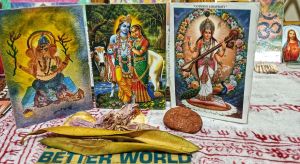
Centre of Attention on the Hermitage temple alter
Also included in my personal pantheon, are the Divine Mother, Kirishna, Ganesha, Lord Jesus, The Buddha, Sarasvati, as well as other teachers and saints from many traditions who pop in and out of my prayers, seemingly at random.
My prayers are of praise and/or gratitude to the teacher, deity or saint who seems to me at that moment to be most linked to my current circumstances and thoughts.
All of this I call prayer. To God. Or Brahman or Ishvara. Or very often, simply My Lord,
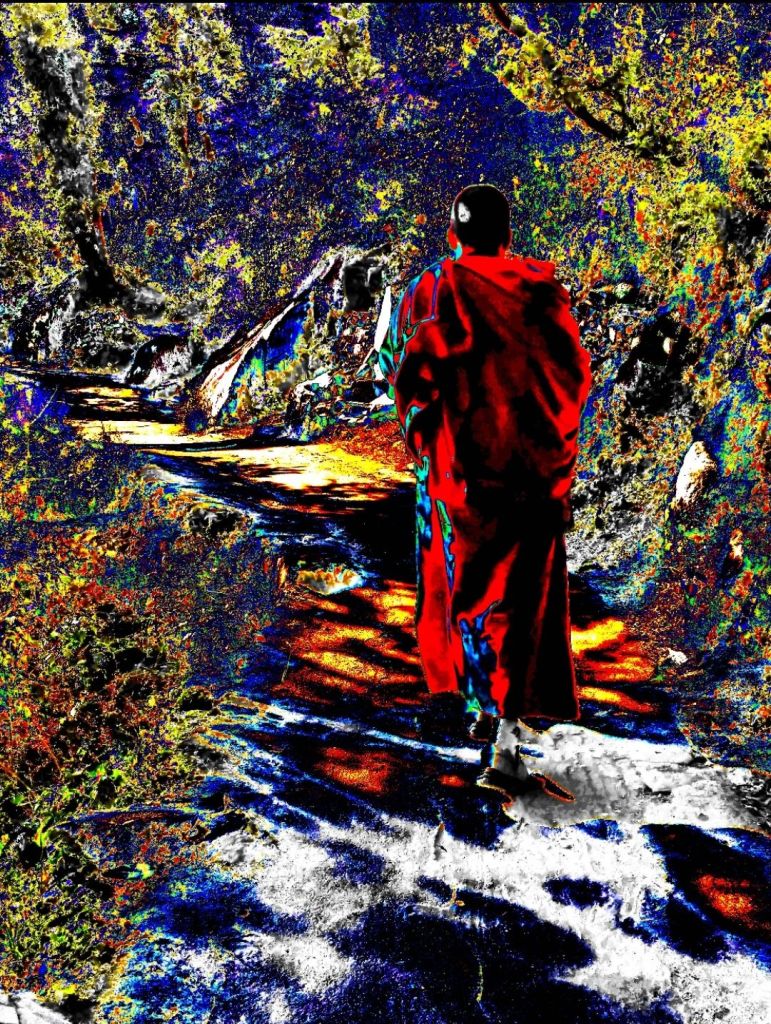
Today I went on a pilgrimage.Not that I don’t undertake all kinds of little pilgrimages all the time. And even more, it’s not as if my whole life – just like yours and everyone else’s – isn’t one ongoing and continuing pilgrimage.
All true; but this one, today, was embarked upon in what might be called, a classic manner: on foot, to a place of sacred significance, and in a spirit of contemplation of the nature of the journey as well on that which is being pilgrimed too. (I am positive there is no such word!)
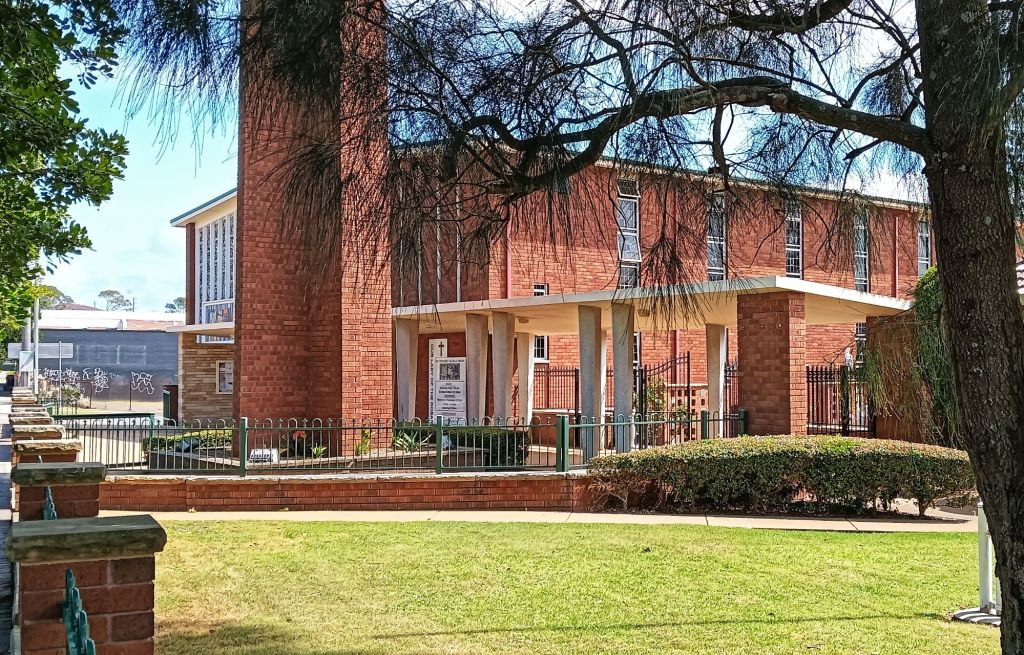
In this case, today’s pilgrimage, that place was a church about two and a half kilometres from the hermitage. It’s a place I have visited several time, but today was the first time I set out as a pilgrim and walked in the way and spirit of the pilgrim.
Our Lady of the Rosary is a Catholic church dedicated to the Mother of Jesus in her role as patron of the Holy Rosary, a Catholic way of prayer that has evolved over time and is a key part of the lives of many Catholic people.
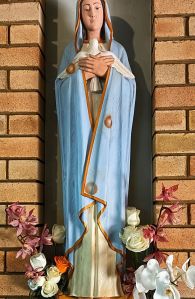
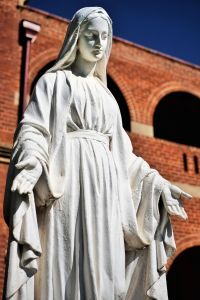
Just to the right, just inside the door there is a plain brick wall in which there is a small niche. The niche holds an almost life-size statue of Mary. She stands, hands folded over her chest on which sits the Dove of Peace.
You can see from the photo that the church itself is a lovely, quiet, serene place full of good vibes and nice peaceful energies. The object, however, of my pilgrimage was not the church in itself, but stood just inside the side door accessed through an equally peaceful, fountain centred garden.
I have come to offer her – this form or manifestation of the Divine Mother – the prayer I wrote to her which I hope you saw when I posted it on this blog recently.
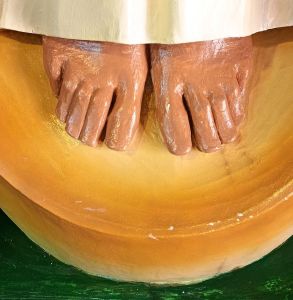
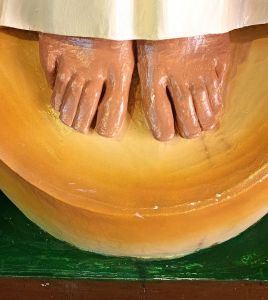
I had decided that my pilgrimage vow would be fulfilled once I had knelt at her feet and offered her the words of my heart in prayer.
My reverence for the Divine Mother is well known, and especially in her form as Mary the Mother of Jesus. Or Our Lady as we called her as good little Catholic children way back in the long ago. And I know I have said often that the entirety of the material and non-material cosmos is a manifestation of the Divine.
So, why then a special trip on foot, that I’m labeling a pilgrimage to a specific site, so I can kneel at the feet of a statue that I know perfectly well is made of stone or plaster and is simply a symbol of one aspect of the Divine?
Actually, the question has answered itself. The pilgrimage and my associated actions worded in that question tell us the why.
It is about acknowledging at a heart level and in my own way, that that symbol, that form, is actually representing a particular aspect of the Divine that I revere.
Besides, I’m not the first person who’s knelt at that spot, at Mary’s feet. I don’t know the age of the church, nor do I know the history of that particular statue, but I think we can say for certain that many hundreds, if not thousands of other people have been there where I was and spoken words from their hearts.
Being honest and true now, what I can say is that, as I said to my partner hermit: ‘I feel like i’ve been on a pilgrimage’.
And I do. I’ve walked – praying and chanting – to a sacred place where I have prayed at the feet of the Divine in the form of a likeness of Mary. I feel blessed that I actually got to offer the prayer I wrote to the Divine Mother.
Somehow I feel a link was established. A heart (mine) opened ever so slightly. I acknowledged the Divine, and I sense that I might just be – ever so slightly again! – topped up with a bit of the Grace that is in reality our true state.
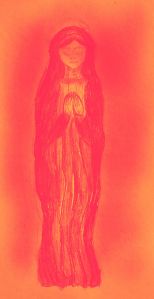
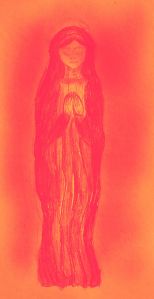
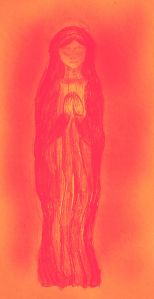
Mary in the Garden (enhanced by a fellow Hermit Pilgrim. Thank you)
So, this is the story of my pilgrimage. I was absolutely exhausted when I arrived back at the hermitage. Most likely that was due to the heat, the traffic, and the noise encountered on the way I trod.
But, now I’ve shared this little tale with you, I’m not tired. Anyway, the Way is not always easy, and we are all very well aware of that aren’t we?
Namaste friends. The Divine in me salutes the Divine in you.
It’s a walk to take,
a pilgrimage to make.
Sometime soon.
Said by me long ago, I don’t know when or where. It was one of those ‘You’re a poet and don’t know it’ moments.
Growing up Catholic, attending Catholic schools from age six to fifteen, going to Confession most weeks, going to mass once a week, oftentimes more, I was deeply immersed in a particular cultural environment of Catholicism. Over time I was (we all were) inculcated with, among other things, a deep love and a reverence for Mary, the mother of Jesus.
I say deep love. No, I’m not being quite precise enough to let it slide. Sure we were taught to love her, but in a kind of limited way. We should love her because she is the mother of Jesus. Not that being the mother of Jesus was what you would label a ‘limited’ role of course. But other than that we were taught to view Mary as an intercessor for us, a conduit if you like between us and our wants, and her son Jesus. So love yes, but a kind of conditional love.
Mind you I was always very fond of Our Lady as we called her. Through a serious dedication (for a time) to The Rosary, and the numerous Hail Marys imposed as penances in Confession, I grew close to her.
And, even as I moved on and out of that Catholic sub-culture and began to explore other ideas and ways of being, I still maintained that fairly deep reverence for Mary, a reverence that has pretty much stayed with me all my life. I only realised today that it wasn’t until quite recently that I stopped calling her Our Lady.
But, in truth, my concept of her evolved beyond her being the mother of Jesus. Indeed, I came to a point when I realised it wasn’t at all relevant if Mary herself was an actual historical figure or not (this was much much later though).
For me Mary had come to represent or symbolise the female aspect of the Divine. Still, in the early days, very dualistic of course, but a huge step from the ‘second place’ she occupied in the earlier days when we weren’t even allowed to worship her as Divine. Worship was reserved for God – who was emphatically and indisputably male, sitting in heaven, entry to which was held tightly in the hands of more males in a male controlled and dominated institution. Which, it does have to be said merely reflected the world it operated in.
Anyway, let’s jump ahead half a life time of, (shall we say for our purposes here?) living, to put ourselves into the present day. Well, recent times anyway.
To put a very long story into one sentence (again for our purposes here today) I will simply say that I moved away from Christianity and especially the denomination of my childhood. Okay, we need another sentence: In more recent times, through a whole lot of circuitous meanderings, I have come to realise that there is only God.
That is to say, all there is is God, only God, nothing else. ‘Not one God, only God.’ as my teacher’s teacher used to say.
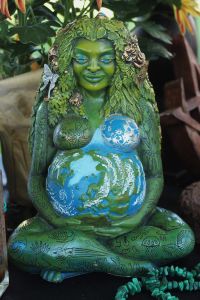
Earth Mother (Courtesy of Amber Avalona, CC0, via Wikimedia Commons)
Nowadays I still love and revere Mary. As symbol. A symbol of the creative energies responsible for bringing the Universe into existence, and which is engaged in the ongoingness of its maintainance through the laws of nature. She is one manifestation among so many of this divine creativity. In a very real sense for me, she is the Divine Mother.
So, a prayer written by me to and for the Great Mother who manifests in whatever form – or no form – in which any of us may choose to worship and love her.





 Notes from the Hermit's Cave