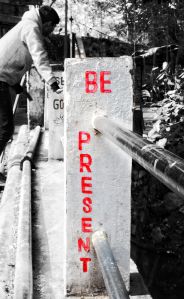
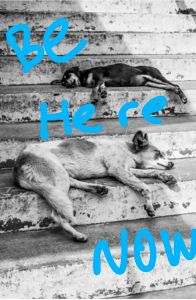
Be Here Now: There’s No There and Then

Earlier today I thought I might write a post to let you know what’s going on at the Hermitage at the moment. That’s it. One thought, no follow up.  One more idea that might or might not work out.

And then just now my partner hermit and I were talking about how we’re not feeling present where we are and how frustrating  that is.


Then I made a joke about how I’d had the thought about updating you on where we’re at right now and how useless that idea is because we aren’t actually here and it’s not actually now. We have already moved in our minds to our next temporary hermitage.
Let me explain.

You see, we move around a lot. Every few months, sometimes even more often. It’s just the way we are, pilgrims and nomads. Still hermits mind you, but the pilgrimage takes us wherever and whenever it wants.

Anyway, we are scheduled to move in about a month. It happens that our next safe haven is in a familiar town that we actually like quite a lot. So, naturally, we’ve been thinking and talking about all the great things about that place. But worse, all that forward thinking, fantasizing, speculating, has lessened our hold on the present, on the here and now.
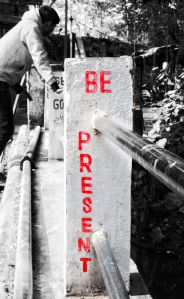
Like I said, it’s as if we aren’t here anymore and that’s a pity. You’d think that someone who writes and thinks so much about presence would be a little more skilled at actually being present. At least sometimes. But, no. It often feels like the more I think about it, the less it happens. Being in the present, in the here and now I mean.

I know that my last post was about story and its central place in pretty much all our communication with each other and the world. With that in mind, there is a story I’d like to tell you now that I’ve heard a couple of times from a favourite teacher of mine.

It’s a story about presence, yes, but it’s also about having an attachment to some kind of anticipated and (in one’s own mind) fixed outcome. It’s really about how we can never really know anything at all about the future for absolute certain, and how that attachment to the outcome can easily obscure from us other possibilities, other outcomes that are available here and now.

Imagine you work in a city office and have just finished work for the day. You head out onto the street in a casual way because you know for sure the bus isn’t due for another 15 minutes and the stop is just across the road.
So, there you are, just about to cross the road, eyes on the ticket home (aka the busstop), and a car pulls up right in front of you. It’s a friend of yours you haven’t seen for a while (this part of the story is my little embellishment, added for extra clarity and detail you might say).

‘Hop in,’ your friend smiles and opens the passenger door to let you in. ‘I’ll drive you home. It’ll give us a chance to catch up.’

You are in a little world of your own after a long tiring day. You’re, already planning what to watch on TV, and thinking about dinner. So, after the hellos and the how are yous, you politely tell your friend that you’re okay, the bus is due in five minutes (time flies!) and you checked and you know it’s coming on time.

Your friend drives off with a shrug and a wave, and you get ready to cross the road .Just as you are about to step out onto the road the light changes leaving you stuck on the spot. Then you see the bus – your bus – pull into the stop. No worries, the light will change again in a few seconds. But it doesn’t. It’s a busy time of day and the traffic keeps on flowing.

Then, as you stand watching, the bus pulls away and your eyes follow it down the road, round the corner, and out of sight. Now, you also know that the next bus isn’t due for an hour and a half. And that is for sure going to ruin dinner and you won’t be watching much TV tonight either. An exhausting end to an exhausting day.

In your attachment to the idea of the bus arriving on time, and on your thinking about the evening ahead, you refused the other option that just by way of serendipity had presented itself.

Now, like all of us who miss opportunities because we’re busy thinking about the future (and of course it could just as easily be the past), you are asking yourself why was I so sure the bus was coming on time? How could I possibly know? Timetables can be wrong can’t they? You’re already regretting saying no to your friend. You were only being polite anyway.

While you sit annoyed and frustrated at the bus stop, you start to think a little differently. It might have been nice to catch up, after so long. Not only that [my friend’s] car would have been way more comfortable than a crowded bus. Not only that I would be almost home by now.

So, what about me? What will I miss because I’m not here while I’m still here? What won’t I see or experience because I’m attached to the next place? Well, unlike our bus timetable know-it-all, I don’t want to find out.

Time now to recentre. Time to practise what I preach. Time to return to where I already am, here and now. Mindfulness in even the smallest activity. When I remember that is; after all, it isn’t called practise for nothing: it’s a practice that never ends.

Time to remind myself that I can’t ever know for certain what’s going to happen from one moment to the next, much less at any moment between now and a planned event in a month. Nothing wrong with planning, with preparing. The trick is to not be so attached to that plan that you are compelled to either ignore the present or fixate on that possible future.

So then, it’s time to open my eyes, ears, mind and heart to what’s around me, where I am and what is happening. Same disclaimer as above mind you! It’s the effort we make that really matters after all.

The real bonus, though, of being as fully in the moment as you can be, is that being there (sorry I mean here) is the only place you can actually be, which means you are fully in the presence of all there is. There’s nothing else. Not in that (this?) moment anyway.
peace and love

Paul the Hermit

A Story of Words and a Journey of Discovery

Remember that old Bee Gees‘ song Words?  It’s about one person offering all they have to another. Well, the one doing the offering must have been a writer because, while the song’s a love story, it’s words that are the big thing on offer here:

It’s only words, and words are all I have
To take your heart away

Well, as this is a blog, words are the way it hopes to reach your heart. Actually, the posts also include photos and sometimes other art, but the main vehicle used here is words.

So, with that in mind I have a couple of words to offer you today. Well, one word and its opposite. Have a look at this sentence from Thomas Merton:

If Irish monks affirmed his Celtic spirit in their mastery of cataphatic contemplation of the wonders of divinity in nature, Buddhist monks evoked his Zen mind and drew him into the apophatic path of formless ’emptiness’…

A quote from the Introduction to When the trees say nothing: nature writings of Thomas Merton

As sentences go (though this is obviously only part of a sentence) this has to rank pretty close to the top for length and denseness.

Kataphatic. What a word! Of course I had to look it up; I’d never heard the word before (this post is a rewrite from notes written a while ago that I never got around to posting.), and even though the sentence seems to  suggest the meaning, I was still curious.

Looking at Wikipedia – where they spell it with a ‘C’ like Merton, as well as with a ‘K’- I learned that cataphatic is an adjective that describes an approach to theology that uses ‘positive terminology to describe or refer to the divine (God, Truth, Dharma, Spirit. You know what I mean: the divine).

Apophatic, as you probably figured out already, is when one uses ‘negative terminology to indicate what it is believed the divine is not’. A process of negation or we could say you get to what the divine is by a process of elimination.

Pretty simple concept really, but with a couple of big words to label it, and a lot of  words to define it. No, don’t worry, I won’t bore you with the meaning and origin of the words and all the rest. Mainly because I don’t know and I’m not especially interested anyway in all that technical stuff.

I simply resonated with the word, and the concept. Cataphatic made me think of Dick Van Dyke and Julie Andrews singing Supercalifragilisticexpialidocious in Mary Poppins. But let’s not go there: this is a serious blog after all. Except to say there’s more to that word than you might imagine.

Putting aside the aesthetic appeal of the word for a minute, let’s contemplate a while on cataphatic, and it’s opposite, apothatic.

To begin thinking about these two words, it’s necessary to acknowledge the existence of the divine. We can call it God, if we like. Or Dharma, Truth, Spirit, Love, Beauty.

As the quote suggests, a cataphatic approach, ideology, theology, or whatever we call it, ascribes names and forms to the divine, as well as describing where and in what the divine may reside.

Whereas apothatic, again as the quote suggests, does not ascribe names and forms to the divine. Instead it seeks to discover what or who god is or isn’t by a process of negation as described already. 

For a long time I labelled myself as a Humanist. I had decided that this physical body is all there is; the physical or material universe is all there is, and that there is no ‘god’ separate from us or who has special powers to affect our lives. No God at all in fact.

In the Grove of the Sentinals

But, all that while, I just knew that there was something else, something more than just the physical.  And over time, I came to the knowledge that there is indeed more than the simply phsical universe (including we humans).

I’ve thought about it a lot over the years and I came to the conclusion not that many years ago, that I had simply been afraid to name or define that something more. It would have meant admitting to myself that something more really did exist.

That is to say, I was scared of taking the cataphatic approach – and I’d never even heard the word.

Well brothers and sisters, I saw the light. The truth was revealed to me. And what is that truth? Well, to put it simply, I wasn’t scared anymore. Not of names and forms, and not of what I couldn’t see.

Now I could take both the Catophatic and the Apothatic approach: that the something else I had actually always known just was, really is, and can have a name and form, or not. The divine is not an omniscient being or any kind of being at all; As I’m very fond of saying, the divine (or truth, God, Dharma) simply is.  And it’s all there is.

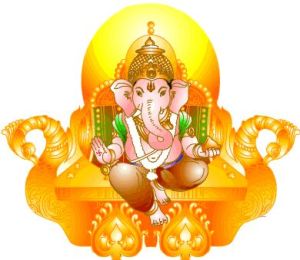
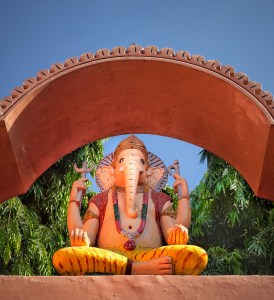
Some of you might know that I am really quite fond of the Indian deity, Ganesha . Do I believe that a man with the head of an elephant actually exists or ever existed?. Of course not. Do I actually think that he resides in the lovely painted icon that sits by my bed? Well, obviously not.

But do I believe that there is a spark or aspect or attribute in all life, in you and me, in nature, in (scary word time) creation, that we can tap into to help us overcome obstacles? Or that we can access when we begin new ventures of whatever kind, or when we need strength to face challenges? Yes, I do. Very definitely.

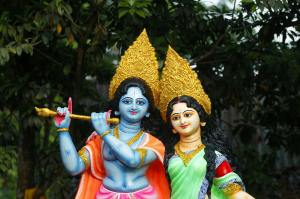
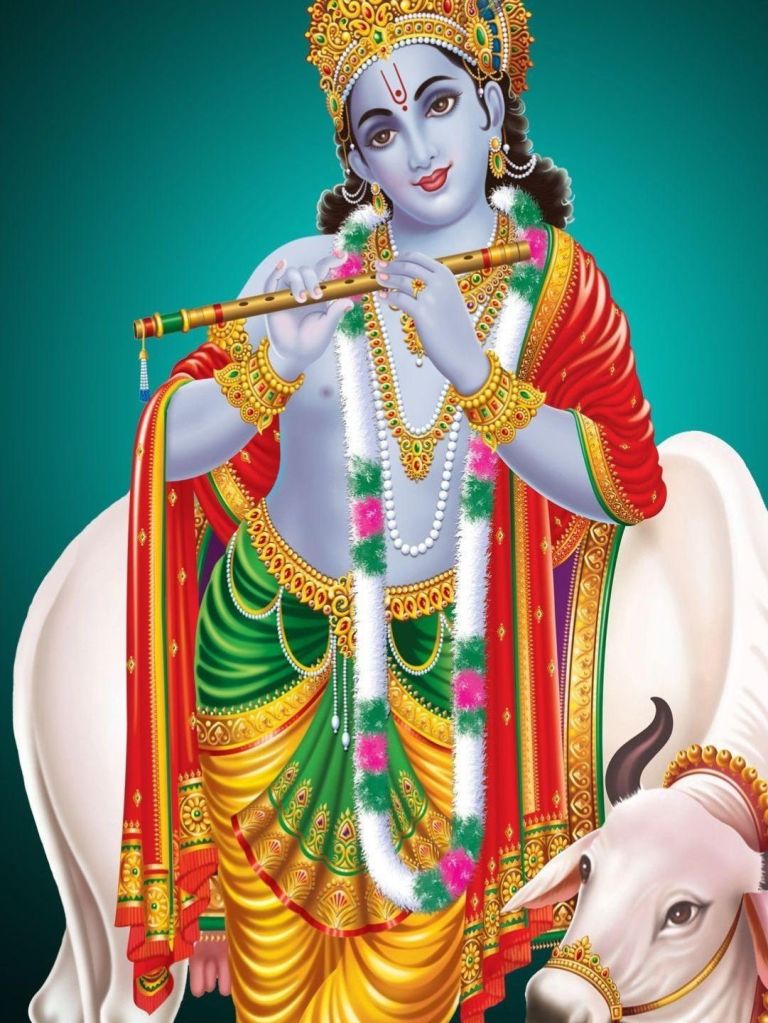
And do I believe in a blue boy called Krishna who lived in India 5000 years ago and spent his time playing in the fields with the village cows and his friends, entertaining them with his flute? Again, of course not. Does he live in the other beautiful icon by my bed? The answer is obvious: no.

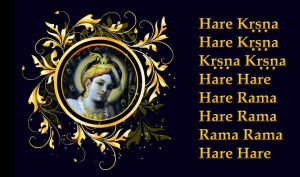
But do I chant the Hare Krishna mantra in an effort to come closer to the divine that is… well, that just is? Yes, again, very definitely.

Words. It’s all only words. Only words? Only??

In the beginning was the word, and the word was  with God and the word was God. (from the opening of the Gospel of John)

It’s all I have (for now).

Peace and Love from me to you

Flee, Be Silent, Pray Always Part 3

Namaste and welcome

Well, here we are with the third and final part of our contemplations on Flee, Be silent, Pray Always, the answer discovered by our friend Arsenius who was looking for a way to be saved from the the things of the world.

In a very real sense, this third injunction might be seen as the most important of the three. Indeed, again in a very real sense, those first two seem to me to be prerequisites for the third. Certainly, many of us would like to flee to a place and state of silence in order to escape the world and its many and varied causes of our suffering. Such people are simply and completely over the noise, the chaos, war, greed, the complexity of relationships, and all the rest.

Then there are many many others who, rather than looking to escape the world, are wanting to ‘flee’ towards a place and state of silence in order to engage more fully with the world by contemplation, meditation, and most of all, prayer. Such people are working towards making their entire lives a prayer.

And then there are the third group which is made up of those who have some sense of running away from the world while at the same time they feel compelled to move towards a contemplative life that they sense will be the best way they can actually serve the world.

I think I can include myself in this last group. I’ve never coped well with masses of people, being in the workforce, or dealing with the horrors that the world seemed to be overwhelmed with.

At the same time, I’ve always wanted to (and have tried to) combat injustice, racism, violence and the rest. I guess you could sum it up by putting it this way: I was (still am) an oversensitive person who one day had had enough of trying to ‘fight the system’ when it was the system making and changing the rules of the game as it went along.

Better I thought, to turn inwards in order to reach or realise my oneness with all living things. I’ve always been predisposed to praying as well, so it was a natural evolution in many ways. My intention and commitment these last few years has been (and still is of course) to pray continuously and with all my being.

My prayer is for the release from suffering for all living beings and that’s my central focus for prayer. For me, it feels very much that I am a lot more use to others living what I think of as a prayerful contemplative life than being actively engaged with the world out there in the midst of it all so to speak.

Pray Always

Prayer for me is not so much about petitioning some all-powerful being who is seemingly on a whim able to grant or refuse my wishes. For me it is more an affirmation of the reality of my already existent oneness with the entirety of the universe. It’s a way of seeking to actually realise that this oneness is my very Self.

Prayer is about being present, not wishing blindly that things be different than they are. In praying I seek to affirm that the ‘universe is unfolding as it should’, as it says in a famous poem I’ve always loved. (Actually if you don’t know about Desiderata [Things Desired] then please do check it out; you’ll love it).

I think that in this sense, prayer is in fact an act of mindfulness, or rather an act which will help develop a mindfulness practice. It is a way to practise being fully focused and present to whatever is going on, whatever circumstances we find ourselves in.

And if we’re able to be present – even on a temporary or momentary basis – then we will be more calm, more at peace, and more able to achieve some clarity in our lives and with whatever is the intention with our prayer.

I know it might sound like a clumsy attempt at a clever play on words, but we’ve described mindfulness as the practice of being fully present. But we can put it another way. We can define that state of being fully present as being in presence.  Like what we might say to a friend who is daydreaming while we are trying to talk to them. We might say something like ‘so and so, your presence would be appreciated’.

In presence of what? I would say everything. When we are absolutely in the present moment (again even momentarily), when we are able to realise our oneness with all things. Essentially the universe is there – or is it here? – with you in that present moment. It’s a moment when we may indeed feel we are in the presence of all that is.

Some may call that presence God, or the Divine, or Universal Consciousness. Others may see it as being in the presence of their own true and authentic Self.

That leads quite nicely to the next aspect of prayer that I want us to look at. Praying to God. I’ve spent so long on mindfulness because I wanted to stress that I don’t think it’s necessary to have a personal name or form for God, or even a notion of an unmanifested, invisible ‘force’ called God, in order to pray.

On the other hand for me, and I know for a lot of people, there are names and forms of the universal consciousness that pervades and permeates the universe, that I personally resonate with and I can reach out to them whenever the feeling or inclination arises. It sounds a bit odd to say, but for me to think that all that is, is all that is, sort of sums it up.

And as a result of that, any prayer  I pray is addressed to my own Self which is simply part and parcel of all there is. In other words, it’s a personal choice for any one of us what form or name we choose to pray to. Or if we don’t pray to a name and form at all. All is one.

One thing I’ve mentioned I think a couple of times is the idea of making all our activities into a prayer, but other than the discussion on mindfulness and presence, I’ve not really addressed the how and why.

Why is pretty obvious. Because living and acting mindfully helps us in so many way such as being more peaceful, more relaxed, happier, and so on. The how, now I’m thinking about it is the purpose of this post. And it’s also true to say we’ve been talking about it since this series began.

That is to say, we flee from the aspects of our lives that don’t serve us and which can be changed. This might be a decision to spend 30 minutes every day sitting quietly and undisturbed. And as we’ve mentioned a few times already it could be going all out and moving to a desert cave somewhere.

In both those scenarios we give ourselves the opportunity to be silent and, hopefully also surrounded by silence. How to pray always? There’s an expression I love and try to live by: Follow your Dharma. Here Dharma means your own truth, being authentic to who you are, having the intention to do what’s right in all situations. And of course actually following through with that intention if at all possible. In this way you transform every action into prayer.

Living a life of prayer does seem on the face of it to not involve much use of spoken prayers, as in saying prayers with words. Well, I don’t intend to be humourous here, but a great deal of prayer does it fact involve talking to one’s Self. To the real self, that part of us that’s part of everything else. It can do us good to have these deep conversations.

Then of course there are the many many prayers that already exist to serve people from so many traditions, cultures, to suit all kinds of purposes and intentions.

Many of us will be familiar with a number of prayers learnt when we were children. If you’re anything like me, they still pop up by themselves from time to time.

Actually as I deepen my prayer practice, I’m discovering that I’m remembering all sorts of prayers from many and varied sources. I think as I dig deeper, more and more are coming up to the surface.

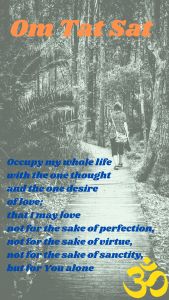
This prayer (by Thomas Merton I think) resonates deeply with me

If these ‘pre-prepared’ prayers say what you want to say and in a way that resonates with you, then you are free to choose those that feel right for you. I guess I mix and match the prayers I use; it’s always dependent on my feelings, thoughts, and intentions at the time.

Like  Arsenius, I try to be open and responsive to whatever the ‘answers’ are, even though my ego does sometimes when it doesn’t like the answer, try and control outcomes.

One point about such prayers: I find it tempting oftentimes to simply recite them at what I’ve heard described as lip level. By rote and without emotion, in other words. At those times I try to slow down or pause to reflect on what I’m doing and why to get back in touch with Self.

A major part of my prayer life is chanting mantra. I try to spend more time chanting as time passes. There are a number that I use depending on inclination and need.

I chant anywhere and sometimes a mantra will start chanting itself, surprising me by its arrival

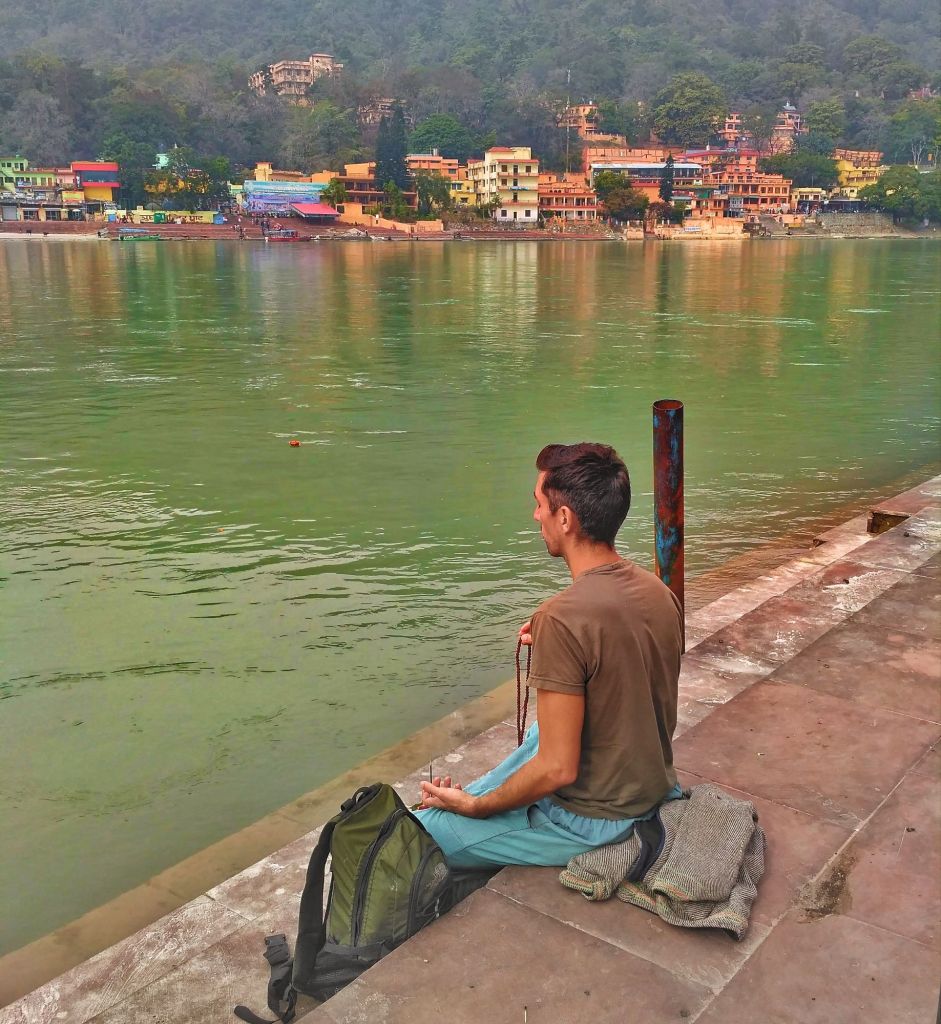
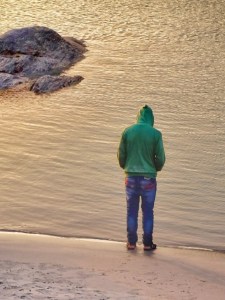
(This photo isn’t me by the way)

Now, probably one of the most important aspects of my own prayer life: I know I’ve mentioned my intentions in praying at all, but one aspect I haven’t mentioned is praying as devotion.

Devotion as in worship, praise, as in gratitude for the beauty in my life, as an expression of love. Knowing with the mind that all is one is fine, but these kinds of prayers help us to cement our awareness of that oneness of all living beings. As I said earlier, I, like you or anyone else, may use particular names and forms to represent this oneness, but, well, it’s all one, so we are non-different from all those names and forms.

Lord Sri Krishna is among my favourite forms of Universal Consciousness  (also known as Brahman)

There are many representations of the Divine, but Krishna and this picture of Him are special to me.

Focusing your devotion on a particular form seems to help make it easier or more real. It’s tricky to pray to and with a thing that has no form and is invisible.

So, my friends I hope what I’ve said here is of some little interest to you and that you have found at least something you can use for your own life.

With peace, love, and with my prayers

Paul

Illusion, fear and wrong thinking? A good question

Greetings to you, visitors to the cave

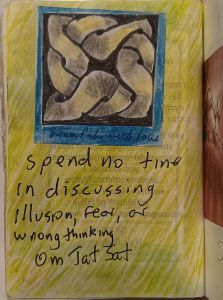
Let me begin this post by asking you a question. No. I’ll start again: I’m going to begin this post by asking me a question. It’s a question prompted by prayers I recite every day, not only during my morning practice, but at random times during the day. Here goes with the question:

How much time do I spend discussing illusion, fear, and wrong thinking?

Well the short answer is, a lot! Despite all my efforts, prayers, meditation, discipline, and the rest, I spend way too much time pondering all kinds of illusions, indulging in an ever revolving range of fears, and thinking about all sorts of ridiculous, irrelevant, and unwanted stuff.

Oh, before I go on, I should mention that there are actually two prayers I’m referring to:

This prayer, which you might call an affirmation comes, I think, from the teachings of the ancient Indian Rishi Adi Shankara. I’ve not been able to track down the exact source. Getting a little ahead of ourselves here, but a perfect example of wrong thinking would be to berate myself for not being more careful with sources.

So, what does it mean to spend time discussing illusion, fear, and wrong thinking? Well, I know I said I was asking myself this question, but I think it would not be out of order to say that we are all prone to spending time on these things.

Discussing is obvious: talking about, thinking about, angsting over, worrying over. Illusion? Anything that isn’t real, stuff that’s ‘make believe’ as the expression goes. Anything that we are imagining for good or bad.

Our illusions are often about worst-case scenarios, or at the other end of the spectrum, they can be about some fantasy, an idealized perfect outcome to a situation. There is a lot written about how we are so very much trapped in illusion; it’s not the place here for that discussion.

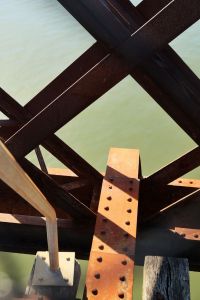
Fears: pretty obvious what fears are. I don’t know about you, but I can get to thinking of stuff to be fearful of anytime, anywhere, even things I know I can face without fear. Like a couple of days ago I was walking across a rail and walking bridge near our current hermitage. A long time ago I had huge paralysing fears of high bridges, especially over water as this one is.

But for a long time now I’ve felt I have mastered this fear and then suddenly on this occasion I looked down to the river below and shocked myself with ‘What am I doing?’ type thinking and fear returned. Mind you, it passed quite quickly as I reminded myself I’d walked over this bridge (and many others) a lot of times without a second thought.

And then there are fears about the future, fears of consequences of past actions, fears of not making the right choices now, fears for health, loved ones, the world. Anything goes when it comes to fear doesn’t it?

Ah, now we get to the biggie: wrong thinking. Again I think it’s safe to say that we all spend far too much time in the company of wrong thoughts. And again, they can be about anything, and can pop up to take over our mind without warning.

Consider how often we think about things that are either none of our business, or they are things we can’t do anything about. We obsess over what we see on the news,  or what celeb is doing what and with whom. Think about how interested we often are in what other people are doing, thinking, saying.

Then there’s blindly following fashion, thinking so much about things we don’t have (and how everyone except us has those things already) that we give into advertising, and end up buying lots of stuff we don’t need, maybe can’t afford, and might not ever use. And don’t forget about the one we all fall for: gossiping about others whether they are famous, our family or friends, or simply our neighbours.

A huge case of wrong thinking are the harsh judgements we make on ourselves; and the amount of time we spend thinking about our faults and failings. And don’t forget the other end of the ego spectrum: it’s also wrong thinking to be constantly telling ourselves how great we are.

There are endless examples of wrong thinking. We need to bear in mind Buddha’s central teachings: there is a middle path that can be taken in all things. Well, this maxim applies to thinking as well. Remember that our mind can be our enemy or our friend.

Even enlightened ones such as sages, rishis, saints and the like, fall victim to illusion, fears, and wrong thinking. Of course as they are enlightened, they perhaps are less affected, less inclined to fall to the depths, as the rest of us might.

Of course, there are ways we can put ourselves on the path to that enlightenment. But in truth, it is a subject that is dealt with very adequately by all great scriptures of the world, not to mention the visionaries who have delved deeply into psychology, philosophy, and the human condition.

And this leads me to the second prayer:

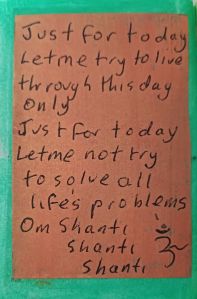
This one comes from a song by George Harrison, titled Just for Today. I actually did a post on this song a couple of years ago that you can find here. As well, if you do check out the lyrics of this masterpiece, you will see that my prayer is a rather generous paraphrase. I don’t think George would mind; I hope you don’t either.

Just for Today (the song and, a little less articulately, this, my paraphrased prayer) is a prayer for presence, a plea to be in this place, and in this time. In other words, an affirmation that I (or you) may remember that there is only here, and only now.

But, and it’s a big big but, we need to make of our entire lives a prayer.

Of course that means using the words, but it also requires a whole lot more. Discipline, self-control, deliberate actions (saying prayers is obviously also an action), meditation, silence, contemplation, and to put it simply: good behaviour in all that we do and think.

Now, this prayer inspired by George is a good place to finish. Or rather, it’s a good place to remind ourselves we can’t solve all life’s problems at once.

Being present, being here and now, really says we have no other choice but to live through this day only. Or perhaps we can paraphrase once more and say we have to actually realise what is already true: we can only live through this one, ever-evolving and moving moment.

So, how do we get to that point of spending less time discussing illusion, fears, and wrong thinking? By coming to realise that being in this moment, and in this place, we are already perfectly fine. All we can and need to do is remember that one simple fact. But don’t worry, all you need to do is remember it just for today.

peace and love

Silence, Solitude: Where can I find it?

Remain in your cell, and your cell will teach you everything

This piece of advice from one of the early Christian desert hermits to a follower has been going round in my head for ages. And I mean a couple of years at least. I’d read it in several books at the time, and I’ve seen it in a few since.

Of course, most of the writers of those books interpreted this advice at face value, literally advising the student, hermit, monk, or other contemplative person to stay in their physical cell (hut, cave monastery cell, suburban bedroom, wherever is their permanent dwelling) and listen, meditate, study, and contemplate. The advice is, stay in that space in silence and seclusion. Quite possibly forever.

‘But it could be the cell of your Self,’ my partner hermit said to me one time. And yes, I thought, that’s exactly right. I liked the symbolism. The actual literal, physical space and its geographical location isn’t necessarily the important factor. What’s important is that you, the real you is actually fully present wherever you are, right here, right now.

Think about what it really means to be present – to be here now: It means that you can say, ‘This is the only space and the only moment that exists. Right here and right now.’

Living life is an ever-flowing movement or process, and at the same time (excuse the unintended pun) is always occuring in the present. And in that ongoing moment you – your Self -is always there.

Of course along for the ride is your little s self with its ego, chattering and never quiet mind reminding you of the distractions, stresses, anxieties, worries about things to do or not do, memories of the past, and fears for the future. It goes on and on.

But, still, that space within where you can meditate, pray, contemplate quietly, that’s your Self, your ‘cell’.

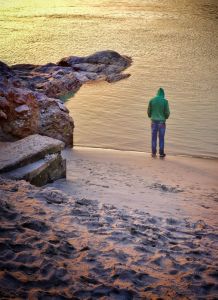
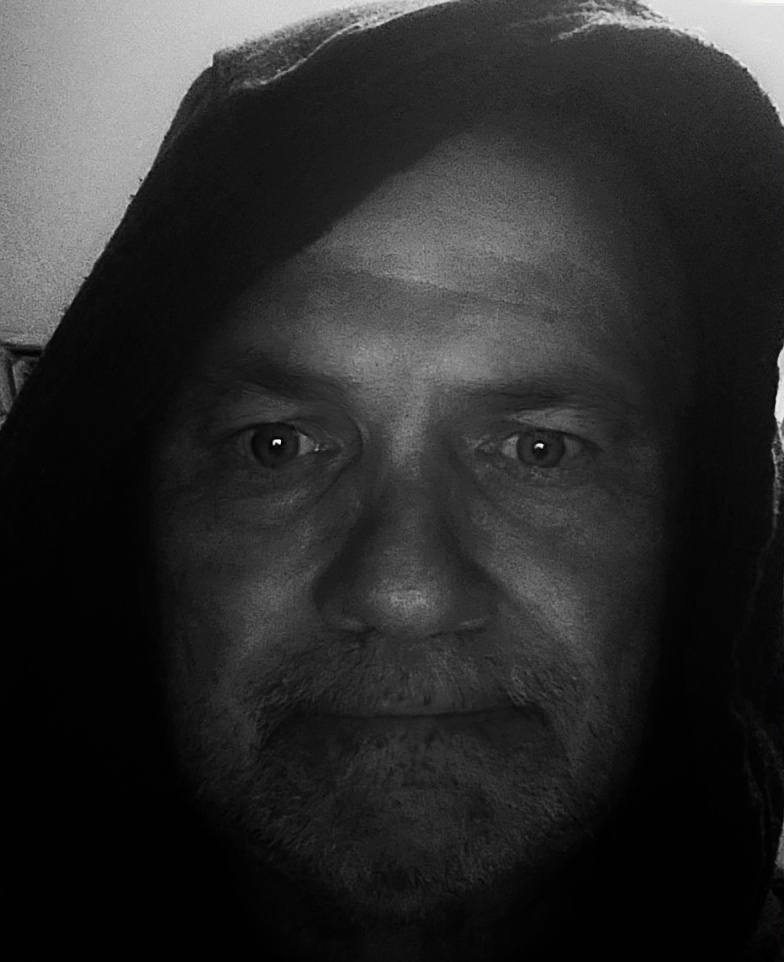
I’ve always liked and worn hoodies. I guess a lot of people do. For some it’s about fashion; others wear them for warmth in cold weather or to keep the sun off when it’s hot; some people even use them to hide.

Then there are others such as nuns, monks, priests and others too, for whom a hood is a part of the robe they wear as a member of their particular group.

In those cases, a hood is called a cowl and most often it’s a largish loose hood sewn onto the robe or habit. Just like a regular hoodie.

I read somewhere (I forget where) that some groups nickname these cowls ‘cells’. In other words, the wearer carries their cell with them wherever they go.

Of course they don’t always actually wear the hood on their heads, but whenever they wish or need to retreat to their cells, all they have to do is simply pull their hood up and over their head and all of a sudden they are in their own private and solitary world; they are in their cell.

As I said earlier, I like the symbolism. But more than that: I find wearing a hood on my head or simply in standby mode, comforting.

I’m not overly good with crowds, or in close proximity to other people on a bus or train or whatever. I like knowing that just by pulling my hood on, I’m able to create my own space apart from my surroundings. In that space I can feel safe and kind of apart.

Even at home I wear a hood when I’m meditating or praying. It’s just one more opportunity to retreat into my cell, into Self

Peace from the Hermit to you
‘Sometime Soon’: When is it?

There used to be a thing – maybe it’s still a thing – that would happen sometimes. You’d be talking to someone and suddenly they’d burst out:

‘Hey that rhymes! You’re a poet and don’t know it!’

This exclamation, this sudden and surprising interruption, was always prompted by some sort of accidental rhyming happening in something you’d said.

Or, sometimes, it even happened when you had written something and had through no fault or thought on your part, created a rhyme, even a little impromptu and accidental poem.
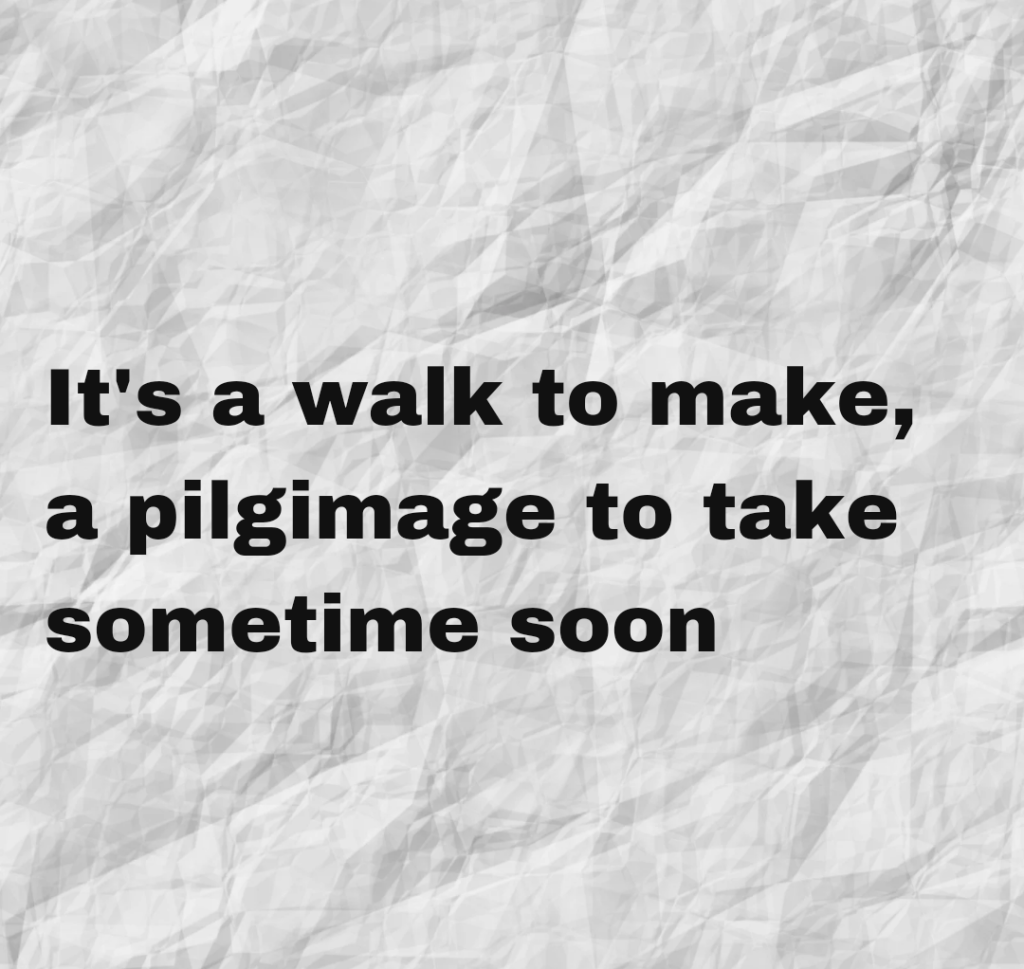
Well, that’s what happened to be. It was a while ago now and I was writing in my journal. It must have been ages ago because I don’t keep a journal anymore.

In any case, with nobody reading over my shoulder, it was left to me to express surprise at a sudden outburst of poetics on the page. And along with the surprise, I was able to make a quick note of what I’d written:

Anyway, this post isn’t about this little demonstration of spontaneous poetic genius; it’s actually about the ‘sometime soon’ tagging along on the end.

I have no idea where or what the walk to take, the pilgrimage to make, was – or is. Which suggests a rather obvious conclusion: ‘sometime soon’ never came. The walk was not taken; the pilgrimage was not made.

Now, I’m thinking to myself, if the walk under discussion was so appealing – as well as so significant that it transformed into a pilgrimage – then how come ‘sometime soon’ wasn’t right now, or rather right then. If you follow me.

Of course there’s no telling the reasons for the sometime soon. Maybe plans would have been required; travel to arrange; equipment to gather; fitness to acquire. Who knows?

Clearly I was inspired to at least put down in writing that I thought this walk, this pilgrimage, was (or would be) a good thing to do.

Meaning, in that moment, in the present that is (or was) of that moment, that walk/pilgrimage was a thing I wanted to undertake.

Now, while I might have longed to take that walk, to make that pilgrimage, in the present of that moment of writing, and even though planning may have been required, thereby putting off the actuality of the taking and making till some future time, I at the very least could have taken some action – again in the present of that moment – to get the ball rolling so to speak.

So, what’s the lesson here?

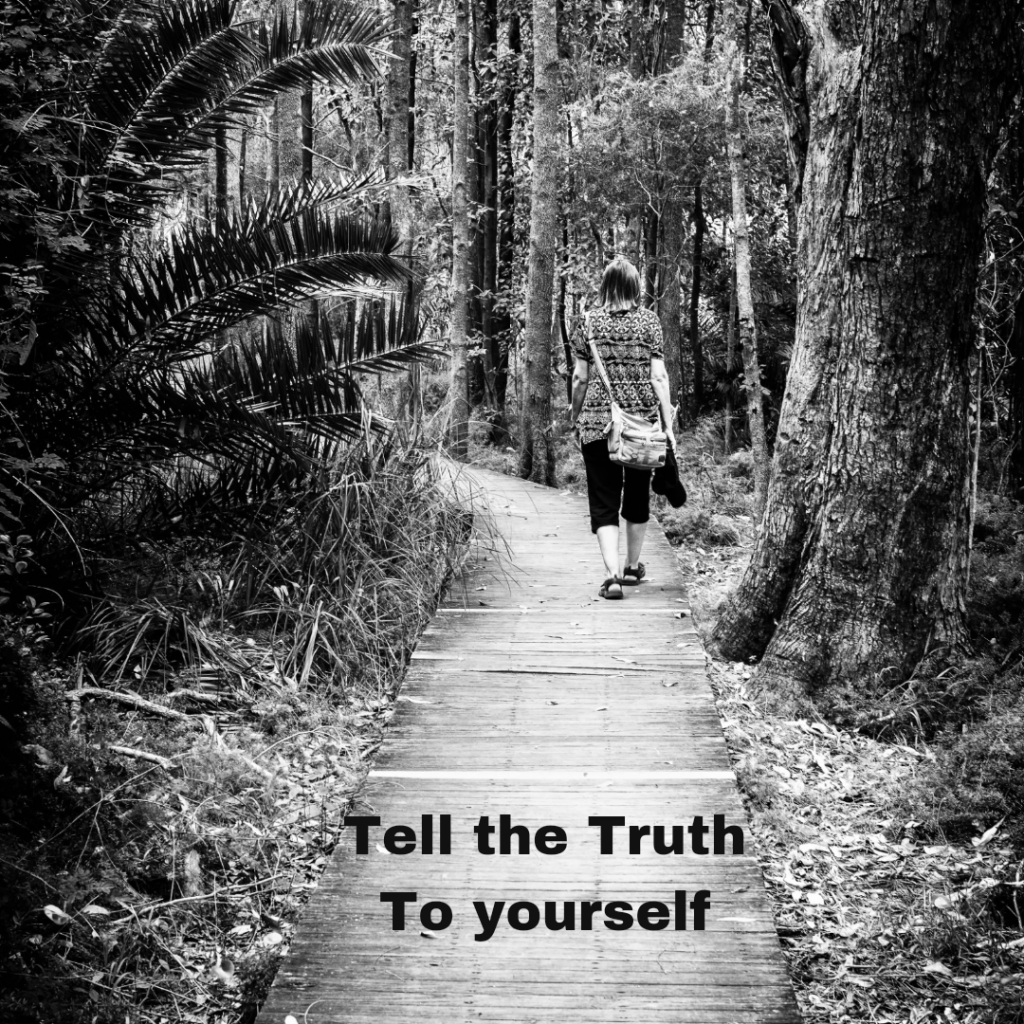
Well it’s simple really, very simple. Maybe simpler to say than to actually put into practice, but I think my lesson here is just this. Tell myself the truth as often and as much as I possibly can. In other words:

Be honest with myself

Let’s look at the options

If I’d really wanted to take this walk, to make this pilgrimage, no matter how remote, how complicated the logistics or planning, why didn’t I take action in that present? Or at least in some present before I actually forgot completely what the walk/pilgrimage was.

And why add ‘sometime soon’ if I didn’t actually desire or intend for this thing to happen? Well, possibly to put of any decision about doing or not doing. Or perhaps it was a way of saying (in completely other words), ‘Well, it sounds very nice, but I doubt I will ever end up doing it.’

So, honesty, and clear thinking about what I want and what I don’t want. That way I won’t be so attached, so keen on clinging to outcomes that I can’t see clearly, can’t easily know what I am to do or not do. Presence. Being present is what this is really about isn’t it?

To be completely present, to be fully here and now, requires me (all of us I suppose) let go of the maybes, and the ifs and buts as well as the endless ruminations about do this or don’t do that.

If I want to take a walk, or make a pilgrimage, then I say to me: just get on with it! If I don’t, then just say so, and move on.

Last little comment: I would really love for the present to remind me of what this walk/pilgrimage was. I’m a bit curious I guess(yes I know, curiosity is a present moment deflater) Maybe it’ll come back to me now I’ve written this post.

Peace

A Journey to the Centre of the World (sort of)

Namaste and greetings

Yesterday I came across a couple of stories – true ones – that I wrote years ago. They are what we might loosely call ‘travellers’ tales. I thought it might be nice to share them here. So here’s the first one. Enjoy

Not the Manu temple I write about, but another one close by

I’d walked up to Old Manali, and I’d kept walking through the town. Then higher still, past the temple to Manu, and the scattering of traditional houses and small fields clustered around the temple.

Three near-naked and stoned saddhus invited me into their cave – more a kind of overhanging rock shelf poking out from the foundations of the temple itself.

Naturally I declined. Politely. I wasn’t, never had been, and never shall be a stoner. Besides, here I was deep in the Himalayas walking through ancient villages and past temples to ancient gods. Seems to me that that’s enough to bring on a high all its own and like no other.

Then, a little higher up the trail. I rounded a corner to be greeted by a kind of open forest glade; a grassed and flowered field protected by a semi circle of forest sentinels, their crowns maybe thirty metres above my head.

And there, in the middle of this magic field, a large flat rocky area, like a series of ‘shelves’ layered one on the other. This maybe twenty square metre tiered platform was probably the remnants of an ancient hill (or mountain?) that got in the way of a more recent but clearly relentless glacier.

Whatever the history, here was an arena with views no theatre or movie could ever hope to reproduce. This natural amphitheatre faced several layers of peaks across the valley. But, before those peaks, and directly in front of me, just down the slope, stood the temple, then more trees, reaching down into the valley. Here the river flowed, surrounded by farmers’ fields and the brown dots of houses.

Then the forests begin again, thick at the bottom in the valley, but becoming more scattered on the higher ground. Then those many layers of higher and higher hills, mountains really, rolling off into the distance to, where on the horizon and behind it all, a row of the really high peaks covered in their permanent snows.

‘This is a special place, a sacred place,’ I heard myself sigh out loud. Sitting cross-legged now, I let my eyes wander over the scene taking in the blue sky, the white peaks, the multiple greens of the forests, the sliver ribbon of the river, and the rest.

At such times and in such places, one’s eyes tend to close of their own accord. And so it was for me then and there. I let myself drift. Thoughts came and went, to be replaced by more thoughts that came and went.

Then, my eyes opened. Again of their own accord. After a few seconds of that cliched ‘where am I?’ feeling one has when startled out of one state and into another, I made out the figure of a person standing facing me a few metres from where I sat.

‘I’m sorry,’ I heard her voice call to me. ‘You just looked so peaceful sitting there meditating, I just had to stop and watch you.’

She told me she’s been watching me for about fifteen minutes, which gave me a start: It’d felt l Ike I’d only just sat down and closed my eyes.

‘They say the light of the world is held about twelve kilometres up this trail. That means it’s the centre of the world.’

I had to stand to try to take in a revelation of this magnitude.

‘And apparently,’ she went on, ‘they’re going to move it soon and nobody knows where.’

Was she an angel? Was I dreaming? They, whoever they were, are about to shift the centre of the world? Even in India one doesn’t hear this kind of news everyday. Actually, I doubt you’d ever hear it on any day.

Then she was gone, headed up the trail. I didn’t follow. I remember thinking: twelve kilometres was too far for me especially as I already had a long walk downhill to my hotel back down in the new town.

Yes, mundane, practical musings, a typical response to news of such a wild and far-out nature. So, not exactly in shock, yet not quite myself, I turned back. Down. Through the village, past the temple with three crashed out saddhus out front, back into the town.

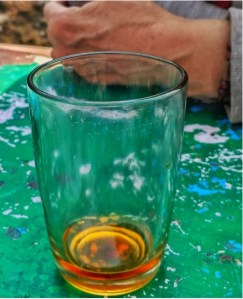
There are cafes there. They sell Chai there. I needed one.

Actually, given the momentous news I was going to have to digest, I might even have a couple extras.

This is a true story; it actually happened more or less the way it’s described here.

Of course, there is no ‘light of the world’ stored in some secret spot, somewhere on Earth.

Well, I suppose if there is a light of the world, then it’s likely to be the world itself, I mean Earth, all the beings who live on this planet. Life itself I guess you could say. Life is light; Life is love.

Peace

If the Tea Needs Stirring: Lessons in Presence (A Poem)

Greetings friends A poem today for you to read and enjoy

If the Tea Needs Stirring: Lessons in Presence

Just now, just here,
stirring the tea.
A flash, an insight;
in reality a realisation
dawned as the tea brewed.

Suddenly I’d seen the solution
to finding the real Self,
to success in the search,
to completing the quest for Truth.

Just keep doing this.
That was the sense of it.
That’s what I heard with the mind’s ear.

Stir the tea?
Yes.
Then? Keep on keeping on.
Step by step,
One task – or no task – to the next.
Just a wu wei flow.
In, through and on the ongoing moment;
on the path of least resistance.
But beware, take care:
That path is not the slippery slope
of apathy, of indifference.
It’s not the way of doing nothing.

It is the way of being,
Of being within your doing.
Fully present, only present.
The tea needs stirring?
Then stir it.

Be the actor – the stirrer.
Be the spoon,
Be the tea.
That’s all there is.

Out for a walk & Singing Sacred Songs

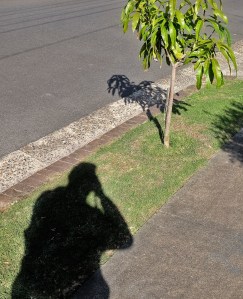
I call this one: Self-portrait With Tree 😁

I was out and about photographing for a few hours this morning. On such walkabouts I like to walk at a slow but steady pace, and in a contemplative frame of mind.

Usually I’ll also chant mantras as a way of focusing my mind, of keeping random thoughts from distracting my attention. And so it was today.

Deep into today’s walk, I was feeling ‘in the zone’, as I like to call it. Making photos and chanting mantra. All of a sudden I heard myself singing a bhajan (sacred song or hymn) in place of the mantra I’d been reciting.

This particular bhajan was By Your Grace, by Krishna Das, It’s a beautiful devotional song that you can listen to here. I’ve been listening to it and singing it for years, and I love it. I find it puts me in a nice prayerful state of mind,  Anyway, here are the lyrics:

Closer than breath, you are the air
Sweeter than life itself, you are here
I am a wanderer, you are my peace
I am a prisoner, you are release

Jai Gurudev…

I am a pilgrim, your road so long
I am the singer, you are the song
Held in the open sky, so far above
I am the lover, you are the love

Jai Gurudev…

I follow your footsteps through the flame
All that I ever need is in your name
Carry your heart in mine, vast as space
All that I am today is by your grace.
By your Grace…
I live by your grace.

One more way to chant sacred songs

Now, the song was written by Krishna Das as a way of thanking and praising his Guru. But, the words and the power of the song can be dedicated to any of our own individual concepts of the Truth. Whether we call it the Absolute Reality, the Supreme Being, the Life Force, the inner Divinity, Nature, Consciousness, God, Guru, the Universe. After all, these are all simply names and forms.

I guess what I’m saying here is that the song is a fine prayerful and meditative way to express our gratitude to, our love for, and devotion to whatever it is in our heart of hearts we know as our support, our teacher, our creator, our Guru. Our very own Truth

Peace blessings from me to you

A Small Gift

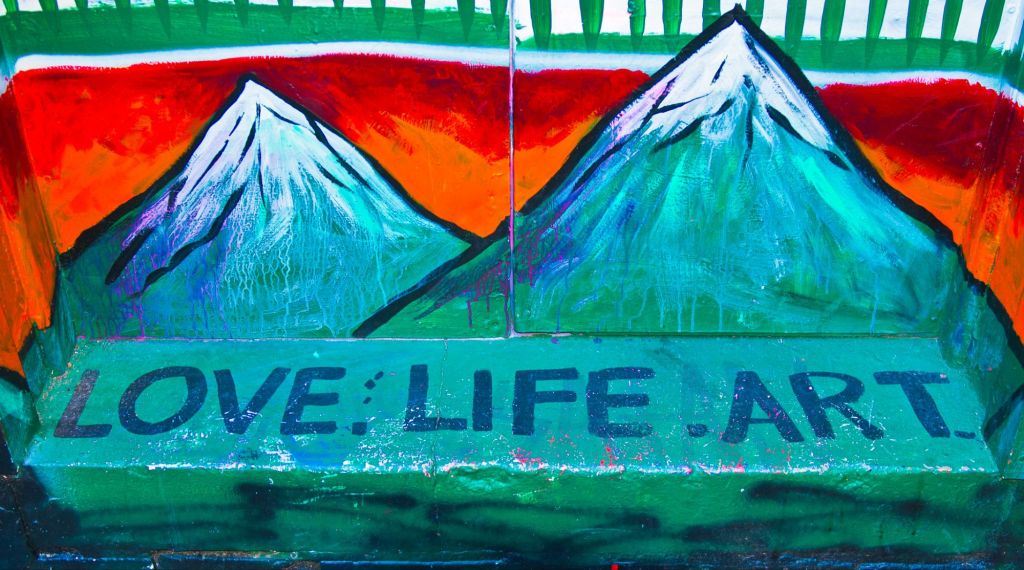
An Encircling Embrace (Unknown and brilliant street artists)

From the Hermit’s Cave to You, wherever you are