Physiotherapy, formal exercises as well as the myriad of day-to-day activities required to maintain a physical body, is prescribed as the way forward for people like me who have experienced a stroke.
Quite right too. Exercises and activities to build and strengthen muscle to help recover mobility; to repair broken – and develop new – brain pathways to help recover dexterity and increase both micro and macro motor functioning.
But what of psychotherapy? Not the talking, talking and more talking kind that aims to uncover past traumas, root out the cause of current psychological and emotional issues in an attempt to ‘fix’ you. While talking can be hugely helpful, (I mean it. Talking to a trusted friend, relative or professional, provides not only emotional support, but can give you new perspectives and fresh insights into even the most intractable issues).
What I’m getting at here is more about therapy for the complete psyche: the emotions and the mind and including the spirit or soul.
It is about the rebuilding of confidence – the ‘I am able’ attitude – and it is about filling the void to evolve a meaningful life.
The refuge that each day I commit to take in the divine will of the universe is where this care of the psyche -the inner me, if you like – begins.
Pause for reflection #1: If I take refuge in the will of that which is on the face of it ‘a higher power’ than my own, then why the big efforts at ‘filling the void’. Sounds like I’m resisting that divine will, or somehow refusing to acknowledge the reality of my life as it is.
Of course the ‘making of effort’ and doing our bit is absolutely vital and necessary. So I pray, I meditate, I read, I sit quietly, I create what and when I can. And I make blog notes like this and they also count.
But it doesn’t feel enough. It’s like I’m trying too hard to get to some point I’ve actually acknowledged I’m already at: in the shelter of the will of the universe.
I don’t like to say it, but I’m bored, and I think it is the constant ‘trying’ that is the big obstacle to having a more rounded and holistic approach and attitude to living here and now with life as it actually is for me at this moment.
‘Trying’ suggests the going outside of the present. Making huge straining efforts to make things other than they are. Hardly living in the moment is it?
There are long periods when I find myself sitting with ‘nothing to do’ (I cant read, write, create and pray all the time as in 24/7 can I?)
Pause for reflection #2: Why not? You may very well be asking, as indeed I am asking myself right now. Perhaps these spaces and times are the will of the Divine specificallydesigned for me to learn to sit in silence and to simply be. Maybe they offer spaces and times for me to be quiet; opportunities to simply be open to receive, lessons in presence.
Not only that, perhaps they are healing times when all the fragments of my psyche can settle back into their rightful place.
So, the problem is the solution, is what I seem to be saying here. The times I am describing here and which I often face and experience with dread, are precisely gifts of grace granted to me to help me heal, and teach me to sit in silence learning to listen.
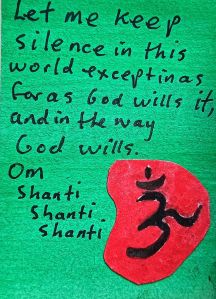
Yes, keeping silent except when and how it is the divine will of the universe might be quite nice.
Among the physical exercises I try to perform on a daily basis, are a couple for strengthening the hips. One of these begins with me standing upright, feet together, eyes level, looking ahead.
Then I swing one leg at a time for ten repetitions in a kind of arc like motion out to side, keeping it level with the side of my body, bringing the leg back to the rest position with feet together. It’s a pendulum motion.
Anyway I’d been merrily going along doing these exercises more or less every day for ages, months really, until one day my partner hermit was watching me, and said:
‘You’re supposed to be doing it slowly and mindfully’. Or words to that effect.
You see I had been quite happy swinging each leg out in turn at a fast pace, kind of like an aerobic sort of thing. Just to get it done if I’m honest. Wrong! Supposed to be slowly and mindfully.
Lift one leg slowly in an arc like motion out to the side of the body. Pay attention to the movement as it’s happening; no need to push the leg out, just lift it to a comfortable position. Just let the arm trail loosely and of its own accord, along with the leg. Then, again slowly and paying attention to the process of the movement, bring the leg back.
And I do have to say there’s been an amazing difference. I can actually feel the muscles working during the exercise, and can sense the minute incremental motion as the leg swings slowly. It’s a way better exercise than it was, and now I wouldn’t do it any other way.
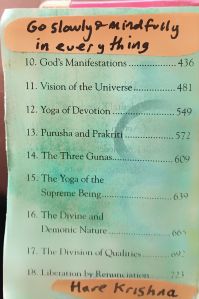
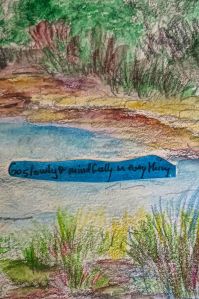
I was reminded of this incident this morning as I came across a short admonition, a little reminder to myself I have stuck on a Table of Contents page in my Bhagavad Gita.
Go slowly and mindfully in everything
What’s interesting is that, despite seeing and reading this so-called reminder more or less every day, and despite proofs of the benefits of actually listening to the reminder, such as what I’ve just described with the exercise , the reminder seems to mostly go right over my head, in one ear and out the other as they say.
Today, for some mysterious reason, it actually got my attention. At the same time, again who knows why, it triggered a truly relevant and appropriate memory to act as a kind of metaphor to illustrate the point to me.
I suppose it’s stating the obvious, but I can say that doing that (or any) exercise slowly and mindfully – in a watchful and observant manner – acts as an exercise in presence. Otherwise I’d not be sensing or feeling the muscles and the movement, or the peace of no random thoughts.
Did I mention that, having corrected my modus operandi with that particular exercise , I’m feeling the benefits? It definitely feels like things with legs and hips are loosening up, getting stronger. I’m actually walking further now without my legs aching on me.
More than that, I actually find myself wanting to do the exercise as opposed to ‘wanting to get it done’. Why is this? Well, I think it’s because I’m yearning to rediscover that feeling of presence; it’s a bit like a meditation, and in the same way clears the mind of random thoughts – at least for the short duration of the exercise. Having said that, even a short duration clarity plays its part in reconditioning a stubborn mind.
So, mental clarity, good exercise for the body, for the heart, even the soul?I think it’s the perfect metaphor for how I aspire to be living my life.
Just now, on rediscovering a quote I’d noted down months ago, I spontaneously decided to download again the book I took it from. This will be the third reading: seems to be one of those books that keep calling you back.
The book (The Abbot’s Shoes by Peter Robertson) tells the story of the author’s foray into monastic living in New Zealand way back in the early 1970s when he was twenty something.
One of many mini monastries we’ve been blessed to live in
I’d like to share the mentioned quote with you, because I think it really speaks to my own commitment to the contemplative, hermit life, which is for us a monastic life too – a hermitage is actually a mini monastery.
Sitting in his apartment one night, completely dissatisfied with life the universe and everything, the author contemplates the state of the world around him.
‘All the marching, all the writing, all the campaigning in the world isn’t going to change this insanity, brutality, and carnage.’
Actually this isn’t the quote I’d made a note of; it’s the preceding sentence which I saw again today and it seemed to just fill out the context for me. Anyway, after a few moments of quietness and thought, the author concludes:
‘I somehow intuited that the most powerful, significant , and influential action I could take to change the course of this kind of history, was to hide in a monastery.’
He goes on to reflect that by doing so – living simply, in a community devoted totally to contemplation and prayer – he could become a tiny part of ‘the turning of the tide’.
Years later, reading Thomas Merton‘s diaries, he discovered that Merton had felt the same way, concluding that those living simple, prayer filled, contemplative and quiet lives were ‘keeping the universe from crashing in pieces and falling apart.’
There is a strong sense among contemplatives, hermits, nuns, monks, that this is their function: keeping the whole thing going. Or as our author says, each playing a tiny part in the big picture. I would say, like I know Merton did many times (and acted upon his words), that action in the world is absolutely necessary; it’s just that it can’t do all the work alone.
In our hermitage we too speak often of these ideas, and think about them deeply and try to realise how they affect our lives as hermit monks.
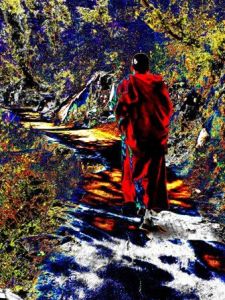
So, hiding in a monastery? Or in a hermitage? It’s true it’s very much a hidden life in many ways. For me though, it’s not about being hidden, it’s more about just what Black Elk says, I’m trying to make my every step a prayer.
Speaking for myself, it’s not that I’m unwilling to pray for a specific individual, or for peace in such and such a country, or relief from poverty, and oppression for specific individuals or communities.
It’s more that: picking and choosing in that way risks leaving people and issues out inadvertently or through some unconscious bias.
I have chosen to live this life apart as much as possible from the world in order to minimise the anxiery being ‘out there’ causes me, to have the quiet, the time, the ‘head and heart’ space to simply pray. To make of my life a prayer
Let every step you take upon Mother Earth be as a prayer
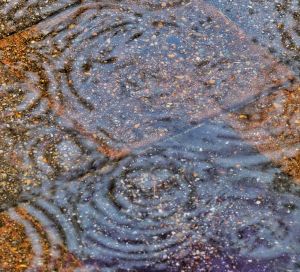
My partner hermit is fond of reminding me of the well known aphorism that a stone dropped in a pond will make ripples that spread out and out. Just like the vibes – the vibrations – emanating from a prayerful life, from all the prayerful lives.
He was referring to what he and his fellow monks are actually doing with their lives in the monastery. He said their lifestyle was helping them to:
‘foster who we truly are before God.’
Hearing this, I had to pause the video, make notes, and do some thinking. What had actually struck me, my first thought on pausing, was that this is exactly what I’m doing as a hermit monk dwelling in our Hermitage. Exactly what I’m doing. Well, at least it’s what I’m aspiring to.
There are two aspects or primary intentions that inform the life I try to live as a hermit and monk that are in fact integral one to the other; they merge actually to become one primary focus of my life.
I practice an ever evolving and I hope intensifying devotion to the divine, with the upliftment of the world and all beings as its central theme.
The other, integral focus, is an equally ever evolving and intensifying quest for self-knowledge, for the answer to the question, who am I?
In other words, I am attempting to foster who I truly am before God. Foster as in ‘encourage the development of …’ (as one definition puts it).
In this case, the development is the growth of the knowledge of my true nature – who I am above and beyond this physical (and mental) creature running around madly trying to figure things out.
In my life there is much effort devoted to the cultivation – a synonym for foster – of that knowledge: meditation, prayer, contemplation, study, just sitting, being still. Did I mention the aspirational nature of all this? It’s an ongoing project to say the least.
Speaking of aspirational: Two more synonyms for foster that I like are nurture and support. Both are even more in that aspirational category; at least it feels like that sometimes. Actually, maybe there’s a more accurate way for me to be putting this.
After all, as I think about it now, even I would agree that my whole lifestyle, my entire way of being in the world supports and nurtures me.
Except for me, myself, and I, that is: Lest the inner grammarian sends me mad in a search for antonyms for foster, let me just say that I am overly skilled in the self-critical and self-destructive departments. My ability to put myself down and to tear myself apart is legendary.
Anyway, with overwhelming nurture and support coming from my partner hermit all the time reinforcing my sense of Self, all I have to do is work on ridding myself of these self-destrucitive and self-critical tendencies.
So, the conditions for the banishment of self-loathing are there; all that’s missing is discipline on my own part in seeing the Divine in myself as I profess to be trying to see it in everyone else.
I need to be rid of the forgetfulness that blinds me to the Truth that is actually very plain to see.
Speaking of the Divine, the ‘before God’ is the vital element for me. God is all there is, so it is always before God that I act, whether in a positive or in a not so great manner.
The best prescription is for me to remember. To remember that God is everywhere and everything (did I say that already?). To remember that me, myself, and I, are also included in that everything and everywhere.
I think that once I do remember these truths even for the odd moment now and again, then the real fostering of who I truly am will have begun.
It’s been just over a week now since the new page on the blog went live. I have to say that it’s been very satisfying setting it up, then uploading some of my devotional poems.
Actually, it was while uploading one yesterday that I thought, I’ll feature this one in its own post. I did mention that I would like to continue this occasional practice.
There’s not too much to say about this particular poem really – best to leave it to speak for itself. I’m only introducing it like this because I wanted to include a Wikipedia link that might help clarity a couple of the terms and some of the details mentioned in the poem.
The poem speaks about the concept of Viakuntha, which as you’ll see is the supreme heaven for some Indian traditions. The link leads to an interesting and short read, well worth the time I think.
The myth of Vaikuntha was a trigger for this poem, as was the meaning of the word itself. Is it a real place? Who knows. Fact and truth don’t always agree, and as for me, I don’t think about the question.
Myth has been the way we humans have always used to tell our story. To try to sort out the big questions: where are we from? Who are we? Where are we going? All the ‘big questions’ are addressed by mythologies from every culture – every family, country, you name it – on Earth.
In any case I think that my poem came about as a result of my own contemplation on the story, on those big questions, on Self really.
I hope you will visit my Poems of Devotion page. I’m still adding poems to the page, and of course, with grace, I will continue to write.
Now, please enjoy reading my poem, and I hope it’s a nice experience for you.
Love and Peace Paul the hermit
OUT BEYOND CAPRICORN & DEEP WITHIN EACH HEART
Vaikuntha: Without anxiety. Is there such a place? Free from worry? Out there, they say, beyond Capricorn. There’ll you’ll find the highest heaven, the abode of God.
No need to look to the stars: Vaikuntha is here. Vaikuntha is now. Within and without you.
Vaikuntha is indeed beyond; beyond the material world, beyond the realm of bodies and minds; beyond the illusions of places and spaces. Atma – Universal Consciousness – you and me, that’s Vaikuntha. You and me, all there is. No anxiety
Renunciation. It’s a popular topic here at the Hermitage. Perhaps popular isn’t the right word; let’s say it’s a subject of conversation, thought, and contemplation on a quite frequent basis. As it is, I think, for most people attempting to live a spiritually focused life. For today, however, I really want to focus on some of my own thoughts around renunciation.
For those of us oriented towards the quest to live a spiritual, prayerful, and dharmic or truthful life, renunciation tends to mean the giving up of things, activities, and behaviours (including thoughts, attitudes, and the like). The theory is the very act of renunciation itself predisposes one to more authentic and close identification with their own true natures. It places them nearer to realisation of the Divine, of God, Absolute Reality.
And of course when harmful things, situations and attitudes are released, one has less to distract from the spiritual quest and life, Of course, most acts of renunciation don’t result in a one off quick fix: I heard in one of our hermitage conversations a few days ago the perfect quote to help make this point:
‘You just have to keep renewing the renunciation.‘
In other words, it’s a full-time, life-long job!
But, in the attempt at renouncing, we can potentially find some help towards a clearer focus on the spiritual side of life as well as more sensitivity towards what is good and what is not good for us.
A person free from both hatred & desire is always renounced. Indifferent to dualities, he is free from all bondage and easily attains liberation
Bhagavad Gita Ch 5:V 3
Which is where every one of us knows exactly what it means to try to give up what’s bad for us. It ‘ain’t easy is it? Still, we’re here to talk about me, not you or anyone else. So …
There are a few things that in perusing the monkish life, that I didn’t have to renounce; some things like eating flesh, drinking and smoking, going out to clubs, pubs and the rest, are things I’ve either never engaged in, or haven’t done for a very long time.
Which brings me to a good point to mention here. Any renunciation whatsover has to be a personal decision taken only after serious reflection and thought. And it must be made without outside coercion or pressures. While others may think they know what’s good (or bad) for you, in truth, it’s only you who really knows.
Anyway, as I was saying, or about to say, renouncing things hasn’t always a piece of cake for me. Actually, I love cakes of many and varied kinds and have had to renounce all of them. But that was more for my body’s health than for my spirit, though obviously the two go hand in hand.
Then, just a couple of days ago in a momentous event which in fact was the trigger for all this reflection on renunciation, I vowed to give up a particular breakfast cereal I’m really very fond of.
This renunciation – not the first attempt I might add – being prompted by the fact that I tend to experience quite strong indigestion, huge bloating, and general feeling yuck, when I’ve indulged in this cereal for any length of time.
There is nothing trivial about attempting to renounce foods and so on that harm our health; as I said, it’s a lifetime’s effort. And equally daunting are the non-physical things like attitudes and behaviours.
Any renunciation whatsover has to be a personal decision taken only after serious reflection and thought.
Here is an example, or group of examples, which along with the above-mentioned cereal saga, played a serious role in bringing about this post. They are behaviours and attitudes which very emphatically interfere with my quest for a Dharmic, prayerful, and spiritually focused life,
What I absolutely hate, despise, detest, am revolted by … Oops sorry; I forgot my monkish manners there for a minute. Let me try to rephrase.
I have a strong aversion to gossip, to judgemental thoughts and comments. I am averse to it on a couple of levels. Firstly, I do not like, for one second, the idea of not minding my own business, of commenting on what other beings do or say, or don’t do or don’t say, or how they behave.
Surely, my thinking goes, I have enough of my own business to mind, why do I need to mind the world’s business?
That’s the key one I think. But I really dislike the feelings such behaviour and attitudes invoke in me: anger, frustration, guilt, inappropriate thoughts, words and conversations. There is even a physical component sometimes when I make myself sick in some way through the stress of such things.
There is another point too, just as key if not more so. I’m routinely disgusted by the notion that these criticisms, judgements, not minding my own business, really do impact on what I call the vibes of life for all of us. Call it vibes, energies, whatever, but I sense that our own behaviour has a ripple effect beyond our immediate relationships and environments to the wider world beyond.
So, by now it’s pretty clear that I am in need of some serious renunciation of my judgemental, critical thought and words, as well as the anger, disgust and the like, I feel and express towards those I deem worthy of my judgement. Okay, not just others: all we’ve been saying here applies equally to myself.
Perhaps it’s to do with family, school, or societal conditioning? And like any full-on conditioning it can tend to preoccupy, even possess, one’s life.
These are all old stories. They come from a past that doesn’t exist. For real, it’s gone right? Actually, when you think about it, there really is no such thing as the past.
Long ago, decades really, I was big into affirmations. I had a whole collection in a little folder that I kept in my pocket of on my desk or wherever was handy.
There are a few I remember even now thirty or more years later, and there are one or two that come to mind that might be helpful that I can resurrect to share here.
I release and let go of all that is unlike love. There is plenty of time and space for everything I want to do.
You let go of all that’s unlike love, what’s left? Love. Love is all. All is love. And this affirmation has an added bonus: no regrets, it’s never too late, there is time – and space – aplenty.
And the second one. I think it’s just as good:
I am at peace with my own feelings. I am safe where I am. I create my own security. I love and approve of myself.
This one I’ve rewritten as a prayer; I might share that one sometime. The helpfulness here is easy to get: I’m safe; it’s okay to have my own feelings.
There’s no outside threat – nothing to attack, nothing to defend – and, finally, I have no need to be entangled with all that unwanted stuff, that – as I’ve already said a couple of times – is none of my business.
For my community, the invisible and the visible, with love















 Notes from the Hermit's Cave