
Less Desires, Less Entanglements Equals More Freedom

Along with many other spiritual seekers across many world cultures and over time as well, I have a more or less daily practice of opening a spiritual book, scripture, or other text ‘at random’ (as if there is such a thing) to receive a message, a lesson, or a little bit of guidance for the day.

In my case, that text has for ages now been the Bhagavad Gita. And over I think the last two or three years, one verse in particular has come up time and again, sometimes on two or three days in a row.
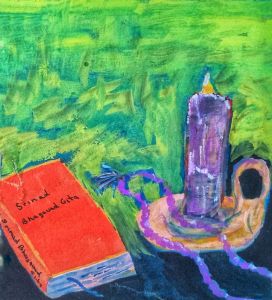
Much thanks to the Hermit Pilgrim who created this beautiful painting

So frequently has this occured that not only have I neglected to examine the verse in any depth, I actually began to ignore it when it came up and went right away to pick another one at random.

Well, this morning, I opened my Gita and there was that verse again – for the second day in a row. However, today, for some reason, I realised that this verse has been calling out to me. Or put it more sensibly: the Divine has been calling on me to take some notice of this verse and its meaning.

So, first of all, allow me to share with you the verse in question.

The Lord of Sri said:

It is said there is an eternal Banyan tree with its roots growing upwards and branches downwards, whose leaves are the Vedic hymns. One who knows this tree knows the Vedas

         Bhagavad Gita 15:01
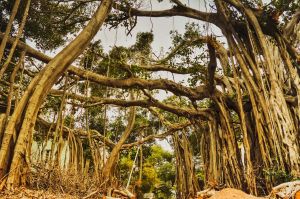
For me at least, this verse has always appeared quite complicated, complex really, and full of symbolism. Of course, being from an ancient religious text, it’s likely to be all those things isn’t it?

Still, despite reading the verse many times and studying and hearing a few commentaries on it, for some reason it has remained for me rather daunting. At least I can say that I was convinced of the notion that this verse confused me, entangling me in convoluted and sometimes upside down thinking.

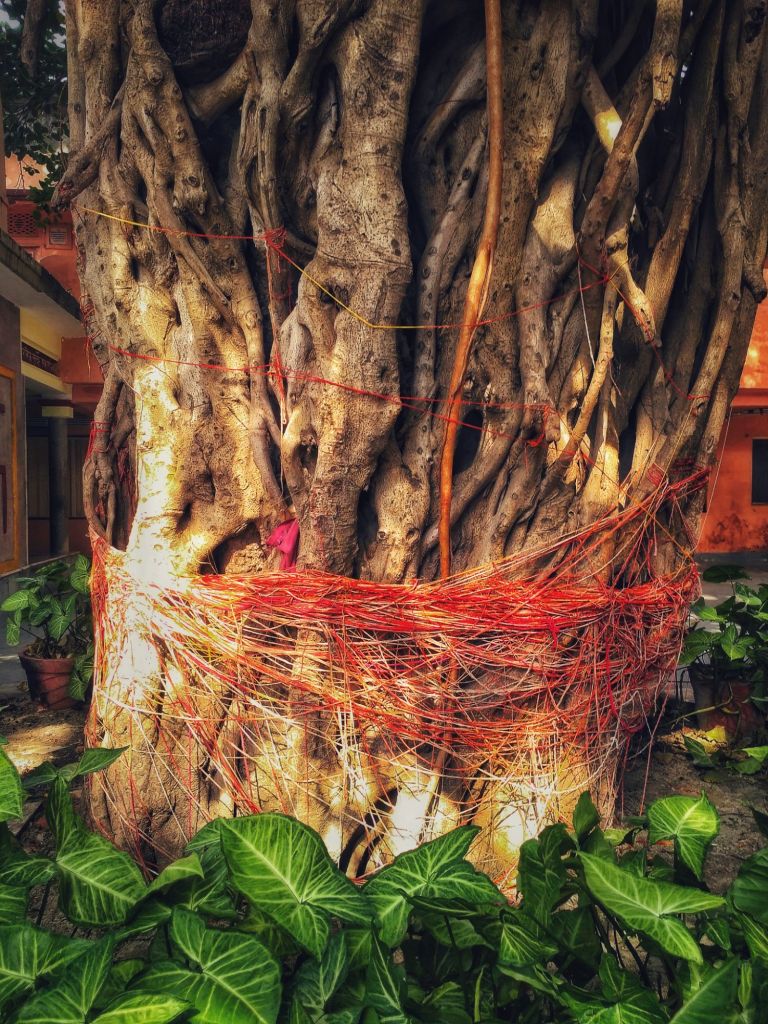
Like the Banyan tree itself I guess. Considered especially sacred among all other sacred trees in India, the Banyan is well known for its way of growing willy nilly, every which way, until the whole thing becomes a complete and dense tangle.
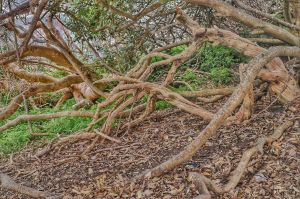
And it is this tangle that is at the heart of the metaphor used to illustrate the lesson in this chapter of the Bhagavad Gita: The tree is Samsara, the illusion that is the material universe in which all of us living beings are entangled. It’s as if we’ve walked into that tangle of branches and roots believing that’s where we will achieve our desires.

A major city in the middle of tourist season is another neat metaphor for this tangle we’re talking about. We look for worldly pleasures there, but find chaos, confusion, and often unhappiness

We are so attached that we identify completely with that physical world (convinced we are merely physical beings ourselves) and are convinced that this is where we can fulfill all our needs.

As the verse says, the leaves of the tree are the Vedas, and one who knows the tree, knows the Vedas. The Vedas are the sacred Hindu scriptures which in this context can be said to represent knowledge. But not knowledge of a mundane ‘ordinary’ kind.

The knowledge to realise (because we already possess this knowledge, we just aren’t aware of it yet) is that we are not the body, so we have no need to be bound to the tree of Samsara with its suffering and its endless entanglements. It is Self Knowledge.

This Self Knowledge leads us to develop what a following verse calls ‘the weapon of detachment’ with which we can chop down this very strong tree of attachments and illusions

A little note: I don’t like this weapon and chopping metaphor at all. I simply pass it on to you as written.

As we begin and progress with this process of truly realizing we aren’t the body, and therefore have no need to identify with or be attached to worldly objects and desires, then slowly the tangle binding us begins to clear, to fall away bit by bit.

I din’t think we need to actually get to that point of cutting down the whole tree before we begin to see results. to reap the benefits if you want to put it that way.

Each and every small thing, desire, compulsion or aversion we no longer feel ourselves bound to, frees us just that much more.

As with any tangle we get ourselves caught up in, once we loosen that first thread (to switch metaphors), the task of unravelling becomes easier.

It’s true – and I think I’ve mentioned it previously – some of my attachments and compulsions are loosening. Some (small ones I admit) have fallen away completely.

As you read in my little note, I’m not comfortable with the whole cutting down trees with weapons metaphor. Perhaps the loosening of threads, the unravelling of tangles and knots sits better with us.

Perhaps my – our? – efforts at detaching from the desires and aversions, from the compulsions for worldly things and objects, and for sense pleasures, can be achieved by a more gentle untying we could call it. A kinder, gentler, calmer, friendlier, means to realizing we are already free.


The Q&A in the Scripture Part 1

Welcome to the first in a short – and occasional – series centred on a text containing a kind of Q & A session between Krishna (God) and Uddhava (his cousin).

Thirty six questions in all, with which Uddhava asks Krishna how he can live a good and honest life, dedicated to doing right and living the truth.

If you haven’t already, it would be really helpful if you read the Introduction post here, before going much further; just so you have a better handle on the context, the background etc. It will just help to set the scene a little more.

Now that’s been said, let’s get on and into it. The very first question Uddhava puts to Krishna is actually two questions in one.

What is quietude and self-control

Good questions, the both of them, given the circumstances Uddhava finds himself in. His hometown (it’s Krishna’s too) is about to descend into a nasty civil war and is most likely a chaotic, noisy, overwhelming and frightening environment to be stuck in.

Uddhava, like the rest of us just wants a peaceful life, and as to the second question, well he’s bound to be asking himself the same question we’d ask: Why can’t these people just control themselves before it’s too late? Not to mention the onslaught of emotional and mental anguish he’d be suffering himself.

Anyway, Uddhava is about to leave town following his cousin’s advice, and would like to find out how he can go on to live a good, righteous and honest life, while he’s in exile from his home.

Krishna chooses (sensibly I’d say: they’re both big questions) to answer one question at a time and he begins by explaining what is quietude:

Quietude is fixing the mind on me.

Krishna is not saying here: ‘Look, once I’m gone [I think I’ve mentioned that he’s leaving too, going back to Heaven or wherever he lives on a permanent basis] try to remember your dear old cuz in the odd quiet moment now and again will you?’

What I think he is actually saying is: ‘If you fix your mind on me, then that’s quietude’. We could call it silence as well. He’s not saying ‘I am in the silence’, nor is he saying ‘Through silence (or quietude) you will come closer to me’. No, what he says is ‘Quietude is what I am’.

So, what about those of us not in a first names relationship with Krishna? Well, think of Krishna as being a name and form of Universal Consciousness. Yes, the same Universal Consciousness  that is all created and non-created things; the sun, Earth herself, trees, the oceans, all living and non-living beings in the Universe, in all universes if there are more than one.

There are a whole list of synonyms for quietude: equanimity, calmness, peace of mind, rest, serenity, dispassion. Just to name a few.

These further definitions are really quite helpful. What I mean to say is that we rarely if ever associate that calmness, equanimity, peace, and the rest, with actually being the Universal Consciousness, that is also all of us and everything else that is. Again, think of Consciousness as the Divine, God, or by any other name and form, you attribute to the natural order and flow of the Universe.

Forgive the repetition : Quietude, calmness, peace of mind, are not where you will find God or consciousness, or whatever. They are all consciousness.

The beach is also dog friendly

Have I mentioned that the current hermitage is a cottage on the side of a large sand dune, on the other side of which is a stunning stretch of Pacific Coast beach. Sitting on the top of the dune and looking out over the beach and ocean it is easy to think of all that’s seen as divine.

It is most definitely a peace of mind, calm and quiet inducing experience to sit there. Certainly it is quietude itself with the only sounds being the song of the universe in the form of the waves and wind.

A question I asked myself, and I now pose to you: If what we’ve been calling Universal Consciousness is actually all that is, then why not a state of mind like quietude, calmness, balance, and the rest? Like everything else perhaps these states are simply elements of that consciousness or Absolute Reality, or oneness, or what some call God, the Divine, or … ?

In any case, I have a feeling that’s what Krishna was getting at with his answer, and what Uddhava somehow intuited with his question.

Thank you for joining me on this little pilgrimage. in the next post in this series (it could appear anytime, so stay tuned!) we will discuss Krishna’s answer to Uddhava’s second question: What is self-control?

Peace

Un hommage à tous les ailés

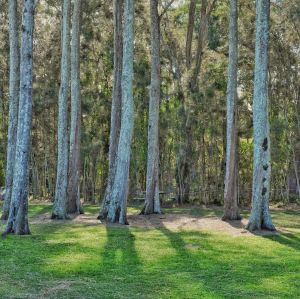
As Promised: A Prayer of Praise and Gratitude to Trees

At one point in my last post on Bhakti (if you missed it you can find it here) I mentioned that I hoped to soon publish a recently written prayer titled A Prayer of Praise and Gratitude to Trees.

Even as I typed those words in that previous post, I thought: ‘soon’? Why the delay? What’s wrong with now? So, without any further delay, here is our next post and in it I’m very glad to be sharing that prayer with you.

As my comment in that previous post explained, this prayer (and others too) is one more little step in my ongoing effort to cultivate a mood or feeling, and a practice, of Bhakti or loving devotion to the Divine.

If you’ve read that last post you will recall that I stressed my deeply held and heartfelt conviction that the Divine is everything. As I may have actually said: there is only the Divine; one, whole, partless and indivisible. Now, to knowingly repeat myself: The Divine is one without a second; that’s all there is.

This prayer to trees is an attempt to acknowledge that oneness of which each and every tree – just like you and me and all other beings – is a manifestation, each with its own unique name and form.

This prayer, though composed by this particular name and form, is in fact just one more expression of that oneness we all share. As such it is as equally yours as it is mine. As I said earlier, I am glad we are sharing this now.

A Prayer of Praise & Gratitude to Trees

Dear Aranyani

With this prayer we greet you. We offer you our praise, and our gratitude.

When we come into your presence, you remind us that in meeting and greeting you, we are in fact meeting and greeting God.

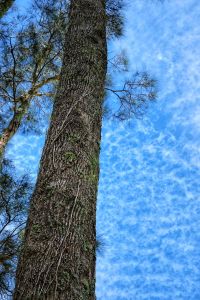
We bless you and we thank you for the shelter that you steadfastly provide to so many living beings. In so doing you support, protect, and nurture the continuance of life for all of us.

Your every exhalation is for so many other living beings the breath of life, of Prana – the life force itself.

You remind us as we witness your strength, your resilience, and your calm flowing with the winds of change that we too share that strength, resilience and the potential for calm flowing with those winds of change that are also constantly buffeting us.

Om Aranyani Namah

PS Who is Aranyani? She is a Hndu deity of the forests and all that dwell within the forests. Basically she is the Goddess of Trees and here is simply the name and form representing all trees.

Sacred Strings, Sacred Tree

One, Without a Second, is All There Is

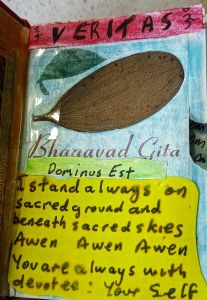
Right at the front of my Bhagavad Gita (the only book aside from the notebook I’m writing this in, that I personally own), I have recorded and inserted sayings and various words , that are important to me. Among those things is a statement I first heard many many years ago, that is common among the First Nations’ peoples of this country:

I [We] stand always on sacred ground and beneath sacred skies.


It is not an affirmation of ownership or possession. It is, instead, an affirmation of belonging to the land, to nature. It is a prayer of thanks, and it is a declaration of the knowledge of unity with the rest of the natural world, that is the hallmark and foundation for Indigenous cultures throughout the world and through time.

I’ve valued – treasured – this sentiment for a very long time – probably from even before I first heard it, which was so long ago as to be lost to memory. Perhaps I always knew it because I’ve somehow always thought this idea was a fundamental truth concerning my existence as a being living on this planet.

Well, now I have heard another statement that for me makes a perfect compliment for this one. The other day, during a lecture, my teacher mentioned that in his student days a fellow student said:

Wherever you are, you are walking through Ishwara

(Ishwara being her preferred name for the divine – for all that is.)

There is a feeling or sense of ‘belonging’, of awe and wonder when we attempt to immerse ourselves in what we term the natural world.

Once again I immediately felt the bell of Truth ringing clearly through this statement. Yes, I thought, everything is divine – including our own selves – so of course it follows that wherever we go, whatever we do, we are always in the divine.

You’ve probably read a number of times me quoting my teacher quoting his teacher:

It’s not that there is only one God, there is only God.
          Swami Dayananda Saraswati

Emphasis very much on only. Meaning of course, that it’s not that God is within us, or that we are within God; we are not surrounded by God; and it’s not that God ‘sits in our hearts’. The reality (for my teacher’s teacher) was that all that is, everywhere, everything, every thought, every word and deed, everything there is, is the divine.

Another way to describe the divine or God, that appeals to me is that Ishwara (also my own preferred name for the Divine) is in reality the natural order of the universe as dictated by the laws of nature. Those laws of nature, the rules that govern how the universe works, are also Ishwara, as are all that is manifest or in existence  as a consequence of the workings of those laws.

In other words, the Divine is the sum total of what some would call the entirety of creation.***

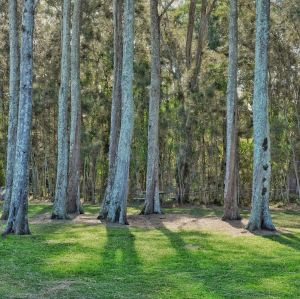
For the hermits a sacred site. Part of a grove we named The Sentinels. A place of experience of unity and oneness of creation

For me this an enormously comforting and reassuring concept. Of course, for me at least, it is also an extremely difficult one to wrap my head around. But here’s a small summary of what I think I’ve grasped so far.

Ishwara – the Divine – is all there is; everything. Also divine is the natural order of the Universe as governed by the laws of nature. These laws are neither good or bad – there is no duality. They are neutral.

You and I, as one more entity among who knows how many others, act as we do and are subject to the laws of nature, just like everything else. We can’t change or influence those laws; we can only live our lives as they unfold.

To quote from Desiderata: No doubt the Universe is unfolding as it should

And, well, then things just work out as they do. While we can’t change the laws of nature, or bend the universe to always suit our liking, it is also true to say that every action we take, every thought we think, every word we utter, even our very presence as a living being in our time and place, do indeed contribute to ‘how things work out’. Another way of saying this is to say, we do our bit, and the universe does its bit and what happens, well, happens.

For me, this is not at all as simple or as straightforward as it sounds. Naturally  we see ourselves as individual selves, as entities on our own. After all, to state the obvious, we live and operate in a material (dualistic) world. So automatically we see ourselves as individuals living in, but always separate from all the other individual entities, as well as being disconnected from the world itself.

It is part of human nature (for the most part) to long for connection; there is so often a drive within us pushing us to create family, enter relationships, feel we belong to a community or communities, and for many but not all, there is the almost instinctive urge to seek connection with the rest of nature.

Many forms, One reality

We often think of these longings as goals to achieve, as something outside of ourselves to attain, to reach for. Consequently, so very often we tend to focus our attention outwards, towards other people, or material things.

But, instead, all these inclinations, desires and longings are simply our Self (note the capital?) endeavoring to open itself to discovering (or rediscovering?) that which already exists: our oneness with, and our non-separation, and non-difference from, The All That Is.

Peace and Love from Paul the Hermit

FOOTNOTE

***Just a few thoughts about naming, or giving labels to the Universe and its laws.  Obviously it’s a personal choice for each of us what we choose to call that creation. Then, on the other hand, we don’t have to call it anything at all. For me personally it is very difficult, even near impossible to not name it. By naming the creation, I don’t think I am attributing the manifestation of the Universe to some distant entity living in some heavenly abode (as my teacher likes to say). Rather I am acknowledging the intelligence  and order, beauty, complexity of all that is and how it all works, as its own reality. At the same time, I am learning to understand that I as my true nature am not separate from the rest of creation, and I feel the need to have a name towards which I am able to focus my thanks and my reverence.