And in Conclusion: According to the Text Message

Welcome to the continuation and conclusion of the topic we were discussing in our last post. We are spending some time reflecting on a text message I received some days ago.

A multi layered text and one full of treasures on leading a purposeful and satisfying spiritual or inner life. If you missed it, please feel free to visit that post here.

In that previous post I included an image of the text in question, and we ended up looking rather deeply and prayerfully at the first sentence in the text:

Go sit in your cell and your cell with teach you everything.

In today’s post I hope to share with you my contemplation and rigorous reflections on the remainder of the text message.

So, let’s carry on with the next little bit of that text message.

Create your own inner world

This little gem speaks directly to the notion that it is your body and mind themselves that are the primary places in which you dwell; they are your cell that you carry around with you (or perhaps it is they that carry you around) always and everywhere.

And in that cell, where you dwell, you are the creator of the world. It needn’t be a fantasy world, as we might think of an inner world we create for ourselves. It need not be made up of wishful thinking, dreams, or endless thinking about the past, future, fears, regrets and all the other stuff we are prone to.

Rather it can be a place where you content yourself with the constant efforts to remain in the present; it can be a place in which your disciplined and focused mind and heart remain on those self enquiry questions which will ultimately lead you to the full realisation of who you really are, what is your true nature.

There’s a paradox here it occurs to me as I type: while everything that exists in the universe is simply a manifestation of Absolute Reality, (and that includes you and me obviously) the only way to actually discover or realise this knowledge is by delving deeply in our own hearts and minds – and sitting in our cells. We won’t find it ‘out there’.

The outer world will reflect the inner peace

So, with all this inner – self – enquiry cause the big shift? Will you see and experience only bliss and happiness? Will the ills of your body suddenly vanish never to return?
Well, yes. And no.

No because as living entities we are able to do our bit in making our lives what they can be; we can do our part in keeping a healthy body and mind; we can play our part in making the world a better place for all living beings.

Ultimately, though, it is the natural order, the natural laws of the universe that controls, directs, and manifests how all of the material world – including us obviously – operates and works itself out.

Yes, because the committed and rigorous discipline necessary to sit in our cells and enquire into our true natures, will over time and step by step help us to change the way we look at all the troubles and events of the world and our own minds and bodies. Our perspective will undergo a big shift (not quite the one mentioned earlier; this one’s for real).

You see, there are three sources from which our suffering come from: other people, nature, and our own bodies and minds. Self-Enquiry will lead us to realise that our true nature is in fact the totality of all there is, the Absolute Reality.

After this realisation of the truth of our natures, the sources of suffering (other people, nature, and our own body and mind) are still going to be there, going about their business as usual. It’s just that we won’t be as affected by them like we were before; we won’t suffer as we once did.

Maintain Equilibrium

Having read this far you might well be thinking that, yes indeed, the realisation of our true natures, the evolving knowledge that we are not simply the mind and body, and that we are in fact the Absolute Reality, just might lead to a life of balance, of equilibrium. Of calm in the face of crises and problems, peace in the wake of strife.

Well, umm yes, that’s all entirely true. But as for me, I can say I’m nowhere near that state yet. And I suspect nor are most people, and most of us will be trying for a few more lifetimes (if there are any more that is) before we make it.
Mind you, equilibrium does seem to come in little bursts, like a kind of reconditioning process. Sometimes I realise that I am indeed acting more calmly, with more equanimity to situations that might once have thrown me completely off balance.

I’ll admit, though it’s an issue that frustrates me (you see? That proves I’m still identifying with and attached to, the idea that I am a body and mind only). I ask myself, how come with all the spiritual practice, the meditation, and all the sitting in my cell, I can still suffer with annoyance and irritation or collapse with existential angst, rant at injustice … You know what I’m talking about.

All I can do, all any of us can do, is persevere with the enquiry into self; Who is it exactly that’s losing it right now?
Of course it’s ‘me’, but is it really? It is the mind and its emotions and the ego. But it isn’t me, and it’s not you.

Be Still

One of the beauties of this wonderful text message, is that the individual injunctions have built – are building – one upon the other in a nicely logical and understandable way.

Now, the advice to be still: Of course we can take it at face value and take it to mean we are to literally sit with our bodies very still in the one place, in the one spot. Not moving.

Well, it seems the Desert Fathers and Mothers  had a saying or a word of advice to fit every situation. I came across a quote from Abba Ammonas, that sits as a kind of caveat, or perhaps a sort of reality check when thinking of sitting still:

A person may remain for a hundred years in his [sic] cell without learning to live in the cell.

Meaning obviously, that thinking we are still doesn’t mean we actually are still. Well, yes it does actually. But it’s only a part of the picture that we name stillness.

For example, right this moment I am making these notes, I’m looking up references online, listening to Bob Marley on my headphones, and every few minutes I’m taking a sip of tea.

Yet I feel quite still. I sense real focus on every one of these particular tasks as I’m performing them. I am feeling pretty calm and even a tad relaxed. Believe it, for me these are big achievements. Actually this very much speaks to a concept called Action in Inaction, and Inaction in Action. If you’re interested, there’s a fascination article here.

In other words, I think I am actually being still. My thoughts are focused as I said. I’m even in the moment well enough to pause everything else to listen to something from Bob in my ear that speaks to me.

I don’t think anyone can tell you how to be still. Not only is it going to be different from every one of us, being still will always vary and fluctuate in quality and degree. You might say it’s one of those ‘it depends’ kind of things.

I am

Ask yourself: Who am I? Usually the answer comes back: I am … followed by a name, designation, label, an identity of some kind.

Nothing wrong with this. In fact it is natural: it’s how members of our species place ourselves – and everyone else – in the order of things; we need to know our position and that of others in order to negotiate our way through and in the world.

So, what happens when I ask myself that big who am I question? Well, I could answer: I am Paul, I am a hermit, I am a writer, I am servant of God, I am tall, I am a friend, I am a …

Stop! These are all things I do or roles I take on and fill by choice or otherwise. They’re not me, though they are ways for me to describe the ‘me’ that exists and acts in the material world.

It seems according to Ramana‘s teachings on Self-Enquiry that the only way we can discover who or what we are is to list instead what we are not.

Neti Neti it’s called: not this, not this. But most of us feel very strongly that we do in fact exist. In other words we are – or referring to myself – I am.

If I’m not to confuse myself with the misidentification , the temporary labels, and other limiting beliefs as I try to answer my own Who am I? question, then the best I can do is metaphorically shrug my shoulders and answer, ‘Well, I am’.

Which means I think we’ve reached the point where we may finally realise that there is actually no answer to our enquiry; we simply are.

There is nothing to ask; nothing to answer. Only pure being, as in existing: the Absolute Reality. There’s nobody to do the asking.

And in the example of this text message the expression I am, speaks as a kind of signature of the text sender. No names, no labels or self-identifiers or anything else. I aim.

Some musings for you

Last, but most definitely not least is this, a final PS if we can call it that. A reminder that I am to contemplate on all the above, that I am to reflect on the words of the text.

And I’m very happy that I’ve spent this time sharing that contemplation, those reflections, with you.

I am. You are. We are
(actually there is only I am, but you know what I mean

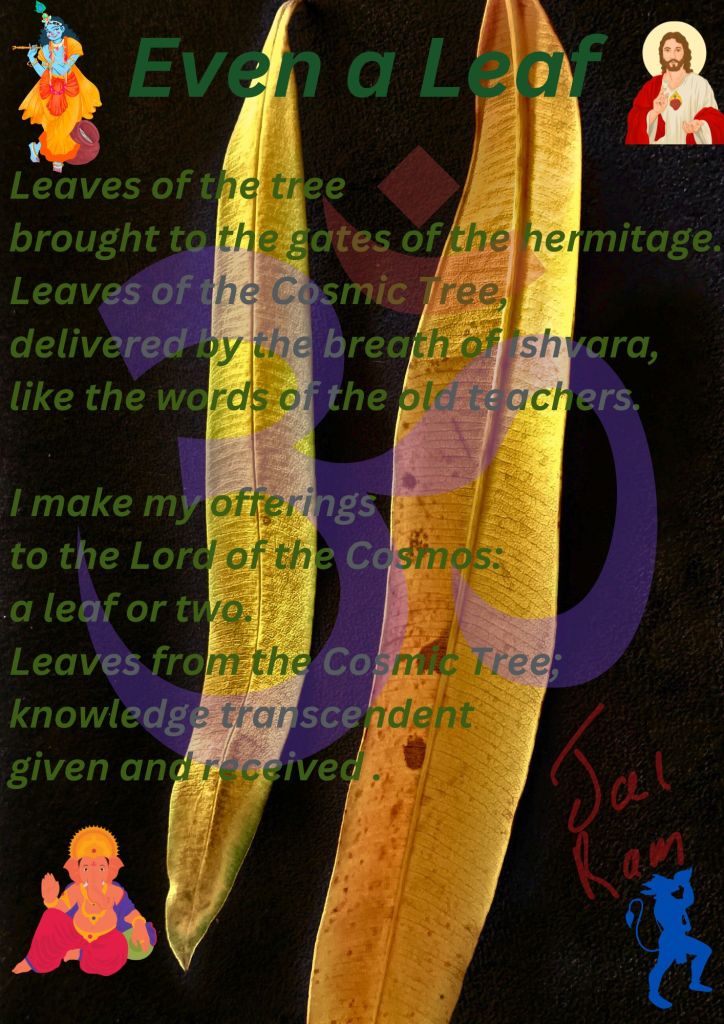
Even a Leaf: A Poetic Offering

Namaste and greetings my friends

Today, a poem for your reading and contemplative pleasure. The title of the poem comes references a verse from the Bhagavad Gita in which Lord Krishna talks about what are acceptable offerings: He tells Arjuna that God, or the Divine will accept even a leaf as an offering of devotion.

So, when I returned to the Hermitage one day recently to find two leaves on the ground at the front gate, I recalled that verse and decided to make of those leaves, just such an offering.

Allow me now to share that offering with you.

Peace and love

Paul the Hermit

When You Say It All in a Text Message

It wouldn’t be quite correct to say that I never get calls or texts on my phone. What would be correct is to say is that the vast majority are to do with what I might call The Bureaucracy: Reminders of Doctor and dentist appointments, notices from various government bodies, library notices; all that kind of thing.

And there is another emerging category that’s actually a lot more welcome: while my partner hermit and I have always phoned each other, lately we’ve been texting more and more as an extra way to communicate with each other.

Sometimes these texts are about the mundane things we all have to do in the world, but then there’s another dimension in which texting allows us to keep in touch with each other’s feelings, thoughts, doings, and simply as a means of keeping the connection open and strong.

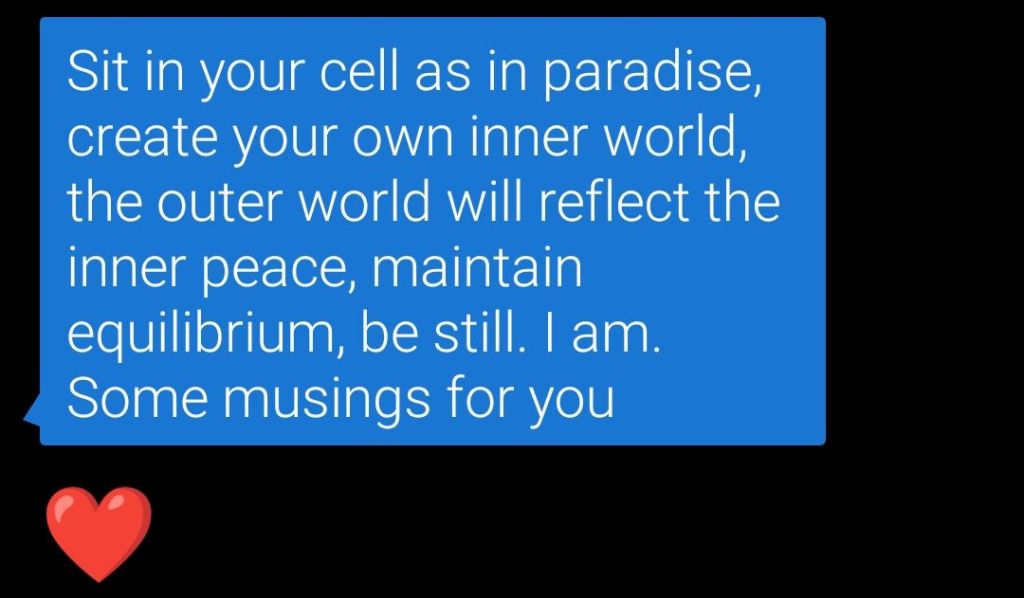
The other day, for example, such a text arrived unannounced in my phone. Like some I get from The Bureaucracy, this one was essentially a little series of reminders. But rather than being about the things of the outside world, these ones, in this text, spoke directly and deeply to the enrichment of the inner life – my inner life.

Powerful messages, all of them, that really go to the heart of one’s (my) efforts to live a life more centred on my spiritual quest and my commitment to living more in sync with Absolute Reality.

On first reading of this text (and on each rereading, of which there have been many), I really felt strongly that I needed to contemplate deeply and prayerfully on the pieces of this whole. And, as well, to share my reflections with you.

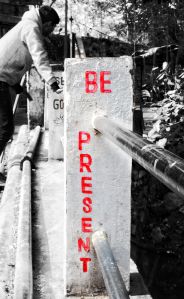
Sit in your cell as in Paradise

This little – yet tremendous – injunction references an answer to a question posed to Abba Moses, one of the early Desert Fathers:

Go sit in your cell and your cell will teach you everything.

Essentially Moses’ advice is, remain within the confines of your dwelling place – whatever and wherever form that place takes. This can be a literal geographical location, or even your own body as it moves in the world. We all have a body, we all dwell there.

Sitting in one’s cell is not a simple or passive activity. It is in fact hard work as we wrestle with the mad monkey mind, and attempt to grow spiritually.

So, what about the ‘as in Paradise’ bit? Well, to me this feels very much like thinking of one’s cell as the place to be. What I mean to say is that it’s the only you can possibly be in right now, in the present of the here and now.
It’s not about judgements of is it good or bad, pleasant or unpleasant, painful or not. Just acceptance of where youu’re at right now. Doesn’t mean you’re stuck there and by no means suggests you resign yourself to your circumstances. It simply means you see it like it is, at this moment.

And it’s about understanding that, while you are in that place, it’s where you know you need to be. Your cell – your dwelling place – has within it everything you need to live, grow, learn, and prosper in the spiritual life.

Whatever the ‘place’ you are in is like, we can try to cocoon ourselves, make a space within the space, even if it is just being aware of our bodies sitting in the space. Cocoon myself is an expression I’ve been using lately to describe the act of isolating myself in any way I can from my surroundings. This can apply on the macro scale or the micro as we seek to centre ourselves and find quiet and a peaceful place.

It’s not as if in this cocoon (or whatever it might be)  that  all will be bliss and light all of a sudden. No, I think the suggestion here is we try to develop an attitude of non-attachment towards the things of the world that trouble us, those things that cause us suffering, precisely because we are attached to them.

That is the purpose of sitting in your cell. That is the everything that your cell will teach you.

You know my friends, I’m a bit weary tonight, and with your permission I will continue with this sharing of my contemplation, my reflections, in my next post.

Thank you for staying with me.

Peace and love

Paul the Hermit

Japa in the Dunes

Japa, or the chanting of the names of God or the Divine, is a central spiritual practice for me. In fact, as time goes by, it becomes even more important for me as I try to spend more time chanting than not!

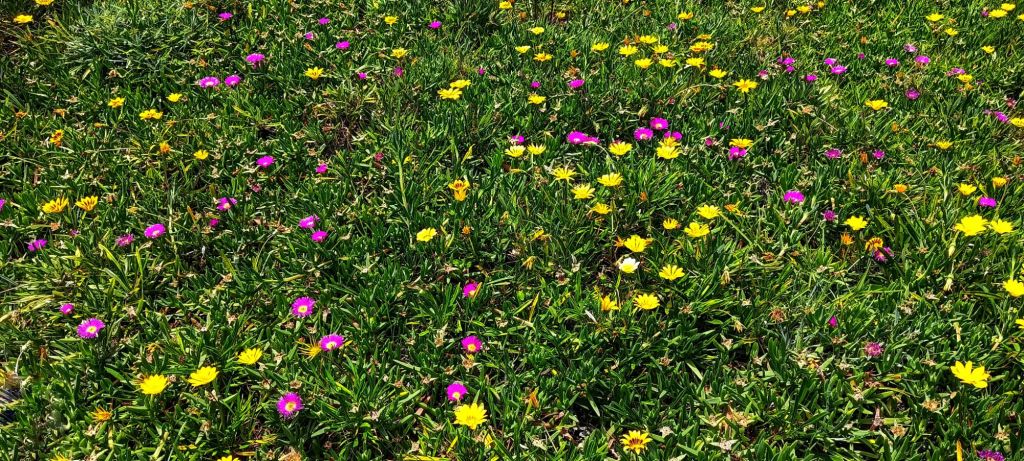
With Japa in mind I climbed yesterday to the crest of the sand dune on which our current hermitage is situated, to spend a while with the sea and the dunefield flowers, the birds, and as I planned to be doing some chanting, also with those unseen aspects of the Divine that I would be addressing with my words.

As seems to be happening quite often these days when I immerse myself in the beauty that is to be found all around me, all that is to be seen and experienced ‘up there’ as it’s come to be called, a poem wrote itself about yesterday’s particular excursion and experience.

I share it with you now in the hope you will enjoy reading it; thank you for reading it!

SAND DUNE KIRTAN

Perched upon the crest of a sand dune,
I chant the names of the Lord
Hare Krishna Hare Krishna
Hare Rama Hare Rama

I am still; the Lord’s names vibrate in my mind.
But Varuna’s energy washes saltwater back and forth
in the middle distance.
Sea waves manifest from depths unknown.
Sea waves dissolve on the shore
in the middle distance.

Now, in the near distance,
near to me where I rest and chant on sacred ground,
flowers with yellow heads, purple heads, wave in the wind
as if ecstatically dancing to a holy Kirtan
gifted them by the wind.

These myriad jewels in the dunefield join me in my japa.
Or is it that I merge with their sacred dances?

It’s neither, and yet it’s both:
The beautiful blooms are me,
and I am them.
We are the One,
Chanting and dancing
the names of the One.

DAYS OF AMSTERDAM CHANTING: A POEM FROM A CHANT SHARED

Reading the other day about the deeper meanings of the word Amen, a memory surfaced.

A memory from the summer of 1971. I was seventeen years old; young yes. I was hitchhiking around Europe, and as for this memory in particular, I was sitting day by day in the Dam Square in Amsterdam.

The memory of which we are speaking involves chanting. One day (or it could have been more), chanting, along with dozens, perhaps hundreds of hippies, freaks, travellers from all over the world, assorted tourists and locals.
Chanting Amen. Just like Sidney Poitier sings in Lilies of the Field. Minus all the verses; we chanted the chorus only. Amen. To help get the vibe, just go here.

Anyway, it was a nice memory, a memory of a day (and more) of music in a time of exploration, on the road and trying to be free.

More that that though: experiencing the memory gave me the feeling that that day, in the Square, had included at least a moment of devotion.

Sure, it was likely just one more tune among many sung during those times, but as I think about it now, I sense a distinct vibe of devotion and praise. I recall a sense of a kind of rejoicing in the word itself – Amen.

Anyway, here is the resulting poem. Do look up the chant; and do please join in, add your voice – your own distinct vibration – to the gathered voices.

Amen

DAYS OF AMSTERDAM CHANTING

Once upon a time
I hitchhiked to Holland.
Another mad attempted escape,
trying to leave the madness behind.
Amen.

Crashing in the park in the night,
beneath a bridge – when it rained,
behind the bushes – when it didn’t.
Amen.

Squatting in the Square in the day.
Sometimes singing days.
Dozens of hippies, freaks,
travellers, and even a few tourists and locals.
Amen.

Many memories of those days remain. Like this one:
I was 17, you see, in those days, squatting in the Square –    Dam Square.
Music in all directions. Truly surround sound.
Guitars, bongos, reedy things like flutes and whistles,
even a trumpet I can recall.
Amen.

Then, a chant erupts, and soon engulfs the gathered.
Amen … Amen … Amen, Amen, Amen.

And, now, I’ve joined the chanting,
maracas shaking held high, as if in exalted devotion,
as I sway to vibration overwhelming.
Amen.

This entrancing word, this creative vibration,
how long did it linger, permeating
the very air I was breathing?
Amen.

Memory informs: it was hours.
That is to say, it was eternal – or was it a mere moment? Same.
Of course, Amen – Om – the vibration of creation
was never born, is never changing, always existent.
Amen.

Always creating. Always dissolving.
Then again creating.
Making manifest that which was unmanifest.
Amen.

Or, is it a sound and light show?
Amen, the word, the vibration, the sound
shining a light on what is there already?
And what is there already,
is all there is.
Amen Amen Amen

Poetics & Photographs: Shared Note

Namaste and greetings

Another poetic and photographic note to share with you today. In the last month or so I’ve written two poems which are about angels. And both connected in some way with rain, or at least impending rain in one and actual rain in the other.

Initially I thought to just include the most recent of the two, but as I put my fingers on the keyboard it just seems to be emerging that I shall share both with you. And as you know I’m not one to ignore the demands of what types me!

Anyway, I offer them to your for your reading pleasure and perhaps cause for contemplation. Last shall be first in this matter I think. Enjoy please!

Angels, they are everywhere.
Perhaps there are more than we know?
Personifications of love, of compassion.
Of charity too.

ON THE TEARS OF ANGELS

Is it good that angels cry?
Anyway, why do they cry at all?

To wash away all the sorrows,
to cleanse, to purify, to make new.
And to ease the world’s pain.

Then, there are those of us
who can’t conceive of ourselves
as angels.

For those ones – each and every one – the tears of angels
are cathartic; granting catharsis.

A CLOUD ANGEL SEEN

An angel wing
seen in a cloud, ephemeral, gossamer.
And the angel?
She stands concealed within the silver linings of clouds, neighbouring clouds,
heralding a soon to be descending deluge.

The Q&A in the Scripture Part 1

Welcome to the first in a short – and occasional – series centred on a text containing a kind of Q & A session between Krishna (God) and Uddhava (his cousin).

Thirty six questions in all, with which Uddhava asks Krishna how he can live a good and honest life, dedicated to doing right and living the truth.

If you haven’t already, it would be really helpful if you read the Introduction post here, before going much further; just so you have a better handle on the context, the background etc. It will just help to set the scene a little more.

Now that’s been said, let’s get on and into it. The very first question Uddhava puts to Krishna is actually two questions in one.

What is quietude and self-control

Good questions, the both of them, given the circumstances Uddhava finds himself in. His hometown (it’s Krishna’s too) is about to descend into a nasty civil war and is most likely a chaotic, noisy, overwhelming and frightening environment to be stuck in.

Uddhava, like the rest of us just wants a peaceful life, and as to the second question, well he’s bound to be asking himself the same question we’d ask: Why can’t these people just control themselves before it’s too late? Not to mention the onslaught of emotional and mental anguish he’d be suffering himself.

Anyway, Uddhava is about to leave town following his cousin’s advice, and would like to find out how he can go on to live a good, righteous and honest life, while he’s in exile from his home.

Krishna chooses (sensibly I’d say: they’re both big questions) to answer one question at a time and he begins by explaining what is quietude:

Quietude is fixing the mind on me.

Krishna is not saying here: ‘Look, once I’m gone [I think I’ve mentioned that he’s leaving too, going back to Heaven or wherever he lives on a permanent basis] try to remember your dear old cuz in the odd quiet moment now and again will you?’

What I think he is actually saying is: ‘If you fix your mind on me, then that’s quietude’. We could call it silence as well. He’s not saying ‘I am in the silence’, nor is he saying ‘Through silence (or quietude) you will come closer to me’. No, what he says is ‘Quietude is what I am’.

So, what about those of us not in a first names relationship with Krishna? Well, think of Krishna as being a name and form of Universal Consciousness. Yes, the same Universal Consciousness  that is all created and non-created things; the sun, Earth herself, trees, the oceans, all living and non-living beings in the Universe, in all universes if there are more than one.

There are a whole list of synonyms for quietude: equanimity, calmness, peace of mind, rest, serenity, dispassion. Just to name a few.

These further definitions are really quite helpful. What I mean to say is that we rarely if ever associate that calmness, equanimity, peace, and the rest, with actually being the Universal Consciousness, that is also all of us and everything else that is. Again, think of Consciousness as the Divine, God, or by any other name and form, you attribute to the natural order and flow of the Universe.
Forgive the repetition : Quietude, calmness, peace of mind, are not where you will find God or consciousness, or whatever. They are all consciousness.

The beach is also dog friendly

Have I mentioned that the current hermitage is a cottage on the side of a large sand dune, on the other side of which is a stunning stretch of Pacific Coast beach. Sitting on the top of the dune and looking out over the beach and ocean it is easy to think of all that’s seen as divine.

It is most definitely a peace of mind, calm and quiet inducing experience to sit there. Certainly it is quietude itself with the only sounds being the song of the universe in the form of the waves and wind.

A question I asked myself, and I now pose to you: If what we’ve been calling Universal Consciousness is actually all that is, then why not a state of mind like quietude, calmness, balance, and the rest? Like everything else perhaps these states are simply elements of that consciousness or Absolute Reality, or oneness, or what some call God, the Divine, or … ?

In any case, I have a feeling that’s what Krishna was getting at with his answer, and what Uddhava somehow intuited with his question.

Thank you for joining me on this little pilgrimage. in the next post in this series (it could appear anytime, so stay tuned!) we will discuss Krishna’s answer to Uddhava’s second question: What is self-control?

Peace

Un hommage à tous les ailés

Follow the Way of Love

Bhakti  – intense devotion – leads to prayerful surrender which clears the mind of thoughts and concerns. Then, meditation is made possible.

            Swami Tadatmananda

A recent favourite quote from my teacher, that is helping me a lot on my own spiritual journey. Wikipedia also describes Bhakti in terms of intense devotion, adding words such as faith, love, homage, worship.

The wonderful Wikipedia also tells us that Bhakti is a term common in Indian religions, which may refer to loving devotion towards a personal god, a formless god or an enlightened being such as Buddha. They add:
Bhakti is often a deeply emotional devotion based on relationship between the devotee and the object of devotion.

Then what of one (AKA me) who at least aspires to see all things – all living and non-living things, all of ‘creation’ – as the Divine? How does a ‘loving devotion’ towards God work when one is striving to fully realise that there is only the Divine?

In my heart I know that all there is is the Divine, or God. Or put another way: it’s not so much that the Divine is in everything, or that everything is divine; the sense I have and aspire to realize completely, is that everything is the Divine. One without a second, the teachers say.

(Just a quick disclaimer: my heart may be telling me that there is only the Divine, but the rest of me still has a lot of catching up to do)

So, how does it work? Well writing it down in words seems to make it sound very simple: if everything is the Divine, is God, then it’s simple logic to assume that devotion to the Divine means having loving devotion towards all and everything; for all of existence, for everything that is. For all of creation as some say.

Simple to say, yes. Not so easy to easy to actually attain such a state. Of course the first thing to say is that it isn’t a state to attain. I am a part (not quite the right word) of that creation, that divinity, and as there is only one without a second, then logic again tells us that I am that creation – just like you and everyone and everything else that exists.

As such, it would seem to be an easy matter of me simply loving myself which automatically includes everyone and everything else in the Universe in that love (note to self: make this little paragraph my new mantra).

Here is where that ‘thoughts and concerns’ thing comes in. We all know how our minds like to interfere and get involved with every little thing. The mind tries to convince us of our separation from other people and the rest of life too, while its ally the ego runs wild convincing us of the urgency of status, of possessing things, of competing (also status isn’t it?), acquiring more stuff and worldly knowledge and power.

The solution? The means to realize one’s love for all? Prayerful surrender – which our quote tells us is acquired through the practice of Bhakti or loving devotion.

But hold on: Isn’t the realisation of our love the very thing we want to achieve? So, we are to use a practice involving love to realize our love?

Ah yes: the means is the end. Now that’s a nice little insight don’t you think? But, still, Bhakti or loving devotion isn’t at all easy, even if you’re talking about a personal God or deity or the Divine; how much harder it is (speaking only for me here mind you) to suddenly love everyone and everything, to suddenly recognise everyone and everything as the Divine. Including, mind you, things and people I don’t like or have a distaste for or aversion towards.

So what I try to do is be open and receptive to things, ideas, concepts, other living beings, that resonate within me as representing the Divine. Then I make those things the objects of my devotion which means my prayers are prayed with a mood of love. Good vibes you see. They spread out like (my partner hermit says) ripples in a pond or even waves in the ocean. No need to think of who or what I don’t like; they’ll be affected by those ripples too.

You’ve read my prayer to the Divine Mother – the embodiment of the Divine qualities of love, nurture, compassion. And soon I hope to post my Prayer of praise and gratitude to Trees. In that prayer I express my love, praise, respect for, and gratitude to, trees.

So many people – even the non-spiritual – view trees as symbols of creation in action, strength, resilience, even compassion and shelter. In other words, the Divine.

To surrender my heart to such representatives of the Divine is my continual effort and prayer. I pray to fully surrender to the natural order and smooth running of the universe, or the Divine.

And that surrender will come through my continuing and growing loving devotion.

Now, the ‘meditation is made possible’ bit? Well we all know what meditation means don’t we? Pretty much as many meanings as there are people meditating (and many who are not!). In this context I think the meditation that’s made possible is more a kind of contemplation leading to a clear comprehension or understanding.

Contemplation of the entirety of the Universe (which includes you obviously) as one whole, undivided expression of love or the Divine.

Comprehension is understanding, in a final, complete truly ‘knowing’ way, that the things of the world – the status, the possessions, wealth, sensual pleasures – are not and never can be the means to attaining perfect peace and happiness.
Of course, the ‘things of the world’ continue to be important. After all, we are (at least our bodies and minds) things of the world too aren’t we?

But that contemplation of the totality as the Divine will help us to reduce our suffering by helping us to reduce our excessive desires or cravings for those worldly things.

I think I mentioned that Bhakti, loving devotion, can be difficult. It’s true it is often hard to focus on love and devotion, to always have your heart available and open. But, you know, it can actually be a very satisfying and enjoyable feeling, and I can say a really nice experience.

So, I hope some of the ripples (and some of the waves too), some of those good good vibes are making themselves known to you.

Thank you and my love to you

Happiness, Freedom & Other Joys VS Anger, Depression & Other Sufferings

Frustrated, depressed, annoyed, and even angry at times. All because I know for certain sure that it’s God’s will that I write more – as in more often, more volume, and more quality too. And I’ve vowed to do God’s will in all things to the best of my ability.

No, actually those extremely un-monklike emotional reactions are not because of this knowledge of the will of the Universe or my vow to obey; I have those unhappy emotions because of the other vow I’ve yet to mention: I have vowed to find ways to content myself with how the universe unfolds for my life, and for the world.

I’m not saying that I have promised to resign myself to ‘fate’ or ‘destiny’ or whatever one might call it. No. And it’s a big no because while what happens in the material world is working out according to the laws of nature, it’s equally true that I am in that mix: I have my part to play in the universal scheme of things, just like we all do. It’s a matter of I do my bit, and the Universe (or God) does its bit.

And then it struck me. Blew my mind is more like it. All my frustration, depression, anger, and whatever, over not writing to my own desired level, is really nothing more than a raging against God’s will. Needless to say, this reaction is really quite a distance from obedience!

Another thought on the topic of God’s will – the laws of nature and the natural order of the Universe: By obvious definition those laws and order must (obviously again) apply to all things in what we call the Cosmos or Universe.

All material things, such as bodies, as well as non-material things like minds, emotions and the like. You name it; All there is is bound by the same set of natural laws.

So, speaking for myself alone, not being able to write to my expected or desired for level is only one – and quite a minor one it has to be said – of numerous areas in my life and the world that cause me frustration and all the rest, as I struggle to to be content with the will of the Universe.

Too big a topic, or should I say too many topics to get into here. In any case, shall we set aside that not so little aside for now?

So, where were we? Right: Raging against God’s will; resisting the ways in which the natural laws of the universe are working themselves out. Sounds terrible when you see it  writen down like that doesn’t it?

Anyway, it’s clear to me that the Universe , the will of God, is trying to say something to me, which sounds something like this:

‘Look you may very well want to write, you might even be desperate to get those words and ideas out of your head and onto the page, but that’s just not the way things are right now is it?

‘Of course the smooth running of the Universe involves you, and in a big big way too, but you are still just one element in what is really quite a complex, not to mention gigantic, system.’ Nature can put you in your place for sure sometimes.

‘In fact it might be,’ this spokesperson for the Universal order continued, ‘that the Universe is trying to get a none too subtle message across to you? Do you think that desperately clinging to some outcome you want or desire that strongly but can’t seem to get, is causing you pain? Of course it is. Anger, depression, all those sad and negative emotions, they are just not necessary.’

The Universe (in its manifestation as my discursive mind) can be very vocal sometimes, but I think I sort of get it.
Essentially what that Universal spokesperson is saying is that the order of the Universe is working out just as it’s supposed to. Actually it can’t do otherwise. I play my part (which according to the spokesperson is bigger than I imagine), and really that’s all there is to it.

In other words, If I’m not writing, then that is precisely what is supposed to be happening (or not happening) right now. And not only that, but because I am an active participant in the way the Universe looks and behaves right now, then it’s also pretty obvious that I already know – deep down somewhere – that it’s really alright. It’s all just as it’s meant to be.

Once again speaking just for myself, I find it quite tricky finding the balance between what part I am to play, and what’s the Universe’s bit, in controlling the direction my life takes or in affecting the conditions that impact me.

Perhaps the best way, indeed it might be the only way, to have a positive impact on my own happiness, peace, contentment, and having a calm mind, is to give up any desires for things that won’t contribute to my spiritual and personal growth or the wellbeing of other beings, while at the same time acting upon without attachment to the outcomes, those desires that seem to me to be for the good of all, including Self. 

Being attached – driven by compulsions or aversion – to the outcome of our desires, however, simply leads to more desires even when fulfilled.  And when they are not fullfilled, there is suffering due to clinging to those compulsions.

Bottom line? I am seriously attached to my desire to write more (as well as so many other things as I alluded to earlier), that not being able to do that right now is causing a lot of suffering. Enough of that I say! Oh, that balance thing: it’s about discernment isn’t it? Okay I get it, story for another day.

PS I’m so glad I got that all out of my head and onto the page. Thanks for listening friends.

Just Another Day at The Office

Who am I to even contemplate composing a commentary on the Bhagavad Gita (BG) after only seven or eight years of study, some formal with a teacher and some more casual alone?

Well, what I am is nowhere near qualified, nowhere near ready. Actually I don’t feel qualified in any way for such a thing. So much less so was I when I first sat down with my newly gifted BG in a tiny cafe called The Office in Rishikesh, literally hanging over the river Ganges.

A Saddhu or Holy man and his phone at The Office

With the best fruit salad in the Universe, and fine chai to match, it was the ideal place for contemplation – that is when it wasn’t bursting at the seams and crazy.

But, as I sat there with my new BG I was one of only a couple of customers, so it was a conducive atmosphere for the aforementioned contemplation. Instead I think what happened as I thought about how to proceed to a proper study, was I allowed the sugar from the just ingested fruit salad go to my head.

You see, I decided, as I sipped a post-fruit salad chai, that the perfect study method would be to write a commentary on the whole thing starting with Chapter one, Verse one.

I no longer possess the diary in which this masterpiece was begun. Nor do I recall much, actually nothing, of what I wrote. It’s enough to say however that nothing I wrote could possibly have had any significance or depth or proper perspective.

So, as you might guess, I rambled and waffled for a couple of verses before I snapped out of my ego-driven state of arrogance and hubris. I realised I had absolutely no business taking on such a task. My lack of knowledge, wisdom, experience, all disqualified me from even thinking I had a right to try.

Now, even with the small amount of knowledge I have managed to acquire after all the study, I’m stunned at that arrogance and hubris – even if it was sugar induced. I mean, I’d never even read more than a few verses of the BG before. So, how could I even form a ‘first impression’ or ‘casual opinion’, much less a full blown commentary?

A couple of days ago I read a couple of verses that really resonated with me, as they have before. So, just like that fool sitting in The Office all those years ago, I confidently asserted that I was more than up to the job of making a commentary on those verses for this blog.

But, and here’s the really weird thing: I only just now realised, as I’ve been writing these notes, that the two verses which I will quote for you shortly, address precisely my behaviour on that post fruit salad, sugar shock induced ego trip.

I realised that it’s as if I have indeed written a commentary on those verses. And I have used a personal experience to illustrate the text. Absolutely unintentionally as it happens.

Regardless of what excuse I come up with the error in judgement in thinking I could write a full blown BG commentary all those years ago, the reality is that I failed to act with discrimination, or what I would call discernment.

In the high holy lands wrong thinking can still happen

Somehow I ignored (or totally forgot) the facts: I knew nothing! I’d lost the ability to discern what I could do and what I couldn’t do, what was a sensible action and what was a ridiculous one.

Stop! Memo to Self: Please stop picking on me!

Anyway, moving right along, here are the verses – free from commentary!

‘Thinking about sense objects brings an attachment towards them. Attachment leads to desire and desire leads to frustration, which in turn leads to delusion.
When you are deluded you lose your memory [the knowledge and experiences you could draw on to make proper decisions; sometime even to the extent of compromising your own values] and with the loss of memory the power of discrimination is destroyed; with the destruction of discrimination your self itself is lost’ .

Bhagavad Gita Chapter 2 Verses 62-63 (my version of the BG sometimes combines verses as it has here)