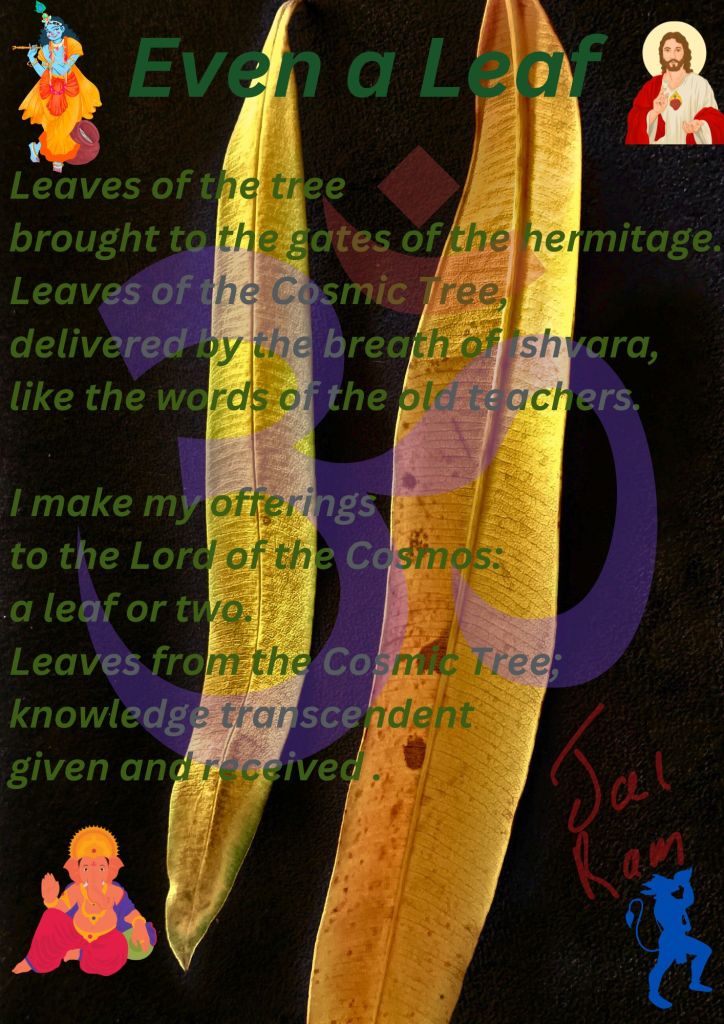
Today, a poem for your reading and contemplative pleasure. The title of the poem comes references a verse from the Bhagavad Gita in which Lord Krishna talks about what are acceptable offerings: He tells Arjuna that God, or the Divine will accept even a leaf as an offering of devotion.
So, when I returned to the Hermitage one day recently to find two leaves on the ground at the front gate, I recalled that verse and decided to make of those leaves, just such an offering.
Today I went on a pilgrimage.Not that I don’t undertake all kinds of little pilgrimages all the time. And even more, it’s not as if my whole life – just like yours and everyone else’s – isn’t one ongoing and continuing pilgrimage.
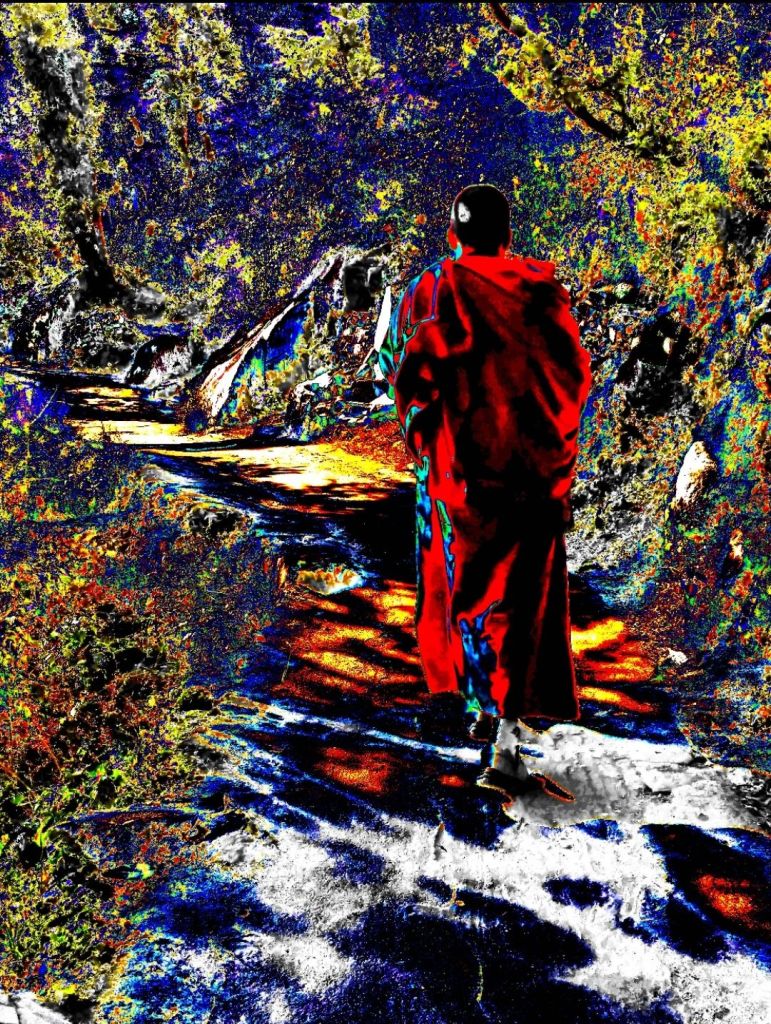
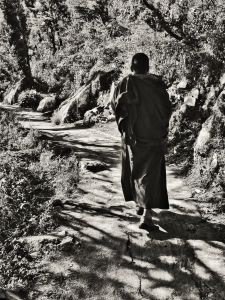
All true; but this one, today, was embarked upon in what might be called, a classic manner: on foot, to a place of sacred significance, and in a spirit of contemplation of the nature of the journey as well on that which is being pilgrimed too. (I am positive there is no such word!)
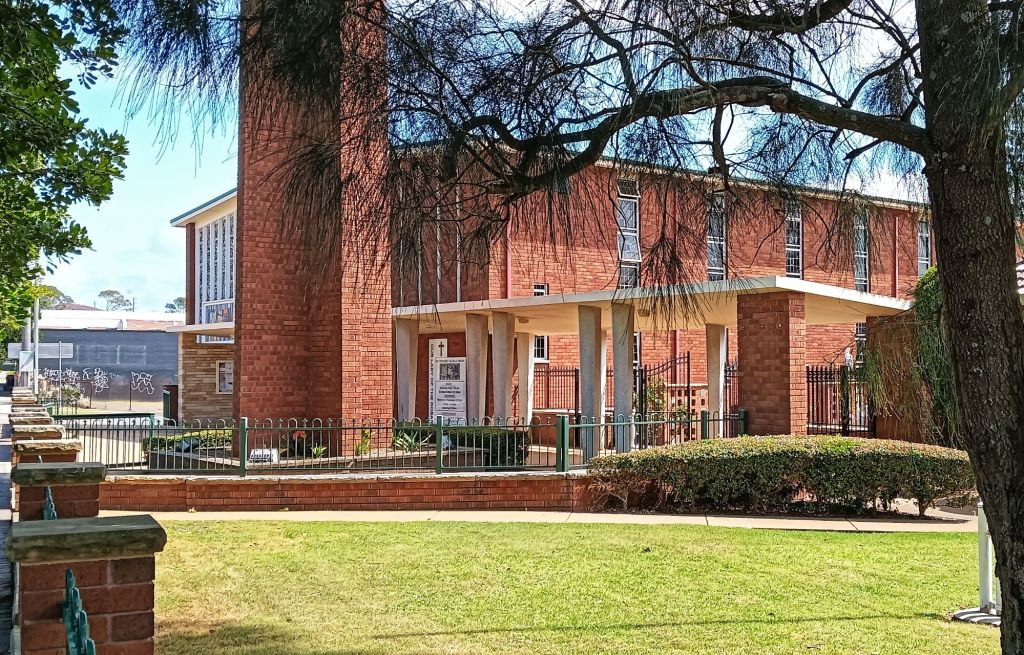
In this case, today’s pilgrimage, that place was a church about two and a half kilometres from the hermitage. It’s a place I have visited several time, but today was the first time I set out as a pilgrim and walked in the way and spirit of the pilgrim.
Our Lady of the Rosary is a Catholic church dedicated to the Mother of Jesus in her role as patron of the Holy Rosary, a Catholic way of prayer that has evolved over time and is a key part of the lives of many Catholic people.
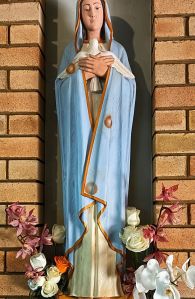
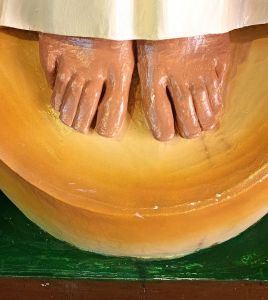
Just to the right, just inside the door there is a plain brick wall in which there is a small niche. The niche holds an almost life-size statue of Mary. She stands, hands folded over her chest on which sits the Dove of Peace.
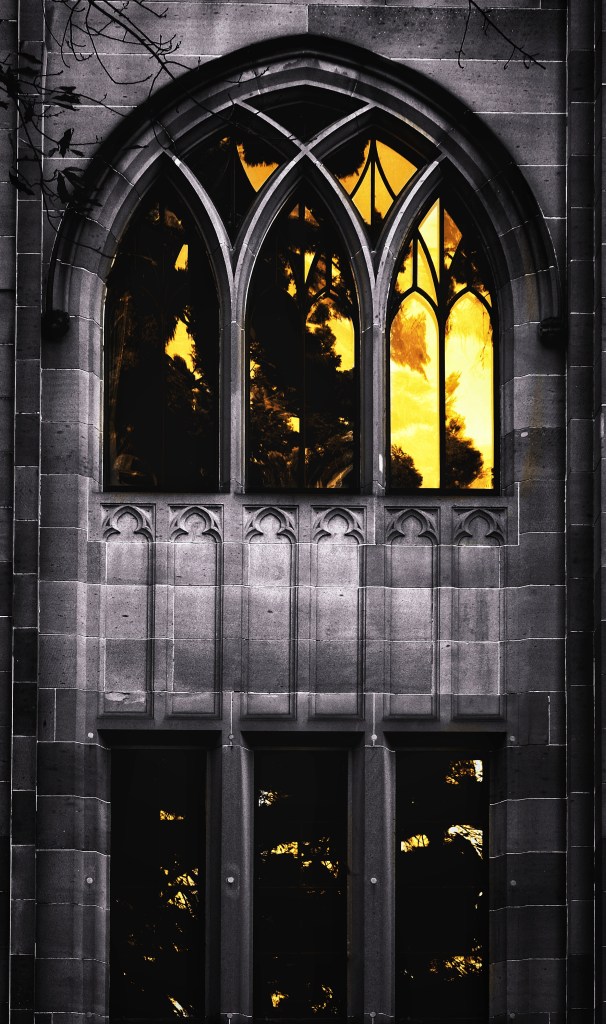
You can see from the photo that the church itself is a lovely, quiet, serene place full of good vibes and nice peaceful energies. The object, however, of my pilgrimage was not the church in itself, but stood just inside the side door accessed through an equally peaceful, fountain centred garden.
I have come to offer her – this form or manifestation of the Divine Mother – the prayer I wrote to her which I hope you saw when I posted it on this blog recently.
I had decided that my pilgrimage vow would be fulfilled once I had knelt at her feet and offered her the words of my heart in prayer.
My reverence for the Divine Mother is well known, and especially in her form as Mary the Mother of Jesus. Or Our Lady as we called her as good little Catholic children way back in the long ago. And I know I have said often that the entirety of the material and non-material cosmos is a manifestation of the Divine.
So, why then a special trip on foot, that I’m labeling a pilgrimage to a specific site, so I can kneel at the feet of a statue that I know perfectly well is made of stone or plaster and is simply a symbol of one aspect of the Divine?
Actually, the question has answered itself. The pilgrimage and my associated actions worded in that question tell us the why.
It is about acknowledging at a heart level and in my own way, that that symbol, that form, is actually representing a particular aspect of the Divine that I revere.
Besides, I’m not the first person who’s knelt at that spot, at Mary’s feet. I don’t know the age of the church, nor do I know the history of that particular statue, but I think we can say for certain that many hundreds, if not thousands of other people have been there where I was and spoken words from their hearts.
Being honest and true now, what I can say is that, as I said to my partner hermit: ‘I feel like i’ve been on a pilgrimage’.
And I do. I’ve walked – praying and chanting – to a sacred place where I have prayed at the feet of the Divine in the form of a likeness of Mary. I feel blessed that I actually got to offer the prayer I wrote to the Divine Mother.
Somehow I feel a link was established. A heart (mine) opened ever so slightly. I acknowledged the Divine, and I sense that I might just be – ever so slightly again! – topped up with a bit of the Grace that is in reality our true state.
Mary in the Garden (enhanced by a fellow Hermit Pilgrim. Thank you)
So, this is the story of my pilgrimage. I was absolutely exhausted when I arrived back at the hermitage. Most likely that was due to the heat, the traffic, and the noise encountered on the way I trod.
But, now I’ve shared this little tale with you, I’m not tired. Anyway, the Way is not always easy, and we are all very well aware of that aren’t we?
Namaste friends. The Divine in me salutes the Divine in you.
It’s a walk to take,
a pilgrimage to make.
Sometime soon.
Said by me long ago, I don’t know when or where. It was one of those ‘You’re a poet and don’t know it’ moments.
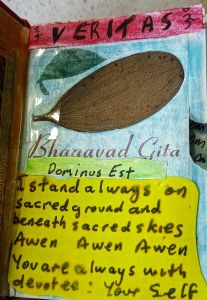
Right at the front of my Bhagavad Gita (the only book aside from the notebook I’m writing this in, that I personally own), I have recorded and inserted sayings and various words , that are important to me. Among those things is a statement I first heard many many years ago, that is common among the First Nations’ peoples of this country:
I [We] stand always on sacred ground and beneath sacred skies.
It is not an affirmation of ownership or possession. It is, instead, an affirmation of belonging to the land, to nature. It is a prayer of thanks, and it is a declaration of the knowledge of unity with the rest of the natural world, that is the hallmark and foundation for Indigenous cultures throughout the world and through time.
I’ve valued – treasured – this sentiment for a very long time – probably from even before I first heard it, which was so long ago as to be lost to memory. Perhaps I always knew it because I’ve somehow always thought this idea was a fundamental truth concerning my existence as a being living on this planet.
Well, now I have heard another statement that for me makes a perfect compliment for this one. The other day, during a lecture, my teacher mentioned that in his student days a fellow student said:
Wherever you are, you are walking through Ishwara
(Ishwara being her preferred name for the divine – for all that is.)
There is a feeling or sense of ‘belonging’, of awe and wonder when we attempt to immerse ourselves in what we term the natural world.
Once again I immediately felt the bell of Truth ringing clearly through this statement. Yes, I thought, everything is divine – including our own selves – so of course it follows that wherever we go, whatever we do, we are always in the divine.
You’ve probably read a number of times me quoting my teacher quoting his teacher:
Emphasis very much on only. Meaning of course, that it’s not that God is within us, or that we are within God; we are not surrounded by God; and it’s not that God ‘sits in our hearts’. The reality (for my teacher’s teacher) was that all that is, everywhere, everything, every thought, every word and deed, everything there is, is the divine.
Another way to describe the divine or God, that appeals to me is that Ishwara (also my own preferred name for the Divine) is in reality the natural order of the universe as dictated by the laws of nature. Those laws of nature, the rules that govern how the universe works, are also Ishwara, as are all that is manifest or in existence as a consequence of the workings of those laws.
In other words, the Divine is the sum total of what some would call the entirety of creation.***
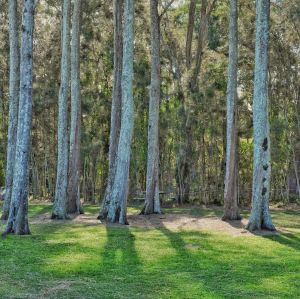
For the hermits a sacred site. Part of a grove we named The Sentinels. A place of experience of unity and oneness of creation
For me this an enormously comforting and reassuring concept. Of course, for me at least, it is also an extremely difficult one to wrap my head around. But here’s a small summary of what I think I’ve grasped so far.
Ishwara – the Divine – is all there is; everything. Also divine is the natural order of the Universe as governed by the laws of nature. These laws are neither good or bad – there is no duality. They are neutral.
You and I, as one more entity among who knows how many others, act as we do and are subject to the laws of nature, just like everything else. We can’t change or influence those laws; we can only live our lives as they unfold.
To quote from Desiderata: No doubt the Universe is unfolding as it should
And, well, then things just work out as they do. While we can’t change the laws of nature, or bend the universe to always suit our liking, it is also true to say that every action we take, every thought we think, every word we utter, even our very presence as a living being in our time and place, do indeed contribute to ‘how things work out’. Another way of saying this is to say, we do our bit, and the universe does its bit and what happens, well, happens.
For me, this is not at all as simple or as straightforward as it sounds. Naturally we see ourselves as individual selves, as entities on our own. After all, to state the obvious, we live and operate in a material (dualistic) world. So automatically we see ourselves as individuals living in, but always separate from all the other individual entities, as well as being disconnected from the world itself.
It is part of human nature (for the most part) to long for connection; there is so often a drive within us pushing us to create family, enter relationships, feel we belong to a community or communities, and for many but not all, there is the almost instinctive urge to seek connection with the rest of nature.
Many forms, One reality
We often think of these longings as goals to achieve, as something outside of ourselves to attain, to reach for. Consequently, so very often we tend to focus our attention outwards, towards other people, or material things.
But, instead, all these inclinations, desires and longings are simply our Self (note the capital?) endeavoring to open itself to discovering (or rediscovering?) that which already exists: our oneness with, and our non-separation, and non-difference from, The All That Is.
Peace and Love from Paul the Hermit
FOOTNOTE
***Just a few thoughts about naming, or giving labels to the Universe and its laws. Obviously it’s a personal choice for each of us what we choose to call that creation. Then, on the other hand, we don’t have to call it anything at all. For me personally it is very difficult, even near impossible to not name it. By naming the creation, I don’t think I am attributing the manifestation of the Universe to some distant entity living in some heavenly abode (as my teacher likes to say). Rather I am acknowledging the intelligence and order, beauty, complexity of all that is and how it all works, as its own reality. At the same time, I am learning to understand that I as my true nature am not separate from the rest of creation, and I feel the need to have a name towards which I am able to focus my thanks and my reverence.
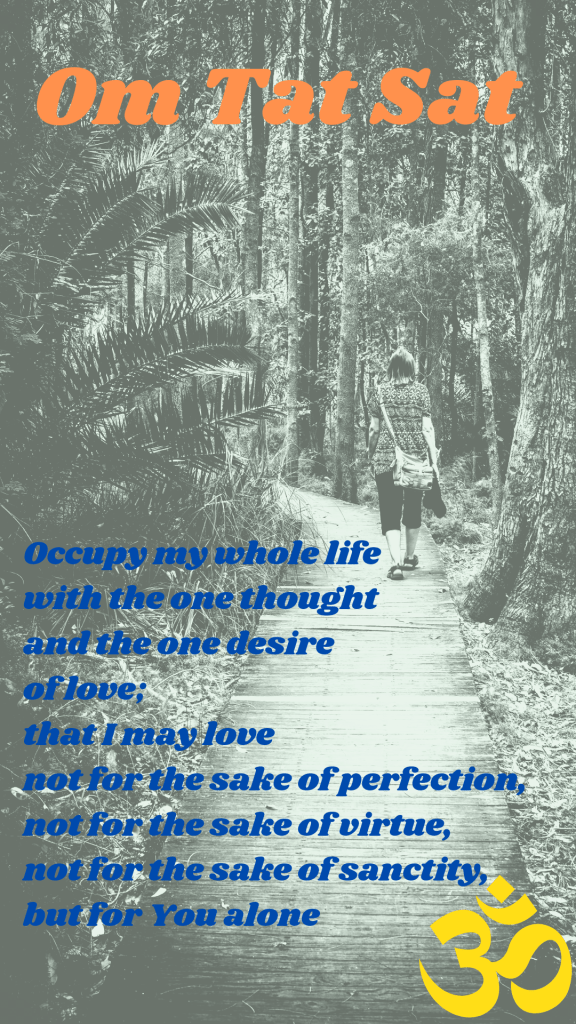
I’m not completely sure where I found this prayer. But I have a feeling it is by Thomas Merton, one of my most favourite and significant teachers and guides.
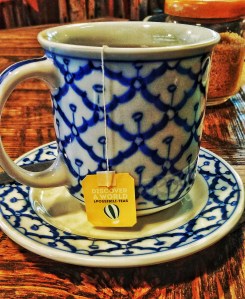
An idea that’s kept its hold on me for a while now concerns Black Tea and Dry Toast. It’s a part of my almost daily diet, and I’ve wanted to write about it. Anyway, here’s the note I first jotted down when the idea first came:
Black Tea and Dry Toast – In Reality is what we might call the food and drink of the Gods, of liberation, especially when I remember to offer it to Brahman and it becomes Prasada: simple, appetising, comforting, nourishing. What else?
Yes, sounds kind of weird, writing about such an apparently mundane subject. But, really, I can say it definitely is for me the food and drink of the Gods. And as such, it moves beyond the little r reality of worldly food, of mundane considerations. It takes on the big R of Transcendental Reality.
Simple, plain food and drink. Pared down from all the extras and the padding, all the ‘additives’ we generally ply ourselves with. In a real sense this simplicity is in keeping with the uncluttered, minimal life I am called to live.
And everyone knows how comforting tea and toast is, how welcome it is pretty much any time of the day or night. Nourishing, too, for the spirit and the mind.
Actually for the body also. At least it is for me as a person who used to eat way too many biscuits, and take jam (thickly) on my toast. As I say, simple with no additives.
All of this equals in my view liberation. Freedom. Freedom at least sometimes, from harmful substances; Liberation from complicated preparations and the stresses and tedium that comes with it.
Black Tea and Dry Toast represents a snack (sometimes even a small meal) that at least for a short time can liberate us from stresses and tiredness. At other times, it gives us that freedom that comes from indulging in simple pleasures.
The food and drink of the Gods is not a complicated, invented and dressed up thing. It is plain, simple, comforting, nourishing.
And yummy.
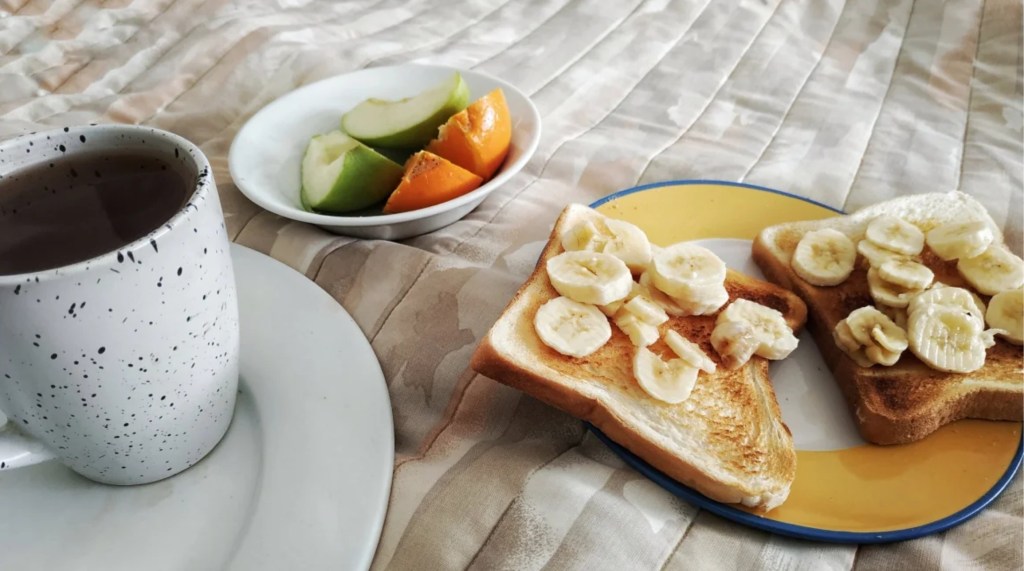
PS Okay. That photo stuck in the middle up there isn’t quite in keeping with the topic is it? Alright, I admit it: Sometimes I really indulge myself and add banana to my toast. And yes, sometimes apples and oranges too


 Notes from the Hermit's Cave