Everything & Everywhere

Namaste friends

In the High Holy Lands Where Magic Sometimes Happens

For the last while (long while really. Actually many years), I have dreamed a few times a month, sometimes more, that I am in, about to arrive in, or just about to leave Rishikesh in India.
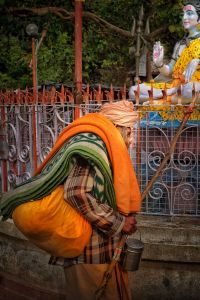
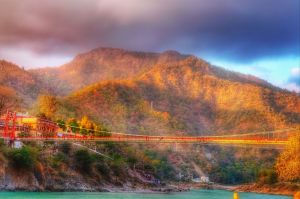
Rishikesh is a small town straddling the Ganges River, and nestled in the foothills of the Himalayas. For millennia it has been considered a sacred place. Its history replete with stories of divine beings, ancient sages and saints, not to mention its status as a major pilgrimage destination for at least a thousand years and the town becoming ever more popular in recent years for pilgrims and ordinary pleasure seeking tourists from around the world.
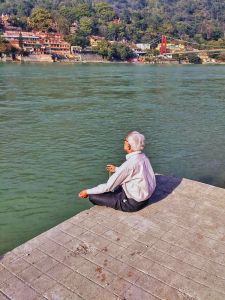
This isn’t me but it could be

I last visited Rishikesh in 2016-17 (having previously spent time there in 2006) when my partner hermit and I stayed for several months. I associate that stay with the strengthening and deepening of my spiritual practice as well as the gaining of a kind of clarity in terms of my outlook on the world particularly on the spiritual path that had been calling to me – as it does still.

Putting aside health issues that hinder our mobility, I think it’s fair to say that my attachment to Rishikesh and my longing to return have more or less faded away almost completely over recent years.

Rishikesh has always been a busy, crowded place with the associated traffic, noise, pollution, and inflated prices. Rampant commercialism has long threatened the town’s ‘spiritual ‘ or ‘sacred’ vibe. These days it is the fourth most visited place in India for overseas travellers  so it’s likely to be more busy, choked with traffic, noisy, more commercial and material focused than ever, with the associated degradation of its appeal for some.
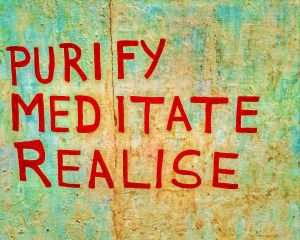
But, even if I were also  able to put all this aside, I think the core of the letting go of my longing for Rishikesh has more to do with the turning inward that has accompanied our eventual recognition of our calling to the hermit life with its quiet, secluded, contemplative lifestyle (or the aspiration for that life).
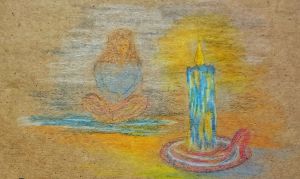
So, why the dreams? Why so often? Well, as I’ve mentioned, Rishikesh has played a significant role in my life. And despite the dropping away of those longings and attachment, I’m not saying going there again is totally out of the realm of possibility, but it no longer has that ‘I’m home’ kind of feeling. No longer has that magnetic attraction for me.

Now, here’s the missing information about these dreams I’ve neglected to mention thus far: Not one of the dreams has been set in the ‘real’ Rishikesh; never have they been ‘geographically correct’ for wont of better description.

Sometimes the dream town is nothing more than a small clump of houses sitting on a hill or in a field with a dirt track passing by.
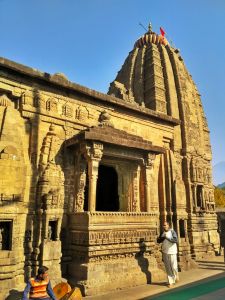
Other times it is a sizeable town with temples, streets, cafes and shops masquerading as an Indian town. Sometimes it’s simply a story taking place inside a shop or restaurant that, in the dream, I know is in Rishikesh though not in the terrestrial town. There have been dreams in which the town is more like a city with highrise buildings, multi-lane roadways, and all the rest.

The most recent dream had me in a bus headed for another bus connection to Rishikesh. Worried about missing the connection, I was told that the Rishikesh bus wasn’t due ‘for weeks’.

Many and varied settings all standing in for the ‘real’ Rishikesh. But I don’t think I need Carl Jung to tell me the meaning of these dreams. All of them are my internal sacred or significant ‘Rishikesh’. It’s as if the actual geographic location in India called Rishikesh is the illusion and these dreams are the reality for me. All emanating from the cave in my heart

My inner or true Self, you might say, telling me that my being concerned with my specific geographical location is missing the point. A message for me that I am always in Rishikesh, that I am always in sacred space and with saints and sages, and that the Divine is everything and everywhere.

Om Tat Sat

The Q&A in the Scripture Part 1

Welcome to the first in a short – and occasional – series centred on a text containing a kind of Q & A session between Krishna (God) and Uddhava (his cousin).

Thirty six questions in all, with which Uddhava asks Krishna how he can live a good and honest life, dedicated to doing right and living the truth.

If you haven’t already, it would be really helpful if you read the Introduction post here, before going much further; just so you have a better handle on the context, the background etc. It will just help to set the scene a little more.

Now that’s been said, let’s get on and into it. The very first question Uddhava puts to Krishna is actually two questions in one.

What is quietude and self-control

Good questions, the both of them, given the circumstances Uddhava finds himself in. His hometown (it’s Krishna’s too) is about to descend into a nasty civil war and is most likely a chaotic, noisy, overwhelming and frightening environment to be stuck in.

Uddhava, like the rest of us just wants a peaceful life, and as to the second question, well he’s bound to be asking himself the same question we’d ask: Why can’t these people just control themselves before it’s too late? Not to mention the onslaught of emotional and mental anguish he’d be suffering himself.

Anyway, Uddhava is about to leave town following his cousin’s advice, and would like to find out how he can go on to live a good, righteous and honest life, while he’s in exile from his home.

Krishna chooses (sensibly I’d say: they’re both big questions) to answer one question at a time and he begins by explaining what is quietude:

Quietude is fixing the mind on me.

Krishna is not saying here: ‘Look, once I’m gone [I think I’ve mentioned that he’s leaving too, going back to Heaven or wherever he lives on a permanent basis] try to remember your dear old cuz in the odd quiet moment now and again will you?’

What I think he is actually saying is: ‘If you fix your mind on me, then that’s quietude’. We could call it silence as well. He’s not saying ‘I am in the silence’, nor is he saying ‘Through silence (or quietude) you will come closer to me’. No, what he says is ‘Quietude is what I am’.

So, what about those of us not in a first names relationship with Krishna? Well, think of Krishna as being a name and form of Universal Consciousness. Yes, the same Universal Consciousness  that is all created and non-created things; the sun, Earth herself, trees, the oceans, all living and non-living beings in the Universe, in all universes if there are more than one.

There are a whole list of synonyms for quietude: equanimity, calmness, peace of mind, rest, serenity, dispassion. Just to name a few.

These further definitions are really quite helpful. What I mean to say is that we rarely if ever associate that calmness, equanimity, peace, and the rest, with actually being the Universal Consciousness, that is also all of us and everything else that is. Again, think of Consciousness as the Divine, God, or by any other name and form, you attribute to the natural order and flow of the Universe.

Forgive the repetition : Quietude, calmness, peace of mind, are not where you will find God or consciousness, or whatever. They are all consciousness.

The beach is also dog friendly

Have I mentioned that the current hermitage is a cottage on the side of a large sand dune, on the other side of which is a stunning stretch of Pacific Coast beach. Sitting on the top of the dune and looking out over the beach and ocean it is easy to think of all that’s seen as divine.

It is most definitely a peace of mind, calm and quiet inducing experience to sit there. Certainly it is quietude itself with the only sounds being the song of the universe in the form of the waves and wind.

A question I asked myself, and I now pose to you: If what we’ve been calling Universal Consciousness is actually all that is, then why not a state of mind like quietude, calmness, balance, and the rest? Like everything else perhaps these states are simply elements of that consciousness or Absolute Reality, or oneness, or what some call God, the Divine, or … ?

In any case, I have a feeling that’s what Krishna was getting at with his answer, and what Uddhava somehow intuited with his question.

Thank you for joining me on this little pilgrimage. in the next post in this series (it could appear anytime, so stay tuned!) we will discuss Krishna’s answer to Uddhava’s second question: What is self-control?

Peace

Un hommage à tous les ailés