You’re Already There.

There are many blessings that come with the living of the hermit life. And I am especially blessed as I am not a ‘hermit alone’ – I share my life, the Hermitage, and my spiritual practice with another hermit. We are partner hermits.
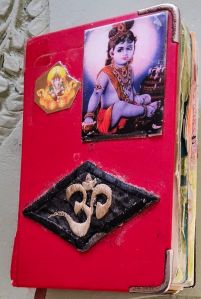
One component of that spiritual practice is our times spent together reading a few verses from the Bhagavad Gita. We pursue our own personal studies, but sometimes one or the other of us will share an especially resonant verse, or an insight or thoughts.

This morning my partner hermit told me, in a casual almost by the way manner, that she’d just read a verse that spoke about not disturbing others, and not letting ourselves be disturbed by others.

At first, I had no memory at all of this verse; I just couldn’t place it. Which might sound a little worrisome, given I’ve been studying this text for seven or eight years.

So, it wasn’t till she gave me chapter and verse and I looked it up for myself, that it finally clicked into place. Of course I knew this verse, but it had slipped from conscious memory.

And that surprised me: this verse seems to me to be speaking to a key concept in the teaching of the text as a whole, as well as to my personal aspirations. Surely, I would think, it should be, what’s the expression? Top of mind?

He [sic] who disturbs no one, and who is never perturbed by anyone, who is unattached to happiness, impatience, fear, and anxiety is dear to Me.

               Bhagavad Gita 12:15

This verse is full of meaning for me. It’s like a one-stop how to lesson in avoiding the personal suffering that’s brought about through attachments. Mind you, once again I can’t help wondering after years of study, and with how much this verse resonates for me, why I had such a hard time remembering even seeing it before.

I suspect the power of the ego and the mind have a lot to do with it. Ego – along with its master, the mind – love attachments to the world, to anything really. I guess they are always doing their best to keep me attached to my compulsions and aversions.

Imagine though, not being disturbed by anything – or anyone – and me actually not doing anything that disturbs anyone or anything?

Not just people and other living entities in my immediate physical environment, but out there in the wider world – in the Universe even.

It’s about vibes isn’t it? What vibrations am I putting out into the world? Are they vibrations and waves of love, peace, compassion, detachment, equinimity? Or at they vibes of discord, dislike, anger and sorrow over the stuff I can’t control?

And just think what it would be like if I weren’t so attached to the idea that my happiness depends on getting pleasure or ‘results’ from worldly things, activities based on the senses? Imagine really understanding that the only true and real and lasting happiness and satisfaction can only come come from within my Self?

This doesn’t mean at all that I can’t be happy, or can’t have fun or enjoyment. It is merely saying that, if I can accept whatever comes to me in life without clinging to the things I want, or running away from the things or situations I don’t want, then there will be less suffering.

Ego is jumping in now and wants me to note that, while I may in fact be on the path to detachment and freedom, I’m not far along enough yet to escape its clutches. Anyway, moving right along.

Impatience, fear, and anxiety are tricky presences in the attachment arena. I’m even less far along the path to letting go of these stubborn attachments. But, again, at least I’m on the path.

And what is that path? Where’s it going? Well (paradox alert), on the path in this instance is another way of saying I’ve not realised fully that I am already at the path’s destination. I just think I have a long way to go.
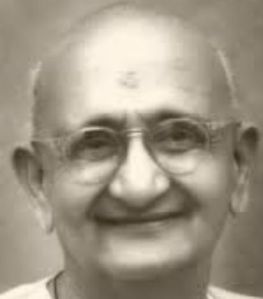
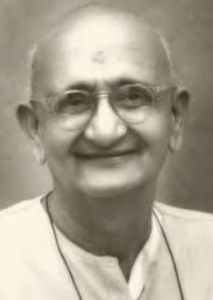
Swami Ramdas (1884-1963) Courtesy Wikipedia

I think Swami Ramdas said: ‘When you set foot upon the path, you have reached the destination.’ I think!

That’s the ‘dear to me’ bit of the verse explained. The ‘me’ in this phrase represents the aspired to full realisation that I am free, liberation or enlightenment some call it. It’s a place, or state of mind in which I move through the world with peace, calm and equilibrium, where nothing disturbs me, and I disturb no one.

That state of liberation doesn’t mean I have given up, or will have to give up, all desires for things I want, nor will I have escaped the things I have aversions to. It simply means I will no longer be driven by those desires and aversions, I will no longer be attached.

It means, too, that I will no longer be concerned in an attached way, to who says or does what to whom, when, where, why or whatever. At that stage I will be in the world, but not of it.

Of course, I am a hermit; you would think it’s easy for me being secluded from the world (well it’s not total seclusion). If only that were true.

I still have the clingings, cravings, and aversions; I’m even attached to the clingings and the aversions.

The one desire, the one I permit myself to cling to, is the desire to free from all other attachments, the attachments that cause so much suffering.

As long at I have that desire guiding my life, then I will be satisfied, when I can be, knowing that one day I will fully realise that I’m already free, unattached, liberated and happy.

There’s a song I wish I could remember the name of, or at least who sings it, but there’s a line in the lyrics that, says something like ‘I don’t want to go searching for what I already have.’ That’s me!

When Love is a Yoga and Lovers are Yogis

There was light at the end of the research tunnel

These last few days I’ve been researching and thinking about an idea for a blog post. But I’ve come to realise that I am grossly underqualified to write about the topic I had in mind. Let me put it another way: I am completely and utterly unqualified in any way whatsoever to go there. In fact, after all the research, I think I’m going to disqualify myself from ever going there in writing.

However, I’m a great believer in the idea that no quest for knowledge is ever a waste of time or effort; there is always something to be learned. During my research I came across a topic I believe I am qualified to discuss, as it forms an integral and vital part of my own personal spiritual practice.

Why I’ve decided to write this post, though, is because I made a discovery that lead to an insight that I know will lead to a great progress in that practice. It’s nothing new, not really, but it was one of those occasions we’ve all experienced of ‘I knew that, but now I really know it.’ For me, it was a realisation of something that till then had been a nice cosy theory and belief.

Bhakti Yoga is that practice. It is really a key foundation, a valuable component of my spiritual life.

Wikipedia opens its entry on Bhakti Yoga (see the link just above) with a description of the practice that mirrors what I think is the traditional understanding of Bhakti Yoga:

Bhakti Yoga (also called Bhakti Marga, literally the path of Bhakti) is a spiritual path or practice within Hinduism focused on loving devotion towards any personal deity.

In the same entry there is a description of the origins and meanings of the two words, Bhakti and Yoga:

The Sanskrit word Bhakti is derived from the root bhaj, which means “divide, share, partake, participate, to belong to”. The word also means ‘attachment, devotion to, fondness for, homage, faith or love, worship, piety to something as a spiritual, religious principle or means of salvation’.

The term Yoga literally means “union, yoke”, and in this context connotes a path or practice for ‘salvation, liberation’. yoga referred to here is the ‘joining together, union’ of one’s Atman (true self) with the concept of Supreme Brahman (true reality).

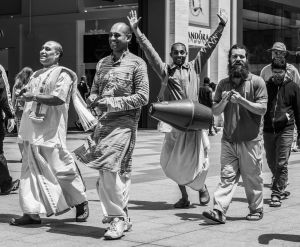
For some, dancing while chanting the names of their God, demonstrates their devotion and celebrates their union with each other and with God

In other words, those called to a religious or spiritual life, practise Bhakti Yoga whenever they pray or otherwise express devotion towards their personal conception of God, or the Divine. This particular definition seems to be saying that such a conception of the Divine, or God, is in the form of a personal deity who is a kind of representative of true reality, which the devotee is aspiring to join with.

Some Bhakta Yogis are full-time, full-on practitioners. People like contemplative nuns or monks, hermits who retire from the world into seclusion. Anyone basically whose entire life and activities are spent in devotion.

So, when I discovered all this, I became intrigued; I decided to go off on a tangent and explore the word Bhakti itself. Wikipedia has a separate entry for the word on its own:

Bhakti is a term common in Indian religions which means attachment, fondness for, devotion to, trust, homage, worship, piety, faith, or love. In Indian religions, it may refer to loving devotion for a personal God

is often a deeply emotional devotion based on a relationship between a devotee and the object of devotion.

In ancient texts the term simply means participation, devotion and love for any endeavor.

May refer to devotion to a personal god? While I thought this entry doesn’t contradict our first quote above, it does seem to broaden, and deepen, the meaning of Bhakti. Expand might be the better word.

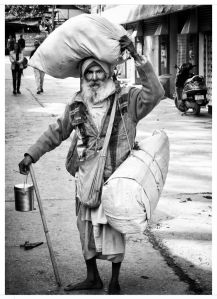
In some traditions a simple life on the road is a way to commit full time to Bhakti or devotion.

It struck me that that object of devotion might be anything. Or even everything. You see? I told you it wasn’t a new idea. It’s just that it’s resonated deeply within me now. It appears that the object of Bhakti Yoga practice doesn’t necessarily have to be a ‘personal god’.

Many many people would say ‘I like animals’ or ‘I think we should save the world’. But, while that may imply a kind of love for or at least a fondness for, I think Bhakti is something more – actually several somethings more!

For example, some people have a particular attraction to and love for, the ocean, or it might be a river they view as, if not sacred in a religious sense, then as special to them in some deep, comforting, even therapeutic way. Others have similar relationships with and feelings for trees, or even a particular tree.

Animals as either individuals or as a species or group, can have the same appeal and call to other people. Then there are those who feel strongly in their hearts you could say, that Earth itself is a sacred object, or others have a knowing that the planet is a living entity and worthy of our devotion.

Bhakti begins with love and devotion, which is about caring for, affection towards, loyalty to, emotional engagement with the object of devotion. But even more than that, there is faith in that object of devotion; faith as in trust, confidence that the love is real, that the ‘relationship’ is sound and real.

Homage and worship too are key aspects of Bhakti. The deep inner feeling we have towards a thing, person, or other being, that is beyond what we normally call ‘love’. It’s about seeing and actually realizing ‘in our hearts’ our desire to be merged or united with that thing, person, or other being.

Actually, seeing that word other just now got me thinking. I had to go back and reread our definition of Yoga up there near the beginning. It says Yoga means ‘union, yoke’. It goes on to add: yoga refers to a ‘joining together, union’.

This passage seems to be suggesting that Yoga (in our case Bhakti Yoga) is both an already existing union, and a process of joining together to achieve union. One thing I would say here is that in my practice of Bhakti (and love as a general thing to strive for and be) it’s both.

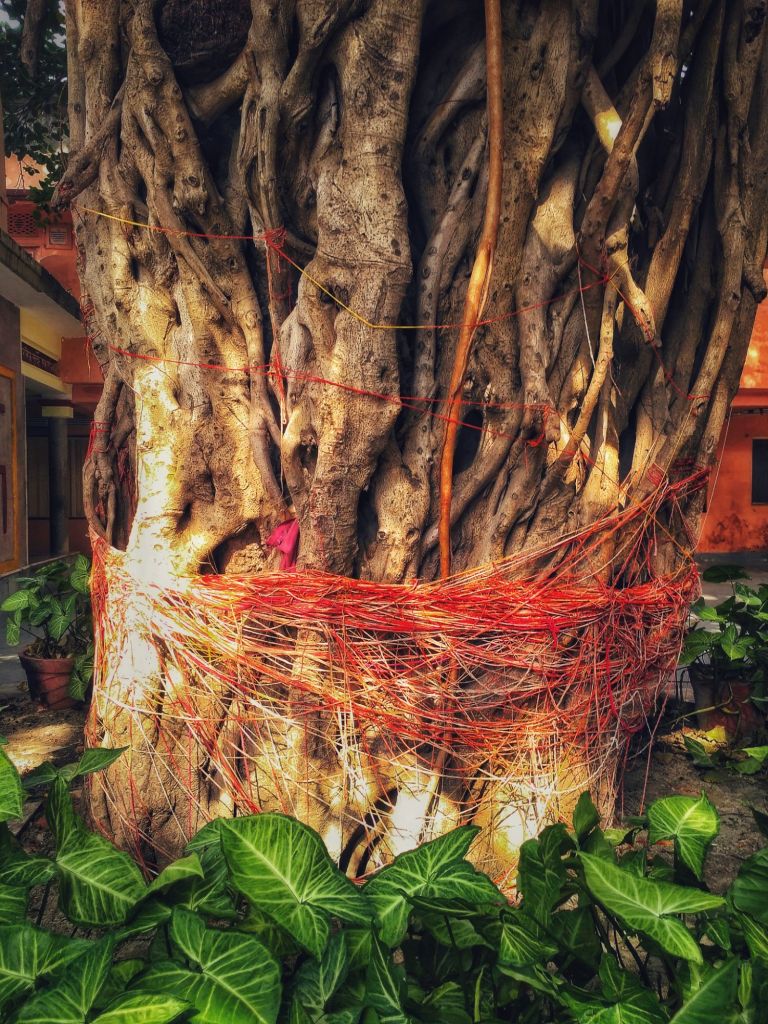
Trees are special beings for many people from a whole variiety of cultures all over the world

But, in the end, it seems to me that the process or practice, the path of Bhakti, serves to awaken us, to assist us to acknowledge, recognise, and realise in that really knowing way, our pre-existent true nature.

That true essential nature can be said to be the reality of our oneness with all things, living and non-living. And their oneness with us too of course. In fact, by putting it that way, I’m saying there is only one, or oneness. What’s that expression? One without a second.

May you be a Bhakta Yogi. Or, perhaps you already are one?

Love and peace from Paul the Hermit

Life has manifested itself as the multitudinous forms that comprise the universe. It is the one Universal Life, Power or Shakti (the laws of the universe or natural laws) that controls, guides and actuates all movements and activities in all beings, creatures and things.

                — Swami Ramdas

Tell Me: What is God? Dominus Est

Welcome dear reader

Have I shared with you my Bhagavad Gita? Well, I know I’ve mentioned a few times that it’s one of, if not the primary resource for study and guidance for me.

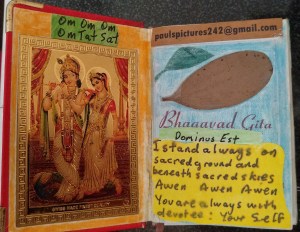
As you’ve probably guessed, this is a quick photo of the inside of the front cover. And, again as you’ve noticed, I like to stick things in my books, especially this little one. (Actually now I mention it, this is the only book in the traditional format as in made of paper, I own). It’s an old practice and for me adds multiple dimensions and depths to what is already a treasure.

Sometime I’d like to go through and describe to you all that I have added, but for today, do you see the little green section with the words Dominus Est printed?

In the religious tradition I was raised in, these two words have a specific meaning and use. However, it’s only recently that I’ve come to think of this little Latin phrase (well technically it’s a sentence, but …) in the sense of the literal meaning of the words themselves: God is.

That’s it. Or the Lord is, or the Master is. If we change the Dominus, we can use this tiny sentence to define our conception of the divine, the holy, in any way that seems right: Truth is, Beauty is, Art is. For me, God is, sits right. As do the others in this list. Same same.

So, God Is. What else could possibly be said that would add to this already very emphatic and simple statement? Nothing at all. It’s stand-alone, complete in itself.

Like asking who or what is God, we can answer: ‘I am this’ or ‘I am not that’. Or we can realise what for me is becoming the only answer:
I am.

Why? Well, if we were to add anything at all to these two words, such as God is Truth, or God is Love, or God Resides in …, or God is called … , then we are in fact stating only a little of the truth. Sure, God is truth and love, and goes by many names and is found in many forms, but once we say what something is, we are actually making more of a statement about what it is not.

In the beginning there was the word, and the word was with God, and the word was God.

Mind you, it’s perfectly natural, and for many of us helpful, even necessary, to ascribe to God a name and or form. We are ourselves material beings, living in a material universe; it’s logical that we would choose (or need) to see God in a word, a physical object, or attribute some other kind of materiality to our notions of the divine.

I must say that I am one of those who find it difficult to envisage an invisible, non-physical, and impersonal ‘God’. Of course, our little statement, God is, does indeed say just this doesn’t it? Isness is pretty non-corporeal, certainly not in the least physical. And isn’t even a ‘spirit’ or ‘entity’ of any kind; Isness just is. The moment we label something (including ourselves) we miss that isness, that essence.

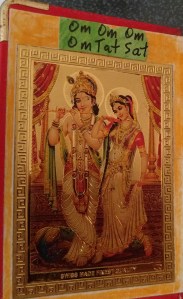
You see my picture of Krishna and Radha? This form, or forms, is one of the several that I feel right in having as a kind of focus, or centre of my devotion to and love for the divine; for love, for truth, and for it all.

You might be saying, this guy does believe in a personal God. He just told us. The truth is I don’t believe or not believe that Krishna (or any of the myriad names and forms we’ve invented) is God. God simply is. And my heart tells me that this is enough.

There are a pair of theological ideas known as Cataphatic Theology, and Apophatic Theology. Cataphatic describes or approaches the divine by stating what God is, while Apothatic (you guessed it) describes God by speaking only of what God is not.

My guess is that pretty much everybody, from whatever tradition, would approach the divine (and not only the divine) in one or other of these ways. But for me it was such a relief to realise that there was no need to go there at all. I could stop with the definitions and the descriptions, the what is and what is not. I have the freedom to not have to believe or not beleive. None of it matters. Dominus Est. God is.

Am I there yet? Have I let go of dualities? Hardly. Maybe the odd glimpse, but it’s rare. And it always will be for as long as I live in a physical body. But to paraphrase something Swami Ramdas said:

I’ve set my feet upon the path, so I am already at the goal.

Peace and love from me to you

God is My All: A Reaching Out, a Rap on time, & a (sort of) unrelated poem

Namaste and Welcome to you.

I can’t remember when I wrote my last post. And of course it isn’t relevant at all is it? I mean to say that in the contemplative life, time sometimes seems to take on some other kind of character.

Or at least I should say that one’s perception of the passage of time shifts; nothing unusal there I hear you say, and of course you’re right. Just thinking out loud I suppose.

For me, having a right perception of time is an important aspect of my Sadhana, my practice: yes, it’s true: time is seen to fly, or it is frustratingly felt to drag. But my aspiration is to see time as simply a human construction that we use to limit, structure, bind, define, and place all kinds of restrictions on our lives.

Which for me, simply means that there is only presence or Presence; only the ongoing continous moment (what we often call The Now). Easier said than done mind!

Swami Ramdas (known as Papa to his followers)

In any case, here I am, just where God would have me be. Feeling strongly to reach out to you, I remember the poem (it’s not really about time in the sense we’re discussing it so far) that emerged the other day after reading a quote from Swami Ramdas that seemed to be an answer to some thoughts I’d been having.

I’m grateul for this, all of this. And for you too, the reader of these musings offered with humility and thanks.

Peace and love from me to you.

GOD IS MY ALL

Thinking thoughts
as if battered by demons.
Memories arising of my own evil deeds, selfish and cruel.
Right away I turn to God:
God is my all;
Hare Krishna

Forego repentance,
relinquish regrets;
you are filled with God,
the supreme essence of life.
God is my all;
Hare Krishna.

Through Papa Ramdas
I hear the Universe speak:
Forgiveness is from God;
and it has been granted.
God is my all;
Hare Krishna.

Broken Hill, Australia
9 July 2022