Who? Just One of Many Questions

In November last year I published a post on this blog that sought to answer the question, Why do I pray?
In that post I said that this question is one of the big ‘Who am I’, Self-Enquiry questions.

I also claimed in that post that it was (is) a core aspiration of mine that I make prayer a ‘whole of life activity’. To quote me from that post:

You see, I want to pray, and make my whole life a prayer. A prayer of praise and devotion; a prayer of gratitude and loving; and a prayer of service to all beings .

Anyway, moving along to today’s post.

That question, why do I pray, is one I ask myself quite often. It’s not a one time enquiry you can tick off and move on from. The contemplation of why pray is an ongoing and evolving thing.
A couple of days ago, as I once again reflected on this particular question, it occured to me that perhaps it wasn’t the only one I needed to be asking myself if I am to think about my prayer life in any depth. Actually, the same could be said for pretty much anything one is trying to find answers to.

Indeed, many writers – particularly story tellers and journalists – will be aware of the series of questions often used to get to the truth of something:

Who? What? When? Where? Why? and How?

Commonly refered to as the ‘The Five W Questions’ (although there is that H in the mix leading to some calling them the WH Questions), these questions asked correctly and thoughtfully, will help to ensure a comprehensive and complete answer to any enquiry.

The next thought popping in suggested that it might be a great idea to apply the W Questions (including the H) to me and my prayer life.

At first I thought it seemed like a neat challenge, a kind of intellectual exercise that would be interesting. Then, though, after thinking about it some more, I realised that contrary to being just some mental challenge, asking myself these questions in relation to my prayer life, might actually be essential.
Especially if I am to some day reach fulfillment of my aspiration to make of my whole life a prayer. It’s the only way, I reasoned, that I would be able to get complete picture of the state of my prayer life.

Of course I have to wonder if it is indeed possible to ever get a ‘complete picture’ of a phenomenon such as an individual’s prayer life. Still, let’s just plunge in, see where it goes, what happens, how it works.

Who

There are actually two ‘who’ questions that I’d like to try to answer, both essential to our enquiry:

Who is it that’s praying? And Who do I pray to?

The answer to the first question is obvious: it’s me doing the praying. But, which me exactly? Not the me who is the true Self, the Absolute Reality. The reason why will become clear as we go along.

No, the me doing the praying is what we might call the body mind complex, the me that lives in the material world as a material being. The impulse to pray, what to pray, who to pray to and all the rest arises in the mind.

Mind you, I along with so many others I’m sure, like to say that I pray with and from my heart, my spiritual heart. But then I do also know that emotions originate as thoughts in the mind. Of course that does not lessen the significance of such emotions and the prayers, love, or devotion that follows.

Now, who do I pray to? I know it’s going to sound a bit odd, flippant and even silly, but as I think about it, I realise that I do in fact pray to everyone and to everything.

Which is to say, my prayers are directed to that invisible ‘something’ that pervades and permeates – and actually is  – everything that exists. You could say that I pray to existence itself. There is nothing or nobody else.

Of course it’s not exactly an easy thing to get a handle on praying to ‘everything and everybody’. I mean, where does one direct their attention? Who or what does one address or speak to? The answer is a lot more straightforward than you might think at first.

Because my prayers are to that amorphous ‘everything and everybody’ it’s quite easy to select one or more resonating and meaningful somethings or somebodys as the objects of my prayer.

There are many spiritual or religious traditions in the world, all with their preferred names and forms of the Divine (or Existence as I named it earlier). Each of these manifestations of the Divine has its own characteristics, their own place in the Universe. They each play their own roles in the cosmic order.

As such there are more or less an infinite number of choices for me to have as foci for my prayer life. I will try to share with you a few of my personal pantheon.

Om: The Essence of Brahman, Absolute Reality

The Existence I’ve mentioned a couple of times is named by some Brahman, the Ultimate Reality, the everything and everybody that I was talking about.

So, I might sometimes pray to Brahman. Mainly it’s an aspirational prayer as I seek to realise fully my already existent oneness with the Ultimate Reality.

Then there is Ishvara, which is probably closer to what most would recognise as God – a personal supreme being, Or, in some traditions Ishvara simply refers to the one or more deities that an individual chooses as objects of her or his devotion.
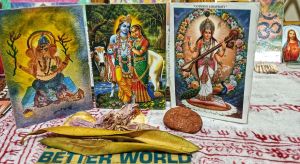
Centre of Attention on the Hermitage temple alter

Also included in my personal pantheon, are the Divine Mother, Kirishna, Ganesha, Lord Jesus, The Buddha, Sarasvati, as well as other teachers and saints from many traditions who pop in and out of my prayers, seemingly at random.

My prayers are of praise and/or gratitude to the teacher, deity or saint who seems to me at that moment to be most linked to my current circumstances and thoughts.

All of this I call prayer. To God. Or Brahman or Ishvara. Or very often, simply My Lord,
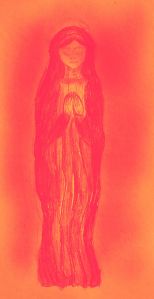
Divine Mother

A Story of Words and a Journey of Discovery

Remember that old Bee Gees‘ song Words?  It’s about one person offering all they have to another. Well, the one doing the offering must have been a writer because, while the song’s a love story, it’s words that are the big thing on offer here:

It’s only words, and words are all I have
To take your heart away

Well, as this is a blog, words are the way it hopes to reach your heart. Actually, the posts also include photos and sometimes other art, but the main vehicle used here is words.

So, with that in mind I have a couple of words to offer you today. Well, one word and its opposite. Have a look at this sentence from Thomas Merton:

If Irish monks affirmed his Celtic spirit in their mastery of cataphatic contemplation of the wonders of divinity in nature, Buddhist monks evoked his Zen mind and drew him into the apophatic path of formless ’emptiness’…

A quote from the Introduction to When the trees say nothing: nature writings of Thomas Merton

As sentences go (though this is obviously only part of a sentence) this has to rank pretty close to the top for length and denseness.

Kataphatic. What a word! Of course I had to look it up; I’d never heard the word before (this post is a rewrite from notes written a while ago that I never got around to posting.), and even though the sentence seems to  suggest the meaning, I was still curious.

Looking at Wikipedia – where they spell it with a ‘C’ like Merton, as well as with a ‘K’- I learned that cataphatic is an adjective that describes an approach to theology that uses ‘positive terminology to describe or refer to the divine (God, Truth, Dharma, Spirit. You know what I mean: the divine).

Apophatic, as you probably figured out already, is when one uses ‘negative terminology to indicate what it is believed the divine is not’. A process of negation or we could say you get to what the divine is by a process of elimination.

Pretty simple concept really, but with a couple of big words to label it, and a lot of  words to define it. No, don’t worry, I won’t bore you with the meaning and origin of the words and all the rest. Mainly because I don’t know and I’m not especially interested anyway in all that technical stuff.

I simply resonated with the word, and the concept. Cataphatic made me think of Dick Van Dyke and Julie Andrews singing Supercalifragilisticexpialidocious in Mary Poppins. But let’s not go there: this is a serious blog after all. Except to say there’s more to that word than you might imagine.

Putting aside the aesthetic appeal of the word for a minute, let’s contemplate a while on cataphatic, and it’s opposite, apothatic.

To begin thinking about these two words, it’s necessary to acknowledge the existence of the divine. We can call it God, if we like. Or Dharma, Truth, Spirit, Love, Beauty.

As the quote suggests, a cataphatic approach, ideology, theology, or whatever we call it, ascribes names and forms to the divine, as well as describing where and in what the divine may reside.

Whereas apothatic, again as the quote suggests, does not ascribe names and forms to the divine. Instead it seeks to discover what or who god is or isn’t by a process of negation as described already. 

For a long time I labelled myself as a Humanist. I had decided that this physical body is all there is; the physical or material universe is all there is, and that there is no ‘god’ separate from us or who has special powers to affect our lives. No God at all in fact.

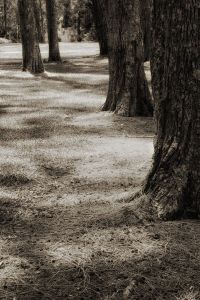
In the Grove of the Sentinals

But, all that while, I just knew that there was something else, something more than just the physical.  And over time, I came to the knowledge that there is indeed more than the simply phsical universe (including we humans).

I’ve thought about it a lot over the years and I came to the conclusion not that many years ago, that I had simply been afraid to name or define that something more. It would have meant admitting to myself that something more really did exist.

That is to say, I was scared of taking the cataphatic approach – and I’d never even heard the word.

Well brothers and sisters, I saw the light. The truth was revealed to me. And what is that truth? Well, to put it simply, I wasn’t scared anymore. Not of names and forms, and not of what I couldn’t see.

Now I could take both the Catophatic and the Apothatic approach: that the something else I had actually always known just was, really is, and can have a name and form, or not. The divine is not an omniscient being or any kind of being at all; As I’m very fond of saying, the divine (or truth, God, Dharma) simply is.  And it’s all there is.

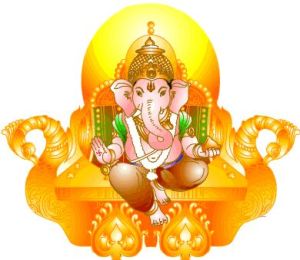
Some of you might know that I am really quite fond of the Indian deity, Ganesha . Do I believe that a man with the head of an elephant actually exists or ever existed?. Of course not. Do I actually think that he resides in the lovely painted icon that sits by my bed? Well, obviously not.

But do I believe that there is a spark or aspect or attribute in all life, in you and me, in nature, in (scary word time) creation, that we can tap into to help us overcome obstacles? Or that we can access when we begin new ventures of whatever kind, or when we need strength to face challenges? Yes, I do. Very definitely.

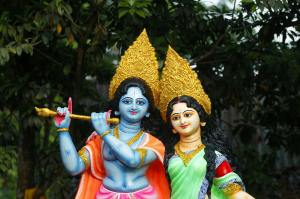
And do I believe in a blue boy called Krishna who lived in India 5000 years ago and spent his time playing in the fields with the village cows and his friends, entertaining them with his flute? Again, of course not. Does he live in the other beautiful icon by my bed? The answer is obvious: no.

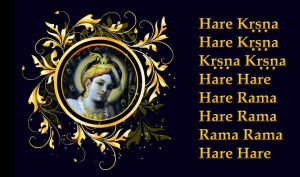
But do I chant the Hare Krishna mantra in an effort to come closer to the divine that is… well, that just is? Yes, again, very definitely.

Words. It’s all only words. Only words? Only??

In the beginning was the word, and the word was  with God and the word was God. (from the opening of the Gospel of John)

It’s all I have (for now).

Peace and Love from me to you

Chant the Name and Write a Blog Post!

Even the biggest dream catcher won’t always catch the dreams

This morning I woke up restless, and extremely tired. It felt as if I hadn t slept at all, though I know I did. Who can say about these things? Perhaps dreams disturbed me or something.

Anyway, despite this grogginess/restlessness vibe, I resolved to get on with morning routines. And, in addition to breakfast and normal stuff, I set an intention to continue with my usual morning devotional practice.

So with that in mind (and a coffee in hand as an extra aid to wakefullness), I sat with that intention and in a mood of devotion.  As is my usual practice, I picked up my Bhagavad Gita.

Now, this particular edition has some pages in front and in the back that aren’t really a part of the main text. Over the years I’ve written things on these pages, and pasted in various pictures, prayers, and other things meaningful to me.

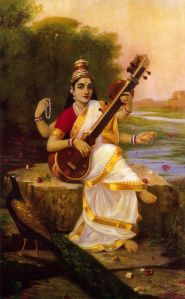
As I picked up the book, it fell open accidentally, by chance, at random, to the pages on which I had placed an image of Saraswati, as well as a page of repeated mantras to her. (I use the female personal pronouns because she is a female representation of the divine in particular aspects. More on this later).

Okay I thought: that’s a pretty clear message about where to go from here. I will chant Saraswati’s mantra for a while. Then I thought, there’s a really nice live recording of the mantra by Krishna Das. Do check it out, it’s very lovely, very meditative and soothing.

So, for about 30 minutes I chanted along with this beautiful renditon of  the mantra. Well, it’s a hymn really, a sacred song. And, now? How do I feel?

Awake! Wide awake, alert, ready to face the rest of the day. Inspired also, hence this quick post. No longer restless, well not as bad as I was anyway.

Oh, I should tell you a little about who I think Saraswati is, though of course if you click on the link on her name above, you’ll learn more.

For me, She is a personifcation, a representation, of the divine; the universal consciousness in its aspect of the arts and learning. Obviously, there’s a lot more to Saraswati than that, but for me, she is like a muse, a sort of mentor; She reminds me that art (and study which I have to get to today as well!) is an expression of all that is divine. Actually, art is the divine just as all things are.

I think that Saraswati has been busy with me this morning.  She has helped me to set down these words I share with you. Perhaps, this little story of my morning has reminded me that I can call on Her more often. One of my biggest aspirations, you see, is to share more with you here.

Oh, one last reminder: There is no such as thing as ‘accidentally’, or ‘by chance’ or ‘at random.

Peace

Walk In The Waters of Life

Since I launched this blog (a whole month and a bit ago already), I’ve had an idea for a post. A short, spontaneous, chatty but informative little piece on my favourite name and form of the Divine Feminine (often referred to as the Goddess): Saraswati.

Well, as the keenly observant among you will have noticed, no such post has appeared. Procrastination in overdrive you might say. Or perhaps it was that the Goddess just wasn’t keen on me doing the post about her?

You see, I did some research, made a ton of notes, and discovered all kinds of fascinating things and I just felt I wanted to share what I’d learned. Somehow, though, the idea didn’t go any further. I’ve thought about it from time to time, but still, nothing has come. Then, a couple of days ago, I came across my notes and reread what I’d discovered.

Now, here’s a key moment: as I reread those notes, I thought (paraphrasing here), ‘I really must post this. It’s all so fascinating and would interest a lot of people and even be helpful.’ Something like that anyway. Yet, still, it is not written.

So, despite my notes seemingly begging for my attention, I guess that maybe it’s not the time. Now my notes are safely tucked into a few nice little folders within a larger folder somewhere in the depths of my harddrive.

All that struggle; all that thinking and fretting over what was supposed to be a short, spontaneous couple of hundred words on a subject I love. Still, the episode has got me thinking about intuition and how it can disguise itself – with our help – as procrastination. And vice versa.

Yes, I know, obvious question: how can we ever know the difference? When are we inventing all kinds of reasons for putting something off, and when is it really intuition trying to guide us?

Well, it’s complicated. As creatures able to reason, we are always ready to come up with arguments for and against, to think endlessly and agonize over the smallest and most trivial details while ignoring the big stuff. Really, in my case that’s all there is to it: I just think too much.

Sticking to the Saraswati blog post episode (a catchy title don’t you think? Watch out for a post headed up ‘The Saraswati Blog Post Episode‘), I don’t recall why I didn’t just get right to writing it. It might have been any number of things: a perceived lack of time; a promise to self to ‘give it some more thought’; a resistance to the actual ‘labour’ required. Who knows?

Or, was it more that, while the idea was a good one, I just wasn’t feeling it? Maybe the timing just wasn’t right? The problem is that sometimes an intuition comes in a flash of knowing – with a capital K – that you can’t possibly miss.

Then, other times, it creeps up so slowly and quietly that it gets drowned out and ignored as our monkey mind takes over with its endless arguments for and against, pros and cons, advantages and disadvantages,

The lesson I was given here was this: What is going to get done, will get done; what is not going to get done, won’t. Sounds simple really, but so often we make it more complicated with our overthinking, our coming up with excuses. We procrastinate.

Then, at other times, we just dive in the deep end, flowing with the intuition. It may be right or it may be wrong, but it’s done. Actually, I am trying to realise that there is no right or wrong about a decision made: it just is as it is. Easy to type, hard to do.

Flowing. That’s a good word actually. Saraswati, along with many other characteristics, embodies flow. As in the flow of the river of life. She’s the Goddess of all things creative as well as any activity that helps one to discover the essence of self.

So, flash or gradual realisation; right or wrong; left or right, be the river: flow with what happens or doesn’t happen. Don’t fret about the twists and turns, the ebb and flow of tides, the rocks in the stream that force us to flow around or over, or to change direction completely. In 1946 the poet Jorge Luis Borges wrote an essay about time. In that essay, among other things he says:

Time is the substance I am made of. Time is a river which sweeps me along, but I am the river (emphasis is mine)

Jean Luis Borges A New Refutation of Time 1946

Reading that quote reminded me of a song that I’ve been humming on and off for a very very long time (hint: I saw the movie when it first came out).

The river flows, it flows to the sea.
Wherever that river goes, that’s where I want to be.
Flow river flow.

Peace from me to you.

PS: Thanks to my memory for giving me these lyrics from The Ballad of Easy Rider. Or was it actually Saraswati whispering in my ear?