Breathing Free & Easy Through My Life: I Wish

There’s this funny little thing I do; it’s an odd little habit. On the face of it, at first glance, it’s not really anything to bother about. Just another little quirk that could easily be dismissed to add to my long list of such quirks.

Don’t laugh. I’ve had this habit for I have no idea how long, and I’ve been wanting for ages now to stop and think about it: why I do it? Can I stop it? You know the thing. Well, I’ve taken steps to try to change it, but still, I think it’s time to look at it properly.

You see, I am prone to holding my breath. Just to illustrate: as I held my pen poised about to write that last sentence: I held my breath. What directly prompted this renewed resolve to finaly get down to facing the facts, is that just a little earlier I’d made a cup of tea, and when I went to put it down on the table? Yes, I held my breath.

I’m likely to hold my breath (for a short moment) at any old time: Bend down to pick up a dropped pen? Hold the breath. Raise a forkful of food to my mouth? Hold my breath. Do one or any of my regular physical exercises? I have to really watch myself, otherwise I’d not breathe at all doing them.

All the time, and at any time, as I said. Why? Well, that’s the question isn’t it? I can kind of understand it as a pause, a way to summon up focus and physical energy before doing a task requiring much physical (or mental?) effort.

But that’s just a guess really. As you probably could imagine, I’ve never discussed breath holding issues with anyone else. Well, present company excepted.

Anyway, my guess doesn’t really tally with the lightweight activities, like my pen poising before a new sentence, or my breath suspending before taking a bite of food. Something else is at play here.

So, what is air? What is it good for exactly? Well, umm, it’s a gaseous combination of a whole heap of ‘stuff’, the key one for us here is oxygen. And, more or less obviously we mammals and other beings too, need oxygen to breathe – to keep breathing. In other words it’s the ideal means of staying alive.

I guess that’s why some traditions call air, not only an element, but a sacred element. Life giving, life sustaining – some call it the Life Force, or Prana. Of course these two terms encompass other elements and concepts, but air is pretty much a fundamental component of the whole eqaution.

Next question: If I know it to be the life force, that which keeps me alive, why would I choose to suspend breathing? No, after pausing here (and holding my breath briefly), I’ve concluded that I very much doubt that I’m trying through this little habit to curtail the flow of the Life Force, or Prana through my body.

So, specifically, what does air do in the body? Well, it fills the lungs, which then somehow get the oxygen into the bloodstream (the heart’s job?), which in turn carries that oxygen to the brain, other organs, and to the muscles. I hope you will forgive my over-reliance on such complex technical jargon.

Once again, I can’t see how holding my breath as I poise my pen, is intended to deprive my arm muscles – and my brain – of the fuel needed to help the pen do its work of putting words on paper.

Anxiety? Well, finally we might be getting somewhere at last. When we get a fright, or fear something, or watch scary stuff in a movie, we will often ‘hold our breath in suspense’.

Maybe that’s where the breath holding habit began for me. Not watching movies, but perhaps when confronted with anxiety making situations. Of course picking up a pen is hardly a cause for anxiety, though eating might be?

Well, maybe those ‘little things’ are where the habit became a habit, but now I’m starting to think this breath holding might be a habit without a cause.

At least no consistent cause or causes. Anyway, there’s no point to  dredging the past to try to find out the why of the thing. What’s important  and the only thing we can impact on is now; best to pay attention to here and now;

So, I suppose the conclusion is simple: Sometimes a quirky little habit is just that, a quirky little habit.

PS A habit to be done away with mind you. Time for some little reconditioning of myself. I’d prefer not to hold my breath while writing notes, while eating, or while doing my exercises – or when doing anything else for that matter. The brain, the digestion, the muscles – this entire being – needs oxygen, and it’s my job to make sure that it flows freely and easily to everywhere it’s needed.

Story of a Misadventure & An Apology

Today I’d like to share with you a short cautionary tale. It’s a true story, relating events that took place very recently.

There was a blogger, a serious student on the spiritual path; a monk whose mission in publishing his blog was – is – to share that path with others, to share the lessons he’s learned/learning. He sees it as one important aspect of his ‘doing God’s work’, reaching out to others of like heart and like mind.

Anyway, this blogger, he suddenly felt an intuition: he thought, I’ll set up an account on (insert here very popular platform) social media. That’s how to promote my blog he thought, and attract more readers.

So, dutifully, he set up an account and began posting. One or two poems, a couple of photos with commentary, that sort of thing. The plan was, post whatever seemed might be enlightening, whenever the feeling was there.

The blogger felt that this was a sort of ‘next step’. He thought that bringing more readers to his blog would help him with his quest to love more, and to share love.

But. Something wasn’t quite right. Sure, he, the blogger was excited by this new venture, this expansion of his service to the Divine and to the world. But he felt – literally and physically – a bit sick. A kind of nervousness gnawed at his guts; he just felt yuck.

‘I can’t do this,’ he thought to himself. ‘It’s not right’

So, there and then he resolved to delete the account, to close that chapter forever, and bring his focus back more fully to his blog. That’s where, he realised, was where God’s work could be done, as well as where his own passions lay.

But, the resolve, didn’t last long. He just had to act immediately. So, again right there and then, he deleted the account.

Instantly, a wave of relief swept over our blogger friend. He felt free, back on track. He now felt less burdened by a burden he’s made for himself, a burden that there really was no need to be carrying.

Okay, I confess: the blogger of whom we speak is in fact me. I know, you guessed that already, but it’s a disturbing saga and I guess I had some need to distance myself a little, at least to start with.

So, why the big relief? Why did it feel so right at the outset, but – almost immediately – felt so wrong to the extent of putting me ‘out of sorts’ physically and mentally?

Funny. That ‘out of sorts’ expression. That’s exactly the root of the issue right there I think. Years ago I withdrew from all social media – though I am on a photo sharing platform that is simply for that purpose and only that purpose, sharing photos.

You see, I thought (and still think) that social media generally had become a ground for conflict, and the celebration of conflict; it was a ground for corruption, gossip and sensation, for all the worst of the news (I know, the best too). Anyway, you know wht I mean: I’m not alone in giving it all up.

And, yet, here I was, feeling led to reopen that particular social media account. An example, I think, of an ego-driven desire for gain disguising itself as a genuine heart or soul intuition or calling.

I choose not to criticise or comdemn any social media platform. They are what they are. All I can say is that it’s not for me, not my ‘sort of thing’, not my cup of tea as it were. No wonder I was feeling out of sorts!

In my selfish, ego-driven compulsion to ‘increase traffic’ (what a horrible expression), I forgot entirely – as we so often do when blinded by desire – that this blog is seen and read by exactly those who are meant to see and read it – you!

So, I apologise to you for that sudden blindness, and for ignoring the absolute reality that it’s all working out just as it’s supposed to.

Thank you for making that so.

Peace and love
Paul the hermit

A Gift Came to Me in an Email

Even a Leaf

A couple of days ago I recieved a beautiful gift in an email. I often receive wonderful things through the email, and this one, as with so many of the others, has profound meaning for me.

Not only that, but this gift has served as a reminder to me of that significance. I’d like to share with you that gift, as well as some thoughts on its importance and meaning to me.

There are a multitude of sources online where you can learn all the technical stuff, word meanings, history, origin, when it’s used and all the rest. I would like, however, to just ‘think out loud’ in my own words, and follow my own heart’s promptings.

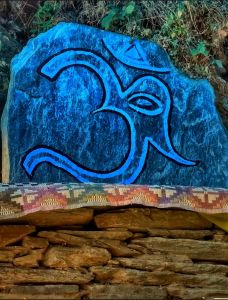
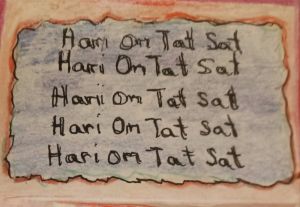
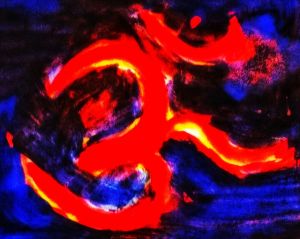
Hari Om Tat Sat, is actually two mantras in one: Hari Om, and Om Tat Sat.

Hari Om represents the totality of what we might call God. Hari refers to the manifested cosmos, as well as the creative impulse in its manifest form. I call that Ishvara, but it doesn’t have a name I’m sure!

Om, is the unmanifested universal consciousness, the Absolute Reality. Meaning, as I understand it, existence itself. I call it Brahman, or God, but again, names are just labels we humans apply to things to make it all seem so neat and tidy!

They say that Om Tat Sat is the most sacred of mantras (in Hinduism). It’s used at the completion of prayers and rituals as a way of invoking the presence of the divine and ‘bringing it all together’ you might say. Well not so much bringing, more like a reminder that everything is one already.

I really like the chanting of Hari Om Tat Sat. It’s a centering practice I would say, a way to remember the oneness of all. And I say it, as the traditionalists do, as a closing to prayers or other practice; it’s like ‘Amen’ or ‘It is so’ or ‘Let it be so’ or, well it’s endless – and personal and subjective.

As mentioned, Om means Brahman – or God in the unmanifested state; Tat, not only sounds like that but does in fact mean all that is. In other words, Brahman or the Absolute. Sat means Truth, Absolute Truth or, once again Brahman.

For me it is a little prayer of its own actually. And I’ve heard it used as a greeting many times. It’s a means I think of honouring the divine within the one being greeted, while at the same time I have a sense that it is a recognition, or acknowledgement rather, of the oneness, the unity of the greeter and the greeted along with everything else.

This is why I don’t really feel the need to break the mantra down to explain in technical detail all the constituent syllables (even I were qualified to do so, which I most surely am not).

It really is a way to acknowledge the oneness of all, the Absolute, which includes, obviously, me and you. The Truth is absolute, it says, so must we be, absolute.

Hari Om!
Om Tat Sat

A Lesson in Humility

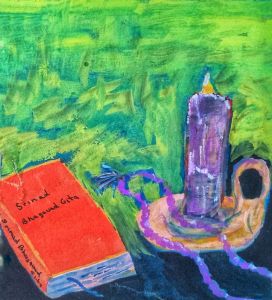
Opening my Bhagavad Gita this morning for my daily reading, I noticed that I was about to begin a new chapter. I always like when that happens, but this post isn’t about that; it’s inspired by a small scrap of paper glued on the facing page.

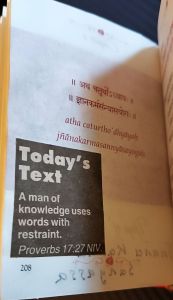
In years long gone, a less minimalist me would collect bits and pieces cut from newspapers, magazines or wherever (no Internet in those days). This particular strip of paper was cut from a newspaper (makes me shudder a bit to think how I would devour newspapers every day if I could. Shudder in horror) and has the title Today’s Text. It was a daily quote, usually a verse, from the Bible, and I’d often cut out those that appealed to me. As this one obviously did.

No longer collecting such bits and pieces, this one somehow survived the now ancient culling of excess material stuff, and has ended up in my Bhagavad Gita. Don’t ask me how or when.

Anyway, before I get off track, or too far down the track, here’s the quote we’re talking about

A man of knowledge uses words with restraint.
    Proverbs 17:37

I paused when I read this. As you probably are already guessing, I just had to write it down and added some notes of my own before getting on with my Bhagavad Gita reading.

What comes next is essentially what those full of first thought notes said, plus a little context setting to begin with.

In addition to the Bhagavad Gita, I am also reading, bit by bit, another sacred text. A couple of times (including today) I’ve been frustrated at having to plough through a page and a half (for example) of a description of a concept or idea that I’ve thought could have been said in no more than a couple of sentences.

Is he, the author, a person of knowledge? He most certainly is. He has wisdom too. He was a respected teacher and scholar. Some, many, say he was a saint.

So, perhaps it’s me demonstrating my own lack of knowledge here. Perhaps it is me, also lacking in wisdom, who is using words without restraint. Just because my opinion proposed using fewer words, does not mean by any means that they are better words.

Perhaps it’s me in error: passing judgement on an author I consider knowledgeable and wise, and who is certainly more than intimate with the topics he’s commenting on.

So, allow me to put another perhaps into this mix: Perhaps if such a person takes one and a half pages to describe an idea, then it might just mean that I am in need of more knowledge than I think I have. Surely I am missing something.

At the very least I am being prompted to reread the sections in question, that I was so hasty to dismiss as too wordy. Perhaps (what is it with this word today? Have to nominate it word of the day – perhaps) there is something for me to actually learn before letting my mind run away with critical thoughts based on quick and ill-informed judgements.

Foster Your True Self: It’s A Big Deal

Today I finished watching  a beautiful and extremely fascinating documentary.  It was about life in a Trappist monastery as well as a fascinating history of that movement. I was struck by something one of the monks said.

He was referring to what he and his fellow monks are actually doing with their lives in the monastery. He said their lifestyle was helping them to:

‘foster who we truly are before God.’

Hearing this, I had to pause the video, make notes, and do some thinking. What had actually struck me, my first thought on pausing, was that this is exactly what I’m doing as a hermit monk dwelling in our Hermitage. Exactly what I’m doing. Well, at least it’s what I’m aspiring to.

There are two aspects or primary intentions that inform the life I try to live as a hermit and monk that are in fact integral one to the other; they merge actually to become one primary focus of my life.

I practice an ever evolving and I hope intensifying devotion to the divine, with the upliftment of the world and all beings as its central theme.

The other, integral focus, is an equally ever evolving and intensifying quest for self-knowledge, for the answer to the question, who am I?

In other words, I am attempting to foster who I truly am before God. Foster as in ‘encourage the development of …’ (as one definition puts it).

In this case, the development is the growth of the knowledge of my true nature – who I am above and beyond this physical (and mental) creature running around madly trying to figure things out.

In my life there is much effort devoted to the cultivation – a synonym for foster – of that knowledge: meditation, prayer, contemplation, study, just sitting, being still. Did I mention the aspirational nature of all this? It’s an ongoing project to say the least.

Speaking of aspirational: Two more synonyms for foster that I like are nurture and support. Both are even more in that aspirational category; at least it feels like that sometimes. Actually, maybe there’s a more accurate way for me to be putting this.

After all, as I think about it now, even I would agree that my whole lifestyle, my entire way of being in the world supports and nurtures me.

Except for me, myself, and I, that is: Lest the inner grammarian sends me mad in a search for antonyms for foster, let me just say that I am overly skilled in the self-critical and self-destructive departments. My ability to put myself down and to tear myself apart is legendary.

Anyway, with overwhelming nurture and support coming from my partner hermit all the time reinforcing my sense of Self, all I have to do is work on ridding myself of these self-destrucitive and self-critical tendencies.

So, the conditions for the banishment of self-loathing are there; all that’s missing is discipline on my own part in seeing the Divine in myself as I profess to be trying to see it in everyone else.

I need to be rid of the forgetfulness  that blinds me to the Truth that is actually very plain to see.

Speaking of the Divine, the ‘before God’ is the vital element for me. God is all there is, so it is always before God that I act, whether in a positive or in a not so great manner.

The best prescription is for me to remember. To remember that God is everywhere and everything (did I say that already?). To remember that me, myself, and I, are also included in that everything and everywhere.

I think that once I do remember these truths even for the odd moment now and again, then the real fostering of who I truly am will have begun.

What Will Please You Lord? A Prayer Contemplated

Namaste my friends

In my last post I reflected upon the meaning for me personally of a Bhagavad Gita verse that had particularly struck me as I carried on with my renewed inspiration to read the text from the beginning.

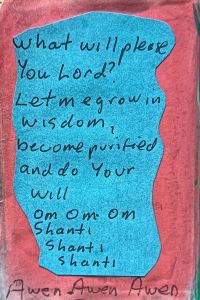
Today, I didn’t even get to the place where my reading left off yesterday. Before reading I like to pray some or all the prayers I have pasted in the front (and the back now). As I was deep into this practice, one prayer in particular stopped me, just as with that verse yesterday.

This one seemed to speak to me, asking ‘What do I mean to you?’ So, I made a mental note (always a risky proposition with me), and carried on with my prayers, determined to take time later to think about that prayer, and try to answer its question. So, here I am, later in the day, making these notes.

The prayer itself I am fairly sure comes from Thomas Merton, monk, mystic, and writer. Not completely sure, but I know that whoever composed it was one clearly inclined towards living the life of the mystic.

What will please you Lord?
Let me grow in wisdom,
become purified,
and do your will.

For whoever composed this prayer, it is an expression of a genuine longing. I can say that for me it is a deep plea, expresses my own longing. Each time I recite it, in fact, I can say that, although this is the first time I’ve addressed the big what does it mean question, I do sense the longing and grasp the meanings of the various words and ideas in the prayer. Actually, now I think about it, I do say this prayer or parts thereof in one form or another very often.

What will please you Lord?

When I begin to pray these words, what I feel I am actually doing is asking the Universe, the Divine, Self, God – the I AM – how can I live my life so that it is attuned to the natural order and flow of the Universe.

I am asking, what do I need to do to let go of attachments to worldly things which arise from material desires? How do I find the grace to accept when things aren’t going completely my way?

In other words, I’m asking how can i live a good, truthful, happy life in harmony with all other beings and with the Universe.

Let me grow in wisdom

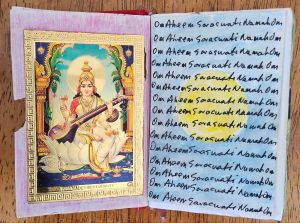
Another of my prayer pages. This one devoted to Maa Saraswati, goddess of, among other things, wisdom

A good place to start, a great first step. But, again I have to ask myself, what does growing in wisdom mean to me?

To me wisdom is not merely knowledge. Though, having said that wisdom needs to rest on a firm foundation of knowledge, otherwise what’s there to be ‘wise’ about?

I’m not talking about worldly knowledge here, though obviously it takes some degree of knowledge for any of us to live in the world. Also it’s relevant to the next part of our prayer; we’ll see that soon.

I’m referring instead to a special kind of knowledge that will (I pray) lead me somewhere closer to acquiring some degree of wisdom – one day.

Self-knowledge is what I’m getting at. And I go about my attempt to obtain self-knowledge in a couple of different ways. I study, sacred texts like the Bhagavad Gita, as well as the words of those wiser than me (which is rather a large selection of people I can tell you) both living and historical.

I meditate (not nearly enough!) as a way to enquire into my own ‘real’ or true nature: who am I? what am I? Just digging deep within to reach some realisation of the answers to those questions.

When I have answered those questions, I will understand that I have reached a true level of self-knowledge. I sense that, at least being on the path to that realisation, I would never be able to develop any level of wisdom.

Mind you, I do feel that all humans are born with some degree of wisdom potential ‘built in’ so to say. As for me, I don’t feel especially wise just yet.

Become purified

For me, becoming purified goes hand in hand with the cultivation of wisdom. In fact I would say that in the very efforts to become purified, it might be possible for me to develop some wisdom as a result of those efforts.

So, here we go again: What does it mean? To become purified? For me it means living a Dharmic life. By Dharmic I mean a life steered and driven by Truth, Right Living, Right Speech, Right Conduct , Right … The Buddha taught The Noble Eightfold Path. That is in my opinion the very best, topmost, pinnacle of self directed means to living a Dharmic or purified life.

The Eightfold Path is not a set of dogmas, rules, or anything like a list of commandments or instructions . The eight steps are merely signposts, a roadmap, pointers for me to follow in order to purify my life, live a Dharmic life. No behaviours are prescribed: it’s entirely my choice what forms my behaviour, actions, and the rest take.

Obviously the path to becoming purified is a life-long one, though some would say that many lifetimes are required. Personally, I can’t even hint that I might be anywhere near close; some days I feel further away than ever.

But, as I work towards ‘growing in wisdom, with the help of my becoming purified path, I pray that some day I might actually learn what I call proper discernment.

This discernment is the ability to act in the world and to react to the joys and sorrows that are inevitable, with compassion, love, and wisdom. To face those inevitabilities with calm and equanimity. Acting with proper discernment will mean that I am living in Truth.

… and do your will

As I reread the words I’ve just written, I realise that, by the time I reach the state described in that last paragraph, I will have succeeded in ‘doing your will.
I will have aligned my self perfectly with the order of the Universe. I will know my place as a tiny fragment of that very order.

If I’m honest however, I have to say that I think it’s going to be a very very long time before such a state come to pass. So, what to do in the meantime?

Well, along with my attempts to live Dharmically, and to cultivate wisdom, I have committed myself to a life of devotion. Devotion, prayer, contemplation.

Devotion to what? To whom?

To the Universe, Divinity, God; all that is represented by all those names we humans have put on the Absolute Reality, that is all there is.

Everything. And everybody, is what I’m saying. There really is no separation except a kind of superficial one we allow ourselves to imagine by applying so many names and forms to the material objects, things and so on, that appear to us as separate one from another, whereas there is in fact only one, without a second.

That’s where the contemplation comes in. It’s a going within, inward to what we imagine is a kind of ‘space’ where all merges into one, the one that is all there is.

I think that’s what ‘pleases the Lord’. While I am indescribably, gravely, deficient at all the steps described above, one course I know to be right for me is to continue to engage with those steps, and to devote myself and my life to the Divine, to the Truth.

That’s what pleases me. I pray that it pleases the Lord.

Friend Or Foe?

Your enemies will now question your capabilities. Is there anything more painful and shameful than that?

Bhagavad Gita 2:36

Thanks to inspiration from my partner hermit, I’ve once again begun reading Bhagavad Gita from the beginning. The quoted verse came up this morning as I continued through chapter 2.

Setting the scene, the Bhagavad Gita is a conversation between Krishna (God) and Arjuna, a famous warrior who’s leading the army of the ‘good guys’. The context is actually a metaphor for the battle that goes on constantly between what some call the Higher Self (represented by Krishna of course), and our lower selves, our ego, mind, and the rest of the worldly us (represented by the very worldly Arjuna).

Knowing that, sometimes a verse will jump out at me as being in some direct way related to me. This verse, this morning seemed spookily all knowing about my mood of just slightly earlier.

Before we move on, I should point out that Arjuna has just realised that if the battle goes ahead, he’s going to have to kill many relatives and friends, teachers, and others he respects. And he’s just decided he’s not going to do it and sits down depressed and dejected on his chariot.

Now while I personally applaud this decision (he even says it might be better if he went off into the forest and lived the life of a wandering monk rather than be in this battle), I have to remind myself that it’s not for real, it’s a metaphor for the battle between our two selves.

Krishna says to Arjuna that you’re going to look really bad if you don’t fight the fight to uphold the Truth as you know it. Lesson number one when studying the Gita: don’t sweat the context!

Anyway, to our current story.

I’d just finished my breakfast cup of tea, and I knew it was time to ‘get on with the day’ as the saying goes. Today, though, Tamas** was strong. Which left me feeling, I don’t really want to get on with the day.

Instead I felt I wanted to not get on with anything; I wanted to lie down and sleep, and not think about anything, or do anything else either!

This picture is called Lunchtime Sleeper but it’s how I felt after breakfast this morning!

Mind you, not in the ’empty your mind of random thoughts, relax the body, realise the Divine’ kind of mood. No, more like ‘lay down, block out everything, blank the mind, sleep.’ Blank as it blot out!

Then, the famous second thought kicks in: No, I said to myself. I will not allow Tamas to take control. So, I got up, brushed my teeth, washed my face, and got ready to begin my practice.

I guess you could say that Tamas finds it easy to take control when one’s mind is in enemy mode as I like to call it (somewhere else in the Gita, Krishna says the mind can be our friend or our enemy).

My mind in particular doesn’t usually need a lot of help to disparage me, put me down. Getting me to question my own capabilities is one of its favourite activities – sometimes.

And it’s exactly right, perhaps I should be questioning myself: If I allow Tamas (mind and ego etc) to have free rein, the pain and the shame is all I feel. Well, perhaps not all, and not always, but still, it’s not a good thing.

So, what’s going on now? I’ve been reading Bhagavad Gita, and now I’m making these notes. Tamas is on the run and my mind is being ever so friendly.

**Tamas is that aspect of our (human) nature that has us leaning towards lethargy, laziness, that ‘I can’t be bothered’ feeling, and excess sleep, and all the other slothful stuff. Blotting out, as I termed it earlier.

Out Beyond Capricorn: Poetic Offering

Namaste and greetings

It’s been just over a week now since the new page on the blog went live. I have to say that it’s been very satisfying setting it up, then uploading some of my devotional poems.

Actually, it was while uploading one yesterday that I thought, I’ll feature this one in its own post. I did mention that I would like to continue this occasional practice.

There’s not too much to say about this particular poem really – best to leave it to speak for itself.  I’m only introducing it like this because I wanted to include a Wikipedia link that might help clarity a couple of the terms and some of the details mentioned in the poem.

The poem speaks about the concept of Viakuntha, which as you’ll see is the supreme heaven for some Indian traditions. The link leads to an interesting and short read, well worth the time I think.

The myth of Vaikuntha was a trigger for this poem, as was the meaning of the word itself. Is it a real place? Who knows. Fact and truth don’t always agree, and as for me, I don’t think about the question.

Myth has been the way we humans have always used to tell our story. To try to sort out the big questions: where are we from? Who are we? Where are we going? All the ‘big questions’ are addressed by mythologies from every culture – every family, country, you name it – on Earth.

In any case I think that my poem came about as a result of my own contemplation on the story, on those big questions, on Self really.

I hope you will visit my Poems of Devotion page. I’m still adding poems to the page, and of course, with grace, I will continue to write.

Now, please enjoy reading my poem, and I hope it’s a nice experience for you.

Love and Peace
Paul the hermit

OUT BEYOND CAPRICORN & DEEP WITHIN EACH HEART

Vaikuntha: Without anxiety.
Is there such a place? Free from worry?
Out there, they say, beyond Capricorn.
There’ll you’ll find the highest heaven,
the abode of God.

No need to look to the stars:
Vaikuntha is here. Vaikuntha is now.
Within and without you.

Vaikuntha is indeed beyond;
beyond the material world,
beyond the realm of bodies and minds;
beyond the illusions of places and spaces.
Atma – Universal Consciousness – you and me,
that’s Vaikuntha.
You and me, all there is. No anxiety

It’s Dhal Day Today

This morning I announced here in the Hermitage to anyone within range, that today, I would be making lentils. No, I thought, I can’t ‘make’ lentils; my job is to cook them so they might become Dhal.  Jokingly to myself I stated by way of correction in my best mentally affirmative voice ‘It’s Dhal day today.’

Dhal is an important staple for us here at the hermitage. Please don’t imagine I’m exaggerating  when I say that we eat it everyday. Actually, come to think of it, it might be just an ever so slight exaggeration.

Very very occasionally we choose some other evening meal, always vegan. But to tell the truth, we all like Dhal so much that we hardly ever feel the need for a change.

Anyway, as I say, it’s one of my relished responsibilities to once a week, or thereabouts, play my part in producing the Dhal that sustains the community for the next week.

Just a little aside: Lest you think Dhal is all we eat, I should mention we eat lots of fruits and vegetables, rice and breads, beans and various other things that come to us one way or another.

Please, the inner editor is begging me, can we just get on with today’s topic? Actually, the topic is the Dhal making that has taken place today. So, really, we are still kind of on track.

Right then. Not long after my announcements to the community and to myself, I got to it,  to the task at hand. First, I pour red lentils into a largish saucepan.

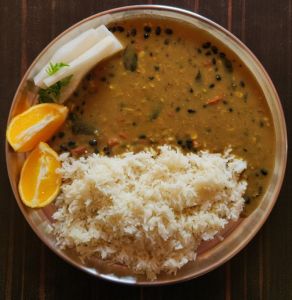
Not my picture. Just to give you an idea of what I saw that prompted my feelings

I watched as the lentils streamed from the packet to form a little mountain, first at the bottom of the saucepan, growing to full saucepan scale. Funny thing to say but I was kind of mesmerized by this mountain building. I was struck by the thought – more like a feeling – this is wonderful, this is important.

I mean to say that I felt a little awestruck by the abundance. In a sort of gratitude induced reverie, I scooped a handful of said lentil mountain, letting lentils stream back to Lentil Mountain in the saucepan.

Then it’s rinsing time. You see, you need to rinse the lentils to get rid of excess starch, bits of dirt,  little stones, or twigs. This is a vital step in the process according to the Dhal Grand Master who taught me this life-sustaining art.

In any case, it’s at this stage that you’re allowed to get your hands right into the mix. Run water, swish the lentils around, drain off now starchy, twiggy, stony water. And repeat five, six, or more times determined by the clarity of the water after each rinse.

I like that bit too actually: kind of pleasant sensation as lentils swirl through fingers and you get experience something of the lentils themselves. Nice feeling.

Next step, fill a giantish sized saucepan (I call it the big pot) with the rinsed lentils, add water (very exacting amounts too, but don’t ask me for precise details), bring to the boil occasionally scooping off any remaining bits and pieces as you watch the alchemy happen.

Then, once boiling, it’s time to stir in various spices. Once again, exact amounts are called for, but, well it’s kind of a trade secret. By which I mean, I couldn’t tell you measurements; one just knows. Could be a cook thing. Or maybe it’s a monk thing?

Enough cooking (sometimes the inner editor doesn’t know when to leave the writer alone).

Okay then.

Gratitude. And wonder. Both experienced today – and not for the first time.

Wonder at & gratitude to Surya (the Sun) which gives and sustains all life, including lentils

Wonder at the aforementioned alchemy that transforms dried, red lentils, a few spices, and water, into a delicious, substantial, healthy and nourishing, food that satisfies and sustains.

Gratitude that I am able to take a small part in this alchemy. Gratitude for the beings who sustain us – me, our community, you, all of us on Earth. Gratitude for the grace I have been granted that actually allows me access to such wonders and abundance.

It’s a lot to be grateful for. All I can add is that it is my deep gratitude that will keep me ‘making lentils’ always.

Cause and Effect: A Poetic Sharing


Greetings my friends, and welcome

Another poetic sharing today. My resolve, my prayer, to write more devotional poetry does indeed seem to be bearing fruit, and I am deeply thankful.

With gratitude and with humility I make this offering to You.

Love and Peace

CAUSE AND EFFECT

Every moment is a cause in which lies a potential effect

Spiritual growth. This is the effect.

Yet, as we grow, our very growth becomes a cause –

   potentially –

as does a winged seed traveling on the wind –

the breath of God – carry with it the potential tree

On your soul, on the souls of other beings, on the soul of the

   world,

the cause, your one moment of growth, may have its effect.

Cause and effect; one and the same.