A Story of a Door

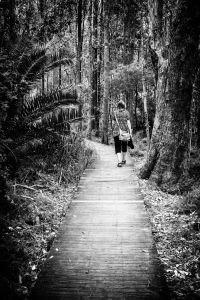
The walk from the Hermitage to the coffee shop at the Village Green takes around five minutes or so. This morning, noticing a pause in the rain, we thought we might take the opportunity to get some fresh air and a walk, at the end of which there would be coffee. So, we stepped bravely forward, with the faith that the gods of the rain were indeed taking a break.
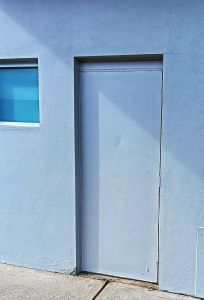
‘Look over there, ‘ said my partner hermit as we passed through the centre of the village. ‘There’s a door that can only be opened from the inside.’

‘I’ve never noticed that before,’ I replied, looking across the street to a wall into which was set a door with no visible handles or lock. The only things that suggested that it was in fact a door were the hinges on one side, as well as its size and shape.

Now don’t ask me how many times I’d passed that spot. Most likely dozens of times, on both sides of the road. Still, now that I had been shown it, I was intrigued. Mentally I was captured: I thought, what a wonderful thing: the one or ones on the other side of the door have complete control over who or what is allowed to enter.

With such a door, one that only opens from your side, you could easily choose to rarely – or even never – open it. Ah, peace at last went my thoughts.

But, right away, those thoughts were dismissed, sent packing: too simplistic, too extreme, to heavy a response. Though, you know, I do feel strongly that such a response to the world – shutting it all out completely – is perfectly understandable, completely reasonable, and oftentimes even an absolute necessity .

Still, I had that feeling towards my reactive thoughts of ‘too extreme’ (inner editor’s note: he has no idea what he’s saying does he? If you ask me, right this minute he will be thinking his initial reaction was spot on and he’d love to have a door like that. Anyway, we’ll let him have it his way).

Some further, more careful thought is required here I think. For a start, here’s a question: If I were to keep the door shut all the time, how would I ever be able to allow my own light, my own love, my own Self, out into the world?

Maybe there’s a way to keep the door open sometimes, then at other times choose to keep it closed to bar access to unwanted intruders in the form of people, thoughts, events, emotions and so on.

After all, it is my door (in this little fantasy at least), the door to the inside, where resides the ‘real’ me, the Self within, beyond and above, the physical form that I so tenaciously cling to as as being the real me. Talk about attachment!
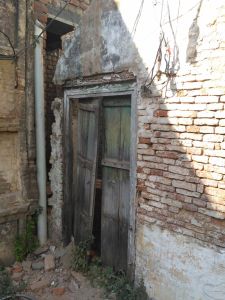
Perhaps slightly exagerated, but this is close to how I see my actual door working as distinct from the story I’m telling in this post.

Where was I? Oh yes. With that door that opens only from the inside, I might come – eventually – to realise that there is nothing to disturb me – unless I open the door and let whoever or whatever that is unwanted, through the door.

I am my own gatekeeper, and without my consent my gate (door) cannot be opened and entered.

And, getting back to the choices I am able to make to sometimes open the door to allow some light and love to flow out from me, out the door and into the world. The more I’m able to discern when, and for how long, to open the door as a way to control what comes in, to what can reach me, the more resources of said love and light I shall be able to build up.

Which, in turn, will lead to more and more opportunities I’ll have to open the door in order to share some of that good.

I can envisage a state reached where my door could quite possibly be left to stand ajar all the time.

You see, the more love and light pouring out, the less that disturbs me can get in. Love and light is transforming, isn’t it?
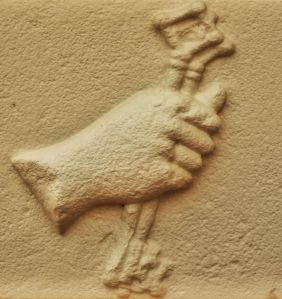
Yes. Now I’ve noticed – recognised – the door that can only be opened from the inside: It’s me! Now, where did I leave my door keys?
What Will Please You Lord? A Prayer Contemplated

Namaste my friends

In my last post I reflected upon the meaning for me personally of a Bhagavad Gita verse that had particularly struck me as I carried on with my renewed inspiration to read the text from the beginning.

Today, I didn’t even get to the place where my reading left off yesterday. Before reading I like to pray some or all the prayers I have pasted in the front (and the back now). As I was deep into this practice, one prayer in particular stopped me, just as with that verse yesterday.

This one seemed to speak to me, asking ‘What do I mean to you?’ So, I made a mental note (always a risky proposition with me), and carried on with my prayers, determined to take time later to think about that prayer, and try to answer its question. So, here I am, later in the day, making these notes.

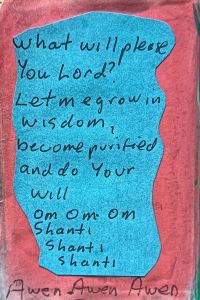
The prayer itself I am fairly sure comes from Thomas Merton, monk, mystic, and writer. Not completely sure, but I know that whoever composed it was one clearly inclined towards living the life of the mystic.

What will please you Lord?
Let me grow in wisdom,
become purified,
and do your will.

For whoever composed this prayer, it is an expression of a genuine longing. I can say that for me it is a deep plea, expresses my own longing. Each time I recite it, in fact, I can say that, although this is the first time I’ve addressed the big what does it mean question, I do sense the longing and grasp the meanings of the various words and ideas in the prayer. Actually, now I think about it, I do say this prayer or parts thereof in one form or another very often.

What will please you Lord?

When I begin to pray these words, what I feel I am actually doing is asking the Universe, the Divine, Self, God – the I AM – how can I live my life so that it is attuned to the natural order and flow of the Universe.

I am asking, what do I need to do to let go of attachments to worldly things which arise from material desires? How do I find the grace to accept when things aren’t going completely my way?

In other words, I’m asking how can i live a good, truthful, happy life in harmony with all other beings and with the Universe.

Let me grow in wisdom

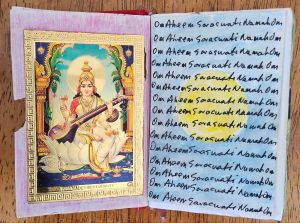
Another of my prayer pages. This one devoted to Maa Saraswati, goddess of, among other things, wisdom

A good place to start, a great first step. But, again I have to ask myself, what does growing in wisdom mean to me?

To me wisdom is not merely knowledge. Though, having said that wisdom needs to rest on a firm foundation of knowledge, otherwise what’s there to be ‘wise’ about?

I’m not talking about worldly knowledge here, though obviously it takes some degree of knowledge for any of us to live in the world. Also it’s relevant to the next part of our prayer; we’ll see that soon.

I’m referring instead to a special kind of knowledge that will (I pray) lead me somewhere closer to acquiring some degree of wisdom – one day.

Self-knowledge is what I’m getting at. And I go about my attempt to obtain self-knowledge in a couple of different ways. I study, sacred texts like the Bhagavad Gita, as well as the words of those wiser than me (which is rather a large selection of people I can tell you) both living and historical.

I meditate (not nearly enough!) as a way to enquire into my own ‘real’ or true nature: who am I? what am I? Just digging deep within to reach some realisation of the answers to those questions.

When I have answered those questions, I will understand that I have reached a true level of self-knowledge. I sense that, at least being on the path to that realisation, I would never be able to develop any level of wisdom.

Mind you, I do feel that all humans are born with some degree of wisdom potential ‘built in’ so to say. As for me, I don’t feel especially wise just yet.

Become purified

For me, becoming purified goes hand in hand with the cultivation of wisdom. In fact I would say that in the very efforts to become purified, it might be possible for me to develop some wisdom as a result of those efforts.

So, here we go again: What does it mean? To become purified? For me it means living a Dharmic life. By Dharmic I mean a life steered and driven by Truth, Right Living, Right Speech, Right Conduct , Right … The Buddha taught The Noble Eightfold Path. That is in my opinion the very best, topmost, pinnacle of self directed means to living a Dharmic or purified life.

The Eightfold Path is not a set of dogmas, rules, or anything like a list of commandments or instructions . The eight steps are merely signposts, a roadmap, pointers for me to follow in order to purify my life, live a Dharmic life. No behaviours are prescribed: it’s entirely my choice what forms my behaviour, actions, and the rest take.

Obviously the path to becoming purified is a life-long one, though some would say that many lifetimes are required. Personally, I can’t even hint that I might be anywhere near close; some days I feel further away than ever.

But, as I work towards ‘growing in wisdom, with the help of my becoming purified path, I pray that some day I might actually learn what I call proper discernment.

This discernment is the ability to act in the world and to react to the joys and sorrows that are inevitable, with compassion, love, and wisdom. To face those inevitabilities with calm and equanimity. Acting with proper discernment will mean that I am living in Truth.

… and do your will

As I reread the words I’ve just written, I realise that, by the time I reach the state described in that last paragraph, I will have succeeded in ‘doing your will.
I will have aligned my self perfectly with the order of the Universe. I will know my place as a tiny fragment of that very order.

If I’m honest however, I have to say that I think it’s going to be a very very long time before such a state come to pass. So, what to do in the meantime?

Well, along with my attempts to live Dharmically, and to cultivate wisdom, I have committed myself to a life of devotion. Devotion, prayer, contemplation.

Devotion to what? To whom?

To the Universe, Divinity, God; all that is represented by all those names we humans have put on the Absolute Reality, that is all there is.

Everything. And everybody, is what I’m saying. There really is no separation except a kind of superficial one we allow ourselves to imagine by applying so many names and forms to the material objects, things and so on, that appear to us as separate one from another, whereas there is in fact only one, without a second.

That’s where the contemplation comes in. It’s a going within, inward to what we imagine is a kind of ‘space’ where all merges into one, the one that is all there is.

I think that’s what ‘pleases the Lord’. While I am indescribably, gravely, deficient at all the steps described above, one course I know to be right for me is to continue to engage with those steps, and to devote myself and my life to the Divine, to the Truth.

That’s what pleases me. I pray that it pleases the Lord.

Friend Or Foe?

Your enemies will now question your capabilities. Is there anything more painful and shameful than that?

Bhagavad Gita 2:36

Thanks to inspiration from my partner hermit, I’ve once again begun reading Bhagavad Gita from the beginning. The quoted verse came up this morning as I continued through chapter 2.

Setting the scene, the Bhagavad Gita is a conversation between Krishna (God) and Arjuna, a famous warrior who’s leading the army of the ‘good guys’. The context is actually a metaphor for the battle that goes on constantly between what some call the Higher Self (represented by Krishna of course), and our lower selves, our ego, mind, and the rest of the worldly us (represented by the very worldly Arjuna).

Knowing that, sometimes a verse will jump out at me as being in some direct way related to me. This verse, this morning seemed spookily all knowing about my mood of just slightly earlier.

Before we move on, I should point out that Arjuna has just realised that if the battle goes ahead, he’s going to have to kill many relatives and friends, teachers, and others he respects. And he’s just decided he’s not going to do it and sits down depressed and dejected on his chariot.

Now while I personally applaud this decision (he even says it might be better if he went off into the forest and lived the life of a wandering monk rather than be in this battle), I have to remind myself that it’s not for real, it’s a metaphor for the battle between our two selves.

Krishna says to Arjuna that you’re going to look really bad if you don’t fight the fight to uphold the Truth as you know it. Lesson number one when studying the Gita: don’t sweat the context!

Anyway, to our current story.

I’d just finished my breakfast cup of tea, and I knew it was time to ‘get on with the day’ as the saying goes. Today, though, Tamas** was strong. Which left me feeling, I don’t really want to get on with the day.

Instead I felt I wanted to not get on with anything; I wanted to lie down and sleep, and not think about anything, or do anything else either!

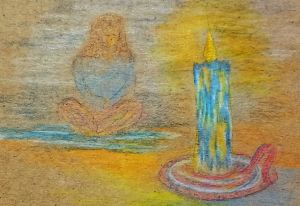
This picture is called Lunchtime Sleeper but it’s how I felt after breakfast this morning!

Mind you, not in the ’empty your mind of random thoughts, relax the body, realise the Divine’ kind of mood. No, more like ‘lay down, block out everything, blank the mind, sleep.’ Blank as it blot out!

Then, the famous second thought kicks in: No, I said to myself. I will not allow Tamas to take control. So, I got up, brushed my teeth, washed my face, and got ready to begin my practice.

I guess you could say that Tamas finds it easy to take control when one’s mind is in enemy mode as I like to call it (somewhere else in the Gita, Krishna says the mind can be our friend or our enemy).

My mind in particular doesn’t usually need a lot of help to disparage me, put me down. Getting me to question my own capabilities is one of its favourite activities – sometimes.

And it’s exactly right, perhaps I should be questioning myself: If I allow Tamas (mind and ego etc) to have free rein, the pain and the shame is all I feel. Well, perhaps not all, and not always, but still, it’s not a good thing.

So, what’s going on now? I’ve been reading Bhagavad Gita, and now I’m making these notes. Tamas is on the run and my mind is being ever so friendly.

**Tamas is that aspect of our (human) nature that has us leaning towards lethargy, laziness, that ‘I can’t be bothered’ feeling, and excess sleep, and all the other slothful stuff. Blotting out, as I termed it earlier.

The Hermits Visit a Coffee Shop

Namaste and Greetings

Welcome to another poetic sharing post. There have been a few lately haven’t there? I had thought that once I had the new page Poems of Devotion up and running that I would only feature one every now and again in its own post.

However the one I feel inclined to share with you today is slightly different. Well, not really: it’s still a devotional piece, but for some reason feels a little other than that.

This hermit’s choice: the number 1 coffee shops in the Hermitage neighbourhood

For a start, it’s set in a café and features the thoughts of a hermit monk (me), and is about what’s going on in that space at that moment. As well as what’s in his mind and heart. Oh yes, almost forgot: the action takes place on Election Day.

So, what is it that makes me feel this poem is ‘still devotional but slightly other’? Well, aside from the setting, timing, and so on I just described, I sense that, in its words, in its composition, the hermit has sought to record (through the poem) that moment in the café as the reaching out to all those fellow beings sharing the space, to recognise, and to celebrate the divine in them all.

May that intention shine through to you too, dear reader

THE HERMITS HAVE COFFEE ON ELECTION DAY

I feel like I’m sitting
in a Hopper painting.
Just off the village green
at a coffee shop, in the Toukley Mall.

There are people; aren’t there always?
Coming and going.
This one catching gossip; that one seeking connection;
One or two heads down, backs bent
over newspapers assimilating myriad tales of woe.
It’s election day.

Of little interest to the hermits,
out of the hermitage for coffee.
A treat that comes at a cost.

Voices – of people and of headlines –
speak, some even shout,
of worldly things. To us not real.

Leaves me hollow.
That’s the vibe,
the feeling inside
– And that’s not real either.

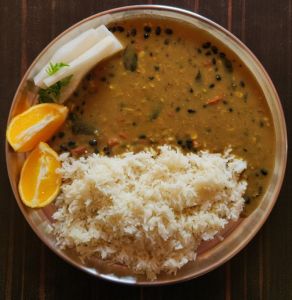
It’s Dhal Day Today

This morning I announced here in the Hermitage to anyone within range, that today, I would be making lentils. No, I thought, I can’t ‘make’ lentils; my job is to cook them so they might become Dhal.  Jokingly to myself I stated by way of correction in my best mentally affirmative voice ‘It’s Dhal day today.’

Dhal is an important staple for us here at the hermitage. Please don’t imagine I’m exaggerating  when I say that we eat it everyday. Actually, come to think of it, it might be just an ever so slight exaggeration.

Very very occasionally we choose some other evening meal, always vegan. But to tell the truth, we all like Dhal so much that we hardly ever feel the need for a change.

Anyway, as I say, it’s one of my relished responsibilities to once a week, or thereabouts, play my part in producing the Dhal that sustains the community for the next week.

Just a little aside: Lest you think Dhal is all we eat, I should mention we eat lots of fruits and vegetables, rice and breads, beans and various other things that come to us one way or another.

Please, the inner editor is begging me, can we just get on with today’s topic? Actually, the topic is the Dhal making that has taken place today. So, really, we are still kind of on track.

Right then. Not long after my announcements to the community and to myself, I got to it,  to the task at hand. First, I pour red lentils into a largish saucepan.

Not my picture. Just to give you an idea of what I saw that prompted my feelings

I watched as the lentils streamed from the packet to form a little mountain, first at the bottom of the saucepan, growing to full saucepan scale. Funny thing to say but I was kind of mesmerized by this mountain building. I was struck by the thought – more like a feeling – this is wonderful, this is important.

I mean to say that I felt a little awestruck by the abundance. In a sort of gratitude induced reverie, I scooped a handful of said lentil mountain, letting lentils stream back to Lentil Mountain in the saucepan.

Then it’s rinsing time. You see, you need to rinse the lentils to get rid of excess starch, bits of dirt,  little stones, or twigs. This is a vital step in the process according to the Dhal Grand Master who taught me this life-sustaining art.

In any case, it’s at this stage that you’re allowed to get your hands right into the mix. Run water, swish the lentils around, drain off now starchy, twiggy, stony water. And repeat five, six, or more times determined by the clarity of the water after each rinse.

I like that bit too actually: kind of pleasant sensation as lentils swirl through fingers and you get experience something of the lentils themselves. Nice feeling.

Next step, fill a giantish sized saucepan (I call it the big pot) with the rinsed lentils, add water (very exacting amounts too, but don’t ask me for precise details), bring to the boil occasionally scooping off any remaining bits and pieces as you watch the alchemy happen.

Then, once boiling, it’s time to stir in various spices. Once again, exact amounts are called for, but, well it’s kind of a trade secret. By which I mean, I couldn’t tell you measurements; one just knows. Could be a cook thing. Or maybe it’s a monk thing?

Enough cooking (sometimes the inner editor doesn’t know when to leave the writer alone).

Okay then.

Gratitude. And wonder. Both experienced today – and not for the first time.

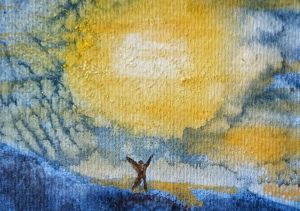
Wonder at & gratitude to Surya (the Sun) which gives and sustains all life, including lentils

Wonder at the aforementioned alchemy that transforms dried, red lentils, a few spices, and water, into a delicious, substantial, healthy and nourishing, food that satisfies and sustains.

Gratitude that I am able to take a small part in this alchemy. Gratitude for the beings who sustain us – me, our community, you, all of us on Earth. Gratitude for the grace I have been granted that actually allows me access to such wonders and abundance.

It’s a lot to be grateful for. All I can add is that it is my deep gratitude that will keep me ‘making lentils’ always.

Realisation of Reality; It started With a Joke

‘I like looking at you,’ says the hermit.

‘You must be sick in the head,’ replies, as quick as  you like, his partner hermit of 40 odd years. (Obviously an old and oft shared joke).

‘Of course I’m sick in the head,’ bursts out of the hermit in response. ‘It’s like saying the sun comes up every morning. It’s a given, a simple fact of life.’

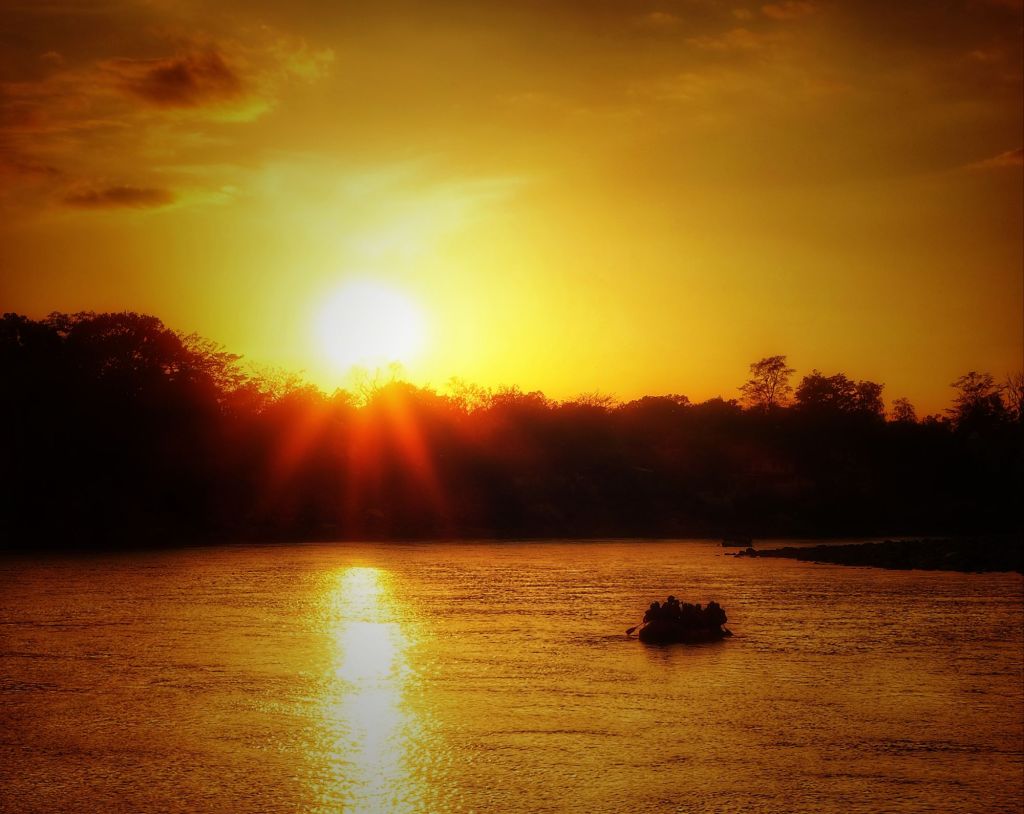
Problem is, it’s not true is it? the sun I mean; it doessn’t come up does it? Doesn’t go down either for that matter. I mean it looks like it rises up every morning, and it looks  like it goes down every night. But it doesn’t. In reality it’s us here on planet Earth who are doing the turning.

At ‘sunrise’, our home planet in its continual revolving has us looking at a stationary star (our Sun, Sol, Surya) that is, rather than going up, just sits there as we revolve downwards leaving it behind, Same story at night with the sunset, just the other way round.

Our experience when looking at this scene is that the sun is going down behind the hills. But in reality it’s the hills and river and the viewer going up as Earth rovolves. Hard to get one’s head around.

To explain what we see, what we experience – or rather what our ancestors saw and sought to explain – the simplest, most obvious thing to do is tell it like we see it. Sounds obvious enough, but as we’ve just seen, the story we inherited and which was only recently (in historical terms that is) shown to be incorrect, of the rising and the setting of the sun was based on an illusion,

As to the hermit and his story – the long-held believed to be true story – well, if we’ve been able to establish that stories we tell ourselves are often based on illusions, then perhaps the hermit can look for another story concerning the state of his head health, that is based a little more on facts, not so much on illusion.

Or to put it in other words: It’s quite possible that if the truth of the matter is that the sun never goes up and never  goes down, then just maybe the hermit is not actually sick in the head.

Except perhaps when it comes to old jokes shared between beloved partner hermits.

Don’t Stick Your Feet Out

Just now (as in earlier today) I had some perfectly natural, normal, and expected thoughts about my prayer life. If I’m to be honest though, and perhaps a tad overly tough on myself, the thoughts I had felt slightly ridiculous given my professed commitment to praying constantly, and my supposed understanding of the meaning and function of prayer.  In other words, there I was again: putting some kind of unrealistic expectations on myself – again!

Anyway, enough of that. To sum up those thoughts: I was thinking they – my prayers – aren’t working. Nothing is happening. And I was asking myself questions: What’s been achieved? What’s coming from all the effort? Where are the results?

And then, exactly at the moment I was writing down those thoughts and questions, I lifted my eyes from my notebook to see my partner-hermit approaching.

‘It’s my blessing at the moment,’ she said walking by my chair.

Why did she say that?

Because, right there before my eyes was evidence that none of my ridiculous thoughts and questions on my prayer life, had any meaning whatsoever. There was the answer, walking past me.

As I said, right there before my eyes.

Sounds and Vibrations

Today’s post opens with what I think is called an oxymoron (funny word that)

No need to repeat here that I am a hermit; there you go, I repeated it, but it’s true nonetheless: I am a hermit. The oxymoron bit comes in when I make another obvious statement to the effect of, as a hermit I very much prefer to spend the vast majority of my time right here where I am right now:  in our hermitage.

This has become even more the case since our community decided to ‘settle down’ for a while in the one spot.

Obviously, just like everyone else, we have shopping and other chores that need to be done. Then there’s the occasional visit to the Doctor, and even the dreaded dentist, that will call me away from my safe-haven.

And that’s even before I mention walking for fresh air, exercise, and simple enjoyment. Or pursuing my Contemplative Photography practise. Both activities take me out and about, but usually not too far or for too long, from the Hermitage.

In any case, both these welcome (and absolutely necessary) pastimes have me mostly on my own, being quiet with heart, mind, and eyes open, or simply contemplating ‘stuff’.

No, it’s nore the occasions when I’m having to interact with people, or when there are crowds. Some might call me over-sensitive, but that label would only apply on my outgoing and gregarious days.

While that was intended as a little ironic humour, I must insist (internal editor speaking here) that I add that oftentimes said outgoingness and gregarious demeanor is an act, a cover for anxiety, and usually ends up making me feel worse anyway.

Although I guess you could also say that I’m allergic to the world and its ways, there are the occasional times when I want to, not so much ‘be around people’, as feeling the need to be somewhere where some life is going on around me. Not hectic life, as I’ve said, more like people going quietly about their business, doggies walking and playing with their humans, maybe people sitting chatting to friends. I guess you know the kind of thing.

This Mystic Tree stands for all the Tree People

The hermit gods blessed us in placing us in a hermitage which we love more and more, literally five minutes walk to a low-key, friendly indoor/outdoor café overlooking the village green with it’s big tree in the middle, and its nice lawns where the above-mentioned not so hectic life with it’s chatting, sitting, and relaxing people, and its doggies leading their humans in games and walks goes on. The coffee is okay too.

Except. People can be friendly, which in itself ,of course, is a lovely lovely thing, but as I’ve been telling you, I’m not really very good with people in those kinds of situations. Keep a low profile, is my ongoing advice to me.

The poem I share today was composed as I sat in the sun on a recent visit to that coffee shop. This visit prompted me to try to describe something – in poetic form and in ‘real time’ – of what I’ve been sharing with you here. No, what it actually describes is my strategy on that occasion for keeping said low profile.

This poem also holds a timely reminder that arrived with, what I can only think of as divinely inspired timing.

SOUNDS AND VIBRATIONS

My eyes are cast down – not downcast.
The brim of my hat pulled low.
As good, I hope,
as a Do Not Disturb sign.


For a hermit, out of his cell,
the cell must be reconstructed.
He is his cell.
Eyes focused on these words revealed;
hat brim, the walls.

I never forget, but just in case!


A chime resounds, but it does not disturb,
for I know for what it tolls:
Chant Hare Krishna, it calls to me.
So, these words must conclude;
words of praise now commence.

Hare Krishna

Cause and Effect: A Poetic Sharing


Greetings my friends, and welcome

Another poetic sharing today. My resolve, my prayer, to write more devotional poetry does indeed seem to be bearing fruit, and I am deeply thankful.

With gratitude and with humility I make this offering to You.

Love and Peace

CAUSE AND EFFECT

Every moment is a cause in which lies a potential effect

Spiritual growth. This is the effect.

Yet, as we grow, our very growth becomes a cause –

   potentially –

as does a winged seed traveling on the wind –

the breath of God – carry with it the potential tree

On your soul, on the souls of other beings, on the soul of the

   world,

the cause, your one moment of growth, may have its effect.

Cause and effect; one and the same.

Surrender: The Key to the Hermitage

The Hermitage

Surrender is a key issue for our community of Hermits. Surrender in the sense of, to put it really simply, how to just go with the flow; how to recognise that the universe moves as it does, and how might we fully realise that while we do what we can, playing our part, in the final analysis, life unfolds as it does.

Like I guess, most people we often have trouble accepting the so-called realities of life like bodily changes, world events that sadden, shock or outrage us. You know what I’m talking about. We just like stuff to work out just as we would prefer, and when it doesn’t? Well that’s when we suffer; we get angry, frustrated or sad or otherwise affected emotionally and even physically. Again you know what I mean.

Courtesy of our resident artist

‘The will of God’ or ‘the will of the Universe’ are common recommendations for surrendering to. But of course ‘God’ or the ‘Universe’ have no will of their own; it simply is what it is, and follows the laws of nature, the natural order of life the Universe and everything as has been famously said time and again.

So, a small poetic offering on just that theme of surrender. This time asking: surrender to whom or to what? The answer I come up with is perhaps not as far out as it might first appear when you read it. Maybe we’ll do a post looking more deeply at that one.

Anyway, please accept my small offering.

WE SHALL SURRENDER UNTO WHOM?

To whom, or to what shall we surrender?
We are hermits; we dwell in a hermitage.
Here are our cells, our Paradise.
A walled enclosure unto which we may surrender.