Happiness, Freedom & Other Joys VS Anger, Depression & Other Sufferings

Frustrated, depressed, annoyed, and even angry at times. All because I know for certain sure that it’s God’s will that I write more – as in more often, more volume, and more quality too. And I’ve vowed to do God’s will in all things to the best of my ability.
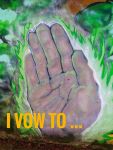
No, actually those extremely un-monklike emotional reactions are not because of this knowledge of the will of the Universe or my vow to obey; I have those unhappy emotions because of the other vow I’ve yet to mention: I have vowed to find ways to content myself with how the universe unfolds for my life, and for the world.

I’m not saying that I have promised to resign myself to ‘fate’ or ‘destiny’ or whatever one might call it. No. And it’s a big no because while what happens in the material world is working out according to the laws of nature, it’s equally true that I am in that mix: I have my part to play in the universal scheme of things, just like we all do. It’s a matter of I do my bit, and the Universe (or God) does its bit.

And then it struck me. Blew my mind is more like it. All my frustration, depression, anger, and whatever, over not writing to my own desired level, is really nothing more than a raging against God’s will. Needless to say, this reaction is really quite a distance from obedience!

Another thought on the topic of God’s will – the laws of nature and the natural order of the Universe: By obvious definition those laws and order must (obviously again) apply to all things in what we call the Cosmos or Universe.

All material things, such as bodies, as well as non-material things like minds, emotions and the like. You name it; All there is is bound by the same set of natural laws.

So, speaking for myself alone, not being able to write to my expected or desired for level is only one – and quite a minor one it has to be said – of numerous areas in my life and the world that cause me frustration and all the rest, as I struggle to to be content with the will of the Universe.

Too big a topic, or should I say too many topics to get into here. In any case, shall we set aside that not so little aside for now?

So, where were we? Right: Raging against God’s will; resisting the ways in which the natural laws of the universe are working themselves out. Sounds terrible when you see it  writen down like that doesn’t it?

Anyway, it’s clear to me that the Universe , the will of God, is trying to say something to me, which sounds something like this:

‘Look you may very well want to write, you might even be desperate to get those words and ideas out of your head and onto the page, but that’s just not the way things are right now is it?

‘Of course the smooth running of the Universe involves you, and in a big big way too, but you are still just one element in what is really quite a complex, not to mention gigantic, system.’ Nature can put you in your place for sure sometimes.

‘In fact it might be,’ this spokesperson for the Universal order continued, ‘that the Universe is trying to get a none too subtle message across to you? Do you think that desperately clinging to some outcome you want or desire that strongly but can’t seem to get, is causing you pain? Of course it is. Anger, depression, all those sad and negative emotions, they are just not necessary.’

The Universe (in its manifestation as my discursive mind) can be very vocal sometimes, but I think I sort of get it.
Essentially what that Universal spokesperson is saying is that the order of the Universe is working out just as it’s supposed to. Actually it can’t do otherwise. I play my part (which according to the spokesperson is bigger than I imagine), and really that’s all there is to it.

In other words, If I’m not writing, then that is precisely what is supposed to be happening (or not happening) right now. And not only that, but because I am an active participant in the way the Universe looks and behaves right now, then it’s also pretty obvious that I already know – deep down somewhere – that it’s really alright. It’s all just as it’s meant to be.

Once again speaking just for myself, I find it quite tricky finding the balance between what part I am to play, and what’s the Universe’s bit, in controlling the direction my life takes or in affecting the conditions that impact me.

Perhaps the best way, indeed it might be the only way, to have a positive impact on my own happiness, peace, contentment, and having a calm mind, is to give up any desires for things that won’t contribute to my spiritual and personal growth or the wellbeing of other beings, while at the same time acting upon without attachment to the outcomes, those desires that seem to me to be for the good of all, including Self. 

Being attached – driven by compulsions or aversion – to the outcome of our desires, however, simply leads to more desires even when fulfilled.  And when they are not fullfilled, there is suffering due to clinging to those compulsions.

Bottom line? I am seriously attached to my desire to write more (as well as so many other things as I alluded to earlier), that not being able to do that right now is causing a lot of suffering. Enough of that I say! Oh, that balance thing: it’s about discernment isn’t it? Okay I get it, story for another day.

PS I’m so glad I got that all out of my head and onto the page. Thanks for listening friends.
Flee, Be Silent, Pray Always Part 2

Welcome friends

Thank you for bearing with me as I chose to post a short story before I got onto this post, the next part in our small series. Actually, I hope you enjoyed the story, and if you missed it, then please feel free to have a look. You will find it here.

Anyway, welcome to Part 2 in our little series of contemplations on the answer that Abba Arsenius received to his question: How can I be saved? (from the world with its  sorrows and noise and traps of all kinds)

The answer he heard from deep within his own Self – what he called God -was the succinct, to the point, no nonsense:

Flee, Be Silent, and Pray Always.

In Part 1 we realised that fleeing (from the world) doesn’t necessarily mean we have to leave everything and everyone behind and go live in a cave in the desert as he did. For some of course it might mean exactly that or some 21st Century equivalent, but I think for the vast majority of us, fleeing simply involves some modification of our current lifestyle, changes to our habitual ways of thinking and behaviours in order to rid ourselves of attachment to and entanglement in the things, situations, and people in the world that aren’t working for us.

And, now, in this post we will spend some time in contemplating the second injunction given to Arsenius: Be Silent.

Be Silent

I haven’t actually given a lot of thought to this topic since our last post. Nor have I done any online research, or watched YouTubes (I checked for fun and there seems to be hundreds, maybe thousands) about silence.

No, at least in this I have tried to remain silent and simply wait for the post to come together of its own accord in its own time. Perhaps this decision came from that same place Mr A heard from when he had his question.

So, what does it mean to be silent? Well, as I just mentioned, there are seemingly unlimited answers out there just waiting for us to grab on to. The better question would probably be, what does it mean for me to be silent?

First thing to say is that I’ve come to realise (okay, it’s an ongoing process of coming to realise, not there quite yet) that there is absolutely no person, no circumstance, and no place that I can rely on to provide me with silence. So, I’m coming to accept, there is no point in looking anywhere, or to anyone, as the source of silence, at least not in the physical world.

Of course, one key element of achieving silence may be the absence of noise. Maybe. so living where there is less traffic, less focus on materialism and commerce, fewer people, less media imput (news, TV, Internet, and all the rest) might be a place for some to start.

Even if it isn’t possible to to avoid all these things completely, I try to drop or change the things I can which for me sometimes at least, gives me a chance at a little silence.

Having said that, I’m reminded of an aphorism I once read: A hermit living alone, in a cave on a remote mountain, away from any kind of road, no radio, TV, etc, is never going to manage to be in silence if his mind and emotions are always busy with thoughts, memories, desires, fears and other emotions.

On the other hand a person living on a busy city street in the midst of all kinds of chaos and noise, may be living in perfect silence. If they have a still mind, steady emotions, that give them the ability to ‘sail through life’ as the saying goes.

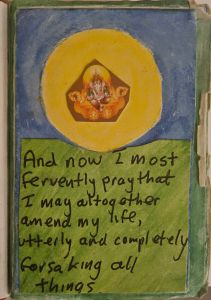
But what about me? Well, this prayer says it all In order to achieve a state in which I can actually be silent, I am attempting to amend my life – utterly and completely.
I can be quite self-critical on this, badgering myself with desperate questions how come I can’t just be silent (and quiet in the accepted sense of the word as well). It’s a dilemma which frustrates and disappoints me. But, to be a little fair to myself, I suspect I’m not very different to most other people when it comes to silence. After all, if it was so easy, how come we need thousands of books, articles, YouTubes on how it’s done?

As mentioned, the absence of noise isn’t necessarily a prerequisite to achieving silence. But, I have to say, that for me, it’s pretty important. Being surrounded by the noise of the world, as well as my own hyperactive mind and seesawing emotions, are for me blocks to silence. Though, when I think about it, there are glimpses, even when one of our temporary hermitages is on a busy street, or under an airport flightpath.

As a bottom-line starting point, I don’t watch or read news; I don’t (anymore) randomly scroll the Internet even when ‘looking for something to watch’ on YouTube. And of course I don’t use television. Ever.

I’m not saying that when I do watch a video online that it’s always only spiritual or holy stuff. Nor do I only read books about saints and spiritual matters. Mind you, I would say more and more lately I’ve been tending in that direction. It’s just happening naturally I think.

A reason for that progression is effects of the amount of time I spend meditating, chanting mantra, and ‘just sitting’. Never enough time spent, but I’m getting there.

In all these three activities there is of course always lot of mental noise trying to mess things up. Not to mention the dreaded external noises. But, even then, there are gaps, spaces between breaths, pauses between repetitions of the mantra, and even when just sitting there are (if my mind has mercy on me) little moments free of thoughts, fleeting gifts of silence.

I think most of us have a tendency to focus on the problem of noise and disturbance, both external and internal, and ignore those fleeting little moments of silence.

With the momentary absence of thoughts it’s like when we ‘get lost in a beautiful piece of music’ as my teacher says. We’re still there, we can still hear, it’s just that we – as in our ego in one of its many and varied forms, our mind – is absent. And that means there is silence. Then we are in that legendary blissful state of being one with the music (or whatever the activity we are ‘lost in’).

Because our thinking mind seems to be absent (no thought equals no mind), there is nothing to judge whether there is silence or not. Just as when we are in deep sleep, as opposed to the dreaming state, there is silence, the absence of thought; no ego dialogues; all is silence. That’s why often don’t realise we have achieved that silent state: no mind to record the experience, so when we do resume thinking, we assume we’ve not stopped thinking at all.

Despite these many years of meditating, chanting, and sitting, I seem to still expect something spectacular to occur. Some blissful state, some revelation of enlightenment, or some other magical happening, maybe visions or some genius idea or something. It’s not a rational expectation of course, but …

Yes. It’s still hard to let go of the search for some kind of ‘signal’ buried under all the ‘noise’. Lately, however, I’m slowly coming to realise that looking for signal is really my ego/mind looking outside in the world for some kind of experience of silence. But to belabour the obvious, silence is silence; what’s to experience?

That doesn’t mean that there’s nothing. Nor that it’s some kind of void, just emptiness and ‘nothingness’. Silence is the space in which the seeds or knowledge are able to take root before they can become manifest in our material world.

It’s just that we might not notice untill sometime later when we see or sense a change in our thinking, our behaviour, or how we feel about the people, places, things, and circumstances of our lives.

See you next post when we look at the final of the three injunctions given to our friend Arsenius, Pray Always.

Thank you and may you realise the silence that already is present within you.

NETI NETI

On the going down and the coming up
silvered and golded stairs
to and from the Underworld.
It’s all just a giant mirror
In which we see who we are not.

Homage to Holiness: A Story to Share with You

This morning as I do most mornings (trying to make it every morning) I sat for my practice starting with some prayers and reading a a few random verses from Bhagavad Gita.

Then I settled to spend some time in devotional chanting of mantra. For a change this morning, while chanting I listened to a lovely album of devotees chanting the Hare Krishna mantra:

Hare Krishna Hare Krishna
Krishna Krishna Hare Hare.
Hare Rama Hare Rama,
Rama Rama Hare Hare.

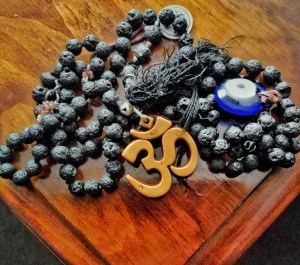
I reached for my mala (prayer beads or rosary) and as I mentally repeated these holy names in accompaniment to the recording, I held a bead between my fingers for each repetition, focusing on the chant.

Now, chanting is much like any other human activity: that is to say, the mind is always there. Usually it manages to bring up all kinds of irrelevant fears, memories, questions, you name it. Today, however, one of those supposedly random memories actually caught my attention in a good way and took me along.

As I continued handling my prayer beads I thought about a story I read in India nearly 15 years ago now. The story concerned prayer beads as it happens. Buddhist nuns, imprisoned in Tibet, were forced  to resort to making their own rosaries in secret after their meagre belongings had been seized.

Almost ten years later, after another extended stay in India, I finally was able to write about this story. In this instance it came into being as a poem I called Homage to Holiness. May I share it with you here?

Homage to Holiness

Threads harvested from threadbare clothing.
Pea-sized bits of bread, sliced from meagre rations,
secretly hoarded for sacred purpose.

Mala makers work at night
in the dark of the stinking and freezing stone cell.
Chewed bits of bread become dough again,

and, by feel, frozen fingers knead the dough
until tiny beads are created.
An even tinier twig, again by feel, pierces each bead through.

Then in solemn prayerful silence and focus,
the nun passes her harvested thread through the first bead.
She ties a knot, no easy task with freezing fingers in the frozen dark.

And so it goes; all sacred duties take their own time.
One by one; one bead of bread threaded; one knot knotted.
The nun nears collapse. But now, at last, her task is done.

As the last knot is knotted, the last bead in its place,
the nun sighs and mutters, whispers, a prayer of thanks.
One hundred and eight beads – plus one – made, and strung
Her Mala
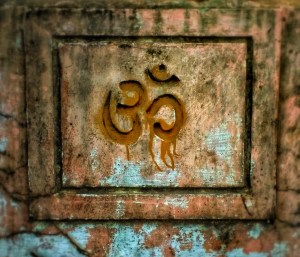
Om Mani Padme Hum

Probably the most sacred and significant of all Buddhist Mantra, Om Mani Padme Hum, means something like ‘the jewel is in the lotus’. But many would say it goes a lot further than the mere literal translation of the words; It is said to be the actual path to Enlightenment. There is a huge amount of information on the Internet about this mantra, so if you’re interested a good place to start is at this link.

Whatever the actual literal meaning, interpretation, or who chants it,  I think we can all agree that the intent of this mantra is to have us focus on the divine, or on the Ultimate or Absolute reality. The same as any mantra one might choose actually. Remember last post? God is.

in any case, I think somewhere above I’ve used the word random. Well I should know better by now: no such thing as random. One of the Bhagavad Gita verses I read – in fact the final one I left marked with my bookmark – seems to me fit very nicely with that ‘random’ memory of a story read years ago, and my humble retelling of the story in a poem many years later

One who knows the Absolute and whose intelligence is fixed on the Absolute is not moved by pleasure or pain, pleasant or unpleasant happenings.

Bhagavad Gita 5:20

Did that nun imprisoned as she was in the dark and the cold feel that pain? Did she feel fear? Of course she did. The thing is, she was, as constantly as her circumstances allowed, fixed on the Absolute: the activity of making the mala, the intended use of the mala, and her prayerful attention and devotion as she worked, all enabling a complete fixing of mind, heart, and attention onto the Absolute.

The cold was still there; the hunger and fear too. But this nun was able to remain centred, you might even say calm and content, despite the dire situation.

Actually content was a word I read in relation to this nun and her sisters (she wasn’t alone in that prison cell): From what I read they were released after some time, and eventually escaped to India where they rejoined friends, family, and of course their leader the Dalai Lama

At the time the story was being recorded for posterity, the Mala Maker reported that she was happy and content and leading a full and fulfilling life. I imagine her as still being fixed on the Absolute.

Thank you for allowing me to share these moments with you
Love and peace

Let Me Tell You About a Visitor I had This Morning

Greeting and Welcome to you

Quite a long time ago now I half wrote a book. I mean to say, I wrote half the thing before giving up. The book was going to be called When a Pet Dies, and was about, well exactly what the title suggests. All the practical stuff that you’d expect, as well as ways to deal with the grief over the loss of a companion animal .

I thought at the time that the reason it was only half written is that, once I got through that practical stuff and was ready to tackle the grief and loss parts, some kind of lethargy set in, or I got lazy. Or perhaps, I was thinking also, the muse for that particular project had simply left and was gone. So it remains half written.

So, why am I musing over this half done, half forgotten project from long ago? Well, let me tell you about a visit I had this morning.

I was sitting, focusing on chanting my mantra. Suddenly I felt an absolutely overwhelming sense of loss and sadness. I don’t recall thinking of anything in particular beforehand, but the sense was overpowering. Flooded with grief is what they call it I think.

Lofi (on the right) with his sister Shanti

And then, just as powerfully, I sensed the presence of Lofi, my cat who died in my arms over ten years ago. Immense feeling of presence is what I wrote in my notebook. Now, I’m not saying he was literally there with me. I’m also not saying he wasn’t. All I can say is that it was among the most intense of similar experiences I’ve had over the years. Anyway, that’s most likely what got me thinking about my incomplete book.

Later this morning I was sitting with my partner on a benchseat overlooking the sea, the bit of the Pacific coast I’ll be leaving behind next week.

Actually, now I’ve mentioned that, you might remember from my last post how keen I am to get out there to the desert. That excitement and anticipation doesn’t mean for a second that I’m not feeling quite sad about leaving the coast.

Anyway, we were just sitting there and chatting on and off, when suddenly a thought seemed to push its way to the surface. I all of a sudden knew why I stopped where I did when writing that book. I realized in a strong and convincing way that you can’t build a structure to define what grief is or how or if it should be experienced, by whom and when.

I’m not talking about the ‘truism’ that one hears all the time that says that the ‘stages of grief’ are in a set order, until they’re not. Actually come to think about it, I’m not even sure this is true. I mean, I’m not sure it (grief) is a thing to be labelled, quantified, recorded, predicted, analysed.

I mean, who’s to ever say how any other individual, or even oneself, will feel about anything at all? Sure, there might be a ‘typical’ set of responses to any given circumstance, such as a loss, but even the proponents of such theories will tell you that none of us is typical.

Which kind of leads me back to my feeling of oneness with my Lofi earlier in the day. Obviously I’m not alone in having such feelings. How often has any one of us heard other people say, after they’ve lost a loved one:e, ‘S/he was really here. It was so real’.

Such experiences can occur anytime, even decades after the loved one has left. I’ve mentioned somewhere else that I’m reading (in little chunks) a great book by Joseph Campbell, the renowned scholar of myth. Let me share with you a quote from the section I’ve been reading today where he’s talking about how art in India seeks to portray the divine in all things:

This is the wonderful song that one hears when one reads the Bhagavad Gītā or any of the great texts of Eastern philosophy. This is the song of that immortal spirit that never was born and never die.

Of course this isn’t meant to be a consolation to myself or anyone else. After all, we are physical beings, living in a material, solid and apparently ‘real’ world. So, naturally, we experience loss, like everything else in that context.

Our bodies react (or don’t) as do our minds, creating physical sensations and emotional responses. Or not. These physical and emotional responses, or lack of them, are totally unpredictable, unexpected, and most definitely unclassifiable by anyone outside of oneself (myself)

Anyway, there are no rules. Even the grief and loss experts will tell you this. Mind you, I can and will only speak for myself, and my experience. Basically that experience has taught me that I have an intuitive resistance to ever thinking in terms of there being a ‘roadmap’ for grief.

Or a statistically valid ‘pattern’ or ‘process’, or that there are even such things as ‘stages of grief’.

My grief for my Lofi is unique, just as everyone’s is. I’m pretty sure I don’t even want to define it, label it, ‘try to get closure’, ‘come to terms with my loss’. No. None of that. It’s like I’ve said someplace else, or at some other times:

Sometimes we make way too many words for something for which there are no words.

Thank you for allowing me to share these words with you. I pray that they are not ‘too many’

peace and love

Am I Here & Now or There & Then?

One week today and I will be there. In other words, this time next week at this time I will have arrived in the desert city of Broken Hill. Almost in the heart of the continent and right in the middle of the Outback. In fact they call that whole area The Big Red after the colour of its tens of thousands of square kilometres of desert sands.

Back to Country

It’s about 1500 kilometres from the Pacific Coast where I am right now. I’d like to write about the ‘call’ to the desert, which I am finally answering, but maybe I’ll get to that in another post.

Right now I only want to say how excited I am to be going. A bit anxious too (I’ve been there before, but still …), and plain and simple looking forward to getting there.

Acturally, to be perfectly clear about it: I can’t wait to be there. But, you see, herein lies the problem: I am so keen to get there that I’m feeling as if I am no longer here. I am not present; I am not living in the moment and in the place I’m in (which I love by the way, the place I mean).

I don’t mean to say that I am some sort of Buddha who is usually fully present in each moment; or who is serene and calm when he knows change is coming. Any reader of this blog will tell you that presence isn’t necessarily my greatest strength.


But, I must say that lately I have improved (slightly) my living in the moment, being here and now, way of living. It’s just that I’ve been longing for this particular change (and all that I anticipate will come with it) so much that I just can’t help myself.

Did I mention already that this is a problem for me? Well, yes, I did, and it is. I prefer very much to be where I am and when I am and fully in the flow of the ongoing present.

Of course there is nothing wrong with wanting something to happen. The problem arises when one is so anxious for whatever it is to happen, that what’s happening here and now ceases to be where one is at—in other words: the trouble is that I stop being in the present.

Buddha taught what are called The Four Noble Truths. (which pretty much form the core of Buddhist teachings) The second of these Truths says that attachment is the cause of suffering. Suffering here means anxiety, worry, regret, fear; all those kinds of things. Whenever we say something like, ‘I can’t wait to…’, then it is a sure sign we are attached to that want or desire.

If I’m in it, will I win it?

By the way, the First Noble Truth is: Life is suffering. Suffering, The Buddha taught, is simply the price of being alive. We get hungry, we are conscious of pain (in all its guises), we grieve; we grow old; we get sick; and we die.

But, right now, I want to talk more about Noble Truths three and four. Number three says that suffering can be overcome. Nice clean, clear, and not to mention, succinct little statement. Of course, it’s easy for him to say isn’t it? He is Buddha after all.

Perfectly reasonable reaction from us suffering humans. But there is hope and we will find that in Noble Truth number four which gives us the how to overcome suffering. There are quite a few ways to put this Truth into words, but the one I like best says:

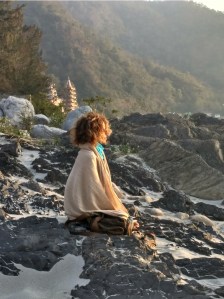
The way to overcome suffering is to sit.

What? Sit? Yes, sit. Be still; stop moving. Of course if we relate this Truth to my little dilemma for wanting to so badly to be somewhere else that I’m not able to be where I am now, we can expand this Truth to something like this:

Focus your full attention on what you are doing now, and where you are now as well. As much as you can, be open to change, but be less attached to the nature or timing of that change. After all, you can make all the plans you like, but who knows what’s really going to happen—you won’t know that till it actually happens.

So, that’s what I am trying to do. Instead of saying stuff like ‘I wish I could go sooner’, or ‘it’s only x days till I go’ (yes I know, that’s what I said way up there at the top of the post), I am going to ask myself, ‘What am I doing now?’, and I plan to look around me, and engage more with the reality of this moment. And try hard to realise the ongoingness of that everlasting moment.

As Ram Dass said,

Be Here Now.

Hey, that’s a great mantra isn’t it? Chanting it whenever I start getting out of the here and now mode, might just put me back there again. I mean here—and now. You know what I mean!

Love and blessings from me to you

Paul

I Think, Therefore I Suffer. Sometimes

Welcome

Let me share with you some random thoughts that came up as I sat to meditate one recent morning. As I settled, a thought struck me.

One among many of course, but this one got my attention. It went something like this:

‘I am where I’m at today because of the life I’ve lived: my choices to travel, my continual need for change and variety. And not to forget the impacts of my health on decisions over the years.’

It was a bad feeling coming on as you can tell.

So, I guess (the thoughts kept coming) I’ve had the fun and adventure and now’s the time to pay the price.

This particular thought train is an antique I’ve been run down by many times. And the way it going this time was downhill fast; it was one of those ‘poor me, what a horrible life I’ve got’ trips. Then, the next thoughts were a bit more truthful:

I live with my life partner and soulmate in a Pacific Coast town, literally five minutes walk to a spectacular beach and some special coastal scenery. The town isn’t too big, and not too small: it has everything we need without the crowds, traffic, noise, pollution, shopping malls, and other paraphernalia that goes with a materialism gone mad.

We live in a very comfortable small house in a Subtropical paradise of a holiday park resort flanked by a beautiful creek and forest. Every day we get to see and watch nicely many species of birds.

Each night literally hundreds of bats fly over on their way to feed, and very often we get to see wild kangaroos up close. Not to mention the lizards, ranging from tiny Geckos to metre long beauties.

It’s true: I did make that mental list. No, I thought, this is no price I have to suffer to pay for past decisions and actions. These are gifts I’ve been granted. Oh, did I mention that I get to pretty much spend all day every day doing more or less exactly what I want or feel lead to do?

This was one time when I was able to divert that ‘poor me look how I’m suffering’ thought train, and let the ‘I’m really and truly blessed’ express to roll on through.

Peace and love to you all from me