A Case of Mixed Feelings & Questions of Identity

Yesterday, after getting back to the Hermitage from a walk around the block, I went to take off my shoes.

Actually, I thought, while I’ve got my shoes on I may as well spray the weeds out the front and out the back in the courtyards of the Hermitage.

Sounds like an innocent and innocuous thing to say and do doesn’t it? Well, in fact it is a far from innocuous euphemism which in reality has me saying: I’ll apply some poison through a spray bottle to the leaves and stems of plants somebody or other has classified weeds, in order to kill them slowly over a few days.

Needless to say, this activity always evokes mixed feelings in me. Like everything else in the material life, this issue has two sides concerning the rightness and wrongness of ‘spraying the weeds’.

On the one hand, I understand that we humans are merely one more species along with so many others. We have to do what we need to do in order to feed, clothe, and shelter ourselves.

Weeds, I know, interfere with humans’ ability to grow food for example. In this context weeds are those plants that threaten to overrun, damage, or reduce supplies of ‘acceptable’ food plant species. Thinking about it now, it strikes me that the decisions about is it a weed or is it not a weed, can be pretty subjective.

On the other hand I personally do not want – nor do I think it right – to kill other living things. Of course, and clearly obvious too, it’s a bit more nuanced than a simple choice between do I? or don’t I?

I eat plants of many varieties, and in many forms, and I understand very well that they are all living beings. And, add to that, how many insects, lizards, snails, small mammals, birds, and other animals are displaced, injured, or killed in the planting, growing, harvesting, packaging, transport, and sale of the fruits, vegetables, nuts and so on that I eat?

Like I said earlier, the human species, like all others, must do what it has to to survive. Obviously, again being human, we have minds capable of discernment and decision making that can help us minimise the harm we cause as we pursue survival.
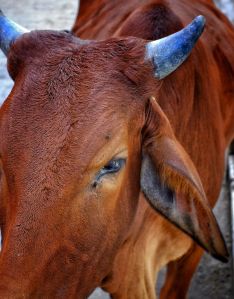
For me, a major component of that harm minimization takes the form of not eating the flesh of animals, as well as my choice to not utilise items made from animals.

Even with this there is a problem: Who’s to say what life forms are acceptable as food, and which aren’t? Humans have invented the scary idea of the Food Chain. We simply decide who is higher and who is lower on that chain and eat accordingly.

Needless to say, humans have appointed themselves to be the highest species on that ‘food chain’. Meaning of course, anything else is lower and hence okay as food.

Anyway, I digress a bit. Getting away from food questions, to look specifically once again at the ‘weeds’ to be sprayed in the Hermitage garden.
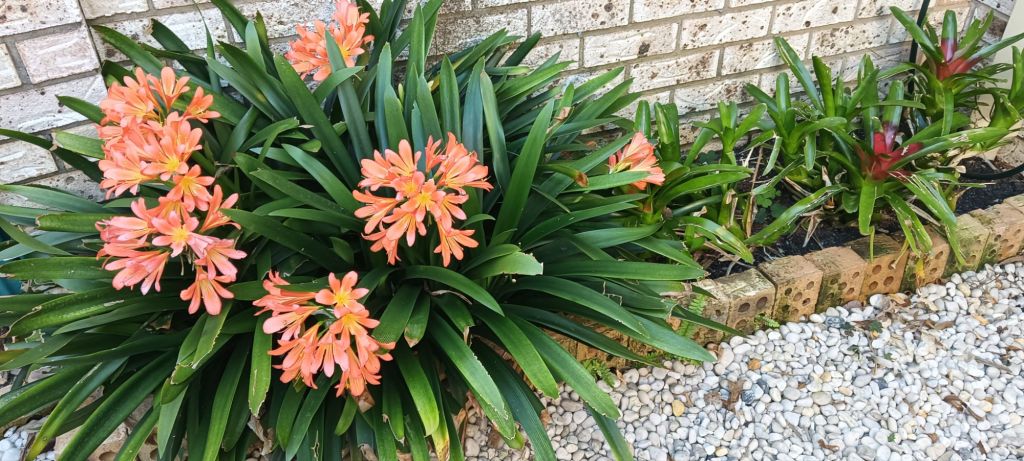
I often ask myself what is it that makes one plant with big orange flowers acceptable as a garden plant? Of course it’s beautiful, ornamental, and a pleasure to have nearby, but what else?
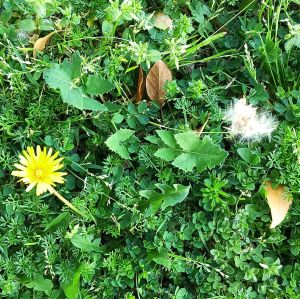
But, what is it that makes another plant, with its delicacy and little flower that are equally beautiful and as pleasing to be around in my view, not acceptable as a garden plant? What makes this one a weed, while that first one we met in the previous paragraph not?

Well, it seems to me that the first answer has to do with necessity dictated by circumstances or conditions beyond one’s control.

As I’ve said, when it comes to growing food, it’s necessary to control plants that threaten that growth. Discernment comes in when we decide how to eliminate that threat with the least harm. One aspect of discernment is actually related to that subjectivity I mentioned before: one person’s weed, is another person’s delicious and nutritious food – and vice versa.
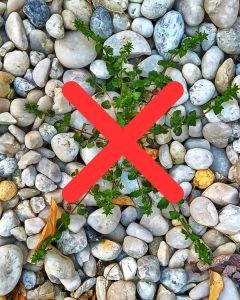
At the Hermitage we don’t grow our own food, so we don’t face that dilemma. Here, at the Hermitage, it is a condition of living here that we control the weeds. And the plants classed as weeds are well known to us due to this condition being a routine clause in most rental contracts.

Besides, it seems that another major factor that makes a plant a weed, is where it grows, how hard it is to keep in bounds and behave.

I guess it’s not only a requirement, that we control the weeds. It’s an issue for our discernment as we try to find ways to share this little patch of the world with the other life forms who also live in this space with us.

It is a wise discernment that tells us to follow the rules of the contract. And our discernment also shows us that, in this human built environment we live in, we can’t allow the space to be taken over by plants that would then provide a safe harbour for insects, rodents, and other creatures that might or would threaten our health and wellbeing and that of our neighbours.
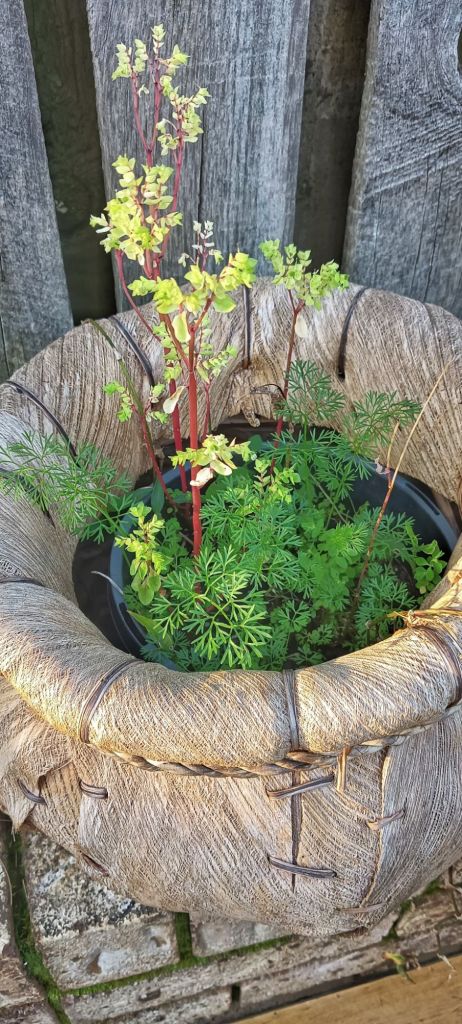
In a pot rescued from a roadside pile of domestic discards, a variety of plants – weeds also rescued over a few months of ‘spraying the weeds’ as a kind of offering to and celebration of life – grow in a group.

It’s a pretty group, I think, of delicate, yet sturdy little lifeforms.

Are they still weeds? Now that I’ve placed them to grow in an ‘approved’ space? Now that they are confined by bounds within which I can control them?

Confined? Controlled? Perhaps for now, but not for long. It’s a comforting thought, realising they all have allies: the sun, the rain – and the wind.

At the same time, we consider all life forms, including humans, to be manifestations of the Divine. All life is one, as I assert so often. Speaking personally, I am sad that any lifeform that is harmed because of my actions and my material needs.

Discernment, compassion, love and mindful action. As we seek to coexist in peace with those beings we share our world and lives with, these things are all required. Empathy too: We are the weeds, the weeds are us.

And the inner editor is insisting I finish by reminding myself  that life, the universe, and all that happens, is unfolding exactly as it’s meant to; all we can do is play our part in that unfolding.
In the Dream The Word Was Written

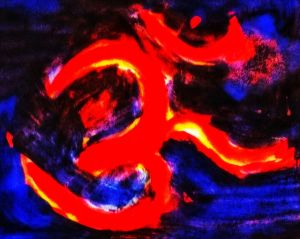
I dreamed I was drawing an OM symbol. Nothing else, no memory of a dream setting or situation, no other dream characters; only the view – as from my own eyes – of my hand making that sacred mark.

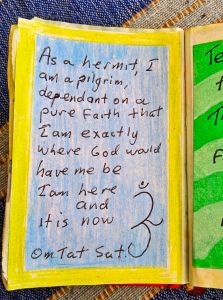
It is quiet during morning prayers today. At one point, after completing one prayer, I turned the page, and began praying the prayer there. Attentively and prayerfully, which is a really nice thing for me to notice because oftentimes I can be a lip level prayer sayer.

As I prayed, I was drawn to the part of that page labelled ‘blank space’. It was at that moment the memory of that dream began to arise.

Instinctively, without thought, I reached for my pen – this pen I now use to make these notes – and inscribed (as that dream memory seemed to demand) the sacred OM in that formerly blank space.

This all transpired as the memory unfolded; really only a matter of a just a few seconds of clock time. But, of course, what meaning is there to ‘clock time’?

In the beginning was the Word, and the Word was with God. And the Word was God. And the Word is God. No beginning. No end.

Om Om Om

PS Thank you John for allowing me to use your words. I know I have paraphrased and modified them a little with my own words, but somehow I don’t think you’d mind.

Flee, Be Silent, Pray Always: A Revisit

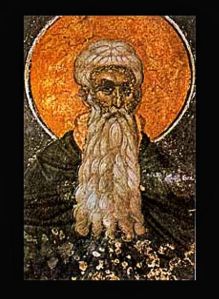
Courtesy Wikipedia

Recently I came across the story of Abba Arsenius – one of the early Christian desert fathers. I’d originally written about him a year ago in what became a short series of posts.

Coming across him and his story again prompted me to revisit those posts – the first of which you can read here – and I reread them again, though as if for the first time. Anyway, here’s a short recap before we move on.

Arsenius was a high ranking official for the Roman Empire, working for many years as a tutor to the sons of the Emperor.

Over time he grew tired of the glamour lifestyle, the politics, corruption and court intrigues, and looked for a way to free himself from the whole material trap he was in.

So he prayed, ceaselessly, the story goes. He prayed for salvation, for freedom.

And, in time the answer, according to the story came in just a few words:

Flee, be silent, and pray always.

And he did. Flee I mean. He headed for the Egyptian deserts which is where he found that silence, and the space, peace, and calm to fulfil  his desire to be praying constantly. And, with some comings and goings, ups and downs, he stayed for the rest of his life.

Now, while Arsenius and his story are fascinating (in fact now I’ve rediscovered him, I’m going to look around  for a biography or something  so I can learn more), what I want to think about here is something I wrote in the first of those previous posts, and how it ties in with our decision (almost a year ago now) to stay in this one place for the present.

For these Hermit Pilgrims ‘fleeing from the world’  has meant a nomadic lifestyle, few possessions and material needs, a hermit life where our engagement or entanglement with the world is kept to a minimum, and in which we feel less of a pressure to conform, to ‘be shaped’ by the world around us.

The notion of staying in this one place – as fully now and in the present as we can be – is actually  paradoxically a fleeing of its own kind. The world of Samsara, the material world ‘out there’ continues to become less and less appealing to these Hermit Pilgrims.

Alongside this growing detachment to the world (as well as the loss of desire to move about in the world geographically speaking), is the deepening realisation that the real and true pilgrimage is within, through and to our own mind and heart.

Complimenting all this, is the growing contentment we are experiencing in this actual place, this hermitage of ours that we are creating on a daily basis. More and more it feels to be the exact place in which that inner pilgrimage is to continue.

Does this mean we have given up on that ‘nomadic lifestyle’? No, not at all. Or, more accurately, we are not niether giving up or not giving up. The present is all there is and we don’t – can’t – know anything beyond that. As the saying goes, What can we say about tomorrow?

We are here, and it is now.

with love
Paul the Hermit

Flowing With the River of Life: A Work in Progress

O Lord, I take refuge in You.
You are my sole guide, my master.
Show me the right path and
I shall follow it.

This is a prayer I like very much. It appeared one day in a previous incarnation of this notebook, then migrated to my prayer book. Its origins are lost in the mists of forgetfullness.

In any case, I like it – a lot. In a big picture kind of way it encapsulates much about the way I aspire to live my life; what I aspire to devote my life and energies to.

The prayer is addressed to the ‘Lord’ – to the Divine; to the Absolute Reality of (to borrow a favourite phrase) Life, the Universe, and Everything. Some will call this God, some think of it as the creator. For me it is simply Lord: all that is existence.

And it is there that I aspire to take refuge. I seek shelter in the knowledge of the rightness and order of the universe. Not an easy task when I think about the state of life ‘on the ground’ on our home planet; how the horrors can be almost impossible to grasp, to understand, and to keep from despairing over.

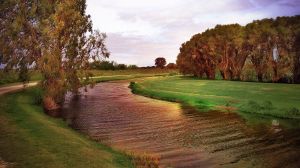
But a contented state of refuge, of safety, security, and even happiness, may be found, I sense, by a cooperation with what we might call the flow of the river of life.

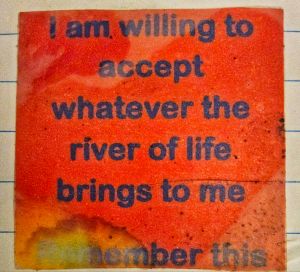
And if I am to discover for myself that refuge, then there really is only one choice: to accept that flow of the river of life as my only guide to how to live, what to do, how to be.

Not surprisingly I struggle with the idea of cooperating with and accepting the often crazy and random nature of that flow of my life as my ‘sole guide’; how much harder is it to accept that very river as my master?

Again, if I ever want to be happy, if I ever hope to be free from suffering and attachments to those things that cause me to suffer, then I must accept and cooperate with the reality: the river of life is the master whether I like it or not. I may as well accept it.

Which absolutely and I hope obviously, does not mean I’m a fatalist, or that I am resigned to just let the currents toss me about willy nilly. No, not at all.

My deep sense (yet another site for other struggles) that the solution to suffering does indeed lie in an acceptance of the reality of the flow of life as it’s happening moment to moment.

By not resisting life and what it presents to me, I aspire to arrive at a state of acceptance where I might contentedly and freely ask what is my role here? What is the universe asking me to do?

If I can listen, and actually hear with the ear of my heart, then I might be able to discern the path, which if followed, will free me from suffering .

Then I shall be going with the flow, following the path of least resistence, and I’ll be contributing to my own smooth (well, smoother at least) ride through life.

I’m ‘Giving Up’ … To Amend My Life

Renunciation. It’s a popular topic here at the Hermitage. Perhaps popular isn’t the right word; let’s say it’s a subject of conversation, thought, and contemplation on a quite frequent basis. As it is, I think, for most people attempting to live a spiritually focused life. For today, however, I really want to focus on some of my own thoughts around renunciation.

For those of us oriented towards the quest to live a spiritual, prayerful, and dharmic or truthful life, renunciation tends to mean the giving up of things, activities, and behaviours (including thoughts, attitudes, and the like). The theory is the very act of renunciation itself predisposes one to more authentic and close identification with their own true natures. It places them nearer to realisation of the Divine, of God, Absolute Reality.

And of course when harmful things, situations and attitudes are released, one has less to distract from the spiritual quest and life,  Of course, most acts of renunciation don’t result in a one off quick fix: I heard in one of our hermitage conversations a few days ago the perfect quote to help make this point:

You just have to keep renewing the renunciation.

In other words, it’s a full-time, life-long job!

But, in the attempt at renouncing, we can potentially find some help towards a clearer focus on the spiritual side of life as well as more sensitivity towards what is good and what is not good for us.

A person free from both hatred & desire is always renounced. Indifferent to dualities, he is free from all bondage and easily attains liberation

Bhagavad Gita Ch 5:V 3

Which is where every one of us knows exactly what it means to try to give up what’s bad for us. It ‘ain’t easy is it? Still, we’re here to talk about me, not you or anyone else. So …

There are a few things that in perusing  the monkish life, that I didn’t have to renounce; some things like eating flesh, drinking and smoking, going out to clubs, pubs and the rest, are things I’ve either never engaged in, or haven’t done for a very long time.

Which brings me to a good point to mention here. Any renunciation whatsover has to be a personal decision taken only after serious reflection and thought. And it must be made without outside coercion or pressures. While others may think they know what’s good (or bad) for you, in truth, it’s only you who really knows.

Anyway, as I was saying, or about to say, renouncing things hasn’t always a piece of cake for me. Actually, I love cakes of many and varied kinds and have had to renounce all of them. But that was more for my body’s health than for my spirit, though obviously the two go hand in hand.

Then, just a couple of days ago in a momentous event which in fact was the trigger for all this reflection on renunciation, I vowed to give up a particular breakfast cereal I’m really very fond of.

This renunciation – not the first attempt I might add – being prompted by the fact that I tend to experience quite strong indigestion, huge bloating, and general feeling yuck, when I’ve indulged in this cereal for any length of time.

There is nothing trivial about attempting to renounce foods and so on that harm our health; as I said, it’s a lifetime’s effort. And equally daunting are the non-physical things like attitudes and behaviours.

Any renunciation whatsover has to be a personal decision taken only after serious reflection and thought.

Here is an example, or group of examples, which along with the above-mentioned cereal saga, played a serious role in bringing about this post. They are behaviours and attitudes which very emphatically interfere with my quest for a Dharmic, prayerful, and spiritually focused life,

What I absolutely hate, despise, detest, am revolted by … Oops sorry; I forgot my monkish manners there for a minute. Let me try to rephrase.

I have a strong aversion to gossip, to judgemental thoughts and comments. I am averse to it on a couple of levels. Firstly, I do not like, for one second, the idea of not minding my own business, of commenting on what other beings do or say, or don’t do or don’t say, or how they behave.

Surely, my thinking goes, I have enough of my own business to mind, why do I need to mind the world’s business?

That’s the key one I think. But I really dislike the feelings such behaviour and attitudes invoke in me: anger, frustration, guilt, inappropriate thoughts, words and conversations. There is even a physical component sometimes when I make myself sick in some way through the stress of such things.

There is another point too, just as key if not more so. I’m routinely disgusted by the notion that these criticisms, judgements, not minding my own business, really do impact on what I call the vibes of life for all of us. Call it vibes, energies, whatever, but I sense that our own behaviour has a ripple effect beyond our immediate relationships and environments to the wider world beyond.

So, by now it’s pretty clear that I am in need of some serious renunciation of my judgemental, critical thought and words, as well as the anger, disgust and the like, I feel and express towards those I deem worthy of my judgement. Okay, not just others: all we’ve been saying here applies equally to myself.

Perhaps it’s to do with family, school, or societal conditioning? And like any full-on conditioning it can tend to preoccupy, even possess, one’s life.

These are all old stories. They come from a past that doesn’t exist. For real, it’s gone right? Actually, when you think about it, there really is no such thing as the past.

Long ago, decades really, I was big into affirmations. I had a whole collection in a little folder that I kept in my pocket of on my desk or wherever was handy.

There are a few I remember even now thirty or more years later, and there are one or two that come to mind that might be helpful that I can resurrect to share here.

I release and let go of all that is unlike love. There is plenty of time and space for everything I want to do.

You let go of all that’s unlike love, what’s left? Love. Love is all. All is love. And this affirmation has an added bonus: no regrets, it’s never too late, there is time –  and space – aplenty.

And the second one. I think it’s just as good:

I am at peace with my own feelings. I am safe where I am. I create my own security. I love and approve of myself.

This one I’ve rewritten as a prayer; I might share that one sometime. The helpfulness  here is easy to get: I’m safe; it’s okay to have my own feelings.

There’s no outside threat – nothing to attack, nothing to defend – and, finally, I have no need to be entangled with all that unwanted stuff, that – as I’ve already said a couple of times – is none of my business.

For my community, the invisible and the visible, with love

Japa in the Dunes

Japa, or the chanting of the names of God or the Divine, is a central spiritual practice for me. In fact, as time goes by, it becomes even more important for me as I try to spend more time chanting than not!

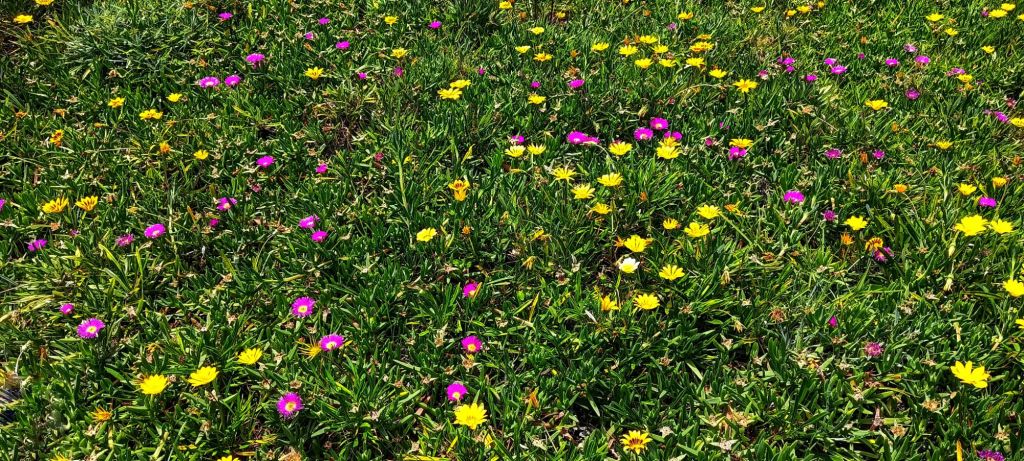
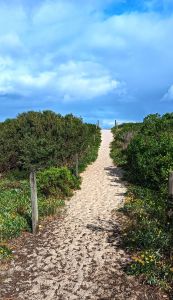
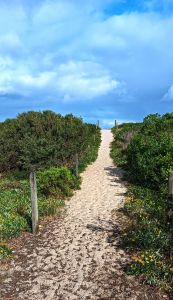
With Japa in mind I climbed yesterday to the crest of the sand dune on which our current hermitage is situated, to spend a while with the sea and the dunefield flowers, the birds, and as I planned to be doing some chanting, also with those unseen aspects of the Divine that I would be addressing with my words.

As seems to be happening quite often these days when I immerse myself in the beauty that is to be found all around me, all that is to be seen and experienced ‘up there’ as it’s come to be called, a poem wrote itself about yesterday’s particular excursion and experience.

I share it with you now in the hope you will enjoy reading it; thank you for reading it!

SAND DUNE KIRTAN

Perched upon the crest of a sand dune,
I chant the names of the Lord
Hare Krishna Hare Krishna
Hare Rama Hare Rama

I am still; the Lord’s names vibrate in my mind.
But Varuna’s energy washes saltwater back and forth
in the middle distance.
Sea waves manifest from depths unknown.
Sea waves dissolve on the shore
in the middle distance.

Now, in the near distance,
near to me where I rest and chant on sacred ground,
flowers with yellow heads, purple heads, wave in the wind
as if ecstatically dancing to a holy Kirtan
gifted them by the wind.

These myriad jewels in the dunefield join me in my japa.
Or is it that I merge with their sacred dances?

It’s neither, and yet it’s both:
The beautiful blooms are me,
and I am them.
We are the One,
Chanting and dancing
the names of the One.

The Q&A in the Scripture Part 4

A sooner rather than later return to our supposedly occasional series on the Q&A between Uddhava and his cousin Krishna on the eve of their departure from their soon to be engulfed in the nightmare of war hometown.

So, why sooner? After all it’s not been that long since our last installment. Well, I was just reading through my notes and the questions and answers we’re looking at today just sort of jumped out at me, asking to be contemplated. So, here we are then.

It’s another two-part question, but unlike with previous questions, we can look at these two in the one post. The reason being that the answers to both questions are, if not quite the same, are very closely related, as are the questions, come to think of it.

Okay, to the questions. Uddhava has already worked through quite a list, but now he gets to, what seem to me to be a couple of biggies:

What are reality and truth?

You see? I did say they were big questions. When you ask what’s reality and what’s truth, then you are really reaching for, well, I guess, what’s real and what’s true. No dilly-dallying, just right to the heart of things.

But, why these questions? Well, look at it from Uddhava’s perspective: his whole world, the only home he’s ever known, is about to be devastated by war. His world is completely turned upside down as he prepares to leave for an uncertain future perhaps never to return.

Like any of us, he’s probably on the verge of despairing, wondering to himself, ‘Is this really happening? I can’t tell what’s real anymore.’

Well, Krishna’s answers are short and succinct, and to the point. A lofty point, but then it would be wouldn’t it, coming from God?

Anyway, his answers:

Reality is seeing all the same.

and

Truth is the true speech uttered by the wise.

Reality does sound very dull if we take Krishna’s answer at face value. But he’s not talking about what we see with our physical eyes; he’s meaning seeing as in understanding, true realisation, as in ‘Ah yes. I get it now.’

But, ‘all the same’?

Obviously all the various beings in the Universe have their own unique names and forms and attributes; clearly they are not tall the same.

No, what Krishna is getting at here is that all beings in the Universe, all living and non-living things, are manifestations of the Divine. At that level all beings are one as the Universal Consciousness that pervades and underpins all that is in existence. Actually it’s not exactly right to say pervades and underpins: rather, consciousness is all there is, and that all is the Divine.

In other words, all beings are one and the same divinity. All the rest, all that we are and see and experience in the physical world are just those names and forms.

I’ve been told that there can’t be any exceptions to this reality, because there is only the one reality. Reality is non-dual in other words. One without a second as I like to say sometimes. One not followed by two and so on. Seems to me to be a simple way to describe this mind boggling (more like mind exploding) concept of nonduality.

Now, to the answer to Uddhava’s second question. Who are these ‘wise’ who utter ‘true speech’. And what is true speech anyway?

Well, the wise are those who have fully realised for themselves the answer to the what is reality question we just discussed. As you might guess, that’s a very small group of enlightened people.

Having said that, the answers to both questions mutually support the other. They each reinforce and promote realisation or understanding of the other.

Ritam (the Sanskrit word Krishna uses for Truth in his answer) is ‘expressive of the whole truth’, one dictionary tells me. It adds that it’s also a state of consciousness, though it’s probably more accurate to say that the ‘whole truth’ is a state of awareness, a state of being.

True Speech, is not just about what comes out of our mouths when we speak. Of course it can and does include what is spoken, written, thought and so on, but also encompasses our lives as a whole. It’s a state of being as mentioned above, and true speech includes all how we are in the world.

In other words all our thoughts, words, and actions.
True speech has to, obviously, be true. Sounds redundant  to say so, but because it’s not only about what is actually ‘spoken’ in words, it makes sense to mention it.

True Speech has to be pleasant. I think this isn’t to say that all that is true (in the world of matter) is necessarily nice; I think it means that in our attitudes, actions, speech itself, and thoughts towards other beings and ourselves too, we should be guided by courtesy, consideration, compassion, generosity and kindness. Love thy neighbours and thyself, in other words.

Last but certainly not least, True Speech is beneficial. In other words, your actual spoken words, as well as your thoughts and deeds in your life as a whole, should be intended to be beneficial for all concerned (which once again and significantly means you as well), or at least with the intent of causing no harm.

True Speech, the Truth, or Honesty, in our thoughts, word and deeds, come with these, what we can call three criteria. Just because you hate a new freind’s new hairstyle and you feel an obligation ‘to be honest’ doessn’t mean that if you hate it you are                           required to tell them it’s ugly and add for good measure it doesn’t suit them. That ‘letting it all hang out’ version of so-called ‘honesty’ is nothing of the sort, and doesn’t meet the criteria for being True Speech.

I mean to say that while it might be true in your opinion, and you deliver the bad news in a nice, pleasant and charming manner, still does not make up for the fact that, far from being beneficial to anyone, your supposed honesty is in reality hurtful, even cruel.

So, the reality – as in there is only one – is that I, and you, along with all other beings, are one consciousness . Our bodies, minds, our individual lives and ways of being in the world, may all be very different, and transient, but consciousness is one, whole, indivisible, indestructible , and never changing.

And, if we as individual entities inhabiting physical bodies, would like to act out our lives as expressive of that absolute reality that is our true nature, then our every thought, word, and deed, needs to be an expression of our acknowledgement of that oneness, that unity of one.

In other words, the only reality is that we are in fact that self same True Speech we’ve been talking about. To become wise (borrowing Krishna’s word here), all we have to do is be true. We need to fully realise that we are in fact Truth, and that Truth is all there is.

That’s it really. That’s the Reality.

Another Poetic Offering: Birds in the Bushes

‘I like writing reverent things,’ I said to my partner Hermit. I’d just shown her a poem I had written about a walk earlier in the day on the track on the crest of the sand dune near the hermitage.

Yes, it’s true I thought later. I do write around themes of solemn respect, deep praise, of love, of appreciation of beauty, of devotional things. About my devotion to all that is Divine – which of course is eveything that is!

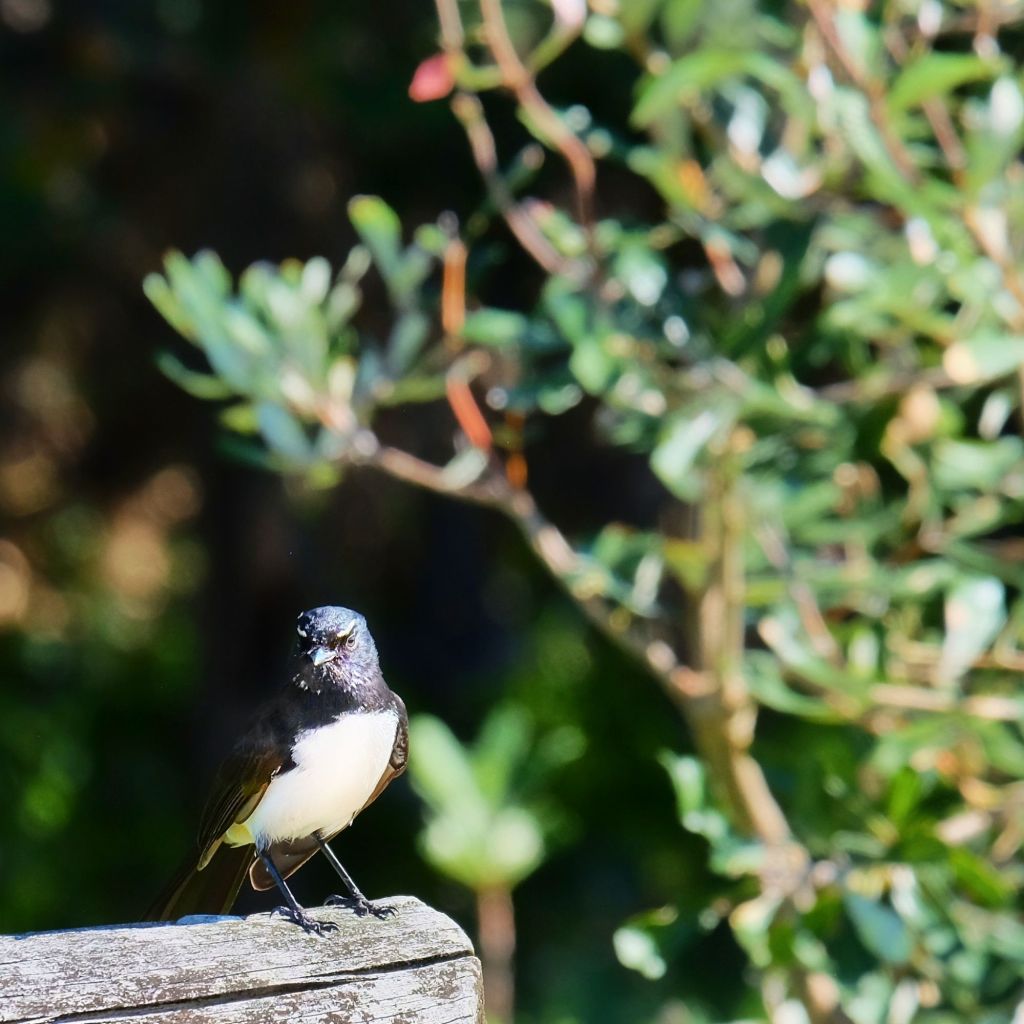
The walk began as a bit of a struggle, a bit challenging, though the challenge was eased somewhat by some winged friends. I know I’ve been writing a bit about angels lately, but this time the winged ones were birds. Mind you, angels can and do take many forms. Perhaps those birds were angels after all!

Anyway, as I recorded the original version while still ‘slogging’ through the sand on the track, I did so without intention. But, what emerged is, in my heart, a song of praise for those winged friends.

BIRDS IN THE BUSHES

Lumbering and stumbling, sometimes shambling
through deep and shifting drifts of sand
along coastal track
on the crest of dune.
Slow going on the track. Plodding.
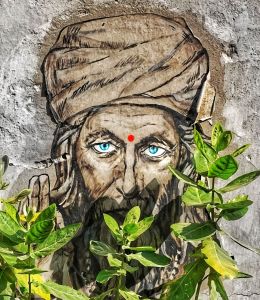
But there are birds in the bushes
alongside the track.
Birds in the bushes twitter their encouragement.
Is it twitter? Is it tweeter?
Is it twirp? Twirping?
Are they twirping? Are they trilling?

In any case, there is encouragement in their serenade.
So, I continue on.
Plodding still
but a little lighter.

The Q&A in the Scripture: Part 2

Namaste

And welcome to Part 2 of The Q&A in the Scripture series in which we are looking at the answers given by Krishna to a list of questions asked by his cousin Uddhava in a scripture called the Uddhava Gita.

Remember the scene? Uddhava has asked Krishna a pile of questions about how to live a good life, how to live in the world with discernment.

These questions have become urgent because the cousins are about to leave their hometown which is on the brink of war. Both will be going their separate ways and both know they won’t be seeing each other for a while – perhaps never again.

Anyway, moving right along: In our last installment, we had Uddhava asking the first of his questions; this one happens to have two parts:

What is quietude and what is self-control?

We discovered that quietude is not the state in which one finds peace, silence, our true selves, or the Divine, but is itself that consciousness, that pervades and permeates all that is, silence, peace. In other words, quietude is  the Divine itself.

In the present post, we move to the second of Uddhava’s two-part question: what is self-control? Krishna’s answer is excellently short and sweet:

Dama  (self-control) is restraint of the senses.

Krishna in his response, makes it clear that restraining the (one’s own) senses includes mind as a kind of sixth sense in addition to the five physical senses. In the context you could almost say that it’s his mind that Uddhava is in most need of restraining. Maybe that’s the message for all of us?

Well, we are all well aware of the ways in which we have tried to control our senses; Uddhava knows too. But look at the situation these two cousins find themselves in:

It’s fine for Krishna: he’s returning home to Heaven, or wherever. But, Uddhava, who is also about to leave, is facing more uncertain prospects. He’s experiencing great turmoil, and fear over his and his familiy’s safety as the threat of war closes in. Most likely he’s also grieving over having to go into exile from his ancestral home.

Of course he’d be fearful for the future: where will he go? What will he do? How will he protect and provide for his family? Like I said, an onslaught of mental and emotional anguish.

Still, it does seem that Uddhava is maintaining quite a steady presence of mind. He’s thinking about the future; he is clear about the sort of stuff he needs to find out from his cousin (remember Krishna is God) in order to put and keep his life on the right track despite the challenges facing him now and in the future.

Then there’s the fact that this self-control thing is only one question on a list of 36. Clearly Uddhava is looking for a lot of advice.

Restrain the senses – all six of them – Krishna says. But how? What does it mean, ‘restrain the senses’? I think I alluded to the notion that we all have some ideas, some clues, about how we as individuals might restrain them, but let’s personalise this: What does it mean for me to restrain my senses?

Actually, now I’ve made that suggestion, I feel overwhelmed: Where would I start? Surely I need to do a whole series of posts, just on this one topic alone?

Oh wait, I can start right there. Exaggeration, hyperbole, over-dramatising, catastrophizing, all perfect examples of emotional reactions leaping from an unrestrained senses central: my mind.

Let’s put aside that mental stuff for a little while, and just say that all those emotional responses could do with a bit more restraining training. Just looking at the physical senses to begin with, I can easily say that they also, at least some of them sometimes, need various degrees of working on.

First, my sense of taste: it goes into overdrive sometimes, and then I eat too much. Not so much as in the past, but the restraint has a way to go still.

My sense of sight is pretty good, well restrained for the most part. But there are times when I lapse into old habits and spend too much time looking at a screen and scrolling in a mindless kind of way. Getting there though!

As for my sense of hearing: You might remember a post from a while ago when I talked about letting go of much of my music collection, some of which I’ve listened to my whole life.  I’m doing this because so much of what used to be ‘my favourite’ songs or artists, no longer serve my spiritual growth, nor does much of it reflect the view of life and the world that I’m trying to cultivate.

Well, I’ve made a good start, but occasionally I slip and find myself humming old tunes, or listening to an album that I really ‘should have’ deleted already. Restrained? Sort of, and I’m still encouraged.

Enough! Let’s get straight to the biggie: my mind. If I’m honest, I have to say that my mind, while not exactly in full agreement with my efforts at restraint, is starting to get into sync with me and my aspirations for a more controlled mind.

But still, those previously mentioned emotional reactions like exaggeration, over-dramatising and the rest, are still there. Falling into line, it’s true, still … .

Then there is the (more than) occasional first port of call reactions to pieces of news of various kinds: I’m prone to ask, just as I imagine Uddhava might have: Why don’t ‘they’ control themselves? Why can’t he or she or such and such country or politician show a little restraint?

Yes, I know, we’re all guilty of this one to some degree or other.

My quickness to anger is not quite, but almost, might soon be, won’t be long before it is, a thing of the past.

Then, there’s my tendency to ruminate: rehash endlessly real and imagined events and other stuff from the past – as well as the always imagined possibilities (as well as the impossibilities) for the future.

Again, I know I’m not alone in this emotional roller coaster ride, and I do know that I am nowhere near as much of a ruminator as I was; I have made great strides, significant inroads, and I am encouraged that the end of rumination is getting closer!

And now, here is the one thing I tend to think of one of my biggest, most tiresome and tedious, most annoying conditioned emotional responses: I talk too much. Not as much as I used to, but still too much for my comfort, and for the peace of mind of those around me. More restraint is called for.

Restraint has played its part in reducing my talking. But in a sense the major ally has been the ongoing quest I’m engaged in to discover my true nature, as consciousness, which is really my oneness with all that is.
And here our second question and answer leads us right back to the first: quietude.

I wrote in that post:

Quietude, calmness, peace of mind, are not where  you will find God, consciousness, or whatever we call it.  Quietude and the rest are God. They are consciousness.

Or putting it the other way round: cultivate silence, calm, peace of mind, and your senses will no longer need to be restrained. Your whole Self, including body and mind, will then be resting in Quietude, in your true nature.

That’s why I think these two questions are asked and answered together: Each leads to the other: by restraining our senses we are more easily able to achieve a state of calm, quiet, some level of peace of mind – in other words, Quietude.

On a Pilgrim’s Way

Today I went on a pilgrimage.Not that I don’t undertake all kinds of little pilgrimages all the time. And even more, it’s not as if my whole life – just like yours and everyone else’s – isn’t one ongoing and continuing pilgrimage.

All true; but this one, today, was embarked upon in what might be called, a classic manner: on foot, to a place of sacred significance, and in a spirit of contemplation of the nature of the journey as well on that which is being pilgrimed too. (I am positive there is no such word!)

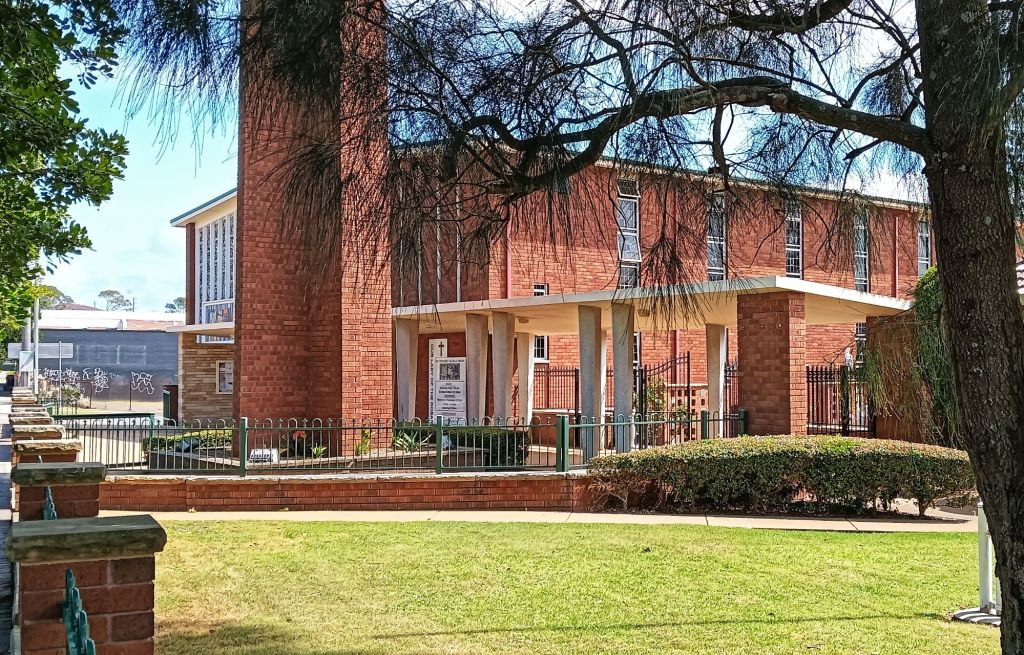
In this case, today’s pilgrimage, that place was a church about two and a half kilometres from the  hermitage. It’s a place I have visited several time, but today was the first time I set out as a pilgrim and walked in the way and spirit of the pilgrim.

Our Lady of the Rosary is a Catholic church dedicated to the Mother of Jesus in her role as patron of the Holy Rosary, a Catholic way of prayer that has evolved over time and is a key part of the lives of many Catholic people.

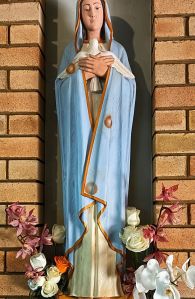
Just to the right, just inside the door there is a plain brick wall in which there is a small niche. The niche holds an almost life-size statue of Mary. She stands, hands folded over her chest on which sits the Dove of Peace.

You can see from the photo that the church itself is a lovely, quiet, serene place full of good vibes and nice peaceful energies. The object, however, of my pilgrimage was not the church in itself, but stood just inside the side door accessed through an equally peaceful, fountain centred garden.

I have come to offer her – this form or manifestation of the Divine Mother – the prayer I wrote to her which I hope you saw when I posted it on this blog recently.

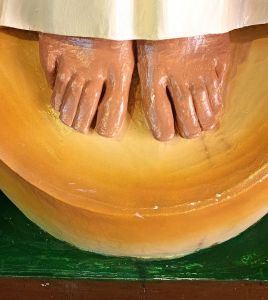
I had decided that my pilgrimage vow would be fulfilled once I had knelt at her feet and offered her the words of my heart in prayer.

My reverence for the Divine Mother is well known, and especially in her form as Mary the Mother of Jesus. Or Our Lady as we called her as good little Catholic children way back in the long ago. And I know I have said often that the entirety of the material and non-material cosmos is a manifestation of the Divine.

So, why then a special trip on foot, that I’m labeling a pilgrimage to a specific site, so I can kneel at the feet of a statue that I know perfectly well is made of stone or plaster and is simply a symbol of one aspect of the Divine?

Actually, the question has answered itself. The pilgrimage and my associated actions worded in that question tell us the why.

It is about acknowledging at a heart level and in my own way, that that symbol, that form, is actually representing a particular aspect of the Divine that I revere.

Besides, I’m not the first person who’s knelt at that spot, at Mary’s feet. I don’t know the age of the church, nor do I know the history of that particular statue, but I think we can say for certain that many hundreds, if not thousands of other people have been there where I was and spoken words from their hearts.

Being honest and true now, what I can say is that, as I said to my partner hermit: ‘I feel like i’ve been on a pilgrimage’.

And I do. I’ve walked – praying and chanting – to a sacred place where I have prayed at the feet of the Divine in the form of a likeness of Mary. I feel blessed that I actually got to offer the prayer I wrote to the Divine Mother.

Somehow I feel a link was established. A heart (mine) opened ever so slightly. I acknowledged the Divine, and I sense that I might just be – ever so slightly again! – topped up with a bit of the Grace that is in reality our true state.

Mary in the Garden (enhanced by a fellow Hermit Pilgrim. 
Thank you)

So, this is the story of my pilgrimage. I was absolutely exhausted when I arrived back at the hermitage. Most likely that was due to the heat, the traffic, and the noise encountered on the way I trod.

But, now I’ve shared this little tale with you, I’m not tired. Anyway, the Way is not always easy, and we are all very well aware of that aren’t we?

Namaste friends. The Divine in me salutes the Divine in you.

It’s a walk to take,

a pilgrimage to make.

Sometime soon.

Said by me long ago, I don’t know when or where. It was one of those ‘You’re a poet and don’t know it’ moments.

Peace!