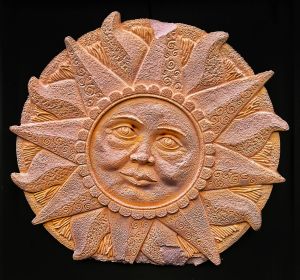
Varuna and Surya. the Hindu deities of sky and all Earth’s waters (Varuna), and our sun (Surya). These names resonate for me. I like how such great natural phenomena fundamental to our existence on this planet, can be ‘personalised’ in this way.
I find that having acquired symbolic or representational names for sky, water, and sun, has allowed me to somehow relate to the inherent giving and preserving of the energies that power all life that water, sky, and sun provide in a prayerful, thankful way. Kind of makes it personal.
Let me put aside for a moment the obvious scientific reality that tells us we can’t live long without water, can’t live at all without the gases in our atmosphere, and if the sun goes dark for whatever length of time it is, then all life ceases to exist.
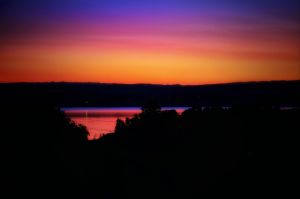
How many times have I stood in awe watching a sunset?
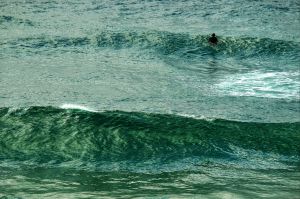
Or watched as big waves rolled in with a surfer hoping for a ride?
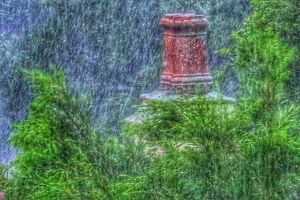
How many times have I welcomed the sound of rain on a roof and the sight of it nourishing trees or other life
And how many times have I sat on or walked along a riverbank feeling uplifted and a little more grounded?
Many, many times is the short answer. Varuna and Surya are constant presences in our lives. And I am grateful for the life-giving and life-sustaining natures of their existence.
Sharing with you today, a little poetic expression of one of those times when sky, water, and sun, gave me just a little more than those fundamental material energies.
ONCE AGAIN VARUNA AND SURYA
Once again, Varuna and Surya are coming to make rescue. They arrive on – as in fact they are – the currents and eddies of the river of life. In this way, the natural order remains in motion.
Shared with love
from Paul the hermit
Flow river go, past the shady tree. Flow river flow, flow to the sea. Flow river flow, flow to the sea.
Thanks to Roger McGuinn for one of the classic flowing on a river songs.
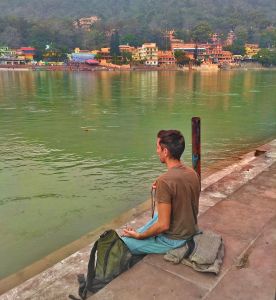
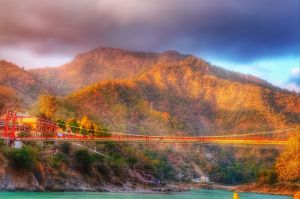
As I sauntered along the shores of the Ganges River in Rishikesh several years ago, I was given a gift.
In the High Holy Lands Where Magic Sometimes Happens
As I ambled, headed upstream in a relaxed kind of mood on that sandy riverbank, I happened to glance down. There, right at my foot I noticed a small shell. Flat with the stereotypical fan shape so many shells have, and a about a centimetre across. I picked it up.
At that moment I sensed that this little shell was a gift from the river to me. Still, I had to wonder how it got there, a seashell on the sandy banks of a freshwater river with it’s source not too far from where I stood, just a bit higher up in the Himalayas – the highest mountain range on the surface of the planet.
One possibility is that this shell originated in the sea that once existed in the lands above, where the Himalayas now stand. Mind you, I’ve only ever heard of the fossils of sea creatures being found in that region.
Another possibility suggested to me at the time, is that some other traveller having picked up the shell on a beach somewhere other on their travels, kept it with them till they arrived at this sacred place.
Then, perhaps as an offering that traveller – fellow pilgrim?- let that shell go into the waters of Maa Ganga.
Of course it doesen’t matter in the least which – if either – of these scenarios reflect what actually happened. Somehow this little shell travelled from an ocean somewhere (and somewhen!) to this precise spot on the banks of the Ganga to be discovered, to be gifted to me.
I received that offering, now a gift from the river to me, with a deep and prayerful thank you, and a sense of the sacredness of that moment and of that place.
And, today, the journey made by that little shell, has come to a kind of full circle. This morning I released it to Varuna, to the sea here on the Pacific Coast at the beach over the dunes from the hermitage.
That initial giving and receiving took place about eight years ago now and I have that little shell with me ever since.
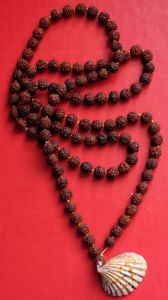
First I wore it around my neck attached to a mala (prayer beads) made of Rudraksha seeds I used for chanting mantra.
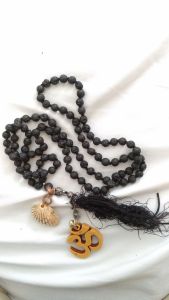
After that, it migrated to another mala – this one made of beads of black volcanic rock, perhaps very fitting given the little shell’s possibly ancient origins.
Then, one day about a year or so ago, that little shell developed a crack and then shattered into several little pieces.
Still, I treasured those remains, those fragment I kept with my other ‘holy bits and pieces’. Then, after a while, I began to get the sense that I was going to have to return this little shell to the sea from where it had come.
I knew, though, that it would have to be the right place, a place I was drawn or led to. So, time passed, we travelled to several different hermitages for about a year.
Then, two days ago, we moved here. To a cozy hermitage on the side of a sand dune, just across a bridge from and on the outskirts of a little seaside town on the Pacific Coast of Australia.
It’s one of those spots where the elevation, distance, and whatever else by nature’s arrangement, all combine in just the right way to allow a vast view that takes the eyes to the curve of Earth herself; the horizon isn’t flat here, it’s a sweeping giant curve. Add to this the equally dramatic view offered by the dome of the sky.
The coast is beautiful here. Not that it’s not special in so many places, but there is something here that speaks to me.
At the top of the dune just beside the hermitage there is an extremely convenient bench seat overlooking the beauty of the ocean.
And it just felt right: here is the place that seeks the return of the remains of that little shell, by now reduced to a couple of small fragments.
So, after a time sitting and contemplating at the above-mentioned convenient seat, I walked down the dune to the beach, and then to the water’s edge. In a mood of prayer, with the edge of the incoming waves lapping at my feet.
After first consigning to the water a shell native to this shore, to show the way to my little shell, I thought of the journey that little shell and I had undertaken together. Then I thought of how far and for how long that little shell had travelled so far on its own journey.
Then I returned what was left of that little shell to the sea from which it had come. And I watched it carried by the waves returning from the sands of the land to waters of the endless ocean.
PS See the Lava Rock Mala? Well, it too has changed form in recent times. It is now no longer a full length neck mala; it has evolved to become a compact and convenient pocket Mala for what you might say is ‘everyday use.
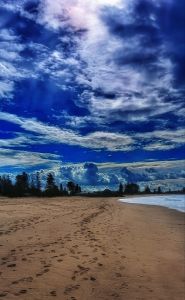
Surya’s life-giving energies shine upon scattered and drifting, yet converging, patches dotting the clear blue sky. Silver linings, so they say, granted to those scattered grey clouds.
Those clouds, those grey scattered and converging clouds, bless. Bless the domain of Varuna, God of the skies with the potential for change. All forms change.
Clouds, silver-lined or no, are Varuna, for he is also God of the skies. And now, with clouds’ convergence, the expectancy ends: the change begins.
The Sun, still present, yet his light blotted out by those very clouds – joins Varuna In the form of the cloud. Alchemy.
From the convergence of energy and matter water droplets emerge; Varuna has remanifested, and falls to wet Earth below.
To cleanse the dust from all things living and non-living. From the feathers of the winged-ones; From the fur of the four-legged; To quench the thirst of the Tree People. And to moisten the throats of us, the Two Legged.
Thank you my friends.
May your day be blessed by both Surya and Varuna, in the correct measure and balance that is for the benifit of all beings.
One of the key elements of the current temporary hermitage, the current safe-haven by the side of the road, is that it is literally two minutes walk from a very uncrowded and quiet coastal beach.
It is a place of golden sands (I know that’s a cliche but in this case I have the evidence!), gentle wave action, and the promise of a possible serenity of a kind I’ve not been close to for a long while.
While I don’t visit this little slice of Pacific coast every day, I get to walk and or sit there several days a week. And when I do, I find that it’s always uplifting and relaxing. A reminder too, of my oneness with all nature. All of us are actually nature, along with every other living thing on our planet (and of course elsewhere too).
Today, for the second time I built a little ‘shrine’ on the sand. Walking away from my little temporary temple, a poetic voice entered my mind and wrote itself a few lines. Too engrossed in the moment, I neglected to record it on my phone, so when I got back to the hermitage I wrote it as remembered.
And now, I would like to share it with you. I am grateful that I am actually able to share it, so thank you.
WE STAND ON SACRED GROUND
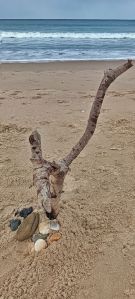
I planted the branch, the branch of a fallen tree person. On the beach, in the sand of the beach.
And I built a shrine around that branch. A pop-up shrine. Shells, stones, and a piece of coal.
A shrine to Varuna. A shrine to Surya, to Saraswati. A shrine to all the gods of Earth, Sky, Water. A shrine to the gods of all beings.
A shrine on the beach is subject to tidal flow. And soon, this simple shrine, pop-up and temporary in nature, will be engulfed.
Lord Varuna will make his claim. What has emerged, must always return.
Remember that old Bee Gees‘ song Words? It’s about one person offering all they have to another. Well, the one doing the offering must have been a writer because, while the song’s a love story, it’s words that are the big thing on offer here:
It’s only words, and words are all I have To take your heart away
Well, as this is a blog, words are the way it hopes to reach your heart. Actually, the posts also include photos and sometimes other art, but the main vehicle used here is words.
So, with that in mind I have a couple of words to offer you today. Well, one word and its opposite. Have a look at this sentence from Thomas Merton:
If Irish monks affirmed his Celtic spirit in their mastery of cataphatic contemplation of the wonders of divinity in nature, Buddhist monks evoked his Zen mind and drew him into the apophatic path of formless ’emptiness’…
As sentences go (though this is obviously only part of a sentence) this has to rank pretty close to the top for length and denseness.
Kataphatic. What a word! Of course I had to look it up; I’d never heard the word before (this post is a rewrite from notes written a while ago that I never got around to posting.), and even though the sentence seems to suggest the meaning, I was still curious.
Looking at Wikipedia – where they spell it with a ‘C’ like Merton, as well as with a ‘K’- I learned that cataphatic is an adjective that describes an approach to theology that uses ‘positive terminology to describe or refer to the divine (God, Truth, Dharma, Spirit. You know what I mean: the divine).
Apophatic, as you probably figured out already, is when one uses ‘negative terminology to indicate what it is believed the divine is not’. A process of negation or we could say you get to what the divine is by a process of elimination.
Pretty simple concept really, but with a couple of big words to label it, and a lot of words to define it. No, don’t worry, I won’t bore you with the meaning and origin of the words and all the rest. Mainly because I don’t know and I’m not especially interested anyway in all that technical stuff.
I simply resonated with the word, and the concept. Cataphatic made me think of Dick Van Dyke and Julie Andrews singing Supercalifragilisticexpialidocious in Mary Poppins. But let’s not go there: this is a serious blog after all. Except to say there’s more to that word than you might imagine.
Putting aside the aesthetic appeal of the word for a minute, let’s contemplate a while on cataphatic, and it’s opposite, apothatic.
To begin thinking about these two words, it’s necessary to acknowledge the existence of the divine. We can call it God, if we like. Or Dharma, Truth, Spirit, Love, Beauty.
As the quote suggests, a cataphatic approach, ideology, theology, or whatever we call it, ascribes names and forms to the divine, as well as describing where and in what the divine may reside.
Whereas apothatic, again as the quote suggests, does not ascribe names and forms to the divine. Instead it seeks to discover what or who god is or isn’t by a process of negation as described already.
For a long time I labelled myself as a Humanist. I had decided that this physical body is all there is; the physical or material universe is all there is, and that there is no ‘god’ separate from us or who has special powers to affect our lives. No God at all in fact.
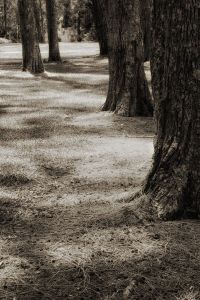
In the Grove of the Sentinals
But, all that while, I just knew that there was something else, something more than just the physical. And over time, I came to the knowledge that there is indeed more than the simply phsical universe (including we humans).
I’ve thought about it a lot over the years and I came to the conclusion not that many years ago, that I had simply been afraid to name or define that something more. It would have meant admitting to myself that something more really did exist.
That is to say, I was scared of taking the cataphatic approach – and I’d never even heard the word.
Well brothers and sisters, I saw the light. The truth was revealed to me. And what is that truth? Well, to put it simply, I wasn’t scared anymore. Not of names and forms, and not of what I couldn’t see.
Now I could take both the Catophatic and the Apothatic approach: that the something else I had actually always known just was, really is, and can have a name and form, or not. The divine is not an omniscient being or any kind of being at all; As I’m very fond of saying, the divine (or truth, God, Dharma) simply is. And it’s all there is.
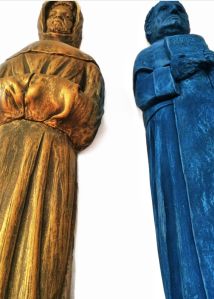
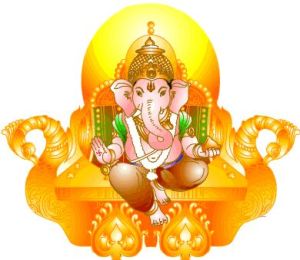
Some of you might know that I am really quite fond of the Indian deity, Ganesha . Do I believe that a man with the head of an elephant actually exists or ever existed?. Of course not. Do I actually think that he resides in the lovely painted icon that sits by my bed? Well, obviously not.
But do I believe that there is a spark or aspect or attribute in all life, in you and me, in nature, in (scary word time) creation, that we can tap into to help us overcome obstacles? Or that we can access when we begin new ventures of whatever kind, or when we need strength to face challenges? Yes, I do. Very definitely.
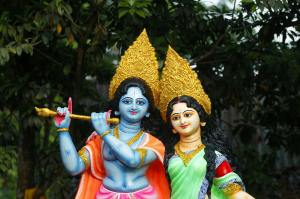
And do I believe in a blue boy called Krishna who lived in India 5000 years ago and spent his time playing in the fields with the village cows and his friends, entertaining them with his flute? Again, of course not. Does he live in the other beautiful icon by my bed? The answer is obvious: no.
But do I chant the Hare Krishna mantra in an effort to come closer to the divine that is… well, that just is? Yes, again, very definitely.
Words. It’s all only words. Only words? Only??
In the beginning was the word, and the word was with God and the word was God. (from the opening of the Gospel of John)



 Notes from the Hermit's Cave