Cries of the Winged Ones

CRIES OF THE WINGED ONES

Just let go
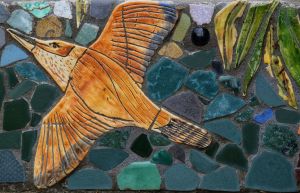
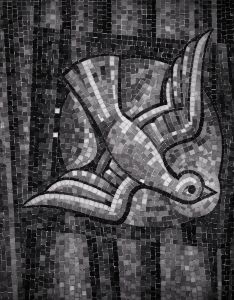
cries the winged messenger
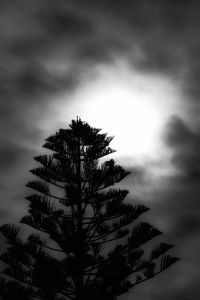
perched in the fence-corner tree.
Let go. Just surrender.
Surrender to what?
The river of life,
its flow, its vibe

Lord here I am,
I cry in reply.
Two beings, one Self.

The winged messenger cries

because she longs for us to listen

In the Dream The Word Was Written

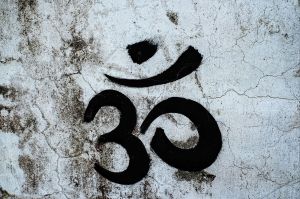
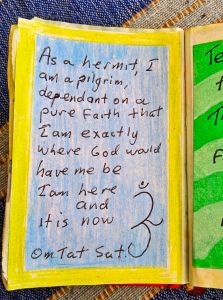
I dreamed I was drawing an OM symbol. Nothing else, no memory of a dream setting or situation, no other dream characters; only the view – as from my own eyes – of my hand making that sacred mark.

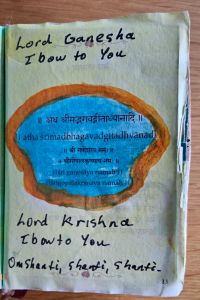
It is quiet during morning prayers today. At one point, after completing one prayer, I turned the page, and began praying the prayer there. Attentively and prayerfully, which is a really nice thing for me to notice because oftentimes I can be a lip level prayer sayer.

As I prayed, I was drawn to the part of that page labelled ‘blank space’. It was at that moment the memory of that dream began to arise.

Instinctively, without thought, I reached for my pen – this pen I now use to make these notes – and inscribed (as that dream memory seemed to demand) the sacred OM in that formerly blank space.

This all transpired as the memory unfolded; really only a matter of a just a few seconds of clock time. But, of course, what meaning is there to ‘clock time’?

In the beginning was the Word, and the Word was with God. And the Word was God. And the Word is God. No beginning. No end.

Om Om Om

PS Thank you John for allowing me to use your words. I know I have paraphrased and modified them a little with my own words, but somehow I don’t think you’d mind.

Taking it Slowly, Taking it Mindfully

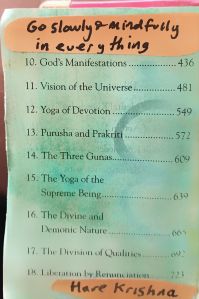
A small irony revealed itself to me just now as I prayed my way through the prayers inserted in the front of my Bhagavad Gita.

I’d completed one prayer and turned the page to the next. Then, without a pause or thought, I quickly turned the page again. I stopped, thought better of it, and turned back to attend to the prayer I’d skipped over.

Now, here’s the irony: The prayer on the first side of that carelessly and mindlessly leafed past page read simply:

Go slowly and mindfully in everything.

Well, that’s not the ironey itself. But, given that this was the page I had simply passed over without a thought, with no pause, the words written there obviously were a lesson for me.

A message to contemplate, to actually stop and pause with, mull over, meditate on, and perhaps make resolutions over. Advice to me to stop, to slow down.

Couldn’t be clearer really.

There’s no telling why I skimmed past that page, that prayer, without a pause. Could be a simple case of absent-mindedness, or a rush to see what was on the next page; a grass is greener type of thing.

Why I was rushing through the pages isn’t the point. What is to the point is here I am, doing morning prayers, praying some, then skipping others. The other point is that in this instance, for some reason I stopped, went back, and prayed the skipped prayers.

So, moving to the resolution.

It’s extraordinary to me when that kind of thing happens. (It does happen quite a lot, but unfortunately I only notice it occasionally) We will have an intuition, or receive a message from ourself that helps to us get back on track when we mess up.

In any case, it’s obvious that I’ve found what I might call the prayer of the day, the mission statement, so to speak, informing whatever activities I undertake today.

Slow and mindful in everything I do, say, and think. For now, for the present, that will the guide on the path of today that I will follow. Keeping in mind the adage that practise makes perfect, for when I falter.

Oh, another irony wrapped up with this one. The prayer on the facing page was also skipped, and in itself sheds another light on the message from that first one. That second prayer actually puts forward one, important, way in which I can actually set about achieving  that first one:

In other words: place more focus on, pay more attention to, the Divine in whatever form, and by whatever name, I encounter it today.

Works both ways I think: Making the effort to go slowly, to be mindful, puts us in the present moment. And, the present moment is the only place we’re going to be able to become aware of the Divine.

Then, as we become aware of the presence of the Divine, we are right where we need to be, when we need to be there in order to actually slow down and be more mindful.

PS These notes were made a few hours ago. Since then, I have on the whole practised being slow and mindful. Not perfectly, mind you, but then as I say, practise makes perfect. Even now as I type this – very attentively – my mind wanders, so there is a way to go for me. The day is not over yet!

It’s All There Is

This is my second attempt to start this post. In the first try I just couldn’t see or feel my voice, myself. Right away, as I began making notes, I launched into and quickly became bogged down, in a wordy, overly complex rational discussion.

It seemed more suited to some kind of academic essay (not that I am remotely qualified to write such essays) than a note from the heart of a hermit contemplating from deep within his cell.

So, here I am beginning again. This time I hope I’ll find a little more of me in what I write, perhaps discern something a little more authentically heartfelt.

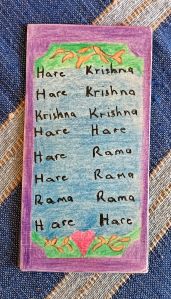
This post emerged from my desire to share with you a little about a small item that helps me as I chant my mantra. My mind seems to switch into strong wandering mode when I try to settle into Japa or chanting mantra mode.

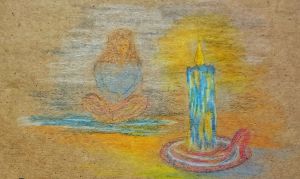
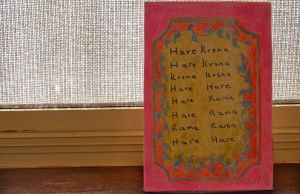
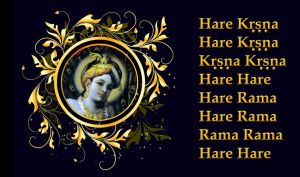
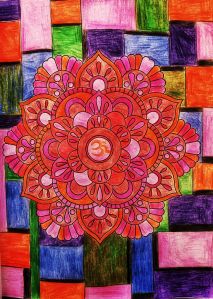
So, I have a small card, made from a cereal box and measuring about 15×7.5 centimetres, decorated with lovely colour pencil designs, with the mantra written in pen. Oh, it’s covered in plastic for protection and longevity, and was given to me as a gift.

Having it in hand or close by when chanting allows me to focus on the words if my mind wanders. I read them slowly, mindfully and I find it puts my chanting back on track – until the next wandering thoughts announce their presence!

Actually we have a couple of similar cards scattered around the Hermitage. One lives on the window ledge above the kitchen sink, and always acts as a timely reminder to make even the washing of dishes an opportunity for prayer.

The View from the Kitchen Sink

Having my card acts as more than a prompter to me to remember and focus; it acts as a kind of tool for contemplation: when looking at the mantra written there, I often sense the meaning of the words, the importance and place of them. I don’t call this mind wandering, this is contemplation and I welcome it.

While on this level, my card can be viewed as a mere ‘prompt’, there are some who would – and do – say that the card, and the very words written on it, are in fact, much more than being simply physical stuff.

They would say that the card, and especially the words are literally, factually, and in truth the Divine (in this case in the form of Krishna). Just as some traditions maintain that ordinary bread is transformed through ritual, into the actual body and blood of their God who was once made human.

Not mine. I’ve had this as a file for ages, and love it. I think it was originally the size of a visiting card

For much of my life I dismissed such notions as mere fantasy, the products of literal interpretations accepted as dogma through blind faith. I’ve even in the past used the word nonsense to describe and dismiss such superstitions.

Nowadays though (and here comes the but, the however, the on the other hand) I’ve come to a slightly different view of the idea. Is my little card literally a piece of cereal box, decorated with nice coloured pencil work, with words written on it? Obviously it is. Of course it is a material thing existing in a material world.

Is the statue of a deity or saint in a church or temple a lump of stone, wood, metal, or other physical material? Again, it’s obviously a material thing with a material existence . Just as communion bread and wine are baked in a bakery, and brewed in a winery.

So, is my card, along with these other examples, merely a stand in, a symbol, a represention of the Divine?

No, I don’t think so.

Over recent times, my instinct, my heart, senses that, in truth, there is only God, only the Divine, only the Absolute Reality, what we can call existence, or being, itself. It seems to me that this Absolute Reality is everything, is everywhere; there can be nothing else.

One without a second, I’ve heard it described. It’s why, I think, we can look at a flower, a tree, the ocean, a person, or some other material object and be able to in awe remark ‘this is divine’. Or how when we hear birds singing in a nearby tree (or on a neighbour’s roof as I can now as I type this) we may have a sense that we have actually had an encounter with the Divine.

Lately I’ve become bored, uninterested, even irritated, with dogma (my own or that of others) and my constant striving for rational and logical answers. My heart tells me – it feels – that the Divine is all there is.

You, me, all that is visible, and all that is invisible, is all there is, one unity. No, not even a unity: that implies the union of one thing with another.

One without a second. Yes, that says it all for me. Those four words, now I think about it, really do encapsulate all there is.

Including my own heartfelt aspiration to fully realise this Truth in the heart and soul of Self.

A Prayer to Share: for the Divine Mother

Namaste and Welcome

Today I would like to share with you a prayer (it’s a poem too, but …) I’ve written in praise of the Divine Mother. It’s actually the second prayer I’ve written to and for her. I shared that first one, called simply, A Prayer to the Divine Mother on the blog previously and you can find it here.

That post will also give you some background to my reverence for the Divine Mother – what she means to me; where my initial devotion comes from; my heart sense that this universal creative energy drives and sustains all creation; and finally how Divine Mother may be worshipped in many and varied (and even no) forms.

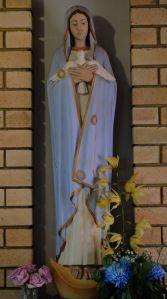
The prayer I share with you today – Jai Shree Maa –  emerged as I knelt chanting those exact word at the alter of a holy place dedicated to the Divine Mother as revered by many in her form as Our Lady of the Rosary.

It is a temple in that name I sometimes go pilgrimming to for quietness, meditation, and devotion.

Please accept my prayer. Thank you

JAI SHREE MAA

In this temple to the Divine Mother
upon my knees and praying.
Jai Shree Maa

I chant with sacred love in my heart,
sacred words upon my lips.
Jai Shree Maa

Divine Mother, with these words,
Jai Shree Maa
I invoke your holy presence;
I speak from my heart to yours.

With love and wishes for peace

Paul the Hermit

Flowing With the River of Life: A Work in Progress

O Lord, I take refuge in You.
You are my sole guide, my master.
Show me the right path and
I shall follow it.

This is a prayer I like very much. It appeared one day in a previous incarnation of this notebook, then migrated to my prayer book. Its origins are lost in the mists of forgetfullness.

In any case, I like it – a lot. In a big picture kind of way it encapsulates much about the way I aspire to live my life; what I aspire to devote my life and energies to.

The prayer is addressed to the ‘Lord’ – to the Divine; to the Absolute Reality of (to borrow a favourite phrase) Life, the Universe, and Everything. Some will call this God, some think of it as the creator. For me it is simply Lord: all that is existence.

And it is there that I aspire to take refuge. I seek shelter in the knowledge of the rightness and order of the universe. Not an easy task when I think about the state of life ‘on the ground’ on our home planet; how the horrors can be almost impossible to grasp, to understand, and to keep from despairing over.

But a contented state of refuge, of safety, security, and even happiness, may be found, I sense, by a cooperation with what we might call the flow of the river of life.

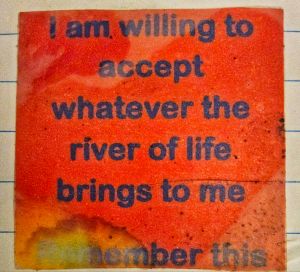
And if I am to discover for myself that refuge, then there really is only one choice: to accept that flow of the river of life as my only guide to how to live, what to do, how to be.

Not surprisingly I struggle with the idea of cooperating with and accepting the often crazy and random nature of that flow of my life as my ‘sole guide’; how much harder is it to accept that very river as my master?

Again, if I ever want to be happy, if I ever hope to be free from suffering and attachments to those things that cause me to suffer, then I must accept and cooperate with the reality: the river of life is the master whether I like it or not. I may as well accept it.

Which absolutely and I hope obviously, does not mean I’m a fatalist, or that I am resigned to just let the currents toss me about willy nilly. No, not at all.

My deep sense (yet another site for other struggles) that the solution to suffering does indeed lie in an acceptance of the reality of the flow of life as it’s happening moment to moment.

By not resisting life and what it presents to me, I aspire to arrive at a state of acceptance where I might contentedly and freely ask what is my role here? What is the universe asking me to do?

If I can listen, and actually hear with the ear of my heart, then I might be able to discern the path, which if followed, will free me from suffering .

Then I shall be going with the flow, following the path of least resistence, and I’ll be contributing to my own smooth (well, smoother at least) ride through life.

Lakshmi Visits: Timely Reminders

Today I have a story to share. It’s one of those stories in which one little random (as if!) event or occurence leads to another, then another. Like life really – one thing leading to another.

When I think about it, this small sharing is very much like many of the other stories I’ve shared: about my prayer life; about realisations and revelations I encounter along the way.

(note from inner editor: Please try to ignore him going on and on like this. You know what he’s like don’t you? You’d think he might find some shorter way to say something so simple wouldn’t you? Something like, that’s why the blog’s called Notes from the Hermit’s Cave and leave it at that. He really should just get out of the way and let me get on with the writing)

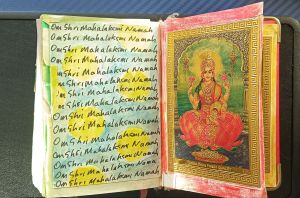
Ignoring that little interruption, I will begin our story. Yesterday morning. I was in the very act of opening my Bhagavad Gita to get to some of my inserted prayers, when without thought I turned towards the back of the little book, landing on the second to last page.

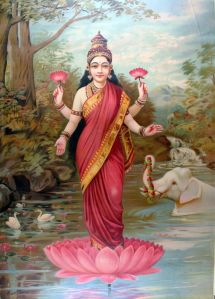
On these facing pages I have a treasured image of Lakshmi and on the facing page I have copied a mantra to her that I particularly like and sometimes chant.

Smiling to myself, I thought that, today (as in yesterday) I would spend a little time with Lakshmi.

For me personally, Lakshmi represents the eventual realisation of my aspiration to complete Self Knowledge, the final realisation of the oneness of all things in one absolute reality. For me that says freedom, liberation, Moksha some call it.

So she – who is one more manifestation of the Divine Feminine and the Divine Mother – represents for me that state of peace, bliss, harmony, as well as a perfect balance in both my internal and external lives.

Sometimes when I feel in need of a little extra courage, some piece of missing knowledge, or perhaps I’m feeling the need to persevere with something or other just a bit longer, I’ll think of Maa Lakshmi, and often recite her mantra.

Really, for me, it’s simply a kind of way to remind myself that the courage, knowledge, perseverance, already exist within me. No need to go looking elsewhere.

I’ve read somewhere that many people appreciate Lakshmi’s  fickleness. You never know what she’ll do, what’s actually going to happen.

Which obviously is a way of saying that thinking of Lakshmi can remind you (or me in this instance) that life is like that: it’s all ups and downs, it’s unpredictable in that it gives us things or situations we don’t want, while also frustratingly not always giving us what we do want.

In other words, Lakshmi reminds me that, whatever happens in my life, regardless of my opinions or wishes on the matter, is happening exactly as things are supposed to be. Of course it’s not really ‘fickleness’ is it? That’s just how we see it sometimes as we seem to impose our own human changeability on the Absolute Reality which is just the way it is, no duality!

Anyway, before that pesky inner editor makes another pop-up appearance, let’s move on wth the story.

So, a ‘little time with Lakshmi’ has turned into a perfect illustration of life working out as it does, and not necessarily according to our little momentary expectations or desires. That planned ‘little time’ has morphed into, so far, a full day and a half.

Back to yesterday morning then: I chanted the Lakshmi mantra, then decided to listen to a recording of the mantra I have so I could contemplate what She means to me.

Right away I discovered that the music file was corrupted, and that sent me on a several hour long quest to find a replacement. Suffice it to say that there are what seemed like an infinite choice of candidates to choose from.

But, even after those few hours, I’d failed to find a version that satisfied all my requirements: it had to be a relaxing, clear chant I could ‘sing along to’; it had to be free of bells, whistles, and other superfluous adornments. Above all, it had to feel right.

As I went forward with this quest, I did in fact come across and listen to several lovely versions of the mantra, that while not quite right for my purposes, I did think might make for good and happy general listening.

These – or the links thereto – I emailed to myself and to my hermit partner. I then put the search aside, thinking that the right mantra will eventually turn up.

Not too long after this, I heard coming from the direction of my hermit partner, a truly magnetic and beautiful version of the Lakshmi mantra. You can find the mantra here

‘Where did you find that?’ I asked wonderingly.

‘You sent it to me,’ was the incredulous and puzzled reply.

Really? I honestly had no memory of hearing that particular version, and I still have no idea about it. In any case, once it was forwarded back to me, I set about listening to the mantra through my earbuds.

Blown away, would be one way to describe my reaction. Probably more accurate to say that listening to that twenty something minutes of beautiful music blew me not away, but inwards; completely and utterly to inner depths rarely experienced. Another full story all its own if truth be told. Perhaps another time.

The serendipitous turning to Lakshmi in my little Bhagavad Gita was yesterday morning. And the poem was written this morning as we listened to the mantra itself. A listening, I might add, that has only just now ended as other things required attention. Several hours, in other words, of exposure to beauty itself.

Anyway, my dear friends, what I share now is my response to that listening experience. Or to put it more accurately, the poem that follows is my response to my response.

Hearing the Song of the Universe, is the name of the poem. And it is an absolutely suitable and appropriate title I think.

May you also hear that song.

HEARING THE SONG OF THE UNIVERSE

Om Shree Maha Laxmi Namah.
The beauty of the words, the blessings of the melody,
infuse me with a mood prayerful.
Inner resonance has my Self reverberating
with the rhythm.
With the drumbeats accompanying the voices of angels.
Like raindrops dripping from eaves
after the storm has passed.

Words of praise for Maa Laxmi
meld with the hypnotic wind
emerging from the flute.
Wood and wind,
and angelic voices.
Together they sing.
They sing the song of the Universe.

Tears well at the corners
of the eyes of the worshipping monk.
‘Let it all go.’
The encouraging words
of the Beloved enter the heart of the monk.
Yet, the tears do not fall.
No, not yet.
In the meantime, the monk breathes.

A Gift Came to Me in an Email

Even a Leaf

A couple of days ago I recieved a beautiful gift in an email. I often receive wonderful things through the email, and this one, as with so many of the others, has profound meaning for me.

Not only that, but this gift has served as a reminder to me of that significance. I’d like to share with you that gift, as well as some thoughts on its importance and meaning to me.

There are a multitude of sources online where you can learn all the technical stuff, word meanings, history, origin, when it’s used and all the rest. I would like, however, to just ‘think out loud’ in my own words, and follow my own heart’s promptings.

Hari Om Tat Sat, is actually two mantras in one: Hari Om, and Om Tat Sat.

Hari Om represents the totality of what we might call God. Hari refers to the manifested cosmos, as well as the creative impulse in its manifest form. I call that Ishvara, but it doesn’t have a name I’m sure!

Om, is the unmanifested universal consciousness, the Absolute Reality. Meaning, as I understand it, existence itself. I call it Brahman, or God, but again, names are just labels we humans apply to things to make it all seem so neat and tidy!

They say that Om Tat Sat is the most sacred of mantras (in Hinduism). It’s used at the completion of prayers and rituals as a way of invoking the presence of the divine and ‘bringing it all together’ you might say. Well not so much bringing, more like a reminder that everything is one already.

I really like the chanting of Hari Om Tat Sat. It’s a centering practice I would say, a way to remember the oneness of all. And I say it, as the traditionalists do, as a closing to prayers or other practice; it’s like ‘Amen’ or ‘It is so’ or ‘Let it be so’ or, well it’s endless – and personal and subjective.

As mentioned, Om means Brahman – or God in the unmanifested state; Tat, not only sounds like that but does in fact mean all that is. In other words, Brahman or the Absolute. Sat means Truth, Absolute Truth or, once again Brahman.

For me it is a little prayer of its own actually. And I’ve heard it used as a greeting many times. It’s a means I think of honouring the divine within the one being greeted, while at the same time I have a sense that it is a recognition, or acknowledgement rather, of the oneness, the unity of the greeter and the greeted along with everything else.

This is why I don’t really feel the need to break the mantra down to explain in technical detail all the constituent syllables (even I were qualified to do so, which I most surely am not).

It really is a way to acknowledge the oneness of all, the Absolute, which includes, obviously, me and you. The Truth is absolute, it says, so must we be, absolute.

Hari Om!
Om Tat Sat

A Lesson in Humility

Opening my Bhagavad Gita this morning for my daily reading, I noticed that I was about to begin a new chapter. I always like when that happens, but this post isn’t about that; it’s inspired by a small scrap of paper glued on the facing page.
In years long gone, a less minimalist me would collect bits and pieces cut from newspapers, magazines or wherever (no Internet in those days). This particular strip of paper was cut from a newspaper (makes me shudder a bit to think how I would devour newspapers every day if I could. Shudder in horror) and has the title Today’s Text. It was a daily quote, usually a verse, from the Bible, and I’d often cut out those that appealed to me. As this one obviously did.

No longer collecting such bits and pieces, this one somehow survived the now ancient culling of excess material stuff, and has ended up in my Bhagavad Gita. Don’t ask me how or when.

Anyway, before I get off track, or too far down the track, here’s the quote we’re talking about

A man of knowledge uses words with restraint.
    Proverbs 17:37

I paused when I read this. As you probably are already guessing, I just had to write it down and added some notes of my own before getting on with my Bhagavad Gita reading.

What comes next is essentially what those full of first thought notes said, plus a little context setting to begin with.

In addition to the Bhagavad Gita, I am also reading, bit by bit, another sacred text. A couple of times (including today) I’ve been frustrated at having to plough through a page and a half (for example) of a description of a concept or idea that I’ve thought could have been said in no more than a couple of sentences.

Is he, the author, a person of knowledge? He most certainly is. He has wisdom too. He was a respected teacher and scholar. Some, many, say he was a saint.

So, perhaps it’s me demonstrating my own lack of knowledge here. Perhaps it is me, also lacking in wisdom, who is using words without restraint. Just because my opinion proposed using fewer words, does not mean by any means that they are better words.

Perhaps it’s me in error: passing judgement on an author I consider knowledgeable and wise, and who is certainly more than intimate with the topics he’s commenting on.

So, allow me to put another perhaps into this mix: Perhaps if such a person takes one and a half pages to describe an idea, then it might just mean that I am in need of more knowledge than I think I have. Surely I am missing something.

At the very least I am being prompted to reread the sections in question, that I was so hasty to dismiss as too wordy. Perhaps (what is it with this word today? Have to nominate it word of the day – perhaps) there is something for me to actually learn before letting my mind run away with critical thoughts based on quick and ill-informed judgements.