In the High Holy Lands Where Magic Sometimes Happens
For the last while (long while really. Actually many years), I have dreamed a few times a month, sometimes more, that I am in, about to arrive in, or just about to leave Rishikesh in India.
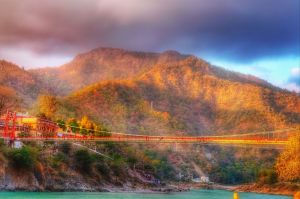
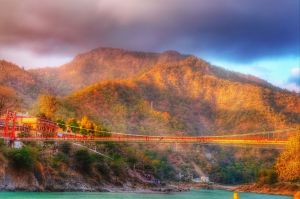
Rishikesh is a small town straddling the Ganges River, and nestled in the foothills of the Himalayas. For millennia it has been considered a sacred place. Its history replete with stories of divine beings, ancient sages and saints, not to mention its status as a major pilgrimage destination for at least a thousand years and the town becoming ever more popular in recent years for pilgrims and ordinary pleasure seeking tourists from around the world.
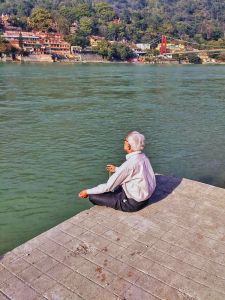
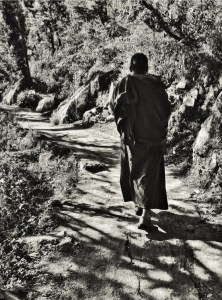
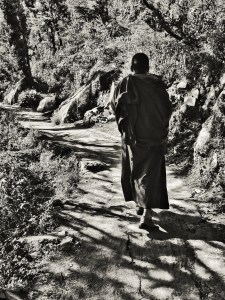
This isn’t me but it could be
I last visited Rishikesh in 2016-17 (having previously spent time there in 2006) when my partner hermit and I stayed for several months. I associate that stay with the strengthening and deepening of my spiritual practice as well as the gaining of a kind of clarity in terms of my outlook on the world particularly on the spiritual path that had been calling to me – as it does still.
Putting aside health issues that hinder our mobility, I think it’s fair to say that my attachment to Rishikesh and my longing to return have more or less faded away almost completely over recent years.
Rishikesh has always been a busy, crowded place with the associated traffic, noise, pollution, and inflated prices. Rampant commercialism has long threatened the town’s ‘spiritual ‘ or ‘sacred’ vibe. These days it is the fourth most visited place in India for overseas travellers so it’s likely to be more busy, choked with traffic, noisy, more commercial and material focused than ever, with the associated degradation of its appeal for some.
But, even if I were also able to put all this aside, I think the core of the letting go of my longing for Rishikesh has more to do with the turning inward that has accompanied our eventual recognition of our calling to the hermit life with its quiet, secluded, contemplative lifestyle (or the aspiration for that life).
So, why the dreams? Why so often? Well, as I’ve mentioned, Rishikesh has played a significant role in my life. And despite the dropping away of those longings and attachment, I’m not saying going there again is totally out of the realm of possibility, but it no longer has that ‘I’m home’ kind of feeling. No longer has that magnetic attraction for me.
Now, here’s the missing information about these dreams I’ve neglected to mention thus far: Not one of the dreams has been set in the ‘real’ Rishikesh; never have they been ‘geographically correct’ for wont of better description.
Sometimes the dream town is nothing more than a small clump of houses sitting on a hill or in a field with a dirt track passing by.
Other times it is a sizeable town with temples, streets, cafes and shops masquerading as an Indian town. Sometimes it’s simply a story taking place inside a shop or restaurant that, in the dream, I know is in Rishikesh though not in the terrestrial town. There have been dreams in which the town is more like a city with highrise buildings, multi-lane roadways, and all the rest.
The most recent dream had me in a bus headed for another bus connection to Rishikesh. Worried about missing the connection, I was told that the Rishikesh bus wasn’t due ‘for weeks’.
Many and varied settings all standing in for the ‘real’ Rishikesh. But I don’t think I need Carl Jung to tell me the meaning of these dreams. All of them are my internal sacred or significant ‘Rishikesh’. It’s as if the actual geographic location in India called Rishikesh is the illusion and these dreams are the reality for me. All emanating from the cave in my heart
My inner or true Self, you might say, telling me that my being concerned with my specific geographical location is missing the point. A message for me that I am always in Rishikesh, that I am always in sacred space and with saints and sages, and that the Divine is everything and everywhere.
Who am I to even contemplate composing a commentary on the Bhagavad Gita (BG) after only seven or eight years of study, some formal with a teacher and some more casual alone?
Well, what I am is nowhere near qualified, nowhere near ready. Actually I don’t feel qualified in any way for such a thing. So much less so was I when I first sat down with my newly gifted BG in a tiny cafe called The Office in Rishikesh, literally hanging over the river Ganges.
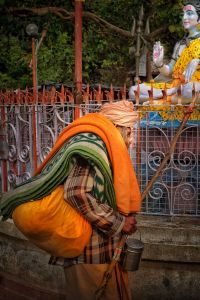
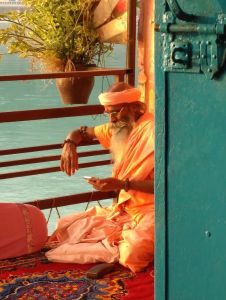
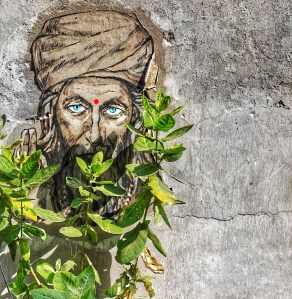
A Saddhu or Holy man and his phone at The Office
With the best fruit salad in the Universe, and fine chai to match, it was the ideal place for contemplation – that is when it wasn’t bursting at the seams and crazy.
But, as I sat there with my new BG I was one of only a couple of customers, so it was a conducive atmosphere for the aforementioned contemplation. Instead I think what happened as I thought about how to proceed to a proper study, was I allowed the sugar from the just ingested fruit salad go to my head.
You see, I decided, as I sipped a post-fruit salad chai, that the perfect study method would be to write a commentary on the whole thing starting with Chapter one, Verse one.
I no longer possess the diary in which this masterpiece was begun. Nor do I recall much, actually nothing, of what I wrote. It’s enough to say however that nothing I wrote could possibly have had any significance or depth or proper perspective.
So, as you might guess, I rambled and waffled for a couple of verses before I snapped out of my ego-driven state of arrogance and hubris. I realised I had absolutely no business taking on such a task. My lack of knowledge, wisdom, experience, all disqualified me from even thinking I had a right to try.
Now, even with the small amount of knowledge I have managed to acquire after all the study, I’m stunned at that arrogance and hubris – even if it was sugar induced. I mean, I’d never even read more than a few verses of the BG before. So, how could I even form a ‘first impression’ or ‘casual opinion’, much less a full blown commentary?
A couple of days ago I read a couple of verses that really resonated with me, as they have before. So, just like that fool sitting in The Office all those years ago, I confidently asserted that I was more than up to the job of making a commentary on those verses for this blog.
But, and here’s the really weird thing: I only just now realised, as I’ve been writing these notes, that the two verses which I will quote for you shortly, address precisely my behaviour on that post fruit salad, sugar shock induced ego trip.
I realised that it’s as if I have indeed written a commentary on those verses. And I have used a personal experience to illustrate the text. Absolutely unintentionally as it happens.
Regardless of what excuse I come up with the error in judgement in thinking I could write a full blown BG commentary all those years ago, the reality is that I failed to act with discrimination, or what I would call discernment.
In the high holy lands wrong thinking can still happen
Somehow I ignored (or totally forgot) the facts: I knew nothing! I’d lost the ability to discern what I could do and what I couldn’t do, what was a sensible action and what was a ridiculous one.
Stop! Memo to Self: Please stop picking on me!
Anyway, moving right along, here are the verses – free from commentary!
‘Thinking about sense objects brings an attachment towards them. Attachment leads to desire and desire leads to frustration, which in turn leads to delusion. When you are deluded you lose your memory [the knowledge and experiences you could draw on to make proper decisions; sometime even to the extent of compromising your own values] and with the loss of memory the power of discrimination is destroyed; with the destruction of discrimination your self itself is lost’ .
Bhagavad Gita Chapter 2 Verses 62-63 (my version of the BG sometimes combines verses as it has here)
Something quite different today. I had planned to write the second part of our contemplations on Armenius’s answer to his prayer. But then I came across a short story from quite a few years ago now, that seems to speak directly to our series title, Flee, Be Silent, Pray Always.
Grab a cup of tea, relax and enjoy the story
I offer it, I share it with you now in the hope that you will find it interesting and (or) entertaining. It’s going to make this post way way longer than usual, but I hope you find it worthwhile to spend some little time reading it.
So, with love, here is the story I once called:
LEAD ME NOT INTO TEMPTATION
The old carpetbag perched as if it ” a living thing, an alien visitor from the other world, in the middle of Brian’s old table. Its bulging bulk and musty smell, a constant reminder of its threatening presence.
It had been three days now and he knew he’d have to make up his mind soon, make some sort of decision. He had to find a way to deal with this.
Brian, or Brother Brian as he would prefer to be known, had made the long climb to this crumbling stone house a long time ago. He could no longer tell how many years it had been. All his life he had known what his destiny was to be. Even as a child, he had felt the call of the mountains and the monastic life. But, like most people, he had ignored the call, ignored his destiny, and settled for an ordinary life: school, university and a job shuffling papers for some obscure government department.
Then, one day without warning, he walked out of the office, sold his belongings, packed a small bag and caught a one-way flight to India. He didn’t know quite what he was looking for, but he did know it was something vaguely spiritual. He thought that if he couldn’t find a spiritual life in India, then he wouldn’t find it anywhere.
It didn’t take him long to find his way to the remote mountain monastery of a reclusive order of contemplative monks. For Brian, it didn’t matter what they taught, what lineage, gurus, or teachings they followed; for him it was the simple and quiet life of meditation that was the main attraction.
Now, all these years later as he sat staring at the carpetbag, he reflected on how fast time can pass when you spend your days meditating and working in the gardens that supplied the monastery. Sighing, he thought that they had been good years. Was it ten? Twelve? No, it was ten years he spent in that place. But, for some reason he could no longer fathom, he had decided that the so-called isolation of the monastery wasn’t isolated enough for him.
Then, smiling, he remembered: after a while the other monks’ constant chatter had begun to irritate him; he had begun to long for total silence.
Not our monk’s actual hermitage!
The Abbot understood Brian’s need for quiet and deeper contemplation. After all, he had been his mentor and advisor for many years and knew his student well. He told Brian of the old house, long abandoned, that lay just over a week’s walk in the hills above the monastery.
So, along with a brother monk to accompany him on his trek and help him carry cooking utensils, food and seeds for the garden he planned, Brother Brian left his home.
There weren’t many comings or goings at the monastery, so Brian’s leaving was a momentous event in the life of the community. Not sad, not happy; these monks had long since learned that what happens is simply what happens. But, for Brian, there was a sneaking sense of excitement as he began the long, but welcome, trek to what he hoped would be his home for the rest of his life.
He embraced his brother with a farewell. Brian smiled as it occurred to him that this was likely to be his last ever contact with a fellow human being. Soon the brother was gone, and Brian was alone. He surveyed the house and saw it wasn’t as bad as he’d been led to believe. Why, there was even a table and chairs to sit at.
It was the work of an hour to place his meagre belongings in their place in the house. And so his life of true isolation began. The years passed and Brian’s prediction proved accurate: he saw nobody, heard no human sounds. His only contact with that other world was the monthly cache of rice and other staples the Abbot arranged to have dropped off for him to collect a couple of hours walk downhill from the house.
Brian always ensured that he would not encounter the brother who made that long trek for him. Lately though, he had seen the tracks of a horse and cart. The monastery must have modernized, he’d laughed to himself at the time. Samsara, he thought, it’ll get you every time.
His plan for total seclusion and quiet had worked for a long time. But now as he stared at the carpetbag, he remembered the day that other visitor from the other world had come calling. It was six months ago now and he’d been at his cooking fire, about to ladle his daily rice into his bowl, when he heard the knock.
At first, it was just another sound from the old house that had over the years developed its own voice, or so Brian liked to think. But the knocking persisted, grew louder, and that did strike him as odd.
Putting down his bowl he went to the door of the house, opened it and came face to face with the first human he had seen since his brother had left him here all those years before.
‘Are you Brian?’ the apparition questioned.
Brian, for some moments, had no answer. It’d been a very long time since he had heard another human voice, and just as long since he’d had to use his own to give an answer to anyone.
‘Are you the man known as Brother Brian?’ The voice was more insistent now and Brian saw its owner seemed to be dressed in some kind of uniform. Was he a policeman? A soldier?
‘I am Brian. His voice shocked him.
‘Well, this letter is for you. It is from the government and it is necessary to deliver it to you in person. That bloody Abbot fellow tried to stop me, but it is my duty you know.’
So, this stranger was a postman. He shoved the letter into Brian’s hand, turned and marched away, leaving Brian standing dumbly in his doorway.
After some time Brian came out of his stunned reverie. He stared at the letter, which did indeed bear his name, or rather the name he once owned and was of use only in that other world he’d turned his back on. And it bore the crest of the government. Brian could not begin to work out what it was about.
But, realizing that there was only one way to find out, he opened the tattered and crumpled envelope.
Before he even read the letter’s contents, Brian’s world fell apart. The date at the top of the typewritten page transported him back into that other world. As if the long intervening years had counted for nothing, he became who he had been then.
That date told him how long he had been away from the place of his birth; it said to him that he was not alone. His years of practice, of attempting to exist in a timeless state with only nature’s seasons to guide his daily activities, suddenly seemed to have no meaning. But what he read next was almost beyond his comprehension:
Dear Sir
You have lived in our country for many years. We believe you are a member of a religious community. However, such a status does not exempt you from the very strict immigration rules that we have put in place to ensure the security and well-being of our nation and her people.
It has recently come to our attention that your original visa was for a period of six months only. Therefore, you are in this country illegally.
We have decided to be lenient in your case and have not insisted on your immediate arrest and detention pending trial for the extremely serious crime of visa violation. We hereby inform you are to leave this country by no later than three weeks from the date on this letter.
Please be warned that should you not present yourself Immigration officials at your chosen point of departure by that date, action will be taken to place you under arrest and your case will be prosecuted to the fullest extent of the law.
Yours truly
Ministerfor Immigration
Brian was calm. He folded the letter, returned it to its envelope and placed it on the little shelf he reserved for his few books and papers. It would not be correct to say that Brian’s life and routine returned normal; he was really only going through the motions, tending his garden, even meditating a little more than usual.
But he was disturbed. Not only had his isolation been broken by the visit of the postman all those months ago, he was as the letter demanded, being forced to leave his safe haven, his home of all these years.
But it was neither of these two issues that seemed to occupy him most on this day. As time passed from what he now called the Day of the Letter, Brian had grown increasingly restless. He found himself spending long hours daydreaming and remembering his old life, his life before that day he walked out of the office and bought a one-way ticket. He even sometimes caught himself wondering what life would be like if he walked back down the mountain.
And now, six months later, he sat staring at the carpetbag. He smiled now, remembering the threat in the letter: he’d had three weeks to leave. Still, he remembered from his old life how slow bureaucracy could move sometimes. He reached down to rub the soreness on the side of his lower leg. As he felt the scratches, he recalled how he’d come by them. Actually, he thought, if it hadn’t been for the carpetbag and its soft bulk, he might have been more badly injured …
Along with that general restlessness engendered by The Day of the Letter, he sensed a growing dissatisfaction, a dissatisfaction that had not passed, even after so many months.
And these feelings seemed to extend to the house itself, still as tumbledown as it was when he’d first laid eyes on it all those years ago. Suddenly it didn’t seem good enough and he had an irresistible urge to improve it, to fix it up a little, as he liked to put it.
So, it was three days ago, and he was rummaging around in one of the small outbuildings at the back of the house. He trod with care: the rough floorboards were all loose and in varying stages of decay. And, sure enough, all his care didn’t prevent the inevitable. As he reached for a bundle of metal garden stakes that he thought might make a fine tripod for his cooking pot, his foot sunk into the floor as one of the rotten boards gave way.
He didn’t sink far; something solid but soft got in the way. Pulling his leg out he saw it had been cut. A small amount of blood oozed from some long scratches. Even so, he realized hed been lucky not to have gone in further and he wondered what had broken his fall.
He peered into the hole and saw what looked like a fabric bag. He reached in and pulled it out. Nice bag, he thought, with his newly reacquired eye for things of the outside world. He seemed to remember that such a bag was called a carpetbag.
Standing up and heaving the bag from the floor, Brian was surprised by its weight. He decided to take the bag, reeking of dust and the musty smell of damp and age, into the house before opening it to see what was inside.
How different he was since the Day of the Letter, he thought as he sat three days since finding the carpetbag, staring at the thing. How many years had he been here without even setting foot in that shed? Anyway, it’d been a very long time since he had been even remotely interested in anything of a material nature.
But, at the time he found the bag, he had acted without a second thought; it was just natural to take the bag from its hiding place and into the house. And it seemed perfectly normal for him to want to open it and look inside.
He had lugged the carpetbag through the door and into his house, heaving the heavy load onto his table. The dust made him cough, but he didn’t hesitate. The bag’s zip was rusty, but came apart easily. However, the sight of the bags contents did make him hesitate.
Bundles of paper that he could see were old English banknotes. Pulling himself together, he started taking out the bundles, twenty in all. He guessed that each bundle had to contain several hundred pounds. Of course, he knew that they were no longer legal currency, but on the antique market, he was sure they would fetch a fortune.
At the very bottom of the bag, he found a large pouch, heavy and solid. Opening the drawstring, he found it full of stones. Pulling out a handful, he realized they were small diamonds, dozens of them. Mixed with the diamonds were stones of many colours: red rubies, green emeralds, purple amethysts.
Even his newfound interest in material things was defeated by this discovery. He returned the pouch and the wads of banknotes to the carpetbag and set the thing in the middle of his table. Suddenly he felt the pain from the scratches on his leg, so he left the house and went to the little stream he used for water and washed the wounds.
For those three days he went about his daily routines as best he could. But he had to pass his table and the carpetbag many times a day, and it came to preoccupy his thoughts. Its contents could ease his re-entry to the outside world in a very nice way. In fact, he doubted he would ever have to think about getting a job or earning a living. But this was his home. No matter how much the postman with his letter had pulled him back to that other world, no matter how much stuff, how many things, this carpetbag and its cargo could buy, he’d have to leave his home.
So he sat and stared. He didn’t think; he’d gone over and over his choices. He couldn’t do it anymore. He just stared, and time passed. With a start, Brian realized it was dark and that the house was cold. Still not thinking, only acting, he went to the little shelf and retrieved the letter and a pencil. He returned to the table where he sat and began to write on the back of the envelope in the tiny script he’d mastered all those years ago when he still thought keeping a journal was a useful practice.
My Dear Brother Abbot
How many years you and my other dear brothers have made the arduous trek to bring to me the staples that keep this body alive. No words of gratitude would ever be enough to tell you how I feel. Of course, I know if I were there with you now you would tell me that you and they are only doing what needs to be done for a brother. Still.
When this letter arrived, I was deeply disturbed. I found myself thinking of and longing for the old world of my youth. I found myself falling into Samsara again. I did not like this, but I found it drove me to change my world here. I began to be obsessed by the need to improve the house in a physical way.
While I went about this crazy business, I injured myself by stepping through a rotten floorboard. My fall was stopped, and my injuries lessened by this carpetbag that I now send to you.
However, in the three days since, I have not been able to engage correctly in my daily routines and practice. When you see what is in the bag you will understand my distress and confusion. On the other hand, you might not: you are so much more advanced along the path to enlightenment than I.
I have just sat through a long dark night of the soul, completely lost and not aware of this body or this material world that surrounds me. When I rose from this state, I knew what I had to do. The letter in this envelope and this carpetbag and its contents do not belong to me, nor do they belong in my world. I send them to you because I do not know what else to do with them.
As always, I rely on your help. You have always been there for me when I stumble and as I enter the bliss.
Your brother salutes you dear Abbot.
Brian
Scooping up the letter and dragging the carpetbag off the table, Brian strode out of the house, and in the darkness, trod the well-worn path to the spot his brothers brought his supplies to.
Long ago, he had built a small shelter for the brothers to rest in, and in which perishable items could be left. He placed the bag there and, with a large stone, weighted down the letter so it would not be missed when the brother next came.
As he rose from this task, Brian saw that it would soon be dawn. He would have to hurry if he was to make it back to the house for his morning meditation.
THE END
If you’ve made it this far, thank you. I hope you had an enjoyable and interesting read. Next post will truly be part 2 of the series, and we will be contemplating the second part of Armenius’s message: Be Silent.
Yesterday I came across a couple of stories – true ones – that I wrote years ago. They are what we might loosely call ‘travellers’ tales. I thought it might be nice to share them here. So here’s the first one. Enjoy
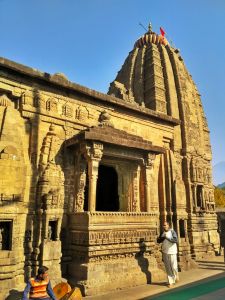
Not the Manu temple I write about, but another one close by
I’d walked up to Old Manali, and I’d kept walking through the town. Then higher still, past the temple to Manu, and the scattering of traditional houses and small fields clustered around the temple.
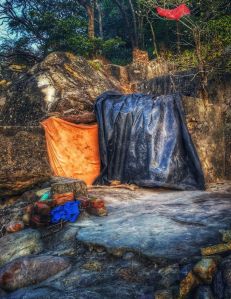
Three near-naked and stoned saddhus invited me into their cave – more a kind of overhanging rock shelf poking out from the foundations of the temple itself.
Naturally I declined. Politely. I wasn’t, never had been, and never shall be a stoner. Besides, here I was deep in the Himalayas walking through ancient villages and past temples to ancient gods. Seems to me that that’s enough to bring on a high all its own and like no other.
Then, a little higher up the trail. I rounded a corner to be greeted by a kind of open forest glade; a grassed and flowered field protected by a semi circle of forest sentinels, their crowns maybe thirty metres above my head.
And there, in the middle of this magic field, a large flat rocky area, like a series of ‘shelves’ layered one on the other. This maybe twenty square metre tiered platform was probably the remnants of an ancient hill (or mountain?) that got in the way of a more recent but clearly relentless glacier.
Whatever the history, here was an arena with views no theatre or movie could ever hope to reproduce. This natural amphitheatre faced several layers of peaks across the valley. But, before those peaks, and directly in front of me, just down the slope, stood the temple, then more trees, reaching down into the valley. Here the river flowed, surrounded by farmers’ fields and the brown dots of houses.
Then the forests begin again, thick at the bottom in the valley, but becoming more scattered on the higher ground. Then those many layers of higher and higher hills, mountains really, rolling off into the distance to, where on the horizon and behind it all, a row of the really high peaks covered in their permanent snows.
‘This is a special place, a sacred place,’ I heard myself sigh out loud. Sitting cross-legged now, I let my eyes wander over the scene taking in the blue sky, the white peaks, the multiple greens of the forests, the sliver ribbon of the river, and the rest.
At such times and in such places, one’s eyes tend to close of their own accord. And so it was for me then and there. I let myself drift. Thoughts came and went, to be replaced by more thoughts that came and went.
Then, my eyes opened. Again of their own accord. After a few seconds of that cliched ‘where am I?’ feeling one has when startled out of one state and into another, I made out the figure of a person standing facing me a few metres from where I sat.
‘I’m sorry,’ I heard her voice call to me. ‘You just looked so peaceful sitting there meditating, I just had to stop and watch you.’
She told me she’s been watching me for about fifteen minutes, which gave me a start: It’d felt l Ike I’d only just sat down and closed my eyes.
‘They say the light of the world is held about twelve kilometres up this trail. That means it’s the centre of the world.’
I had to stand to try to take in a revelation of this magnitude.
‘And apparently,’ she went on, ‘they’re going to move it soon and nobody knows where.’
Was she an angel? Was I dreaming? They, whoever they were, are about to shift the centre of the world? Even in India one doesn’t hear this kind of news everyday. Actually, I doubt you’d ever hear it on any day.
Then she was gone, headed up the trail. I didn’t follow. I remember thinking: twelve kilometres was too far for me especially as I already had a long walk downhill to my hotel back down in the new town.
Yes, mundane, practical musings, a typical response to news of such a wild and far-out nature. So, not exactly in shock, yet not quite myself, I turned back. Down. Through the village, past the temple with three crashed out saddhus out front, back into the town.
There are cafes there. They sell Chai there. I needed one.
Actually, given the momentous news I was going to have to digest, I might even have a couple extras.
This is a true story; it actually happened more or less the way it’s described here.
Of course, there is no ‘light of the world’ stored in some secret spot, somewhere on Earth.
Well, I suppose if there is a light of the world, then it’s likely to be the world itself, I mean Earth, all the beings who live on this planet. Life itself I guess you could say. Life is light; Life is love.
The hand of the monk agéd, insistent, but gentle too, takes and holds mine. The monk sits, the Dharma before him, sacred texts resting in their saffron shroud. My presence completes this circle.
Mountain monastery calling him; it’s not home. Other mountains he’s climbed. Escape. High places divide this world from that, that time from this.
His loving touch, his smile, linger in rarefied air. Air drenched with the warmth of the Dharma, in this late monsoon restaurant of the Snow Lion, south of his land.
Notes from the Hermit’s Cave is what this blog is called. I promised to publish musings or notes of all sorts: your regular text blog; photos or other pictures; poems; and other assorted bit and pieces.
Well, I’ve rediscovered a poem that I think would be great to share with you.
Looking through some posts saved from old blogs no longer active, I came across theaforementioned poem. It’s about a guy I met in a cafe in India back in 2006. This person kept me and a crowd of other travellers spellbound for a couple of hours one monsoon afternoon. Not to mention the many conversations focused on him that followed in the next few days and the several pages in my Journal recounting the whole experience.
Anyway, as soon as I saw this poem again, I thought I just have to post it here. That trip was a big step for me in my own healing and spiritual journey. And meeting this guy has played a part in all that.
So, please join me in making this small offering of thanks to that guy, whose actual name I never learned, and who forever will be known to several very fortunate travellers as the Cockroach Man
THE COCKROACH MAN
This is what he said. He’d lived many years in India, and, in that time he’d done many things. Even, he said, for a while he’d trained with a yogi, his guru. This is what he said.
Yogic training is not easy, he said, In fact, he said, one aspect made him sick for a year. This is what he said.
His Guru put beings in his head. Beings like parasites he said. Yes, yogic training, it made him sick. This is what he said.
Parasites implanted in the head? A part of yogic training? No. I don’t think so. Actually, inserted was the word he used. ‘inserted beings in my head.’ This is what he said.
All gone now, save one, he said. Only one remains—it’s like a cockroach. And it’s still in him making him sick. This is what he said.
At night, he said, there is sometimes relief. The cockroach leaves and floats just below the ceiling. Well, its astral body leaves his head and floats above his bed. This is what he said
‘You’re a healer. You understand,’ is what he says as he turns to me. Umm, no. Actually I don’t. But this is not what I said.
Where is he now, the Cockroach Man? ‘It’s winter soon. I’m gonna give blankets to the villagers.’ This is what he said.
He’s known suffering, he said. And you could tell he was tired from fighting the cockroach. ‘I’ll feed the poor.’ This is what he said.















 Notes from the Hermit's Cave