There would be some – including me – who would say that all human beings, and not just monks, need to learn to awaken their hearts, to cultivate attitudes and a life of love, compassion, empathy, and kindness.
Who would disagree with such a suggestion?
Well, I’ve already said that I am one of the ‘some’ who would welcome such an evolution in human consciousness. But, at the same time, I don’t want to make pronouncements, form judgements, hold opinions, on what anybody should do, or be like. Only me. I am only responsible for my own behaviours, attitudes, ideas, thoughts, speech, and the rest of how to live my life. I just can’t – as in I’m not entitled – to tell anyone else what to do, what to think, what to say and so on.
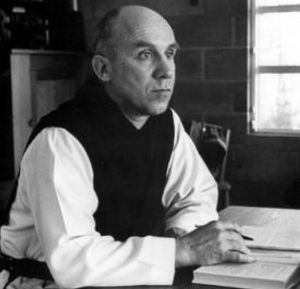
Actually I’d even speculate that Merton is in fact talking about just the one monk: himself; he’s not preaching a prescription for the behaviour of others.
I’ve read so much Merton that it’s impossible now for me to remember exactly where I read this statement of his, but I do know that when I first saw it and made a note, the concept resonated deeply for me as a great aspiration for my own life as a monk, and as a trying to be decent human being.
In other words, this monk – me, myself, and I – has a task to carry on with: to cultivate an awakened heart. And being a ‘great study’ it’s bound to be at least a lifetime’s project.
It’s an effort though, awakening one’s heart. It’s even a bit of a mystery at times what the phrase actually means in real terms.
Love, obviously, tops the list for any aspirant on the awakened heart path. And, yes, I do feel, express, and act out love – so deeply sometimes to the point of being overwhelmed or ‘flooded’; sometimes speechless (that’s the good bit), sometimes full of words.
But then there are times (oftentimes is the word) when that love is clouded or shrouded completely by angers and irritations, by regrets of what should be or shouldn’t be, could be or cant’t be, what isn’t.
The great study of the monk is to have an awakened heart Thomas Merton
All attachments to what is not as I think it should be. All barriers to love. All ways and means of keeping the heart asleep – or at best semi-awake, and still sleepy: slow to respond, slow to act, and with ongoing blockages to seeing how things actually are.
The quest to acquire an awakened heart and the outpourings of love, kindness, gentleness, generosity, that such a state would allow, is probably at the root, the foundation, of my life as a hermit monk, of my life as a pilgrim journeying through and to Self.
Living quietly and simply; developing a contemplative way of being in the world while definitely being not of the world; cultivating silence, peace and calm; all are activities and attitudes directed at cultivating an awakened heart.
All that generosity, patience, love, kindness, empathy, and all the rest are definitely all characteristics of an awakened heart. Here’s my dilemma (only one among many that riddle my crazy monkey mind): they are also precisely the elements that need to be practised in order for one to acquire an awakened heart. What’s the expression? Catch 22?
Of course, it just occurs to me now, everything that is, is exactly as it’s meant to be, happening just as it ‘should’. So, in other words, all these words of reflection are simply a commentary on what has been and gone already, that which is in the past, and is no longer existing.
All that matters – all that exists – now is that at this moment, in its ongoingness, I am as loving, as kind, as patient, and as generous (not to forget compassionate, empathetic) as I’m able. To others obviously, as well as to myself.
All that wonderful list of characteristics of an awakened heart all exist right now within me. Perhaps I need to wake up my mind a bit more so I might see that reality. Then I might actually realise that I already have an awakened heart and that I simply got forgetful somewhere along the way.
Did you know that Thoreau, when he was staying at Waldon Pond would sometimes sit on the front steps of his cabin right after sunrise.
Often he would look up and discover that it was already midday or even late afternoon; he’d spent those several hours in a reverie.
Being in a reverie is most often described as being a pleasant experience, just like a nice day-dream. It is also universally (at least in the context of my short Google searches) described as being ‘lost in thought’, as well as being a place of fantasy, a place in which fanciful and impractical ideas are born.
In other words, a reverie while being pleasant, does not seem to be looked upon as a useful, productive, or worthwhile experience.
The outcome of this contemplation and the above-mentioned little bits of Googling, is that I don’t agree at all with the dictionaries when they tell us that reveries are almost useless and have little or no benefits.
Even the Hourihans dismiss the value of reveries when compared to the practice of formal meditation. Listen to what they say:
There is a difference between the two. Meditation means effort, concentration of the total mind. What Thoreau has experienced is reverie – passive, beautiful and enchanting, but not true meditation.
My reaction to this dismissal? Well, I say, what’s wrong with an experience that is passive (there might be a book in the idea that reveries might not be all that passive after all) beautiful and enchanting?
And on the other side? Why is it seen as virtuous to be always making efforts and concentrating the total mind all the time? Speaking for me and I suspect several billion other people, I get tired, always trying, making effort, always concentrating and the rest.
I’m not saying at all that I’m not in favour of meditation. Indeed, I spend hours each day (in theory that is) in some kind of effortful, concentrated meditation. But, really, isn’t it nice now and again to just give up the effort, lose concentration, just for a bit? Just rest.
Of course when one’s mind wanders in reverie, fanciful ideas and thoughts will arise. Mind you it’s equally likely that some of those thoughts and ideas won’t be fanciful, but be helpful. And you know, I doubt there’s a meditator in the universe who would not report exactly the same thoughts and fancies come up despite all their meditatory efforts and concentration That’s just how our minds work.
The notion of being ‘lost in thought’ is interesting to look at too. I don’t think it’s quite the right way to refer to what happens in reveries. At least not completely.
Was Thoreau really lost in thought when he would suddenly realise that several hours had passed without him being aware?
Perhaps it’s more likely that at least a proportion of those hours were spent in a thought free state, just as in deep sleep when our mind is absent.And we all know how restful and satisfying deep, dreamless sleep can be. Maybe that’s why reveries are described as ‘pleasant’ experiences.
My teacher talks about how sometimes when we’re listening to a favourite piece of music, we can become ‘lost in the music’. We all know how that feels. He then asks us to consider, what is it exactly that ‘gets lost’?
Well, just as with deep sleep or when in a state of Samadhi or deep meditation, it is the mind that disappears – along with its self-idenifying ego sense. In other words, whoever we think we are goes missing or absent for a while.
When I’ve experienced that state when listening to music, I would describe it as losing track of time, or rather not being aware of time at all. Thoughts come and go but don’t often stay long, ‘just floating by like clouds’ as someone recently described it to me. And afterwards when I return to ‘normal’ I sometimes have a sense that for a time I and the music were one, no separation or judgements, non-different.
And so it is when ‘lost’ in a reverie: the ego disappears; thoughts come and go. What’s left is the space between thoughts – a bit like the silence that exists between notes in a musical composition.
Some say that it is this silence, this space when mind and ego are absent, is where the divine is to be found. It is said, by some, that it is in this space, this silence, one may experience God, or Absolute Reality.
So, no ego; no monkey mind jumping about; no ‘I’ to interfere with the state of silence, stillness, and peace. And quiet!
And if one removes the letter ‘I’ from the word reverie? We are left with revere. Perhaps those who tell us that the silence is God, those who say that the absence of thoughts, ego and so on, allows us to detect the Divine, are onto something. That silence, and the process by which it is realised, are to be revered.
Being ‘lost’ (the dictionary’s word not mine) in a reverie might just be the most useful and the most productive (not the world’s definition, but more in the sense of the actions that make for the betterment of Self) thing we can do when the mood, the moment, and the inclination strike.
Well, here we are with the third and final part of our contemplations on Flee, Be silent, Pray Always, the answer discovered by our friend Arsenius who was looking for a way to be saved from the the things of the world.
In a very real sense, this third injunction might be seen as the most important of the three. Indeed, again in a very real sense, those first two seem to me to be prerequisites for the third. Certainly, many of us would like to flee to a place and state of silence in order to escape the world and its many and varied causes of our suffering. Such people are simply and completely over the noise, the chaos, war, greed, the complexity of relationships, and all the rest.
Then there are many many others who, rather than looking to escape the world, are wanting to ‘flee’ towards a place and state of silence in order to engage more fully with the world by contemplation, meditation, and most of all, prayer. Such people are working towards making their entire lives a prayer.
And then there are the third group which is made up of those who have some sense of running away from the world while at the same time they feel compelled to move towards a contemplative life that they sense will be the best way they can actually serve the world.
I think I can include myself in this last group. I’ve never coped well with masses of people, being in the workforce, or dealing with the horrors that the world seemed to be overwhelmed with.
At the same time, I’ve always wanted to (and have tried to) combat injustice, racism, violence and the rest. I guess you could sum it up by putting it this way: I was (still am) an oversensitive person who one day had had enough of trying to ‘fight the system’ when it was the system making and changing the rules of the game as it went along.
Better I thought, to turn inwards in order to reach or realise my oneness with all living things. I’ve always been predisposed to praying as well, so it was a natural evolution in many ways. My intention and commitment these last few years has been (and still is of course) to pray continuously and with all my being.
My prayer is for the release from suffering for all living beings and that’s my central focus for prayer. For me, it feels very much that I am a lot more use to others living what I think of as a prayerful contemplative life than being actively engaged with the world out there in the midst of it all so to speak.
Pray Always
Prayer for me is not so much about petitioning some all-powerful being who is seemingly on a whim able to grant or refuse my wishes. For me it is more an affirmation of the reality of my already existent oneness with the entirety of the universe. It’s a way of seeking to actually realise that this oneness is my very Self.
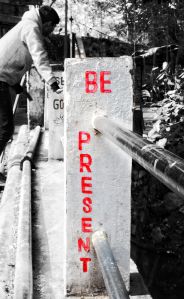
Prayer is about being present, not wishing blindly that things be different than they are. In praying I seek to affirm that the ‘universe is unfolding as it should’, as it says in a famous poem I’ve always loved. (Actually if you don’t know about Desiderata [Things Desired] then please do check it out; you’ll love it).
I think that in this sense, prayer is in fact an act of mindfulness, or rather an act which will help develop a mindfulness practice. It is a way to practise being fully focused and present to whatever is going on, whatever circumstances we find ourselves in.
And if we’re able to be present – even on a temporary or momentary basis – then we will be more calm, more at peace, and more able to achieve some clarity in our lives and with whatever is the intention with our prayer.
I know it might sound like a clumsy attempt at a clever play on words, but we’ve described mindfulness as the practice of being fully present. But we can put it another way. We can define that state of being fully present as being in presence. Like what we might say to a friend who is daydreaming while we are trying to talk to them. We might say something like ‘so and so, your presence would be appreciated’.
In presence of what? I would say everything. When we are absolutely in the present moment (again even momentarily), when we are able to realise our oneness with all things. Essentially the universe is there – or is it here? – with you in that present moment. It’s a moment when we may indeed feel we are in the presence of all that is.
Some may call that presence God, or the Divine, or Universal Consciousness. Others may see it as being in the presence of their own true and authentic Self.
That leads quite nicely to the next aspect of prayer that I want us to look at. Praying to God. I’ve spent so long on mindfulness because I wanted to stress that I don’t think it’s necessary to have a personal name or form for God, or even a notion of an unmanifested, invisible ‘force’ called God, in order to pray.
On the other hand for me, and I know for a lot of people, there are names and forms of the universal consciousness that pervades and permeates the universe, that I personally resonate with and I can reach out to them whenever the feeling or inclination arises. It sounds a bit odd to say, but for me to think that all that is, is all that is, sort of sums it up.
And as a result of that, any prayer I pray is addressed to my own Self which is simply part and parcel of all there is. In other words, it’s a personal choice for any one of us what form or name we choose to pray to. Or if we don’t pray to a name and form at all. All is one.
One thing I’ve mentioned I think a couple of times is the idea of making all our activities into a prayer, but other than the discussion on mindfulness and presence, I’ve not really addressed the how and why.
Why is pretty obvious. Because living and acting mindfully helps us in so many way such as being more peaceful, more relaxed, happier, and so on. The how, now I’m thinking about it is the purpose of this post. And it’s also true to say we’ve been talking about it since this series began.
That is to say, we flee from the aspects of our lives that don’t serve us and which can be changed. This might be a decision to spend 30 minutes every day sitting quietly and undisturbed. And as we’ve mentioned a few times already it could be going all out and moving to a desert cave somewhere.
In both those scenarios we give ourselves the opportunity to be silent and, hopefully also surrounded by silence. How to pray always? There’s an expression I love and try to live by: Follow your Dharma. Here Dharma means your own truth, being authentic to who you are, having the intention to do what’s right in all situations. And of course actually following through with that intention if at all possible. In this way you transform every action into prayer.
Living a life of prayer does seem on the face of it to not involve much use of spoken prayers, as in saying prayers with words. Well, I don’t intend to be humourous here, but a great deal of prayer does it fact involve talking to one’s Self. To the real self, that part of us that’s part of everything else. It can do us good to have these deep conversations.
Then of course there are the many many prayers that already exist to serve people from so many traditions, cultures, to suit all kinds of purposes and intentions.
Many of us will be familiar with a number of prayers learnt when we were children. If you’re anything like me, they still pop up by themselves from time to time.
Actually as I deepen my prayer practice, I’m discovering that I’m remembering all sorts of prayers from many and varied sources. I think as I dig deeper, more and more are coming up to the surface.
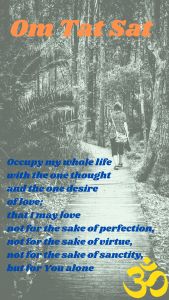
This prayer (by Thomas Merton I think) resonates deeply with me
If these ‘pre-prepared’ prayers say what you want to say and in a way that resonates with you, then you are free to choose those that feel right for you. I guess I mix and match the prayers I use; it’s always dependent on my feelings, thoughts, and intentions at the time.
Like Arsenius, I try to be open and responsive to whatever the ‘answers’ are, even though my ego does sometimes when it doesn’t like the answer, try and control outcomes.
One point about such prayers: I find it tempting oftentimes to simply recite them at what I’ve heard described as lip level. By rote and without emotion, in other words. At those times I try to slow down or pause to reflect on what I’m doing and why to get back in touch with Self.
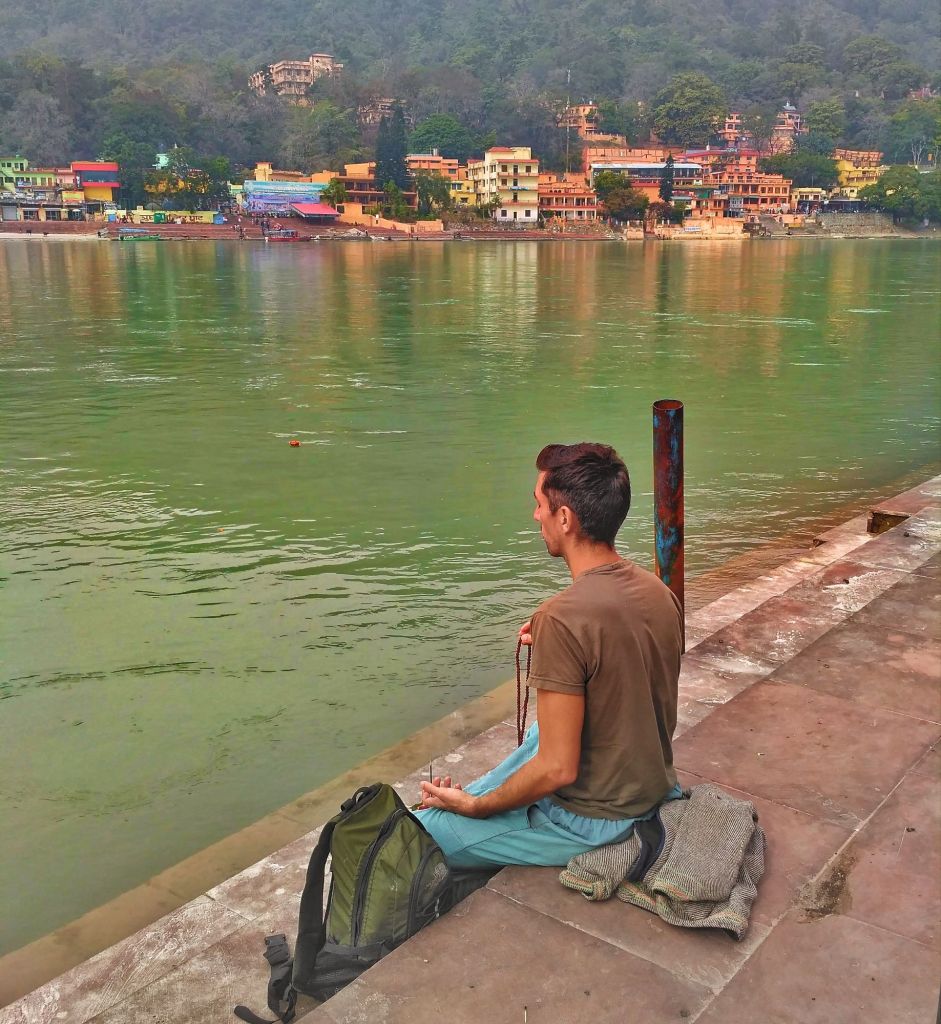
A major part of my prayer life is chanting mantra. I try to spend more time chanting as time passes. There are a number that I use depending on inclination and need.
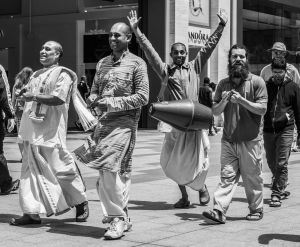
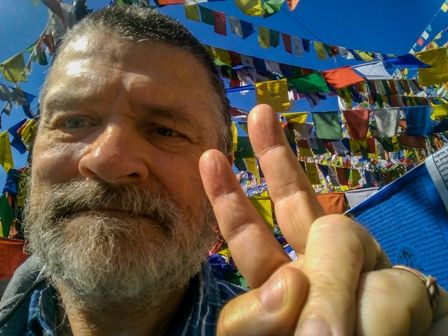
I chant anywhere and sometimes a mantra will start chanting itself, surprising me by its arrival
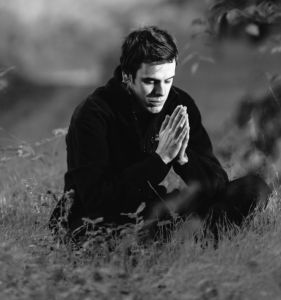
(This photo isn’t me by the way)
Now, probably one of the most important aspects of my own prayer life: I know I’ve mentioned my intentions in praying at all, but one aspect I haven’t mentioned is praying as devotion.
Devotion as in worship, praise, as in gratitude for the beauty in my life, as an expression of love. Knowing with the mind that all is one is fine, but these kinds of prayers help us to cement our awareness of that oneness of all living beings. As I said earlier, I, like you or anyone else, may use particular names and forms to represent this oneness, but, well, it’s all one, so we are non-different from all those names and forms.
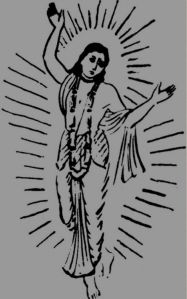
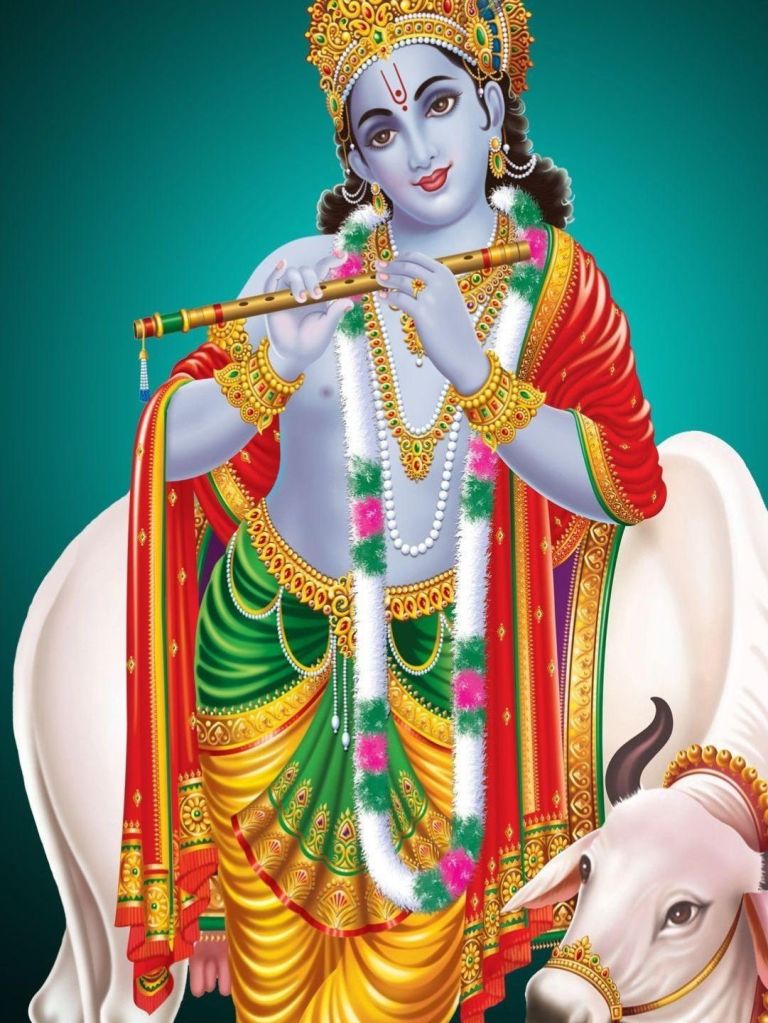
Lord Sri Krishna is among my favourite forms of Universal Consciousness (also known as Brahman)
There are many representations of the Divine, but Krishna and this picture of Him are special to me.
Focusing your devotion on a particular form seems to help make it easier or more real. It’s tricky to pray to and with a thing that has no form and is invisible.
So, my friends I hope what I’ve said here is of some little interest to you and that you have found at least something you can use for your own life.
Thank you for bearing with me as I chose to post a short story before I got onto this post, the next part in our small series. Actually, I hope you enjoyed the story, and if you missed it, then please feel free to have a look. You will find it here.
Anyway, welcome to Part 2 in our little series of contemplations on the answer that Abba Arsenius received to his question: How can I be saved? (from the world with its sorrows and noise and traps of all kinds)
The answer he heard from deep within his own Self – what he called God -was the succinct, to the point, no nonsense:
Flee, Be Silent, and Pray Always.
In Part 1 we realised that fleeing (from the world) doesn’t necessarily mean we have to leave everything and everyone behind and go live in a cave in the desert as he did. For some of course it might mean exactly that or some 21st Century equivalent, but I think for the vast majority of us, fleeing simply involves some modification of our current lifestyle, changes to our habitual ways of thinking and behaviours in order to rid ourselves of attachment to and entanglement in the things, situations, and people in the world that aren’t working for us.
And, now, in this post we will spend some time in contemplating the second injunction given to Arsenius: Be Silent.
Be Silent
I haven’t actually given a lot of thought to this topic since our last post. Nor have I done any online research, or watched YouTubes (I checked for fun and there seems to be hundreds, maybe thousands) about silence.
No, at least in this I have tried to remain silent and simply wait for the post to come together of its own accord in its own time. Perhaps this decision came from that same place Mr A heard from when he had his question.
So, what does it mean to be silent? Well, as I just mentioned, there are seemingly unlimited answers out there just waiting for us to grab on to. The better question would probably be, what does it mean for me to be silent?
First thing to say is that I’ve come to realise (okay, it’s an ongoing process of coming to realise, not there quite yet) that there is absolutely no person, no circumstance, and no place that I can rely on to provide me with silence. So, I’m coming to accept, there is no point in looking anywhere, or to anyone, as the source of silence, at least not in the physical world.
Of course, one key element of achieving silence may be the absence of noise. Maybe. so living where there is less traffic, less focus on materialism and commerce, fewer people, less media imput (news, TV, Internet, and all the rest) might be a place for some to start.
Even if it isn’t possible to to avoid all these things completely, I try to drop or change the things I can which for me sometimes at least, gives me a chance at a little silence.
Having said that, I’m reminded of an aphorism I once read: A hermit living alone, in a cave on a remote mountain, away from any kind of road, no radio, TV, etc, is never going to manage to be in silence if his mind and emotions are always busy with thoughts, memories, desires, fears and other emotions.
On the other hand a person living on a busy city street in the midst of all kinds of chaos and noise, may be living in perfect silence. If they have a still mind, steady emotions, that give them the ability to ‘sail through life’ as the saying goes.
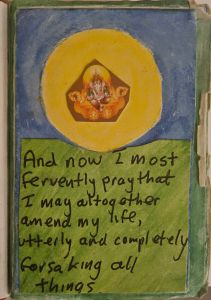
But what about me? Well, this prayer says it all In order to achieve a state in which I can actually be silent, I am attempting to amend my life – utterly and completely. I can be quite self-critical on this, badgering myself with desperate questions how come I can’t just be silent (and quiet in the accepted sense of the word as well). It’s a dilemma which frustrates and disappoints me. But, to be a little fair to myself, I suspect I’m not very different to most other people when it comes to silence. After all, if it was so easy, how come we need thousands of books, articles, YouTubes on how it’s done?
As mentioned, the absence of noise isn’t necessarily a prerequisite to achieving silence. But, I have to say, that for me, it’s pretty important. Being surrounded by the noise of the world, as well as my own hyperactive mind and seesawing emotions, are for me blocks to silence. Though, when I think about it, there are glimpses, even when one of our temporary hermitages is on a busy street, or under an airport flightpath.
As a bottom-line starting point, I don’t watch or read news; I don’t (anymore) randomly scroll the Internet even when ‘looking for something to watch’ on YouTube. And of course I don’t use television. Ever.
I’m not saying that when I do watch a video online that it’s always only spiritual or holy stuff. Nor do I only read books about saints and spiritual matters. Mind you, I would say more and more lately I’ve been tending in that direction. It’s just happening naturally I think.
A reason for that progression is effects of the amount of time I spend meditating, chanting mantra, and ‘just sitting’. Never enough time spent, but I’m getting there.
In all these three activities there is of course always lot of mental noise trying to mess things up. Not to mention the dreaded external noises. But, even then, there are gaps, spaces between breaths, pauses between repetitions of the mantra, and even when just sitting there are (if my mind has mercy on me) little moments free of thoughts, fleeting gifts of silence.
I think most of us have a tendency to focus on the problem of noise and disturbance, both external and internal, and ignore those fleeting little moments of silence.
With the momentary absence of thoughts it’s like when we ‘get lost in a beautiful piece of music’ as my teacher says. We’re still there, we can still hear, it’s just that we – as in our ego in one of its many and varied forms, our mind – is absent. And that means there is silence. Then we are in that legendary blissful state of being one with the music (or whatever the activity we are ‘lost in’).
Because our thinking mind seems to be absent (no thought equals no mind), there is nothing to judge whether there is silence or not. Just as when we are in deep sleep, as opposed to the dreaming state, there is silence, the absence of thought; no ego dialogues; all is silence. That’s why often don’t realise we have achieved that silent state: no mind to record the experience, so when we do resume thinking, we assume we’ve not stopped thinking at all.
Despite these many years of meditating, chanting, and sitting, I seem to still expect something spectacular to occur. Some blissful state, some revelation of enlightenment, or some other magical happening, maybe visions or some genius idea or something. It’s not a rational expectation of course, but …
Yes. It’s still hard to let go of the search for some kind of ‘signal’ buried under all the ‘noise’. Lately, however, I’m slowly coming to realise that looking for signal is really my ego/mind looking outside in the world for some kind of experience of silence. But to belabour the obvious, silence is silence; what’s to experience?
That doesn’t mean that there’s nothing. Nor that it’s some kind of void, just emptiness and ‘nothingness’. Silence is the space in which the seeds or knowledge are able to take root before they can become manifest in our material world.
It’s just that we might not notice untill sometime later when we see or sense a change in our thinking, our behaviour, or how we feel about the people, places, things, and circumstances of our lives.
See you next post when we look at the final of the three injunctions given to our friend Arsenius, Pray Always.
Thank you and may you realise the silence that already is present within you.
Last night I had a dream. Of course there’s nothing unusual in that: I dream every night, every time I sleep (and sometimes when I’m supposed to be meditating as well). Actually I’m no different than probably every other living being in the Universe: I dream when I sleep.
No. The particular dream isn’t my point here (though we’ll be discussing it soon enough). What makes it worth noting is the fact that last evening, before going to bed, I watched a documentary on Carl Jung and The Red Book.
Jung compiled The Red Book at a time of personal crisis and distress. Using dream analysis, his own imagination, and intense self reflection, he used both paintings and text to express what he saw and understood from these practices. Hauntingly beautiful, other worldly pictures depicting dream images, archetypes, both personal and universal, helped him delve deeply into his unconscious mind and the collective unconscious.
I gave up trying to interpret dreams a long long time ago. Don’t ask me why: I probably couldn’t say. Most likely something to do with a kind of wariness about going too much into where the mind wants to take me, and my sense that the “dream” doesn’t stop when we wake up.
Still, watching this doco prompted a lot of discussion with my partner hermit, and a lot of thinking on my part. The mind is not our enemy, though sometimes I feel that it is. Well, it can be the enemy if we allow it, but equally we can allow the mind to be our friend. After all, what activity of any kind is possible in the world without mind?
So, with that in mind (get it? in mind?) I will share with you that above mentioned dream from last night.
In the dream I was in a small kitchen, making tea. I’d put on a kettle to boil. A very large, heavy kettle, probably three or four times the size of a normal one. I was in the process of looking for a mug or cup, and just as I picked one up that I liked the look of, a crowd of five or six people came bustling noisily into this very crowded space.
‘I’ve just put the kettle on,’ I called loudly over the din. As it happened I’d filled the kettle almost to overflowing, much more than I needed for myself alone.
‘There’s plenty of boiling water to go round.’
Then I busied myself looking for something (a tea bag perhaps?), and when I finally turned back to the kettle to make my tea, I saw it was gone. I was very unhappy with this disappearance: After all, I was the one who had filled the kettle and put it on to boil. Then without a thought or a, what’s the expression? without a by your leave, it’s all gone, nothing left for me. Not only no more water, but nothing to boil more with.
I looked everywhere, even outside the kitchen. Outside was a camp ground and apartment complex, where I (and presumably all the other people) was staying.
Anyway, that’s it. All I remember at least. So, the meaning? Was I merely processing trivial facts and events from my day in this strange fashion? Or was I in touch with the deepest part of my psyche and with the collective unconscious? Possibly a bit of both.
It’s not a big job to make a guess about the meaning. I had a plentiful supply of water (or whatever), and without thought, put the needs of others before my own. But then, I actively resented what had been ‘taken from me’, even though I had freely given it in the first place.
So, the message I take from this dream? Just as I’ve been studying lately, the fruits of my actions are not my responsibility. I have no say over what, if anything, will happen as a result of actions I take. All I am responsible for is the taking of the action itself, the manner in which I undertake it, and the attitude with which I approach the actions I take. That’s it. That’s all I can do. The rest is up to the laws of the universe. Call it Karma, or Natural Law.
Another idea just occured to me: When I take action (like boiling the kettle) and then serve others, I am serving Self, all life, everyone and everything. And obviously that includes me. I’m not suggesting I should have made sure ahead of time that I’d ‘reserved’ enough water for myself, but at the same time …
I might keep this dream analysis thing as practice to practise occasionally, when the inclination or inspiration is there. No more blocking memories of dreams, no more stubborn refusal to reflect on dreams. After all, I spend a lot of time contemplating and reflecting on what I do in my waking life, how is it any different just because it happens while I’m asleep?
Greetings friends. I welcome you from my new hermitage in desert country.
You know, it’s an old idea, a cliché even, to say that we, all of us, are on a pilgrimage called life, a Hero’s Journey as it’s called by the Mythologists. And, on any such journey there is what those same scholars call a Call to Adventure.
They are the times when we are challenged by life to commit to an action that will stretch us somehow, take us out of our comfort zone, change our life; to make a move; take a risk; embark on a journey either internally or out in the physical world.
So, when I tell you I got a call to come out here to the desert, and that I answered it, why the necessity to add ‘eventually’? What happened to delay that journey? Well, that’s what our Mythologist friends call The Refusal of the Call.
They’re the times when, once we’ve heard the call, and when we’ve felt its rightness, we still say no. Not now. And we come up with all kinds of perfectly reasonable explanations for our refusal.
In my case, I said, hey, it’s fine here; I’m near the beach; I really have no reason to move; there are plenty of ‘other places’ to check out first. The excuses went on and on.
All along though, there was this place, this country, calling. Of course ‘the desert’ isn’t always or for everybody the literal sand covered land, that gets very hot, and is generally thought of as barren and even hostile. It can also be a metaphor for any place – or no place in particular – that is a place of retreat, a quiet place, a place for living apart from the mainstream of human life.
For some people inclined to a life of contemplation and solitude, this place might be a small hut in a forest or a wood, or a camp on a remote beach on an even more remote island. Then there are others who are called to an actual cave high in the mountains, or on the banks of some sacred river somewhere.
And, equally, the desert, the place of retreat, quiet, solitude, and living apart, may well be an apartment or house in a suburb, or even in the centre, of a big city.
Then there’s me: called to this desert town of Broken Hill, almost but not quite in the centre of the continent of Australia. It is deep in the arid zone: it’s very far out back here in the Outback, 1500 kilometres inland from the east coast to be precise.
Yes, well this is all well and good, but shouldn’t I be answering my own question: why eventually? Well, we’ve covered the excuses, but really isn’t that just plain old procrastination? Yes indeed. If we get back to our Mythologist friends once more, we learn there is a stage in this Hero’s Journey that follows on from the Refusal: The Supernatural Act.
These are the times when things happen that seem to come at us out of the blue, from no rational, logical, or explainable source. Something that we might find hard to beleive at first because it’s way out there; supernatural like it says.
But that supernatural bit doesn’t have to take a spooky form, it might be that the ‘supernatural act’ is an internal insight or realisation triggered by a perfectly natural occurance. That’s what happened for me. What was this non-spooky, natural event that prompted such internal insights and realisations in me and got me moving?
Rain. Yes, rain. It rained almost every day for over six months. I am very very blessed that I wasn’t affected by flooding as so many in nearby area were, and I am thankful for that. But it’s safe to say that rain, mud, no sun, and limited or no access to the outside for days or weeks at a time, soured my romance with the coastal lifestyle.
You could say that through the sound of rain on the roof, I could still hear the call of the desert. In fact it got so loud that, eventually, I could no longer ignore it.
So, eventually, I answered the call, and here I am. Here is a small miner’s cottage and my new hermitage, my new safe haven by the side of the road. The cottage is situated in a mining town that sprung up in the 1880s. So this cottage has been home to miners and their families for generations, including the current owners.
In a sense it’s quite likely that I am the first occupant who hasn’t been or isn’t a miner. Though you might say that my excavations, rather than being in the dark underworld beneath the surface of Mother Earth, are taking place in the equally dark, hidden interior places of Self. A mining of another sort you might say.
Before flying out here, I was thinking about what was actually calling me to the desert (putting aside the rain for a moment). After all, I lived in a small cabin in a park like setting literally five minutes walk to a pristine Pacific Coast beach; I had trees and forest like spaces all round, as well as a small river two minutes walk. And that’s not even thinking about the abundance of wildlife.
And it occured to me that it is the stillness of the desert that was calling to me. This town of Broken Hill is a mid size town (actually a small city with about 15000 people), with the usual shops, cars, people, and the rest.
Yet there is a stillness. No longer can I hear the constant sound of seawaves crashing. No longer can I sense the never stopping coming in and going out of sea tides. And out here, it seems like even the people are moving quite a bit slower too. I’ve yet to see a single person rushing about. And they seem to smile a lot as well.
The street I live on is extremely quiet, and even on the so-called ‘busy streets’ there isn’t the mad acceleration and braking we’d see everywhere on the coast. Of course there is the odd driver who thinks every car is a racecar, but where don’t you get that?
But, actually it’s more than this. There is, beyond the actual literal quietness, a silence that seems to exist as an entity or state of being in its own right.
A stillness that is a solid thing, just as on the coast there was (is I suppose) a constant frenetic atmosphere that seemed to overlay everything. People rushing – on foot or in cars – even when there seems to be no reason for hurry (though of course you can never tell can you?). And not so many smiles either.
Contemplative people, those seeking solitude, and peace and quiet in which to pray, to live slowily, and to explore the divine, have been drawn or called to deserts (in all its forms) for thousands of years or longer. And I am fortunate enough to have finally (eventually) heeded the call myself.
Here, away from the incessant acceleration and braking (I do like this expresion), and in that stillness that envelops this land, perhaps I can dig a little deeper, uncover a bit of quiet, and discover a piece of solitude.
Out here, in the Outback, life can be harsh for all living beings, often dangerous in its aridity and isolation. It’s a long way from major cities, food and supply chains are extended to extreme limits, and the human hold on the land is precarious at best.
Yet, the paradox exists: out here far from the fertile coasts, the soft sandy beaches, the major urban centres where the mainstream of (human) life goes on, there is a quiet, a peace, a stillness that seems to pervade the very air one breathes.
A wise person wrote something short and sweet that sums all this up for me:
Remember in my last post I mentioned that I like to ‘Let the noble thoughts come to me from all corners of the universe’? Well I’ve been exploring, investigating, studying, in one of those corners for a few years now.
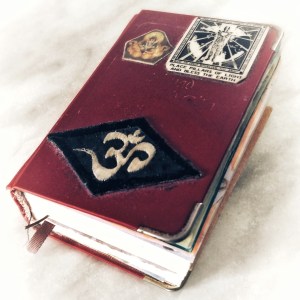
In 2016, in India, I gifted myself a small copy of the Bhagavad Gita. It’s a little red book, my Gita; no commentaries, just a plain, simple, and easy to understand translation of the 5000-year-old text known as the ‘Song of God’
Of course there are many sources of divine wisdom. No. That’s not right. Start again. Everything is a source of divine wisdom, of the word of God, universal knowledge, Truth, the Dharma. We can call it what we like.
But every living thing – human and non-human – every experience we have, and the entirety of the material and non-matieral creation, is divine wisdom in action.
Speaking for myself, I don’t always remember or realise (as in believe, trust, know) this never-ending, inexhaustible supply of wisdom. So I have to make use of some physical forms that help me narrow my focus, to centre my attention. It happens that the Bhagavad Gita is for me, one of those physical forms.
So today I want to talk about a verse from the Gita that really leapt out at me when I opened the book at random yesterday. That verse comes from a chapter titled Self Knowledge and Enlightenment. It’s where Krishna – representing our Higher Self, Divine Wisdom; the real us, the real me – is telling Arjuna – the ego self, or little self, the us that thinks ‘this is me’, ‘puny, small, little me, just a sack of bones’ – all the various attributes and qualities of the Higher Self, the real us.
In other words, our Higher Self is helping our lower self to realise what we really are, trying to get us to see that there is a lot more to us than meets the (physical) eye.
Anyway, to the verse:
Of the strong, I am strength devoid of desire and passion, and I am love that is virtuous.
Bhagavad Gita Ch 7 verse 11
My sense is that the entire Bhagavad Gita is designed to help rid us of our attachments to the dualities of the world. Of course material life is obviously a state of dualities: we like good things, don’t like bad things; sometimes we’re happy, sometimes full of sorrow; we might at one time have many material possessions, then at another have nothing. You know where I’m going here; after all you dwell in the same world as I do!
Naturally none of us want bad things to happen, so we try to develop ways to be strong, to gather strength so we can face the bad stuff when it (inevitably) happens. And there’s nothing wrong with being strong, nothing amiss about having strength, but here Krishna (Higher Self) says that we don’t need to desire to get strength: we already are strength. Remember: Krishna is our Higher Self, so if Krishna is strength then that means we all are.
The desire and passion he talks about is really our attachment to outcomes, to expectations, to labelling things good or bad, or this or that, or wanting to feel this emotion but not that one. In other words, we are strength without any of these attachments;
So, when those inevitable ‘bad things’ happen, we already have the ability to flow with them, to cope with them, without judgements, without fear. Equally, when the inevitable ‘good things’ happen, we can rejoice, but we are strength, so there’s no need to hang onto them, wishing them to keep on happening, or being fearful of them changing.
You know there is an expression I used to loathe: It’s all good. It’s one of those non-commital, bland platitudes that really doesn’t mean anything. Well I don’t hate it quite as much as I used to but I still have trouble with it. Maybe we can take it a bit further?
Perhaps we could say instead: It all is. No good or bad; no joy or sorrow; no dualities of any kind. Sounds like heaven doesn’t it?
Well, while we’re in physical bodies here on Earth (and who can say what kind of bodies if any we’ll get to inhabit in the future), then the most that can ever happen is a glimpse – or maybe a few glimpses – of isness. Moments when we actually stop labelling, stop seeing dualities, and really and truly can know, it all is. For real.
And the love bit? Well, here we have Krishna (our Higher Self) saying he is love. He means us. He’s actually telling us that we are love. And virtuous love at that. Mind you, is there any other kind?
Perhaps shameful is too strong a word, but that’s kind of how it feels. You see, I’ve been thinking of giving up on the book I’m reading at the moment. And you are thinking, this is a big deal? If you don’t like it, put it aside and try something else.
Yes, excellent advice, thank you. And usually that’s what I would do. In fact now I think about it there was a time when I would force myself to complete a book, even if I wasn’t enjoying it or was bored with it. But I learned a long time ago that this is a waste of time, waste of mind, waste of energy, and unfair to me.
Yet, on this occasion, I started to have some thoughts that took it a bit deeper. It’s true to say that I’m a bit bored with this book; it’s as if I’m not overly interested in the story the author is telling, and in the way she’s telling it. As well I had this feeling that the book was ‘ordinary’: meaning that it was a kind of day to day telling of a segment of a life with its mundane and routine elements included along with the ‘good bits’.
And it was that feeling of being not so interested that got me thinking. The author’s vocation, thinking, activities, and the subject of the book itself, is exactly in line with areas I am very interested in reading about, not only for entertainment but for my learning, for my own spiritual journey and way of life.
The way she’s telling it? Now, this one got to me even more. The book was put together after the author’s death and is made up of extracts from the author’s journals and from the many letters she wrote to family and friends during the period of her life the book covers.
That’s what I do isn’t it? Keep a journal? Write letters? These and the many many blog posts (which in a way are a lot like letters, and even journal entries do you think?) I’ve written over many years, and the journal I’ve been keeping for most of my life, are the core of at least the personal writing I have done over my lifetime. By rejecting this book I started to feel that I was rejecting my own, for want of a better word, genres.
Or, worse than that, I’m rejecting the invitation to share a life. And illogically I’m rejecting the life story and insights of a person whose own experience I actually value for my own quest and from whom I could learn a great deal.
And what about the feeling of boredom and that the book was too ‘ordinary’ and mundane? Well, to borrow a well-worn phrase, this really does take the cake. I mean if you were to look at much of my past writings and look at my photography blogs from times past, you would see that one of my main statements of belief was:
There are no ordinary moments, nor are there any ordinary people.
And I still believe this. Indeed, spiritual practice and study has only deepened my instincts that all there is is the moment; all there is is all the beings of the world experiencing that ongoing presence, that never-ending moment. There can be nothing in the least ordinary about that.
I’ve saved the best – or is it the worst? – for last: what the book is about. It tells the story of a three year period in the life of a person just out of university who looking for a deeper meaning to life and to finding a true course for her life, travels from her home to Japan and enters a Zen monastery to become a monk.
Her journals and letters give the reader an intimate and in-depth account of her experiences: what she learned; insights into the language, culture, and history of Japan and Zen itself; the people she met and knew, her own feelings and reactions to what was a huge shift in her life.
After three years the author left the monastery to travel slowly back to see family at home. Sadly she was killed in a bus crash along the way.
Pretty much everything that has to do with living a life. And here’s me rejecting it because it was ‘ordinary’ and some details were ‘boring’.
So, I’m going to stay with this book. It’s taught me a lot already, and I think there is more there for me. Perhaps, I can better put into practice by own so strongly held idea that there are no ordinary moments or ordinary people.
A few weeks ago I finished one of the most extraordinary books I have ever read. Yes, I know: we live in the days of hype and the redundant superlative. Everything is the best, biggest, greatest. Or, conversely, the worst, most tragic, saddest; it goes on and on.
In this case however I am not exaggerating. This book was amazing. It’s Learning from Henry Nouwen and Vincent Van Gogh: A portrait of a compassionate Life, by Carol A. Berry. From this book I’ve learned as much and more about Van Gogh’s motivations, his vision, his art, and yes, his very nature and soul, than in everything I’ve read, seen or heard about Vincent until now put together. And that includes from several visits to the magnificent Van Gogh museum in Amsterdam.
The book had its genesis in a course the author sat in on in the 1970s put on by Henry Nouwen for Theology students. The course aimed at helping future ministers and pastors learn to connect with their future parishioners. Basically it was about accessing the compassionate sides of their own natures so they might better help others. Nouwen used Van Gogh as a the model of a person who had lived a life built on compassion for others.
The author has mined Vincent’s letters (mostly to his brother Theo) and studied deeply his paintings and drawings, in order to understand and demonstrate what it means to live a life of compassion, and to highlight the artist’s mission in life. For me that mission is summed up very nicely in a quote from one of Van Gogh’s letters:
Art is to console those who are broken by life.
Vincent Van Gogh to his brother Theo
I had a vague sense of Vincent’s spiritual leanings (I knew he’d been a missionary living among poor miners and their families to better understand and help them), and he’d tried to become a preacher. But, before finding this book my thinking hadn’t gone much deeper than that.
But, through reading this book I discovered Vincent was really what many of us might call a mystic. The author goes further and after what i’ve learned, I tend to agree with her: she thinks Van Gogh is a saint.
A mystic in the sense that he tried to live a holy and compassionate life. He viewed all nature (of which he concluded humans are simply one equal part) as being expressions of the divine. And a saint in that he dedicated his life to making art that would inject light and colour into the darkness of people’s lives.
As I mentioned, Vincent had been a missionary for a time. But his radical way of living among the poor and sharing their lives in order to know and love them better was shocking and way too extreme for his bosses, and he had to move on.
So, he finally settled on full-on immersion in his art. His mission was to make paintings that offered comfort and consolation to those who are suffering. And that’s all of us to one degree or another isn’t it?
You can see by now that this supremely accessible (and pleasurable to read) work has had a profound impact on me. This book isn’t only for artists, nor is it a religious book; it is as I have said an inspiration and guide to living a compassionate and loving life.
I don’t want to just say ‘I can’t recommend highly enough that you read this book’; I want to say instead Please, please read this book. Then obviously act on what you have read!
I’ve always admired – loved – Vincent, now I think I know why. Or as Don McLean says in one of the most profound love songs (Vincent) in history (remember, I never exaggerate):
Now, I understand, what you tried to say to me How you suffered for your sanity How you tried to set them free They would not listen, they did not know how Perhaps they’ll listen now























 Notes from the Hermit's Cave