‘I’ll carry on with my Gita then,’ I said to my partner hermit after we’d been discussing something for a while.
‘I’m enjoying reading my prayers this morning. So I’ll read a few more then read a few verses’ (of the Bhagavad Gita).
‘Reading’ my prayers? Is that what I’m doing? Surely a prayer – prayers – are for praying? Anyway, not simply for ‘reading’.
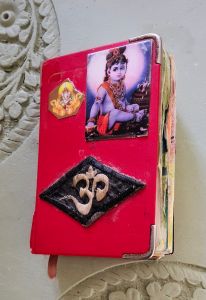
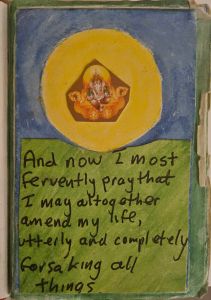
Of course in this particular instance, the forms the prayers are taking – on the most superficial, worldly, material level – are as words written by human hand (mine) on paper pages in a little book.
But, right now, the big question, the existential question really, is have I been merely reading those prayers? Or have I been praying those prayers?
Then there’s another, equally existential, concern that arises: How to know the difference. Reading? Or praying?
I feel like saying that the first thought that comes to mind – the first answer to reach the tip of my pen on this page – is this: Actually, the answer has come in the form of a rhetorical question:
If a prayer is prayed, how would it ever even occur to me query if it is in fact a prayer, and not just words on a page to be read?
Yes, first thought best thought here I think. When a prayer is prayed, even if its form is words written on a page, there is a movement beyond those words on the page. In fact, there is a transcendence of all that is of the material world that takes place.
A prayer is what it’s always been: a prayer. The forms prayers take are, I think, literally endless, uncountable, and can never be submitted to categorisation by us humans.
Prayer is for praying, that’s the lesson for me. Just pray.
Among the physical exercises I try to perform on a daily basis, are a couple for strengthening the hips. One of these begins with me standing upright, feet together, eyes level, looking ahead.
Then I swing one leg at a time for ten repetitions in a kind of arc like motion out to side, keeping it level with the side of my body, bringing the leg back to the rest position with feet together. It’s a pendulum motion.
Anyway I’d been merrily going along doing these exercises more or less every day for ages, months really, until one day my partner hermit was watching me, and said:
‘You’re supposed to be doing it slowly and mindfully’. Or words to that effect.
You see I had been quite happy swinging each leg out in turn at a fast pace, kind of like an aerobic sort of thing. Just to get it done if I’m honest. Wrong! Supposed to be slowly and mindfully.
Lift one leg slowly in an arc like motion out to the side of the body. Pay attention to the movement as it’s happening; no need to push the leg out, just lift it to a comfortable position. Just let the arm trail loosely and of its own accord, along with the leg. Then, again slowly and paying attention to the process of the movement, bring the leg back.
And I do have to say there’s been an amazing difference. I can actually feel the muscles working during the exercise, and can sense the minute incremental motion as the leg swings slowly. It’s a way better exercise than it was, and now I wouldn’t do it any other way.
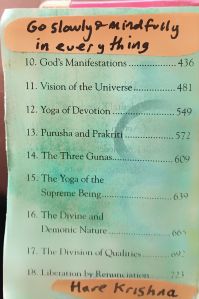
I was reminded of this incident this morning as I came across a short admonition, a little reminder to myself I have stuck on a Table of Contents page in my Bhagavad Gita.
Go slowly and mindfully in everything
What’s interesting is that, despite seeing and reading this so-called reminder more or less every day, and despite proofs of the benefits of actually listening to the reminder, such as what I’ve just described with the exercise , the reminder seems to mostly go right over my head, in one ear and out the other as they say.
Today, for some mysterious reason, it actually got my attention. At the same time, again who knows why, it triggered a truly relevant and appropriate memory to act as a kind of metaphor to illustrate the point to me.
I suppose it’s stating the obvious, but I can say that doing that (or any) exercise slowly and mindfully – in a watchful and observant manner – acts as an exercise in presence. Otherwise I’d not be sensing or feeling the muscles and the movement, or the peace of no random thoughts.
Did I mention that, having corrected my modus operandi with that particular exercise , I’m feeling the benefits? It definitely feels like things with legs and hips are loosening up, getting stronger. I’m actually walking further now without my legs aching on me.
More than that, I actually find myself wanting to do the exercise as opposed to ‘wanting to get it done’. Why is this? Well, I think it’s because I’m yearning to rediscover that feeling of presence; it’s a bit like a meditation, and in the same way clears the mind of random thoughts – at least for the short duration of the exercise. Having said that, even a short duration clarity plays its part in reconditioning a stubborn mind.
So, mental clarity, good exercise for the body, for the heart, even the soul?I think it’s the perfect metaphor for how I aspire to be living my life.
Welcome to another poetic sharing post. There have been a few lately haven’t there? I had thought that once I had the new page Poems of Devotion up and running that I would only feature one every now and again in its own post.
However the one I feel inclined to share with you today is slightly different. Well, not really: it’s still a devotional piece, but for some reason feels a little other than that.
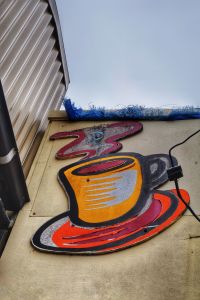
This hermit’s choice: the number 1 coffee shops in the Hermitage neighbourhood
For a start, it’s set in a café and features the thoughts of a hermit monk (me), and is about what’s going on in that space at that moment. As well as what’s in his mind and heart. Oh yes, almost forgot: the action takes place on Election Day.
So, what is it that makes me feel this poem is ‘still devotional but slightly other’? Well, aside from the setting, timing, and so on I just described, I sense that, in its words, in its composition, the hermit has sought to record (through the poem) that moment in the café as the reaching out to all those fellow beings sharing the space, to recognise, and to celebrate the divine in them all.
May that intention shine through to you too, dear reader
THE HERMITS HAVE COFFEE ON ELECTION DAY
I feel like I’m sitting in a Hopper painting. Just off the village green at a coffee shop, in the Toukley Mall.
There are people; aren’t there always? Coming and going. This one catching gossip; that one seeking connection; One or two heads down, backs bent over newspapers assimilating myriad tales of woe. It’s election day.
Of little interest to the hermits, out of the hermitage for coffee. A treat that comes at a cost.
Voices – of people and of headlines – speak, some even shout, of worldly things. To us not real.
Leaves me hollow. That’s the vibe, the feeling inside – And that’s not real either.
It was way back in the earlier days of this blog, sometime in 2022, that I wrote a post about our community’s liking for snacking on plain toast by choice. It’s our more or less regular late evening, before bed, bite to eat. Perhaps accompanied by black tea, as I described in that post.
As I also point out in that post, I do actually enjoy plain toast. It’s not that I no longer like jam or other yummy spreads; I like them too well truth be told, but sometimes, well, plain is good.
As the day winds down to become night, and we settle to our evening snack, I will sometimes make a joke about simple food, or monks with simple tastes, whatever. Anyway, a few nights ago I made a remark, a joke, that has had a profound impact on me.
‘I’ll just say a prayer for my two slices of dry toast.’
Of course I am just like so many other religious or spiritually inclined people, and say a prayer before I receive any and all food or drink. It’s a long time habit, and a blessing I like to perform. Just a thank you is all it is really.
This comment, this joke, as soon as it was out of my mouth, I realised, of course I will. Don’t I always?
It’s true that our community lives simply, as simply as we can. And that includes what we eat and drink. It’s also true that this is not some sort of ethical stance consciously taken; nor is it a kind of overlaid act of solidarity with those who have no choices due to poverty or other circumstances.
It’s purely and simple because we like simple. It really does suit our natures and temperaments and for us it is the obvious way to live.
It is no renunciation: we welcome simple. This obviously is not to say that we are unaware that our very natures and temperaments naturally steer us away from choices that are unethical or are out of sync with compassion (call it solidarity) for other beings.
The reason I’m ranting on about this off-hand comment thrown out as a so-called joke is, well just that: It was off-hand, and my misguided intention in making this ‘joke’ was insensitive and careless; it was lacking compassion for all the other living beings sharing life and consciousness with me.
And for that flippancy and carelessness, I ask forgiveness from the invisible community that is in fact all of us struggling to live in a material world.
My sense is that in saying ‘all of us’ I might instead say, all of us who are in truth One; We who are that one Self that seeks forgiveness.
Anyone who has tried to meditate for more than a minute, knows very well that the mind right away jumps into overdrive, trying its hardest to keep us nice and distracted; anything but quiet and peace is the mind’s aim. Speaking for myself, all I want to do is get rid of that mind altogether.
But, I know, that would be a mistake. I may not like how my mind behaves sometimes, but I do actually quite like having one, a mind that is. I guess, for me, it’s about realising that my mind is here to stay, and can be either my friend or my foe.
Trouble is, when trying to meditate, I can easily believe it’s my worst enemy. Another mistake, I think, that arises from a not so discerning attitude to the thoughts that flood in seemingly at random.
But, sometimes in that quiet and still space – and even if that quiet and peaceful space hasn’t yet been reached – a thought comes from the mind friend, not the foe. It seems I must learn discernment. Here’s a good example.
Not long into my meditation earlier today, but already bombarded with random thoughts, memories, and other distractions to said peace and quiet, an idea came that just caught my attention. Suddenly, there seemed to be a full-blown idea for what sounded like a great blog post.
I din’t have this notebook with me, and though I had my phone handy, I thought, no, be firm, don’t let interruptions in. Of course, I thought that I’d remember the idea, but sure enough, I didn’t. Now, it’s nowhere to be found. I mean it must be in some tiny neuron in my brain, but it’s hiding pretty well!
Later, after my meditation session, I thought to myself, how come I could make a list of all the less than useful thoughts, memories, ideas and random mental craziness that tried its best to keep me distracted, yet I have no idea what that one wonderful blog post idea was?
I think it might possibly be about attachment; a lesson I’m giving myself in discerning between what thoughts are from my friend mind which ones from my foe mind, the mind running wild with its accomplice, my ego.
It’s a lesson I badly need, I think. Endless thoughts of little or no use to me have stayed, while the one that might have been helpful is gone, seemingly forever.
Yes indeed. Perhaps ny perspective on what ideas ad thoughts are useful to me and what ones aren’t, needs to be contemplated upon.
Actually, it’s not really needing a lot of contemplation: I mean, the one idea I thought would be great is gone. But looking at it the other way around, the fact that the great pile of not so good thoughts staying with me has given us this post I am now writing, and you are reading.
Perspective. It’s all about perspective. And discernment.
You know, for all my prayers; for all my mental discipline – efforts at mental discipline – for all my meditations, chanting, and other practices, I still just talk way too much for my liking, and often it feels like it’s only talking for the sake of talking.
I still just open my mouth and let come out any old thing that keeps the noise going. Oh, it’s worse than that: sometimes when I talk it’s rambling and waffling that I cleverly (or not so cleverly) disguise as intelligent, rational, and based logically on knowledge that I either have or haven’t got. Either way, I somehow seem to think I’m offering words of well thought out wisdom.
Whereas, as I said, the noise I make is so often rambling, contradictory , ill-informed, thoughtless waffle.
Enough! Blimey, that’s enough. Talk about opening a post on a calm, relaxed, optimistic, and compassionate note.
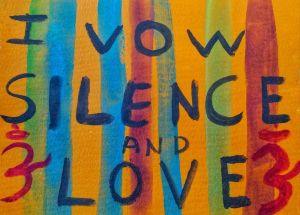
Here’s the thing: I want to devote my entire life to devotion and prayer. And that requires at least some silence. Yet, instead, I merely talk about the joys of silence, about the joys of full-on devotion to the divine, and as well I occupy so much time and energy to just voicing random thoughts that come and go, go and come, without rhyme, without reason.
Okay, here’s the second thing: I long with my deepest longing to be silent – to not simply stop talking, though that would be an excellent beginning. No, I want to be quiet; I want my vocal chords to have a break and let my true voice speak through my life, through this blog, my photographs and in whatever way I am lead.
So, what to do? Well, here’s the third thing, thing number three: all I need to do in order to both stop talking so much and be silent is to just sit. Sit and do nothing. There is no thing that I can do that will magically turn me into an oasis of silence and peaceful calm.
Sometime in the dim distant path I read someone paraphrasing The fouth Noble Truth in two words, Just sit. Buddha did indeed know what he was talking about. And I do get the irony: when I talk, I need to say something that helps, not just make noise and try to avoid silence.
Walking home, returning to the sanctuary of the hermitage, I fell over. Or to be exact, I tripped.
It’s not the first time I’ve tripped in my life, and I’m sure it won’t be the last. Mind you, I’m not supposed to be making speculations about the future; after all, I may never fall over (or trip) again.
Let me share with you how I came to find myself lying on the ground, fully conscious thankfully, with only a few grazes on arms and knees, and a sore spot on the side of my head.
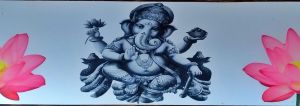
Walking along the sidewalk quite freely, earbuds feeding my ears and my heart my favourite mantra to Ganesha – known as the remover of obstacles and the God of wisdom. (more on the earbud issue later)
At one point I noticed, a few metres ahead, what appeared to be the back of a largish sign board leaning against the base of an electricity pole growing out of the pavement.
Not the actual sidewalk
Without any thought whatsoever, as I came up to that pole, I turned my head to the left to see what the sign read. Next thing I know, is I have the sense of falling. Later I remembered that at the exact moment I turned my head, my foot caught the broken and uneven edge of a slab of the pavement.
I was blessed by two passersby who stopped and helped me back to my feet, and stayed with me as I regained some semblance of my bearings. Thank you to those two good and kind ones.
Now, I don’t like falling over (well, when you think about it, who does?), but in this case I can say through this fall, I have learned a couple of good lessons.
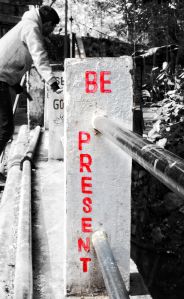
Presence – or lack thereof. Here I am, the hermit monk who is supposedly constantly practising being present, in the moment, here and now; yet I tripped over what I later discovered was a really obvious, clear obstacle on my path.
We all get distracted, you might be thinking. And, yes, it’s true. We can be paying close attention, fully focused, riveted to and in the moment, and, suddenly distraction barges in – in the form of a thought, an external noise, visual imput, and even a broken pavement. You name it, and mind will use any excuse it can to manifest a distraction.
Another lessen – intimately related to presence – is pausing, or not! As I noticed that sign coming up, I could have chosen to pause to look at it once I reached it.
Then, rather than being a distraction, looking at that sign would have simply been another moment in the ongoing flow of the present. In other words, there’d have been no tripping.
The actual earbuds in question
Now, to the earbud issue. To be honest, my earbuds have more or less replaced my regular over the ears headphones. Because I was never comfortable going out and about with those clunky things on my head and earbuds have allowed me to listen to music pretty much whenever and wherever I go. Even to me wearing them, they are barely noticeable. It’s possible that’s the problem right there: unnoticeable.
More than 30 years ago now, I spent every Tuesday evening for a year attending classes at a school of philosophy . To this day I still follow some of the practices I learned there. And, passed to me were so many good lessons, so much good knowledge drawn from many of the world’s spiritual and intellectual traditions. So many of these lessons have stuck with me.
Presence, or rather the benefits and rewards of realizing the present is all there is, was I would say, one of the cornerstones of those teachings.
One illustration about presence concerned driving, and although at the time I haddn’t learned to drive, it resonated with me. Our teacher told us that, when she was driving, she never listened to music or anything else. She told us that she simply put her full attention on the task at hand: driving.
She described how it often happened that when driving she’d reach her destination with little or no memory of the actual act of driving or any landmarks or events on the trip itself. She said it was if she was somehow unconscious, yet still able to drive ‘on autopilot’ was how she put it.
And of course it’s not a phenomenon limited to driving: how much of our routine daily activity runs on autopilot?
Anyway, back to the other day and me grooving to Ganesh in my ears and tripping in a moment of inattention.
I don’t recall being distracted by the mantra in my head, or moving on autopilot. But, thinking back, I was in one of the busiest sections of the little town that hosts our hermitage. I’d been to the supermarket, the parking lot of which is as busy – and crazy – as one you would find in any big city.
Just another sidewalk tripper
So, I realise now, I had already kind of set myself up to fall for any distraction that happened to come along. While I don’t really remember myself as being ‘unconscious’ of my surroundings or of the path itself, clearly I wasn’t completely there, not in the here and now sense if you know what I mean. Just an after thought: who remembers ‘being unconscious? Nobody I think!
Whatever I say now, I wasn’t present; I wasn’t fully in the moment, not paying attention to either what I was doing or what was going on around me.
Since my little trip, I have vowed before my hermit community to not ever walk again in a built up and busy area wearing my earbuds.
Not only do I have a sense of danger lurking when I think of the idea of wearing them in those situations, but I also feel that it’s not exactly being present, in the here and now is it?
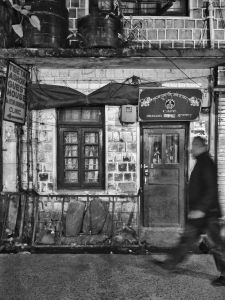
Another closed cafe on some other trip
Okay, I am very sure you are waiting with great anticipation to learn what what fateful sign, put in my way by the Universal Traffic Controller to push me into changing direction, actually said:
It was a handwritten advertisement for ‘great coffee’ to be had in a cafe across the road. A closed cafe I might add.
On Main Road – a road that more than lives up to its name – perhaps there are worse fates awaiting the inattentive than merely tripping on the sidewalk.
A poem for your reading pleasure. Written on site today in response to an experience while out walking on the dunes next to the hermitage.
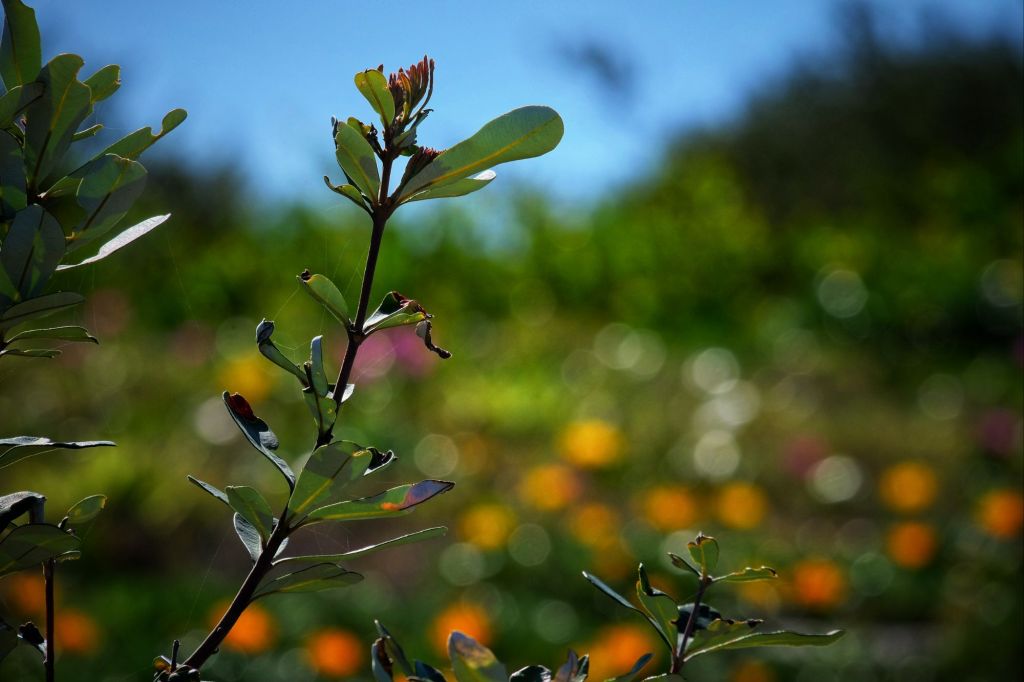
I’m including a photo I made a few weeks ago of the exact place where the poem was written,
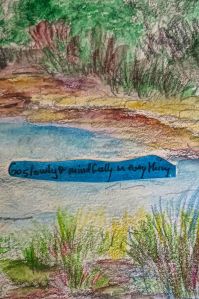
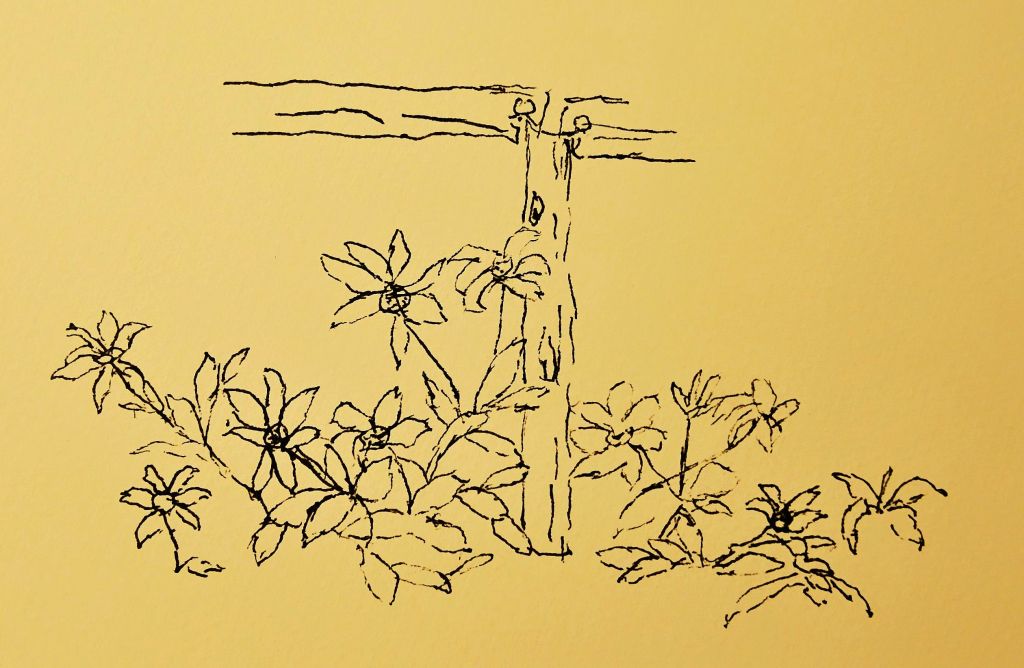
And many loving thanks to my partner hermit for the sketch made in the same area today (synchronistically it was made unknown to me and vica versa)
Please enjoy.
Love from Paul the Hermit
BRIGHT LIGHTS IN THE DUNEFIELDS
Today. On the Ocean Track. Daily hiking across the top of the dunefields. Not so sure-footed, I trudge heavy-footed.
As I pass by, there are bright lights in the dunefields. I pause in my passing as my eyes are drawn (or is it my heart?) to the bright lights in the dunefields.
I feast my senses upon the bright lights in the dunefields. They bless me, these bright lights. They sing to me; they speak to me.
In my silence, I hear them. But I hear not voices. I see them. But I see not colours, shapes or forms.
What I see, I see. I see me, I see you. They see me, the bright lights in the dunefields.
They see you; can you see them? These bright lights in the dunefields.
Welcome to the first in a short – and occasional – series centred on a text containing a kind of Q & A session between Krishna (God) and Uddhava (his cousin).
Thirty six questions in all, with which Uddhava asks Krishna how he can live a good and honest life, dedicated to doing right and living the truth.
If you haven’t already, it would be really helpful if you read the Introduction post here, before going much further; just so you have a better handle on the context, the background etc. It will just help to set the scene a little more.
Now that’s been said, let’s get on and into it. The very first question Uddhava puts to Krishna is actually two questions in one.
What is quietude and self-control
Good questions, the both of them, given the circumstances Uddhava finds himself in. His hometown (it’s Krishna’s too) is about to descend into a nasty civil war and is most likely a chaotic, noisy, overwhelming and frightening environment to be stuck in.
Uddhava, like the rest of us just wants a peaceful life, and as to the second question, well he’s bound to be asking himself the same question we’d ask: Why can’t these people just control themselves before it’s too late? Not to mention the onslaught of emotional and mental anguish he’d be suffering himself.
Anyway, Uddhava is about to leave town following his cousin’s advice, and would like to find out how he can go on to live a good, righteous and honest life, while he’s in exile from his home.
Krishna chooses (sensibly I’d say: they’re both big questions) to answer one question at a time and he begins by explaining what is quietude:
Quietude is fixing the mind on me.
Krishna is not saying here: ‘Look, once I’m gone [I think I’ve mentioned that he’s leaving too, going back to Heaven or wherever he lives on a permanent basis] try to remember your dear old cuz in the odd quiet moment now and again will you?’
What I think he is actually saying is: ‘If you fix your mind on me, then that’s quietude’. We could call it silence as well. He’s not saying ‘I am in the silence’, nor is he saying ‘Through silence (or quietude) you will come closer to me’. No, what he says is ‘Quietude is what I am’.
So, what about those of us not in a first names relationship with Krishna? Well, think of Krishna as being a name and form of Universal Consciousness. Yes, the same Universal Consciousness that is all created and non-created things; the sun, Earth herself, trees, the oceans, all living and non-living beings in the Universe, in all universes if there are more than one.
There are a whole list of synonyms for quietude: equanimity, calmness, peace of mind, rest, serenity, dispassion. Just to name a few.
These further definitions are really quite helpful. What I mean to say is that we rarely if ever associate that calmness, equanimity, peace, and the rest, with actually being the Universal Consciousness, that is also all of us and everything else that is. Again, think of Consciousness as the Divine, God, or by any other name and form, you attribute to the natural order and flow of the Universe.
Forgive the repetition : Quietude, calmness, peace of mind, are not where you will find God or consciousness, or whatever. They are all consciousness.
The beach is also dog friendly
Have I mentioned that the current hermitage is a cottage on the side of a large sand dune, on the other side of which is a stunning stretch of Pacific Coast beach. Sitting on the top of the dune and looking out over the beach and ocean it is easy to think of all that’s seen as divine.
It is most definitely a peace of mind, calm and quiet inducing experience to sit there. Certainly it is quietude itself with the only sounds being the song of the universe in the form of the waves and wind.
A question I asked myself, and I now pose to you: If what we’ve been calling Universal Consciousness is actually all that is, then why not a state of mind like quietude, calmness, balance, and the rest? Like everything else perhaps these states are simply elements of that consciousness or Absolute Reality, or oneness, or what some call God, the Divine, or … ?
In any case, I have a feeling that’s what Krishna was getting at with his answer, and what Uddhava somehow intuited with his question.
Thank you for joining me on this little pilgrimage. in the next post in this series (it could appear anytime, so stay tuned!) we will discuss Krishna’s answer to Uddhava’s second question: What is self-control?
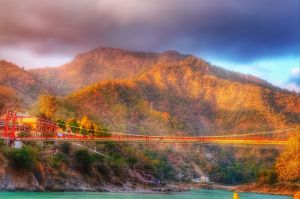
As I sauntered along the shores of the Ganges River in Rishikesh several years ago, I was given a gift.
In the High Holy Lands Where Magic Sometimes Happens
As I ambled, headed upstream in a relaxed kind of mood on that sandy riverbank, I happened to glance down. There, right at my foot I noticed a small shell. Flat with the stereotypical fan shape so many shells have, and a about a centimetre across. I picked it up.
At that moment I sensed that this little shell was a gift from the river to me. Still, I had to wonder how it got there, a seashell on the sandy banks of a freshwater river with it’s source not too far from where I stood, just a bit higher up in the Himalayas – the highest mountain range on the surface of the planet.
One possibility is that this shell originated in the sea that once existed in the lands above, where the Himalayas now stand. Mind you, I’ve only ever heard of the fossils of sea creatures being found in that region.
Another possibility suggested to me at the time, is that some other traveller having picked up the shell on a beach somewhere other on their travels, kept it with them till they arrived at this sacred place.
Then, perhaps as an offering that traveller – fellow pilgrim?- let that shell go into the waters of Maa Ganga.
Of course it doesen’t matter in the least which – if either – of these scenarios reflect what actually happened. Somehow this little shell travelled from an ocean somewhere (and somewhen!) to this precise spot on the banks of the Ganga to be discovered, to be gifted to me.
I received that offering, now a gift from the river to me, with a deep and prayerful thank you, and a sense of the sacredness of that moment and of that place.
And, today, the journey made by that little shell, has come to a kind of full circle. This morning I released it to Varuna, to the sea here on the Pacific Coast at the beach over the dunes from the hermitage.
That initial giving and receiving took place about eight years ago now and I have that little shell with me ever since.
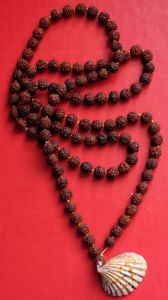
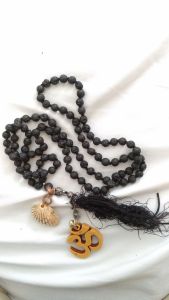
First I wore it around my neck attached to a mala (prayer beads) made of Rudraksha seeds I used for chanting mantra.
After that, it migrated to another mala – this one made of beads of black volcanic rock, perhaps very fitting given the little shell’s possibly ancient origins.
Then, one day about a year or so ago, that little shell developed a crack and then shattered into several little pieces.
Still, I treasured those remains, those fragment I kept with my other ‘holy bits and pieces’. Then, after a while, I began to get the sense that I was going to have to return this little shell to the sea from where it had come.
I knew, though, that it would have to be the right place, a place I was drawn or led to. So, time passed, we travelled to several different hermitages for about a year.
Then, two days ago, we moved here. To a cozy hermitage on the side of a sand dune, just across a bridge from and on the outskirts of a little seaside town on the Pacific Coast of Australia.
It’s one of those spots where the elevation, distance, and whatever else by nature’s arrangement, all combine in just the right way to allow a vast view that takes the eyes to the curve of Earth herself; the horizon isn’t flat here, it’s a sweeping giant curve. Add to this the equally dramatic view offered by the dome of the sky.
The coast is beautiful here. Not that it’s not special in so many places, but there is something here that speaks to me.
At the top of the dune just beside the hermitage there is an extremely convenient bench seat overlooking the beauty of the ocean.
And it just felt right: here is the place that seeks the return of the remains of that little shell, by now reduced to a couple of small fragments.
So, after a time sitting and contemplating at the above-mentioned convenient seat, I walked down the dune to the beach, and then to the water’s edge. In a mood of prayer, with the edge of the incoming waves lapping at my feet.
After first consigning to the water a shell native to this shore, to show the way to my little shell, I thought of the journey that little shell and I had undertaken together. Then I thought of how far and for how long that little shell had travelled so far on its own journey.
Then I returned what was left of that little shell to the sea from which it had come. And I watched it carried by the waves returning from the sands of the land to waters of the endless ocean.
PS See the Lava Rock Mala? Well, it too has changed form in recent times. It is now no longer a full length neck mala; it has evolved to become a compact and convenient pocket Mala for what you might say is ‘everyday use.
















 Notes from the Hermit's Cave