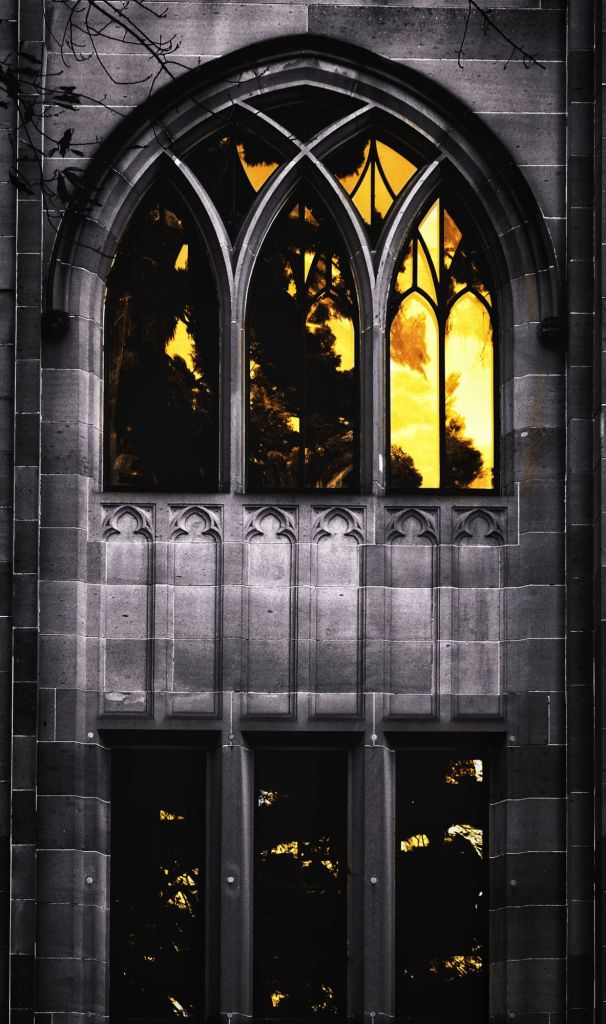
Today, a poem and a photo for you. I made the photo just over a year ago, and was very fond of it from the start. Then when I put into an editing app, it evolved to what you see today.
As well as that, as I ‘worked on’ the image, the little poem, (a kind of freestyle Haiku I think it could be called … sort of!) just emerged and I had to hurry to write it down.
Last night I was going through some poems of mine, and came across this one again. Not so much that I’d forgotten about it, more that I hadn’t thought of it since way back then.
So, I went on a search for the photo (also not forgotten, just buried deep in the hard drive!), so I could share it and the poem here with you on this blog. First the photograph:
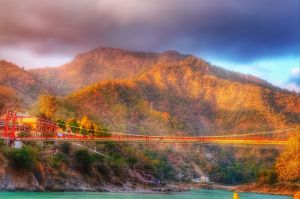
As I sauntered along the shores of the Ganges River in Rishikesh several years ago, I was given a gift.
In the High Holy Lands Where Magic Sometimes Happens
As I ambled, headed upstream in a relaxed kind of mood on that sandy riverbank, I happened to glance down. There, right at my foot I noticed a small shell. Flat with the stereotypical fan shape so many shells have, and a about a centimetre across. I picked it up.
At that moment I sensed that this little shell was a gift from the river to me. Still, I had to wonder how it got there, a seashell on the sandy banks of a freshwater river with it’s source not too far from where I stood, just a bit higher up in the Himalayas – the highest mountain range on the surface of the planet.
One possibility is that this shell originated in the sea that once existed in the lands above, where the Himalayas now stand. Mind you, I’ve only ever heard of the fossils of sea creatures being found in that region.
Another possibility suggested to me at the time, is that some other traveller having picked up the shell on a beach somewhere other on their travels, kept it with them till they arrived at this sacred place.
Then, perhaps as an offering that traveller – fellow pilgrim?- let that shell go into the waters of Maa Ganga.
Of course it doesen’t matter in the least which – if either – of these scenarios reflect what actually happened. Somehow this little shell travelled from an ocean somewhere (and somewhen!) to this precise spot on the banks of the Ganga to be discovered, to be gifted to me.
I received that offering, now a gift from the river to me, with a deep and prayerful thank you, and a sense of the sacredness of that moment and of that place.
And, today, the journey made by that little shell, has come to a kind of full circle. This morning I released it to Varuna, to the sea here on the Pacific Coast at the beach over the dunes from the hermitage.
That initial giving and receiving took place about eight years ago now and I have that little shell with me ever since.
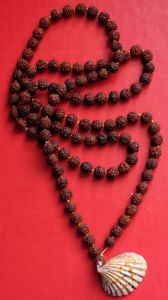
First I wore it around my neck attached to a mala (prayer beads) made of Rudraksha seeds I used for chanting mantra.
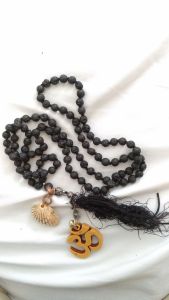
After that, it migrated to another mala – this one made of beads of black volcanic rock, perhaps very fitting given the little shell’s possibly ancient origins.
Then, one day about a year or so ago, that little shell developed a crack and then shattered into several little pieces.
Still, I treasured those remains, those fragment I kept with my other ‘holy bits and pieces’. Then, after a while, I began to get the sense that I was going to have to return this little shell to the sea from where it had come.
I knew, though, that it would have to be the right place, a place I was drawn or led to. So, time passed, we travelled to several different hermitages for about a year.
Then, two days ago, we moved here. To a cozy hermitage on the side of a sand dune, just across a bridge from and on the outskirts of a little seaside town on the Pacific Coast of Australia.
It’s one of those spots where the elevation, distance, and whatever else by nature’s arrangement, all combine in just the right way to allow a vast view that takes the eyes to the curve of Earth herself; the horizon isn’t flat here, it’s a sweeping giant curve. Add to this the equally dramatic view offered by the dome of the sky.
The coast is beautiful here. Not that it’s not special in so many places, but there is something here that speaks to me.
At the top of the dune just beside the hermitage there is an extremely convenient bench seat overlooking the beauty of the ocean.
And it just felt right: here is the place that seeks the return of the remains of that little shell, by now reduced to a couple of small fragments.
So, after a time sitting and contemplating at the above-mentioned convenient seat, I walked down the dune to the beach, and then to the water’s edge. In a mood of prayer, with the edge of the incoming waves lapping at my feet.
After first consigning to the water a shell native to this shore, to show the way to my little shell, I thought of the journey that little shell and I had undertaken together. Then I thought of how far and for how long that little shell had travelled so far on its own journey.
Then I returned what was left of that little shell to the sea from which it had come. And I watched it carried by the waves returning from the sands of the land to waters of the endless ocean.
PS See the Lava Rock Mala? Well, it too has changed form in recent times. It is now no longer a full length neck mala; it has evolved to become a compact and convenient pocket Mala for what you might say is ‘everyday use.
The first line of this post was going to read something like: I listen to a lot of music. Then just as I put fingers to keys, I thought, no I don’t. More true to say I don’t listen to anywhere as much music as I’d like.
But I do try, and I am blessed that I have quite a large and extremely diverse music collection. All digital these days (which in itself is a great blessing), but once, I had CDs, DVDs, cassettes, as well as quite a nice range of vinyl singles and LPs.
Thank you Wikipedia No glasses?
Anyway. Moving right along. Tonight, as I cooked dinner for the hermit pilgrims, I was listening to a self-titled album called Buddy Holly. I just discovered that it was his debut studio album recorded in 1958. My copy is most likely a rerelease,though unlike most of the rereleases, this one features the original track line up.
I found myself thinking about, fantasizing I could say, about what might have happened had tragedy not called a halt to Buddy’s songs and life. Who can say? Then I mentally shook myself: this kind of daydreaming and speculation is not what one might call being present in the here and now; such thinking is an outright denial of the truth of things as they are. But, remember, I’m still learning: not yet enlightened; just another sentimental human who can’t help himself or control his wayward mind.
A Studied Pose
Some would say that the album contains songs that are typical rock and roll pop songs. And yes, they would be absolutely correct. Why? Because, as you’ve probably worked out in your own life, living on this planet as a human being is a drama in itself ready made for song lyrics, movie scripts, and novel plots. It’s not a new idea!
As such the songs’ lyrics are about love and loss, hope and despair, longing, joy, sadness; you know, the normal everyday ups and downs, ins and outs of life. Not a lot you might think to interest the likes of me. But there is something, that I’m not sure I can name in Holly’s music and lyrics that strikes a chord (sorry pun not intended) for this hermit-pilgrim, aspiring to be a monk, rock and roll fan, who just loves music from wherever and whoever.
Sure, the songs being products of their times can be a little sexist (nothing compared to the twisted misogyny we sometimes hear today though): sometimes naive and simplistic. But, for me there seems to be an innocence, even a kind of purity to the lyrics. Have a look at the lyrics of Mailman Bring Me No More Blues:
Mailman, bring me no more blues Mailman, bring me no more blues One little letter is all I can use
She wrote me only one sad line Told me she’s no longer mine Mr. Mailman, that’ll do for some time
Cried like never before So hard, couldn’t cry no more Shoo, shoo, Mailman, stay away from my door
Mailman, bring me no more blues Mailman, bring me no more blues One blue letter is all I can use
By the way, those two lines in the second verse are about as sexist as any of the album’s lyrics get, not that I am suggesting we minimise in any way whatsover such a sentiment. It’s abhorrent to me.
Anyway, it is pretty clear what this song is all about: it is the pleas of our rejected hero to be left alone; he can’t handle any more bad news or heartbreak.
Actually as I’ve listened to this particular song a few times tonight, I’ve realised that it’s about attachment, about compulsions and aversions. It’s about how this guy believes his wellbeing depends on someone else, that without her he is doomed to suffer.
When we think like that, we are compelled to chase after those things in the world that we think will make us happy, and run away from the things that we think make us suffer. In this song it’s all the mailman’s fault.
Obviously we are all like that; it’s part of human nature isn’t it? You might ask, am I now preaching a dualistic , clinging to your desires type of approach to living. No, but at the same time, it’s a true story isn’t it? This song. None of us want suffering, pain, rejection, and all the rest of it. I guess instead I should be saying now: let go of worldly attachments, give up your notion that things of the world can make you happy.
Now, how about these partial lyrics from Everyday. One of Buddy’s biggest hits:
Everyday, it’s a gettin’ closer, Goin’ faster than a roller coaster, Love like yours will surely come my way, (hey, hey, hey) Everyday, it’s a gettin’ faster, Everyone says go ahead and ask her, Love like yours will surely come my way, (hey, hey, hey)
Everyday seems a little longer, Every way, love’s a little stronger, Come what may, do you ever long for True love from me?
…
…
And the music. Holly has been credited with being the originator of what became the standard set up for rock and roll bands: two guitars, bass, and drums. Mind you, according the album notes I read online, many of the songs on this album also feature many other instruments, classical and contemporary. I think it’s brilliant; something about it makes me think of alchemy
Wake me up for the drum solo
For me it’s that instrumentation, the tunes, the melodies, and sometimes great harmonies (not to mention the occasional lack of harmony) that promote or provoke a kind of mellow, reflective mood. Sometimes though it feels like the music itself goes further and actually creates or induces that mood.
I just love these songs. That’s the essence of what I’m saying. In a strange way, they serve to uplift, despite the sometimes apparant gloom and doom of many of them.
Anyway, let me leave you with a couple of verses from one more song, Valley of Tears, which was actually written and first recorded by Fats Domino.
While most of us have been at some time or another a frequent visitor to or even long term resident in that valley, in this song our hero wants to actually go there forever!
Of course, I don’t think it’s that simple. I think he wants so badly to be relieved of his suffering that the only place he can think of where he can truly belong is where everybody else is suffering like him.
I want you to take me Where I belong Where hearts have been broken With a kiss and a song
The Closed Cafe at the End of Lonely Street
Spend the rest of my days, dear Without any cares Everyone understands me In the Valley of Tears
I guess that’s why I love and respect Buddy Holly along with so many others: he’s telling us, reminding us, that happiness doesn’t come from outside, from out there in the world. And if it does, it’s fleeting, only temporary. He reminds us, or at least he speaks this truth to me, that the only place I can find permanent peace, love, happiness is within.
Peace and love from me to you
PS: A note of thanks
Most of the photos are mine, except for the ones depicting the record single and the LP cover. I am very grateful to Wikipedia for allowing such access to these things.
Also thank you to Wikipedia for the song lyrics. If you ask my personal opinion, I will tell you that Wikipedia is one of the greatest resources for knowledge (or rather informatioun with the potential to become knowledge), that has ever existed in the historyof our species.
Has anyone seen Walk the Line? It’s a great movie that tells the story (or a version thereof) of the life of Johnny Cash. Yes, I know: not everyone is into country music. This movie, however, is an intriguing insight into the life and work of a gifted but troubled artist. He was a prolific and inspired singer and songwriter.
There is a scene in the movie in which Johnny is about ten or so. He’s talking to his brother who is maybe 14. The brother is studying the Christian scriptures (he wants to be a preacher when he grows up, but dies soon after in an horrific accident) and Johnny says, ‘Why you studying so hard?’ His brother looks up from his reading and says,
‘You can’t help nobody if you don’t tell ´em the right stories.’
Yes, I thought when I heard that, you have to tell them the right stories. But, what are the right stories? It’s a good question but, fortunately, there is a simple answer: they are all the right stories. That is if they are told from and with the heart, and if they are created and shared with the intention of conveying Truth, promoting harmony, and doing or causing to be done, what’s right.
The ‘them’ of poor brother Cash’s reply are those who get to hear/see/feel the stories we tell. And we all tell stories don’t we? I mean I’m telling you a story right now. As a (cringe) blogger, that’s what I do.
But we all share stories of all kinds. Sometimes they are stories of our lives, sometimes they are from memories passed down the generations. Other times they might be something we ‘make up’ to help someone to understand a point or idea. Pretty much all of us, most of the time communicate in one kind of story or another.
Of course there’s the other kind of stories; the ones meant to spread rumour or gossip, to hurt someone, to mislead. We all know how that works, and it’s not today’s topic anyway, so let’s just leave it there.
Those we share stories with may be those we intend to share with, and they might be others who at the time are distant from us both in time and space. Just as the stories we tell each other might be decades or even centuries old, so might our stories keep on reverberating through time and space.
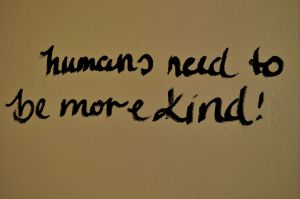
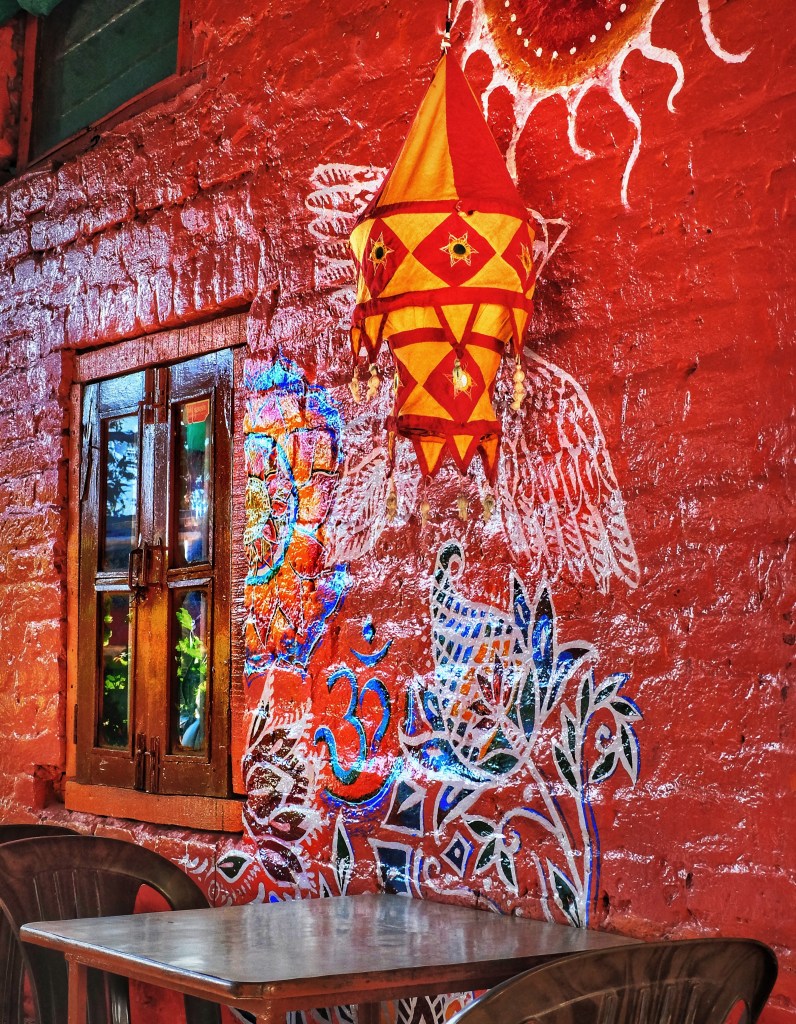
A true story written on a wall somewhere
It’s also true that the stories that ‘help’ people come in all shapes and forms and are about an unlimited variety of subjects and topics. Then there’s the matter of timing. How often have you ‘just by chance’ read something inspirational when you were needing some guidance or advice?
Or what about those times when you are feeling a bit low or under the weather and you come across a story that makes you smile or otherwise lifts your spirits? I’ve often been in need of a good cry only to come across a sad movie or story or a moving tale of one kind or another. (Just last night I read a wonderful phrase I’d never seen before: Transformational Weeping. Probably a story or two there do you think?)
A story I tell myself literally every day. One that’s a prayer and an affirmation
So, let’s keep telling stories. They are all the right ones for us to tell – if they come from the heart and told with the intention of serving Truth. Someone once wrote:
If there is a way to improve the world, it is by telling a good story.
Okay then.
Once upon a time on a dark but not so stormy night …
PS I saw the movie in Dharamsala India. On a postcard home I wrote a little rhyme about some writing work I was doing on some of the town’s environmental issues for a local magazine:
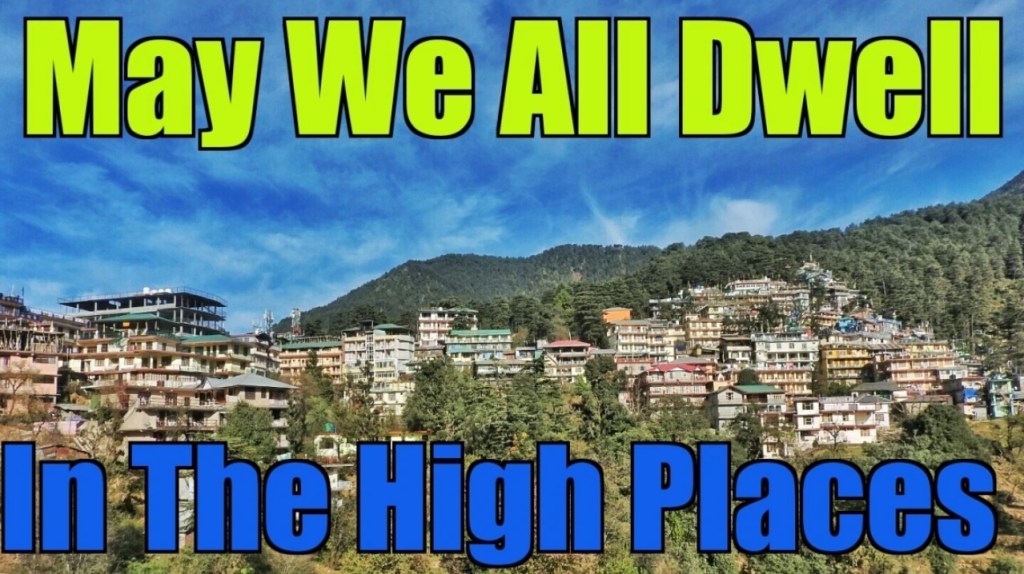
He walked the line did Johnny Cash. But here in Dalai Lama Land my words will help reduce trash.
I did say stories come in all shapes and forms didn’t I?
One of the key elements of the current temporary hermitage, the current safe-haven by the side of the road, is that it is literally two minutes walk from a very uncrowded and quiet coastal beach.
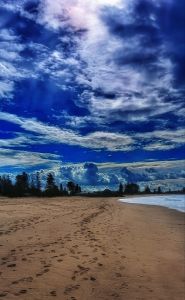
It is a place of golden sands (I know that’s a cliche but in this case I have the evidence!), gentle wave action, and the promise of a possible serenity of a kind I’ve not been close to for a long while.
While I don’t visit this little slice of Pacific coast every day, I get to walk and or sit there several days a week. And when I do, I find that it’s always uplifting and relaxing. A reminder too, of my oneness with all nature. All of us are actually nature, along with every other living thing on our planet (and of course elsewhere too).
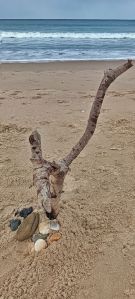
Today, for the second time I built a little ‘shrine’ on the sand. Walking away from my little temporary temple, a poetic voice entered my mind and wrote itself a few lines. Too engrossed in the moment, I neglected to record it on my phone, so when I got back to the hermitage I wrote it as remembered.
And now, I would like to share it with you. I am grateful that I am actually able to share it, so thank you.
WE STAND ON SACRED GROUND
I planted the branch, the branch of a fallen tree person. On the beach, in the sand of the beach.
And I built a shrine around that branch. A pop-up shrine. Shells, stones, and a piece of coal.
A shrine to Varuna. A shrine to Surya, to Saraswati. A shrine to all the gods of Earth, Sky, Water. A shrine to the gods of all beings.
A shrine on the beach is subject to tidal flow. And soon, this simple shrine, pop-up and temporary in nature, will be engulfed.
Lord Varuna will make his claim. What has emerged, must always return.
As a self-described Hermit Pilgrim, I aspire always to live a contemplative and secluded life, as far apart from wordly concerns as I can manage. At the same time, I am a pilgrim, in both the sense of the internal journey of the Self as I study and meditate, as well as in the world itself: I move from one living space to another – one temporary hermitage to another- as I feel directed or led.
In the last several years I’ve noticed how often I seem to find myself in one more temporary hermitage that ‘just happens’ to be located right next door or across the road from a sports-ground, or what’s often called ‘a local oval’.
At least three times in recent years, that I can recall. And it is so at the moment. This time the hermitage is in a suburb of a mid-size city (by Australian standards) that in reality is more a low-key and small seaside town on a peninsular.
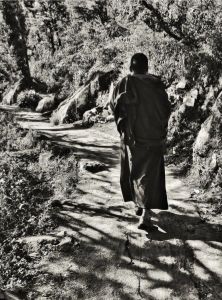
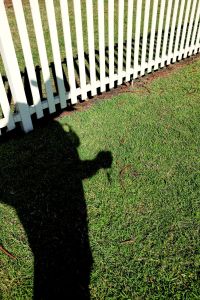
Anyway, just as with those other occasions, I have been grateful for the oval across the road: It makes for an ideal Kora.
Kora is a Tibetan words that means the act of walking around or circumamabulating a sacred place or object.
A monk on the Kora around the home and temple of the Dalai Lama in the Indian Himalayas
Tibetan Buddhists do Kora as a form of pilgrimage and walking meditation. It is a devotional practice and it is said to have transformative powers.
Of course Buddhists are not alone in practising this kind of circumamabulation (from the Latin circum (around) and ambulare (to walk).): Muslims circle seven times around the Kaaba in Mecca as the final stage of Hajj .
Many religious traditions consider Mount Kailish in Tibet a sacred place and circling it on foot, even once, is considered by some to be the equivalant of one complete lifetime.
In south India there is another sacred hill called Mount Arunachala. Each year millions of pilgrims walk around its base, which takes a couple of days. In India, the word pradakshina is used to describe such circular acts of devotion and pilgrimage.
And the list goes on: as I said many if not most religious traditions have a practice of walking around sacred sites or places as acts of pilgrimage or devotion.
So, what has any of this have to do with me walking around local ovals or sports grounds and calling what I do a Kora? Well, my intentions are similar to those other pilgrims but perhaps more humble. Let me explain.
Not being a sports-oriented person (not into competition and team sports at all really) I can’t comment too much on the idea that a sportsground is sacred ground because of the sports played there.
I do acknowledge and understand how it is that so many people do in fact consider the games played there as sacred activity with winnings and losings and full of heroic deeds. This indeed makes these places sacred sites.
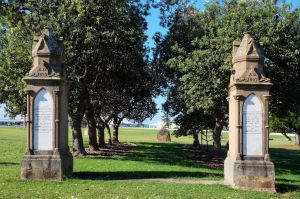
Then there is the fact that many such grounds are named in memory of local people who have been prominent in the community. And, as is the case with the oval over the road from the current hermitage, ovals do actually become sites of memory.
This one, called Lynn Oval hosts several memorials at its periphery: there are tributes to miners who have died in accidents in local mines.
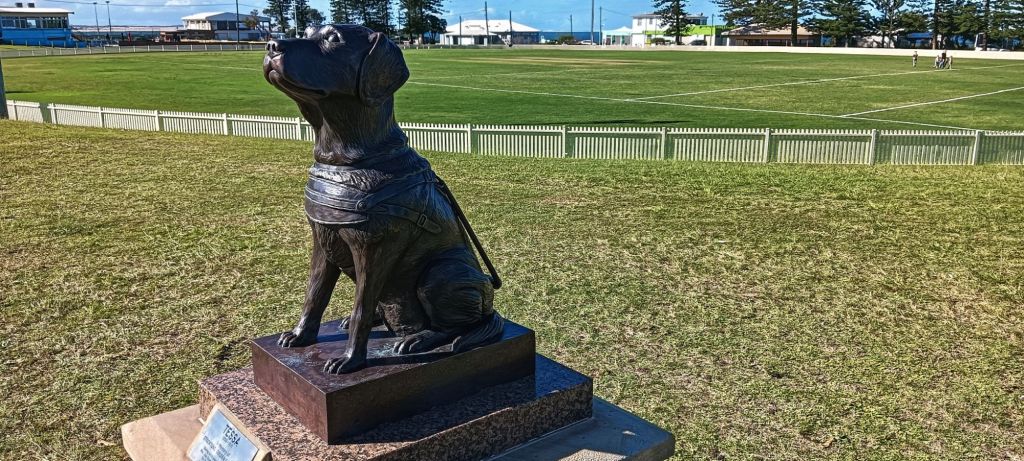
And there is a lovely statue of a guide (service dog for people who have vision impairments) dog called Tessa who is famous in the area for helping to raise a lot of money for more guide dogs.
Lastly but, for me, probably the most significant ‘evidence’ for a local oval being sacred ground is that it, well it just is. Just as all ground is sacred. An affirmation borrowed from First Nations’ Peoples says it all very nicely:
We stand always on sacred ground and beneath sacred skies.
In other words, everthing, everytwhere is sacred. All the rest, the memorials, the games played, they are not what makes the ground sacred, they are the things that people layer onto the space as a way of acknowledging the inherent sacredness.
And that is how it is for me. It’s not me walking around the oval chanting mantra (or at other times ‘just thinking’) that makes it sacred ground, despite being sacred acts in their own right.
I mentioned earlier an alternative word for Kora, pradakshina. This comes from the Sanskrit for ‘to the right’, because traditionally the idea was to always circle the sacred site or object clockwise, so the sacred object remains on one’s right.
Obvioiusly there isn’t much to see on the middle of the oval as I walk around the boundary fence (it’s about 400 to 500 meters by the way). Mind you, the other day a flock of pigeons were feeding in the centre while I walked. Then, at another oval, in another town, there would often be a lone Ibis sitting almost in the centre. It’s all sacred.
This idea of centre has me realising that the whole point for me of walking around ovals chanting my mantra, is the reach mycentre. The temple I’m circumamabulating is me; I’m the container so to speak, for the Consciousness which pervades and actually is all there is.
Peace and Love
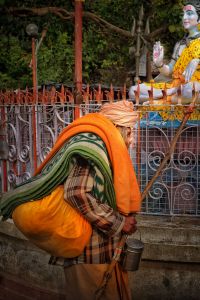
Holy Wanderer: A Saddhu performs pradakshina around a shrine to Shiva in Rishikesh India
PS: I’ve written another post, also related to Kora. Please feel free to visit that post here
Yesterday I came across a couple of stories – true ones – that I wrote years ago. They are what we might loosely call ‘travellers’ tales. I thought it might be nice to share them here. So here’s the first one. Enjoy
Not the Manu temple I write about, but another one close by
I’d walked up to Old Manali, and I’d kept walking through the town. Then higher still, past the temple to Manu, and the scattering of traditional houses and small fields clustered around the temple.
Three near-naked and stoned saddhus invited me into their cave – more a kind of overhanging rock shelf poking out from the foundations of the temple itself.
Naturally I declined. Politely. I wasn’t, never had been, and never shall be a stoner. Besides, here I was deep in the Himalayas walking through ancient villages and past temples to ancient gods. Seems to me that that’s enough to bring on a high all its own and like no other.
Then, a little higher up the trail. I rounded a corner to be greeted by a kind of open forest glade; a grassed and flowered field protected by a semi circle of forest sentinels, their crowns maybe thirty metres above my head.
And there, in the middle of this magic field, a large flat rocky area, like a series of ‘shelves’ layered one on the other. This maybe twenty square metre tiered platform was probably the remnants of an ancient hill (or mountain?) that got in the way of a more recent but clearly relentless glacier.
Whatever the history, here was an arena with views no theatre or movie could ever hope to reproduce. This natural amphitheatre faced several layers of peaks across the valley. But, before those peaks, and directly in front of me, just down the slope, stood the temple, then more trees, reaching down into the valley. Here the river flowed, surrounded by farmers’ fields and the brown dots of houses.
Then the forests begin again, thick at the bottom in the valley, but becoming more scattered on the higher ground. Then those many layers of higher and higher hills, mountains really, rolling off into the distance to, where on the horizon and behind it all, a row of the really high peaks covered in their permanent snows.
‘This is a special place, a sacred place,’ I heard myself sigh out loud. Sitting cross-legged now, I let my eyes wander over the scene taking in the blue sky, the white peaks, the multiple greens of the forests, the sliver ribbon of the river, and the rest.
At such times and in such places, one’s eyes tend to close of their own accord. And so it was for me then and there. I let myself drift. Thoughts came and went, to be replaced by more thoughts that came and went.
Then, my eyes opened. Again of their own accord. After a few seconds of that cliched ‘where am I?’ feeling one has when startled out of one state and into another, I made out the figure of a person standing facing me a few metres from where I sat.
‘I’m sorry,’ I heard her voice call to me. ‘You just looked so peaceful sitting there meditating, I just had to stop and watch you.’
She told me she’s been watching me for about fifteen minutes, which gave me a start: It’d felt l Ike I’d only just sat down and closed my eyes.
‘They say the light of the world is held about twelve kilometres up this trail. That means it’s the centre of the world.’
I had to stand to try to take in a revelation of this magnitude.
‘And apparently,’ she went on, ‘they’re going to move it soon and nobody knows where.’
Was she an angel? Was I dreaming? They, whoever they were, are about to shift the centre of the world? Even in India one doesn’t hear this kind of news everyday. Actually, I doubt you’d ever hear it on any day.
Then she was gone, headed up the trail. I didn’t follow. I remember thinking: twelve kilometres was too far for me especially as I already had a long walk downhill to my hotel back down in the new town.
Yes, mundane, practical musings, a typical response to news of such a wild and far-out nature. So, not exactly in shock, yet not quite myself, I turned back. Down. Through the village, past the temple with three crashed out saddhus out front, back into the town.
There are cafes there. They sell Chai there. I needed one.
Actually, given the momentous news I was going to have to digest, I might even have a couple extras.
This is a true story; it actually happened more or less the way it’s described here.
Of course, there is no ‘light of the world’ stored in some secret spot, somewhere on Earth.
Well, I suppose if there is a light of the world, then it’s likely to be the world itself, I mean Earth, all the beings who live on this planet. Life itself I guess you could say. Life is light; Life is love.
I can’t remember when I wrote my last post. And of course it isn’t relevant at all is it? I mean to say that in the contemplative life, time sometimes seems to take on some other kind of character.
Or at least I should say that one’s perception of the passage of time shifts; nothing unusal there I hear you say, and of course you’re right. Just thinking out loud I suppose.
For me, having a right perception of time is an important aspect of my Sadhana, my practice: yes, it’s true: time is seen to fly, or it is frustratingly felt to drag. But my aspiration is to see time as simply a human construction that we use to limit, structure, bind, define, and place all kinds of restrictions on our lives.
Which for me, simply means that there is only presence or Presence; only the ongoing continous moment (what we often call The Now). Easier said than done mind!
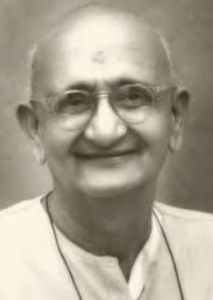
Swami Ramdas (known as Papa to his followers)
In any case, here I am, just where God would have me be. Feeling strongly to reach out to you, I remember the poem (it’s not really about time in the sense we’re discussing it so far) that emerged the other day after reading a quote from Swami Ramdas that seemed to be an answer to some thoughts I’d been having.
I’m grateul for this, all of this. And for you too, the reader of these musings offered with humility and thanks.
Peace and love from me to you.
GOD IS MY ALL
Thinking thoughts as if battered by demons. Memories arising of my own evil deeds, selfish and cruel. Right away I turn to God: God is my all; Hare Krishna
Forego repentance, relinquish regrets; you are filled with God, the supreme essence of life. God is my all; Hare Krishna.
Through Papa Ramdas I hear the Universe speak: Forgiveness is from God; and it has been granted. God is my all; Hare Krishna.






 Notes from the Hermit's Cave