Sometimes, when the ears can hear and the eyes can see, there are many signs and wonders to be witnessed; there are communications to be recieved from some seemingly other source than inside our little physical, material selves.
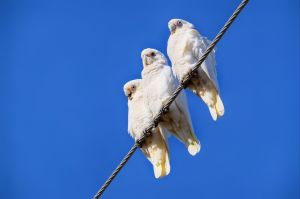
Birds, they say, sing with the voice of God, their song being the song of the Universe, so that the rest of us may hear. Or if you like, a bird’s song opens up within us a kind of portal to the true or Higher Self so we may hear the words of the Divine within.
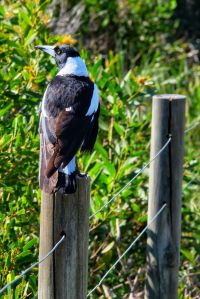
There is a particular bird that we have often heard, though never seen, who is close to our hermitage, though we also hear others with the same song from farther away. The song seems simple, but it is profound.
Two sounds, 1,2. Two notes in slightly different keys. Like the hoot of an owl but not low and deep as I imagine an owl’s voice might be. But not especially high or shrill either. Flat? No I wouldn’t say so: each note is unique.
Some days ago my partner hermit was ‘just sitting in the hermitage garden, not focusing on anything in particular, when she heard the bird’s voice again.
And then without volition or any bidding on her part, the words Let Go seemed to superimpose themselves over the two notes of the bird’s call.
Naturally, she shared what she had heard with me, a message from or via the winged one. So, when next I heard the bird call, I automatically heard Let Go, Let Go. Now, it’s difficult to not hear the message in that short song.
But there’s more.
From time to time the bird’s call (or that of a more distant relative) becomes a three part call, 1,2,3, with the first note short, very short but seemingly with a particular stress of its own. Quickly this new variation morphed into the expanded message, Just let go. Sometimes Let go, sometimes Just let go.
But, wait, there is even more, hence this story I am sharing with you now.
Last night, in the dark and quiet of early morning wakefulness, I heard the bird once again, another new variation: again the same 1,2,3, but now with a fourth note added 1,2,3,4,. Now I heard Just let go now.
Let go of what? No need to ask: just let go of random, chaotic, and repetitive thoughts; release tension and worry, fear and anxiety. When? Now. You can’t let go in an hour, or tomorrow, or next Wednesday. There is only now.
This is the song of the cosmos that we have heard. As I can hear, now in the distance, the two tone variation: Let go, let go.
Physiotherapy, formal exercises as well as the myriad of day-to-day activities required to maintain a physical body, is prescribed as the way forward for people like me who have experienced a stroke.
Quite right too. Exercises and activities to build and strengthen muscle to help recover mobility; to repair broken – and develop new – brain pathways to help recover dexterity and increase both micro and macro motor functioning.
But what of psychotherapy? Not the talking, talking and more talking kind that aims to uncover past traumas, root out the cause of current psychological and emotional issues in an attempt to ‘fix’ you. While talking can be hugely helpful, (I mean it. Talking to a trusted friend, relative or professional, provides not only emotional support, but can give you new perspectives and fresh insights into even the most intractable issues).
What I’m getting at here is more about therapy for the complete psyche: the emotions and the mind and including the spirit or soul.
It is about the rebuilding of confidence – the ‘I am able’ attitude – and it is about filling the void to evolve a meaningful life.
The refuge that each day I commit to take in the divine will of the universe is where this care of the psyche -the inner me, if you like – begins.
Pause for reflection #1: If I take refuge in the will of that which is on the face of it ‘a higher power’ than my own, then why the big efforts at ‘filling the void’. Sounds like I’m resisting that divine will, or somehow refusing to acknowledge the reality of my life as it is.
Of course the ‘making of effort’ and doing our bit is absolutely vital and necessary. So I pray, I meditate, I read, I sit quietly, I create what and when I can. And I make blog notes like this and they also count.
But it doesn’t feel enough. It’s like I’m trying too hard to get to some point I’ve actually acknowledged I’m already at: in the shelter of the will of the universe.
I don’t like to say it, but I’m bored, and I think it is the constant ‘trying’ that is the big obstacle to having a more rounded and holistic approach and attitude to living here and now with life as it actually is for me at this moment.
‘Trying’ suggests the going outside of the present. Making huge straining efforts to make things other than they are. Hardly living in the moment is it?
There are long periods when I find myself sitting with ‘nothing to do’ (I cant read, write, create and pray all the time as in 24/7 can I?)
Pause for reflection #2: Why not? You may very well be asking, as indeed I am asking myself right now. Perhaps these spaces and times are the will of the Divine specificallydesigned for me to learn to sit in silence and to simply be. Maybe they offer spaces and times for me to be quiet; opportunities to simply be open to receive, lessons in presence.
Not only that, perhaps they are healing times when all the fragments of my psyche can settle back into their rightful place.
So, the problem is the solution, is what I seem to be saying here. The times I am describing here and which I often face and experience with dread, are precisely gifts of grace granted to me to help me heal, and teach me to sit in silence learning to listen.
Yes, keeping silent except when and how it is the divine will of the universe might be quite nice.
Yesterday, after getting back to the Hermitage from a walk around the block, I went to take off my shoes.
Actually, I thought, while I’ve got my shoes on I may as well spray the weeds out the front and out the back in the courtyards of the Hermitage.
Sounds like an innocent and innocuous thing to say and do doesn’t it? Well, in fact it is a far from innocuous euphemism which in reality has me saying: I’ll apply some poison through a spray bottle to the leaves and stems of plants somebody or other has classified weeds, in order to kill them slowly over a few days.
Needless to say, this activity always evokes mixed feelings in me. Like everything else in the material life, this issue has two sides concerning the rightness and wrongness of ‘spraying the weeds’.
On the one hand, I understand that we humans are merely one more species along with so many others. We have to do what we need to do in order to feed, clothe, and shelter ourselves.
Weeds, I know, interfere with humans’ ability to grow food for example. In this context weeds are those plants that threaten to overrun, damage, or reduce supplies of ‘acceptable’ food plant species. Thinking about it now, it strikes me that the decisions about is it a weed or is it not a weed, can be pretty subjective.
On the other hand I personally do not want – nor do I think it right – to kill other living things. Of course, and clearly obvious too, it’s a bit more nuanced than a simple choice between do I? or don’t I?
I eat plants of many varieties, and in many forms, and I understand very well that they are all living beings. And, add to that, how many insects, lizards, snails, small mammals, birds, and other animals are displaced, injured, or killed in the planting, growing, harvesting, packaging, transport, and sale of the fruits, vegetables, nuts and so on that I eat?
Like I said earlier, the human species, like all others, must do what it has to to survive. Obviously, again being human, we have minds capable of discernment and decision making that can help us minimise the harm we cause as we pursue survival.
For me, a major component of that harm minimization takes the form of not eating the flesh of animals, as well as my choice to not utilise items made from animals.
Even with this there is a problem: Who’s to say what life forms are acceptable as food, and which aren’t? Humans have invented the scary idea of the Food Chain. We simply decide who is higher and who is lower on that chain and eat accordingly.
Needless to say, humans have appointed themselves to be the highest species on that ‘food chain’. Meaning of course, anything else is lower and hence okay as food.
Anyway, I digress a bit. Getting away from food questions, to look specifically once again at the ‘weeds’ to be sprayed in the Hermitage garden.
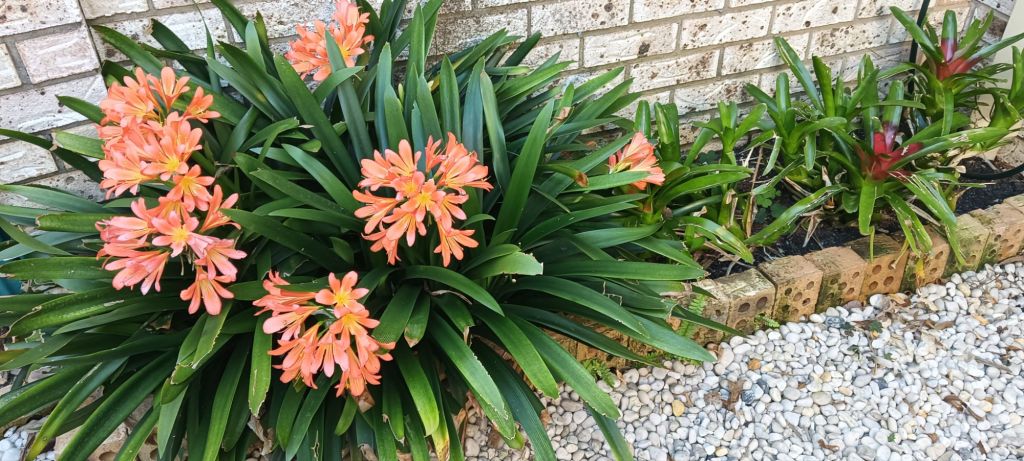
I often ask myself what is it that makes one plant with big orange flowers acceptable as a garden plant? Of course it’s beautiful, ornamental, and a pleasure to have nearby, but what else?
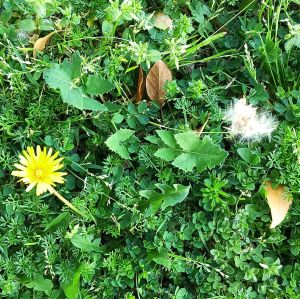
But, what is it that makes another plant, with its delicacy and little flower that are equally beautiful and as pleasing to be around in my view, not acceptable as a garden plant? What makes this one a weed, while that first one we met in the previous paragraph not?
Well, it seems to me that the first answer has to do with necessity dictated by circumstances or conditions beyond one’s control.
As I’ve said, when it comes to growing food, it’s necessary to control plants that threaten that growth. Discernment comes in when we decide how to eliminate that threat with the least harm. One aspect of discernment is actually related to that subjectivity I mentioned before: one person’s weed, is another person’s delicious and nutritious food – and vice versa.
At the Hermitage we don’t grow our own food, so we don’t face that dilemma. Here, at the Hermitage, it is a condition of living here that we control the weeds. And the plants classed as weeds are well known to us due to this condition being a routine clause in most rental contracts.
Besides, it seems that another major factor that makes a plant a weed, is where it grows, how hard it is to keep in bounds and behave.
I guess it’s not only a requirement, that we control the weeds. It’s an issue for our discernment as we try to find ways to share this little patch of the world with the other life forms who also live in this space with us.
It is a wise discernment that tells us to follow the rules of the contract. And our discernment also shows us that, in this human built environment we live in, we can’t allow the space to be taken over by plants that would then provide a safe harbour for insects, rodents, and other creatures that might or would threaten our health and wellbeing and that of our neighbours.
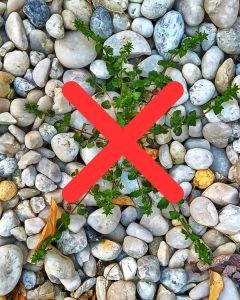
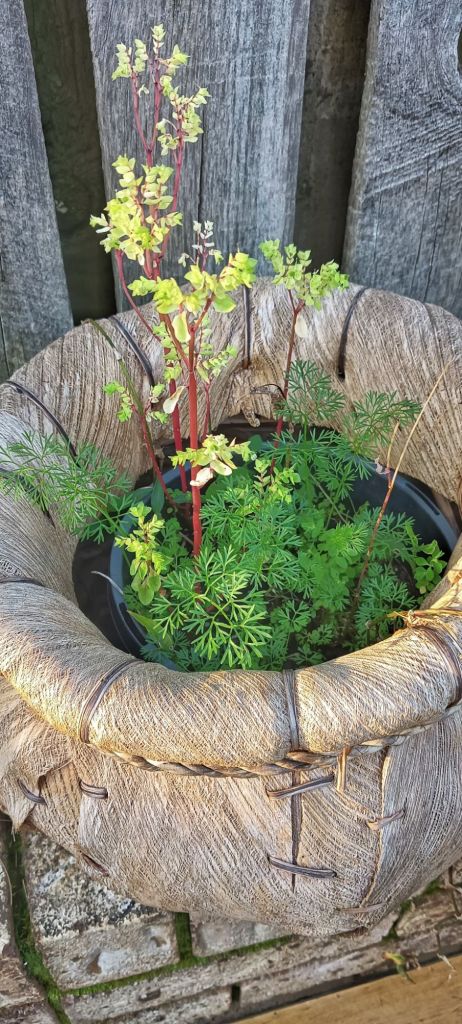
In a pot rescued from a roadside pile of domestic discards, a variety of plants – weeds also rescued over a few months of ‘spraying the weeds’ as a kind of offering to and celebration of life – grow in a group.
It’s a pretty group, I think, of delicate, yet sturdy little lifeforms.
Are they still weeds? Now that I’ve placed them to grow in an ‘approved’ space? Now that they are confined by bounds within which I can control them?
Confined? Controlled? Perhaps for now, but not for long. It’s a comforting thought, realising they all have allies: the sun, the rain – and the wind.
At the same time, we consider all life forms, including humans, to be manifestations of the Divine. All life is one, as I assert so often. Speaking personally, I am sad that any lifeform that is harmed because of my actions and my material needs.
Discernment, compassion, love and mindful action. As we seek to coexist in peace with those beings we share our world and lives with, these things are all required. Empathy too: We are the weeds, the weeds are us.
And the inner editor is insisting I finish by reminding myself that life, the universe, and all that happens, is unfolding exactly as it’s meant to; all we can do is play our part in that unfolding.
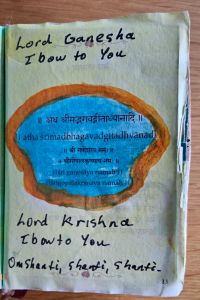
A small irony revealed itself to me just now as I prayed my way through the prayers inserted in the front of my Bhagavad Gita.
I’d completed one prayer and turned the page to the next. Then, without a pause or thought, I quickly turned the page again. I stopped, thought better of it, and turned back to attend to the prayer I’d skipped over.
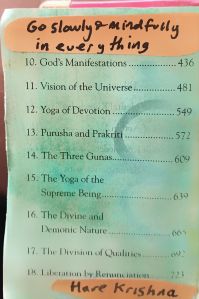
Now, here’s the irony: The prayer on the first side of that carelessly and mindlessly leafed past page read simply:
Go slowly and mindfully in everything.
Well, that’s not the ironey itself. But, given that this was the page I had simply passed over without a thought, with no pause, the words written there obviously were a lesson for me.
A message to contemplate, to actually stop and pause with, mull over, meditate on, and perhaps make resolutions over. Advice to me to stop, to slow down.
Couldn’t be clearer really.
There’s no telling why I skimmed past that page, that prayer, without a pause. Could be a simple case of absent-mindedness, or a rush to see what was on the next page; a grass is greener type of thing.
Why I was rushing through the pages isn’t the point. What is to the point is here I am, doing morning prayers, praying some, then skipping others. The other point is that in this instance, for some reason I stopped, went back, and prayed the skipped prayers.
So, moving to the resolution.
It’s extraordinary to me when that kind of thing happens. (It does happen quite a lot, but unfortunately I only notice it occasionally) We will have an intuition, or receive a message from ourself that helps to us get back on track when we mess up.
In any case, it’s obvious that I’ve found what I might call the prayer of the day, the mission statement, so to speak, informing whatever activities I undertake today.
Slow and mindful in everything I do, say, and think. For now, for the present, that will the guide on the path of today that I will follow. Keeping in mind the adage that practise makes perfect, for when I falter.
Oh, another irony wrapped up with this one. The prayer on the facing page was also skipped, and in itself sheds another light on the message from that first one. That second prayer actually puts forward one, important, way in which I can actually set about achieving that first one:
In other words: place more focus on, pay more attention to, the Divine in whatever form, and by whatever name, I encounter it today.
Works both ways I think: Making the effort to go slowly, to be mindful, puts us in the present moment. And, the present moment is the only place we’re going to be able to become aware of the Divine.
Then, as we become aware of the presence of the Divine, we are right where we need to be, when we need to be there in order to actually slow down and be more mindful.
PS These notes were made a few hours ago. Since then, I have on the whole practised being slow and mindful. Not perfectly, mind you, but then as I say, practise makes perfect. Even now as I type this – very attentively – my mind wanders, so there is a way to go for me. The day is not over yet!
This is my second attempt to start this post. In the first try I just couldn’t see or feel my voice, myself. Right away, as I began making notes, I launched into and quickly became bogged down, in a wordy, overly complex rational discussion.
It seemed more suited to some kind of academic essay (not that I am remotely qualified to write such essays) than a note from the heart of a hermit contemplating from deep within his cell.
So, here I am beginning again. This time I hope I’ll find a little more of me in what I write, perhaps discern something a little more authentically heartfelt.
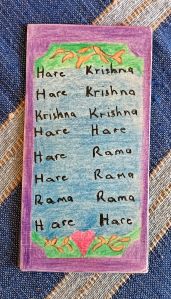
This post emerged from my desire to share with you a little about a small item that helps me as I chant my mantra. My mind seems to switch into strong wandering mode when I try to settle into Japa or chanting mantra mode.
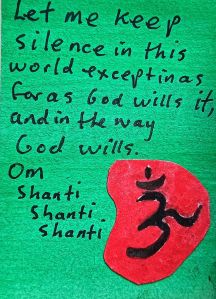
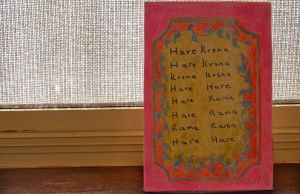
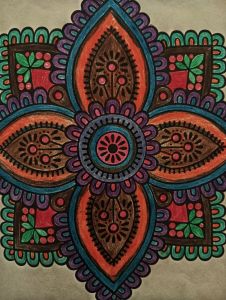
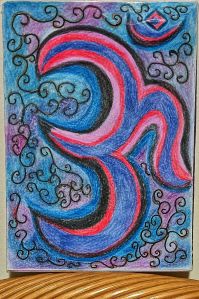
So, I have a small card, made from a cereal box and measuring about 15×7.5 centimetres, decorated with lovely colour pencil designs, with the mantra written in pen. Oh, it’s covered in plastic for protection and longevity, and was given to me as a gift.
Having it in hand or close by when chanting allows me to focus on the words if my mind wanders. I read them slowly, mindfully and I find it puts my chanting back on track – until the next wandering thoughts announce their presence!
Actually we have a couple of similar cards scattered around the Hermitage. One lives on the window ledge above the kitchen sink, and always acts as a timely reminder to make even the washing of dishes an opportunity for prayer.
The View from the Kitchen Sink
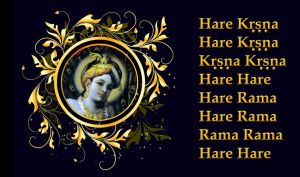
Having my card acts as more than a prompter to me to remember and focus; it acts as a kind of tool for contemplation: when looking at the mantra written there, I often sense the meaning of the words, the importance and place of them. I don’t call this mind wandering, this is contemplation and I welcome it.
While on this level, my card can be viewed as a mere ‘prompt’, there are some who would – and do – say that the card, and the very words written on it, are in fact, much more than being simply physical stuff.
They would say that the card, and especially the words are literally, factually, and in truth the Divine (in this case in the form of Krishna). Just as some traditions maintain that ordinary bread is transformed through ritual, into the actual body and blood of their God who was once made human.
Not mine. I’ve had this as a file for ages, and love it. I think it was originally the size of a visiting card
For much of my life I dismissed such notions as mere fantasy, the products of literal interpretations accepted as dogma through blind faith. I’ve even in the past used the word nonsense to describe and dismiss such superstitions.
Nowadays though (and here comes the but, the however, the on the other hand) I’ve come to a slightly different view of the idea. Is my little card literally a piece of cereal box, decorated with nice coloured pencil work, with words written on it? Obviously it is. Of course it is a material thing existing in a material world.
Is the statue of a deity or saint in a church or temple a lump of stone, wood, metal, or other physical material? Again, it’s obviously a material thing with a material existence . Just as communion bread and wine are baked in a bakery, and brewed in a winery.
So, is my card, along with these other examples, merely a stand in, a symbol, a represention of the Divine?
No, I don’t think so.
Over recent times, my instinct, my heart, senses that, in truth, there is only God, only the Divine, only the Absolute Reality, what we can call existence, or being, itself. It seems to me that this Absolute Reality is everything, is everywhere; there can be nothing else.
One without a second, I’ve heard it described. It’s why, I think, we can look at a flower, a tree, the ocean, a person, or some other material object and be able to in awe remark ‘this is divine’. Or how when we hear birds singing in a nearby tree (or on a neighbour’s roof as I can now as I type this) we may have a sense that we have actually had an encounter with the Divine.
Lately I’ve become bored, uninterested, even irritated, with dogma (my own or that of others) and my constant striving for rational and logical answers. My heart tells me – it feels – that the Divine is all there is.
You, me, all that is visible, and all that is invisible, is all there is, one unity. No, not even a unity: that implies the union of one thing with another.
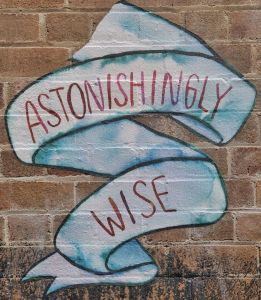
One without a second. Yes, that says it all for me. Those four words, now I think about it, really do encapsulate all there is.
Including my own heartfelt aspiration to fully realise this Truth in the heart and soul of Self.
O Lord, I take refuge in You. You are my sole guide, my master. Show me the right path and I shall follow it.
This is a prayer I like very much. It appeared one day in a previous incarnation of this notebook, then migrated to my prayer book. Its origins are lost in the mists of forgetfullness.
In any case, I like it – a lot. In a big picture kind of way it encapsulates much about the way I aspire to live my life; what I aspire to devote my life and energies to.
The prayer is addressed to the ‘Lord’ – to the Divine; to the Absolute Reality of (to borrow a favourite phrase) Life, the Universe, and Everything. Some will call this God, some think of it as the creator. For me it is simply Lord: all that is existence.
And it is there that I aspire to take refuge. I seek shelter in the knowledge of the rightness and order of the universe. Not an easy task when I think about the state of life ‘on the ground’ on our home planet; how the horrors can be almost impossible to grasp, to understand, and to keep from despairing over.
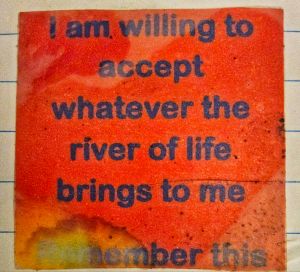
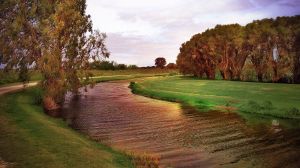
But a contented state of refuge, of safety, security, and even happiness, may be found, I sense, by a cooperation with what we might call the flow of the river of life.
And if I am to discover for myself that refuge, then there really is only one choice: to accept that flow of the river of life as my only guide to how to live, what to do, how to be.
Not surprisingly I struggle with the idea of cooperating with and accepting the often crazy and random nature of that flow of my life as my ‘sole guide’; how much harder is it to accept that very river as my master?
Again, if I ever want to be happy, if I ever hope to be free from suffering and attachments to those things that cause me to suffer, then I must accept and cooperate with the reality: the river of life is the master whether I like it or not. I may as well accept it.
Which absolutely and I hope obviously, does not mean I’m a fatalist, or that I am resigned to just let the currents toss me about willy nilly. No, not at all.
My deep sense (yet another site for other struggles) that the solution to suffering does indeed lie in an acceptance of the reality of the flow of life as it’s happening moment to moment.
By not resisting life and what it presents to me, I aspire to arrive at a state of acceptance where I might contentedly and freely ask what is my role here? What is the universe asking me to do?
If I can listen, and actually hear with the ear of my heart, then I might be able to discern the path, which if followed, will free me from suffering .
Then I shall be going with the flow, following the path of least resistence, and I’ll be contributing to my own smooth (well, smoother at least) ride through life.
Just about to open my tablet to retrieve an email I’d sent myself a day or two ago with a prayer attached that I’d found in a book.
But I stopped: I felt, no, no need to transcribe that prayer; I sense some words of my own that are struggling to emerge (actually paraphrasing a very vague sense and direction here; I rarely think – or speak – in such a formal way). So, I left my tablet and reached for my notebook instead
So, what emerged? Well, it’s a prayer and it’s a poem. It’s a prayer or a poem, Either or, and both. In any case, here is the first draft – I only got these words down on paper a half hour ago.
Words from my heart to my heart. A prayer to my Self, a prayer to all that is. And it’s a poem too, remember! So, now I share this prayer (or poem?) with you.
I am, you are, we are.
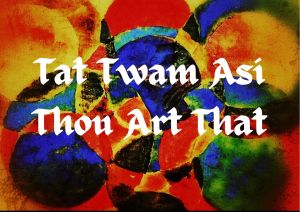
Thou art that
MY LORD, WHAT SHALL BE MY PRAYER?
My Lord, what shall be my prayer? Oh, where even to begin.
There are painful fragments from the past, fear-fuelled fantasies of the future. None of them real. None of them mine. The mind only controls. Yet clinging to them haunts me.
I aspire to monkhood, to the hermit life. Yet to desires of many kinds I am attached.
I long to be absorbed in Bhakti; I long to worship, to praise, and to celebrate All Ceaseless prayer I aspire to, to be absorbed in communion. Yet again the ego-mind fills me with reason’s illusions and endless words of the world. I am barricaded, from You.
I strive to remember who I am; to recall who You are. Within the words of this prayer lies that memory: I am. You are. Thou Art That.
A couple of days ago I recieved a beautiful gift in an email. I often receive wonderful things through the email, and this one, as with so many of the others, has profound meaning for me.
Not only that, but this gift has served as a reminder to me of that significance. I’d like to share with you that gift, as well as some thoughts on its importance and meaning to me.
There are a multitude of sources online where you can learn all the technical stuff, word meanings, history, origin, when it’s used and all the rest. I would like, however, to just ‘think out loud’ in my own words, and follow my own heart’s promptings.
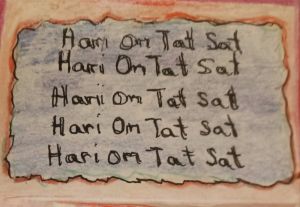
Hari Om Tat Sat, is actually two mantras in one: Hari Om, and Om Tat Sat.
Hari Om represents the totality of what we might call God. Hari refers to the manifested cosmos, as well as the creative impulse in its manifest form. I call that Ishvara, but it doesn’t have a name I’m sure!
Om, is the unmanifested universal consciousness, the Absolute Reality. Meaning, as I understand it, existence itself. I call it Brahman, or God, but again, names are just labels we humans apply to things to make it all seem so neat and tidy!
They say that Om Tat Sat is the most sacred of mantras (in Hinduism). It’s used at the completion of prayers and rituals as a way of invoking the presence of the divine and ‘bringing it all together’ you might say. Well not so much bringing, more like a reminder that everything is one already.
I really like the chanting of Hari Om Tat Sat. It’s a centering practice I would say, a way to remember the oneness of all. And I say it, as the traditionalists do, as a closing to prayers or other practice; it’s like ‘Amen’ or ‘It is so’ or ‘Let it be so’ or, well it’s endless – and personal and subjective.
As mentioned, Om means Brahman – or God in the unmanifested state; Tat, not only sounds like that but does in fact mean all that is. In other words, Brahman or the Absolute. Sat means Truth, Absolute Truth or, once again Brahman.
For me it is a little prayer of its own actually. And I’ve heard it used as a greeting many times. It’s a means I think of honouring the divine within the one being greeted, while at the same time I have a sense that it is a recognition, or acknowledgement rather, of the oneness, the unity of the greeter and the greeted along with everything else.
This is why I don’t really feel the need to break the mantra down to explain in technical detail all the constituent syllables (even I were qualified to do so, which I most surely am not).
It really is a way to acknowledge the oneness of all, the Absolute, which includes, obviously, me and you. The Truth is absolute, it says, so must we be, absolute.
He was referring to what he and his fellow monks are actually doing with their lives in the monastery. He said their lifestyle was helping them to:
‘foster who we truly are before God.’
Hearing this, I had to pause the video, make notes, and do some thinking. What had actually struck me, my first thought on pausing, was that this is exactly what I’m doing as a hermit monk dwelling in our Hermitage. Exactly what I’m doing. Well, at least it’s what I’m aspiring to.
There are two aspects or primary intentions that inform the life I try to live as a hermit and monk that are in fact integral one to the other; they merge actually to become one primary focus of my life.
I practice an ever evolving and I hope intensifying devotion to the divine, with the upliftment of the world and all beings as its central theme.
The other, integral focus, is an equally ever evolving and intensifying quest for self-knowledge, for the answer to the question, who am I?
In other words, I am attempting to foster who I truly am before God. Foster as in ‘encourage the development of …’ (as one definition puts it).
In this case, the development is the growth of the knowledge of my true nature – who I am above and beyond this physical (and mental) creature running around madly trying to figure things out.
In my life there is much effort devoted to the cultivation – a synonym for foster – of that knowledge: meditation, prayer, contemplation, study, just sitting, being still. Did I mention the aspirational nature of all this? It’s an ongoing project to say the least.
Speaking of aspirational: Two more synonyms for foster that I like are nurture and support. Both are even more in that aspirational category; at least it feels like that sometimes. Actually, maybe there’s a more accurate way for me to be putting this.
After all, as I think about it now, even I would agree that my whole lifestyle, my entire way of being in the world supports and nurtures me.
Except for me, myself, and I, that is: Lest the inner grammarian sends me mad in a search for antonyms for foster, let me just say that I am overly skilled in the self-critical and self-destructive departments. My ability to put myself down and to tear myself apart is legendary.
Anyway, with overwhelming nurture and support coming from my partner hermit all the time reinforcing my sense of Self, all I have to do is work on ridding myself of these self-destrucitive and self-critical tendencies.
So, the conditions for the banishment of self-loathing are there; all that’s missing is discipline on my own part in seeing the Divine in myself as I profess to be trying to see it in everyone else.
I need to be rid of the forgetfulness that blinds me to the Truth that is actually very plain to see.
Speaking of the Divine, the ‘before God’ is the vital element for me. God is all there is, so it is always before God that I act, whether in a positive or in a not so great manner.
The best prescription is for me to remember. To remember that God is everywhere and everything (did I say that already?). To remember that me, myself, and I, are also included in that everything and everywhere.
I think that once I do remember these truths even for the odd moment now and again, then the real fostering of who I truly am will have begun.








 Notes from the Hermit's Cave