One, Without a Second, is All There Is

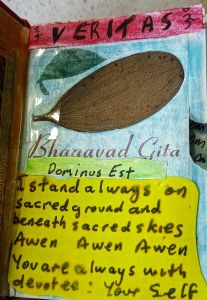
Right at the front of my Bhagavad Gita (the only book aside from the notebook I’m writing this in, that I personally own), I have recorded and inserted sayings and various words , that are important to me. Among those things is a statement I first heard many many years ago, that is common among the First Nations’ peoples of this country:

I [We] stand always on sacred ground and beneath sacred skies.


It is not an affirmation of ownership or possession. It is, instead, an affirmation of belonging to the land, to nature. It is a prayer of thanks, and it is a declaration of the knowledge of unity with the rest of the natural world, that is the hallmark and foundation for Indigenous cultures throughout the world and through time.

I’ve valued – treasured – this sentiment for a very long time – probably from even before I first heard it, which was so long ago as to be lost to memory. Perhaps I always knew it because I’ve somehow always thought this idea was a fundamental truth concerning my existence as a being living on this planet.

Well, now I have heard another statement that for me makes a perfect compliment for this one. The other day, during a lecture, my teacher mentioned that in his student days a fellow student said:

Wherever you are, you are walking through Ishwara

(Ishwara being her preferred name for the divine – for all that is.)

There is a feeling or sense of ‘belonging’, of awe and wonder when we attempt to immerse ourselves in what we term the natural world.

Once again I immediately felt the bell of Truth ringing clearly through this statement. Yes, I thought, everything is divine – including our own selves – so of course it follows that wherever we go, whatever we do, we are always in the divine.

You’ve probably read a number of times me quoting my teacher quoting his teacher:

It’s not that there is only one God, there is only God.
          Swami Dayananda Saraswati

Emphasis very much on only. Meaning of course, that it’s not that God is within us, or that we are within God; we are not surrounded by God; and it’s not that God ‘sits in our hearts’. The reality (for my teacher’s teacher) was that all that is, everywhere, everything, every thought, every word and deed, everything there is, is the divine.

Another way to describe the divine or God, that appeals to me is that Ishwara (also my own preferred name for the Divine) is in reality the natural order of the universe as dictated by the laws of nature. Those laws of nature, the rules that govern how the universe works, are also Ishwara, as are all that is manifest or in existence  as a consequence of the workings of those laws.

In other words, the Divine is the sum total of what some would call the entirety of creation.***
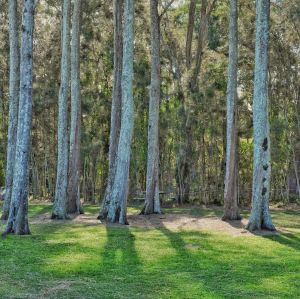
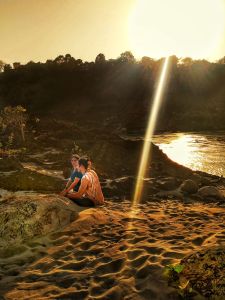
For the hermits a sacred site. Part of a grove we named The Sentinels. A place of experience of unity and oneness of creation

For me this an enormously comforting and reassuring concept. Of course, for me at least, it is also an extremely difficult one to wrap my head around. But here’s a small summary of what I think I’ve grasped so far.

Ishwara – the Divine – is all there is; everything. Also divine is the natural order of the Universe as governed by the laws of nature. These laws are neither good or bad – there is no duality. They are neutral.

You and I, as one more entity among who knows how many others, act as we do and are subject to the laws of nature, just like everything else. We can’t change or influence those laws; we can only live our lives as they unfold.
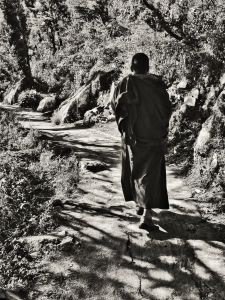
To quote from Desiderata: No doubt the Universe is unfolding as it should

And, well, then things just work out as they do. While we can’t change the laws of nature, or bend the universe to always suit our liking, it is also true to say that every action we take, every thought we think, every word we utter, even our very presence as a living being in our time and place, do indeed contribute to ‘how things work out’. Another way of saying this is to say, we do our bit, and the universe does its bit and what happens, well, happens.

For me, this is not at all as simple or as straightforward as it sounds. Naturally  we see ourselves as individual selves, as entities on our own. After all, to state the obvious, we live and operate in a material (dualistic) world. So automatically we see ourselves as individuals living in, but always separate from all the other individual entities, as well as being disconnected from the world itself.

It is part of human nature (for the most part) to long for connection; there is so often a drive within us pushing us to create family, enter relationships, feel we belong to a community or communities, and for many but not all, there is the almost instinctive urge to seek connection with the rest of nature.
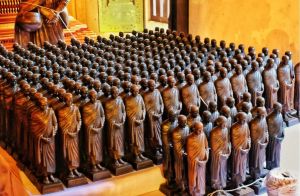
Many forms, One reality

We often think of these longings as goals to achieve, as something outside of ourselves to attain, to reach for. Consequently, so very often we tend to focus our attention outwards, towards other people, or material things.

But, instead, all these inclinations, desires and longings are simply our Self (note the capital?) endeavoring to open itself to discovering (or rediscovering?) that which already exists: our oneness with, and our non-separation, and non-difference from, The All That Is.

Peace and Love from Paul the Hermit

FOOTNOTE

***Just a few thoughts about naming, or giving labels to the Universe and its laws.  Obviously it’s a personal choice for each of us what we choose to call that creation. Then, on the other hand, we don’t have to call it anything at all. For me personally it is very difficult, even near impossible to not name it. By naming the creation, I don’t think I am attributing the manifestation of the Universe to some distant entity living in some heavenly abode (as my teacher likes to say). Rather I am acknowledging the intelligence  and order, beauty, complexity of all that is and how it all works, as its own reality. At the same time, I am learning to understand that I as my true nature am not separate from the rest of creation, and I feel the need to have a name towards which I am able to focus my thanks and my reverence.

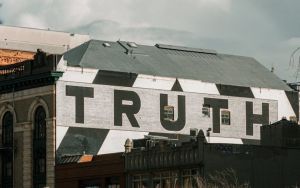
Wish for Truth and Honour with your signature

Maybe fifteen or so years ago, I reconnected with a good friend, after losing touch for a while (we’ve lost touch again). This friend used to send his poetry to friends on his email list, and after reconnecting, I was reading through some of those old emails.

I began to notice, as I read, that along with his name, he signed each email with a really lovely sentence which at that time I’d not heard before:

Vishwa dharma ki jai

This is Sanskrit and obviously I had to look it up. Not only did it read so nicely in Sanskrit, the English translation, was just as striking: it translates to: ‘victory to universal truth and honour’. When I read this translation, I was moved. What a beautiful way to sign off an email, or (age warning here) or a letter on paper.

(And, just rechecking online now, I see that there are songs, magazines, and organizations, that carry this expression as their name or slogan. Do a search for Vishwa dharma ki jai)

what about this as a signature?

Now, I don’t have a problem with ‘yours sincerely’ or ‘kind regards’ and so on, as ways of signing off a written communication. Indeed, I think those salutations (is that the right word?) can be meaningful and can carry heartfelt and sincere wishes from one person to another.

However, as with a lot of things we do ‘automatically’ and as a matter of course, these expressions seem to have lost much, if not all their true meanings. In fact, how often do we get emails with no such signing off, and with merely the sender’s name at the bottom?

Actually, now I think about it, I remember some emails that don’t even carry the sender’s name as a way of signing off. Now, that seems on the surface to be a rude omission, but in reality it’s not rude nor is it really an omission: people and the way they communicate are changing; I guess some of these so-called ‘niceties’ are just naturally going to be lost.

So, I thought after reading the Sanskrit salutation, hey,  I would really like to use this beautiful expression as my ‘signature’ for emails. What better salutation for a truth seeker (that’s me) to sign off with? And I’ve been using it ever since.

It might be that a wish for the victory of universal truth and honour sounds a bit old fashioned, a bit formal even. Not at all: how up to date, how necessary even, in our fast-paced, materialistic, and sometimes lonely and corrupt world, is it to seek truth and to act with honour? Honour isn’t the fuddy-duddy, formal term you might think. Look it up: it’s about honesty, truth, right behaviour, integrity, all that good and right stuff.

So, I’m going to continue using this great salutation whenever I can. And my message to you, dear reader?

It’s only words. Or is it?

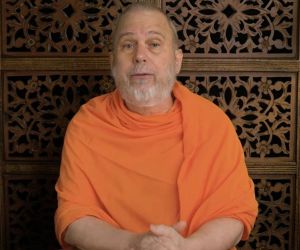
The other day, while listening to a talk by my teacher Swami Tadatmananda,  I was struck by something he said. Of course, being my teacher, there are many things that he says that have significance and that resonate with me. But these statements in particular found a home in me that day:

Words can’t get you there (ie realisation of our oneness with the Divine, God, Universal Consciousness, we may call it many things), but words can help you get rid of everything else.

Talking with my partner hermit this morning about this idea, I suddenly thought that for the vast majority of us there are only a given number of words used on a daily basis. And I think this would apply to whatever language we speak – even when you think of specialist groups like scientists, religious people, engineers, – any group.

I’m not talking here about whether me or you as an individual has a ‘wide’ vocabulary, or a ‘limited’ one; I’m just saying that there are only so many words we need to get by while living in our particular worlds.

And that thought led to a not so original idea that those words will be used to achieve all kinds of ends, including opposing goals and purposes.

In other words (no pun intended, I promise!), words may be used to attack and hurt others and ourselves; or in the relaying or writing of the news telling us (constantly and repetitively) all the bad things going on in the world; to express hate; to promote violence; in advertising for anything and everything; to threaten and dominate – have power over – other living beings or Earth herself.

Then, on the other hand, those exact same words can be used to heal others and ourselves; spread news about good things happening around us; in the prayers many of us utter every day; in the many holy scriptures and other sacred texts so many hold dear; to promote love and express love; to promote harmony and unity among peoples and with Earth and all her life; to empower ourselves and others to live well and to thrive.

So, where’s the difference? Well, I think there is a theme developing in this post: it’s going to be packed solid with obvious, even clichéd words and statements. What I’m getting at is this: Two very well worn clichés just popped into mind:

Sticks and stones might break my bones, but words will never hurt me.

And the other:

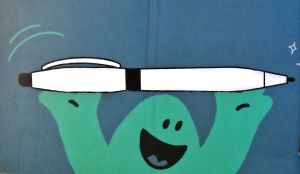
The pen (or any other means of communication) is mightier than the sword.

Behold the Mighty Pen

It seems to me that these two statements appear to be at odds with each other; kind of opposite ideas aren’t they? Well, clichés may be ‘hackneyed oft-repeated aphorisms’ (I read that definition somewhere ages ago), but I rather think that a great many clichés are merely truths passed down the ages that have been remembered and treasured precisely because they are true and have proven helpful.

Words can hurt; we have all experienced that truth for ourselves. Of course, for ‘enlightened ‘ people words might roll over them like, (forgive another cliché or two) like water off a duck’s back, or those words will go in one ear and out the other. But, I think most of us have a way to go before enlightenment, certianly it’ll be a rather high number of lifetimes before I’m even close.

Which means that before that day of enlightenment comes, words will continue to hurt. Or heal. All of us can think of many examples of words that can be used in so many ways, but let’s just take one example:

Power or powerful. In how many ways can we use that word? What does it mean if I say: ‘He’s a powerful politician’.?

Does it mean this politician is a dictator who forces people to do what he wants? Does he ban anyone who disagrees with him? Is he a believer in the myth that the people are all there to serve him? Does he raise taxes so he can live luxuriously? Does he make policies that keep people poor or hungry?

Or does it mean that this politician is a strong, good, and compassionate leader? Does he know how to empower people to move themselves and society forward? Is he sensitive to the needs of all the people he serves? Does he listen to the people and follow through on what they tell him? Does he do his best to ensure that nobody goes poor and hungry?

You probably get the point I think? Exactly the same words; two diametrically opposed meanings. Of course, we could all cite countless examples of this duality: same words, different meanings. And you know something? We all do it.

So, what’s the solution? How can we find words that don’t hurt? How are we to learn that our ‘pen’ (read voice, keyboard, paintbrush, camera, or any medium we use to ‘speak with’) is mightier? Well, until that aforementioned day of enlightenment is upon us, all we can do is practise; after all, practise makes perfect (sorry).

Okay then, how shall we practise? I can only tell you what I am trying to do myself. Focus on truth in all your actions, words, thoughts. Turn away, as your default response, from all that you know to be untrue. Develop your powers of discernment so you will know what is true and what isn’t.

And this requires that you remind yourself constantly that you already do know the difference. Your heart will tell you, so listen to it as well!

Does all this work. Yes. Maybe. Sometimes. But what I can say for sure is that practising this way of reconditioning your thoughts, words, and deeds so that they are all on the same page, (there I go again with the clichés again)  advances you ever so steadily on that road that leads to enlightenment, when we will know exactly what, when, and how to say what we need to say whenever we try to express ourselves in any given situation.

Living the Life

Welcome to another musing from the hermits’ cave. It’s been a while hasn’t it?

Mind you, I’ve been busy: settling into the new hermitage here in the desert. Actually, it’s been cloudy since we arrived, and raining sometimes. It’s as if the Subtropics have followed us here, except that it’s been freezing.

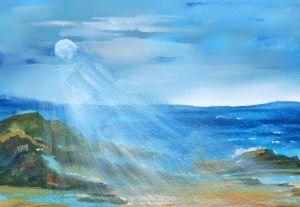
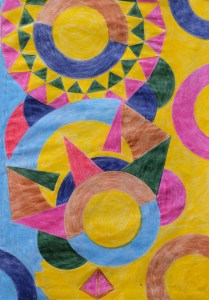
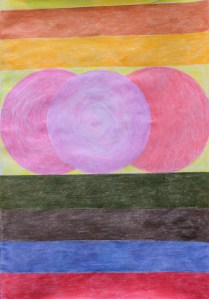
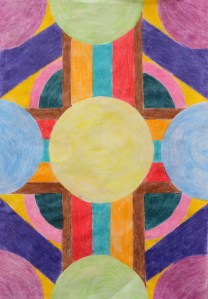
And I’ve been busy colouring in as well. Not as in filling in a picture book designed for colouring, but in making my own patterns and shapes with the one aspiration of making colour happen.

Japanese calligraphy masters will tell you that God is in the ink, or in my case in the pigment of the colour pencils I use. I draw designs, sometimes complex, sometimes simple, then fill the spaces with colour. Sometimes just one or two, sometimes multiple colours.

Why? Well, the simple answer is because I like doing it. I like to see colour covering the page, seeing it slowly fill that empty space. I’m not good at ‘drawing’ and painting in the traditional sense, but one thing I can do is make colour. So I do.

And it’s a sacred act: God is in the ink remember? It’s the making of beauty. And that is a holy act. There’s that aphorism isn’t there? It’s better to light a candle than curse the darkness?

Or, I could say that it’s better to make colour and patterns than it is to be swamped by the darkness.

There’s a Bhagavad Gita verse I like that I came across again the other day:

If one’s thoughts are fully absorbed in the Absolute all his [sic] spiritual offerings also become a part of that same Absolute

Bhagavad Gita 4:24

In other words, all our actions – and we never cease from activity while we dwell in a material body – are not only prayers or offerings to that Absolute (or you can say to God, to beauty, to art, to love, to the universe, to life. Or you don’t have to name it at all. None of the names and forms are relevant) but in fact become that Absolute.

I am a hermit pilgrim, living a contemplative life devoted to the Absolute we just talked about. I have little to offer, but I offer all that I am. And with my photographs, and with my ‘colouring in’, I try to create a little bit of the sacred, a lit bit of colour and beauty to keep us all away from the darkness.

Peace and love

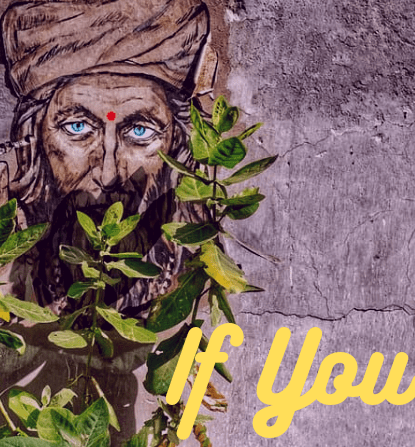
If You … Don’t Quote Me on This

I don’t remember when I began to collect quotes; my early teens I think. I just started making notes of quotes from books (even comics in those far off younger days), from conversations overheard. Then, later, little excerpts from my own journals and other writings. Even slogans I’d see on t-shirts, billboards, or wherever else.

This doesn’t mean much in these times when you can type in a search for quotes on any subject, for any occasion, by anyone from anytime in history. But, in those long ago days before computers were in our hands, and certainly way before the Internet, it wasn’t so quick and easy.

Anyway, fast forward to the not so distant past;One day I sat at the computer (it was time for computers, thank goodness) and typed up all those collected quotes stored in several boxes full of little notebooks and scraps of paper.

The result is literally hundreds of pages of tightly typed quotes. That typing (which in fact took me quite a bit longer than one day) was in fact the genesis of a book that has remains half written.

You see, as I typed I saw so many great words of wisdom that I just felt compelled to put some of them together somehow.
Ive now been at that task for many years: its a very intense process and takes so much energy and, as any writer will tell you, the muse has to strike before we can begin to strike those keyboard keys! Anyway, it will be done when its done; the very notion of presence, of there only being now, is actually one of the major themes of the book.

As I got to the end of that original typing marathon, I noticed that, strangely, the very last quote in that long long list reads simply, If you. Clearly a sentence begun but left hanging. Who will ever know what would or should or could have come next but never did?

Some time ago I remembered that interesting little fact and began to think about its meaning. I decided to do a quick search of the whole collection for that little conditional phrase. The search revealed that there are 139 instances of quotes beginning with If you.

So, dear readers, dear friends and fellow travellers on life’s journey, here are eight (why pick ten like everyone else would?) of those quotes, chosen at random (is there such a thing really?).

No commentary or comment from me; you, the reader, can do very nicely without my two cents worth thrown in. Well, okay, just 2c worth: I have often learned a lot from quotes such as these (not necessarily these ones specifically); sometimes a simple quote has led to a healing or an important insight.

So, I thought it would be a great idea to share some of my collection with you and perhaps there will be one or more that strikes a chord:

If You …

  • If you allow things to surprise you, you will get easily confused.
  • If you always do your best, you will be free from regrets.
  • If you follow the eternal law, you can understand how to love.
  • When you forget who you are, and dont know what to do, act the way you would if you did.
  • If you really dont care, you arent going to know if something is wrong. The thought would never occur to you. The act of pronouncing something wrong is a form of caring.
  • If you have to ask questions all the time, you never get time to just know.
  • If you are not interested in this, then why are you here?
  • If you deny even one person entrance to your life, youll never get their uniqueness from anyone else.

So, there you are. Theres much to reflect on here. Lots to focus on, to meditate on, and contemplate.

Love and blessings from me to you