Listen: It’s Already Silent

‘I must be back in the blog writing mode, I’m really hanging out for a new topic.’ I blurted out to my partner hermit just now.

Actually, it was desperate. What I actually said was ‘I’m really desperate‘ for a new topic. I quickly modified it to anxious then again to keen, in an attempt to keep the sound of attachment out of my voice. Finally, in these notes, it’s morphed into ‘hanging out’ which is obviously no better at all.

Her reply needs no disclaimer, no modification: ‘The answer comes from the silence,’ she said quietly.

I’ve actually had a relatively quiet – even silent – day: resting in recovery, laying on my bed, sometimes sleeping, sometimes simply following my breath.

Mind wandering, of course, that’s what minds do after all. But overall at least a semblance of silence seemed to be the order of the day.

Even then, after all that silence, quiet, rest and mostly a not overly busy mind, the best I can come up with is ‘I’m desperate’?

As in, I’m really hanging out; really anxious; really keen. As in, I”m not really listening – not at all silent. In fact, so full of desire, clinging and attachment for a new blog topic was I, that actually noticing one come out of the ‘silence’ would likely take a miracle.

All day – hours – I lie still. As I said, only sometimes sleeping, the rest of those several hours watching my breath, attempting just to be in silence and in the stillness.

So is it me? Am I missing something? An answer has come (here I am making notes for a new blog post), but what’s this ‘silence’ business from where answers apparently come all about?

Clearly, silence does not always seem to require an absolute, complete, and total absence of noise, voice, words, thoughts, if it is indeed the source of ‘answers’.

Maybe silence itself produced an apparent state of attachment to a new blog idea as a kind of ruse or trick to have my Self fool myself into seeing the foolishness of attachment as well as showing me how silence really works – in the real world.

Silence is not some sort of rarified mystical state that we have to enter through rigorous spiritual practices. It is actually a condition that emerges from everyday moments, ‘random’ thoughts, or comments made seemingly without thought or any apparent significance or meaning. Actually silence lives everywhere, is in everything and is all the time.

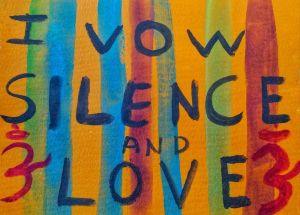
Listen and you’re there

Not Talking About Time

If my life was ruled by ‘clock’ time (which generally speaking it is in spite of my many protests and despite my continuing meditation and other practices designed to assist in developing a sense of being fully present thereby enabling one to truly live in the here and now), I would be telling you now that there’s been a long gap between posts and that this has occurred because two and A half months ago I had a stroke and I didn’t leave the hospital untill less than a fortnight ago.

But there’s been no ‘gap’, the posts will carry on flowing along (or not) of their own accord; and while it is true that my brain and heart colluded in an action that has for now resulted in some damage to other bits of my body, the simple reality is that life has gone on doing what life does, and I AM still here, with perhaps a little more of a clue to the ‘how to live in the here and now’ as well as the whole ‘I AM THAT I AM and not the body’ mysteries.

Obviously, I’m not into swapping ‘You think your hospital stay was bad? Well let me tell you … .’ stories. Now I think about it, there are quite a few of the good, uplifting, kindness and compassion, decency and respect variety a couple of which I might write about if they decide they want to be shared.

But for now (when else is there?) I am here (where else is there?) trying to flow in the life I share with my partner hermit in our new (for us) hermitage just over the other side of the village Main Road.

How Shall I Live?

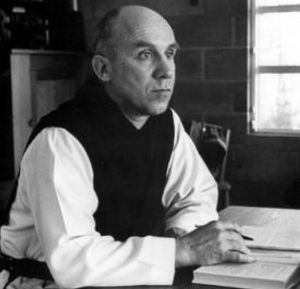
Thomas Merton in his hermitage (Courtesy Wikipedia)

The great study of the monk is to have an awakened heart

      Thomas Merton


There would be some – including me – who would say that all human beings, and not just monks, need to learn to awaken their hearts, to cultivate attitudes and a life of love, compassion, empathy, and kindness.

Who would disagree with such a suggestion?

Well, I’ve already said that I am one of the ‘some’ who would welcome such an evolution in human consciousness. But, at the same time, I don’t want to make pronouncements, form judgements, hold opinions, on what anybody should do, or be like. Only me. I am only responsible for my own behaviours, attitudes, ideas, thoughts, speech, and the rest of how to live my life. I just can’t – as in I’m not entitled – to tell anyone else what to do, what to think, what to say and so on.

Actually I’d even speculate that Merton is in fact talking about just the one monk: himself; he’s not preaching a prescription for the behaviour  of others.

I’ve read so much Merton that it’s impossible now for me to remember exactly where I read this statement of his, but I do know that when I first saw it and made a note, the concept resonated deeply for me as a great aspiration for my own life as a monk, and as a trying to be decent human being.

In other words, this monk – me, myself, and I – has a task to carry on with: to cultivate an awakened heart. And being a ‘great study’ it’s bound to be at least a lifetime’s project.

It’s an effort though, awakening one’s heart. It’s even a bit of a mystery at times what the phrase actually means in real terms.

Love, obviously, tops the list for any aspirant on the awakened heart path. And, yes, I do feel, express, and act out love – so deeply sometimes to the point of being overwhelmed or ‘flooded’; sometimes speechless (that’s the good bit), sometimes full of words.

But then there are times (oftentimes is the word) when that love is clouded or shrouded completely by angers and irritations, by regrets of what should be or shouldn’t be, could be or cant’t be, what isn’t.

The great study of the monk is to have an awakened heart
          Thomas Merton

All attachments to what is not as I think it should be. All barriers to love. All ways and means of keeping the heart asleep – or at best semi-awake, and still sleepy: slow to respond, slow to act, and with ongoing blockages to seeing how things actually are.

The quest to acquire an awakened heart and the outpourings of love, kindness, gentleness, generosity, that such a state would allow, is probably at the root, the foundation, of my life as a hermit monk, of my life as a pilgrim journeying through and to Self.

Living quietly and simply; developing a contemplative way of being in the world while definitely being not of the world; cultivating silence, peace and calm; all are activities and attitudes directed at cultivating an awakened heart.

All that generosity, patience, love, kindness, empathy, and all the rest are definitely all characteristics of an awakened heart. Here’s my dilemma  (only one among many that riddle my crazy monkey mind): they are also precisely the elements that need to be practised in order for one to acquire an awakened heart. What’s the expression? Catch 22?

Of course, it just occurs to me now, everything that is, is exactly as it’s meant to be, happening just as it ‘should’. So, in other words, all these words of reflection are simply a commentary on what has been and gone already, that which is in the past, and is no longer existing.

All that matters – all that exists – now is that at this moment, in its ongoingness, I am as loving, as kind, as patient, and as generous (not to forget compassionate, empathetic) as I’m able. To others obviously, as well as to myself.

All that wonderful list of characteristics of an awakened heart all exist right now within me. Perhaps I need to wake up my mind a bit more so I might see that reality. Then I might actually realise that I already have an awakened heart and that I simply got forgetful somewhere along the way.

with love
Paul the Hermit

Let It Be

I’m not complaining, nor am I bemoaning my lot, when I say that for much of the time I feel totally and absolutely exhausted.

Well, there might be the odd time when I might feel ‘just a bit tired’, but generally speaking, I’d say that exhaustion is closer to what I mean.

But, then, this morning, as I pottered around in the kitchen, making tea, putting dishes away while I waited for water to boil, I had, what I can only describe as a sudden awakening of a sense that this – the perception of permanent and total exhaustion – might not be completely true.

I sensed, in a kind of wordless insight, that – at least in this instance – it wasn’t exhaustion I felt overwhelmed by. Perhaps, there are at least fleeting moments when I am actually relaxed and I’ve simply mistaken that feeling for fatigue, not having had enough experience of being relaxed to know the difference.

The same slow movements: mindfulness and relaxed, or tiredness?

The same slow and considered speech (and thought): again, slow and mindful, or fatigue?

Even the overwhelming sadness and melancholy that often goes hand in hand with exhaustion might be something else: perhaps it is in reality a slowing down (though it often feels far from slow, more like a racing) of the mind, combined with a state of intense inner contemplation, mistaken for sadness or whatever.

After all, the meditation I practise, the ‘just sitting’ times of quiet restful contemplation, the study of texts meant to be ‘road maps’ to inner peace, calm, and liberation, all are claimed to produce, just that mindfulness, contentment, and inner peace that I am describing.

So, how to know? How can I discern the difference? Am I absolutely and totally exhausted, consumed by melancholy and the horror thoughts that go with it?

Or am I relaxed and calm, having slowed both body and mind, and in a state of inner enquiry (contemplation) that’s ridding my mind of the horror thoughts and the sadnesses?

Thinking about it now, when I ask myself these questions, it seems to me that I am questioning what I’m experiencing as opposed to states of being as such.

And experiences are never permanent, they are always in flux, changing. New ones come, old ones go. Then more and more come and go. That is, I guess, what being alive does.

Next I’m thinking, if I truly were in a relaxed, calm state of non-suffering, wouldn’t I actually know it, and therefore have no need to ask?

Mmm; maybe. Still another thought just occured to me. Perhaps what happened, as I pottered in he kitchen was a kind a surprise reaction, or rather a reaction to a surprise. My mind – heart, soul, whatever – was so shocked by that feeling of being relaxed, content, happy even, that it simply had to pose the question out of disbelief.

Meaning, as I ramble on in my usual overly wordy way, that what happened was I noticed a change in my state of being; for that moment I was not exhausted, sad, suffering. Perhaps – for that moment – I had entered a state of relaxation and freedom from suffering.

Let it be, I say. Stop the words; give up the analysis. Let the experiences come and go. It might be that, if I can allow those changes in states of being to be just as they are, then they’ll have a chance to develop, to evolve, perhaps even to make the changes permanent!

Scribbling let it be just now, put in my mind the Beatles song of that name, especially one small snippet of the lyric, a chorus really. Even a mantra (now there’s a thought):

Let it be, let it be, let it be.
Whisper words of wisdom, let it be.

With love and peace

Who is whispering the words of wisdom? And when and where?

When I find myself in times of trouble,

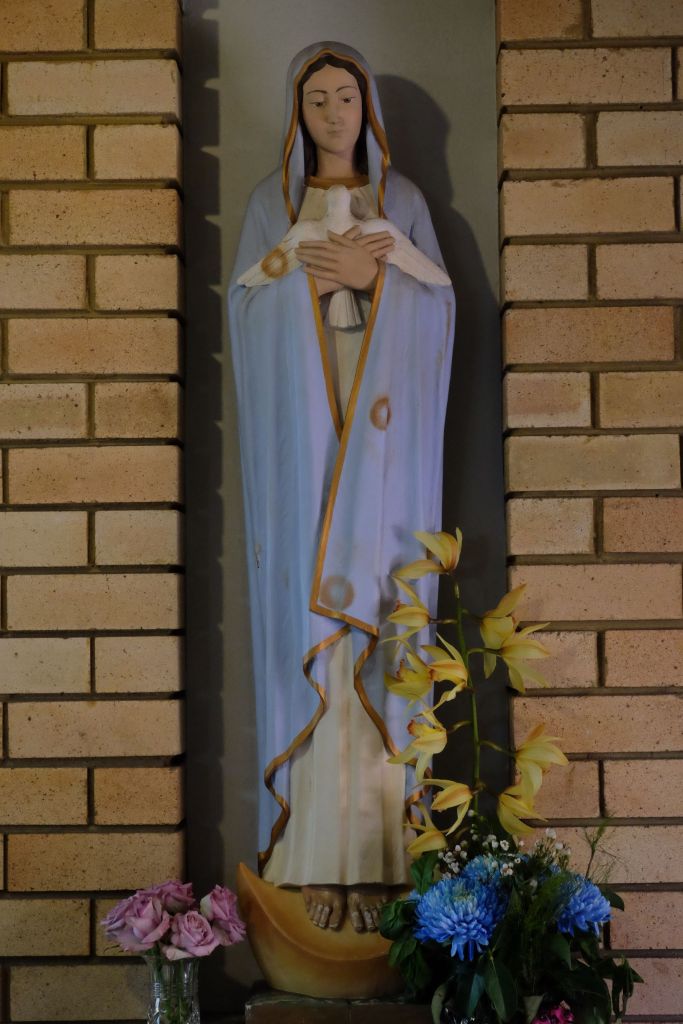
Mother Mary comes to me

Speaking words of wisdom, let it be

And in my hour of darkness she is standing right in front of me
Speaking words of wisdom, let it be.

Mary. The Divine Mother

Jai Maa

Paul the Hermit

PS I was 16 when Let It Be was released by the Beatles. I loved it at first hearing (didn’t everyone?) and I love it now. It meant a lot then, even more now. Thank you very much for the music.

Mindful? Full of What?

Anyone who has tried to meditate for more than a minute, knows very well that the mind right away jumps into overdrive, trying its hardest to keep us nice and distracted; anything but quiet and peace is the mind’s aim. Speaking for myself, all I want to do is get rid of that mind altogether.

But, I know, that would be a mistake. I may not like how my mind behaves sometimes, but I do actually quite like having one, a mind that is. I guess, for me, it’s about realising that my mind is here to stay, and can be either my friend or my foe.

Trouble is, when trying to meditate, I can easily believe it’s my worst enemy. Another mistake, I think, that arises from a not so discerning attitude to the thoughts that flood in seemingly at random.

But, sometimes in that quiet and still space – and even if that quiet and peaceful space hasn’t yet been reached – a thought comes from the mind friend, not the foe. It seems I must learn discernment. Here’s a good example.

Not long into my meditation earlier today, but already bombarded with random thoughts, memories, and other distractions to said peace and quiet, an idea came that just caught my attention. Suddenly, there seemed to be a full-blown idea for what sounded like a great blog post.

I din’t have this notebook with me, and though I had my phone handy, I thought, no, be firm, don’t let interruptions in. Of course, I thought that I’d remember the idea, but sure enough, I didn’t. Now, it’s nowhere to be found. I mean it must be in some tiny neuron in my brain, but it’s hiding pretty well!

Later, after my meditation session, I thought to myself, how come I could make a list of all the less than useful thoughts, memories, ideas and random mental craziness that tried its best to keep me distracted, yet I have no idea what that one wonderful blog post idea was?

I think it might possibly be about attachment; a lesson I’m giving myself in discerning between what thoughts are from my friend mind which ones from my foe mind, the mind running wild with its accomplice, my ego.

It’s a lesson I badly need, I think. Endless thoughts of little or no use to me have stayed, while the one that might have been helpful is gone, seemingly forever.

Yes indeed. Perhaps ny perspective on what ideas ad thoughts are useful to me and what ones aren’t, needs to be contemplated upon.

Actually, it’s not really needing a lot of contemplation: I mean, the one idea I thought would be great is gone. But looking at it the other way around, the fact that the great pile of not so good thoughts staying with me has given us this post I am now writing, and you are reading.

Perspective. It’s all about perspective. And discernment.

A Little Bit of Self Knowledge Hard Won

You know, for all my prayers; for all my mental discipline – efforts at mental discipline – for all my meditations, chanting, and other practices, I still just talk way too much for my liking, and often it feels like it’s only talking for the sake of talking.

I still just open my mouth and let come out any old thing that keeps the noise going. Oh, it’s worse than that: sometimes when I talk it’s rambling and waffling that I cleverly (or not so cleverly) disguise as intelligent, rational, and based logically on knowledge that I either have or haven’t got. Either way, I somehow seem to think I’m offering words of well thought out wisdom.

Whereas, as I said, the noise I make is so often rambling, contradictory , ill-informed, thoughtless waffle.

Enough! Blimey, that’s enough. Talk about opening a post on a calm, relaxed, optimistic, and compassionate note.

Here’s the thing: I want to devote my entire life to devotion and prayer. And that requires at least some silence. Yet, instead, I merely talk about the joys of silence, about the joys of full-on devotion to the divine, and as well I occupy so much time and energy to just voicing random thoughts that come and go, go and come, without rhyme, without reason.

Okay, here’s the second thing: I long with my deepest longing to be silent – to not simply stop talking, though that would be an excellent beginning. No, I want to be quiet; I want my vocal chords to have a break and let my true voice speak through my life, through this blog, my photographs and in whatever way I am lead.

So, what to do? Well, here’s the third thing, thing number three: all I need to do in order to both stop talking so much and be silent is to just sit. Sit and do nothing. There is no thing that I can do that will magically turn me into an oasis of silence and peaceful calm.

Sometime in the dim distant path I read someone paraphrasing The fouth Noble Truth in two words, Just sit. Buddha did indeed know what he was talking about. And I do get the irony: when I talk, I need to say something that helps, not just make noise and try to avoid silence.

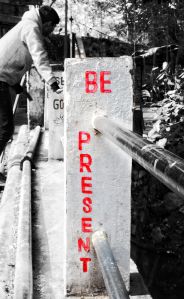
Just sit

Who Brings the Bins in?

Wheelie Bins Waiting in the Burbs

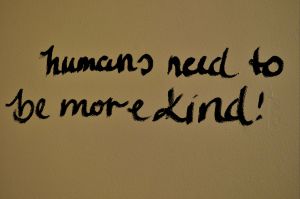
Do they really? Who needs to be more kind? How would I know? I mean, I could say, but I won’t – I can’t. It’s not my place, or my right to judge what someone else needs to do or not do. I find it hard enough to look at my own behaviours and to tell myself what I need to do or stop doing. Actually, I sense a question coming on, but I think we’ll leave it for another day.

Anyway, let me share with you an act of kindness of which the Hermitage community was this morning on the receiving end of.

On looking out the front door we discovered that our bins had been brought in. Monday morning is the weekly garbage collection time in our neighbourhood, which means later day Mondays are the times for the bringing the bins in ritual.

But today, no ritual for us: our bins were brought in by … well we don’t know who. It might have been a neighbour, or it might have been a random passerby.

In any case, whoever performed this not so small act of kindness lifted the spirits of our community members. In other words, it made us feel good.

So, perhaps I can’t judge whether or not other humans need to be more kind, but I can tell you how it feels to be on the receiving end of such kindnesses: nice.

And grateful.

The Q&A in the Scripture Part 4

A sooner rather than later return to our supposedly occasional series on the Q&A between Uddhava and his cousin Krishna on the eve of their departure from their soon to be engulfed in the nightmare of war hometown.

So, why sooner? After all it’s not been that long since our last installment. Well, I was just reading through my notes and the questions and answers we’re looking at today just sort of jumped out at me, asking to be contemplated. So, here we are then.

It’s another two-part question, but unlike with previous questions, we can look at these two in the one post. The reason being that the answers to both questions are, if not quite the same, are very closely related, as are the questions, come to think of it.

Okay, to the questions. Uddhava has already worked through quite a list, but now he gets to, what seem to me to be a couple of biggies:

What are reality and truth?

You see? I did say they were big questions. When you ask what’s reality and what’s truth, then you are really reaching for, well, I guess, what’s real and what’s true. No dilly-dallying, just right to the heart of things.

But, why these questions? Well, look at it from Uddhava’s perspective: his whole world, the only home he’s ever known, is about to be devastated by war. His world is completely turned upside down as he prepares to leave for an uncertain future perhaps never to return.

Like any of us, he’s probably on the verge of despairing, wondering to himself, ‘Is this really happening? I can’t tell what’s real anymore.’

Well, Krishna’s answers are short and succinct, and to the point. A lofty point, but then it would be wouldn’t it, coming from God?

Anyway, his answers:

Reality is seeing all the same.

and

Truth is the true speech uttered by the wise.

Reality does sound very dull if we take Krishna’s answer at face value. But he’s not talking about what we see with our physical eyes; he’s meaning seeing as in understanding, true realisation, as in ‘Ah yes. I get it now.’

But, ‘all the same’?

Obviously all the various beings in the Universe have their own unique names and forms and attributes; clearly they are not tall the same.

No, what Krishna is getting at here is that all beings in the Universe, all living and non-living things, are manifestations of the Divine. At that level all beings are one as the Universal Consciousness that pervades and underpins all that is in existence. Actually it’s not exactly right to say pervades and underpins: rather, consciousness is all there is, and that all is the Divine.

In other words, all beings are one and the same divinity. All the rest, all that we are and see and experience in the physical world are just those names and forms.

I’ve been told that there can’t be any exceptions to this reality, because there is only the one reality. Reality is non-dual in other words. One without a second as I like to say sometimes. One not followed by two and so on. Seems to me to be a simple way to describe this mind boggling (more like mind exploding) concept of nonduality.

Now, to the answer to Uddhava’s second question. Who are these ‘wise’ who utter ‘true speech’. And what is true speech anyway?

Well, the wise are those who have fully realised for themselves the answer to the what is reality question we just discussed. As you might guess, that’s a very small group of enlightened people.

Having said that, the answers to both questions mutually support the other. They each reinforce and promote realisation or understanding of the other.

Ritam (the Sanskrit word Krishna uses for Truth in his answer) is ‘expressive of the whole truth’, one dictionary tells me. It adds that it’s also a state of consciousness, though it’s probably more accurate to say that the ‘whole truth’ is a state of awareness, a state of being.

True Speech, is not just about what comes out of our mouths when we speak. Of course it can and does include what is spoken, written, thought and so on, but also encompasses our lives as a whole. It’s a state of being as mentioned above, and true speech includes all how we are in the world.

In other words all our thoughts, words, and actions.
True speech has to, obviously, be true. Sounds redundant  to say so, but because it’s not only about what is actually ‘spoken’ in words, it makes sense to mention it.

True Speech has to be pleasant. I think this isn’t to say that all that is true (in the world of matter) is necessarily nice; I think it means that in our attitudes, actions, speech itself, and thoughts towards other beings and ourselves too, we should be guided by courtesy, consideration, compassion, generosity and kindness. Love thy neighbours and thyself, in other words.

Last but certainly not least, True Speech is beneficial. In other words, your actual spoken words, as well as your thoughts and deeds in your life as a whole, should be intended to be beneficial for all concerned (which once again and significantly means you as well), or at least with the intent of causing no harm.

True Speech, the Truth, or Honesty, in our thoughts, word and deeds, come with these, what we can call three criteria. Just because you hate a new freind’s new hairstyle and you feel an obligation ‘to be honest’ doessn’t mean that if you hate it you are                           required to tell them it’s ugly and add for good measure it doesn’t suit them. That ‘letting it all hang out’ version of so-called ‘honesty’ is nothing of the sort, and doesn’t meet the criteria for being True Speech.

I mean to say that while it might be true in your opinion, and you deliver the bad news in a nice, pleasant and charming manner, still does not make up for the fact that, far from being beneficial to anyone, your supposed honesty is in reality hurtful, even cruel.

So, the reality – as in there is only one – is that I, and you, along with all other beings, are one consciousness . Our bodies, minds, our individual lives and ways of being in the world, may all be very different, and transient, but consciousness is one, whole, indivisible, indestructible , and never changing.

And, if we as individual entities inhabiting physical bodies, would like to act out our lives as expressive of that absolute reality that is our true nature, then our every thought, word, and deed, needs to be an expression of our acknowledgement of that oneness, that unity of one.

In other words, the only reality is that we are in fact that self same True Speech we’ve been talking about. To become wise (borrowing Krishna’s word here), all we have to do is be true. We need to fully realise that we are in fact Truth, and that Truth is all there is.

That’s it really. That’s the Reality.

Another Poetic Offering: Birds in the Bushes

‘I like writing reverent things,’ I said to my partner Hermit. I’d just shown her a poem I had written about a walk earlier in the day on the track on the crest of the sand dune near the hermitage.

Yes, it’s true I thought later. I do write around themes of solemn respect, deep praise, of love, of appreciation of beauty, of devotional things. About my devotion to all that is Divine – which of course is eveything that is!

The walk began as a bit of a struggle, a bit challenging, though the challenge was eased somewhat by some winged friends. I know I’ve been writing a bit about angels lately, but this time the winged ones were birds. Mind you, angels can and do take many forms. Perhaps those birds were angels after all!

Anyway, as I recorded the original version while still ‘slogging’ through the sand on the track, I did so without intention. But, what emerged is, in my heart, a song of praise for those winged friends.

BIRDS IN THE BUSHES

Lumbering and stumbling, sometimes shambling
through deep and shifting drifts of sand
along coastal track
on the crest of dune.
Slow going on the track. Plodding.

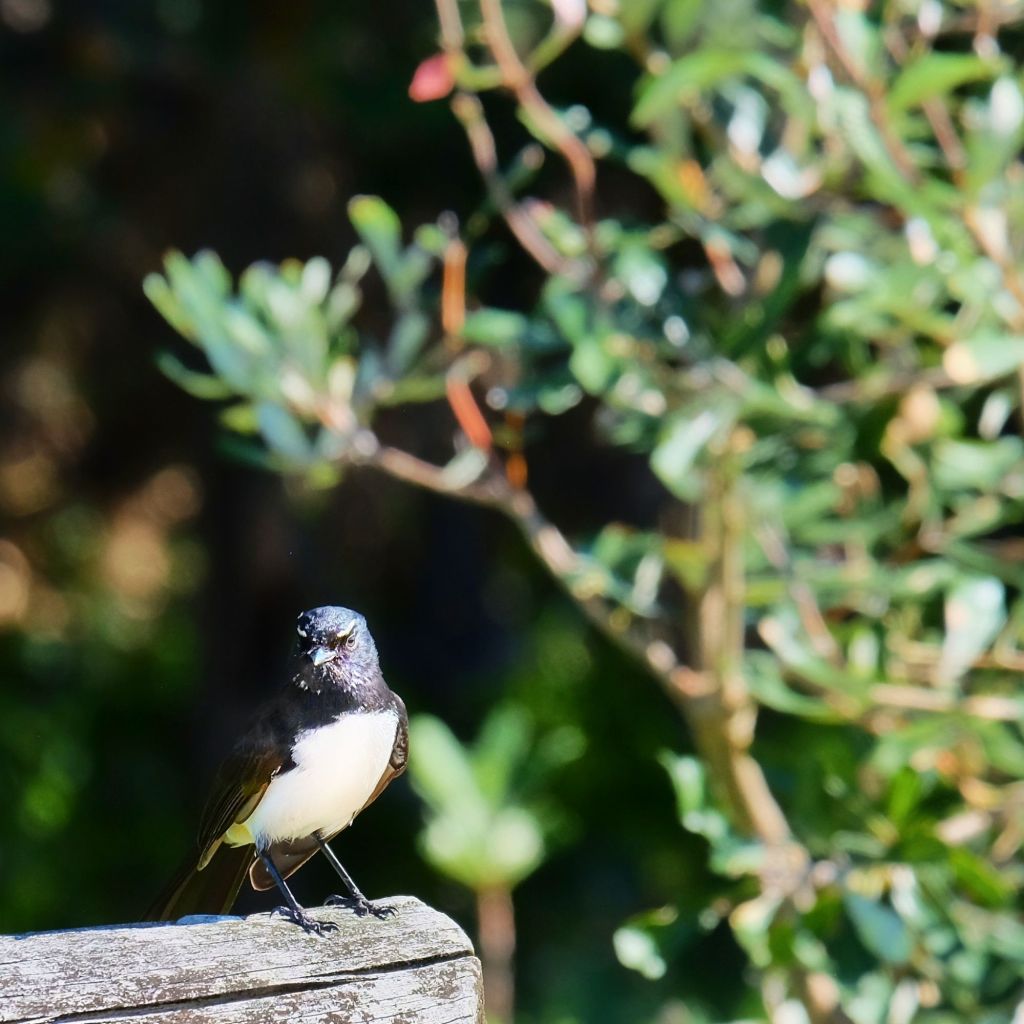
But there are birds in the bushes
alongside the track.
Birds in the bushes twitter their encouragement.
Is it twitter? Is it tweeter?
Is it twirp? Twirping?
Are they twirping? Are they trilling?

In any case, there is encouragement in their serenade.
So, I continue on.
Plodding still
but a little lighter.

One, Without a Second, is All There Is

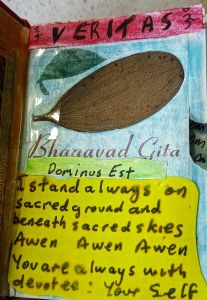
Right at the front of my Bhagavad Gita (the only book aside from the notebook I’m writing this in, that I personally own), I have recorded and inserted sayings and various words , that are important to me. Among those things is a statement I first heard many many years ago, that is common among the First Nations’ peoples of this country:

I [We] stand always on sacred ground and beneath sacred skies.


It is not an affirmation of ownership or possession. It is, instead, an affirmation of belonging to the land, to nature. It is a prayer of thanks, and it is a declaration of the knowledge of unity with the rest of the natural world, that is the hallmark and foundation for Indigenous cultures throughout the world and through time.

I’ve valued – treasured – this sentiment for a very long time – probably from even before I first heard it, which was so long ago as to be lost to memory. Perhaps I always knew it because I’ve somehow always thought this idea was a fundamental truth concerning my existence as a being living on this planet.

Well, now I have heard another statement that for me makes a perfect compliment for this one. The other day, during a lecture, my teacher mentioned that in his student days a fellow student said:

Wherever you are, you are walking through Ishwara

(Ishwara being her preferred name for the divine – for all that is.)

There is a feeling or sense of ‘belonging’, of awe and wonder when we attempt to immerse ourselves in what we term the natural world.

Once again I immediately felt the bell of Truth ringing clearly through this statement. Yes, I thought, everything is divine – including our own selves – so of course it follows that wherever we go, whatever we do, we are always in the divine.

You’ve probably read a number of times me quoting my teacher quoting his teacher:

It’s not that there is only one God, there is only God.
          Swami Dayananda Saraswati

Emphasis very much on only. Meaning of course, that it’s not that God is within us, or that we are within God; we are not surrounded by God; and it’s not that God ‘sits in our hearts’. The reality (for my teacher’s teacher) was that all that is, everywhere, everything, every thought, every word and deed, everything there is, is the divine.

Another way to describe the divine or God, that appeals to me is that Ishwara (also my own preferred name for the Divine) is in reality the natural order of the universe as dictated by the laws of nature. Those laws of nature, the rules that govern how the universe works, are also Ishwara, as are all that is manifest or in existence  as a consequence of the workings of those laws.

In other words, the Divine is the sum total of what some would call the entirety of creation.***

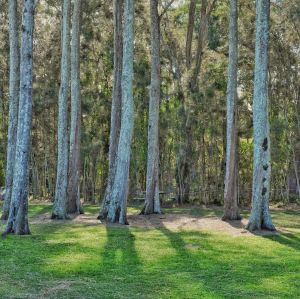
For the hermits a sacred site. Part of a grove we named The Sentinels. A place of experience of unity and oneness of creation

For me this an enormously comforting and reassuring concept. Of course, for me at least, it is also an extremely difficult one to wrap my head around. But here’s a small summary of what I think I’ve grasped so far.

Ishwara – the Divine – is all there is; everything. Also divine is the natural order of the Universe as governed by the laws of nature. These laws are neither good or bad – there is no duality. They are neutral.

You and I, as one more entity among who knows how many others, act as we do and are subject to the laws of nature, just like everything else. We can’t change or influence those laws; we can only live our lives as they unfold.

To quote from Desiderata: No doubt the Universe is unfolding as it should

And, well, then things just work out as they do. While we can’t change the laws of nature, or bend the universe to always suit our liking, it is also true to say that every action we take, every thought we think, every word we utter, even our very presence as a living being in our time and place, do indeed contribute to ‘how things work out’. Another way of saying this is to say, we do our bit, and the universe does its bit and what happens, well, happens.

For me, this is not at all as simple or as straightforward as it sounds. Naturally  we see ourselves as individual selves, as entities on our own. After all, to state the obvious, we live and operate in a material (dualistic) world. So automatically we see ourselves as individuals living in, but always separate from all the other individual entities, as well as being disconnected from the world itself.

It is part of human nature (for the most part) to long for connection; there is so often a drive within us pushing us to create family, enter relationships, feel we belong to a community or communities, and for many but not all, there is the almost instinctive urge to seek connection with the rest of nature.

Many forms, One reality

We often think of these longings as goals to achieve, as something outside of ourselves to attain, to reach for. Consequently, so very often we tend to focus our attention outwards, towards other people, or material things.

But, instead, all these inclinations, desires and longings are simply our Self (note the capital?) endeavoring to open itself to discovering (or rediscovering?) that which already exists: our oneness with, and our non-separation, and non-difference from, The All That Is.

Peace and Love from Paul the Hermit

FOOTNOTE

***Just a few thoughts about naming, or giving labels to the Universe and its laws.  Obviously it’s a personal choice for each of us what we choose to call that creation. Then, on the other hand, we don’t have to call it anything at all. For me personally it is very difficult, even near impossible to not name it. By naming the creation, I don’t think I am attributing the manifestation of the Universe to some distant entity living in some heavenly abode (as my teacher likes to say). Rather I am acknowledging the intelligence  and order, beauty, complexity of all that is and how it all works, as its own reality. At the same time, I am learning to understand that I as my true nature am not separate from the rest of creation, and I feel the need to have a name towards which I am able to focus my thanks and my reverence.