Note To Self: Keep Chanting

What I want to talk about today, what I’d like to share, isn’t new. By that I mean the ideas are well known in the world – and they’ve even occured to me from time to time.

But, today, the thought seems new. Clearer and more obvious somehow. Perhaps when a little bit of knowledge finally ‘sinks in’, and is fully realised for what it is, then maybe that’s the beginnings of wisdom. Or an enlightenment. Perhaps we can say simply that a profound insight was had.

The thoughts I’m talking about concern prayer. More specifically the thoughts were prompted by my experience this morning chanting mantra – in this case, the Hare Krishna Maha Mantra, my mainstay you might call it; My main focus of devotion and meditation.
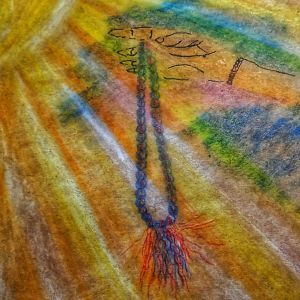
Hare Krishna Hare Krishna

Krishna Krishna Hare Hare

Hare Rama Hare Rama

Rama Rama Hare Hare

As so often happens, as I chanted today, I found myself thinking other thoughts, following mental stories invented as they went. I carried on chanting, but I was thinking other stuff at the same time.

I stopped the mental recitation of the mantra so I could focus on the emerging thoughts.

Yes, it’s true I was, chanting but it was merely at ‘lip level’ as I’ve heard it described. My intention may well have been to focus my full attention on the words of the mantra, on my means of devotion, and the repeating of God’s names. But clearly my mind had other plans as it wandered and skipped around on other paths.

I guess it’s a problem for anyone who prays in whatever form the prayer takes; it’s very easy to be distracted my experience tells me. I’ve read that people may have chanted a mantra for decades – twenty or more years – and feel that they still can’t ‘get it’, that while the intention is there and strong, they just can’t seem to fully immerse themselves in the mantra. Nothing of it reaches the heart. It’s a lonely feeling, I know.

They, like me quite often, will feel frustrated, empty, and as if their devotion is not devotion at all but simply a mouthing of supposedly holy words. Just an exercise, another spiritual practice to simply get through. Some, give up.

That’s why I stopped chanting this morning: I felt the insight coming on. That new revelation that’s hardly new at all.

Here it is then, the insight. If I become aware that my mind is straying and the mantra is being recited rote fashion, then so long as I gently bring my attention back to the words of the mantra, then in fact, all is well.
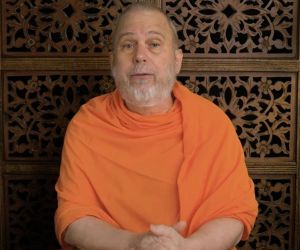
Swami Tadatmanda Resident teacher at Arsha Bodha Centre

My teacher, Swami Tadatmananda has said when speaking about meditation, that the very act of bringing the mind, our attention back to the object of meditation when we notice it’s wanderings, is in itself an integral component of the meditation itself.

So, if I’m chanting and my mind begins to jump about, and I notice those mental antics and bring my focus back to the words of the mantra, then in truth, in the reality of the thing, I’ve actually not ceased my chanting at all. There hasn’t been any interruption.

As I said, it’s not a new idea; it’s not my own idea. But it feels new, it feels as if it’s an idea meant for me.
Intention, effort, resolve, persistence (or is it perseverance?) – and love. The only other necessity is that I continue chanting, both in that moment of supposed interruption and generally in my life.

In other words, if it feels like I’m only mouthing words that aren’t reaching my heart, don’t worry.

Just keep chanting

Hare Krishna!
A Case of Mixed Feelings & Questions of Identity

Yesterday, after getting back to the Hermitage from a walk around the block, I went to take off my shoes.

Actually, I thought, while I’ve got my shoes on I may as well spray the weeds out the front and out the back in the courtyards of the Hermitage.

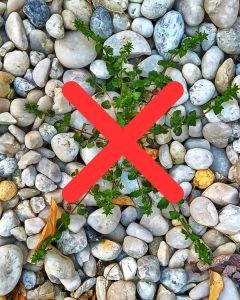
Sounds like an innocent and innocuous thing to say and do doesn’t it? Well, in fact it is a far from innocuous euphemism which in reality has me saying: I’ll apply some poison through a spray bottle to the leaves and stems of plants somebody or other has classified weeds, in order to kill them slowly over a few days.

Needless to say, this activity always evokes mixed feelings in me. Like everything else in the material life, this issue has two sides concerning the rightness and wrongness of ‘spraying the weeds’.

On the one hand, I understand that we humans are merely one more species along with so many others. We have to do what we need to do in order to feed, clothe, and shelter ourselves.

Weeds, I know, interfere with humans’ ability to grow food for example. In this context weeds are those plants that threaten to overrun, damage, or reduce supplies of ‘acceptable’ food plant species. Thinking about it now, it strikes me that the decisions about is it a weed or is it not a weed, can be pretty subjective.

On the other hand I personally do not want – nor do I think it right – to kill other living things. Of course, and clearly obvious too, it’s a bit more nuanced than a simple choice between do I? or don’t I?

I eat plants of many varieties, and in many forms, and I understand very well that they are all living beings. And, add to that, how many insects, lizards, snails, small mammals, birds, and other animals are displaced, injured, or killed in the planting, growing, harvesting, packaging, transport, and sale of the fruits, vegetables, nuts and so on that I eat?

Like I said earlier, the human species, like all others, must do what it has to to survive. Obviously, again being human, we have minds capable of discernment and decision making that can help us minimise the harm we cause as we pursue survival.

For me, a major component of that harm minimization takes the form of not eating the flesh of animals, as well as my choice to not utilise items made from animals.

Even with this there is a problem: Who’s to say what life forms are acceptable as food, and which aren’t? Humans have invented the scary idea of the Food Chain. We simply decide who is higher and who is lower on that chain and eat accordingly.

Needless to say, humans have appointed themselves to be the highest species on that ‘food chain’. Meaning of course, anything else is lower and hence okay as food.

Anyway, I digress a bit. Getting away from food questions, to look specifically once again at the ‘weeds’ to be sprayed in the Hermitage garden.

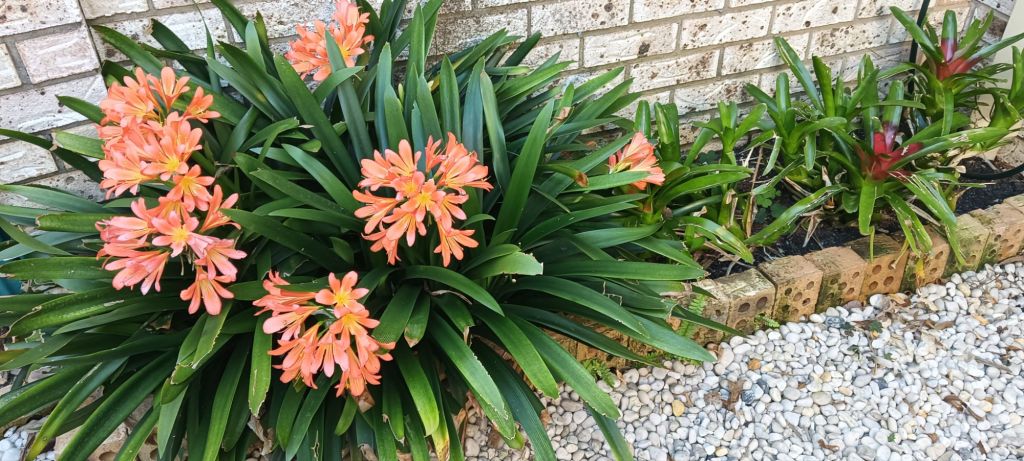
I often ask myself what is it that makes one plant with big orange flowers acceptable as a garden plant? Of course it’s beautiful, ornamental, and a pleasure to have nearby, but what else?

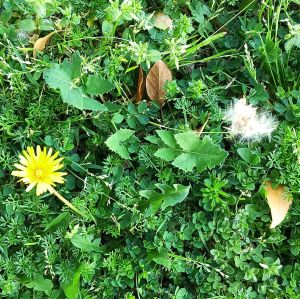
But, what is it that makes another plant, with its delicacy and little flower that are equally beautiful and as pleasing to be around in my view, not acceptable as a garden plant? What makes this one a weed, while that first one we met in the previous paragraph not?

Well, it seems to me that the first answer has to do with necessity dictated by circumstances or conditions beyond one’s control.

As I’ve said, when it comes to growing food, it’s necessary to control plants that threaten that growth. Discernment comes in when we decide how to eliminate that threat with the least harm. One aspect of discernment is actually related to that subjectivity I mentioned before: one person’s weed, is another person’s delicious and nutritious food – and vice versa.

At the Hermitage we don’t grow our own food, so we don’t face that dilemma. Here, at the Hermitage, it is a condition of living here that we control the weeds. And the plants classed as weeds are well known to us due to this condition being a routine clause in most rental contracts.

Besides, it seems that another major factor that makes a plant a weed, is where it grows, how hard it is to keep in bounds and behave.

I guess it’s not only a requirement, that we control the weeds. It’s an issue for our discernment as we try to find ways to share this little patch of the world with the other life forms who also live in this space with us.

It is a wise discernment that tells us to follow the rules of the contract. And our discernment also shows us that, in this human built environment we live in, we can’t allow the space to be taken over by plants that would then provide a safe harbour for insects, rodents, and other creatures that might or would threaten our health and wellbeing and that of our neighbours.

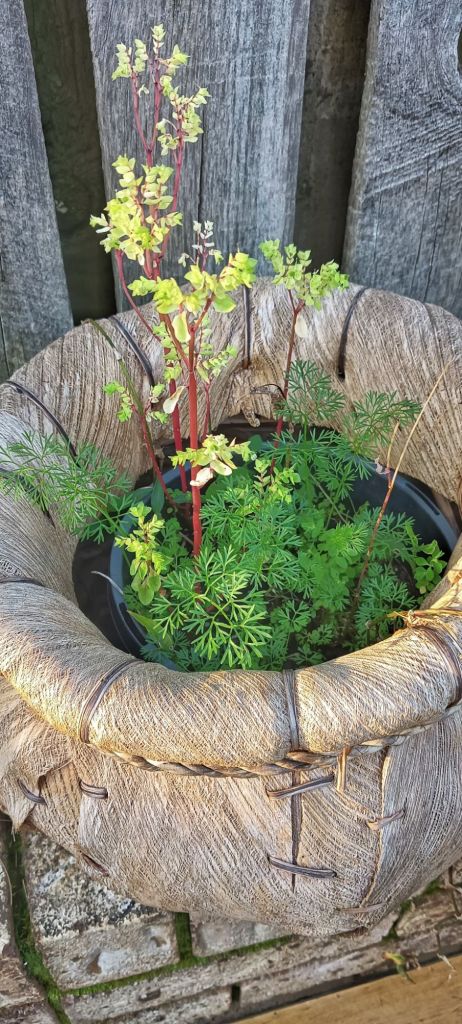
In a pot rescued from a roadside pile of domestic discards, a variety of plants – weeds also rescued over a few months of ‘spraying the weeds’ as a kind of offering to and celebration of life – grow in a group.

It’s a pretty group, I think, of delicate, yet sturdy little lifeforms.

Are they still weeds? Now that I’ve placed them to grow in an ‘approved’ space? Now that they are confined by bounds within which I can control them?

Confined? Controlled? Perhaps for now, but not for long. It’s a comforting thought, realising they all have allies: the sun, the rain – and the wind.

At the same time, we consider all life forms, including humans, to be manifestations of the Divine. All life is one, as I assert so often. Speaking personally, I am sad that any lifeform that is harmed because of my actions and my material needs.

Discernment, compassion, love and mindful action. As we seek to coexist in peace with those beings we share our world and lives with, these things are all required. Empathy too: We are the weeds, the weeds are us.

And the inner editor is insisting I finish by reminding myself  that life, the universe, and all that happens, is unfolding exactly as it’s meant to; all we can do is play our part in that unfolding.

Taking it Slowly, Taking it Mindfully

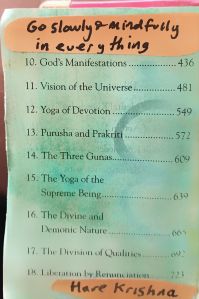
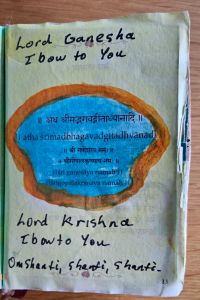
A small irony revealed itself to me just now as I prayed my way through the prayers inserted in the front of my Bhagavad Gita.

I’d completed one prayer and turned the page to the next. Then, without a pause or thought, I quickly turned the page again. I stopped, thought better of it, and turned back to attend to the prayer I’d skipped over.

Now, here’s the irony: The prayer on the first side of that carelessly and mindlessly leafed past page read simply:

Go slowly and mindfully in everything.

Well, that’s not the ironey itself. But, given that this was the page I had simply passed over without a thought, with no pause, the words written there obviously were a lesson for me.

A message to contemplate, to actually stop and pause with, mull over, meditate on, and perhaps make resolutions over. Advice to me to stop, to slow down.

Couldn’t be clearer really.

There’s no telling why I skimmed past that page, that prayer, without a pause. Could be a simple case of absent-mindedness, or a rush to see what was on the next page; a grass is greener type of thing.

Why I was rushing through the pages isn’t the point. What is to the point is here I am, doing morning prayers, praying some, then skipping others. The other point is that in this instance, for some reason I stopped, went back, and prayed the skipped prayers.

So, moving to the resolution.

It’s extraordinary to me when that kind of thing happens. (It does happen quite a lot, but unfortunately I only notice it occasionally) We will have an intuition, or receive a message from ourself that helps to us get back on track when we mess up.

In any case, it’s obvious that I’ve found what I might call the prayer of the day, the mission statement, so to speak, informing whatever activities I undertake today.

Slow and mindful in everything I do, say, and think. For now, for the present, that will the guide on the path of today that I will follow. Keeping in mind the adage that practise makes perfect, for when I falter.

Oh, another irony wrapped up with this one. The prayer on the facing page was also skipped, and in itself sheds another light on the message from that first one. That second prayer actually puts forward one, important, way in which I can actually set about achieving  that first one:

In other words: place more focus on, pay more attention to, the Divine in whatever form, and by whatever name, I encounter it today.

Works both ways I think: Making the effort to go slowly, to be mindful, puts us in the present moment. And, the present moment is the only place we’re going to be able to become aware of the Divine.

Then, as we become aware of the presence of the Divine, we are right where we need to be, when we need to be there in order to actually slow down and be more mindful.

PS These notes were made a few hours ago. Since then, I have on the whole practised being slow and mindful. Not perfectly, mind you, but then as I say, practise makes perfect. Even now as I type this – very attentively – my mind wanders, so there is a way to go for me. The day is not over yet!

Breathing Free & Easy Through My Life: I Wish

There’s this funny little thing I do; it’s an odd little habit. On the face of it, at first glance, it’s not really anything to bother about. Just another little quirk that could easily be dismissed to add to my long list of such quirks.

Don’t laugh. I’ve had this habit for I have no idea how long, and I’ve been wanting for ages now to stop and think about it: why I do it? Can I stop it? You know the thing. Well, I’ve taken steps to try to change it, but still, I think it’s time to look at it properly.

You see, I am prone to holding my breath. Just to illustrate: as I held my pen poised about to write that last sentence: I held my breath. What directly prompted this renewed resolve to finaly get down to facing the facts, is that just a little earlier I’d made a cup of tea, and when I went to put it down on the table? Yes, I held my breath.

I’m likely to hold my breath (for a short moment) at any old time: Bend down to pick up a dropped pen? Hold the breath. Raise a forkful of food to my mouth? Hold my breath. Do one or any of my regular physical exercises? I have to really watch myself, otherwise I’d not breathe at all doing them.

All the time, and at any time, as I said. Why? Well, that’s the question isn’t it? I can kind of understand it as a pause, a way to summon up focus and physical energy before doing a task requiring much physical (or mental?) effort.

But that’s just a guess really. As you probably could imagine, I’ve never discussed breath holding issues with anyone else. Well, present company excepted.

Anyway, my guess doesn’t really tally with the lightweight activities, like my pen poising before a new sentence, or my breath suspending before taking a bite of food. Something else is at play here.

So, what is air? What is it good for exactly? Well, umm, it’s a gaseous combination of a whole heap of ‘stuff’, the key one for us here is oxygen. And, more or less obviously we mammals and other beings too, need oxygen to breathe – to keep breathing. In other words it’s the ideal means of staying alive.

I guess that’s why some traditions call air, not only an element, but a sacred element. Life giving, life sustaining – some call it the Life Force, or Prana. Of course these two terms encompass other elements and concepts, but air is pretty much a fundamental component of the whole eqaution.

Next question: If I know it to be the life force, that which keeps me alive, why would I choose to suspend breathing? No, after pausing here (and holding my breath briefly), I’ve concluded that I very much doubt that I’m trying through this little habit to curtail the flow of the Life Force, or Prana through my body.

So, specifically, what does air do in the body? Well, it fills the lungs, which then somehow get the oxygen into the bloodstream (the heart’s job?), which in turn carries that oxygen to the brain, other organs, and to the muscles. I hope you will forgive my over-reliance on such complex technical jargon.

Once again, I can’t see how holding my breath as I poise my pen, is intended to deprive my arm muscles – and my brain – of the fuel needed to help the pen do its work of putting words on paper.

Anxiety? Well, finally we might be getting somewhere at last. When we get a fright, or fear something, or watch scary stuff in a movie, we will often ‘hold our breath in suspense’.

Maybe that’s where the breath holding habit began for me. Not watching movies, but perhaps when confronted with anxiety making situations. Of course picking up a pen is hardly a cause for anxiety, though eating might be?

Well, maybe those ‘little things’ are where the habit became a habit, but now I’m starting to think this breath holding might be a habit without a cause.

At least no consistent cause or causes. Anyway, there’s no point to  dredging the past to try to find out the why of the thing. What’s important  and the only thing we can impact on is now; best to pay attention to here and now;

So, I suppose the conclusion is simple: Sometimes a quirky little habit is just that, a quirky little habit.

PS A habit to be done away with mind you. Time for some little reconditioning of myself. I’d prefer not to hold my breath while writing notes, while eating, or while doing my exercises – or when doing anything else for that matter. The brain, the digestion, the muscles – this entire being – needs oxygen, and it’s my job to make sure that it flows freely and easily to everywhere it’s needed.

A Story of a Door

The walk from the Hermitage to the coffee shop at the Village Green takes around five minutes or so. This morning, noticing a pause in the rain, we thought we might take the opportunity to get some fresh air and a walk, at the end of which there would be coffee. So, we stepped bravely forward, with the faith that the gods of the rain were indeed taking a break.

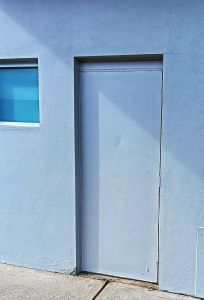
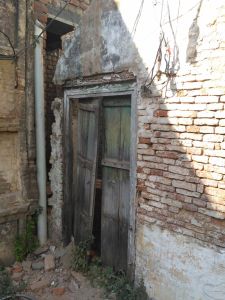
‘Look over there, ‘ said my partner hermit as we passed through the centre of the village. ‘There’s a door that can only be opened from the inside.’

‘I’ve never noticed that before,’ I replied, looking across the street to a wall into which was set a door with no visible handles or lock. The only things that suggested that it was in fact a door were the hinges on one side, as well as its size and shape.

Now don’t ask me how many times I’d passed that spot. Most likely dozens of times, on both sides of the road. Still, now that I had been shown it, I was intrigued. Mentally I was captured: I thought, what a wonderful thing: the one or ones on the other side of the door have complete control over who or what is allowed to enter.

With such a door, one that only opens from your side, you could easily choose to rarely – or even never – open it. Ah, peace at last went my thoughts.

But, right away, those thoughts were dismissed, sent packing: too simplistic, too extreme, to heavy a response. Though, you know, I do feel strongly that such a response to the world – shutting it all out completely – is perfectly understandable, completely reasonable, and oftentimes even an absolute necessity .

Still, I had that feeling towards my reactive thoughts of ‘too extreme’ (inner editor’s note: he has no idea what he’s saying does he? If you ask me, right this minute he will be thinking his initial reaction was spot on and he’d love to have a door like that. Anyway, we’ll let him have it his way).

Some further, more careful thought is required here I think. For a start, here’s a question: If I were to keep the door shut all the time, how would I ever be able to allow my own light, my own love, my own Self, out into the world?

Maybe there’s a way to keep the door open sometimes, then at other times choose to keep it closed to bar access to unwanted intruders in the form of people, thoughts, events, emotions and so on.

After all, it is my door (in this little fantasy at least), the door to the inside, where resides the ‘real’ me, the Self within, beyond and above, the physical form that I so tenaciously cling to as as being the real me. Talk about attachment!

Perhaps slightly exagerated, but this is close to how I see my actual door working as distinct from the story I’m telling in this post.

Where was I? Oh yes. With that door that opens only from the inside, I might come – eventually – to realise that there is nothing to disturb me – unless I open the door and let whoever or whatever that is unwanted, through the door.

I am my own gatekeeper, and without my consent my gate (door) cannot be opened and entered.

And, getting back to the choices I am able to make to sometimes open the door to allow some light and love to flow out from me, out the door and into the world. The more I’m able to discern when, and for how long, to open the door as a way to control what comes in, to what can reach me, the more resources of said love and light I shall be able to build up.

Which, in turn, will lead to more and more opportunities I’ll have to open the door in order to share some of that good.

I can envisage a state reached where my door could quite possibly be left to stand ajar all the time.

You see, the more love and light pouring out, the less that disturbs me can get in. Love and light is transforming, isn’t it?

Yes. Now I’ve noticed – recognised – the door that can only be opened from the inside: It’s me! Now, where did I leave my door keys?

Out Beyond Capricorn: Poetic Offering

Namaste and greetings

It’s been just over a week now since the new page on the blog went live. I have to say that it’s been very satisfying setting it up, then uploading some of my devotional poems.

Actually, it was while uploading one yesterday that I thought, I’ll feature this one in its own post. I did mention that I would like to continue this occasional practice.

There’s not too much to say about this particular poem really – best to leave it to speak for itself.  I’m only introducing it like this because I wanted to include a Wikipedia link that might help clarity a couple of the terms and some of the details mentioned in the poem.

The poem speaks about the concept of Viakuntha, which as you’ll see is the supreme heaven for some Indian traditions. The link leads to an interesting and short read, well worth the time I think.

The myth of Vaikuntha was a trigger for this poem, as was the meaning of the word itself. Is it a real place? Who knows. Fact and truth don’t always agree, and as for me, I don’t think about the question.

Myth has been the way we humans have always used to tell our story. To try to sort out the big questions: where are we from? Who are we? Where are we going? All the ‘big questions’ are addressed by mythologies from every culture – every family, country, you name it – on Earth.

In any case I think that my poem came about as a result of my own contemplation on the story, on those big questions, on Self really.

I hope you will visit my Poems of Devotion page. I’m still adding poems to the page, and of course, with grace, I will continue to write.

Now, please enjoy reading my poem, and I hope it’s a nice experience for you.

Love and Peace
Paul the hermit

OUT BEYOND CAPRICORN & DEEP WITHIN EACH HEART

Vaikuntha: Without anxiety.
Is there such a place? Free from worry?
Out there, they say, beyond Capricorn.
There’ll you’ll find the highest heaven,
the abode of God.

No need to look to the stars:
Vaikuntha is here. Vaikuntha is now.
Within and without you.

Vaikuntha is indeed beyond;
beyond the material world,
beyond the realm of bodies and minds;
beyond the illusions of places and spaces.
Atma – Universal Consciousness – you and me,
that’s Vaikuntha.
You and me, all there is. No anxiety

The Q&A in the Scripture Part 4

A sooner rather than later return to our supposedly occasional series on the Q&A between Uddhava and his cousin Krishna on the eve of their departure from their soon to be engulfed in the nightmare of war hometown.

So, why sooner? After all it’s not been that long since our last installment. Well, I was just reading through my notes and the questions and answers we’re looking at today just sort of jumped out at me, asking to be contemplated. So, here we are then.

It’s another two-part question, but unlike with previous questions, we can look at these two in the one post. The reason being that the answers to both questions are, if not quite the same, are very closely related, as are the questions, come to think of it.

Okay, to the questions. Uddhava has already worked through quite a list, but now he gets to, what seem to me to be a couple of biggies:

What are reality and truth?

You see? I did say they were big questions. When you ask what’s reality and what’s truth, then you are really reaching for, well, I guess, what’s real and what’s true. No dilly-dallying, just right to the heart of things.

But, why these questions? Well, look at it from Uddhava’s perspective: his whole world, the only home he’s ever known, is about to be devastated by war. His world is completely turned upside down as he prepares to leave for an uncertain future perhaps never to return.

Like any of us, he’s probably on the verge of despairing, wondering to himself, ‘Is this really happening? I can’t tell what’s real anymore.’

Well, Krishna’s answers are short and succinct, and to the point. A lofty point, but then it would be wouldn’t it, coming from God?

Anyway, his answers:

Reality is seeing all the same.

and

Truth is the true speech uttered by the wise.

Reality does sound very dull if we take Krishna’s answer at face value. But he’s not talking about what we see with our physical eyes; he’s meaning seeing as in understanding, true realisation, as in ‘Ah yes. I get it now.’

But, ‘all the same’?

Obviously all the various beings in the Universe have their own unique names and forms and attributes; clearly they are not tall the same.

No, what Krishna is getting at here is that all beings in the Universe, all living and non-living things, are manifestations of the Divine. At that level all beings are one as the Universal Consciousness that pervades and underpins all that is in existence. Actually it’s not exactly right to say pervades and underpins: rather, consciousness is all there is, and that all is the Divine.

In other words, all beings are one and the same divinity. All the rest, all that we are and see and experience in the physical world are just those names and forms.

I’ve been told that there can’t be any exceptions to this reality, because there is only the one reality. Reality is non-dual in other words. One without a second as I like to say sometimes. One not followed by two and so on. Seems to me to be a simple way to describe this mind boggling (more like mind exploding) concept of nonduality.

Now, to the answer to Uddhava’s second question. Who are these ‘wise’ who utter ‘true speech’. And what is true speech anyway?

Well, the wise are those who have fully realised for themselves the answer to the what is reality question we just discussed. As you might guess, that’s a very small group of enlightened people.

Having said that, the answers to both questions mutually support the other. They each reinforce and promote realisation or understanding of the other.

Ritam (the Sanskrit word Krishna uses for Truth in his answer) is ‘expressive of the whole truth’, one dictionary tells me. It adds that it’s also a state of consciousness, though it’s probably more accurate to say that the ‘whole truth’ is a state of awareness, a state of being.

True Speech, is not just about what comes out of our mouths when we speak. Of course it can and does include what is spoken, written, thought and so on, but also encompasses our lives as a whole. It’s a state of being as mentioned above, and true speech includes all how we are in the world.

In other words all our thoughts, words, and actions.
True speech has to, obviously, be true. Sounds redundant  to say so, but because it’s not only about what is actually ‘spoken’ in words, it makes sense to mention it.

True Speech has to be pleasant. I think this isn’t to say that all that is true (in the world of matter) is necessarily nice; I think it means that in our attitudes, actions, speech itself, and thoughts towards other beings and ourselves too, we should be guided by courtesy, consideration, compassion, generosity and kindness. Love thy neighbours and thyself, in other words.

Last but certainly not least, True Speech is beneficial. In other words, your actual spoken words, as well as your thoughts and deeds in your life as a whole, should be intended to be beneficial for all concerned (which once again and significantly means you as well), or at least with the intent of causing no harm.

True Speech, the Truth, or Honesty, in our thoughts, word and deeds, come with these, what we can call three criteria. Just because you hate a new freind’s new hairstyle and you feel an obligation ‘to be honest’ doessn’t mean that if you hate it you are                           required to tell them it’s ugly and add for good measure it doesn’t suit them. That ‘letting it all hang out’ version of so-called ‘honesty’ is nothing of the sort, and doesn’t meet the criteria for being True Speech.

I mean to say that while it might be true in your opinion, and you deliver the bad news in a nice, pleasant and charming manner, still does not make up for the fact that, far from being beneficial to anyone, your supposed honesty is in reality hurtful, even cruel.

So, the reality – as in there is only one – is that I, and you, along with all other beings, are one consciousness . Our bodies, minds, our individual lives and ways of being in the world, may all be very different, and transient, but consciousness is one, whole, indivisible, indestructible , and never changing.

And, if we as individual entities inhabiting physical bodies, would like to act out our lives as expressive of that absolute reality that is our true nature, then our every thought, word, and deed, needs to be an expression of our acknowledgement of that oneness, that unity of one.

In other words, the only reality is that we are in fact that self same True Speech we’ve been talking about. To become wise (borrowing Krishna’s word here), all we have to do is be true. We need to fully realise that we are in fact Truth, and that Truth is all there is.

That’s it really. That’s the Reality.

When One Word is Actually Two & Becomes One Again

‘It’s good practis/ce sitting out here.’ So said my partner hermit as we sat sipping post evening meal tea on our little front porch that happens to face exactly due west.

It was on the tip of my tongue to ask: ‘Do you mean it’s a good thing (practice) to be doing regularly as in Sadhana,  a spiritual practice? In other words is it a good habit to cultivate?

‘Or do you mean it’s good as a kind of training – as practise – in improving our ability to sit in quiet and stillness?’

As I say, these questions were on the tip of my tongue, but then: Blog Alert!!. So, in a rare moment of triumph I managed to hold my tongue (metaphorically speaking) and let those questions sift through my mind so that later (it’s now the next day) a post to share with you might emerge.

So, here we are, setting the scene for this post. I know it’s about words, about language. Semantics is what it could be about, given that it’s about words and their meanings.

But, aren’t words simply symbols for the things they describe or represent? And so often semantics involves quibbles over meanings.

So let’s not make this about semantics, no quibbling required here. You see what set off the Blog Alert!!! was that here was the one word, that is actually two distinct words each with their own meanings, that just happen to sound alike.

Still no quibbling though: we don’t need to pick and choose between meanings – actual and/or intended. Two words, two symbols, two meanings (one for each word that is), so we can choose not to choose – remember no quibbling.

We can realise that in the context, both words are equal and correct. Both may be acknowledged as being meaningful to and in the moment, to the situation.

Lately I think I’ve been saying quite a lot about silence quiet – quietude – peace and calm. Stillness also. All are the same thing: all are states in which we might realise the truth of our natures as divine.

Same Sun Another time & place

Anyway, we had just finished our evening meal, and now sat with tea, having just witnessed the last remnants of the sun sink below the horizon (or was it the horizon coming up to meet and finally hide the sun?).

Quietly sitting, relaxing you might say, in post sunset peace and quiet, with only the occasional and softly spoken conversation going on.

Then that comment from my partner hermit, sharing that sitting as we were is good practis/ce.

Certainly for one such as me who has great difficulties in being quiet, being still, and cultivating silence, such occasions of quiet sitting (with tea naturally) is excellent practise, good training in the changing of long-established and conditioned habits and behaviours.

And, as such, it is a most excellent practice to cultivate, a great thing to do (I’d say action to take, but somehow that feels not quite right) to cultivate stillness and silence. I’ve written elsewhere that to cultivate or to rediscover silence is to realise that silence already existent as the divine, as consciousness, as all and everything.

My partner hermit is one of the wise ones, a sage. One spoken word that actually contains two words, two symbols, each with its own meaning, that finally merge into One.

No quibbling.

Salute to the Sun

Namaste

In today’s post I’d like to share with you a photo. Actually, I share photos with you in just about every post don’t I? In fact, for me sharing photos (the vast majority of the ones I post on this blog are made by me.) is a really special and important element of my spiritual practice.

As is the actual making of them. My camera is – I think has always been – a tool for contemplation. Essentially, I wander around with my camera ready, my eyes open to see and receive, and with my heart and mind open. These last two are in the ‘much as I can’ category, but really that’s what I try to achieve: a kind of open, receptive, presence.

Then, sometimes, my eyes, mind, and heart all sort of see the same thing at the same time, or something draws my attention, or an insight dawns. Then, I raise my camera to my eye and the picture is made.

Anyway, let’s back to the topic. This isn’t a post about Contemplative Photography. My intention today is to share this photo with you.

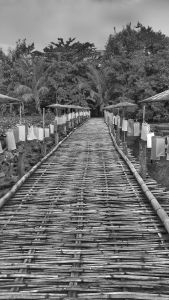
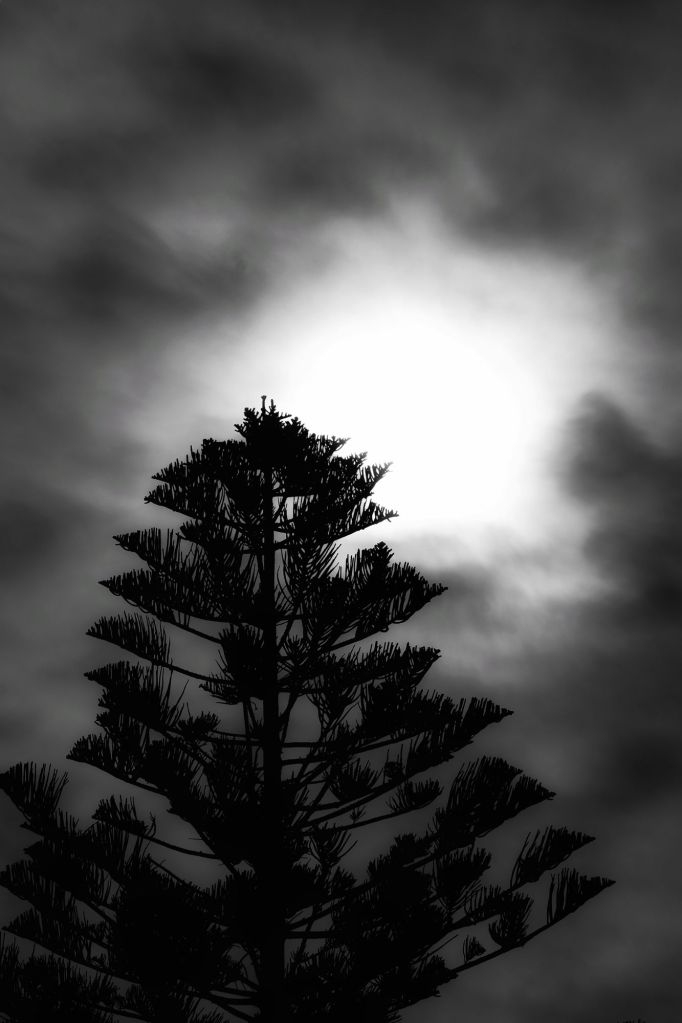
It’s called At a Time of Prayer, and from the moment my senses, mind and heart too, coalesced to cause me to raise my camera to my eye and make the photo, it’s had a unique or special resonance for me.

And not only me: The photo has gone viral here at the hermitage, appearing on phone screens and tablet desktops and lock screens. And it appears very often in my thoughts and prayers, my contemplations and even in conversations.
Perhaps you will allow me to share the little story behind this image as well as a possible explanation for its hermitage wide fame, favour, and love.

About a month ago I was walking along the lake front in the seaside town hosting the hermits at the moment, heading home after a long walk. I was listening to and chanting a favourite mantra (one about removing obstacles).

Absorbed in the music and the vibe of the mantra, I looked up – seemingly at random – and saw, well what you see in the photo. Without thought or hesitation and simply instinctively, I raised my camera to make the picture.

Ah yes, I see what you mean. You are quite right, I can’t exactly say I saw the scene in tones of grey, not technically. Though the camera did actually see and record it in monochrome. Let me explain.

You see, sometimes I switch my camera to only make black and white photographs, with the intention of shifting my way of looking and seeing the world around me. It’s always amazing to me how differently I start seeing things, once I get used to the change. I never get tired of it really. Like magic!

Anyway, once I lowered my camera, I said a prayer to Surya,  the divine in the form of the sun.

Everyday, each morning when I first get up, I go to a window in the hermitage that faces the rising sun. I give thanks and praise for the life given and sustained by the sun; I praise its beauty too and give thanks for its light and warmth. Today, although the cloud is mostly covering the sun, I know it is still there and still shining, giving us all life.

Okay, back to the moment of the making of the picture. It was after my small prayer – my Surya Namaskar –  my salute to the Sun – that the name of the photo came to me: At a Time of Prayer.

That made sense to me: I was already praying before I made the photo, then after it was made, I once more said a prayer. It truly was a time of prayer.

Now, the big question: Why has this particular photo had such an impact here in this haven of the hermits? Why, even now, do I find it a really appealing focus for contemplation?

Despite it being a dramatic photograph of start contrasts between light and dark, it seems to me to exude a kind of serenity. Perhaps it’s precisely the balance of those contrasts that makes for a peaceful easy feeling in what otherwise might not be seen as a quiet and calm image.

And it may be just that serenity arising due to that balance that contributes to the sense I get when looking at the photo: All is well.

All is Well. Why sense that in particular? Perhaps because I was there at the time. Perhaps because I was praying, looked up at just that moment and all my senses led me, along with my camera, to make the picture.

And in a sense, it’s a moment I can relive and remem ber through the photo, especially given the prayerful, contemplative mood in which it was made. At that moment of making it did indeed seem that All’s well.

And now? I know that All is well, all shall be well, and all manner of things shall be well (paraphrasing and with thanks to Julian of Norwich.)

There is too, the power and light of the sun illumining life, which here is represented in the form of the towering Pine Tree.

Yes, I sense that balance again. A kind of harmony also. This time between life itself and that which enables and supports life. It is good to contemplate balance and harmony.

Anyway, a gift given to me, now shared with you.

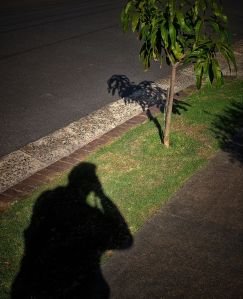
The Hermit Contemplates His Shadow

Me & My Senses

Today, once again, I would like to share with you some thoughts and insights on a quote I have written in the front of my Bhagavad Gita. Yes, I know, I do this quite frequently, but there really is a good reason.

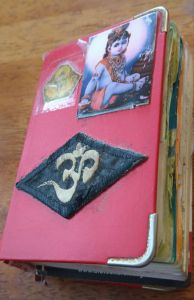
You see, for me, this particular Bhagavad Gita, this little book (and it is a little book: 10 x 7cm but still a little fat too!) is so much more than a collection of bits of paper with words printed on them inside a nice cover.

Well, it is a book, so of course it is that as well. But for me it is more a repository of wisdom. It is actually the first scripture or holy book of any kind that I have spent years studying. And over those years I have devoted who knows how much time, energy, heart and mind to it. As for how many times I’ve read it cover to cover, well I don’t keep count!

This Bhagavad Gita is truly a treasure trove that enriches me and my life every time I open it.

Anyway, enough of the praise and gratitude intro. Allow me to share the verse (in fact it’s a part of a verse) with you:

… restrain your senses and focus your entire mind on me.
               Bhagavad Gita 2:61

Let me try to explain why this verse – and this particular portion of the verse – is like a kind of motto or mission statement for my life. Well, to be honest, It’s one among a whole collection, but this one for me seems to especially significant.

It is through and only through, the senses that we are able to experience the world. In addition to the traditional five senses (sight, smell, hearing, taste, and touch) here we include the mind. This sixth sense includes all the activities of the mind.

When you think about it, the mind is really our major sense organ, in that it is in the mind that imput from our other senses comes together in such a way that allows us to perceive and experience the world around us as a coherent whole.

Then of course, the mind being a sense organ in its own right, does its share of providing us with imput in the form of thoughts and emotions. The problem arises when we let the mind have its way and we hand over control of our senses to our mind (and also we let our other senses free rein to control the mind) completely or at least in ways that  might not be in our best interests.

So, if we are to restrain our senses – all of them – what are we to do? Well, rather than getting into a long rave with a big list of what we should do, why don’t I simply talk about some of the ways in which I try to put into practice, the injunction to restrain the senses.

The Eyes of the Teacher

First, a disclaimer : I’m still in a human body. Meaning that I’ve been struggling with my senses for a long long time. And it means the struggle continues, just as it does with all of us. It’s the effort, though, that is the real key: to restrain the senses we might easily add retrain the senses including the mind.

For so much of my life I was careless about what I put into my body by way of my sense of taste. Food, I was not very controlled when it came to what, when and how I ate. I’ve been vegetarian for about 40 years and vegan for at least the last ten years. But until the last few years (and I still struggle now) that didn’t stop me from going for the tasty stuff – meaning the fatty and sugary things that can (and do) cause great harm, as they did to me.

Now, strictly vegan as I said, I never add sugar (okay one in coffee on very rare occasions), there’s no cooking with oils, and eating as little processed foods as is possible. Simple food too, simply cooked, with just a few spices. Surprisingly (to myself at least) I always have enough taste sensations to satisfy.

As to what I consume via the senses of sight and hearing, there is only so much that one can do unless one lives in a remote desert or mountain cave. Which, of course, some people do for this exact reason – to control and limit what they consume or are exposed to. Still, I don’t watch, listen to, or read news of any kind.

Like many people I watch videos on the Internet. While there is a massive amount of brilliant  content available, it is hard to sift through inappropriate suggested videos, impossible to avoid advertising, and even the news sneaks through quite often. For a while now I’ve been on the brink of deleting online video viewing platforms, but I’m not quite there yet. Soon.

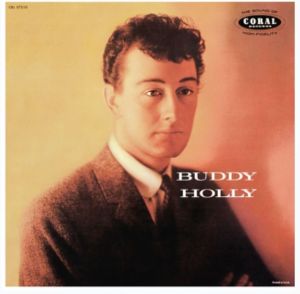
Give up listening to Buddy Holly??? That’ll be the day!

As for music, I’ve gathered a large collection over the years. Lately however I’m finding that I’m not wanting to listen to much of the music I have.  Why? Well, I think as I’ve meditated more, studied, contemplated more, I’m slowly beginning to exert some discipline over my mind making me more sensitive to what my senses pick up.

It seems to me that more and more of the music and songs I’ve loved and listened to my whole life are about dark themes and subjects, about emotions made petty, and sometimes songs or tunes just feel plain and simply nasty.

I’m content with this outcome and curious to see where it leads. As with videos, TV or the news, so much of the music I listened to does’t speak of Truth, at least for me.

With a view to control visual and audio imput, I try to live in as quiet an environment as possible. As we all know, these days this is becoming more and more difficult, perhaps even for those who can retreat to the desert cave! And we have a saying in the hermitage about just this issue: Something’s gotta give! Meaning of course that the time is right for radical thinking and action to be taken in the search for silence.

Which leads me to mind – my mind anyway. Like yours, my mind is a raging torrent of often repetitive thoughts going in all directions (or none) and very often without any kind of rhyme or reason.

But, through the above efforts at discipling the other senses, I do have some control, not much, but… . Through an increasing amount of time and effort spent on meditation and engaging mindfully in all my actions as much as I can, I think I am at least giving myself (my mind that is) some control over the other senses, my thoughts, and all that mental chaos.

Now, what does it mean, ‘focus your entire mind on me’? Well, this is a question that you will find asked and answered  given in numerous books, blogs, and in many other places. But, for me, and to sum it up in the one sentence, it’s about focusing all my senses (including mind) on what is of the good, what is right, what speaks of truth, love, and is for the betterment of all beings.

I mentioned that our quote is only a part of a verse. Here’s the whole thing:

In order to attain steady wisdom {knowledge of the true nature of Self and the world} restrain your senses and focus your entire mind on me.
               Bhagavad Gita 2:61

Self Enquiry is the means to acquire Self Knowledge which leads to real wisdom

It is this wisdom, or at least the efforts we make at acquiring it, that is the way to a happier, freer life. At least that’s my take on it all.
Peace