I feel like talking more … Sorry. Start again. It’s not what it seems and, well rather than get into it now, just read on a bit and all shall become clear.
Anyway, there’s an old joke that goes like this: One friend says to another friend: ‘How come you’re always talking to yourself?’ To which the second friend replies: ‘Well, you see, I always like to talk to the most intelligent person in the room, so I look around and usually I find that it’s me. So I end up talking to myself’.
Okay, maybe not so funny. Could be taken as bad manners or rude come to think of it. But that’s how jokes often are isn’t it?
Anyway, and here we get to the little bit of clarity I promised, you’re probably going to remind me that I have often said I would like to talk less, and be quiet more often.
That’s still true, but this is different. You see, lately I’ve been feeling the need to talk more about various aspects of my ‘inner life’. You know the sort of thing: confusions and worries; niggling issues bugging me; that kind of stuff.
And my community hear and experience quite enough of my inner life, with its contradictions, mood swings, and the rest; I have no intention of being more of a burdon than I probably already am.
So, I look around and ask who’s left? Me! Myself! I! Not exactly the most intelligent person in the room, so there the joke breaks down, but it does indeed look like I might end up talking to myself after all.
Well, it’s kind of a yes and no sort of thing. ‘Myself’ is the individual with this mind and body, making these words appear on the screen. It’s the ego self, the me that’s the being who walks, talks, breathes, and … Well you know what else.
But, and this is the brilliant bit, if I separate the words to read My Self, will it’s a whole other story. For a start, Self is not ‘mine’. Self is that part of me that is consciousness; and it’s not a different entity than ‘your’ consciousness, or anyone or anything else’s.
So, if I start talking to this Self that’s actually anyone and everyone, and not just me, who is it that I am in fact talking to?
Sounds to me like I’d be talking to you, and you, and everyone else; to the trees, the birds; everybody!
And yes, that’s exactly right. For me, there is only Self – consciousness – that is indeed anyone, anything, everyone, and everything in the Universe, both seen and unseen.
In other words, I’d be talking to God; the Divine; the Absolute Reality; the Thou Art That described by at least one of the world’s great spiritual traditions.
Which is to say, I want – need – to spend some more time talking to, and in conversation with, God.
Phew. I’m glad I figured that out.
You might remember the prayer I wrote a while ago to the Divine Mother? Seems like a good place to share it with you again.
It was way back in the earlier days of this blog, sometime in 2022, that I wrote a post about our community’s liking for snacking on plain toast by choice. It’s our more or less regular late evening, before bed, bite to eat. Perhaps accompanied by black tea, as I described in that post.
As I also point out in that post, I do actually enjoy plain toast. It’s not that I no longer like jam or other yummy spreads; I like them too well truth be told, but sometimes, well, plain is good.
As the day winds down to become night, and we settle to our evening snack, I will sometimes make a joke about simple food, or monks with simple tastes, whatever. Anyway, a few nights ago I made a remark, a joke, that has had a profound impact on me.
‘I’ll just say a prayer for my two slices of dry toast.’
Of course I am just like so many other religious or spiritually inclined people, and say a prayer before I receive any and all food or drink. It’s a long time habit, and a blessing I like to perform. Just a thank you is all it is really.
This comment, this joke, as soon as it was out of my mouth, I realised, of course I will. Don’t I always?
It’s true that our community lives simply, as simply as we can. And that includes what we eat and drink. It’s also true that this is not some sort of ethical stance consciously taken; nor is it a kind of overlaid act of solidarity with those who have no choices due to poverty or other circumstances.
It’s purely and simple because we like simple. It really does suit our natures and temperaments and for us it is the obvious way to live.
It is no renunciation: we welcome simple. This obviously is not to say that we are unaware that our very natures and temperaments naturally steer us away from choices that are unethical or are out of sync with compassion (call it solidarity) for other beings.
The reason I’m ranting on about this off-hand comment thrown out as a so-called joke is, well just that: It was off-hand, and my misguided intention in making this ‘joke’ was insensitive and careless; it was lacking compassion for all the other living beings sharing life and consciousness with me.
And for that flippancy and carelessness, I ask forgiveness from the invisible community that is in fact all of us struggling to live in a material world.
My sense is that in saying ‘all of us’ I might instead say, all of us who are in truth One; We who are that one Self that seeks forgiveness.
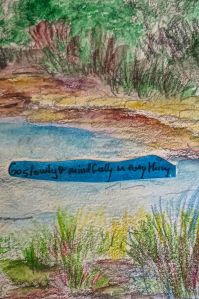
Varuna and Surya. the Hindu deities of sky and all Earth’s waters (Varuna), and our sun (Surya). These names resonate for me. I like how such great natural phenomena fundamental to our existence on this planet, can be ‘personalised’ in this way.
I find that having acquired symbolic or representational names for sky, water, and sun, has allowed me to somehow relate to the inherent giving and preserving of the energies that power all life that water, sky, and sun provide in a prayerful, thankful way. Kind of makes it personal.
Let me put aside for a moment the obvious scientific reality that tells us we can’t live long without water, can’t live at all without the gases in our atmosphere, and if the sun goes dark for whatever length of time it is, then all life ceases to exist.
How many times have I stood in awe watching a sunset?
Or watched as big waves rolled in with a surfer hoping for a ride?
How many times have I welcomed the sound of rain on a roof and the sight of it nourishing trees or other life
And how many times have I sat on or walked along a riverbank feeling uplifted and a little more grounded?
Many, many times is the short answer. Varuna and Surya are constant presences in our lives. And I am grateful for the life-giving and life-sustaining natures of their existence.
Sharing with you today, a little poetic expression of one of those times when sky, water, and sun, gave me just a little more than those fundamental material energies.
ONCE AGAIN VARUNA AND SURYA
Once again, Varuna and Surya are coming to make rescue. They arrive on – as in fact they are – the currents and eddies of the river of life. In this way, the natural order remains in motion.
Shared with love
from Paul the hermit
Flow river go, past the shady tree. Flow river flow, flow to the sea. Flow river flow, flow to the sea.
Thanks to Roger McGuinn for one of the classic flowing on a river songs.
Anyone who has tried to meditate for more than a minute, knows very well that the mind right away jumps into overdrive, trying its hardest to keep us nice and distracted; anything but quiet and peace is the mind’s aim. Speaking for myself, all I want to do is get rid of that mind altogether.
But, I know, that would be a mistake. I may not like how my mind behaves sometimes, but I do actually quite like having one, a mind that is. I guess, for me, it’s about realising that my mind is here to stay, and can be either my friend or my foe.
Trouble is, when trying to meditate, I can easily believe it’s my worst enemy. Another mistake, I think, that arises from a not so discerning attitude to the thoughts that flood in seemingly at random.
But, sometimes in that quiet and still space – and even if that quiet and peaceful space hasn’t yet been reached – a thought comes from the mind friend, not the foe. It seems I must learn discernment. Here’s a good example.
Not long into my meditation earlier today, but already bombarded with random thoughts, memories, and other distractions to said peace and quiet, an idea came that just caught my attention. Suddenly, there seemed to be a full-blown idea for what sounded like a great blog post.
I din’t have this notebook with me, and though I had my phone handy, I thought, no, be firm, don’t let interruptions in. Of course, I thought that I’d remember the idea, but sure enough, I didn’t. Now, it’s nowhere to be found. I mean it must be in some tiny neuron in my brain, but it’s hiding pretty well!
Later, after my meditation session, I thought to myself, how come I could make a list of all the less than useful thoughts, memories, ideas and random mental craziness that tried its best to keep me distracted, yet I have no idea what that one wonderful blog post idea was?
I think it might possibly be about attachment; a lesson I’m giving myself in discerning between what thoughts are from my friend mind which ones from my foe mind, the mind running wild with its accomplice, my ego.
It’s a lesson I badly need, I think. Endless thoughts of little or no use to me have stayed, while the one that might have been helpful is gone, seemingly forever.
Yes indeed. Perhaps ny perspective on what ideas ad thoughts are useful to me and what ones aren’t, needs to be contemplated upon.
Actually, it’s not really needing a lot of contemplation: I mean, the one idea I thought would be great is gone. But looking at it the other way around, the fact that the great pile of not so good thoughts staying with me has given us this post I am now writing, and you are reading.
Perspective. It’s all about perspective. And discernment.
A curious title for a post, I thought as the words popped into mind. And it’s one that could be hinting at, pointing towards, any number of ideas, topics, or whatever.
In this case, however, it is really quite straightforward: The title refers to a three-line quote I rediscovered when I was transferring notes from a full notebook to a new one the other day.
Actually, ‘three-line’ quote may not be quite correct. In fact, I have no idea if it is a longer quote consisting of three lines, or, three individual one-liners that I happen to have grouped together.
Whatever the case, I don’t know where I found this quote or these quotes. All I can say is that I was surprised to come across them as I performed the normally routine task of transferring notes.
Surprised, because each of these lines I think, hold a special message for me; a unique piece of advice. You could even call them guidance.
Each individual line and its message is wrapped around and driven by the verb to keep:
Keep your spirits up Please help keep the silence. God’s will be done and keep calm.
As a whole, this quote (these quotes) constitute a kind of ‘how to live in the world’ mini-guide. Each – and all – of the three lines point to an aspect of what we might call Right Living – guiding us to the means by which we may approach daily life with its ups and downs, its sorrows and joys, good and bad times, mistakes, hurts, confusion, that make up our lives as flawed human beings living the best we can in an imperfect world.
Keep your spirits up
What with all those ups and downs, sorrows, daily crises – in our own lives and in the world around us – how are we to keep our spirits up?
How do we free ourselves of the pain and suffering caused to us by all these travails?
How do we remain positive and optimistic in the face of what passes for a life ‘in the world’?
All good questions, and there are many many answers out there in that same crazy, mixed-up world that’s giving us all the trouble in the first place.
Speaking only for me, I have nowhere near reached the point where I can say that my spirits are consistently lifted, that I let nothing disturb me.
Why is that? The answer is simple: because I’m a human being. Or perhaps it’s better to say I inhabit a human body which is subject to one thing only: constant change.
I’m learning more and more that the only one I can address such questions to is me. If there are any answers to how to keep my spirits up, I’m realizing slowly that I won’t find them out there in the world or in the things of the world.
So, going within has to be at least my tentative response. It seems that there really is nothing else that will keep my spirits up for more than some fleeting often illusory moments here and there.
Please help keep the silence
What silence? Well may you ask: hardly what you’d call a quiet place to live, this world of ours.
Once again, for me, going within is a good start. Though I’m not the quietest person in the world, especially ‘within’. Too many thoughts, emotions coming and going, all the craziness of an overactive mind and heart.
But it’s a start.
I keep re-centring when I can. I focus on my breath; recite some favourite prayers; chant mantra (the names of God); I sometimes just sit. All these do help me, will help me, I know. They do, sometimes, every now and again, for little moments, create that little (vast?) space I call silence.
As to playing my part in keeping that broader, silence? Well I’ve mentioned before the invisible community – the heaps of people all over the world who are on the same or similar paths, practising their own unique ways of going within, of cultivating both inner and external quiet, or silence.
All of which tells me, I am not alone. And it says, my little contribution to silence – to being still and quiet – actually counts.
God’s will be done and keep calm
For me, ‘God’s will be done’ is simply another way of saying that the Universe (or life) is unfolding exactly as it does in the only way it can. It just is as it is. And me, being also that life, I play my part.
And that’s all: we play our part; we do our bit, and it all happens as it does.
Acceptance of this truth is also one of those aspiration things I keep near the top of my list. Surrender, I sometimes call it. Surrender, rather than being a ‘giving up’ as we sometimes use the word, is more about going with the flow of the river, or accepting and cooperating with the flow of the natural order of the Universe as we experience it in our lives.
That ‘keep calm’ bit reminds me of that meme that was everywhere a few years ago: ‘Keep calm and carry on’. It, in a real sense, is exactly what I’m trying to do.
Surrendering, or accepting that ‘the universe is unfolding as it should’ (to borrow once again from the astonishing Desiderata) seems to be the clearest most obvious way to that calm our quote speaks about: Calm acceptance, free from the resistance and struggle against the flow of the river of life that lies at the root of much of our suffering.
So, the Dharma of Keeping. One small (or perhaps not so small) set of clues about how to live right in the world – and with the world.
The river of life is calling me to the kitchen. Even hermit monks have dishes to put away. So, keeping calm, I carry on.
Hermitage on the Loch (courtesy: a member of our community
You know, for all my prayers; for all my mental discipline – efforts at mental discipline – for all my meditations, chanting, and other practices, I still just talk way too much for my liking, and often it feels like it’s only talking for the sake of talking.
I still just open my mouth and let come out any old thing that keeps the noise going. Oh, it’s worse than that: sometimes when I talk it’s rambling and waffling that I cleverly (or not so cleverly) disguise as intelligent, rational, and based logically on knowledge that I either have or haven’t got. Either way, I somehow seem to think I’m offering words of well thought out wisdom.
Whereas, as I said, the noise I make is so often rambling, contradictory , ill-informed, thoughtless waffle.
Enough! Blimey, that’s enough. Talk about opening a post on a calm, relaxed, optimistic, and compassionate note.
Here’s the thing: I want to devote my entire life to devotion and prayer. And that requires at least some silence. Yet, instead, I merely talk about the joys of silence, about the joys of full-on devotion to the divine, and as well I occupy so much time and energy to just voicing random thoughts that come and go, go and come, without rhyme, without reason.
Okay, here’s the second thing: I long with my deepest longing to be silent – to not simply stop talking, though that would be an excellent beginning. No, I want to be quiet; I want my vocal chords to have a break and let my true voice speak through my life, through this blog, my photographs and in whatever way I am lead.
So, what to do? Well, here’s the third thing, thing number three: all I need to do in order to both stop talking so much and be silent is to just sit. Sit and do nothing. There is no thing that I can do that will magically turn me into an oasis of silence and peaceful calm.
Sometime in the dim distant path I read someone paraphrasing The fouth Noble Truth in two words, Just sit. Buddha did indeed know what he was talking about. And I do get the irony: when I talk, I need to say something that helps, not just make noise and try to avoid silence.
Earlier today I took my camera out for a walk. Which is to say, I had an intention that the walk would be more than exercise for the body (very much needed as it is), but also an opportunity for my eyes and heart to open up a little to the tiny part of the world I was to pass through.
I also hoped that my mind would join in so that I would be able to actually recognise what I was seeing and feeling, allowing me to perhaps make images of what I saw and felt.
One final prayer: In doing its job, I hoped my mind would stay focused, and work behind the scenes very quietly.
A few minutes walk from the Hermitage is the shore of a fairly large lake, and when I reached that spot, I sat on a conveniently placed little wall, so I could, well, just sit for a bit.
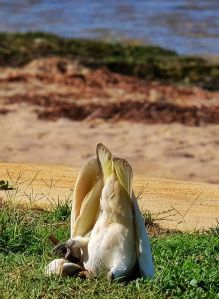
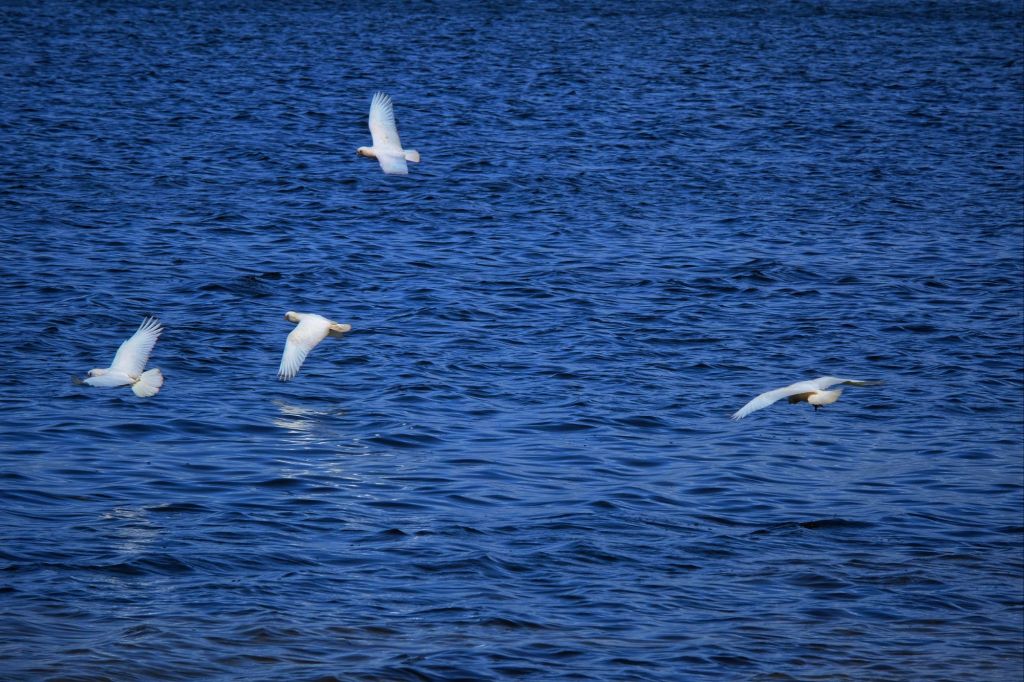
By chance, um. Sorry, let me rephrase that. By the brilliant synchronicity that results from the perfect working out of the natural laws of the Universe, right in front of me, nearer to the water’s edge, a dozen or more Corellas played and foraged. At least to my limited human eyes, that’s what they were doing.
Zoom in and share the fun!!
It’s mesmerizing watching them: tumbling with each other or on their own; picking up and wrestling with twigs and other small things. I was blessed too, to witness several of these creatures taking off, in flight, and landing.
You might have heard me say (or read when I wrote) that ‘I was just not there’. Well, not today; today I was definitely there. In a contemplative reverie in which I felt connected with what I was witnessing through my lens.
‘I had a small sense of being relaxed,’ I commented casually to my community when I arrived back at the Hermitage. And that’s what it felt like: I had relaxed for a time. I can’t say I was aware of the passage of time; it was more an eternal being in the moment if I was to try to label it now. It might have been thirty minutes or ten by the world’s measure; I have no idea really.
I’m only ever going to be a beginner when it comes to paying full attention, to contemplating and being completely immersed in the moment, and not forgetting trying to control the monkey mind. Practise will never make perfect in that department!
Anyway that’s why spiritual practices are called practices: they require the spiritual seeker to be committed to a life of ongoing and continual practise.
Of course encountering those birds at the lake today is definitely a practice I would be happy to practise anytime!
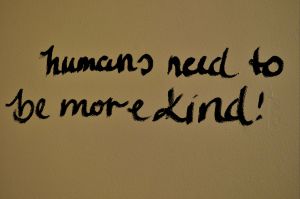
Do they really? Who needs to be more kind? How would I know? I mean, I could say, but I won’t – I can’t. It’s not my place, or my right to judge what someone else needs to do or not do. I find it hard enough to look at my own behaviours and to tell myself what I need to do or stop doing. Actually, I sense a question coming on, but I think we’ll leave it for another day.
Anyway, let me share with you an act of kindness of which the Hermitage community was this morning on the receiving end of.
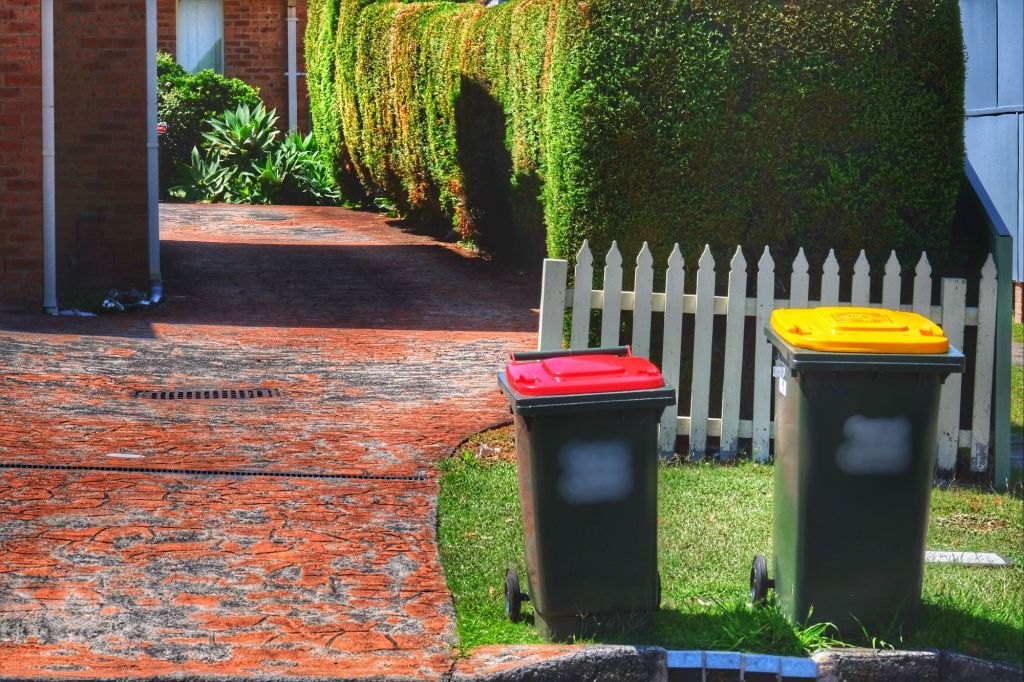
On looking out the front door we discovered that our bins had been brought in. Monday morning is the weekly garbage collection time in our neighbourhood, which means later day Mondays are the times for the bringing the bins in ritual.
But today, no ritual for us: our bins were brought in by … well we don’t know who. It might have been a neighbour, or it might have been a random passerby.
In any case, whoever performed this not so small act of kindness lifted the spirits of our community members. In other words, it made us feel good.
So, perhaps I can’t judge whether or not other humans need to be more kind, but I can tell you how it feels to be on the receiving end of such kindnesses: nice.
There, dear friends, right there, in the title are our next two W questions, as well as the answers to both.
The answer is brief, succinct, right to the point, yes indeed. But somehow to me it doesen’t seem very helpful, a bit vague.
Here and now. Let’s look at this tricky little phrase. On the face of it Here and Now has an obvious meaning: if we choose to think on it in the spirit of our ongoing contemplation on my prayer life, it’s very clear. Here and now is a timely reminder to me to pray right where I am, right now, wherever I might be; and whatever the time, day or night.
But it’s not really a very satisfying answer is it? Here and Now? It seems too flippant to me, too bland, even a bit of a ‘catch all’ cliche thrown around without any real insight into its meaning or importance.
Anyway, moving right along …
We are exhorted to pray without ceasing in the Christian Bible with similar exhortations found in so many other texts and scriptures from many faith traditions.
Remember my aspiration to make of my life a prayer? Well, that’s the idea: to pray without ceasing. Which translates to mean that everything I do, say, think, feel (what else?) will be prayer – or I can also say a prayer. Life is a prayer, life is lived as a prayer.
Of course the precise forms my prayer takes are – and will ever be – many and varied. We’ll be looking at some of those forms and types later in the How post of this series. But, for now, allow me to brainstorm on the topic for a bit.
Consider washing the dishes, a task we all find ourselves engaged in to some degree or other. I have a sense that my feelings towards dish washing is actually quite neutral. Don’t get me wrong: if I never had to wash a dish again you would not hear me complain.
At the same time, I have absolutely no hard feelings against washing dishes.I just get on with it, just like most everybody else.
Sticking with dish washing …
Most often dishes need washing as a consequence of preparing, cooking, and eating food, for a meal or meals. Right there is an obvious opportunity for a simple prayer of gratitude.
It might be a simple whispered thank you for the gifts of the nourishment, satisfaction, even pleasure of the meal. Anyway, just a random first thought on the subject.
There are a few other points to be made in our little dish washing thought exercise as it fits into my own prayer life.
Sometimes, while actually dish washing and cleaning up, I might chant mentally, or otherwise pray with words – set prayers. Prayers of praise or gratitude; mainly whatever pops into mind. Go with the flow is the theme here.
Now, that’s one thought. Next: I might decide to be quiet while washing up. That is not speaking and being as silent inside as I can be.
On these occasions I just focus as intently as I can on what I’m doing: washing dishes. I make it an occasion for not doing the dishes just to get them done, or to get them out of the way, or to put an end to an onerous chore.
Rather, it’s more an opportunity to simply wash the dishes, by being with the dishes and the actions required to clean them. Just a little aside: this particular form of mindful (prayerful) dish washing actually results in cleaner dishes. It’s been proven scientifically.
These two approaches to washing dishes – not to mention all the other means and forms of prayer – are not necessarily mutually exclusive, nor are they the only one: a given dish washing event might involve several prayer modes.
Which leads me to the next thought that I had more or less forgotten…
Sometimes I do indeed slip into that old ‘Just get the blank blank things done’ frustration mood. And it doesn’t just happen when faced with the dishes!
It goes without saying that I wouldn’t need an aspiration if I was already acting full time in that prayerful manner. I do practise – sometimes with more determination than others – performing all my actions mindfully (aka prayerfully), though there’s far to go for me in the praying ceaselessly department.
So, to a good question you may be asking: Is there somewhere (or multiple somewheres) that I go to to pray? Some special sacred or holy place?
Well, I know that we are always all of us standing on sacred ground – it is all the Divine. Still, there are places that help me, all of us, feel closer to that divinity, to the sacred, to God, or whatever we call it.
There are places that exude that special vibe, or have a certain atmosphere of calm, quiet, or stillness, that are conducive to prayer.
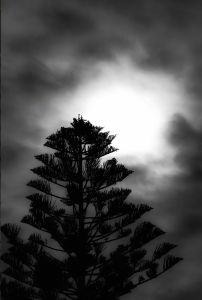
An apparently random glance skyward blessed me with this moment and this place of prayer
Talking about the idea that we are always standing and walking on sacred ground, there are often places I come across that speak to me as places of prayer. It might be a tree, like the one pictured here; it might be a distant view of a lake and the hills beyond.
Such places call to me to stop. Perhaps for a moment, perhaps to sit and linger and pray with words, or with silence.
In the Hermitage, there is temple, a room we have set aside for that purpose, and no other. From the very first day I set this room aside as a temple, I have felt a stillness there, a tranquil vibe.
Among such spontaneous little moments, there are times I simply stop and stare at a flower, or without thought put my hand on a tree. I will whisper a quiet thank you and a blessing to the Divinity I sense there.
Temples, churches, chapels, prayer rooms, mosques, and other types of sacred sites from andy and all spiritual and religious traditions, attract me as well.
These are all places people have spent time in praying, contemplating their lives and their union with the Divine. All that energy, all that love and devotion has caused an atmosphere of holiness, or sacredness to build up over what can be years, centuries, even millennia, in some places I have prayed.
But, really, when all is said and done, anywhere and anywhen can be and is a place for prayer. Here, in this booth, in the cafe at the lakeshore near the Hermitage, I make these notes in a mood of prayer, a prayer of love and devotion.
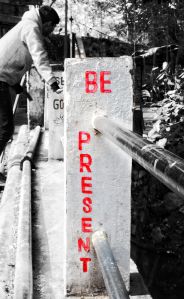
Being present, mindful, and prayerful in all I do, that’s my aspiration. Here and Now. Anywhere and anywhen; it’s all prayer.
Deceptively simple is how I’d thought to describe the lyrics of a love song by John Lennon I heard again recently for the first time in years.
But, no I thought straight away, that’s not right. The message of the song is simple, and the lyrics convey that message to us just as simply.
Of course why the song is so powerful – and personally significant to me and so many others – is that, while the message may be simple, the ramifications of really hearing the lyrics, really digging the words and trying to put them into action, are far from simple or limited and have few if any boundaries of any kind.
The one word title of the song I’m talking about says it all: Love. Lennon included Love on his first solo album with the Plastic Ono Band, which was released in 1970. So not actually a solo album, but you know what I mean.
The original purpose of this post was to share with you a poem I wrote in response to reconnecting with this masterpiece.
While I will still be sharing that poem, I thought I would first let you see the lyrics of Love put together through my own listenings to the song itself. No copyright breach is intended here. I only print the lyrics for illustration purposes, and besides, if you can’t share a song called Love, by John Lennon, what can you share?
If before or after reading the lyrics you prefer to actually listen to the song being sung by John, then just head here for a great early version.
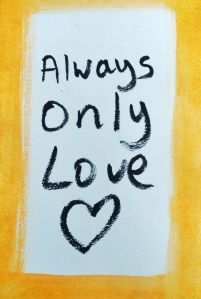
Love is real, real is love. Love is feeling, feeling love. Love is wanting to be loved.
Love is touch, touch is love. Love is reaching, reaching love. Love is asking to be loved.
Love is you, You and me. Love is knowing We can be.
Love is free, free is love, Love is living, living love. Love is needing to be loved.
You see? Simple lyrics, simple melody, but the message! It’s all about the message. Or is it an invocation? A love mantra?
Mind you, the song is presented in such a light-hearted and gentle soft manner, that it might be easy for some to dismisss the message as being merely wishful or fluffy thinking. But, there really isn’t anything fluffy about love is there?
Now, to my response. Well one response among many I should say. I offer this poetic effort in humility and gratitude – indeed, in and with love.
John was a singer and a writer of songs. John was a friend of mine – yet never known personally. Yet known by me all my life. A fab friend for everyone.
John wrote songs, songs he sang, lyrics given life by voices very few heard. It was hysterical.
He wrote a love song, a song I heard and loved. In fact, a whole lot of love songs he wrote. One verse, in that one song, caught my ear, snatched at my heart.
This is the verse, the stanza I love: Love is you You and me Love is knowing We can be.
No sickly, sweet sentiment this. Not like some plastic bobble-head lurking in some grubby rear window. No, as the song he wrote says: Love is real.
Love not for the sake of getting it right all the time; Love not for the sake of always looking like the good guy; Love not for the sake of a distant and cold devotion; But love, Love for you alone.

































 Notes from the Hermit's Cave