A Prayerful Poetics, A Poetic Prayer

Just about to open my tablet to retrieve an email I’d sent myself a day or two ago with a prayer attached that I’d found in a book.

But I stopped: I felt, no, no need to transcribe that prayer; I sense some words of my own that are struggling to emerge (actually paraphrasing a very vague sense and direction here; I rarely think – or speak – in such a formal way). So, I left my tablet and reached for my notebook instead

So, what emerged? Well, it’s a prayer and it’s a poem. It’s a prayer or a poem, Either or, and both. In any case, here is the first draft – I only got these words down on paper a half hour ago.

Words from my heart to my heart. A prayer to my Self, a prayer to all that is. And it’s a poem too, remember!
So, now I share this prayer (or poem?) with you.

I am, you are, we are.

Thou art that

MY LORD, WHAT SHALL BE MY PRAYER?

My Lord, what shall be my prayer?
Oh, where even to begin.

There are painful fragments from the past,
fear-fuelled fantasies of the future.
None of them real. None of them mine.
The mind only controls.
Yet clinging to them haunts me.

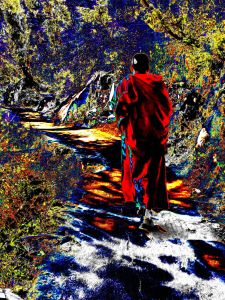
I aspire to monkhood, to the hermit life.
Yet to desires of many kinds I am attached.

I long to be absorbed in Bhakti;
I long to worship, to praise, and to celebrate All
Ceaseless prayer I aspire to,
to be absorbed in communion.
Yet again the ego-mind
fills me with reason’s illusions
and endless words of the world.
I am barricaded, from You.

I strive to remember who I am;
to recall who You are.
Within the words of this prayer lies that memory:
I am. You are.
Thou Art That.

Friend Or Foe?

Your enemies will now question your capabilities. Is there anything more painful and shameful than that?

Bhagavad Gita 2:36

Thanks to inspiration from my partner hermit, I’ve once again begun reading Bhagavad Gita from the beginning. The quoted verse came up this morning as I continued through chapter 2.

Setting the scene, the Bhagavad Gita is a conversation between Krishna (God) and Arjuna, a famous warrior who’s leading the army of the ‘good guys’. The context is actually a metaphor for the battle that goes on constantly between what some call the Higher Self (represented by Krishna of course), and our lower selves, our ego, mind, and the rest of the worldly us (represented by the very worldly Arjuna).

Knowing that, sometimes a verse will jump out at me as being in some direct way related to me. This verse, this morning seemed spookily all knowing about my mood of just slightly earlier.

Before we move on, I should point out that Arjuna has just realised that if the battle goes ahead, he’s going to have to kill many relatives and friends, teachers, and others he respects. And he’s just decided he’s not going to do it and sits down depressed and dejected on his chariot.

Now while I personally applaud this decision (he even says it might be better if he went off into the forest and lived the life of a wandering monk rather than be in this battle), I have to remind myself that it’s not for real, it’s a metaphor for the battle between our two selves.

Krishna says to Arjuna that you’re going to look really bad if you don’t fight the fight to uphold the Truth as you know it. Lesson number one when studying the Gita: don’t sweat the context!

Anyway, to our current story.

I’d just finished my breakfast cup of tea, and I knew it was time to ‘get on with the day’ as the saying goes. Today, though, Tamas** was strong. Which left me feeling, I don’t really want to get on with the day.

Instead I felt I wanted to not get on with anything; I wanted to lie down and sleep, and not think about anything, or do anything else either!

This picture is called Lunchtime Sleeper but it’s how I felt after breakfast this morning!

Mind you, not in the ’empty your mind of random thoughts, relax the body, realise the Divine’ kind of mood. No, more like ‘lay down, block out everything, blank the mind, sleep.’ Blank as it blot out!

Then, the famous second thought kicks in: No, I said to myself. I will not allow Tamas to take control. So, I got up, brushed my teeth, washed my face, and got ready to begin my practice.

I guess you could say that Tamas finds it easy to take control when one’s mind is in enemy mode as I like to call it (somewhere else in the Gita, Krishna says the mind can be our friend or our enemy).

My mind in particular doesn’t usually need a lot of help to disparage me, put me down. Getting me to question my own capabilities is one of its favourite activities – sometimes.

And it’s exactly right, perhaps I should be questioning myself: If I allow Tamas (mind and ego etc) to have free rein, the pain and the shame is all I feel. Well, perhaps not all, and not always, but still, it’s not a good thing.

So, what’s going on now? I’ve been reading Bhagavad Gita, and now I’m making these notes. Tamas is on the run and my mind is being ever so friendly.

**Tamas is that aspect of our (human) nature that has us leaning towards lethargy, laziness, that ‘I can’t be bothered’ feeling, and excess sleep, and all the other slothful stuff. Blotting out, as I termed it earlier.

Sun, Water, Sky, and Me

Varuna and Surya. the Hindu deities of sky and all Earth’s waters (Varuna), and our sun (Surya). These names resonate for me. I like how such great natural phenomena fundamental to our existence on this planet, can be ‘personalised’ in this way.

I find that having acquired symbolic or representational names for sky, water, and sun, has allowed me to somehow relate to the inherent giving and preserving of the energies that power all life that water, sky, and sun provide in a prayerful, thankful way. Kind of makes it personal.

Let me put aside for a moment the obvious scientific reality that tells us we can’t live long without water, can’t live at all without the gases in our atmosphere, and if the sun goes dark for whatever length of time it is, then all life ceases to exist.

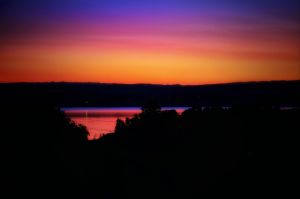
How many times have I stood in awe watching a sunset?

Or watched as big waves rolled in with a surfer hoping for a ride?

How many times have I welcomed the sound of rain on a roof and the sight of it nourishing trees or other life

And how many times have I sat on or walked along a riverbank feeling uplifted and a little more grounded?

Many, many times is the short answer. Varuna and Surya are constant presences in our lives. And I am grateful for the life-giving and life-sustaining natures of their existence.

Sharing with you today, a little poetic expression of one of those times when sky, water, and sun, gave me just a little more than those fundamental material energies.

ONCE AGAIN VARUNA AND SURYA

Once again, Varuna and Surya
are coming to make rescue.
They arrive on – as in fact they are – the currents and eddies
of the river of life.
In this way, the natural order remains in motion.

Shared with love

from Paul the hermit

Flow river go, past the shady tree.
Flow river flow, flow to the sea.
Flow river flow, flow to the sea. 

Thanks to Roger McGuinn for one of the classic flowing on a river songs.